

Vicus Septentrionalis
“If Novaium judges you at all, it does so first at the northern gate.”
Vicus Septentrionalis is the northern gate ward of Novaium, the district through which most overland travellers first encounter the capital. Roads from the hinterlands converge here before passing beneath the city’s walls, bringing merchants, envoys, pilgrims, and petitioners into direct contact with imperial order. The ward exists to receive them, house them, and, where necessary, watch them.
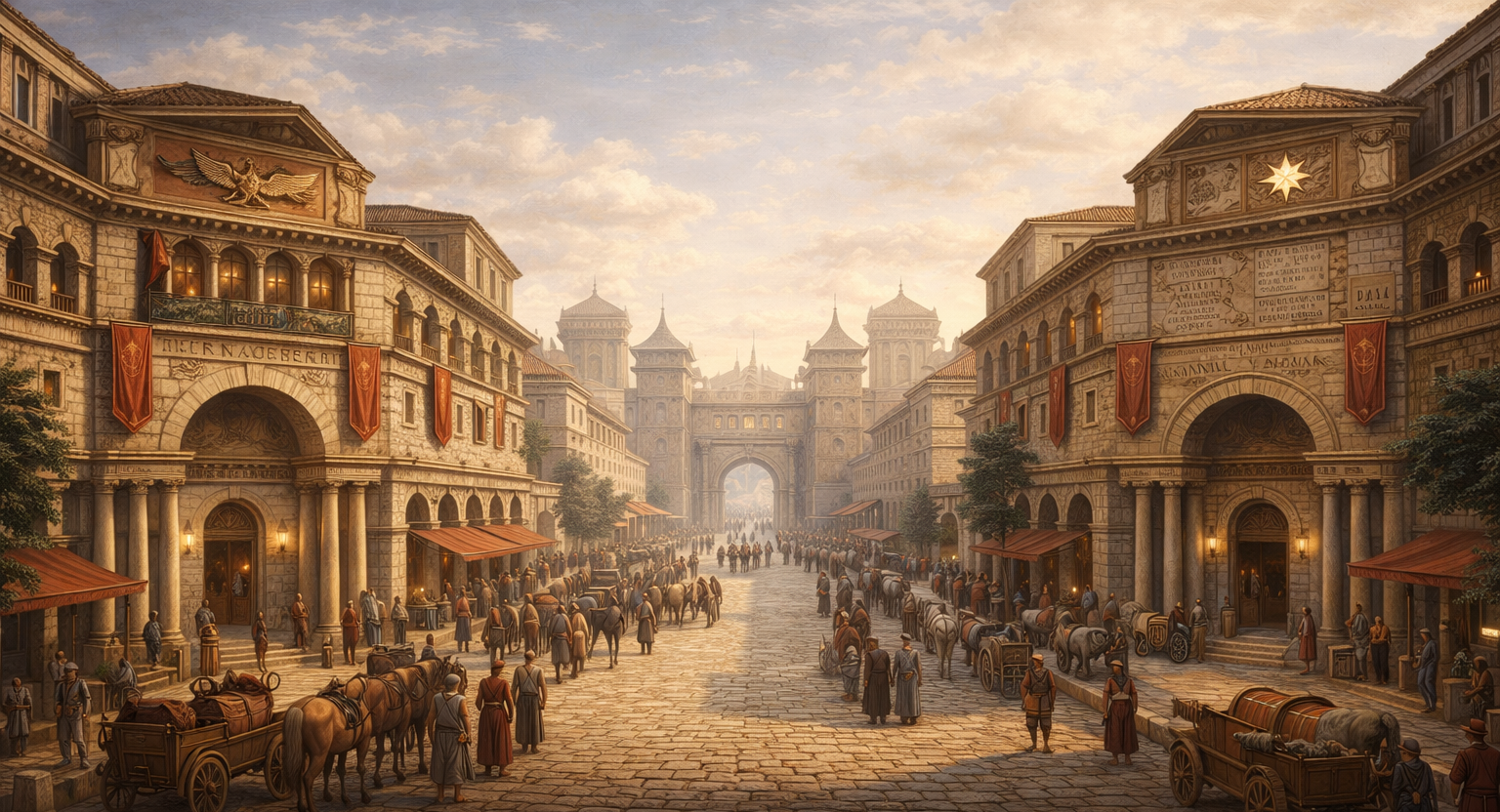
The district is shaped by movement rather than settlement. Inns, stables, caravan yards, and lodging houses dominate the streets nearest the gate, arranged to accommodate transient populations whose presence is temporary but constant. Wagons are unloaded, animals watered, documents inspected, and intentions assessed long before a visitor reaches the inner districts. Civic authority is visible and deliberate, exercised through gate officials, inspectors, and patrols whose presence reminds newcomers that entry into Novaium is a privilege, not a right.
Among the ward’s most notable features are its rival great inns, whose competition has become something of a local legend. The Golden Northstar and the Hearth of Seven Roads stand opposite one another along the main approach from the gate, each claiming superiority in comfort, security, and clientele. Both establishments are operated by brothers, estranged for decades, whose mutual resentment has turned hospitality into a quiet battleground of reputation, patronage, and civic favour. Their rivalry animates the district, drawing travellers into its orbit long before they realise they have chosen sides.
Beyond lodging and stables, Vicus Septentrionalis supports the infrastructure necessary to manage arrival at scale. Caravan yards provide secure holding for goods and animals, outfitters supply replacements and repairs for long journeys, and moneychangers and scribes cluster nearby to serve those unfamiliar with imperial systems. While few residents remain here permanently, those who do are specialists in transience—people whose livelihoods depend on the steady flow of strangers.
Vicus Septentrionalis is not the city’s face, but it is its handshake. It introduces Novaium as organised, watchful, and indifferent to charm, offering shelter without warmth and order without welcome. Those who pass through it understand quickly that they have entered a city that notices who comes and remembers how they behave.
Demographics
Vicus Septentrionalis supports a substantial and stable population, larger than that of Insulae Civium, shaped by its role as Novaium’s primary northern approach and reception ward. While transience remains a defining feature, the district’s scale requires a significant permanent population to sustain its functions. Innkeepers, stablemasters, caravan factors, porters, animal handlers, farriers, guards, clerks, scribes, and inspectors form the district’s enduring core, many residing here for generations.
Residential zones extend well beyond the immediate gate frontage. Streets of modest housing support families whose livelihoods are tied to gate traffic, logistics, and hospitality. Unlike the Old City’s intergenerational pride or the artisan quarters’ guild identity, permanence here is pragmatic. Residents remain because their work demands proximity to arrival, inspection, and accommodation, not because of heritage or status.
The transient population remains considerable and highly visible. Merchants, envoys, pilgrims, seasonal traders, and long-distance travellers occupy the district in constant rotation, filling inns, caravan yards, and lodging houses. At peak periods, the temporary population can rival or exceed that of permanent residents, giving the district a fluctuating density unmatched elsewhere in the city.
The ward is markedly diverse. Visitors from across the Imperium and beyond are routine, and non-human travellers are common. Dwarrow caravans, Brass City envoys, halfling traders, and centaur delegations frequently pause here, often choosing to remain within Vicus Septentrionalis rather than venture deeper into the capital. Elves are encountered less often but appear regularly among diplomatic and scholarly parties. Integration is governed by regulation rather than custom; coexistence is managed through permits, inspections, and clearly enforced civic norms.
Wealth within the district is uneven and ephemeral. Some arrivals bring significant resources and entourages, while others possess little beyond transport and intent. Permanent residents tend toward modest but steady prosperity, their income derived from volume, reliability, and repeat custom rather than elite patronage. In Vicus Septentrionalis, population is measured not only in numbers, but in turnover, making it one of Novaium’s most populous and most fluid districts simultaneously.
Government
Governance in Vicus Septentrionalis is among the most visible and procedural in all of Novaium, reflecting the district’s role as the city’s primary point of overland entry. While ultimate authority rests with the Praefectus Urbi Novaii, direct control is exercised through the Gate Prefecture of the North, a specialised civic office responsible for regulating entry, lodging, and movement within the ward.
Gate officials oversee inspection of persons, goods, and animals entering the city, issuing permits and directing traffic according to civic priority. Their authority extends beyond the gate itself into the surrounding streets, inns, and caravan yards, allowing for continued supervision of travellers until they are cleared to proceed inward or redirected elsewhere. This extended jurisdiction distinguishes Vicus Septentrionalis from other districts and reinforces its function as a controlled threshold rather than a neutral space.
Inns, stables, and caravan operators are licensed and inspected regularly. Lodging registers are maintained and reviewed, with hosts held accountable for the conduct of their guests. The rivalry between major establishments is tolerated, even quietly encouraged, so long as standards are maintained and disturbances contained. Civic authorities intervene swiftly if competition threatens public order or obstructs gate operations.
The city watch maintains a strong and highly visible presence throughout the district, supported by mounted patrols and inspectors trained specifically for crowd management and dispute resolution. Enforcement here is immediate and practical, aimed at preventing issues from spreading inward rather than addressing them retrospectively.
Vicus Septentrionalis is governed less as a neighbourhood than as a process. Its systems are designed to filter, assess, and distribute newcomers efficiently, ensuring that Novaium remains open to the world without surrendering control over who enters its streets.
Industry & Trade
Industry and trade in Vicus Septentrionalis are oriented toward arrival, assessment, and temporary provision rather than production. The district exists to receive people and goods at scale, stabilise them, and pass them onward into the city or back out along the roads from which they came. Its economy is built on service, access, and timing.
Hospitality is the district’s primary trade. Inns, lodging houses, stables, and caravan yards generate steady income by accommodating merchants, envoys, pilgrims, and travellers in transit. These establishments range from austere hostels intended for bulk traffic to more refined houses catering to diplomatic parties and wealthy merchants. Competition is fierce but regulated, with reputation, security, and proximity to the gate determining success more than luxury.
Supporting trades cluster densely around this core. Farriers, wagonwrights, harness-makers, animal healers, and outfitters provide essential services to caravans preparing to enter the city or depart onward. Scribes and clerks offer document preparation, translation, and certification, while moneychangers and factors facilitate conversion into imperial currency and systems. Much of this commerce is brief and transactional, completed within hours or days.
Goods entering Novaium often pause here for inspection and reassignment. While large-scale warehousing is uncommon, short-term holding yards and bonded stores allow cargoes to be assessed before being released to Portus Vetus, Mercatum Occidentis, or other districts. Fees, permits, and service charges contribute significantly to civic revenue, making the district economically valuable despite its lack of manufacture.
Trade in Vicus Septentrionalis is defined by movement rather than accumulation. Wealth flows through the district continuously, rarely settling, reinforcing its character as a threshold economy—one that profits not from what it makes, but from managing who and what is allowed to pass.
Infrastructure
Infrastructure in Vicus Septentrionalis is built to manage volume, delay, and inspection rather than comfort or permanence. The district’s streets, yards, and buildings are arranged to receive large numbers of people, animals, and wagons simultaneously, then disperse them in controlled stages. Broad approach roads lead directly from the northern hinterlands to the gate complex, feeding into spacious staging areas where traffic can be halted, redirected, or processed as required.
Caravan yards form the backbone of the district’s physical layout. These enclosed compounds provide secure space for wagons, animals, and cargo awaiting inspection or clearance, equipped with watering troughs, feed stores, and basic shelter. Their design prioritises containment and visibility, allowing civic officials to monitor activity without excessive intervention. Adjacent stables and farrier courts support constant animal traffic, with reinforced surfaces and drainage to withstand heavy use.
Inns and lodging houses are distributed deliberately rather than clustered haphazardly. Larger establishments are positioned along the main routes from the gate, capable of absorbing sudden influxes of travellers, while smaller hostels and boarding houses fill the secondary streets. Many inns incorporate internal courtyards, counting rooms, and secured storage, enabling them to function as temporary administrative hubs for travelling parties.
The gate complex itself is integrated into the district’s infrastructure rather than standing apart from it. Inspection halls, record offices, holding chambers, and guard quarters extend inward from the walls, allowing officials to operate beyond the immediate threshold. Underground service passages link portions of the gate to nearby yards and watch posts, facilitating discreet movement of personnel during periods of congestion or unrest.
Public wells, cisterns, refuse pits, and sanitation channels are numerous, reflecting the strain placed on resources by transient populations. Maintenance is continuous and closely supervised, as failure here would compromise both health and order. Vicus Septentrionalis is not elegant in its construction, but it is deliberate, forming a civic machine designed to absorb the world at Novaium’s gates without allowing it to overwhelm the city beyond.
Guilds and Factions
Guild influence in Vicus Septentrionalis is pragmatic rather than dominant, reflecting the district’s service-oriented economy and its proximity to civic authority. Hospitality guilds—representing innkeepers, stablemasters, and lodging houses—maintain a coordinated presence, regulating standards of accommodation, pricing bands, and obligations toward civic inspection. Membership in these guilds is effectively mandatory for long-term operation, ensuring that transient populations are managed within predictable bounds.
Caravan masters and transport factors operate through looser associations rather than formal guild halls. These groups coordinate access to yards, negotiate priority at inspections, and share information about road conditions and gate procedures. Their influence is situational and transient, rising during peak travel seasons and receding when traffic slows. Civic authorities tolerate this informality so long as it does not obstruct gate operations or inspection protocols.
The most conspicuous non-civic rivalry within the district centres on its major inns. The Golden Northstar and the Hearth of Seven Roads, operated by estranged brothers, dominate the ward’s hospitality trade. Their competition is long-standing and personal, expressed through subtle one-upmanship in security, comfort, and clientele rather than overt conflict. Each establishment cultivates loyalty among different classes of traveller, and their rivalry has become an accepted, if closely watched, feature of the district’s social life.
Beyond these visible structures, quieter factions operate at the margins: information brokers, translators, guides, and intermediaries who facilitate movement through the city’s bureaucratic layers. They hold no charters and claim no halls, yet their familiarity with procedures grants them influence disproportionate to their apparent status. In Vicus Septentrionalis, power belongs to those who understand passage—who may enter, how swiftly, and under what conditions.
History
Vicus Septentrionalis took shape as Novaium’s northern approaches grew in importance, evolving from a narrow gate precinct into one of the city’s largest and most structured districts. In the early years after the Rift, northern entry was handled through a modest gate and a scattering of hostels and yards, sufficient for a city still consolidating itself. As Novaium expanded and its influence drew increasing numbers of merchants, envoys, and petitioners, this arrangement proved inadequate.
Successive civic reforms expanded the gate complex and pushed its supporting infrastructure outward. Roads were widened, caravan yards enclosed, and permanent lodging encouraged through licence and charter. What had once been an ad hoc reception area became a deliberately planned ward, designed to absorb arrivals at scale while maintaining strict oversight. The district’s growth was not organic but administrative, shaped by regulation rather than settlement.
The rise of long-distance trade and formal diplomacy further entrenched Vicus Septentrionalis’ role. Inns grew larger and more specialised, catering separately to bulk traffic, high-status guests, and extended stays. Rivalries emerged alongside consolidation, most notably between the district’s great inns, whose competition mirrored the increasing stakes of reputation and access at the city’s threshold.
Periods of crisis—plagues, border conflicts, and surges of displaced populations—tested the ward repeatedly. Each time, its systems were reinforced rather than replaced, expanding holding capacity and refining inspection protocols. These moments shaped the district’s character, embedding caution, vigilance, and procedural authority into its identity.
Today, Vicus Septentrionalis stands as the product of necessity rather than ambition. It is not a monument to imperial grandeur, but to endurance and control—a district built to manage the world’s approach to Novaium, and to ensure that what enters does so on the city’s terms alone.
Points of interest
The defining feature of Vicus Septentrionalis is the Northern Gate Complex, an extensive assemblage of walls, towers, inspection courts, and administrative chambers that controls all overland entry into Novaium from the north. More than a simple gate, it functions as a processing space where travellers are assessed, documented, and directed. Its scale and visibility make it the first unmistakable sign of imperial authority encountered by most visitors.
Facing one another along the main approach road are the district’s most famous establishments: the Golden Northstar and the Hearth of Seven Roads. Both are large, long-established inns renowned for security, capacity, and their ability to accommodate high-status guests. Their proprietors—brothers whose rivalry is as enduring as it is bitter—have turned hospitality into a contest of reputation and influence. Travellers quickly learn that choosing one over the other is rarely a neutral act.
Several vast caravan yards lie just inside the gate, enclosed compounds designed to hold wagons, animals, and goods awaiting inspection or onward clearance. These yards are among the busiest spaces in the district, operating continuously and under constant supervision. Adjacent stables and farrier courts support the steady flow of transport animals entering and leaving the city.
Scattered throughout the ward are smaller but essential sites: inspection halls, where documents are reviewed and fees assessed; counting houses used by merchants and factors to settle accounts before proceeding inward; and licensed lodging houses that cater to travellers of lesser means or shorter stay. Though unremarkable individually, these establishments collectively sustain the district’s function as Novaium’s principal point of arrival.
Together, these points of interest define Vicus Septentrionalis as a place of passage rather than destination, where authority, rivalry, and routine intersect at the threshold of the capital.
Tourism
Vicus Septentrionalis is not promoted as a destination, yet it is encountered by more visitors than any other district of Novaium. Most who pass through do so out of necessity rather than curiosity, arriving weary from travel and focused on clearance, lodging, and onward movement. As a result, the district’s relationship with tourism is incidental rather than intentional.
Those who linger are typically merchants awaiting permits, envoys preparing formal entry, or travellers recovering from long journeys before proceeding deeper into the city. For such visitors, the ward offers practicality over comfort: secure inns, reliable stables, and predictable services. The rivalry between the Golden Northstar and the Hearth of Seven Roads has become a minor attraction in itself, with seasoned travellers often expressing strong preference for one house over the other, sometimes based as much on loyalty as on quality.
A smaller number of visitors come specifically to observe the workings of the gate and its systems. Scholars of administration, foreign officials, and military observers study the district as a model of controlled urban entry, noting how authority is exercised through procedure rather than spectacle. These observers are tolerated but rarely indulged, granted access only where it does not interfere with operations.
Vicus Septentrionalis does not seek admiration. It offers shelter without hospitality, order without welcome, and service without ceremony. For most visitors, it is remembered less as a place than as an experience—the moment when travel ends and the reality of Novaium begins.
Architecture
Architecture in Vicus Septentrionalis is purposeful, durable, and overtly civic in character, reflecting the district’s role as Novaium’s principal point of arrival. Buildings are designed to manage movement, supervision, and temporary residence rather than long-term domestic life. Stone and heavy timber dominate construction, chosen for endurance under constant traffic and repeated inspection, with façades kept plain and authoritative rather than inviting.
Inns and lodging houses are the most prominent structures, built on a larger scale than those found elsewhere in the city. These buildings typically rise two to three storeys, organised around internal courtyards that allow for controlled access, secure storage, and separation of guests by status or purpose. Ground levels are given over to common halls, counting rooms, and stables, while upper floors provide tightly arranged sleeping chambers. Architectural competition between major inns is expressed subtly through proportion, cleanliness, and internal layout rather than ornament.
Caravan yards and stables form expansive, enclosed complexes with reinforced gates and high walls. Their architecture prioritises containment and visibility, with open interiors, raised walkways, and limited access points that allow civic officials to observe activity at a glance. Materials are utilitarian, and repairs are frequent, resulting in structures that show continual modification rather than stylistic cohesion.
Civic buildings near the gate—inspection halls, record offices, and guard quarters—are more formal in design. These structures employ straight lines, symmetrical plans, and restrained colonnades to signal authority and order. While lacking the grandeur of the Praesidium Imperii, they are unmistakably imperial in tone, reinforcing the seriousness of entry and oversight.
Overall, the architecture of Vicus Septentrionalis communicates function before comfort. It is a district built to receive, assess, and regulate, where every wall, gate, and courtyard serves the practical purpose of managing the flow of the world into Novaium.
Geography
Vicus Septentrionalis occupies the broad northern approaches to Novaium, where the land flattens and opens into a natural corridor for overland travel. Long before the city’s expansion, these routes served as the most reliable paths from the interior provinces toward the river and the capital beyond. The district grew outward along this axis, shaped less by terrain than by the inevitability of movement converging upon the city’s walls.
The ground here is firm and gently graded, well suited to heavy traffic and large enclosures. This has allowed for the construction of expansive caravan yards, stables, and inspection courts without the terracing or reinforcement required in other parts of the city. Drainage follows shallow channels cut deliberately toward civic systems, preventing standing water despite the constant presence of animals and wagons.
To the north, the land opens into fields, roads, and managed approaches that give clear sightlines toward the gate, allowing incoming traffic to be observed well before it reaches the walls. To the south, the district compresses gradually as it approaches the Old City, funnelling movement inward through controlled routes that narrow by design. This transition reinforces Vicus Septentrionalis’ role as a buffer space between the outside world and the city proper.
Unlike river districts shaped by water or industrial quarters defined by resources, Vicus Septentrionalis is defined by access. Its geography offers no dramatic elevation or natural feature, but it provides what Novaium requires most at its threshold: space to receive, organise, and judge all who approach.
Climate
Vicus Septentrionalis experiences the same temperate climate as the rest of Novaium, but its open layout and exposure to the northern approaches give the district a more changeable and windswept character. With fewer tall structures and broader streets than the inner city, the ward feels the full effect of prevailing winds, particularly during the cooler months.
Summers are warm but tolerable. Open yards and wide roads allow heat to disperse more readily than in denser districts, though the presence of animals and constant traffic contributes to dust and lingering odours. Work and travel continue throughout the day, with shade provided by covered arcades, inn courtyards, and gate structures rather than by narrow streets.
Winters are brisk rather than severe. Cold winds funnel down the approach roads and through the gate complex, making the district feel colder than more sheltered quarters. Frost is uncommon but not unknown, and early mornings can be sharp, particularly in open caravan yards. Rainfall is moderate, and while the ground remains firm, mud becomes a persistent inconvenience during wet periods.
Seasonal variation in Vicus Septentrionalis affects rhythm more than survival. Travel slows in harsh weather, inns fill more quickly, and inspections take longer as conditions worsen. The district endures these changes without adaptation or ceremony, reflecting its role as a place of passage—one that absorbs the climate along with the world it admits.

Comments