

Praesidium Imperii
“In the Praesidium, even footsteps sound as if they require approval.”
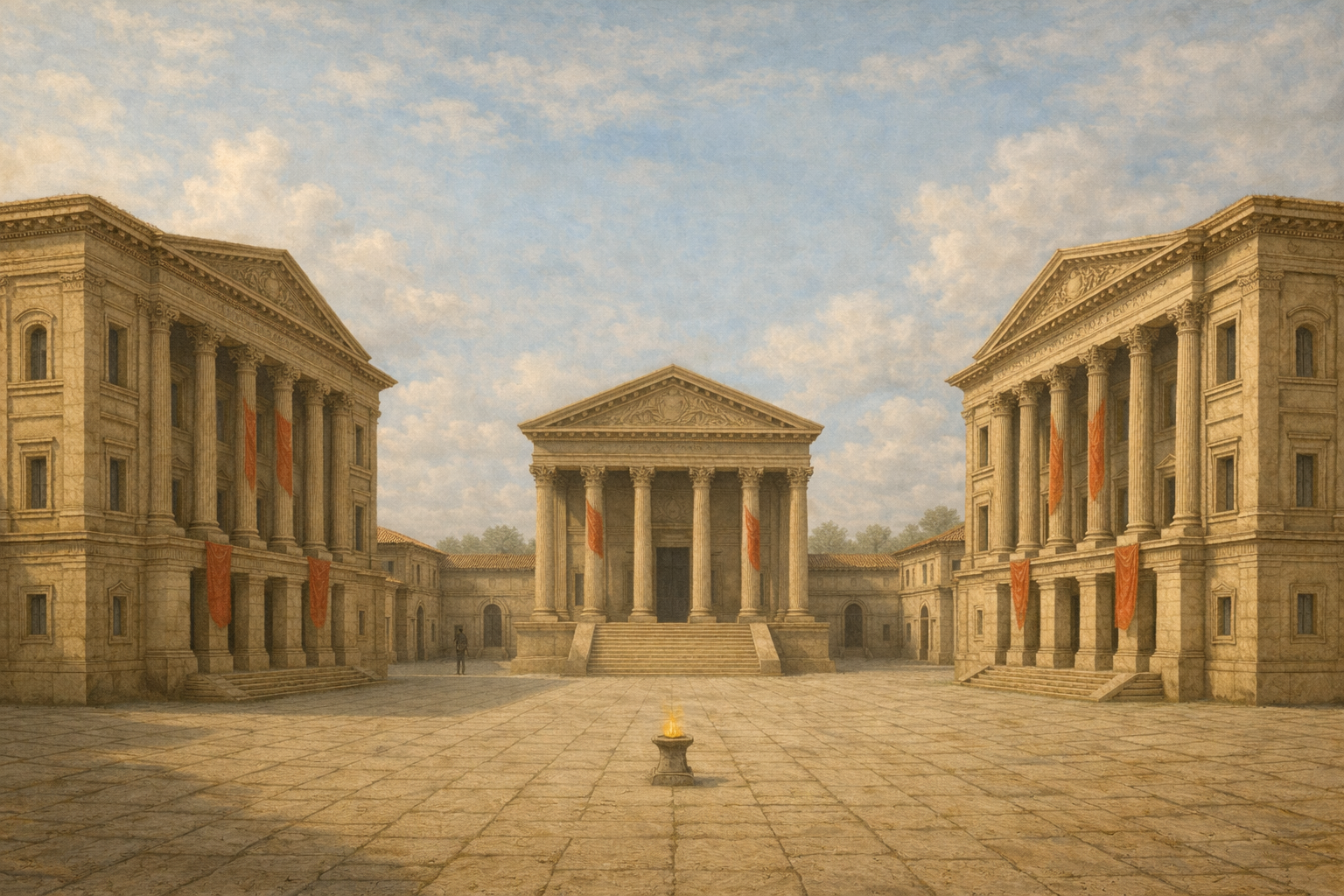
This is not a district shaped by commerce or residence, but by administration. Its streets are broad and measured, its plazas deliberately open, and its buildings set back behind colonnades and forecourts that impose distance as much as dignity. Movement here feels controlled without being overtly restricted, guided by architecture, sightlines, and custom rather than by force. The result is a space that communicates authority through restraint, and permanence through order.
The daily rhythm of the Praesidium Imperii differs markedly from that of the surrounding city. It is busiest during daylight hours, when clerks, advocates, petitioners, and delegations move between offices and courts under constant supervision. At dusk, activity recedes quickly, leaving the district quiet, watchful, and austere. Even at its most crowded, the Praesidium never feels chaotic; it absorbs pressure rather than reflecting it.
Though the Emperor does not reside here, imperial authority is tangible throughout the district. Law is debated, recorded, interpreted, and enforced within its walls, supported by institutions whose proximity ensures balance rather than dominance. The Senate, the courts, and the Collegium Arcanum all maintain their principal presence here, bound together by proximity and precedent.
More than any other part of Novaium, the Praesidium Imperii resists reinvention. It has been repaired, reinforced, and refined over centuries, but rarely altered in intent or form. The district stands as a reminder that the Imperium did not simply conquer or endure the Rift—it organised itself around it, and from that organisation built a capital meant to last.
Demographics
The Praesidium Imperii is sparsely inhabited when compared to the districts that surround it. Permanent residents are few, consisting primarily of senior magistrates, appointed officials, institutional retainers, and a limited number of families whose service to the civic apparatus requires constant proximity. Residency here is a matter of function rather than status alone, and living space is granted by office, appointment, or long-established privilege.
By contrast, the district experiences a pronounced daily influx. Clerks, advocates, scribes, inspectors, petitioners, and accredited representatives move through its streets in steady numbers from dawn until late afternoon, giving the Praesidium its characteristic rhythm of controlled activity followed by abrupt quiet. These transient populations are regulated through permits and schedules, ensuring access without congestion.
Non-human presence within the district is rare and almost entirely institutional. Elven scholars, dwarrow engineers, and other sanctioned specialists appear only where their expertise is formally required, typically under escort or accreditation. Casual residence by non-humans is virtually unknown, reflecting both the district’s restricted function and its emphasis on procedural uniformity.
Social stratification within the Praesidium Imperii is unusually compressed. Wealth is less visible here than authority, and distinctions are drawn more sharply by rank, office, and proximity to decision-making than by material display. Even those of high status move within clear bounds, reinforcing the district’s defining characteristic: that no individual presence outweighs the institutions it serves.
Government
The Praesidium Imperii is administered directly under the authority of the Praefectus Urbi Novaii, acting in the Emperor’s name and bound by imperial statute. Within this district, civic authority is exercised at its highest concentration, encompassing judicial oversight, administrative coordination, and the enforcement of law. Decisions made here rarely concern a single street or citizen alone; more often, they shape policy and precedent for the city as a whole.
The Senate maintains its principal chambers within the Praesidium, asserting legislative influence through debate, decree, and inquiry rather than direct administration. Though formally separate from the prefectural apparatus, senatorial presence ensures that governance here is never singular in voice. Law is contested, interpreted, and refined within walking distance, a proximity long regarded as essential to the city’s political stability.
Alongside these civic bodies operates the Collegium Arcanum, whose authority within the district is regulatory rather than sovereign. Its halls house oversight offices, sealed archives, and advisory chambers where matters of sanctioned magical practice intersect with civic law. While its remit is specialised, its influence is persistent, and its counsel is routinely sought in proceedings where arcane precedent or risk is involved.
No military command operates openly within the Praesidium Imperii. This absence is intentional and historic. Order is maintained by civic officials and the city watch, reinforcing the district’s identity as a place governed by law and process rather than force. In this way, authority in the Praesidium Imperii is made visible not through arms, but through continuity, proximity, and the unbroken operation of institutions designed to endure.
Industry & Trade
The Praesidium Imperii is intentionally removed from the commercial life of Novaium. Trade, where it exists at all, is subordinate to function and tightly regulated, serving the needs of governance rather than profit. The absence of markets, guild halls, and open commerce is a defining feature of the district and one that distinguishes it sharply from the surrounding quarters.
Economic activity within the Praesidium is confined largely to professional services required by the civic apparatus. Advocates, licensed scribes, record-copyists, surveyors, and certified notaries operate from discreet offices, their work conducted under charter and subject to inspection. These services exist to support legal process and administration, not to attract custom, and their presence is controlled to prevent the district from becoming a centre of private influence.
Provisioning for institutions is handled through sanctioned contracts rather than local exchange. Food, fuel, writing materials, and other necessities are delivered on scheduled rotations from approved suppliers elsewhere in the city, reducing unnecessary traffic and ensuring accountability. Payments and accounts are settled through central treasuries, bypassing informal trade entirely.
This deliberate exclusion of commerce reinforces the Praesidium Imperii’s character. By denying trade a foothold, the district preserves its role as a place where decisions are made free from the immediacy of market pressure. What little economic life exists here is quiet, procedural, and invisible—another system operating in service of governance rather than competing with it.
Infrastructure
Infrastructure within the Praesidium Imperii is designed to support governance rather than growth. Every element of the district’s layout serves to facilitate oversight, regulate movement, and preserve continuity, reflecting its role as the administrative core of the capital.
Streets are wide, stone-paved, and meticulously maintained, allowing for ceremonial processions, official convoys, and the steady movement of civic traffic without congestion. Their alignment favours direct routes between institutions, reducing unnecessary crossings and limiting unregulated access. Drainage and paving are held to the highest civic standard, inspected regularly and repaired without delay, ensuring that no lapse in maintenance undermines the district’s authority.
Public buildings are arranged around open plazas and enclosed courtyards, creating transitional spaces that slow approach and control gathering without overt restriction. These spaces serve practical functions—assembly, petitioning, and inspection—while reinforcing a sense of order and scale. Guard posts, record offices, and inspection points are integrated into surrounding structures rather than imposed as separate fortifications, maintaining an appearance of calm oversight.
Utilities within the district receive priority provisioning. Fresh water is supplied reliably through aqueduct-fed cisterns, and waste is channelled through sealed conduits connected to the city’s primary sewer system. Storage vaults, archive chambers, and administrative depots are constructed below ground level where possible, protected by both engineering and restricted access.
The Praesidium Imperii is connected to the rest of Novaium by controlled thoroughfares rather than open markets or incidental streets. This deliberate isolation ensures that while the district remains accessible to those with legitimate purpose, it is insulated from the pressures and disruptions of the surrounding city.
Guilds and Factions
Formal guild presence within the Praesidium Imperii is limited by design. The district is not a place where collective interests are meant to bargain openly, and organisations whose primary purpose is commercial or professional are generally kept at its periphery. Those that are permitted to operate here do so under strict charter and for narrowly defined purposes.
The most visible associations are the collegia of advocates, scribes, and surveyors, whose members provide essential services to the courts and administrative offices. These bodies function less as guilds in the traditional sense and more as regulated professional orders, their membership controlled through examination, licence, and appointment rather than apprenticeship alone. Their influence lies not in numbers, but in familiarity with procedure and precedent.
More subtle are the informal factions that emerge within the bureaucracy itself. Senior clerks, magistrates’ aides, and court officials form enduring networks shaped by shared service, patronage, and institutional loyalty. These alignments rarely announce themselves, yet they influence how quickly petitions are heard, how rigorously statutes are interpreted, and which matters attract senatorial attention. Such factions are neither illegal nor officially acknowledged; they are an accepted consequence of long service within a complex system.
The Senate and the Collegium Arcanum also function as factions in practice, though neither would accept the term. Their proximity within the Praesidium Imperii ensures constant interaction, cooperation, and quiet rivalry, each institution guarding its remit while relying on the others to maintain balance. This tension is not regarded as a flaw, but as a stabilising force that prevents authority from consolidating too completely in any single hand.
Absent from this landscape are popular movements, mercantile leagues, or religious orders acting independently. The Praesidium Imperii tolerates influence only when it is institutional, traceable, and accountable. In this restraint, the district maintains its character as a place where power is exercised through systems rather than seized through persuasion.
History
The Praesidium Imperii marks the original centre of Novaium and remains the most intact expression of the city’s earliest purpose. It was here, in the immediate aftermath of the Rift, that the first permanent civic structures were raised and the framework of imperial governance preserved. Defensive necessity and administrative survival were inseparable concerns in those years, and the district’s initial layout reflects this urgency: compact, defensible, and organised around authority rather than habitation.
As stability took hold, the Praesidium Imperii became less a place of refuge and more a place of order. Temporary structures were replaced with stone, ad hoc courts formalised into permanent chambers, and the earliest records transcribed into durable archives. The inner wall was completed during this period, fixing the district’s boundaries and establishing a civic core that would remain largely unchanged even as the city expanded beyond it.
Over subsequent centuries, Novaium grew outward in deliberate phases, but the Praesidium Imperii resisted incorporation into that growth. While surrounding districts were rebuilt, repurposed, or re-zoned to accommodate trade, population, and industry, the civic core remained insulated from such pressures. Expansion was answered not by sprawl, but by refinement: reinforcing foundations, re-aligning plazas, and regulating access ever more precisely.
Periods of political strain, reform, and senatorial upheaval are well recorded in the district’s archives, yet few left visible marks upon its streets. Where other quarters bear scars of fire or redevelopment, the Praesidium Imperii shows continuity. Its history is not one of dramatic transformation, but of sustained use, repair, and institutional memory.
This persistence has granted the district a symbolic weight disproportionate to its size. To govern Novaium is to govern from here, and to change the city is to do so through mechanisms rooted in this ancient core. The Praesidium Imperii endures not because it has adapted, but because it has been preserved—an unbroken link between the city’s founding moment and its present authority.
Points of interest
The Praesidium Imperii contains the most significant civic institutions in Novaium, each positioned deliberately within the district to reflect balance, oversight, and continuity rather than dominance. These sites are not arranged to impress the casual visitor, but to function efficiently within a system where proximity equates to influence.
Foremost among them is the Triumvirate Plaza, the broad civic space around which the district is organised. It serves as the primary point of convergence for governance, separating and yet uniting the major institutions that define imperial authority within the city. The plaza’s scale and openness allow it to host formal assemblies, public proclamations, and controlled gatherings without disrupting the district’s order.
Bordering the plaza stand the principal halls of governance: the Curia Nova, where the Senate convenes; the Praetorium Imperiale, seat of the city’s highest courts and administrative offices; and the primary halls of the Collegium Arcanum, whose sealed chambers oversee sanctioned magical practice. Each institution occupies its own architectural mass, distinct in form yet harmonised in placement, ensuring no single authority visually eclipses the others.
Scattered throughout the district are lesser but no less essential structures: record vaults, magistrates’ offices, petition halls, and inspection courts, many of which are unmarked to the untrained eye. Their significance lies not in grandeur, but in the authority conferred by their function, and it is within these quieter buildings that much of the city’s governance is enacted.
Detailed accounts of these institutions, their histories, and their internal workings are preserved in their respective articles. Within the Praesidium Imperii, they exist not as destinations, but as instruments—components of a civic system designed to endure.
Architecture
Architecture within the Praesidium Imperii is intentionally restrained, conveying authority through proportion, alignment, and permanence rather than ornament. Buildings are constructed primarily of dressed stone and brick, their façades governed by symmetry and civic regulation. Height is controlled, sightlines are preserved, and no structure is permitted to dominate the district through scale alone.
Public buildings are set back from the streets behind colonnades, forecourts, and enclosed plazas, creating graduated approaches that slow movement and impose formality without overt obstruction. Columns, lintels, and reliefs are used sparingly, favouring inscriptions of office, law, and dedication over decorative excess. Where embellishment exists, it serves to record authority rather than celebrate individual achievement.
Streets and squares are framed to emphasise axial relationships between institutions, reinforcing the sense that governance here is interconnected and deliberate. Alterations to existing structures are rare and tightly controlled, requiring civic approval to ensure continuity with the district’s established character. As a result, the Praesidium Imperii presents a remarkably cohesive architectural language despite centuries of use.
The cumulative effect is a district that feels timeless rather than ancient. Nothing appears improvised, and nothing invites personal expression. The architecture communicates a single, persistent message: that institutions endure beyond those who serve within them.
Geography
The Praesidium Imperii occupies a position of subtle prominence within Novaium, set on gently elevated ground north of the river and securely enclosed by the ancient inner wall. This placement was deliberate, chosen to balance accessibility with control and to separate the city’s civic authority from the commercial pressures of the riverfront without removing it entirely from the urban flow.
The terrain within the district is stable and even, well suited to monumental construction and broad civic spaces. Slight rises in elevation are used to advantage, allowing key institutions to overlook adjacent plazas and approaches without resorting to excessive height. These natural contours, modest though they are, reinforce the district’s visual and symbolic dominance over the surrounding quarters.
Proximity to the river is managed rather than embraced. While the Praesidium lies within easy reach of the crossings that bind the city together, it is buffered from the noise, congestion, and humidity of the docks by intervening streets and controlled approaches. This separation preserves both the dignity of the district and the clarity of its function.
Encircled by walls and bounded by carefully planned roads, the Praesidium Imperii forms a defined geographic core within Novaium. Its position ensures that all major routes lead toward it, yet none pass through it incidentally. In this way, geography serves governance, shaping a district that is central without being exposed, elevated without being isolated, and firmly anchored within the city it commands.
Climate
The Praesidium Imperii does not possess a climate distinct from the city that surrounds it. Weather, seasonal change, and environmental conditions here mirror those of Novaium as a whole and are addressed fully in the city’s primary settlement record.
What distinguishes the district is not climate, but exposure. Its open plazas, broad streets, and stone architecture leave it more susceptible to wind and rain than the denser residential quarters, reinforcing its austere character during poor weather. In summer, the absence of shade makes the district notably warmer by day and cooler by night, further discouraging unnecessary lingering.
In all practical terms, however, the Praesidium Imperii inherits Novaium’s temperate stability, a climate well suited to administration, ceremony, and the long preservation of records.

Comments