

Vicus Flumineus
“All that enters Novaium by water first learns the city here.”
Vicus Flumineus is the living threshold between Novaium and the river that sustains it. Stretched along the southern bank, where the land falls away from the Old City toward the water, the district exists in a state of constant motion. Cargo is unloaded and redistributed, vessels arrive and depart with the tide, and labour never truly ceases. Unlike the ordered stillness of the inner districts, Vicus Flumineus is defined by flow—of goods, of people, and of information.
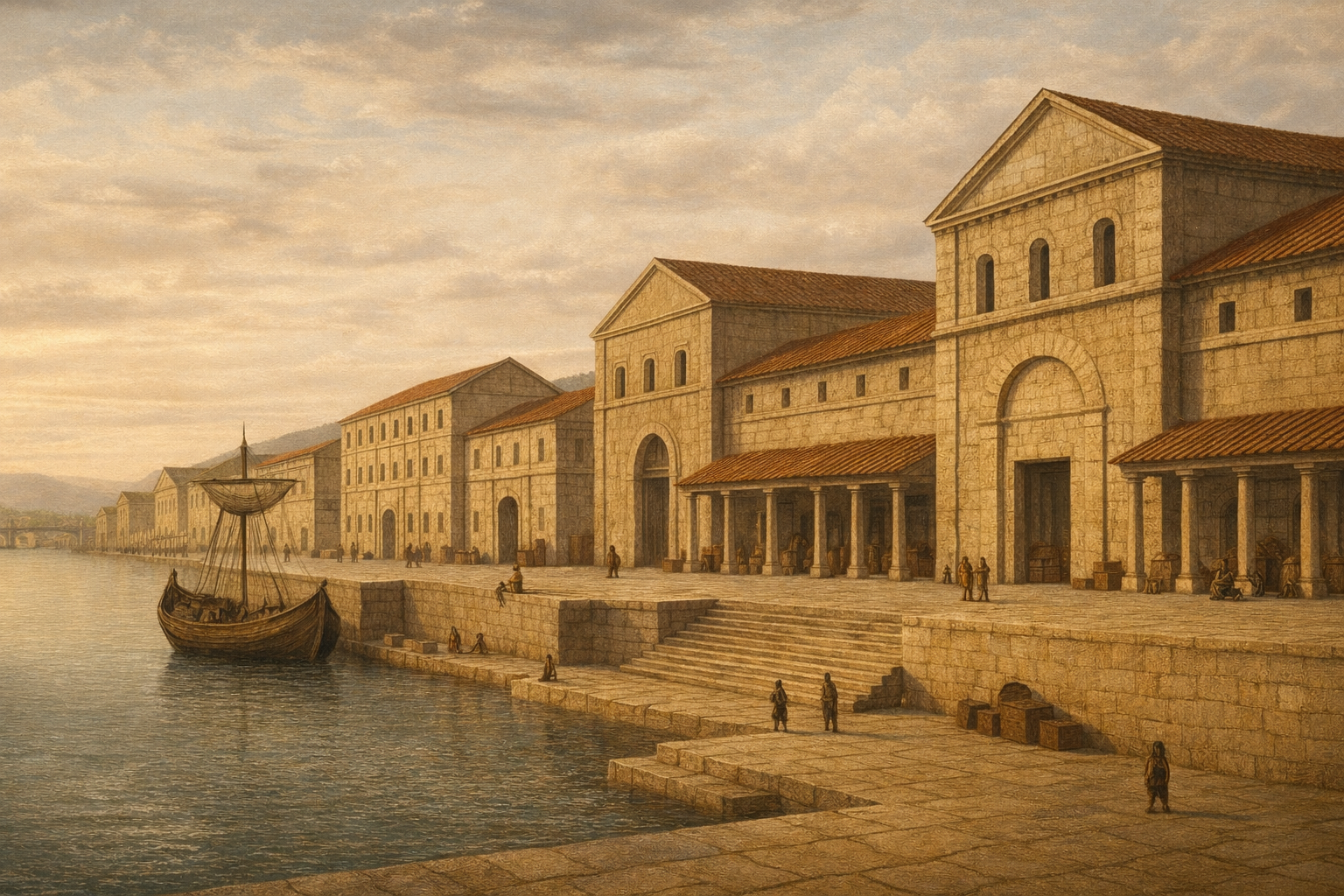
The district’s character is shaped as much by the river as by imperial planning. Streets run parallel to the quay before fracturing inland into narrow lanes crowded with storehouses, workshops, and dense housing. Warehouses open directly onto the water, while homes and taverns cluster close behind, creating a layered environment where work and life overlap without clear boundary. The smell of wet timber, pitch, river-silt, and smoke lingers constantly, carried inland by prevailing breezes.
Vicus Flumineus is indispensable to the capital. Grain, timber, stone, livestock, and manufactured goods all pass through its docks before reaching the markets and storehouses of the city proper. At the same time, outbound traffic—exports, official shipments, and military supplies—are staged here under close supervision. This dual role makes the district both prosperous and volatile, attracting opportunity alongside risk.
Socially, the district is more fluid than most of Novaium. Residents include dockworkers, sailors, warehouse clerks, fishermen, carters, and traders, alongside families who have lived by the river for generations. Transience is common, permanence less so, and civic oversight is constant. The riverbank itself is unwalled, a deliberate choice that prioritises commerce and access over fortification, but it renders Vicus Flumineus one of the city’s most closely watched quarters.
To the Imperium, Vicus Flumineus is not a place of ceremony or memory, but of necessity. It is tolerated noise, controlled disorder, and managed risk—an essential artery whose value lies not in what it represents, but in what it moves.
Demographics
Vicus Flumineus supports a dense and constantly shifting population shaped by labour, proximity to the river, and the rhythms of trade. Permanent residents include dockworkers, fishermen, warehouse hands, lightermen, carters, net-menders, and their families, many of whom trace their livelihoods along the riverbank back several generations. These households form the district’s stable core, accustomed to irregular hours, seasonal fluctuations, and the physical demands of river work.
Alongside this rooted population exists a sizeable transient presence. Sailors, itinerant traders, seasonal labourers, and river crews move through the district in steady waves, swelling its numbers during peak trading periods and thinning them again as traffic ebbs. Lodging houses and shared tenements cater to this flow, creating streets where faces change often and familiarity is provisional.
The district is notably more diverse than much of Novaium. Non-human residents and visitors are common, particularly among river crews and merchant traffic. Dwarrow are frequently encountered in roles tied to heavy cargo and warehousing, while envoys and traders from the Brass Cities maintain a visible presence along the quays. Elves are rarer but not unknown, often appearing as navigators, factors, or specialist traders rather than permanent residents. Integration here is pragmatic; usefulness and reliability matter more than origin.
Wealth is unevenly distributed and openly visible. A small class of successful merchants, ship-owners, and warehouse masters occupy sturdier homes set slightly back from the quay, while labourers and transient workers crowd into cheaper housing closer to the water. Despite this disparity, social boundaries are porous. Shared dependence on the river fosters a culture of mutual awareness, where reputation for work and conduct carries more weight than status alone.
In Vicus Flumineus, population is defined less by belonging than by participation. Those who work the river are accepted, those who do not tend to move on, and the district remains in a constant state of renewal—never static, never fully settled, and always shaped by the flow that defines it.
Government
Governance in Vicus Flumineus is pragmatic, vigilant, and visibly present. The district falls under the authority of the Praefectus Urbi Novaii, but day-to-day control is exercised by the River Prefecture, a specialised civic office charged with overseeing docks, shipping, labour, and river traffic. This body operates with broader discretionary powers than most ward administrations, reflecting the district’s volatility and strategic importance.
Officials of the River Prefecture maintain constant oversight of cargo manifests, docking rights, tolls, and labour assignments. Inspections are frequent and often unannounced, aimed as much at deterring smuggling and theft as at enforcing regulation. While formal proceedings exist, many disputes are resolved swiftly and locally, with prefectural agents empowered to issue fines, suspend operations, or reassign labour without prolonged review.
The city watch maintains a heightened presence along the quays and major thoroughfares, supported by river patrols that monitor traffic beyond the docks themselves. These forces are less ceremonial than elsewhere in Novaium, their authority reinforced through action rather than display. Order is maintained through visibility, repetition, and an understanding that infractions will be addressed immediately.
Guild influence exists but is secondary to civic authority. Merchant associations and dockworker collectives are consulted on matters of scheduling and capacity, yet they operate at the pleasure of the River Prefecture rather than as autonomous bodies. This arrangement prevents any single faction from dominating the riverfront, ensuring that control of the district remains firmly in imperial hands.
In Vicus Flumineus, governance is not subtle. It is an ever-present structure that keeps the river working, the city supplied, and instability contained through constant, deliberate intervention.
Industry & Trade
Industry and trade define Vicus Flumineus in both purpose and character. The district exists to receive, process, and redistribute the immense flow of goods that sustain Novaium, and nearly every street-facing activity is tied, directly or indirectly, to the river. Cargo handling, storage, and onward transport form the backbone of the local economy, supported by a dense network of ancillary trades that thrive on proximity to the docks.
The quays are lined with warehouses, granaries, fishmongers’ sheds, and bonded storehouses, many of them leased under long-term civic charter. Grain from the hinterlands, timber from upriver forests, stone from nearby quarries, livestock, preserved foods, metals, and finished goods all pass through these facilities before being released into the city’s markets or transferred to imperial reserves. Outbound trade follows the same routes in reverse, with manufactured goods, official shipments, and military supplies staged here under close supervision.
Fishing and river harvesting provide a steady secondary industry. Nets are repaired along the quay, catches sold fresh at dawn or salted for storage, and by-products processed locally. Boatbuilding and maintenance yards operate in quieter stretches of the riverbank, producing sturdy, utilitarian craft rather than ornate vessels, their work dictated by function and durability.
Commerce in Vicus Flumineus is regulated but brisk. Transactions are frequent, margins narrow, and competition sharp. Coin circulates quickly, and reputation for reliability is as valuable as capital. While great fortunes are rarely made here, steady profit is possible for those who understand the river’s rhythms and the city’s demands.
In all respects, Vicus Flumineus functions as Novaium’s commercial artery. It does not create luxury or spectacle, but it ensures that the city eats, builds, trades, and endures—an economy measured not by elegance, but by continuity of supply.
Infrastructure
Infrastructure in Vicus Flumineus is built for endurance under strain rather than elegance. The district’s layout follows the riverbank closely, with primary quays running parallel to the water and a lattice of narrower streets branching inland to connect warehouses, workshops, and housing. These routes are engineered to accommodate constant movement of carts, animals, and labourers, and are maintained to withstand heavy loads and frequent use.
The riverfront itself is reinforced with stone embankments, timber pilings, and stepped landings that allow vessels to dock at varying water levels. Cranes, winches, and loading frames are fixed features along the quay, operated by licensed crews and maintained under civic oversight. Slipways and repair yards occupy quieter stretches of the bank, positioned to avoid interference with cargo traffic.
Warehousing infrastructure is dense and vertically layered. Many storehouses incorporate raised floors, internal hoists, and sealed chambers designed to protect goods from damp and vermin. Bonded warehouses are fitted with lookouts and secure access points, ensuring that controlled goods remain under constant observation. Grain silos and cold cellars are integrated into larger complexes, reflecting the district’s role in food security.
Water management is a critical concern. Drainage channels run alongside streets and beneath buildings, carrying runoff back to the river while preventing flooding during seasonal surges. Fresh water is supplied through a combination of aqueduct-fed conduits and public cisterns, supplemented by river access for non-potable use. Fire suppression infrastructure is more extensive here than in most districts, with ready access to water and strategically placed reservoirs.
Though utilitarian in appearance, Vicus Flumineus is fully integrated into Novaium’s civic systems. Roads are inspected frequently, structures repaired as a matter of necessity, and failures addressed swiftly. The district’s infrastructure reflects a singular priority: to keep the river moving and the city supplied, regardless of weather, wear, or disruption.
Guilds and Factions
Guild influence within Vicus Flumineus is strong, practical, and tightly bounded by civic authority. The most prominent organisations are the dockworkers’ guilds, river pilots’ associations, warehouse masters’ compacts, and fishermen’s brotherhoods, each responsible for regulating labour, training apprentices, and maintaining standards within their respective trades. These bodies are longstanding and deeply embedded in the district’s daily operation, their authority derived from experience rather than chartered privilege.
Merchant interests are organised through loose coalitions rather than a single dominant guild. Traders whose livelihoods depend on river traffic cooperate on matters of scheduling, storage access, and risk-sharing, but rivalry remains constant. Alliances form and dissolve with the seasons, shaped by cargo volume, water conditions, and shifting demand. No merchant faction is permitted to consolidate control over the quays, a limitation enforced deliberately by the River Prefecture.
Labour collectives exert quieter influence. Dock crews and carters often operate as extended kin-groups or neighbourhood associations, coordinating work informally while presenting a unified front in negotiations over pay and conditions. While strikes are rare and swiftly curtailed, collective withdrawal of labour has occurred in times of acute stress, leaving a lasting impression on civic authorities.
Illicit factions exist at the margins, though rarely in organised form. Smugglers, fence networks, and river-band intermediaries exploit the district’s permeability, but their operations are fragmented and short-lived. Persistent criminal organisation is difficult to sustain under the scrutiny imposed by patrols, inspections, and the ever-present risk of denunciation.
In Vicus Flumineus, power belongs to those who move goods efficiently and without disruption. Guilds and factions endure only so long as they serve that purpose, their influence tolerated by the Imperium not as a right, but as a necessity constrained by constant oversight.
History
Vicus Flumineus was already a functioning river quarter before the Rift, serving as the primary point of contact between the early city and the waterway that sustained it. In that earlier era, its scale was modest, its structures lighter, and its role largely local, supporting fishing, ferrying, and limited trade with nearby settlements. This continuity places the district firmly within the bounds of the Old City, even as its present form bears little resemblance to its origins.
The Rift marked a decisive transformation. In the aftermath, as populations shifted and supply lines reoriented, the river became one of Novaium’s most reliable lifelines. Vicus Flumineus expanded rapidly to meet this demand, its shoreline reinforced, docks extended, and warehouses raised where smaller structures once stood. Much of the original riverside fabric was dismantled or absorbed into new construction, leaving only fragments of the pre-Rift quarter visible beneath later layers.
As the Imperium consolidated control, the district was reorganised repeatedly. Informal landings gave way to regulated quays, private jetties were removed or licensed, and river traffic was brought under systematic oversight. Each reform prioritised efficiency and security over preservation, and Vicus Flumineus became one of the most heavily modified parts of the Old City.
Despite these changes, the district has never lost its foundational purpose. While its appearance and scale have evolved dramatically, its function as the city’s riverward interface remains unbroken. Vicus Flumineus stands today as a palimpsest of adaptation—older than much of Novaium, reshaped more than most of it, and defined by the necessity to change in order to endure.
Points of interest
The defining feature of Vicus Flumineus is its riverfront infrastructure, which functions simultaneously as economic engine and civic stage. Along the southern bank of the river runs the Processional Way of Ash and Light, a broad stone thoroughfare following the line of the quay. While used daily for the movement of cargo and labour, it is formally reserved for imperial ceremonies, sanctioned arrivals, and ritual processions that enter or depart Novaium by water. Its dual role as working quay and ceremonial route marks the river as both resource and threshold.
Major dock complexes line this southern bank, each comprising reinforced quays, bonded warehouses, and administrative offices under the authority of the River Prefecture. These installations are known locally by long-established names rather than formal civic designations, their reputations shaped by reliability, speed of unloading, and adherence to regulation. Together, they form the primary interface through which bulk goods enter and leave the capital.
Adjacent to the docks are the district’s fish markets and curing sheds, most active in the early hours before dawn. These facilities supply a significant portion of the city’s daily food requirements and are among the oldest continuously operating sites along the riverfront, though much rebuilt since the Rift.
Further inland lie a number of well-known taverns and lodging houses catering to river crews, dockworkers, and itinerant traders. While unremarkable in appearance, several function as informal centres of negotiation, recruitment, and information exchange, their significance understood by those who work the river rather than proclaimed publicly.
Boatyards and repair slips occupy the quieter eastern reaches of the district along the same southern bank, their timber frameworks and scaffolding a constant presence. These yards are treated as strategic assets, inspected regularly and licensed tightly, as the uninterrupted flow of river traffic depends upon their operation.
Individual quays, establishments, and ceremonial routes are detailed in their respective articles, where their histories, stewards, and customs are recorded in full.
Tourism
Vicus Flumineus is not a destination sought out for leisure, yet it is one of the most frequently encountered districts for those entering Novaium by water. Visitors arrive here out of necessity rather than curiosity, their first impressions shaped by noise, labour, and the smell of the river rather than ceremony or comfort. For many travellers, the district is a place passed through, not lingered within.
Those who remain tend to be merchants, river captains, factors, and officials whose business requires proximity to the docks. Accommodation is practical and utilitarian, offered by long-established lodging houses that prioritise proximity and availability over refinement. Taverns cater to transient custom, providing food, drink, and information rather than entertainment, and close early in accordance with river schedules rather than civic fashion.
A smaller number of visitors are drawn by interest rather than obligation. Scholars of trade, logistics, and civic administration occasionally observe the district to study the flow of goods and labour that sustains the capital. Others attend sanctioned ceremonies along the Processional Way of Ash and Light, where the riverfront briefly assumes a more formal character during official arrivals or departures.
The district does not court admiration, nor does it attempt to manage its image. Vicus Flumineus presents itself as it is: functional, demanding, and indifferent to comfort. Those who come expecting spectacle soon move on; those who understand its purpose recognise it as one of the clearest expressions of how Novaium endures.
Architecture
Architecture in Vicus Flumineus is shaped almost entirely by function. The district is dominated by warehouses, quays, and industrial blocks whose forms prioritise capacity, durability, and ease of access over aesthetic refinement. Buildings are broad rather than tall, constructed of heavy stone, timber framing, and reinforced foundations designed to bear constant vibration, weight, and moisture from the river environment.
Warehouses line the river bank in near-continuous sequence, their façades punctuated by wide loading doors, hoists, and external cranes. Many open directly onto the quay, allowing cargo to move from vessel to storehouse with minimal handling. Rooflines are practical and repetitive, often fitted with vents, winch housings, and covered walkways to protect goods and labourers from weather. Decorative elements are rare and usually limited to ownership marks or civic seals carved into lintels.
Interspersed among these industrial structures are blocks devoted to processing and storage: curing sheds, grain halls, cooperages, and maintenance yards. These buildings are utilitarian in every respect, their layouts dictated by workflow rather than symmetry. Repairs and additions are frequent, resulting in layered construction that reveals successive phases of expansion since the Rift.
Residential architecture exists alongside this industrial core rather than apart from it. Tenement housing rises behind the quays and above workshops, built close and compact to accommodate labourers and their families. These structures are sturdier than those of poorer inner districts but lack the refinement of the city’s residential quarters elsewhere. Merchant houses, where present, are more substantial, often combining private residences with offices and secure storage, their river-facing façades signalling status through size rather than ornament.
Overall, Vicus Flumineus presents a dense, working architecture that makes no attempt to conceal its purpose. Stone is worn smooth by use, timber darkened by water and smoke, and buildings stand as records of continual adaptation. The district’s appearance reflects its role precisely: a place built to move goods, house labour, and withstand the river’s demands without pause or sentiment.
Geography
Vicus Flumineus occupies the low northern bank of the river where Novaium descends from the Old City toward the water. The land here is flatter and heavier than elsewhere in the capital, shaped by centuries of flooding, reinforcement, and human alteration. The river runs broad and steady along this stretch, its course defining the district’s length and orientation more decisively than any civic boundary.
The shoreline is fully worked rather than natural. Stone embankments, stepped quays, and timber pilings have replaced any original bank, creating a hard edge between city and water that allows constant docking regardless of seasonal variation. Minor inlets and older channels have been filled or redirected, leaving only subtle irregularities in the quay line to hint at the river’s former shape.
Inland, the ground rises gently toward the inner districts, a gradient that channels runoff and traffic away from the riverfront. This slope has encouraged dense development along the bank, with larger industrial structures closest to the water and progressively mixed-use and residential buildings set further back. The geography creates a natural stratification of labour, noise, and activity, with the riverfront always dominant.
The district’s position leaves it exposed. Unlike much of Novaium, the riverbank here is unwalled, prioritising access and movement over fortification. This openness makes Vicus Flumineus both a vital artery and a point of vulnerability, a geographic reality that shapes its constant oversight and reinforces its role as the city’s most permeable edge.
Climate
Vicus Flumineus experiences the same temperate climate as the rest of Novaium, but its proximity to the river gives the district a distinct character shaped by moisture, wind, and seasonal variation. Humidity is consistently higher along the quays, and morning mists frequently rise from the water, lingering over the docks before dispersing as the day warms.
Summers in the district are heavy rather than oppressive. Stone and timber structures absorb heat during daylight hours, while river breezes offer limited relief, carrying the smells of water, pitch, and worked wood inland. Activity begins early to avoid the worst of the heat, with much of the heaviest labour completed before midday. Winters are damp and cold, though rarely severe, with the river moderating extremes but increasing chill through persistent moisture.
Rainfall is a constant concern. Seasonal downpours swell the river and test embankments, requiring vigilant maintenance and rapid response from civic crews. Streets nearest the quay remain slick long after storms pass, and the sound of water draining through channels is a familiar backdrop to daily life.
Over time, residents and workers of Vicus Flumineus have adapted to these conditions through routine rather than infrastructure alone. Clothing, schedules, and construction practices reflect an acceptance of the river’s influence, reinforcing the district’s identity as a place where climate is endured as part of the work rather than resisted.

Comments