

Gaius Aurelius Varro
“Solaria feeds the Empire because it is defended as if it were already under threat.”
Gaius Aurelius Varro serves as Dux Solariae, the Imperium’s supreme military and security authority over the Solarian provinces. His mandate is neither symbolic nor ceremonial. He exists to ensure that the Empire’s most productive agricultural heartland remains secure, stable, and capable of feeding both the capital and the frontier legions without interruption.
Solaria is not a distant border march nor a quiet interior province. It is a breadbasket with teeth—vast fields, fortified roads, granaries protected as fiercely as cities, and a population accustomed to living under the shadow of preparedness. Varro’s command reflects this dual nature. He oversees provincial defence, patrol networks, fortifications, and rapid-response forces, coordinating legionary detachments and auxiliaries with a precision shaped by decades of service. Civil authority falls beneath his remit only where it intersects with security; governance, lawmaking, and taxation remain the province of civilian administrators, but all operate with the understanding that Varro’s priorities override comfort when stability is at stake.
Unlike provincial governors or civic prefects, Varro does not rule through proximity to the populace. His authority is visible in infrastructure rather than proclamation: roads maintained for troop movement, storehouses designed for siege endurance, training schedules that never lapse in times of peace. His presence reassures farmers and merchants alike, not because he promises safety, but because his systems assume danger as a constant.
Politically, Varro is adept without being indulgent. He understands the Senate’s language of reports, budgets, and appearances, and he communicates in terms they respect: preparedness, risk mitigation, and continuity of supply. He neither challenges senatorial authority nor flatters it, presenting his demands as necessities rather than ambitions. This has earned him a reputation as reliable, if unyielding—a commander whose requests are rarely denied because they are rarely excessive.
To the people of Solaria, Varro is regarded as a protector rather than a ruler. To the legions, he is a disciplined professional who values readiness over rhetoric. To the Imperium as a whole, he is a stabilising force on which prosperity quietly depends. Varro does not seek glory in victory; his success is measured in harvests delivered on time, borders untested, and wars that never come.
Physical Description
General Physical Condition
Varro carries the body of a man shaped by years of soldiering and altered by the weight of command. His build remains solid and grounded, with the broad shoulders and forearms of a former legionary, but the relentless pace of campaigning has given way to councils, inspections, and extended periods in the saddle. As a result, he has grown slightly soft around the middle—a change he neither hides nor excuses.
Despite this, Varro is far from unfit. He endures long days without complaint, rides hard when required, and walks Solarian fields and fortifications with a steady, measured stride. His stamina is sustained through routine rather than exertion: early mornings, regular movement, and a disciplined approach to health that prioritises function over appearance.
Age and responsibility have introduced minor stiffness to his joints, particularly after long rides or cold nights, but these are treated as inconveniences rather than limitations. Varro does not chase youthful conditioning, nor does he indulge in neglect. His physical condition reflects the balance of his life—no longer a man of the shield wall, but still capable of standing in one if the need arises.
Identifying Characteristics
Varro’s most striking feature is the long, brutal scar that runs from shoulder to wrist along his right arm, a legacy of an orcish blade delivered at close quarters during his early frontier service. The wound healed poorly, leaving a pale, ridged line that twists with the movement of muscle and draws the eye immediately. He wears it openly, neither embellishing its story nor concealing its existence, treating it as a factual record of survival rather than a badge of honour.
On his left hand, two fingers are missing, taken in the same engagement. The loss has subtly reshaped the way he moves and gestures; his grip is adjusted, his hand often held slightly angled, an unconscious compensation learned over years of adaptation. Those unfamiliar with him notice the absence quickly, while seasoned officers recognise it as a reminder that Varro’s authority was forged under real threat, not ceremonial hardship.
Together, these injuries give Varro a presence that is unmistakably martial without being theatrical. They speak to experience, endurance, and consequence—marks of a man who has paid for his command in flesh, and who carries those costs without sentimentality.
Apparel & Accessories
Varro’s attire reflects the dual nature of his office—civil authority grounded in military readiness. He wears the robes of a provincial commander rather than a field officer: layered wool and linen in restrained Solarian hues, cut for durability and clarity of rank rather than ornament. The fabric is heavy enough to endure travel and weather, the tailoring practical, allowing ease of movement whether seated in council or inspecting fortifications. These robes signal governance, not pageantry, and Varro wears them with the unselfconscious familiarity of a man who has no need to impress.
Despite this civic presentation, Varro is never without his legionary gladius. The blade hangs at his side in a plain leather scabbard, its fittings worn smooth by years of use. It is unmistakably a soldier’s weapon—unadorned, balanced, and meticulously maintained. He does not draw attention to it, nor does he allow it to become symbolic excess. Its presence is matter-of-fact, a continuation of habit rather than a statement.
To those who serve under him, the combination is telling. The robes speak of authority and responsibility; the sword speaks of experience and preparedness. Together, they encapsulate Varro’s approach to command: governance first, force held in reserve, and the unspoken understanding that Solaria’s peace is preserved not by appearance, but by readiness that never fully sleeps.
Mental characteristics
Personal history
Gaius Aurelius Varro entered the legions as a young man, driven less by ambition than by a sense of obligation expected of his house. Though born into patrician lineage, he chose the path of service rather than comfort, requesting assignment to the frontier rather than a sheltered post. His early years were spent along the border of the Brass Cities, where diplomacy and deterrence blurred into one another and a careless action could unravel months of careful balance. There, Varro learned restraint—how to hold ground without provoking conflict, and how to project strength without inviting escalation.
From the western marches he was reassigned north, to the harsher and less forgiving Warborn border. It was here that his career hardened. Patrols were longer, skirmishes bloodier, and the line between peace and open conflict thinner than anywhere else in the Imperium. Varro proved reliable under pressure, earning the trust of his commanders not through heroics, but through preparation, discipline, and an ability to keep men alive in situations where losses were expected.
It was during one of these engagements that Varro suffered the wounds that would end his front-line career: the orcish blade that scarred his arm and the injury that cost him two fingers of his left hand. Though he recovered, it was clear that his days as a field officer were numbered. Rather than retire him quietly, the Imperium granted Varro approval to attend formal schooling—an opportunity reserved for officers deemed too valuable to lose.
There, he was trained in governance, logistics, law, and provincial administration. Unlike many who came to such studies late, Varro approached them with the same seriousness he had brought to soldiering. He studied not as an aspirant politician, but as a commander learning new terrain. By the time he returned to service, he was no longer merely a soldier promoted beyond his wounds, but a man reshaped for command at a higher level.
This dual life—earned authority in the field, refined authority in the halls of administration—set the course for the rest of his career. When he was later appointed Dux Solariae, Varro was neither an academic governor nor a blunt instrument of war, but a commander forged by borders, tempered by injury, and prepared to defend the Empire not only with steel, but with systems that ensured war remained unnecessary.
Education
Varro’s formal education came later than most men of his rank and was shaped by necessity rather than tradition. After being wounded on the Warborn border, he was granted approval to attend Imperial schooling reserved for officers transitioning into strategic and administrative command. There, he studied provincial governance, military logistics, law, and supply management, disciplines essential to holding territory rather than merely fighting over it.
His instruction emphasised the integration of civil and military authority: how food production, transport routes, taxation, and local administration intersected with defence. Varro proved a diligent if unspectacular student, excelling where theory met practice. He questioned assumptions, tested doctrine against experience, and approached governance as another form of command—one requiring preparation, clarity, and restraint.
Though he never cultivated the polish of a scholar or senator, his education gave him the tools to operate effectively within Imperial systems. It transformed him from a capable frontier officer into a commander able to manage provinces, negotiate with civilian authorities, and present strategic necessity in terms the Senate could neither ignore nor easily dismiss.
Employment
Varro’s career spans both the field and the administrative spine of the Imperium. He began as a junior legionary officer assigned to frontier duties, serving first along the Brass Cities border where his responsibilities combined patrol work with the careful enforcement of treaties and trade protections. These early postings demanded discipline and judgement more than aggression, and Varro gained a reputation as an officer who could be trusted not to turn tension into incident.
His reassignment to the Warborn border marked the most demanding phase of his military service. There he rose steadily through the ranks, commanding patrols, then companies, and later coordinating wider defensive responses during periods of heightened incursion. His leadership was characterised by preparation and caution; engagements under his command were rarely decisive, but losses were consistently limited and positions held.
Following his injury and subsequent education, Varro returned to service in a different capacity. He was appointed to a series of regional command and oversight roles, where he applied his combined military and administrative training to fortification planning, supply chain security, and the coordination of civilian authorities with standing forces. These posts brought him into regular contact with senatorial committees and Imperial logistics offices, sharpening his political acuity without diminishing his professional focus.
His appointment as Dux Solariae crowned this progression. In the role, Varro commands all military forces within the Solarian provinces, oversees provincial defence infrastructure, and ensures that agricultural production and transport remain secure under all conditions. His employment is defined not by conquest or expansion, but by continuity: the uninterrupted flow of grain, the deterrence of threat, and the maintenance of readiness in a province whose value makes it perpetually vulnerable.
Accomplishments & Achievements
Varro’s accomplishments are defined by absence rather than spectacle. Under his command, Solaria has remained secure, productive, and largely untouched by the conflicts that have scarred other frontier regions. The province’s fields have continued to yield, its granaries have remained full, and its roads open—even during periods when neighbouring borders experienced instability or open threat. That this has been achieved without large-scale mobilisation is regarded by Imperial strategists as his greatest success.
He oversaw the systematic militarisation of Solaria’s infrastructure without disrupting its agricultural output. Fortified granaries, patrol-linked road networks, and layered response garrisons were introduced gradually, integrated into civilian life so thoroughly that most inhabitants came to regard them as normal rather than intrusive. This balance ensured that defence enhanced productivity rather than strangling it.
Varro is also credited with standardising frontier readiness doctrine for agricultural provinces, a framework later adopted elsewhere in the Imperium. His approach treated farms, storehouses, and transport hubs as strategic assets equal to forts and watchtowers, redefining how the Empire understood “rear areas” in an age of unpredictable threat.
Diplomatically, he maintained stable relations along the Brass Cities border through disciplined enforcement rather than concession, preventing escalation while protecting Imperial interests. Along the Warborn frontier, his insistence on preparedness and controlled retaliation reduced raids without provoking wider conflict, earning him the respect of both soldiers and senators who preferred stability to heroics.
Varro’s achievements have not brought him fame, but they have delivered results the Imperium values deeply: full granaries, quiet borders, and a province that feeds the Empire without needing to be rescued by it.
Failures & Embarrassments
Varro’s record is not without fault, and his failures are remembered precisely because his standards are so high. Early in his tenure as Dux Solariae, he underestimated the political sensitivity of increased patrol presence near several major farming communities. Though the measures were tactically sound, they were implemented too quickly, provoking unrest among landholders who feared requisition and conscription. The resulting petitions reached the Senate before Varro’s explanatory reports did, forcing him into a rare public defence of his actions and a temporary scaling back of visible forces.
During his later service on the Warborn border, Varro authorised a limited retaliatory strike following a series of raids, intending to reassert deterrence without escalation. While militarily successful, the action drew criticism from senatorial factions who viewed it as unnecessarily provocative. Though the border ultimately stabilised, the incident lingered as a reminder that even restrained force can be politically costly.
On a more personal level, Varro’s injuries became an unspoken embarrassment early in his administrative career. Some within the Senate quietly questioned whether a commander missing fingers and bearing visible scars was suited for provincial authority rather than battlefield leadership. Varro never addressed such doubts directly, allowing his performance to answer them instead, but the perception persisted long enough to harden his reputation as a man who would rather endure judgement than contest it.
These moments did not derail Varro’s career, but they shaped it. Each failure reinforced his caution, sharpened his political awareness, and confirmed a lesson he carries still: in Solaria, even correct decisions can carry costs, and preparedness must extend beyond the battlefield into the realm of perception.
Intellectual Characteristics
Varro’s intellect is practical, structured, and deeply informed by experience. He thinks in terms of systems rather than moments, preferring plans that hold under strain to ideas that succeed only in ideal conditions. Years on the frontier taught him to anticipate second- and third-order consequences, a habit that now defines his approach to command and governance.
He is methodical in analysis, weighing risk, resource, and outcome with a soldier’s caution and an administrator’s precision. Varro is not given to abstraction or speculation; he values information that can be acted upon and dismisses theory that cannot survive contact with reality. His thinking is shaped by the belief that preparedness is not a reaction, but a state of mind.
Though not a philosopher or rhetorician, Varro possesses a disciplined clarity that makes his judgments reliable. He listens carefully, asks pointed questions, and reaches conclusions without unnecessary delay. This intellectual restraint—knowing when enough is enough—has earned him a reputation as a commander who can be trusted to think clearly when uncertainty is greatest.
Morality & Philosophy
Varro’s moral outlook is rooted in duty, restraint, and the belief that peace is preserved through readiness rather than optimism. He does not view war as inevitable, but he rejects the notion that it can be wished away. To him, the absence of conflict is not a sign of safety, but of preparation done correctly and maintained without lapse.
He believes authority carries an obligation to protect without provoking, to deter without cruelty, and to act decisively only when alternatives have been exhausted. Varro places little faith in grand declarations or ideological purity, preferring measured action grounded in consequence. Right action, in his view, is that which prevents greater harm, even if it invites criticism or misunderstanding in the present.
Varro holds a strong sense of responsibility toward those under his command and the civilians whose lives depend upon his decisions. He regards unnecessary risk—whether taken for glory, political advantage, or impatience—as a moral failure. Conversely, he accepts personal cost as an inherent part of leadership, believing that those who command must be willing to bear consequences on behalf of others.
His philosophy can be summarised simply: strength exists to make violence unnecessary, and the highest expression of command is a province that remains peaceful because its defence was never neglected.
Personality Characteristics
Motivation
Varro is motivated by a deeply ingrained sense of responsibility to the Imperium and to the people who depend upon Solaria’s stability. He understands that the province’s fields feed armies, cities, and distant frontiers, and that any failure in its defence would ripple far beyond its borders. This awareness anchors his actions and leaves little room for complacency.
He is driven not by ambition or the pursuit of distinction, but by a determination to ensure that the systems under his care do not fail through neglect or miscalculation. Varro measures success in continuity: harvests gathered without interruption, roads kept secure, borders quiet not because they are ignored, but because they are respected.
At a more personal level, Varro is motivated by the lessons of his own past—by wounds sustained, mistakes witnessed, and the knowledge that preparedness is learned through cost. He is resolved that Solaria will not relearn those lessons through blood if foresight can prevent it. In this, his motivation is steady and unshowy, shaped by the belief that the truest service is to make one’s own necessity invisible.
Savvies & Ineptitudes
Varro’s strengths lie in strategic foresight and disciplined execution. He excels at long-term planning, particularly where defence, logistics, and agricultural productivity intersect. His ability to integrate military readiness into civilian infrastructure allows Solaria to remain both secure and economically robust, a balance few commanders manage successfully. He is also highly effective at risk assessment, identifying vulnerabilities early and addressing them methodically rather than reactively.
He demonstrates strong operational judgement, knowing when to apply pressure and when restraint will serve better. Subordinates value his clarity of intent and consistent standards, which foster confidence and reduce uncertainty even in complex situations. Varro is particularly skilled at translating military necessity into terms civilian administrators and senators can accept, making him an effective intermediary between field command and political authority.
Conversely, Varro is less adept at prolonged political manoeuvring detached from practical outcome. He has little patience for abstract debate, symbolic gestures, or indecision framed as deliberation. While he understands political necessity, extended negotiation without clear direction frustrates him, and his preference for directness can occasionally be mistaken for inflexibility. These limitations do not undermine his effectiveness, but they do ensure that Varro operates best where clarity, structure, and purpose are valued over persuasion and spectacle.
Likes & Dislikes
Varro appreciates order that serves purpose. He values preparedness, disciplined routines, and systems that function without constant intervention. Well-maintained roads, efficient granaries, and troops who understand their roles give him a quiet sense of reassurance. He respects competence in others, particularly when it is demonstrated without need for recognition, and he values straightforward communication unburdened by embellishment.
He has little tolerance for complacency or indulgence, especially in matters of defence. Varro dislikes unnecessary risk taken for prestige, political interference that compromises readiness, and decisions made to satisfy appearance rather than necessity. He is particularly dismissive of those who underestimate Solaria’s strategic importance, regarding such ignorance as dangerous rather than merely inconvenient.
His preferences reflect a man who finds comfort not in ceremony or praise, but in the steady assurance that the province under his watch is prepared for challenges it may never visibly face.
Virtues & Personality perks
Varro’s foremost virtue is reliability. He is consistent in judgement, measured in action, and unshaken by pressure, providing a stabilising presence in a province whose value makes it perpetually vulnerable. Those under his command trust that his orders are grounded in preparation rather than impulse, and that he will not expend lives or resources carelessly.
He possesses a strong sense of discipline and restraint, applying force only when necessary and favouring deterrence over escalation. This self-control allows him to balance military readiness with civilian prosperity, ensuring that Solaria remains productive without becoming oppressive. Varro’s patience, honed through years of frontier service, enables him to endure long periods of vigilance without lapsing into complacency.
Another of his strengths lies in earned authority. His experience as a soldier grants him credibility among the ranks, while his administrative competence earns respect from civilian officials. He does not command loyalty through charisma, but through fairness, clarity, and a demonstrated willingness to shoulder responsibility himself.
Together, these virtues make Varro an effective guardian of Solaria—one whose strength lies not in conquest or acclaim, but in the quiet competence that keeps the Empire fed, defended, and untroubled by crises that never quite come to pass.
Vices & Personality flaws
Varro’s greatest flaw is a tendency toward overcaution, born of long experience with the cost of failure. While this restraint has preserved Solaria’s stability, it can also slow decisive action when circumstances change rapidly, as he prefers certainty to speed. In rare moments, this has allowed minor threats to linger longer than necessary.
He is also prone to emotional reserve, keeping personal concerns tightly contained and rarely sharing doubt or frustration with others. This self-containment, while reinforcing his authority, distances him from those who might otherwise offer insight or support. Subordinates respect him, but few truly know him.
Lastly, Varro carries a quiet inflexibility where principles of preparedness are concerned. Once convinced of a necessary course, he is reluctant to abandon it, even in the face of political pressure or incomplete information. This stubbornness has protected Solaria from reckless compromise, but it has also earned him a reputation among some senators as difficult to redirect once committed.
Social
Reign
Varro’s tenure as Dux Solariae has been characterised by stability achieved through vigilance rather than expansion or reform. His reign has unfolded without major wars, dramatic crises, or celebrated victories—a fact he considers success rather than stagnation. Under his command, Solaria has remained secure, productive, and reliably integrated into the Imperium’s logistical heart, feeding cities and legions alike without interruption.
He has governed the province through a doctrine of constant preparedness, maintaining patrols, fortifications, and rapid-response forces even during extended periods of peace. Rather than scaling back defences to placate political pressure or reduce expenditure, Varro has insisted that readiness itself is the deterrent. This posture has kept external threats cautious and internal unrest rare, though it has occasionally drawn criticism for being overly conservative.
Administratively, his reign has strengthened coordination between military and civilian authorities without allowing either to dominate the other. Agricultural cycles, transport routes, and defensive planning are treated as a single system, ensuring that Solaria’s prosperity does not come at the expense of its security. These measures have made the province resilient, capable of absorbing shocks without cascading failure.
Varro’s reign is not marked by popular acclaim, but by trust. Farmers continue to sow without fear, merchants travel guarded roads, and the Senate receives grain on time. In Solaria, peace is not celebrated—it is maintained. And under Varro’s steady command, that maintenance has become the defining feature of his rule.
Contacts & Relations
Varro maintains a carefully managed network of relationships grounded in professionalism rather than allegiance. He works closely with Imperial logistical offices and senatorial supply committees, communicating in terms of risk, yield, and continuity—an approach that has earned him a reputation as dependable, if inflexible. His political acumen allows him to navigate these bodies without becoming entangled in factional disputes.
Militarily, he holds the loyalty and respect of the Solarian legionary commands and auxiliary forces, many of whom served under him earlier in his career. His relationships with subordinate officers are formal but trusted, built on clear expectations and a shared understanding of preparedness as doctrine rather than posture.
Along the southern border, Varro maintains structured, disciplined contact with authorities of the Brass Cities, ensuring that patrol coordination and trade security remain stable without provoking diplomatic tension. These relations are deliberately procedural, designed to prevent misunderstanding rather than foster intimacy.
Within Solaria itself, he liaises regularly with provincial administrators, agrarian councils, and transport guilds, treating them as strategic partners in defence rather than purely civil institutions. Varro avoids close association with noble houses or local power blocs, preferring to keep his authority anchored in Imperial mandate and operational necessity rather than patronage.
Together, these affiliations form a restrained but resilient web of cooperation—sufficient to secure Solaria’s borders and harvests, without allowing any single relationship to compromise his primary obligation: the province’s readiness and the Imperium’s sustenance.
Family Ties
Varro is married, though his family life remains deliberately private and largely separate from his public duties. His spouse resides primarily within Solaria, managing household and estate affairs with minimal involvement in provincial politics. The marriage is stable and respectful, built on mutual understanding rather than public prominence.
He has children, raised with an emphasis on discipline, education, and service, but Varro is careful not to position them for advancement through his office. He is mindful of the perception such favour might invite and is determined that his authority not become hereditary in practice, even if his name carries weight.
Though he fulfils his familial obligations, Varro’s primary loyalty remains to his command. His absences are frequent, his time divided, and his presence at home intermittent. This distance is accepted rather than resented, understood as the cost of holding Solaria secure. In this, his family life mirrors his character: steady, restrained, and shaped by duty rather than indulgence.
Religious Views
Varro observes the traditional civic rites of the Imperium with disciplined regularity, treating religion as a stabilising force rather than a source of personal revelation. He honours the gods associated with order, harvest, and protection, offering prayers not for favour, but for continuity—good seasons, quiet borders, and the endurance of those under his command.
Privately, his faith is restrained and practical. Varro does not look to omens or prophecy when making decisions, believing that preparedness and responsibility outweigh divine interpretation. He respects the gods, but he does not expect them to compensate for human failure, holding that it is the duty of commanders to act as though no intervention will come.
To Varro, belief is not a guide to action but a reminder of limits: that prosperity can be lost, vigilance must be maintained, and humility is required when guarding what feeds an empire.
Social Aptitude
Varro possesses a controlled and assured social presence shaped by years of command in environments where clarity mattered more than persuasion. He is neither aloof nor convivial; instead, he engages others with calm authority, setting expectations early and adhering to them without deviation. His manner reassures subordinates and civilians alike, conveying that decisions will be made deliberately and upheld consistently.
He navigates hierarchical settings with ease, understanding when to listen, when to speak, and when silence carries greater weight than argument. In councils and assemblies, Varro allows others to exhaust rhetoric before offering measured conclusions, a habit that lends his words disproportionate influence. He does not seek consensus through charm, but often achieves it through the quiet confidence that his assessments are grounded in preparation rather than impulse.
While personally reserved, he is not inaccessible. Officers and administrators find him approachable on matters of substance, knowing that competence will be recognised even if flattery is ignored. His restraint prevents personal relationships from blurring professional judgement, reinforcing trust across diverse groups without entanglement.
Varro’s social aptitude lies in balance: firm without arrogance, distant without coldness, and authoritative without spectacle. In a province that values both productivity and protection, this steadiness allows him to lead effectively without ever needing to dominate the room.
Mannerisms
Varro’s manner is defined by restraint and control, habits ingrained through years of command where excess invited risk. He moves with deliberate efficiency, wasting no gesture and rarely shifting his stance once settled. When standing, his posture is square and grounded, feet planted as if braced against unseen pressure, his hands often clasped behind his back or resting near the hilt of his gladius—not as a threat, but as a familiar point of balance.
In conversation, Varro listens without interruption, maintaining steady eye contact that is attentive rather than confrontational. Silence does not unsettle him; he allows it to linger, using it to draw clarity from others before he speaks. When he does respond, it is after a brief pause, as though weighing not only the words themselves but the consequences they will carry once released.
His gestures are minimal and precise—small movements of the hand, a slight inclination of the head, the quiet closing of a document to signal finality. Irritation or disagreement rarely surfaces openly; instead, it appears in subtle tightening of his expression or a measured narrowing of the eyes. Even then, his voice remains level, his tone unchanged.
These mannerisms convey a man accustomed to vigilance without tension, authority without display. Varro does not command attention through presence alone, but through the assurance that every motion, like every decision, is considered, intentional, and grounded in readiness.
Speech
Varro’s speech is measured, deliberate, and unmistakably professional. He speaks in a calm, even register, rarely raising his voice and never wasting words. His sentences are structured for clarity rather than effect, shaped by the habits of issuing orders that must be understood the first time. He avoids metaphor, flourish, and emotional appeal, preferring language that conveys intent, consequence, and expectation with precision.
When addressing subordinates, his tone is direct and instructional, leaving little room for misinterpretation. Praise, when given, is brief and specific; criticism is delivered without heat, focused on correction rather than reproach. In councils or political settings, he adjusts his phrasing to be exact and defensible, framing necessity as inevitability rather than opinion.
Varro pauses often while speaking, allowing silence to do part of the work. These pauses are not hesitation but control, signalling that his words are chosen carefully and that he expects the same discipline from others. Even in disagreement, his voice remains steady, conveying resolve without confrontation.
Those who serve under him come to recognise that when Varro speaks, decisions have already been made. His speech does not seek agreement—it establishes direction.
Wealth & Financial state
Varro has acquired a modest but secure level of wealth through decades of Imperial service, sufficient to grant independence without attracting attention. He has never pursued enrichment through office, nor does he indulge in ostentation. His finances are carefully managed, transparent, and deliberately unremarkable—an intentional contrast to the conspicuous fortunes of some provincial elites.
He resides on a well-maintained estate beyond the outskirts of Novaium, where he oversees a small but productive vineyard. The cultivation of grapes and the making of wine serve as both investment and respite. Though much of the labour is managed by stewards, Varro remains personally involved in key decisions, favouring consistency and quality over expansion. He regards the vineyard as a long-term endeavour, one governed by cycles rather than urgency.
The estate itself is functional rather than luxurious, designed for privacy and durability rather than display. For Varro, this measured prosperity represents stability earned rather than status claimed—a life anchored in land and season, offering a rare contrast to the perpetual readiness and vigilance demanded by his command.
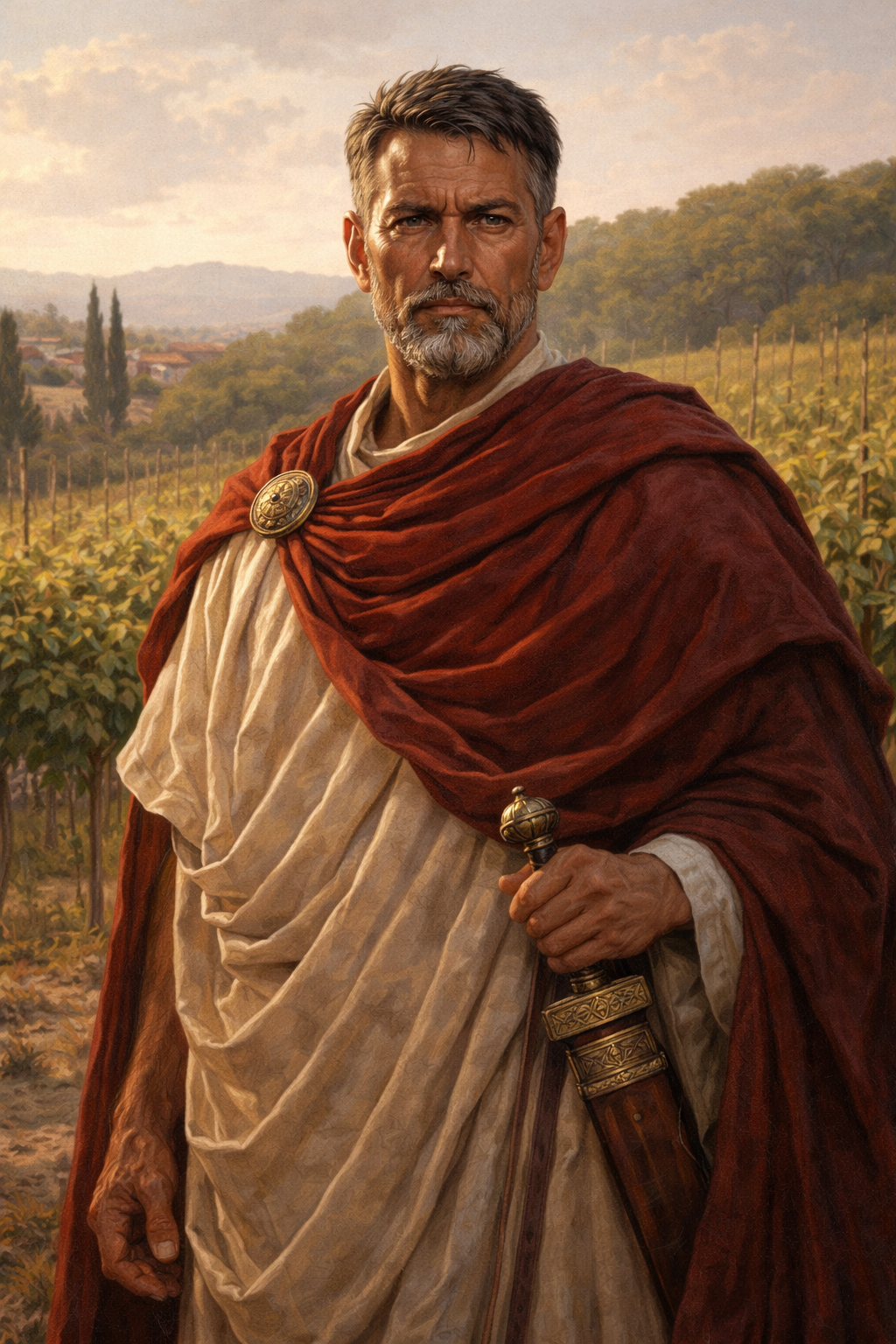
Dux Solariae
Fluent in Lingua Imperialis, with functional command of regional Solarian dialects and practical proficiency in the Brass Cities trade tongue, sufficient for border coordination and diplomatic exchange.

Comments