

Portus Vetus
“The city eats here first, before it eats anywhere else.”
Portus Vetus is the old harbour district of the New City, rebuilt and expanded after the Rift to meet the daily needs of a growing capital. Though its name speaks of age, its present form is the product of deliberate reconstruction, laid out to replace river facilities lost or rendered inadequate in the upheaval that followed the city’s transformation. Where Vicus Flumineus evolved through adaptation, Portus Vetus was planned for volume.
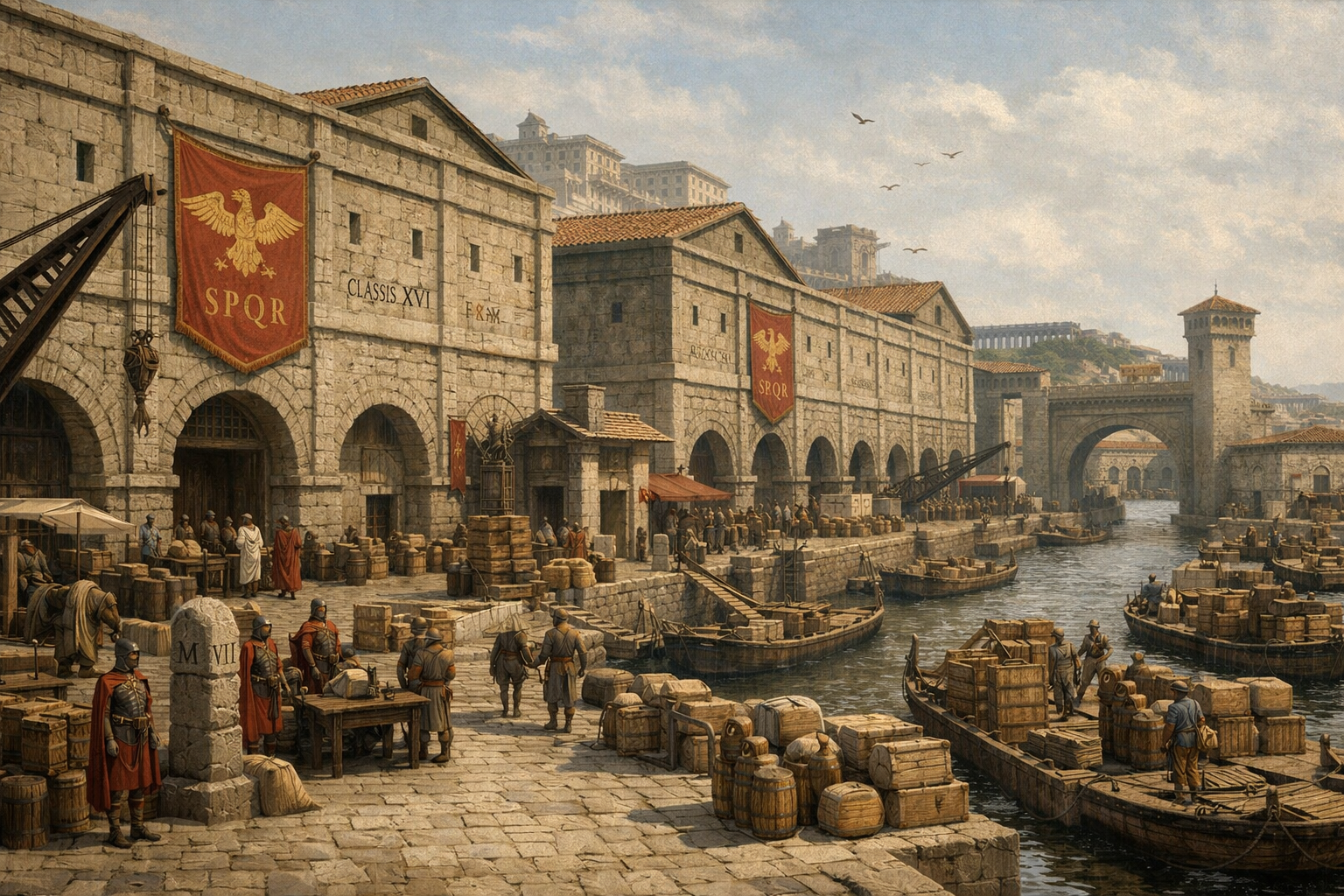
The district is centred on fisheries, river docks, warehouses, and food markets, forming the primary intake point for perishables entering Novaium by water. Boats arrive at all hours, nets are hauled in at dawn, and markets are busiest before most of the city wakes. The air is thick with sound and smell: shouting dockhands, gulls and river birds, wet rope, fish, smoke, and salt. This is not a place of ceremony or refinement, but of constant, visible labour.
Portus Vetus exists in close relationship with the river and in constant tension with it. Its quays and docks are engineered for speed rather than permanence, and its buildings prioritise access, drainage, and storage over comfort. Warehouses sit shoulder to shoulder with market halls and processing sheds, while modest housing clusters just beyond the loudest stretches of quay. Everything here is positioned to minimise delay between arrival, processing, and distribution.
Though firmly part of the New City, Portus Vetus retains a functional conservatism born of necessity. Methods persist because they work, not because they are old, and change is accepted only when it improves throughput or reliability. The district is essential, noisy, and unromantic, supplying much of Novaium’s daily sustenance and maintaining a vital link between the capital and the river trade that keeps it fed.
Demographics
Portus Vetus supports a large, working population defined by labour intensity and proximity to food supply rather than permanence or prestige. The district is home primarily to fishermen, dockhands, market porters, processors, coopers, salters, carters, and warehouse clerks, many of whom work irregular hours dictated by tides, catches, and delivery schedules. Households here are smaller and more transient than those of the Old City, shaped by seasonal demand and physical strain.
A significant portion of the population is semi-permanent. Crews follow river traffic, fishermen move between ports, and labourers arrive for peak seasons before drifting onward. Lodging houses, shared tenements, and employer-provided quarters dominate residential space, producing neighbourhoods where familiarity exists but deep-rooted lineage is rare. Stability comes from routine rather than inheritance.
The district is notably diverse. Non-human labour is common, particularly among dwarrow engaged in heavy handling, cold storage, and structural maintenance, and among traders from the Brass Cities involved in preserved goods and bulk food exchange. Elves appear less frequently but are present as factors, inspectors, or navigators rather than as residents. Integration is functional and immediate; usefulness and reliability matter more than origin or custom.
Wealth disparities are visible but narrow. A small number of fishmongers, warehouse masters, and distribution agents enjoy modest prosperity, while the majority live close to subsistence, their income fluctuating with supply and weather. Despite this, Portus Vetus maintains a strong collective identity rooted in shared dependence on the river and the markets it feeds. Here, people are known less by name than by role, and belonging is measured by contribution rather than tenure.
Government
Governance in Portus Vetus is direct, practical, and relentlessly focused on continuity of supply. The district falls under the authority of the Praefectus Urbi Novaii, but operational control is delegated to the Office of the Harbour and Markets, a civic body distinct from the River Prefecture that oversees Vicus Flumineus. Its mandate is narrow and uncompromising: food must arrive, be processed, and be distributed without interruption.
Officials of the Harbour Office maintain a constant presence across the docks, markets, and processing halls. Inspectors regulate weights, quality, and pricing, while clerks track intake volumes and allocate storage and distribution priorities. Authority is exercised openly and without ceremony; fines are issued quickly, licences suspended without prolonged appeal, and operations halted if standards are not met. In Portus Vetus, efficiency is treated as a civic obligation rather than a commercial virtue.
The city watch operates here in support of market order rather than general policing. Their role is to prevent theft, crowd disorder, and disputes over access to goods, particularly during peak market hours. Intervention is swift and often physical, reflecting the density and volatility of the district. River patrols coordinate closely with harbour officials to manage arrivals and departures, ensuring that food traffic is prioritised over less essential cargo.
Guilds and worker collectives are consulted where practical, but they do not govern. No single group is permitted to exert lasting control over markets or docks, a restriction enforced deliberately to prevent shortages, hoarding, or price manipulation. In Portus Vetus, authority is unapologetically civic, exercised in the open and justified by necessity.
Industry & Trade
Industry and trade in Portus Vetus are singular in purpose: to feed the city. Every activity in the district is oriented toward the rapid intake, processing, and redistribution of foodstuffs arriving by river. Fisheries, market halls, smokehouses, salting sheds, granaries, and cold storage facilities dominate the waterfront and its immediate hinterland, forming a tightly integrated system designed to minimise delay between arrival and consumption.
Fishing is the district’s defining industry. River craft unload catches daily, often before dawn, with fish sorted, cleaned, and sold or preserved within hours. Fresh produce moves directly to market, while surplus is salted, smoked, or packed for short-term storage and onward distribution. Supporting trades—net-mending, barrel-making, ice-cutting, and waste processing—operate continuously to sustain this cycle.
Trade in Portus Vetus is regulated, high-volume, and low-margin. Prices are controlled, weights enforced, and speculative holding discouraged by civic mandate. Merchants operate under licence and within strict quotas, ensuring steady flow rather than profit maximisation. Bulk goods such as grain, legumes, oils, and preserved meats pass through the district in vast quantities, destined for urban markets, military reserves, and institutional stores across Novaium.
Outbound trade exists but is secondary. Surplus preserves and processed foods are shipped upriver or exchanged with neighbouring settlements, yet such commerce is carefully balanced against domestic demand. In Portus Vetus, trade is never abstract; it is measured in meals delivered and shortages averted. The district’s economy does not seek growth or prestige—it exists to sustain life, reliably and without interruption.
Infrastructure
Infrastructure in Portus Vetus is engineered for volume, speed, and sanitation rather than durability or display. The district is laid out to move large quantities of perishable goods efficiently from river to market, with broad quays feeding directly into processing halls, storage complexes, and market spaces. Streets are wide where carts must pass and sharply functional where labour concentrates, allowing constant circulation even during peak hours.
The riverfront is heavily worked, lined with reinforced quays, unloading ramps, and shallow docks suited to fishing craft and supply barges. These structures are designed for frequent replacement rather than permanence, with timber decking and modular stonework that can be repaired or rebuilt quickly as wear demands. Drainage is extensive and visible, carrying waste and runoff back toward the river to prevent accumulation within the district.
Market infrastructure dominates the interior. Covered halls provide sheltered space for sorting and sale, while adjacent processing buildings house smokehouses, salting sheds, and cold storage. Many of these facilities are interconnected, allowing goods to move internally without returning to the street. Waste channels, wash stations, and refuse pits are distributed throughout, reflecting the district’s strict sanitary requirements.
Residential infrastructure is secondary and utilitarian. Lodging blocks and shared tenements are clustered away from the busiest quays, built for density and ease of maintenance rather than comfort. Public wells, cisterns, and communal facilities are numerous, positioned to support a workforce that operates at all hours.
Portus Vetus is fully integrated into the city’s logistical systems. Roads leading inland are reinforced to bear constant cart traffic, inspections are frequent, and maintenance is continuous. The district’s infrastructure is neither elegant nor enduring, but it functions with relentless efficiency, ensuring that the city is fed regardless of season, weather, or strain.
Guilds and Factions
Guild presence in Portus Vetus is extensive and openly acknowledged, reflecting the district’s role as the city’s primary centre for food handling and distribution. Fishermen’s guilds, porters’ collectives, coopers’ unions, and market stewards maintain a visible and structured influence, regulating labour, apprenticeships, and standards of practice. These organisations are pragmatic rather than ceremonial, concerned chiefly with throughput, reliability, and adherence to civic quotas. Their authority is tolerated—and reinforced—so long as supply remains uninterrupted.
Alongside these legitimate bodies operate looser associations whose boundaries are less clearly defined. Informal networks of labour brokers, tally-keepers, and warehouse runners facilitate the rapid movement of goods and information, smoothing inefficiencies that formal structures cannot always address. Such figures are known to officials, if not always recorded by name, and are often relied upon during periods of strain despite their ambiguous standing.
There are persistent murmurs, rarely spoken aloud, that certain flows through Portus Vetus do not always follow their recorded paths. Cargo occasionally arrives lighter than expected, manifests require quiet correction, and goods appear in inland markets sooner than logistics alone would suggest. No single organisation is ever named in connection with these irregularities, and no lasting evidence is permitted to accumulate. Oversight remains firm, yet selective blindness is sometimes practised in the interest of maintaining pace.
In Portus Vetus, influence belongs to those who understand movement—of goods, of labour, of opportunity. Whether through chartered guilds or less formal arrangements, power in the district is exercised obliquely, measured not by visibility but by how smoothly the city continues to eat.
History
As Novaium’s population expanded in the centuries following the Rift, the demands placed upon its river supply grew beyond anything the older docks could sustain. What had once been sufficient for a smaller city—adapted quays, mixed-use landings, and incremental expansion along the river—became a constraint rather than an asset. Shortages, congestion, and delays made clear that the capital’s survival could no longer depend solely on inherited infrastructure.
In response, the city undertook the deliberate construction of a new harbour complex beyond the confines of the Old City. This project became Portus Vetus, a planned expansion designed not for tradition or continuity, but for volume and resilience. Broad quays were laid, docks extended, and river access reshaped to accommodate constant arrivals of food and bulk goods from beyond the city’s immediate hinterland. Unlike earlier river districts, Portus Vetus was conceived as a logistical solution from its inception.
Around these new docks grew an ecosystem of support structures essential to sustaining a large urban population. Warehouses, granaries, curing sheds, and market halls were erected in rapid succession, followed by lodging blocks and service yards to house and supply the workforce required to keep the harbour operating. Roads were reinforced to carry uninterrupted cart traffic inland, binding Portus Vetus directly into the city’s distribution network.
Over time, the district proved indispensable. Periods of flood, poor harvest, or regional disruption repeatedly demonstrated that without Portus Vetus, Novaium could neither endure nor expand. While rarely celebrated and seldom beautified, the harbour’s reliability became one of the city’s quiet strengths. Portus Vetus did not shape Novaium’s identity, but it enabled its survival, standing as a testament to the Imperium’s willingness to build not only for power and prestige, but for the unglamorous necessities of life.
Points of interest
The heart of Portus Vetus is its expanded harbour basin, a dense concentration of quays, unloading ramps, and shallow docks designed specifically for fishing vessels and supply barges. This basin operates continuously, its activity peaking before dawn as the night’s catch and early shipments are brought ashore. The surrounding stonework bears the marks of constant use, patched and reinforced rather than replaced, and serves as the visual anchor of the district.
Immediately inland are the Great Market Halls, long covered structures where fresh produce, fish, and preserved goods are sorted and sold under civic supervision. These halls are among the busiest spaces in Novaium during the early hours, their floors washed daily and their operation governed by strict regulation of weight, quality, and price. Though unadorned, they are critical to maintaining order in the city’s food supply.
Adjacent to the markets stand the processing complexes—smokehouses, salting sheds, and cold storage blocks—whose chimneys, vents, and drainage channels define much of the district’s skyline. These facilities operate in close coordination with the docks, allowing surplus goods to be preserved quickly and redistributed as needed. Their importance lies in function rather than visibility, and they are treated as strategic assets by civic authorities.
Several long-established river taverns and lodging houses occupy the edges of the harbour and market streets. Known more for reliability than comfort, these establishments serve as informal gathering points for crews, porters, and traders, and are often where employment is arranged and information exchanged. While none are formally designated as civic spaces, their role in the district’s daily operation is widely understood.
Detailed accounts of individual docks, halls, processing sites, and riverfront establishments are maintained in their respective articles, where their histories, operators, and peculiar customs are recorded in full.
Tourism
Portus Vetus is not a district that welcomes tourism, nor is it presented as one. Those who enter it do so out of necessity rather than curiosity, drawn by trade, labour, or official duty rather than leisure. The district’s noise, smells, and constant motion offer little comfort to casual visitors, and no effort is made to soften or curate its character for external consumption.
Visitors who remain for any length of time are typically merchants, factors, inspectors, or scholars concerned with logistics and food supply. Their interest lies in observation rather than enjoyment, and their movements are constrained by regulation and schedule. Accommodation is functional and limited, provided by lodging houses intended for transient workers rather than guests seeking respite.
Occasionally, outsiders attend the district during moments of civic significance, such as inspections following poor harvests or the arrival of unusually large shipments. Even then, access is controlled and temporary. There are no guided routes, no commemorative markers, and no spaces set aside for spectacle.
Portus Vetus does not seek to be admired. Its value is measured in sustenance delivered and shortages avoided, not impressions made. For most visitors, the district is remembered less as a place than as a process—one that works relentlessly, whether or not it is observed.
Architecture
Architecture in Portus Vetus is unapologetically utilitarian, shaped by necessity rather than legacy. Buildings are broad, heavy-set, and functional, constructed to endure moisture, weight, and constant use rather than to convey prestige. Stone and treated timber dominate, with surfaces left plain and edges reinforced where wear is expected. Ornamentation is minimal, limited to civic marks, ownership sigils, or structural numbering required for regulation.
Warehouses and storage halls form the district’s primary mass. These structures are long and low, with wide doors, internal ramps, and reinforced floors designed to support bulk goods and rapid turnover. Many are fitted with internal hoists, suspended beams, and drainage channels, allowing goods to be moved, preserved, and cleared with minimal delay. Rooflines are practical, often vented to release smoke or heat from processing within.
Quays and dock structures are integral to the district’s architecture rather than adjuncts to it. Stone embankments, stepped landings, and timber decking define the river edge, punctuated by cranes, winches, and unloading frames. These elements are repaired constantly and replaced without ceremony, resulting in a patchwork of construction phases that reflect function over uniformity.
Residential architecture exists primarily at the margins of the district. Tenements and lodging blocks rise behind the industrial frontage, built for density and durability rather than comfort. Merchant houses, where present, are sturdier and slightly more refined, combining living quarters with offices and secure storage, their size indicating status more clearly than decoration.
Overall, Portus Vetus presents an architecture of work. Its buildings are designed to move goods, shelter labour, and withstand the river’s demands, bearing visible marks of use and repair. The district’s appearance communicates its purpose immediately: this is a place built to feed a city, not to impress it.
Geography
Portus Vetus occupies a broad, low-lying stretch of the river’s edge within the New City, where the land flattens and widens enough to support large-scale harbour works. The river here runs steady and accessible, its banks shaped and reinforced to accommodate constant docking and unloading rather than natural flow. This geography makes the district uniquely suited to volume handling, but also renders it closely tied to the river’s temperament.
The shoreline has been almost entirely engineered. Natural banks have been replaced with stone quays, ramps, and embankments that extend the usable edge of the river, creating long, uninterrupted stretches of working frontage. Minor inlets and former channels have been filled or redirected, leaving only subtle irregularities in the quay line to hint at the river’s earlier course.
Inland, the terrain rises gradually toward the rest of the city, allowing runoff and refuse to be directed away from residential areas and back toward controlled drainage systems. This gentle incline supports the district’s layered layout, with docks and processing facilities closest to the water, warehouses and markets set just behind, and lodging and service buildings further inland.
Portus Vetus’s geography makes it indispensable and exposed in equal measure. Its openness to the river enables the flow of food and supplies that sustain Novaium, but it also places the district at the mercy of flooding, weather, and seasonal change. As a result, the landscape here is one of constant adjustment, shaped as much by civic intervention as by the river itself.
Climate
Portus Vetus experiences the same temperate climate as the rest of Novaium, but its low elevation and direct exposure to the river give the district a harsher, more demanding character. Moisture is a constant presence. Morning fogs frequently rise from the water, clinging to the docks and market streets well into the day, while damp air settles heavily among warehouses and processing halls.
Summers are warm and humid rather than oppressive, with heat amplified by stone quays and crowded structures that retain warmth long after sunset. Work begins early to avoid the worst of the day, and the smell of fish, smoke, and river water becomes more pronounced as temperatures rise. River breezes offer limited relief, often carrying dampness inland rather than cooling it.
Winters are mild but persistently wet. Rainfall is frequent, and cold winds off the river cut through the district, making conditions uncomfortable even without severe cold. Flood risk increases during seasonal surges, and civic crews remain on constant alert to reinforce embankments and clear drainage channels.
Life in Portus Vetus is shaped by this climate through habit rather than mitigation. Buildings are designed to shed water, routines adjust to weather rather than resist it, and the workforce accepts discomfort as part of the district’s function. The climate here is not an adversary to be conquered, but a condition to be endured in service of the city’s survival.

Comments