

Marcus Valerius Draconis
“A commander stands where the line is weakest, or he is no commander at all.”
Magister Legionum (a.k.a. Draco Imperii)
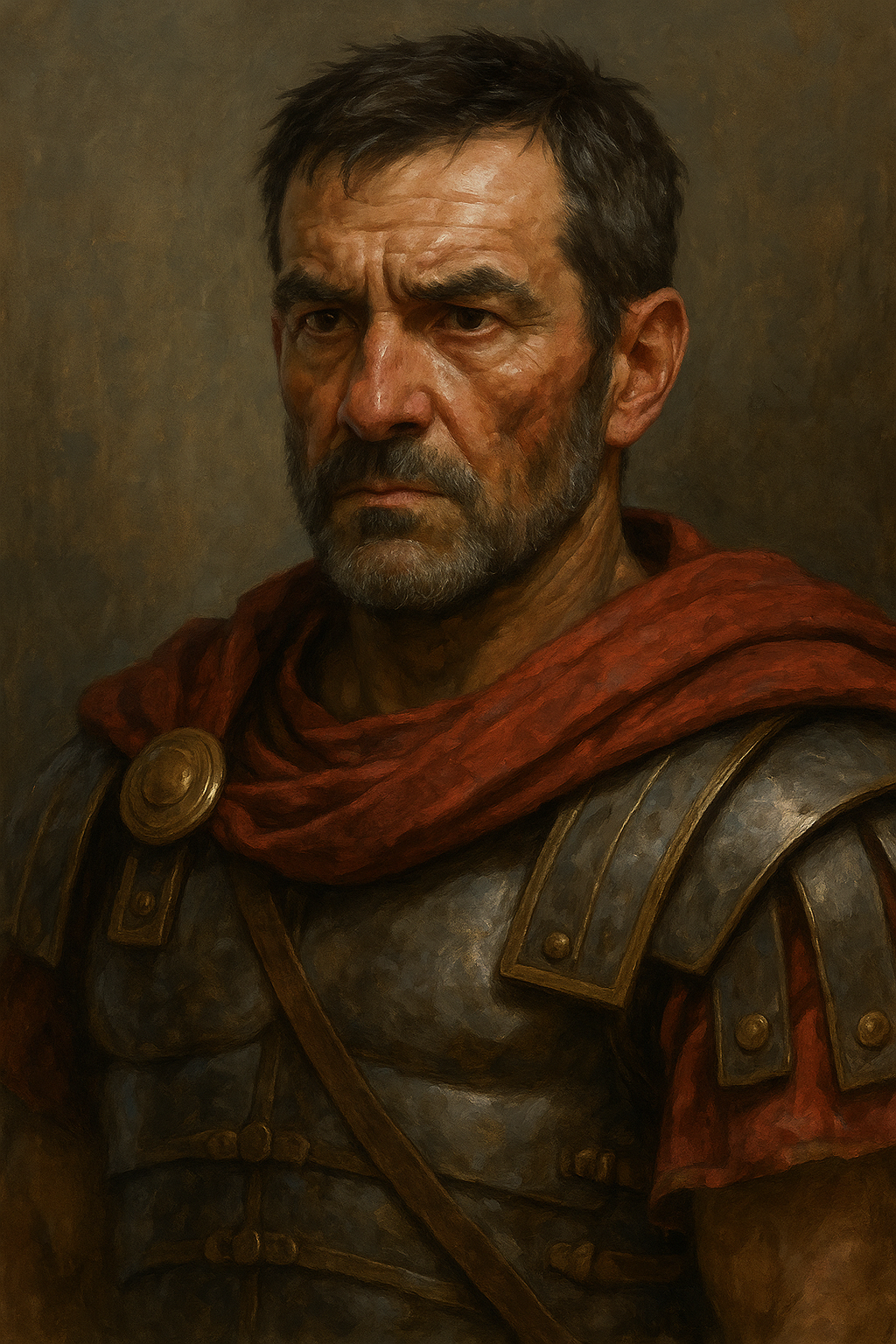
Marcus Valerius Draconis, current Magister Legionum of the Imperium Novum, stands as the most accomplished battlefield commander of his generation and the living embodiment of the legions’ martial ethos. Born without noble pedigree and raised far from the courts of Novaium, Draconis forged his reputation the only way a common man could: through unbroken discipline, years of frontier service, and an instinct for command that grew sharper with every campaign.
He entered the legions as a nameless recruit and rose, slowly but relentlessly, through each rank—legionary, optio, centurion, primus pilus, tribune—earning every step in blood and frost along the Empire’s northern marches. Where others sought glory in the Senate or influence in the Collegium, Draconis carved his future against the Warborn, whose raids and border wars hardened him into the general the Imperium now depends upon.
Draconis’ leadership style is as unmistakable as it is effective: direct, unsentimental, unyielding. He sees war not as a theatre for heroics but as a calculus of clarity and consequence. His soldiers adore him because he asks nothing of them he does not demand of himself; the Senate tolerates him because the Empire’s borders hold firm under his watch; and the Emperor values him because his loyalty has never faltered.
Yet Draconis remains, in essence, a soldier—not a courtier, not a politician, not a mythic figure of the Aurellian mould. He moves through the halls of power like a man passing through unfamiliar terrain: cautious, terse, disinterested in pomp. But in the camps, on the training fields, and along the frostbitten watchtowers of the North, he is legend—the general who never asks his men to stand anywhere he has not stood first.
His career is a testament to the rare truth that in the Imperium Novum, greatness can still be earned, even by those not born to it. And as long as the frontiers remain precarious, the Empire will continue to look to Marcus Valerius Draconis—its iron sentinel, its loyal blade, its unshakable commander.
Physical Description
General Physical Condition
Draconis carries the unmistakable physique of a man carved by long service on the frontier. Broad-shouldered, thick-armed, and built with the enduring strength of a career infantryman, he possesses none of the polished elegance of court-trained officers. His body reflects decades of campaigning against the Warborn: old bruises made into callus, muscle earned through necessity, and a gait shaped by years of marching frozen roads rather than parade grounds.
Though no longer young, he retains the stamina of a battlefield commander. He rides hard, drills with his centurions, and keeps the same physical expectations of himself that he demands of his soldiers. Age has introduced stiffness to one knee and a deep ache in the ribs from an old Warborn hammer-blow, but neither slows him—he moves with the quiet, implacable momentum of a man who refuses to acknowledge deterioration.
Observers often remark that Draconis looks permanently battle-ready. He stands like a shield-wall—solid, immovable, deliberate. His presence is not explosive but steadying: the physicality of a man who has survived storms, held lines that should have broken, and learned early that command begins with the endurance to remain standing when others fall.
Identifying Characteristics
The most recognisable of his scars runs across his right forearm: a deep, jagged wound left by a Warborn axe during the Raid on Ushbar, when Draconis led a pursuit force across the border to free a dozen captured legionaries and civilians. The Warborn shock-trooper who struck him nearly severed the arm, but Draconis fought through the blood and pain long enough to break the palisade and secure the hostages.
The scar became a symbol among his soldiers—not of injury, but of the day a common-born centurion defied orders, saved Imperial lives, and razed a Warborn settlement with nothing but thirty legionaries and his own refusal to retreat.
Apparel & Accessories
Draconis dresses like the soldier he has always been. Even as Magister Legionum, he rejects the ornate parade uniforms favoured by senatorial generals, preferring the practical attire of a man who expects to be on a horse or in a trench within the hour.
His most recognisable garment is his frontier-worn legionary cloak, a heavy, dark-red wool mantle bleached unevenly by northern winds. Its edges are frayed, repaired many times with field stitching—visible reminders that Draconis has spent more winters on the border than in Novaium. Unlike many commanders, he refuses to replace it, remarking once that “a new cloak has nothing to say about a man.”
Beneath the cloak he wears a modified officer’s cuirass, reinforced with thicker plates over the ribs and shoulders—an unofficial adaptation developed after a Warborn hammer-blow nearly crushed him at Ushbar. The armour is meticulously maintained but unadorned, the metal dulled by repeated polishing rather than decorated by artisans. Soldiers say you can tell Draconis’ armour from any other by the distinctive cross-grain scraping along the breastplate, the mark of years spent on campaign rather than in ceremony.
He carries at nearly all times a centurion’s vine-staff—not the ornate baton of high command, but the traditional, knotted staff used historically for discipline and signalling in the ranks. In his hands it is less a symbol of authority than a tool: he uses it to point out weak spots in formations, to measure distances in the dirt, or to rap sharply against shields during drills.
Draconis keeps no jewellery save a simple bronze torque, awarded after the Raid on Ushbar by the survivors he rescued. The torque is dented, uneven, and of crude construction, forged quickly by grateful hands. He wears it only during battlefield inspections, believing it a reminder of why rank exists at all.
At his belt hangs his old legionary gladius, the same blade he carried as a common soldier. The grip has been rewrapped half a dozen times, the pommel lightly chipped from years of field use. Officers have attempted to gift him ceremonial weapons, but he refuses them all. The legions tell a story—possibly apocryphal—that Draconis once returned a gilded sword to a senator with the words: “This blade has never lost a man. I cannot say the same for yours.”
Even in full regalia, Marcus Valerius Draconis looks less like a lord of the Empire and more like its sentinel—armoured not in splendour, but in the credibility of a life lived on the line he asks others to hold.
Mental characteristics
Education
Draconis received none of the classical education afforded to senatorial sons or rising bureaucrats. His schooling began in the informal, uneven fashion common to frontier-born families: basic literacy taught by a retired legion clerk, practical arithmetic learned at his father’s market stall, and a rudimentary grounding in Imperial law delivered by whichever travelling magistrate passed through the settlement that season. What he lacked in refinement he compensated for with an early and voracious appetite for clarity—he preferred facts to theory, instruction to abstraction, and lessons with immediate purpose.
His true education began the day he entered the legions.
As a fresh recruit, Draconis learned discipline through repetition: formation drills at dawn, shieldwork until his arms shook, evenings spent memorising command signals and battlefield geometry. He absorbed every scrap of knowledge he could from veteran centurions—how to read hostile terrain, how to march a cohort without bleeding morale, how to spot weakness in an enemy line before it breaks. Older soldiers joked that Draconis “studied war the way priests study scripture,” and the comparison was not far from the truth.
During his rise through the ranks, he sought out mentors not for patronage, but for instruction. He shadowed supply officers to understand logistics, learned from engineers how to assess fortifications, and sat quietly beside map tables long before he had any right to be there. He acquired a working knowledge of Warborn dialects through necessity rather than scholarship, often by interrogating prisoners himself.
By the time he reached the rank of centurion, Draconis had developed an education more rigorous than many academy graduates—an education born not of privilege, but of survival. His later promotion to tribune and ultimately Magister Legionum did not change his habits: he still reads field reports with a recruit’s intensity, still insists on attending tactical lectures given to junior officers, and still believes that a commander’s mind must stay as sharp as his blade.
Though historians occasionally remark on his lack of classical polish, few question the depth of his practical learning. Draconis is not a scholar of the old Imperial schools; he is a scholar of the field, of the frontier, and of the hard lessons that shape a man forged in the Empire’s coldest classrooms.
Employment
Draconis’ career reflects the slow, grinding rhythm of a frontier defined not by grand wars, but by ceaseless tension and blood-soaked skirmishes. He enlisted as a nameless recruit in the 9th Cohort, one of the hardest regiments stationed along the northern marches, where the Warborn raids were frequent enough to shape a soldier’s life yet never large enough to spark a true campaign.
He rose quickly through the ranks, not through dramatic victories but through the quiet, relentless competence demanded in a theatre where vigilance mattered more than glory. As a legionary, then optio, and eventually centurion, Draconis became known for his steadiness under sudden violence—midnight raids, ambushes in frozen ravines, hit-and-run strikes that tested readiness more than strategy.
His defining early action was the Raid on Ushbar, when he led a pursuit force across the border after a Warborn strike abducted legionaries and civilians. Draconis’ decision to cross into enemy territory without waiting for formal sanction was a calculated breach of protocol. The strike was swift and brutal: the captives were freed, the raiding warband annihilated, and the settlement of Ushbar razed to prevent its continued use as a staging point.
The Senate issued a formal reprimand.
The Emperor issued a commendation.
The legions remembered the result.
Promoted to primus pilus, and later tribune, Draconis transitioned from the raw immediacy of the line to the tactical demands of frontier command. Here, he excelled. His strategies were not meant for open battles—they were built for attrition, anticipation, and reading the pulse of a hostile border. He developed new rotation schedules for watch-forts, refined rapid-response protocols, and established a now-standard pattern of overlapping patrols that dramatically reduced the success of Warborn raids.
Upon the death of the previous Magister Legionum, it was the legion commanders who first named Draconis as successor. The Senate hesitated at elevating a common-born officer to the Empire’s highest military post, but the Emperor—mindful of the northern frontier’s importance—confirmed the appointment.
As Magister Legionum, Draconis’ leadership has been defined not by victories in open war, but by the absence of catastrophe. Under his oversight, raids decreased, supply routes stabilised, and frontier morale strengthened. He is, above all else, the man who keeps the Empire’s most volatile border from becoming a battlefield—and in a world of unpredictable threats, such steadiness is its own form of triumph.
Accomplishments & Achievements
Draconis’ legacy is not built on sweeping campaigns or conquered territories, but on something far rarer: the sustained stability of a frontier that should, by all accounts, have collapsed centuries ago. His achievements lie in discipline, vigilance, and a mastery of the northern marches that has kept the Imperium secure through countless small crises no historian could ever fully catalogue.
His first great mark upon the Empire came with the Raid on Ushbar, an operation now studied in officer academies as an example of decisive clarity in a theatre defined by hesitation. When a Warborn raiding party abducted Imperial citizens and fled across the border, Draconis led a pursuit force without waiting for formal orders. His strike was swift and merciless: twelve captives freed, the raiders annihilated, and the settlement razed. The Senate considered it reckless; the legions considered it leadership. The Emperor quietly agreed. Ushbar became the moment Draconis stepped out of obscurity.
As he rose through the ranks, Draconis transformed frontier defence from a patchwork of isolated forts into a coherent strategic system. He implemented overlapping patrol rotations, restructured winter rations and supply lines, and established the now-standard practice of rapid-deployment strike cohorts stationed at key border nodes. These reforms drastically reduced the frequency and success of Warborn raids, turning a volatile frontier into a region defined by resilience rather than crisis.
Draconis is also credited with revitalising the Watch-Fort Ring, a network of ageing outposts whose decline had long troubled military planners. Under his oversight, they were rebuilt, resupplied, and reorganised into a synchronised command lattice that allows information to travel faster along the border than at any previous time in Imperial history.
Among the legions, perhaps his most revered achievement is cultural rather than structural: he restored a sense of shared identity and pride to frontier cohorts who had grown accustomed to being overlooked by the political centre. Draconis leads from the ground, drills with his soldiers, walks their frostbitten ramparts, and ensures that every cohort—no matter how remote—believes its service essential to the Empire’s survival. Morale, discipline, and recruitment surged during his tenure, a phenomenon legion historians call the Draconian Renewal.
And though he never sought political influence, Draconis nevertheless reshaped the Senate’s approach to military affairs. His blunt testimony, drawn from decades of experience rather than theory, steered policy toward practical needs: better funding for frontier logistics, improved medical support for isolated forts, and the establishment of clearer protocols for post-raid reconstruction.
Yet the achievement most often attributed to him is both simple and profound:
Under his command, the northern border has not broken once.
In a world defined by unpredictable threats and ancient grudges, such consistency is as rare as victory in open war. Draconis is not celebrated as a conqueror, for he has never needed to be one; he is revered as the general who ensures the Empire wakes each dawn unburned, unbroken, and unafraid.
Failures & Embarrassments
For all his discipline and clarity of command, Draconis carries a small litany of failures that cling more tightly to him than any official commendation. None were catastrophic, but each left its mark—on his record, on his conscience, or on his standing among the political elite.
His earliest and most oft-whispered embarrassment is the Incident at Brukh Pass, where an inexperienced Draconis, then an optio, misread the aftermath of a Warborn raiding spoor and led his patrol into a dead-end ravine. Four legionaries were injured in the retreat, and one lost fingers to frostbite after Draconis ordered a night march in sub-zero winds to escape encirclement. Though his centurion judged the mistake a consequence of inexperience rather than negligence, Draconis returned to the fort with a bitterness he carried for years. It became the first lesson in a career-long obsession with reading terrain correctly.
A more politically damaging failure came years later, when as a seasoned centurion he attempted to reorganise the watch schedules of Fort Kaelrun without securing approval from the fort’s patrician-born tribune. The resulting confusion caused a twenty-minute gap in perimeter surveillance—exactly long enough for a Warborn scout-band to slip within sight of the walls before being detected. No harm was done, and the raiders withdrew, but the Senate seized upon the incident as evidence of Draconis’ “habitual insubordination.” Draconis never denied the accusation; he simply pointed out that the new schedule would have caught the raiders earlier had it been implemented on time.
His third failure, and the one he speaks of least, occurred during the Deepwinter Silence—a long, bleak season where raids ceased entirely. Draconis assumed (incorrectly) that the Warborn were suffering internal hardship, and he reduced long-range patrols to preserve manpower. The Warborn had not weakened; they were preparing. When the raids resumed in spring with unprecedented coordination, several northern farmsteads were burned before the legions could respond. Draconis held himself personally responsible, though the Senate declared it an unavoidable misjudgment. Soldiers recall finding him at dawn the next morning, sketching new patrol grids in the frost with the tip of his vine-staff.
And yet his most enduring embarrassment is not tactical at all—it is social. Draconis remains famously ill-suited to the etiquette of Novaium. He once addressed a senator by rank instead of title, and on another occasion dismissed a ceremonial parade as a “waste of good soldiers and good daylight.” These breaches of decorum have earned him a collage of senatorial complaints, none of which have managed to diminish his standing among the legions. When confronted, Draconis typically responds with a shrug and the same dry phrase:
“If they want better manners, they should send a different general.”
These failures, rather than tarnish him, have become part of his mystique. They reveal a commander whose strength is born not of perfection, but of relentless adaptation—one who learns quickly, corrects decisively, and refuses to allow pride to cloud his judgement. If the Senate finds him abrasive and the legions find him infallible, it is because Draconis is, in truth, something far rarer: a man whose flaws sharpened him rather than broke him.
Mental Trauma
Draconis carries his traumas the way he carries his armour: silently, functionally, and without expectation that anyone else should bear their weight. They do not weaken him, but they shape his internal landscape with a severity that few outside the legions ever glimpse.
The earliest and most lingering wound comes from the Deepwinter Silence, the season when Warborn raids ceased for months. Many celebrated it as a omen of peace; Draconis did not trust it. When the raids resumed with sudden precision, several outlying homesteads were destroyed before the legions could intervene. Though investigations later concluded that no reasonable commander could have predicted the shift, Draconis internalised the failure with brutal clarity. He keeps, tucked into the inside lining of his cloak, a small strip of scorched leather taken from one of the burned farmsteads—a reminder, he claims, to “expect the worst even from quiet.”
The Raid on Ushbar, though remembered as his defining triumph, left deeper marks than the scar on his arm. Draconis has never fully reconciled with the violence required that night: the necessity of razing a settlement, the knowledge that civilian lives may have been lost in the chaos, and the fact that no soldier under his command hesitated to follow him into an action outside the law. He never speaks of the rescued captives with pride; he speaks, instead, of the nine soldiers wounded in the assault and the one who died of his injuries weeks later. His refusal to glorify Ushbar is one of the reasons the legions respect him—and why he sometimes wakes from sleep with his right hand clenched into a fist.
Long service on the northern frontier has also carved invisible lines into him. Draconis has seen more abandoned watchposts, more frostbitten casualties, more border graves than most senators could bear to imagine. He forgets none of their faces. Subordinates note that he has a habit of recounting the names of the dead when alone, as though reciting a litany. Whether this is ritual, coping, or simple remembrance, no one has ever had the courage to ask.
Perhaps the deepest wound, however, is the trauma he refuses to name: the fear that one day the line will break—not because the legions fail, but because he does. Draconis lives with the constant, unspoken dread that a single misjudgment could undo decades of hard-won stability. This fear does not paralyse him; it fuels him. But it has hollowed something inside him, a quiet space where doubt and duty grind against one another without resolution.
To the Senate, he appears hard and unemotional.
To the legions, unshakeable.
But to those few who see the truth, Marcus Valerius Draconis is a man who has absorbed the frontier’s long cruelty into his own bones—and who continues to stand not because he is unhurt, but because he refuses to fall.
Intellectual Characteristics
Draconis possesses an intellect honed not in academies or senatorial debate chambers, but in the brutal, slow education of the northern marches. His intelligence is fundamentally pragmatic—a soldier’s mind sharpened into a strategist’s tool by long exposure to uncertainty, shifting terrain, and enemies who rely on unpredictability rather than doctrine.
He thinks in patterns of movement: the angle of a valley floor, the rhythm of raids across a season, the way a Warborn warband scatters when pressed too hard, or gathers when given too much space. Officers describe his mind as “weathered”—not worn down, but trained to read the subtle signs of impending danger the way a farmer reads the sky. It is said that Draconis can stand on a ridge for two minutes and predict the next twelve hours of battlefield possibility.
Draconis has little patience for abstract theory. He values clarity, function, and consequences. In council meetings he is known for stripping arguments down to essentials, asking blunt questions that cut through politics like a blade: What does it cost? Who carries the risk? What happens if it fails? This directness unsettles senators unused to being confronted so plainly, but among officers it is considered a virtue bordering on a creed.
Despite lacking classical rhetorical polish, Draconis possesses a sharp analytical instinct. He remembers details with unsettling precision—supplies consumed, patrol routes missed, the exact wording of commands issued months prior. This memory, combined with his relentless habit of reevaluating old mistakes, forms the backbone of his strategic clarity. He is not innovative in the academic sense, but he is ruthlessly adaptive, able to pivot instantly when a situation demands it.
His emotional discipline is often mistaken for coldness. In truth, Draconis feels deeply, but he places duty before sentiment in every calculation. He has mastered the difficult art of making swift decisions without allowing guilt or fear to cloud them—yet he carries the weight of those choices privately, in silence. This internal tension fuels his perfectionism, his harsh self-scrutiny, and his relentless drive to improve the legions’ readiness.
Perhaps the most remarkable aspect of his intellect is his intuitive rapport with soldiers. Draconis understands how fear travels through a cohort, how exhaustion erodes judgement, and how morale can hinge on the smallest gesture from a commander. He reads men as readily as he reads maps, recognising when a centurion is pushing too hard, or when a green recruit needs a simple, steady word.
Senators consider him blunt.
Scholars consider him unrefined.
But the legions know the truth:
Marcus Valerius Draconis is one of the Empire’s sharpest minds—
not because he was taught,
but because he learned.
Morality & Philosophy
Draconis’ moral philosophy is the product of a lifetime spent on the border, where laws exist only as far as a commander can enforce them, and where hesitation costs lives long before politics ever notices the loss. His worldview is built on three pillars: clarity, responsibility, and consequence.
At the heart of his morality lies a simple conviction:
“If you command it, you own it.”
To Draconis, leadership is not a privilege but a burden—one that demands ruthless honesty with oneself. He believes a commander must never hide behind orders, bureaucracy, or circumstance. Any life lost under his authority is his to account for. This belief drives his relentless self-scrutiny and explains why he is harsher with his own mistakes than with those of his subordinates.
He values practical justice over theoretical purity. Draconis distinguishes sharply between malice and misjudgment. A soldier who errs in confusion is retrained; a soldier who endangers others through negligence faces consequences. His punishments are firm but consistent, rooted in the belief that discipline is not cruelty, but protection—especially for the inexperienced.
Draconis rejects idealism in all its forms. He mistrusts lofty rhetoric, philosophical abstraction, and senatorial speeches about “greater visions.” In his experience, the Empire survives not because of visionaries, but because men and women wake before dawn, march into cold wind, and hold the line without complaint. He has no patience for moralising disconnected from reality. A choice is either effective, or it endangers lives; anything else is posturing.
Yet beneath this hardened simplicity lies an unexpected thread of compassion. Draconis has an instinctive respect for ordinary citizens—farmers, caravaners, frontier settlers—whose lives are shaped by decisions made far from their world. His reforms often prioritise their safety over political favour, earning him a reputation in the northern provinces as a soldier who “remembers who suffers first.”
His philosophy toward the Warborn is similarly pragmatic. He neither demonises nor romanticises them. He sees them as a rival people with their own codes, dangers, and needs. He does not seek their extermination, only predictability. The frontier, he believes, is not a place of hatred—it is a place of boundaries. Peace is possible, but only if each side understands and respects the consequence of crossing those boundaries.
Perhaps the clearest distillation of his moral worldview comes from a remark he once made to a junior officer who questioned the ethics of pursuing raiders across the border:
“Right and wrong are luxuries of safe places. Out here, we choose between what protects the living and what does not. Choose well.”
Draconis is not a philosopher in the classical sense. But the philosophy he embodies—unyielding responsibility, disciplined compassion, and moral clarity forged in hardship—has shaped generations of officers who see in him a reminder that the Empire’s survival depends not on heroes, but on those willing to bear the cost of keeping it steady.
Personality Characteristics
Motivation
At his core, Draconis is driven by a single, unwavering conviction: the frontier must never fail on his watch. Everything else—rank, reputation, comfort, politics—is secondary to this purpose. He has spent his entire adult life on the northern marches, and in that crucible he learned a truth that has shaped his every decision: the Empire endures only as long as someone is willing to stand where it is most vulnerable.
His motivation is therefore not ambition, legacy, or personal pride. It is duty, in its most austere form. Draconis believes that the lives of thousands hinge on the discipline and readiness of the legions, and it is this belief that drives him to rise before dawn, to inspect forts personally, to scrutinise reports until the lines blur, and to demand excellence not out of ego, but necessity.
He is deeply motivated by responsibility to ordinary citizens—those whose farms lie within a day’s ride of the border, whose caravans risk narrow passes, whose safety depends on soldiers they will never meet. Draconis carries their vulnerability with him like a second pack, a weight he refuses to set down. It is for them, more than for the Senate or the Emperor, that he sharpens the frontier into a shield.
A quieter, more personal motivation lies beneath his hardened exterior: the desire to ensure that no soldier under his command meets the fate of those he could not save in his youth. The scars of the Deepwinter Silence and the memory of failures he cannot forget imbue his leadership with urgency. He is driven by the fear—not of dying, but of failing those who trust him to keep them alive.
Draconis is also propelled by a kind of moral defiance toward complacency. He cannot abide the notion that the frontier is “quiet enough” or that centuries without open war justify laxity. To him, peace is not a natural state—it is a temporary victory, maintained only through vigilance. His motivation is to preserve that hard-won peace through preparation rather than hope.
Yet above all, Draconis is motivated by something uniquely simple:
he is the Empire’s shield, and a shield exists to be struck.
He stands because someone must.
He endures because he believes the Empire cannot afford for him not to.
And while he rarely speaks of purpose in philosophical terms, those who serve beside him know the truth:
Marcus Valerius Draconis is a man who wakes each day ready to bear the weight that others cannot—because to him, there is no greater calling.
Likes & Dislikes
Draconis’ preferences are as unadorned and practical as the man himself, shaped by decades of frontier duty and a life lived far from the comforts of Novaium.
He has a deep appreciation for routine and structure, finding a kind of quiet solace in predictable rhythms: morning drills, the clatter of armour being checked, the familiar weight of a cloak against northern wind. To him, order is not mere discipline—it is reassurance that the world is still holding together. He enjoys long marches, especially those taken in silence, where the beat of footsteps and the crunch of snow under boots provide the only conversation he needs.
He holds a particular fondness for frontier nights, when the fires burn low and the men settle into a steady calm. In those moments, when the watch rotates smoothly and the land lies quiet, Draconis feels something close to peace. He also enjoys mapping terrain—a habit that began as a necessity and became a contemplative practice. His quarters are littered with hand-drawn sketches of valleys, passes, and ridgeline views.
His palate is equally pragmatic: simple stews, hard bread, smoked meat, and clean water. He distrusts elaborate dishes and refuses wine unless offered in formal courtesy. Officers joke that Draconis considers anything with more than three ingredients a decadent risk.
Conversely, Draconis harbours a strong dislike—bordering on irritation—for ceremony and empty formality. He finds parades wasteful, senatorial speeches tedious, and any attempt to embellish military tradition with pageantry dangerously close to making soldiers forget their purpose. He is equally disinterested in luxury: he avoids ornate clothing, refuses decorative weapons, and once reportedly removed gilding from a command tent because it “reflected light like a beacon.”
He has little patience for political manoeuvring, especially the kind done for personal advancement rather than the Empire’s security. Senators who speak in abstractions or disguise indecision behind rhetoric draw from him a level stare that makes lesser men reconsider their arguments.
More subtly, Draconis dislikes complacency in all its forms. He grows restless when the frontier goes too quiet for too long and visibly bristles when officers assume a lull means safety. To him, a calm border is not a comfort—it is a warning.
But his sharpest aversion is reserved for waste—of time, of resources, of lives. Nothing angers him faster than carelessness that endangers others. In this, as in all things, Draconis’ preferences reveal a man shaped by necessity: one who values what keeps people alive, and discards anything that distracts from that purpose.
Social
Contacts & Relations
Draconis moves through the Empire’s institutions like a stone through deep water—felt, respected, but never fully part of the currents that swirl around him. His affiliations are shaped not by pedigree or patronage but by decades of trust earned on frozen ramparts and wind-scoured watchtowers.
His strongest and most enduring bonds lie with the legions themselves. Draconis maintains close, almost familial ties with the centurionate: veteran officers who served alongside him in the years before Ushbar, many of whom he personally promoted. Within this tight-knit circle, his word carries the quiet authority of shared hardship. They are his advisors, his critics, and—on the frontier—often the only voices he permits to challenge him.
His relationship with the Magisterial Staff and Military Engineers is equally strong. Draconis has long respected the logistical backbone of the frontier, consulting engineers on fortification design and the placement of new watch-towers. These collaborations are marked by mutual pragmatism; the engineers trust Draconis to use their work wisely, and he trusts them to tell him the unvarnished truth.
With the Senate, his relations are more complex. A number of senators respect him for the stability his command has brought, particularly those representing northern provinces that know the value of his vigilance. But others view him with thinly veiled discomfort—a common-born soldier elevated to one of the highest offices in the Imperium, blunt in speech, unversed in political courtesies, and impossible to manipulate. Political allies call him dependable; political opponents call him dangerously unpolished. Draconis calls them all “distractions.”
His most important institutional relationship is with the Emperor. While not personally close, Draconis and the Emperor share a linguistic shorthand of trust built on results, not flattery. The Emperor values Draconis for his consistency and his refusal to cloak military realities in comforting language. For his part, Draconis respects any ruler who listens more than he speaks. Their audiences are brief, pointed, and productive—praised by military historians as models of clarity between sovereign and soldier.
Outside formal structures, Draconis maintains a limited but significant rapport with several frontier governors and provincial wardens, most of whom rely on his assessments to guide civilian defence measures. These relationships are defined by mutual interdependence rather than personal affinity; Draconis protects their people, and they provide him with the resources necessary to keep the line intact.
Notably, Draconis has no meaningful alliances with noble houses, no ties to influential academies, and no entanglements with the Collegium Arcanum beyond the occasional exchange of intelligence. He is a man whose loyalty is given to the Empire’s safety, not its politics.
In every sphere of influence, Draconis stands apart—respected by those who value results, distrusted by those who rely on decorum, and quietly revered by soldiers who know that as long as he holds command, the northern horizon remains just a little less dark.
Family Ties
For much of his life, Draconis was considered a man married only to the frontier. His early decades in the legions left little room for companionship, and he spent most of his youth and early adulthood moving between outposts where long-term ties were a luxury few could afford. Officers assumed he would die a bachelor, survived only by the soldiers who shared his frozen campaigns.
This expectation changed in the later years of his rise through the ranks, when Draconis met Livia Serina, a healer attached to the northern supply route. Their relationship surprised many—Livia was quiet where he was blunt, measured where he was decisive, and possessed a warmth that the frontier rarely afforded its inhabitants. They married in a modest ceremony at Fort Kaelrun, attended not by senators or nobles, but by soldiers who had served with Draconis since his earliest campaigns.
Their marriage was one of steady companionship rather than dramatic romance. Livia tempered his harsher instincts, encouraged him to sleep more than a few hours a night, and insisted that even a commander needed moments of stillness. Those close to Draconis observed that she was one of the only people capable of persuading him to leave the map table and eat a proper meal.
Their son, Valerius Draconis Minor, entered the world in the early years of Draconis’ tenure as tribune. From the beginning, Draconis refused to let the boy grow up under the shadow of privilege. When Valerius came of age, his father made it clear—publicly and without exception—that he would receive no special commissions, no accelerated promotions, no guard assignments.
He would enter the legions as a standard legionary, earn his scars, and rise (or fall) by the same rules as every other soldier.
Draconis did not attend his son’s enlistment ceremony, citing a border inspection. Officers later admitted they believed this was deliberate—an effort to keep the young man from being treated differently. Yet those same officers quietly noted that Draconis requested his son’s cohort assignment twice, something he had never done for any other recruit.
Father and son share a relationship founded more on respect than sentiment. Draconis is not a demonstrative man, and Valerius—now a fresh legionary facing his first winter rotation—seems to understand that affection, in the Draconis household, is expressed through expectations rather than words.
Among the northern legions, whispers circulate that the commander watches his son’s progress with the same reserved scrutiny he grants every soldier. The truth is simpler: Marcus Valerius Draconis is proud of his son, but he refuses to let that pride soften the standards that have kept the Empire’s border safe for generations.
Religious Views
Draconis approaches religion the same way he approaches leadership—with quiet respect, little sentiment, and no illusions. He honours the traditional civic rites of the Imperium, attending public observances when duty requires and offering the expected sacrifices before major deployments. But he is not a man shaped by mysticism or omens; his faith is pragmatic, not devotional.
He believes the gods—old Roman household deities, martial spirits venerated by the legions, and the newer Rift-born divinities—reward discipline, clarity, and service, not elaborate ritual. Draconis holds that a soldier who maintains his equipment and keeps his watch faithfully honours the gods more than any noble who prays but neglects responsibility. To him, piety is measured in action, not incense.
On campaign, he performs the minimal rites: a pinch of grain at dawn, a low spoken invocation to the martial spirits of protection before crossing into dangerous territory, a moment of silence for the dead after each engagement. He leaves the deeper interpretations of divine will to chaplains and augurs, trusting them to perform their roles as he performs his.
Privately, Draconis harbours a respectful scepticism toward aetheric prophecy and arcane divination. He acknowledges their power but distrusts their reliability. “The gods may speak,” he once remarked, “but the frontier never lies.” He rejects the notion that fate excuses failure, insisting that commanders must take responsibility for outcomes rather than attribute them to destiny.
Despite this reserve, he holds a deep if understated reverence for household gods and the spirits associated with family and home. Livia encouraged him to maintain a small domestic shrine, which he continues to honour in her absence. These rites—simple offerings, quiet words—are the only expressions of spirituality that stir something close to vulnerability in him.
Among the legions, Draconis is known as a man “favoured by the gods because he favours duty.” Whether this is superstition or truth, soldiers trust in his presence the way others trust in omens. And if Draconis himself places little stock in divine intervention, he nonetheless understands the power of faith to steady a frightened cohort on a long, cold night.
Social Aptitude
Draconis is not a sociable man in the conventional sense, but he possesses a form of charisma born of clarity, competence, and unflinching presence. In legion camps and frontier forts, his manner inspires confidence; in senatorial halls, it inspires discomfort. He navigates both worlds with the same blunt honesty, though the results vary sharply depending on the company.
Among soldiers, Draconis is considered approachable in the way a stormfront is predictable. He speaks plainly, listens intently, and wastes no words. His questions are direct, his expectations clear, and his approval—when given—carries the weight of earned honour. Legionaries often remark that he “sees through nonsense like smoke,” a quality that makes even junior recruits sit straighter in his presence.
His demeanour is reserved but not cold. Draconis has no interest in dominating a room with personality; instead, he fills it with the steady gravity of a man who has made too many life-or-death decisions to be rattled by trivialities. Officers who attempt flattery quickly learn it slides off him like snow from a shield. He prefers honest disagreement to polite avoidance, and respects those who meet him with equal forthrightness.
In civilian settings, his lack of interest in social nuance becomes more noticeable. He does not perform courtly pleasantries well, and although never intentionally rude, he often fails to disguise impatience when conversation drifts toward ceremony or abstraction. This gives him a reputation for being brusque, though those who know him understand that his bluntness is never malicious—only efficient.
Draconis’ interactions with senators are particularly fraught. He possesses a natural aversion to political theatre, and his refusal to cushion his assessments in diplomatic phrasing has earned him both admiration and irritation. Some find his candour refreshing; others interpret it as insubordination. Either way, his presence forces discussions to become more grounded, if not always more pleasant.
Despite his limited social grace, Draconis exerts influence through silent authority. His willingness to accept responsibility, his consistent results, and his transparent motivation make him difficult to dismiss. Even those who dislike him privately admit that he is indispensable. He is the rare figure who commands trust not by charm, but by reliability.
In short, Draconis is socially competent not because he conforms to social expectations, but because he refuses to be anything but himself—steady, honest, and entirely uninterested in performance. In a world of masks and manoeuvring, his sincerity is both his greatest handicap and his greatest strength.
Mannerisms
Draconis moves with the controlled economy of a man who has spent decades conserving strength for moments that matter. Every gesture is deliberate, as if waste—of motion, time, or breath—is something he cannot abide. When standing still, he defaults to a soldier’s posture: feet planted shoulder-width apart, hands clasped neatly behind his back, chin slightly raised to survey whatever lies ahead. It is the stance of someone who has spent too many nights scanning ridgelines for movement.
When listening, he becomes completely motionless. Officers joke that he “turns to stone,” but the stillness is not rigid—it is the poise of a predator assessing significance. His eyes narrow slightly, not in aggression, but in concentration, giving the impression that he is weighing the speaker’s every word for relevance and truth. Few people ramble in his presence; the silence he creates encourages concision.
Draconis rarely gestures with his hands, but when he does, the movement is sharp and precise—a jab at a map, a short slicing motion to signal a tactical correction, a single raised finger to halt unnecessary commentary. Elegance has no place in his mannerisms; effectiveness does.
He has a habit of brushing frost or dust from his vambrace with the side of his thumb, even indoors—a subconscious echo of years spent on exposed ramparts. When tense, he straightens the fall of his cloak or adjusts the strap of his swordbelt, not out of vanity, but to ensure readiness. These motions are subtle, but they never go unnoticed by soldiers, who read them the way they might read weather signs.
Draconis’ rare displays of irritation are equally restrained. He does not sigh, groan, or pace. Instead, he tilts his head slightly downward and fixes the offending individual with a flat stare that can freeze a room faster than any raised voice. Officers call this expression “the winter look,” and it has ended more pointless debates than any decree.
Perhaps his most recognisable mannerism emerges during strategic discussions: he leans over a map with one hand braced on the table and the other holding his vine-staff like a pointer, tapping once—only once—on the location where he believes the next problem will arise. He is almost always correct.
Despite his severity, Draconis has one unexpectedly human habit. When speaking with raw recruits, he softens his posture just enough to seem less imposing: shoulders loosen, voice drops in volume, and his gaze shifts from assessing to instructive. It is the closest he comes to warmth, though he would never name it as such.
Speech
Draconis speaks the way he commands: without embellishment, without hesitation, and without a single wasted syllable. His voice is a low, steady baritone shaped by years of barking orders across frozen ramparts and speaking over the howl of northern winds. Even in conversation, there is a clipped sharpness to his tone, as though each word has been weighed and deemed necessary before being released.
He favours the plain military register of frontier officers—succinct phrasing, direct verbs, and a noticeable absence of rhetorical ornament. When addressing soldiers, he uses short, declarative sentences that carry a clarity few commanders can match: “Shields tight. Eyes forward. Move.” These commands are delivered calmly, never shouted unless distance requires it. His men claim that Draconis could say “run” in the same tone another man might say “rest,” and they would still sprint as if their lives depended on it.
Among officers and senators, his speech becomes even more pointed. Draconis has little patience for circumlocution; he responds to meandering arguments with flat questions designed to pin a speaker to their claim:
“What are you asking?”
“What does it cost?”
“Who carries the risk?”
These interjections, delivered in an even tone without visible irritation, have derailed more senatorial speeches than any act of protest.
Draconis does not interrupt out of rudeness—he simply refuses to let conversation waste time. If someone attempts flattery, he responds with brisk acknowledgement and immediate redirection. If someone attempts metaphor, he waits politely, then restates the point in concrete terms. Officers joke that Draconis treats language the way he treats a battlefield: unnecessary ground is ignored, critical points are taken and held.
His dialect is strongly frontier-influenced High Imperial, with hardened consonants and a slightly compressed cadence resulting from years of speaking in harsh weather where clarity mattered more than elegance. When irritated, his voice lowers rather than raises, becoming so controlled that junior officers recognise it as a warning sign. He does not shout unless the wind or distance requires it.
Despite his bluntness, Draconis is not incapable of diplomacy. When speaking with civilians—especially frightened settlers—his tone shifts subtly. He slows his phrasing, softens his cadence, and chooses words meant to steady rather than command. It is not warmth, but something close to reassurance.
His favourite compliments are short and rare:
“Good work.”
“You held.”
“That will do.”
Among the legions, these phrases are traded like medals.
His insults are similarly minimal but far more feared:
“Unacceptable.”
“Do it again.”
“You didn’t think.”
When Draconis swears, it is always in the old soldier’s tongue—brief, functional oaths that sound like field commands rather than vulgarities. He never curses at people, only situations.
Perhaps the most distinctive feature of his speech is that he never speaks to fill silence. When Draconis falls quiet, it is not hesitation—it is calculation. Officers have learned that his pauses are not lapses, but moments when he is assembling the clearest possible answer. That silence, as much as his words, defines him.
Wealth & Financial state
Draconis lives with the unassuming comfort expected of a high-ranking officer, but nothing about his lifestyle hints at the full measure of his imperial salary. His quarters in Novaium are functional to the point of austerity: a plain desk, a well-used map table, a few shelves of tactical treatises and weathered field journals, and a modest household shrine kept in honour of his late wife. The only luxury he allows himself is a heavy wool cloak woven by frontier artisans—a practical indulgence rather than a decorative one.
To senators and civilians, Draconis appears simply as a man who prefers simplicity to splendour. What few know—and what he has gone to deliberate lengths to keep private—is that he donates the majority of his income to the families of legionaries who die under his command. These contributions are made quietly through intermediaries, recorded in his ledgers under coded notations that only his adjutant and a trusted clerk understand.
The funds support widows, provide education for orphans, and keep homesteads solvent when their primary labour is gone. Draconis never signs the letters of assistance; he insists they come “from the Empire,” not from him. Only a handful of officers close to him know the truth, and even they speak of it rarely, as though the act itself is something sacred.
His refusal to accumulate personal wealth often perplexes senators who measure success in estates and patronage networks. Draconis dismisses such concerns with characteristic bluntness:
“Coin has no use on the frontier except to fill the gaps where duty failed.”
Though his official accounts appear appropriate for a man of his rank, Draconis owns no estates, funds no political allies, and invests in nothing beyond the welfare of the soldiers whose names he carries on his conscience. In a city where wealth is often equated with influence, Draconis remains an anomaly—comfortable in means, poor in indulgence, and rich only in the respect of those who know why.

Comments