

Insulae Civium
“If you wish to know Novaium, do not stand before its halls of power. Walk its insulae at dusk.”
The Insulae Civium form the oldest residential quarters of Novaium, lying wholly within the ancient inner wall and predating the city’s later civic and diplomatic refinements. These districts emerged alongside the first permanent settlement after the Rift, when habitation, labour, and survival were inseparable from governance. Though the Imperium has reshaped the capital around them, the Insulae Civium remain defined by continuity rather than design.
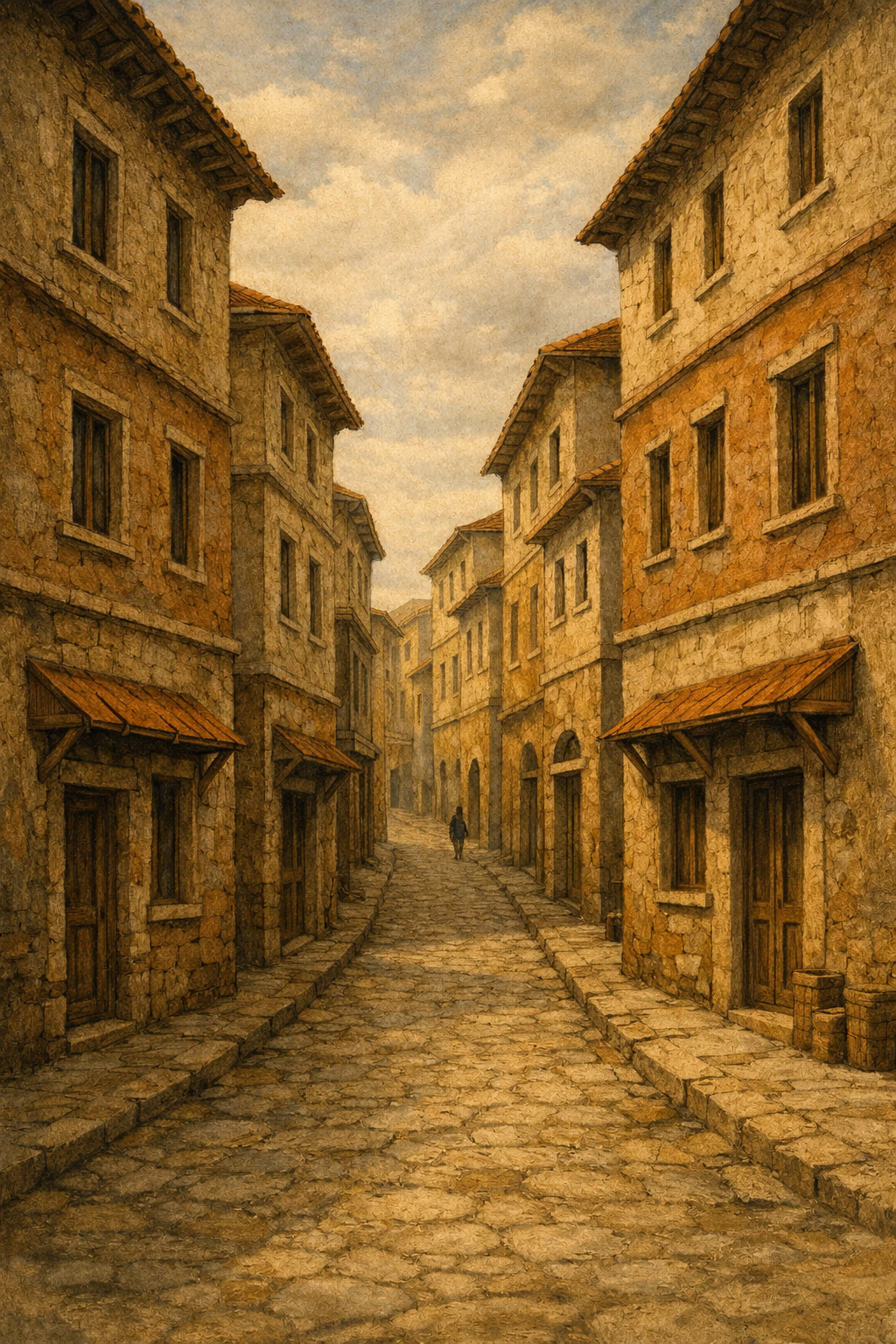
Here, the city feels compressed and enduring. Streets are narrow and irregular, following lines established long before formal planning took hold, and buildings rise in layered accretions rather than unified blocks. Homes, workshops, and communal spaces interlock tightly, shaped by generations of adaptation rather than decree. Unlike the measured openness of the Praesidium Imperii, the Insulae Civium feel lived-in, enclosed, and deeply familiar to those who belong to them.
Life within these quarters is marked by inheritance. Families occupy the same plots for centuries, guild affiliations pass from parent to child, and neighbourhood reputations carry more weight than official titles. The presence of imperial authority is constant but understated, woven into routine inspections, taxation, and civic maintenance rather than imposed through spectacle. Order here is not asserted; it is assumed.
Though often overshadowed by the institutions that surround them, the Insulae Civium are essential to Novaium’s identity. They anchor the city to its origins, preserving the habits, trades, and social bonds that sustained it before imperial structures fully emerged. To walk these districts is to encounter the capital not as an idea or an institution, but as a place that has been continuously inhabited, repaired, and remembered since its founding.
Demographics
The Insulae Civium are home to a stable and deeply rooted population, shaped by long continuity rather than recent growth. Many families have occupied the same dwellings for generations, their presence recorded in civic rolls that stretch back to the earliest decades of Novaium’s settlement. This continuity gives the district a strong sense of internal identity, where lineage, reputation, and familiarity often carry more weight than formal rank.
Households are typically multi-generational, with extended families sharing subdivided buildings adapted over time to changing needs. Artisans, labourers, small traders, and minor civic employees form the bulk of the population, supported by apprentices, dependants, and long-standing tenants. Social mobility exists, but it is gradual, and newcomers are more readily accepted through marriage, guild affiliation, or long residence than through wealth alone.
Non-human residents are present in modest numbers and are generally well integrated. Elves, dwarrow, and others who live within the Insulae Civium are almost always long-term inhabitants rather than recent arrivals, tied to specific trades, families, or guilds. Their acceptance is practical rather than ideological, grounded in shared routines and mutual reliance rather than abstract tolerance.
Daily movement through the district is dominated by residents rather than visitors. While officials, inspectors, and messengers pass through regularly, the streets belong to those who live and work there. Faces are familiar, absences are noticed, and behaviour that might pass unnoticed elsewhere is quickly remarked upon. In this way, the Insulae Civium function as a self-aware community within the larger city, sustained as much by social memory as by civic order.
Government
Governance within the Insulae Civium is exercised through a combination of formal civic administration and long-established local custom. Ultimate authority rests with the Praefectus Urbi Novaii, yet day-to-day oversight is delegated to ward magistrates and inspectors whose responsibilities include taxation, maintenance, public order, and the resolution of minor disputes. These officials are familiar figures within the district, their authority reinforced by routine presence rather than ceremonial display.
Unlike the Praesidium Imperii, where governance is defined by statute and process, authority in the Insulae Civium is tempered by precedent and expectation. Ward magistrates are expected to understand neighbourhood dynamics, family histories, and guild relationships, and enforcement is often calibrated accordingly. Strict application of law is possible, but rarely necessary; social pressure and established practice resolve most matters before they escalate.
Guilds play a significant informal role in local governance. While lacking legal authority, their senior members frequently act as intermediaries between residents and civic officials, advocating for their wards and ensuring compliance with regulation. This relationship is tacitly acknowledged by the city, which relies on these networks to maintain stability within the district’s dense and ageing fabric.
Imperial authority is thus present but restrained. The Insulae Civium are governed not through constant intervention, but through familiarity, negotiation, and the shared understanding that order here has been maintained for centuries through cooperation rather than coercion.
Defences
Defence within the Insulae Civium is not expressed through walls or garrisons, but through density, familiarity, and proximity to authority. As part of the Old City, the district lies wholly within the ancient inner wall of Novaium, benefiting from the capital’s oldest and most robust fortifications without possessing any distinct defensive structures of its own.
Security is maintained through layered presence rather than overt force. The city watch patrols the main thoroughfares regularly, while narrower lanes and courtyards are effectively self-policing, watched over by residents who know one another by sight and habit. Unfamiliar movement is quickly noticed, and disturbances rarely go unremarked for long. In this way, social awareness functions as the district’s first line of defence.
The close integration of housing, workshops, and communal spaces further discourages large-scale disorder. Streets are ill-suited to rapid movement or mass formation, and any attempt at organised violence would be quickly constrained by the environment itself. Should serious threat arise, response from nearby civic forces is swift, aided by the district’s proximity to both the Praesidium Imperii and major inner-city routes.
Taken together, the Insulae Civium are defended less by arms than by endurance. Their security rests on continuity, mutual reliance, and the unbroken presence of imperial order that has protected these streets since the city’s earliest days.
Industry & Trade
Industry within the Insulae Civium is local, inherited, and deeply entwined with daily life. These districts do not host large-scale manufacturing or imperial commerce; instead, they sustain the city through countless small trades practiced continuously across generations. Workshops are embedded within homes, ground floors open onto narrow streets, and labour unfolds at a human pace shaped by familiarity rather than volume.
Artisans dominate the economic character of the district. Smiths, cobblers, carpenters, masons, bakers, dyers, and metalworkers operate modest workshops that serve neighbourhood needs first and the wider city second. Many trades are family-held, their techniques refined through repetition rather than innovation, and reputation matters more than output. Customers are often known personally, and credit is extended on trust built over years rather than contract alone.
Trade here is informal but reliable. Small markets and street-side vendors appear at predictable intervals, supplying food, tools, and household goods drawn from both local production and deliveries routed through outer districts. Coin changes hands frequently but quietly, and large transactions are uncommon. Wealth circulates slowly, reinforcing stability over growth.
Guild oversight is present but understated, ensuring standards are maintained without disrupting established patterns. In this way, the Insulae Civium function as the economic memory of Novaium: a district where the city’s trades endure not because they are profitable on an imperial scale, but because they are necessary, trusted, and rooted in place.
Infrastructure
Infrastructure within the Insulae Civium reflects age, adaptation, and long use rather than coherent design. Much of the district’s physical framework predates formal imperial planning, resulting in systems that have been repeatedly repaired, extended, and repurposed rather than replaced. What functions here does so because it has been made to endure, not because it was ever ideal.
Streets are narrow and irregular, shaped by centuries of foot traffic and incremental construction. Main lanes follow ancient routes linking the original gates and civic centres, while secondary passages branch unpredictably, often narrowing into alleys or enclosed courtyards. These routes favour pedestrians and carts, discouraging heavy traffic and reinforcing the district’s enclosed character.
Water infrastructure is a layered system of old wells, cisterns, and later aqueduct-fed conduits, many of which have been retrofitted into existing structures. Public fountains and bathhouses serve as both practical amenities and social anchors, particularly in denser neighbourhoods where private facilities are limited. Drainage varies in quality, with older sections relying on shallow channels and newer improvements tied into the city’s broader sewer network.
Buildings are closely packed and frequently interconnected, sharing walls, foundations, and utilities. Additions and repairs are common, often undertaken piecemeal as families expand or trades evolve. As a result, the district’s infrastructure appears uneven but resilient, its redundancies born of necessity rather than planning.
Despite its age, the Insulae Civium remain fully integrated into Novaium’s civic systems. Maintenance is continuous, inspections regular, and failures addressed quickly, not because the infrastructure is elegant, but because too many lives depend upon it daily.
Assets
The principal assets of the Insulae Civium are not stored in vaults or tallied in ledgers, but embedded in continuity, skill, and social cohesion. These districts possess a depth of experience and labour that cannot be replicated elsewhere in Novaium, sustained by generations who have lived, worked, and adapted within the same confined streets.
Material assets are modest but widespread. Workshops contain well-used tools passed down through families, homes hold accumulated furnishings and heirlooms of local significance, and guild halls maintain shared equipment, records, and reserves that support members in times of hardship. Individually, such holdings are unremarkable; collectively, they represent a substantial and resilient economic foundation.
The district also holds significant intangible value. Its residents carry institutional memory of civic practice, trade standards, and neighbourhood obligation that predates many formal reforms. This knowledge allows the city to function smoothly at the local level, resolving minor issues before they escalate into matters requiring imperial attention.
Finally, the Insulae Civium represent a demographic asset to Novaium itself. Their stable population provides a reliable base of labour, apprentices, and civic participants, ensuring continuity in both trade and governance. In this sense, the district’s greatest asset is endurance: a lived stability that supports the capital quietly and persistently, generation after generation.
Guilds and Factions
Guilds exert their strongest and most enduring influence within the Insulae Civium. Many of the city’s oldest craft and trade guilds are rooted here, their halls and workshops occupying the same streets for centuries. Membership is often hereditary or established through long apprenticeship, and guild identity is closely tied to neighbourhood affiliation. These organisations regulate standards, mediate disputes, and provide mutual support, functioning as both professional bodies and social anchors.
Beyond formal guild structures, the district is shaped by informal factions grounded in family networks, shared trades, and veteran communities. Long-standing households command quiet respect, their opinions carrying weight in local matters regardless of official title. Such influence is rarely codified, but it is widely recognised and often consulted by ward magistrates seeking to resolve disputes without escalation.
Veterans’ associations also maintain a presence, particularly among families with generational ties to imperial service. While these groups hold no formal authority, their collective memory of service and sacrifice grants them social capital, especially in moments of civic strain. They tend to act conservatively, favouring stability and continuity over reform.
Religious fraternities and neighbourhood cults operate discreetly throughout the district, centred on small shrines and communal rites rather than grand temples. These groups reinforce local identity and obligation, binding residents together through shared observance rather than doctrine.
Taken together, the guilds and factions of the Insulae Civium form a dense web of influence that governs daily life as effectively as law. Power here is not seized or proclaimed; it is accumulated through time, reputation, and the unspoken understanding that those who endure longest often shape the district most profoundly.
History
The Insulae Civium constitute the last surviving portion of the city that existed before the Rift. While much of Novaium was reshaped, rebuilt, or wholly transformed in the aftermath of that event, these quarters endured with their foundations, street lines, and habitations largely intact. As such, they are widely regarded as the final tangible remnant of the world as it was—a fragment of unbroken continuity preserved amid rupture.
When the Rift occurred, destruction and displacement reshaped the surrounding districts, but the Insulae Civium were spared the worst of the upheaval. Whether by chance, geography, or forces not fully understood, the old residential quarters remained standing, their streets still walkable and their dwellings still habitable. In the uncertain years that followed, this survival proved decisive. The district became an anchor point for resettlement, governance, and memory, providing a physical reference against which the new city could orient itself.
As Novaium expanded outward, the Insulae Civium were neither erased nor redesigned. Instead, they were absorbed, enclosed within the inner wall, and preserved through necessity and reverence. Successive administrations recognised the district’s value not merely as housing, but as a living record of continuity. Reforms were applied cautiously, repairs undertaken with restraint, and large-scale redevelopment consistently deferred.
Over centuries, layers of imperial infrastructure were woven into the district’s older fabric, yet its essential character endured. Walls were reinforced, utilities retrofitted, and civic oversight imposed, but the original streets and plots remained recognisable. In this way, the Insulae Civium became both archive and habitation: a place where people continued to live ordinary lives atop extraordinary history.
Today, the district stands as a reminder that Novaium was not built entirely anew. It grew around something that survived. The Insulae Civium are more than the city’s oldest neighbourhoods; they are the last physical link to the world before the Rift, preserved not as a monument, but as a place still inhabited, still worked, and still remembered.
Points of interest
The Insulae Civium contain no grand monuments or city-defining institutions, yet they are dense with places of quiet importance. Small shrines occupy street corners and inner courtyards, many of them older than any recorded civic registry, maintained by neighbourhood custom rather than formal priesthood. These sites are rarely named on maps, but are well known to local residents, serving as anchors of routine observance and communal memory.
Guild halls are scattered throughout the district, often indistinguishable from surrounding buildings to the uninitiated. Within these modest structures, standards are set, apprentices sworn, disputes mediated, and records maintained that trace lineages of craft and labour back centuries. Several of these halls are recognised as among the oldest continuously operating institutions in Novaium, predating both imperial reform and post-Rift reconstruction.
Bathhouses, courtyards, and covered wells serve as informal centres of neighbourhood life. While none are significant beyond their immediate surroundings, their cumulative presence defines the district’s social fabric. News spreads here first, reputations are forged or undone, and civic change is often felt at these sites before it is acknowledged elsewhere.
There are no singular landmarks that draw visitors to the Insulae Civium. Its points of interest are meaningful only through familiarity, revealed through repeated passage rather than proclamation. Detailed accounts of specific sites are preserved in their respective articles, where their local significance may be properly understood.
Tourism
The Insulae Civium attract little in the way of formal tourism, and this absence is neither accidental nor regretted by those who live there. Visitors who come seeking spectacle, ceremony, or imperial grandeur are directed elsewhere, toward the civic plazas, temples, and riverfront districts better suited to such expectations. What the Insulae Civium offer is familiarity, not display.
Those who do venture into the district tend to be scholars, chroniclers, or pilgrims of a more reflective temperament. They come not for monuments, but to walk streets that predate the Rift, to observe buildings whose foundations have never been wholly replaced, and to experience a part of Novaium that has endured without reinvention. Such visitors are tolerated rather than welcomed, expected to move respectfully and without intrusion.
Accommodation within the district is limited to small, long-established inns and private lodgings that cater primarily to local needs. These places offer comfort without indulgence and are often patronised by returning guests rather than newcomers. Taverns are similarly understated, serving familiar faces and closing early by comparison with those in more commercial quarters.
In this way, the Insulae Civium resist commodification. They are not preserved for visitors, nor curated for admiration. Those who pass through are reminded that this district is not a relic of the past on display, but a living neighbourhood whose value lies in continued habitation rather than attention.
Architecture
Architecture within the Insulae Civium is defined by restraint, age, and deliberate continuity. Most buildings rise no more than two storeys, their proportions shaped by early construction practices that favoured stability over height. Ground levels are typically devoted to shops, workshops, or storage, opening directly onto the street, while residential spaces occupy the upper floors, reached by narrow stairways worn smooth by centuries of use.
Over time, many families have expanded not upward but outward. Adjacent buildings have been gradually acquired and joined, internal walls removed to create broad, interconnected living spaces that house multiple generations under a single roof. These composite dwellings often appear modest from the street, concealing their true scale behind unassuming façades that give little indication of the extended households within.
Materials are traditional and visibly aged. Stone foundations, brickwork, timber beams, and plastered interiors dominate, repaired rather than replaced wherever possible. Alterations tend to follow existing forms, preserving irregular layouts and inherited features rather than imposing uniformity. Even where improvements have been made, they are usually concealed, integrated carefully so as not to disrupt the district’s visual continuity.
There is a pronounced resistance to modernisation within the Insulae Civium. New construction is rare, and wholesale redevelopment is regarded with suspicion. For many residents, maintaining these buildings is a matter of identity as much as practicality. To live here is to inhabit the last vestige of ancient Rome as it once stood before the Rift, and this continuity is a source of quiet pride. The district’s architecture does not aspire to grandeur or efficiency; it endures as a statement of survival, memory, and belonging.
Geography
The Insulae Civium occupy a low but distinct rise within the Old City, a natural elevation that once offered modest protection from flooding and provided clear separation from the surrounding lowlands. This rise is subtle rather than dramatic, yet it defines the district’s character, lending its streets a gentle, uneven incline that becomes familiar to those who traverse them daily.
Along the southern edge of the district, the land slopes gradually downward toward the river. This descent has shaped both movement and settlement, with streets narrowing as they approach the lower ground and buildings stepping down in irregular tiers rather than following a single grade. The transition from residential lanes to the riverward quarters is gradual, marked more by changes in sound, humidity, and activity than by any clear boundary.
The district’s elevation places it above the river’s immediate influence while keeping it closely connected to the life of the waterway. This balance has allowed the Insulae Civium to remain dry, stable, and continuously inhabited, even as riverfront districts have been rebuilt or repurposed over time. Geography here does not dominate the landscape, but it quietly supports endurance, reinforcing the district’s role as the oldest and most persistent part of Novaium.
Climate
The Insulae Civium share Novaium’s temperate climate, but their age and density give the district a distinct microclimate shaped by stone, elevation, and enclosure. Narrow streets and closely set buildings limit airflow, making summers feel warmer and more stagnant than in the open civic districts, while winters are softened by retained heat and shelter from prevailing winds.
Seasonal changes are felt intimately here. Rain lingers on stone steps and in shaded alleys, and morning mists from the river often cling to the lower streets along the southern slopes before lifting. In hotter months, the district cools slowly after sunset, its thick walls releasing stored warmth well into the night.
These conditions are well understood by residents, who have adapted routines, construction, and daily habits accordingly. Shutters, awnings, and shared courtyards are used to manage heat and light, and life shifts rhythmically with the seasons. The climate of the Insulae Civium is neither harsh nor forgiving, but familiar—a constant presence shaped by centuries of lived experience.

Comments