

Castrum Primus
“The city endures because the legion waits.”
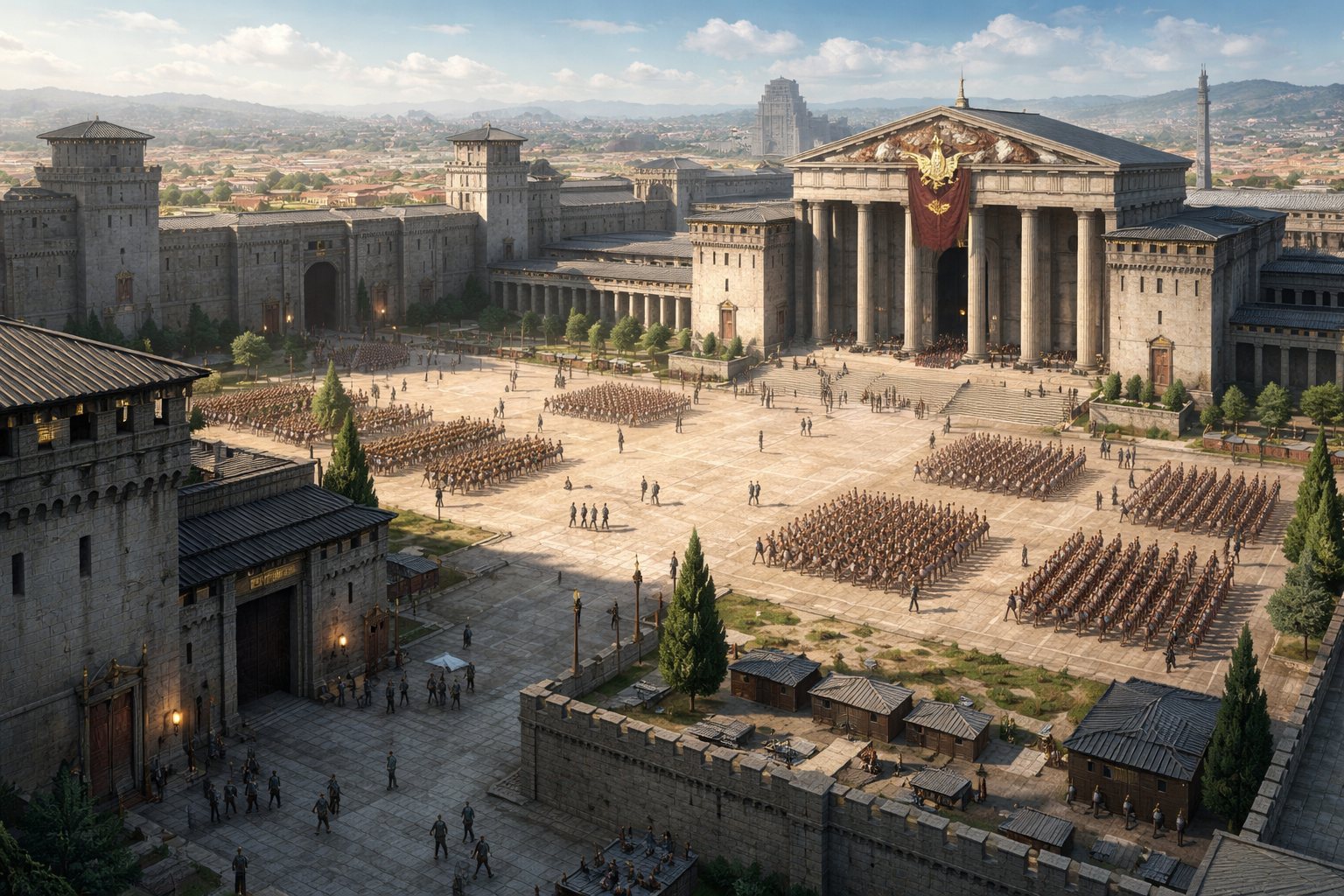
Castrum Primus is the permanent legionary garrison of Novaium, a purpose-built military district enclosed within the outer wall yet deliberately set apart from the rhythms of civic life. It exists to house, train, and sustain Legio I, ensuring the capital is defended by a standing force without allowing military presence to overshadow governance, commerce, or diplomacy.
The district is defined by order and restraint. Its streets are straight, its structures uniform, and its spaces designed for function rather than comfort. Barracks, drill courts, armouries, and command halls dominate the landscape, arranged according to established military doctrine rather than organic growth. Movement within Castrum Primus is regulated, timed, and visible, reinforcing discipline through environment as much as command.
Despite its proximity to the heart of the capital, Castrum Primus remains socially distinct. Legionaries are present in the city, but they return here to live, train, and answer to their own hierarchy. This separation is intentional, reflecting imperial policy that values a strong military tempered by clear boundaries between sword and senate.
Castrum Primus is not a neighbourhood in the civic sense. It does not cater to visitors, nor does it cultivate culture beyond that required to maintain morale and cohesion. Instead, it stands as a controlled presence—silent reassurance to the citizens of Novaium, and a clear warning to any who might test the city’s resolve.
Demographics
The population of Castrum Primus is overwhelmingly military in composition, shaped almost entirely by the presence of Legio I and the support structures required to sustain it. The vast majority of residents are active legionaries, officers, and non-commissioned specialists, housed according to rank and function within the district’s barracks and compounds. Unlike civilian districts, population figures here fluctuate only modestly, changing primarily through rotation, promotion, or attrition rather than migration.
Alongside the soldiers are a smaller but essential civilian contingent. Armourers, quartermasters, scribes, medicae, engineers, and instructors reside within the district under military contract, their families often permitted to live in designated quarters. These civilians are carefully vetted and subject to military law while within the castrum, reinforcing the district’s closed character.
The demographic profile is notably uniform in age and fitness compared to the rest of Novaium. Most legionaries are in early to middle adulthood, with veterans occupying senior roles or administrative posts. Retired soldiers rarely remain within Castrum Primus, instead being settled elsewhere in the city or on frontier lands in accordance with imperial policy.
Non-human presence is limited but not absent. A small number of auxiliaries, specialists, and exchange officers from allied peoples may be attached to the legion, though they are typically housed in segregated quarters and remain a visible minority. Their presence reflects strategic necessity rather than integration.
Castrum Primus is therefore a district of purpose rather than diversity. Its population is stable, disciplined, and transient by design, existing to serve the Imperium for a fixed span of years before moving on, leaving behind order rather than lineage.
Government
Castrum Primus is governed entirely under military law, operating parallel to, but distinct from, the civic administration of Novaium. Ultimate authority within the district rests with the Legatus Legionis of Legio I, who answers directly to the Emperor and the central military command, rather than to the city’s civil magistrates. This separation is deliberate, ensuring that the chain of command within the garrison remains clear and unambiguous.
Day-to-day administration is handled through the legion’s internal hierarchy. Senior officers oversee discipline, logistics, training schedules, and deployment readiness, while dedicated administrative staff manage records, supply requisitions, and correspondence with imperial authorities. Civilian officials of Novaium hold no direct jurisdiction within Castrum Primus, entering only by invitation or formal necessity, and always under escort.
Matters involving both military and civilian interests—such as troop movement through the city, requisition of resources, or coordination during emergencies—are managed through formal liaison rather than shared authority. Designated officers act as intermediaries between the legion and the Praefectus Urbi, ensuring cooperation without encroachment.
Justice within Castrum Primus is swift and internal. Disciplinary matters are addressed according to military codes, with penalties ranging from loss of privilege to reassignment or corporal punishment, depending on severity. This strict governance reinforces the district’s identity as a controlled and self-contained institution.
Castrum Primus thus exists as a city within the city, bound to Novaium by walls and purpose, but governed by a structure that answers upward to the Imperium rather than outward to civic consensus.
Industry & Trade
Industry and trade within Castrum Primus are limited, inward-facing, and tightly controlled, existing solely to sustain the operational readiness of Legio I. The district does not participate in open commerce, nor does it contribute directly to the city’s civilian markets. All economic activity here serves military necessity rather than profit.
The primary industries are logistical and technical. Armouries produce and maintain weapons, shields, and armour to legion standards, while workshops staffed by smiths, engineers, and artificers handle repairs to equipment, siege tools, and transport gear. Tailoring halls and leatherworks supply uniforms, harnesses, and field kit, replacing worn items on a continual cycle dictated by training and deployment schedules.
Provisioning is managed through centralised stores rather than trade. Grain, preserved food, oil, and other necessities are delivered under contract from Portus Vetus and the surrounding hinterlands, recorded and distributed by quartermasters according to ration scales. No independent merchants operate within the district, and private exchange among legionaries is discouraged and regulated.
Limited interaction with the wider city occurs through controlled procurement. Specialist materials, replacement animals, and contracted services are acquired via formal requisition rather than negotiation, with deliveries made to secured gates at scheduled times. Civilian craftsmen may be permitted entry for specific tasks, but they operate under supervision and are barred from general access.
Castrum Primus therefore functions as a closed economic system. It consumes resources but does not trade, produces equipment but does not sell, and circulates labour without allowing accumulation. This deliberate isolation ensures that the legion remains supplied without becoming economically entangled in the life of the city it protects.
Infrastructure
Infrastructure in Castrum Primus is uncompromisingly functional, designed to enforce discipline, efficiency, and readiness at every scale. The district follows a deliberate military plan rather than organic growth, with straight streets laid out in a grid that allows rapid movement of troops and clear lines of sight for supervision. Every structure is positioned according to role and hierarchy, reinforcing order through spatial design.
Barracks form the backbone of the district. These long, uniform buildings are constructed to house soldiers by cohort and rank, with shared sleeping quarters, equipment storage, and internal courtyards for inspection and assembly. Officers’ quarters are separate and more spacious, located closer to command buildings and administrative halls. All residential structures prioritise durability and ease of maintenance over comfort.
Training infrastructure is extensive. Drill courts, marching grounds, and weapons yards occupy large open spaces within the castrum, surfaced to withstand constant use. Covered training halls allow instruction to continue in poor weather, while specialised facilities support formation practice, equipment drills, and tactical exercises. The rhythm of daily life is set by these spaces, audible throughout the district.
Support infrastructure is equally robust. Armouries, granaries, workshops, medicae halls, and supply depots are distributed strategically to minimise movement time and congestion. Water is provided through dedicated cisterns and aqueduct spurs, while sanitation systems are separate from civilian networks, reflecting the district’s autonomy and scale.
Defensive infrastructure is integrated rather than ornamental. Walls, watchtowers, and controlled gates define the castrum’s perimeter, while internal checkpoints regulate access between sections. Castrum Primus is built to function as a fortress, a training ground, and a living institution simultaneously—its infrastructure embodying the Imperium’s belief that discipline begins with environment.
Guilds and Factions
Formal guild presence within Castrum Primus is minimal by design. The Imperium does not permit independent civilian organisations to establish authority within a standing legionary garrison, and all recognised functions operate under military command rather than charter. Craft specialists—armourers, engineers, medicae, and logisticians—are integrated directly into the legion’s structure, their roles defined by rank and duty rather than guild affiliation.
That said, informal factions exist, though they are neither named nor officially acknowledged. Cohorts develop reputations, rivalries, and internal identities shaped by campaign history, deployment prestige, and command favour. These distinctions influence assignment, advancement, and morale, but are carefully managed to prevent division from undermining cohesion. Loyalty to the legion and to the Imperium is enforced above all other affiliations.
Veterans exert a quiet but significant influence. Senior soldiers and centurions form networks of experience and authority that guide younger legionaries, transmitting doctrine, discipline, and institutional memory. While not factions in the civic sense, these bonds shape decision-making and behaviour within the castrum more effectively than written regulation alone.
External organisations interact with Castrum Primus only through formal channels. Military suppliers, auxiliary contingents, and allied specialists enter under contract or command, never as independent actors. Any attempt to establish parallel influence—whether commercial, political, or ideological—is swiftly curtailed.
In Castrum Primus, power does not flow through halls or banners. It moves through rank, service, and shared obligation, reinforcing the district’s identity as a place where unity is enforced not through persuasion, but through structure and discipline.
History
Castrum Primus was established alongside the formal expansion of Novaium beyond its original bounds, conceived as a permanent solution to the problem of defending a growing imperial capital without militarising its civic heart. In the years following the Rift, Legio I was quartered temporarily within and around the Old City, a necessity that quickly proved untenable. The presence of large numbers of troops among civilian districts strained resources, blurred authority, and risked entangling military power with civic life.
In response, the Imperium commissioned the construction of a purpose-built garrison within the outer wall, set apart both physically and administratively from the city proper. Castrum Primus was laid out according to established legionary doctrine, its plan prioritising readiness, containment, and rapid deployment. From its inception, it was intended not as a frontier fort, but as a disciplined reserve—close enough to respond immediately, distant enough to remain distinct.
Over the centuries, the district has expanded and modernised in measured phases, each reflecting shifts in military doctrine, technology, and imperial need. Barracks have been rebuilt atop older foundations, training grounds resurfaced, and support facilities expanded to accommodate changing equipment and tactics. Yet the essential structure of the castrum has remained intact, preserving continuity of practice and command.
Castrum Primus has never been besieged, nor has it launched from its walls in defence of Novaium itself. Its value lies in deterrence and preparedness rather than in recorded battle. During periods of unrest, rebellion, or external threat, the mere readiness of Legio I has proven sufficient to stabilise the capital and reassure its citizens.
Today, Castrum Primus stands as a quiet constant in Novaium’s history: a district defined not by dramatic events, but by sustained vigilance. Its walls have watched generations pass, its soldiers have trained for wars they may never fight, and in doing so it has fulfilled its purpose—ensuring that the city’s strength is always present, but never dominant.
Points of interest
The principal landmark of Castrum Primus is the Principia of Legio I, the administrative and ceremonial heart of the garrison. This complex houses the legion’s command chambers, records halls, and standards shrine, where oaths are renewed and honours recorded. Though austere in design, the Principia carries immense symbolic weight, embodying the continuity and authority of the legion within the capital.
Adjacent to the Principia lies the Grand Drill Court, a vast open ground used for formation training, inspections, and formal assemblies. Its scale allows entire cohorts to manoeuvre in unison, and its visibility reinforces discipline through constant observation. On certain days, the rhythm of drills can be heard beyond the castrum walls, a deliberate reminder of the legion’s readiness.
The Armamentaria, a fortified armoury complex, serves as the primary repository for weapons, armour, and field equipment. Access is tightly controlled, and its internal organisation reflects meticulous record-keeping and accountability. Smaller satellite armouries are distributed throughout the district, but the Armamentaria remains the central node for issue and maintenance.
The Medicae Halls form another critical point of interest, providing treatment, recovery, and training for military healers. These facilities are among the most advanced in the city, designed to address both routine injuries and battlefield trauma. Their presence underscores the Imperium’s investment in preserving its soldiers as long-term assets rather than expendable force.
Scattered throughout Castrum Primus are the Standards Courts and Memorial Plinths, modest but numerous spaces where fallen legionaries are recorded by name and service. Unlike the grandeur of the Mausoleum Imperiale, these memorials are restrained and functional, intended to reinforce duty and remembrance within the ranks rather than to inspire public reverence.
Together, these points of interest define Castrum Primus as a place of preparation rather than spectacle, where every space exists to support command, training, and continuity of military purpose.
Tourism
Castrum Primus is not open to tourism, nor is it presented as a place of public interest. Access is restricted, and civilians have no cause to enter the district without formal authorisation. There are no inns, markets, or amenities intended for casual visitors, and the castrum does not seek to cultivate admiration through exposure.
That said, visiting diplomats and foreign envoys are occasionally received within Castrum Primus as part of formal protocol. Such visits are carefully choreographed, framed as honours rather than privileges. Guests are hosted in designated reception halls and escorted through selected areas of the garrison, where order, discipline, and readiness are on deliberate display. Drills may be conducted, armouries shown, and formations assembled, all without spectacle or excess.
These visits serve a dual purpose. They extend respect to the guest by granting access to a normally closed institution, while simultaneously reinforcing the Imperium’s military strength and organisational discipline. The message is subtle but unmistakable: Novaium is protected not by rhetoric or fortification alone, but by forces that train continually and stand ready.
Beyond these controlled occasions, Castrum Primus remains inward-facing and insular. It exists to defend the city, not to impress it, and any exposure to outsiders is permitted only insofar as it reinforces that role.
Architecture
The architecture of Castrum Primus is austere, uniform, and intentionally repetitive, reflecting the Imperium’s belief that discipline is reinforced through environment. Buildings are constructed according to standardised military designs, prioritising clarity of function, durability, and ease of oversight over individuality or comfort. Stone, brick, and heavy timber dominate, finished plainly and maintained meticulously, with little tolerance for deviation or embellishment.
Barracks form long, rectilinear blocks arranged in precise rows, their entrances aligned with streets and drill courts to facilitate rapid assembly. Interiors are functional and spare, with shared quarters, equipment alcoves, and minimal personal space. Officers’ buildings follow the same architectural language, differing only in scale and internal arrangement rather than outward appearance, reinforcing hierarchy without ostentation.
Command and administrative structures, including the Principia, are more substantial but no more ornate. These buildings favour symmetry, thick walls, and broad interior halls capable of hosting assemblies or inspections. Columns and arches are employed sparingly and only where structurally or ceremonially necessary, serving as markers of authority rather than decoration.
Training and support buildings—armouries, workshops, granaries, and medicae halls—are integrated seamlessly into the district’s grid. Their placement reflects logistical logic, minimising movement and congestion. Rooflines are low and practical, designed to withstand weather and conceal internal activity, while courtyards and open yards provide light and ventilation without compromising control.
Defensive architecture is woven into the district rather than appended to it. Walls, towers, and gates are built to the same restrained standard as internal structures, creating a cohesive architectural identity that blurs the line between habitation and fortification. Castrum Primus presents no monumental skyline and no welcoming façade; instead, its architecture communicates purpose, readiness, and permanence through uniformity and restraint.
Geography
Castrum Primus occupies a deliberately chosen position within Novaium’s outer wall, set on firm, slightly elevated ground that allows clear lines of movement both toward the city and outward toward the surrounding approaches. Its location balances proximity and separation: close enough to respond rapidly to threats or unrest, yet sufficiently removed to prevent the constant presence of soldiers from encroaching upon civic life.
The terrain within the district is levelled and regularised, reshaped to suit military planning rather than natural contour. Subtle gradients allow for drainage without disrupting drill grounds or streets, and the absence of significant elevation change ensures that formations, supply wagons, and patrols can move efficiently in all directions. Unlike the organic sprawl of civilian districts, the geography here has been imposed rather than adapted.
The castrum’s perimeter aligns closely with the city’s outer wall, integrating the garrison into Novaium’s defensive geography without making it the city’s face. Access routes are direct and controlled, linking Castrum Primus to major roads and gates while avoiding unnecessary intersection with residential or commercial districts. Open ground beyond portions of the wall is maintained deliberately, providing clear sightlines and denying cover to any approaching force.
Castrum Primus is thus defined less by natural features than by strategic intent. Its geography serves readiness, visibility, and control, reinforcing the Imperium’s preference for terrain shaped to doctrine rather than doctrine adapted to terrain.

Comments