

Legiones Imperiales
"Strength through discipline; victory through unity. Wherever the Eagle stands, there stands the Imperium."
"Strength through discipline; victory through unity. Wherever the Eagle stands, there stands the Imperium."
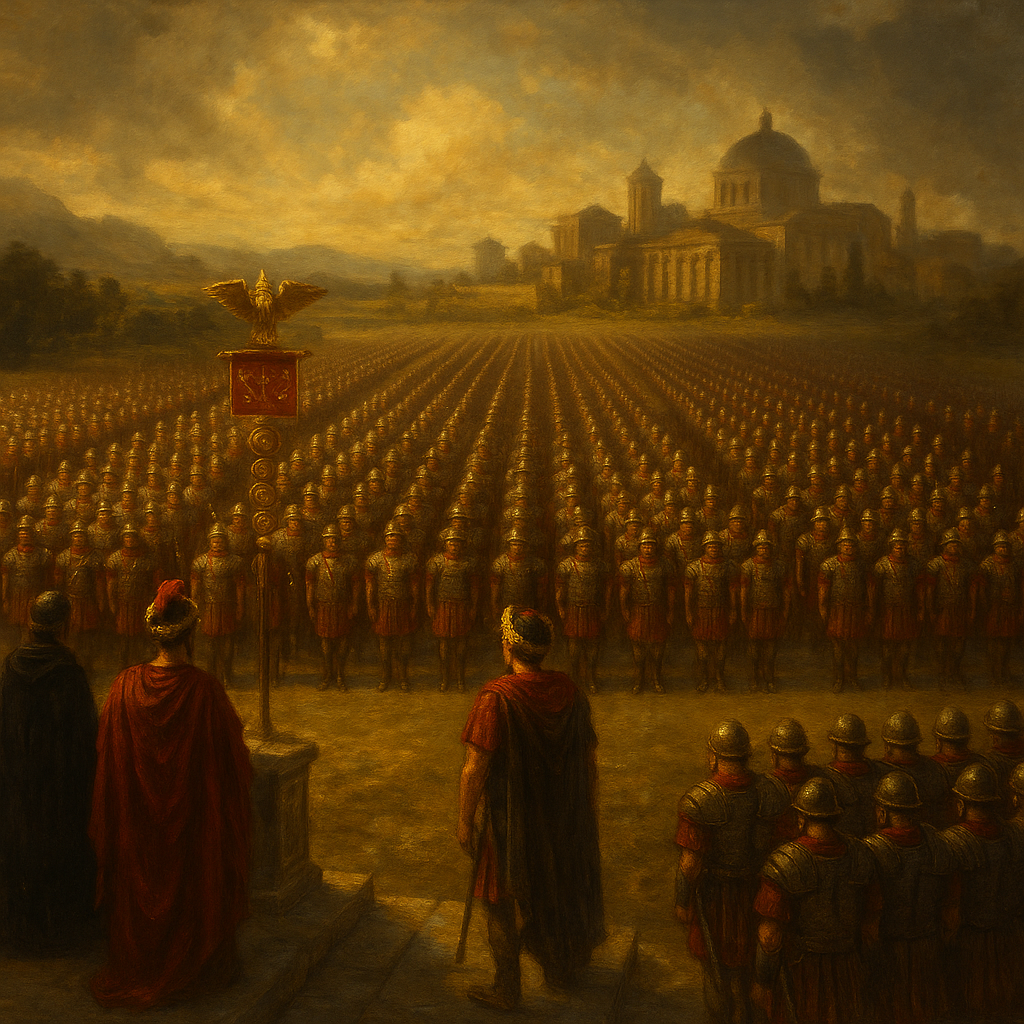
The Legiones Imperiales stand as the disciplined heart of the Imperium Novum, a direct inheritance from the Roman legion that Rifted into Exilum Novum eight centuries ago. Though shaped by foreign skies, strange foes, and the slow integration of new peoples, the Legions have remained unwavering in purpose: to secure Imperial order through mastery of infantry warfare and the iron resolve of citizen-soldiers.
From the original Rifted cohort sprang a tradition that has endured war with orcish hordes, uneasy peace with the dwarrow realms, and campaigns across both forest and steppe. The modern Legion is a formidable hybrid of ancestral doctrine and centuries of adaptation. Its ranks are filled by the annual levy of young citizens undertaking their mandatory service, supported by a hardened core of long-serving professionals who preserve the institutional memory of Rome. Siegecraft and engineering are enhanced by the dwarven auxilia, while the rare presence of sanctioned arcanii is reserved for intelligence, counter-magic, and high-value precision rather than battlefield spectacle.
Despite its expanded responsibilities and improved equipment, the Legion remains recognisably Roman in character. Its tactics are rooted in discipline, cohesion, and deliberate method; its culture prizes duty above glory; its organisation mirrors the classical cohort system, unchanged in essence even as the world around it grows stranger with each Rift. The Legiones Imperiales are both relic and evolution — an army born of the old world, perfected in the crucible of the new.
Structure
Each Legion is organised around the classical ten-cohort framework inherited from Old Rome, though expanded and refined over eight centuries in Exilum Novum. The structure balances the rotation of citizen-levy conscripts with the institutional stability provided by a professional core of long-service soldiers and officers.
Legatus Legionis (Legion Commander)
Overall command of the legion, holding both military and political authority. Supported by a senior staff of professionals drawn from the Collegium Militaris.
Praefectus Castrorum (Camp Prefect)
Third in command, responsible for fortifications, engineering coordination with dwarf auxilia, logistics, and the practical functioning of the legion on campaign. Almost always a veteran with decades of service.
Primus Pilus (Senior Centurion of the 1st Cohort)
Second only to the Legate in battlefield authority. Commands the elite First Cohort, maintains the tactical discipline of the entire legion, and oversees the centurionate.
COHORT STRUCTURE
Every legion consists of 10 cohorts, with the First Cohort at double strength and composed entirely of long-service professionals. The remaining cohorts integrate both conscripts and veterans.
1st Cohort — Double Strength Elite Formation
- Approx. 1,000 soldiers
- Divided into five centuries, each double the manpower of standard centuries
- Contains the legion’s most experienced soldiers
- Protects the legion standard and forms the anchor point of battle lines
Cohorts II–X — Standard Cohorts
- Approx. 480 soldiers each
- Divided into six centuries of about 80 men
- Mixture of trained conscripts, experienced regulars, and career professionals
- Serve as the core tactical building blocks for the Roman-style battlefield system
CENTURIES & CONTUBERNIUMS
Century (Centuria)
Commanded by a Centurion, supported by an Optio, a Signifer, and various specialists.
The century remains the fundamental fighting unit of the Legion.
Contubernium
The smallest living and marching unit — eight soldiers sharing a tent, pack mule, and responsibilities.
This structure has survived intact from Old Rome, proving essential to discipline and cohesion.
AUXILIA & SUPPORT UNITS
While not counted within the 6,500-strong Legion headcount, several attached units operate under its command during campaigns:
Dwarrow Engineering Auxilia
- Sappers, tunnelers, fortification builders, and siege engineers
- Attached at a typical strength of 200–400 depending on operational needs
- Operate semi-independently but answer to the Praefectus Castrorum
Arcanii Specialist Detachment
- Small, strictly regulated group of Imperial mages
- Handles communications, scrying, counter-magic, and precision arcane tasks
- Never embedded in cohorts; report directly to Legion HQ
Medical Corps (Medici & Chirurgi)
- Mix of trained healers and non-magical field surgeons
- Operate mobile clinics, triage posts, and convalescent sections
Logistical Train (Impedimenta)
- Teamsters, armourers, farriers, cooks, quarters officers, and supply clerks
- Manages wagons, pack animals, equipment repair, and supply distribution
- Critical to the legion’s capacity for long campaigns
CAVALRY & SCOUTING ELEMENTS
While the Imperium does not field large cavalry forces, each legion includes:
Turmae Exploratores (Scout Cavalry)
- Light cavalry units of 120–200 riders
- Conduct reconnaissance, screening, and message relay
- Typically composed of citizens trained specifically for mounted service or allied auxiliaries where appropriate
Culture
The culture of the Legiones Imperiales is a living monument to Rome’s ancient martial ethos, preserved through Rift, war, and centuries of adaptation. At its heart lies a fierce devotion to discipline, unity, and the belief that service to the Imperium is both duty and honour. Every legionary, whether a two-year conscript or a hardened veteran of twenty campaigns, is shaped by the same crucible: relentless drills, strict hierarchy, and the shared burden of defending civilisation against the chaos that lurks beyond the borders.
Despite the passage of ages, the Legions retain an almost ritual reverence for tradition. The daily salutes to the Aquila, the structured etiquette between ranks, and the ceremonial oaths sworn upon enlistment all echo the customs of Old Rome. The presence of conscripted citizen-soldiers infuses the Legions with a sense of civic identity; every cohort carries men who will return home to speak of their service, embedding Legion values deep into the fabric of Imperial society.
At the same time, professional soldiers hold a special prestige within the ranks. These long-service men form the cultural backbone of the legions — guardians of its lore, its methods, and its soul. Their mentorship ensures that even raw recruits stand in ordered lines and march with confidence under banners older than their grandparents.
Interactions with auxiliaries further shape Legion culture. The dwarrow engineers are respected for their mastery of stone and steel, though their blunt manner and disdain for inefficiency often clash with Roman formality. Arcanii specialists, though few, are treated with a cautious blend of awe and distance; their presence is a reminder that magic is a tool to be controlled, not worshipped.
Above all, the culture of the Legiones Imperiales is defined by its continuity. The world may change with each Rift, but the Legion remains — a pillar of order forged in the old world and perfected in the new. Here, soldiers do not fight for plunder or glory; they fight for the endurance of the Imperium itself.
Public Agenda
The stated mission of the Legiones Imperiales is clear, unwavering, and deeply woven into the identity of the Imperium: to safeguard Imperial lands, uphold the rule of law, and project the strength of civilisation into the uncertain realms beyond its borders. In official proclamations, the Legions are portrayed not merely as a standing army but as the bulwark of order in a world shaped by unpredictable Rifts, hostile powers, and ancient rivalries.
Publicly, the Legions commit themselves to three primary duties. First is defence — the protection of citizens, trade routes, and allied territories from threats such as orcish incursions, jotun raids, and the dangers emerging in the wake of each Rift event. Second is stability, which includes riot suppression, disaster response, and maintaining security during moments of political tension or arcane upheaval. Third is expansion of influence, a phrase carefully crafted to imply diplomatic and infrastructural reach, though historically it has often meant the establishment of new forts, colonies, and borders shaped at spearpoint.
The Imperium presents the Legions as a noble institution whose purpose is nothing less than the preservation of civilisation against barbarism and uncertainty. Recruitment edicts frame service as both a patriotic obligation and a pathway to personal honour. Festivals celebrate legionary heroes; senatorial speeches praise their discipline and restraint. Even citizens who have never seen a battlefield know the public narrative well: the Legiones Imperiales exist so that others may live in safety beneath the Eagle’s shadow.
Behind the rhetoric lies a practical truth — the Legions are the Imperium’s most visible instrument of power, and their agenda reflects both military necessity and political will. But in the eyes of the people, their purpose remains pure: to stand where others cannot, and to ensure that the world beyond never overwhelms the world within.
Assets
The Legiones Imperiales command a broad and meticulously maintained suite of assets that enable them to operate as a fully self-sufficient field army. While the legionary remains the institution’s core strength, these supporting resources allow the Legions to sustain long campaigns, construct fortifications, and wage war with the precision expected of the Imperium’s foremost military force.
Foremost among the Legion’s assets are its siege engines, constructed and maintained in cooperation with the dwarrow engineering auxilia. These include reinforced torsion ballistae capable of breaching timber palisades, heavy onagers for stone bombardment, and portable scorpiones used to support infantry lines. Though lacking magical augmentation, centuries of metallurgical refinement have produced machinery of exceptional durability and reliability.
Complementing these engines is the legion’s expansive baggage train, comprising hundreds of wagons drawn by oxen and mules. These carry foodstuffs, tents, timber, spare weapons, medical supplies, forges, and construction tools. The impedimenta ensures each legion can march for weeks across unfamiliar terrain without reliance on local stores — a necessity in lands where the next settlement might belong to elves, jotun, or worse.
The Legions also maintain a dedicated field engineering corps, composed of legionaries trained in construction, roadworks, fortification, and rapid earthworks. In battle or siege conditions, these teams coordinate with dwarven sappers to build ramparts, dig trenches, raise defensive palisades, and assemble siege towers as needed.
At the Legion headquarters, the Arcanii Specialist Detachment holds a small but potent array of arcane devices used for communication, reconnaissance, and anti-magic screening. These instruments — scrying lenses, encoded message tablets, warding standards, and detection rods — are tightly secured and never placed in general legionary use, reflecting the Imperium’s strict regulation of battlefield magic.
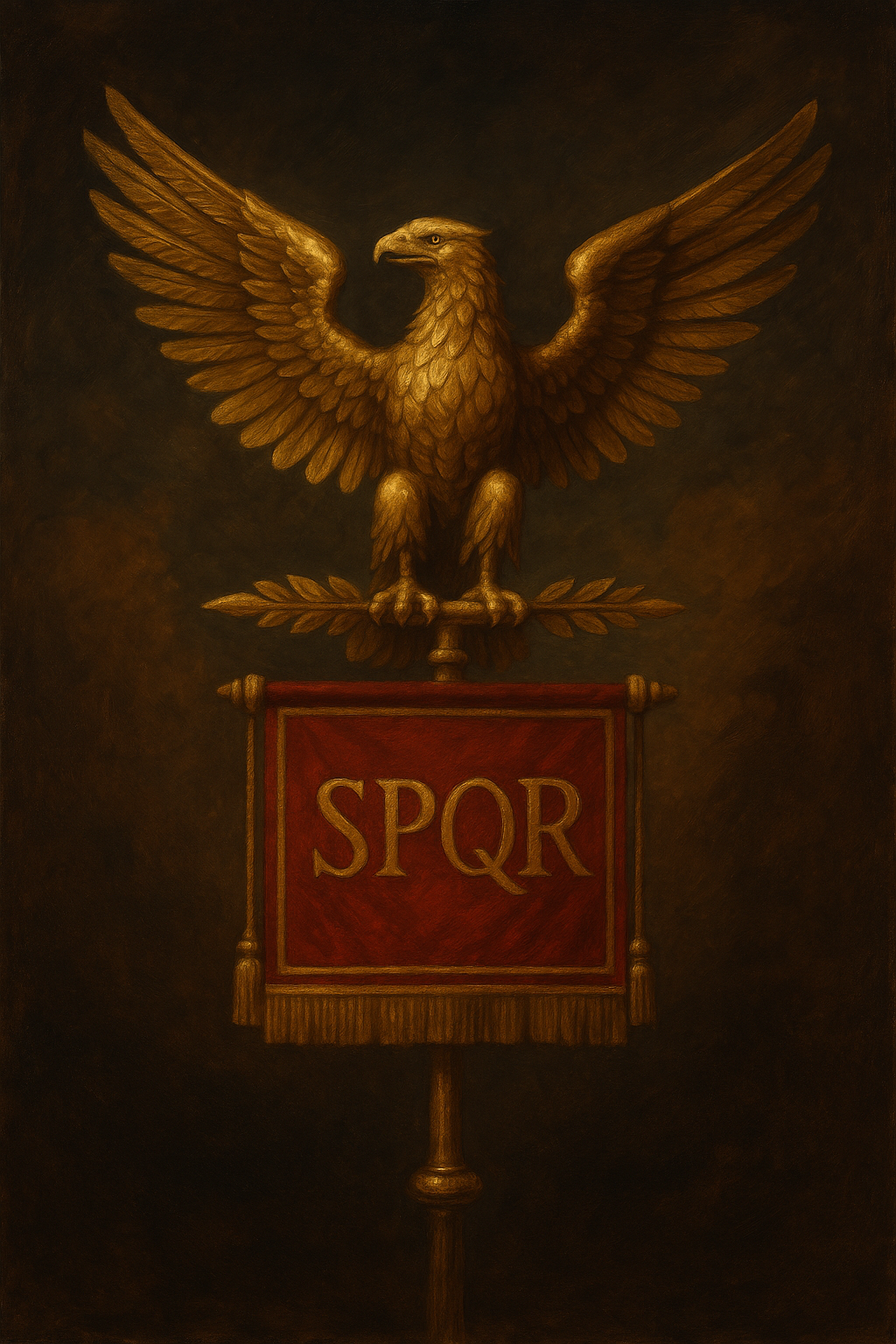
Finally, the Legions maintain a symbolic asset of immense cultural weight: the Aquila, the Eagle Standard. Forged with unmatched craftsmanship and guarded by the elite of the First Cohort, each Aquila embodies the authority of the Imperium itself. Its loss would be a disgrace; its presence steels the ranks.
Together, these assets transform the Legiones Imperiales from a disciplined infantry force into a mobile embodiment of Imperial might, capable of shaping the battlefield through engineering, organisation, and unyielding resolve.
History
The history of the Legiones Imperiales begins not with their founding, but with their arrival. When the Rift tore open eight centuries ago and drew a Roman provincial capital, its farmlands, villages, and one full legion into Exilum Novum, the soldiers of that displaced army became the first to march beneath a sky not their own. Their discipline held firm even in the face of gods they did not recognise and creatures no bestiary had ever named. In those early years, the Rifted legion served as the Imperium’s anchor — the stabilising force that allowed Roman law, language, and identity to endure when everything familiar had been stripped away.
As the Imperium Novum expanded, the Legions evolved. The first century saw desperate conflicts with orcish warbands, who tested the reorganised legion’s cohesion and forced the development of new defensive strategies suited to a more aggressive and less predictable enemy. The dwarrow clans, initially hostile, soon came to respect the Legions’ resolve. The stalemate wars that followed reshaped both peoples: dwarven craft and earthward engineering became foundational to Roman siegecraft, while the Legion’s insistence on order and formal structure influenced dwarrow approaches to large-scale warfare.
By the second century NE, the Legions had grown into a full standing army — no longer a single Rifted formation, but a constellation of newly raised cohorts built on the old legion’s doctrines. As each generation passed through mandatory military service, the Legions became not merely an institution but a defining element of Imperial citizenship. Veterans helped build roads, fortifications, irrigation works, and frontier colonies, spreading the Legion’s discipline across the emerging empire.
The centuries that followed saw continual refinement. Jotun raiders forced the Legions to adapt to swift coastal responses and lighter scouting cavalry. The elves contributed knowledge of forest manoeuvres and silent marching, born from necessity during the joint campaigns against orcish incursions into the great woods. The rise of the Collegium Arcanum introduced sanctioned mages into Imperial service, though always in small, tightly controlled numbers; their presence shaped intelligence, communications, and counter-magic, but never altered the infantry-centric identity of the Legions.
Across their long history, the Legiones Imperiales have participated in every major conflict, from the Western Tribal Wars to the Stormfront Campaigns and the Pacification of the Southern Reaches. Their banners have stood atop burned forts, rebuilt cities, and the edges of uncharted frontiers. More importantly, their continuity has granted legitimacy to every Emperor who followed Gaius Marcellus Aurelius, the Rifted Legate who became the Imperium’s first ruler.
Today, eight centuries after their arrival, the Legions remain the Imperium’s most enduring institution — the steady hand in an ever-changing world. Every Rift alters the balance of power, every age brings new adversaries, but the Legiones Imperiales continue to march, drill, build, and fight, as constant as the Eagle that crowns their standards.

Comments