

Mausoleum Imperiale Novaii
“In these halls the founders sleep, yet their shadows still walk beside the living. To honour them is to remember what we must become.”
The Mausoleum Imperiale Novaii stands upon the western rise of Novaium, where the first imperial augurs declared the ground “sanctified by memory yet unborn.” From the earliest years of the Imperium Novum it has served not merely as a resting place for the illustrious dead, but as a civic temple in which the living commune with the lineage that shaped their destiny. Pilgrims ascend its broad marble steps at dawn, offering incense to the Ancestors and seeking favourable omens before life’s pivotal moments—marriage, enlistment, elections, and voyages across the wider world.
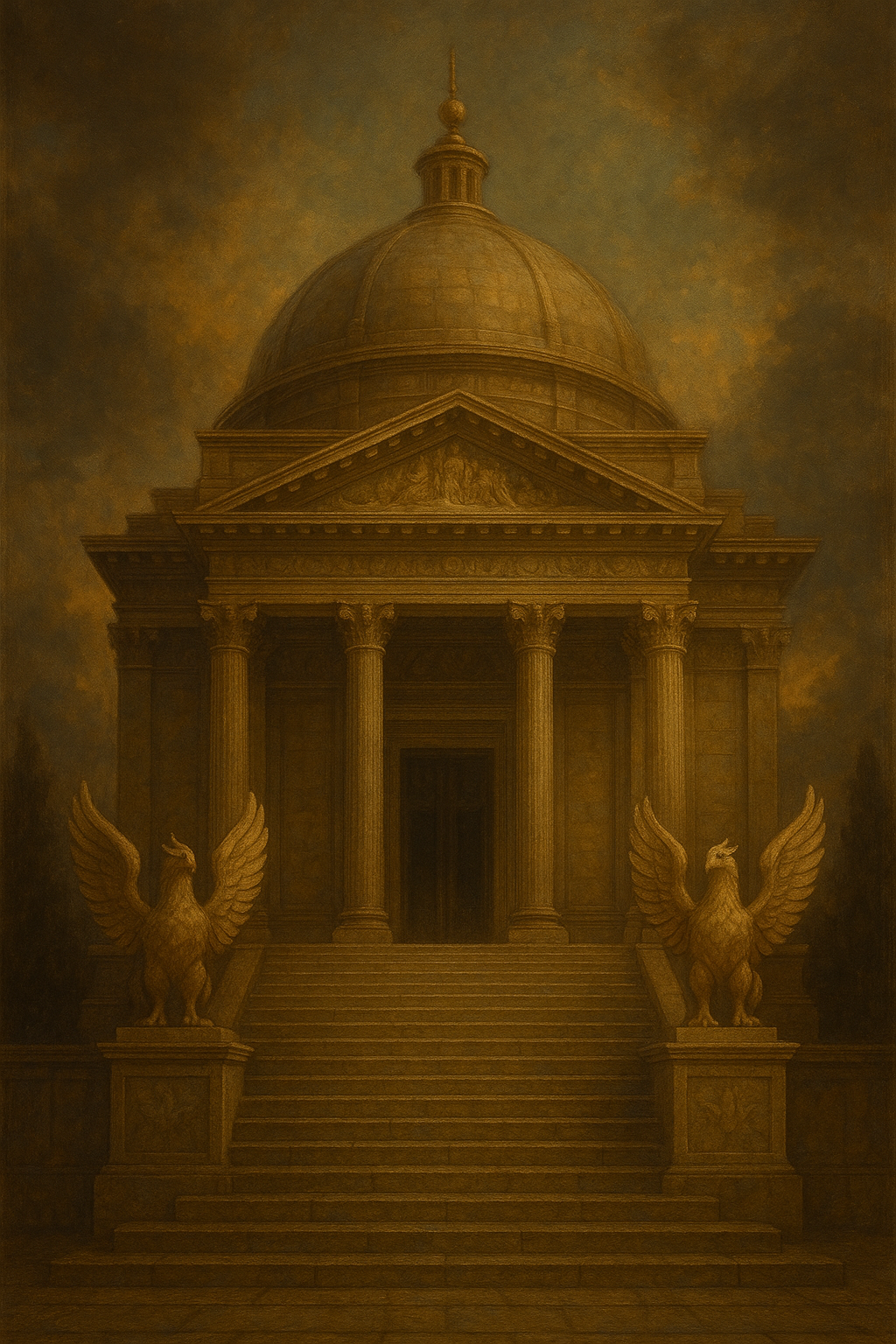
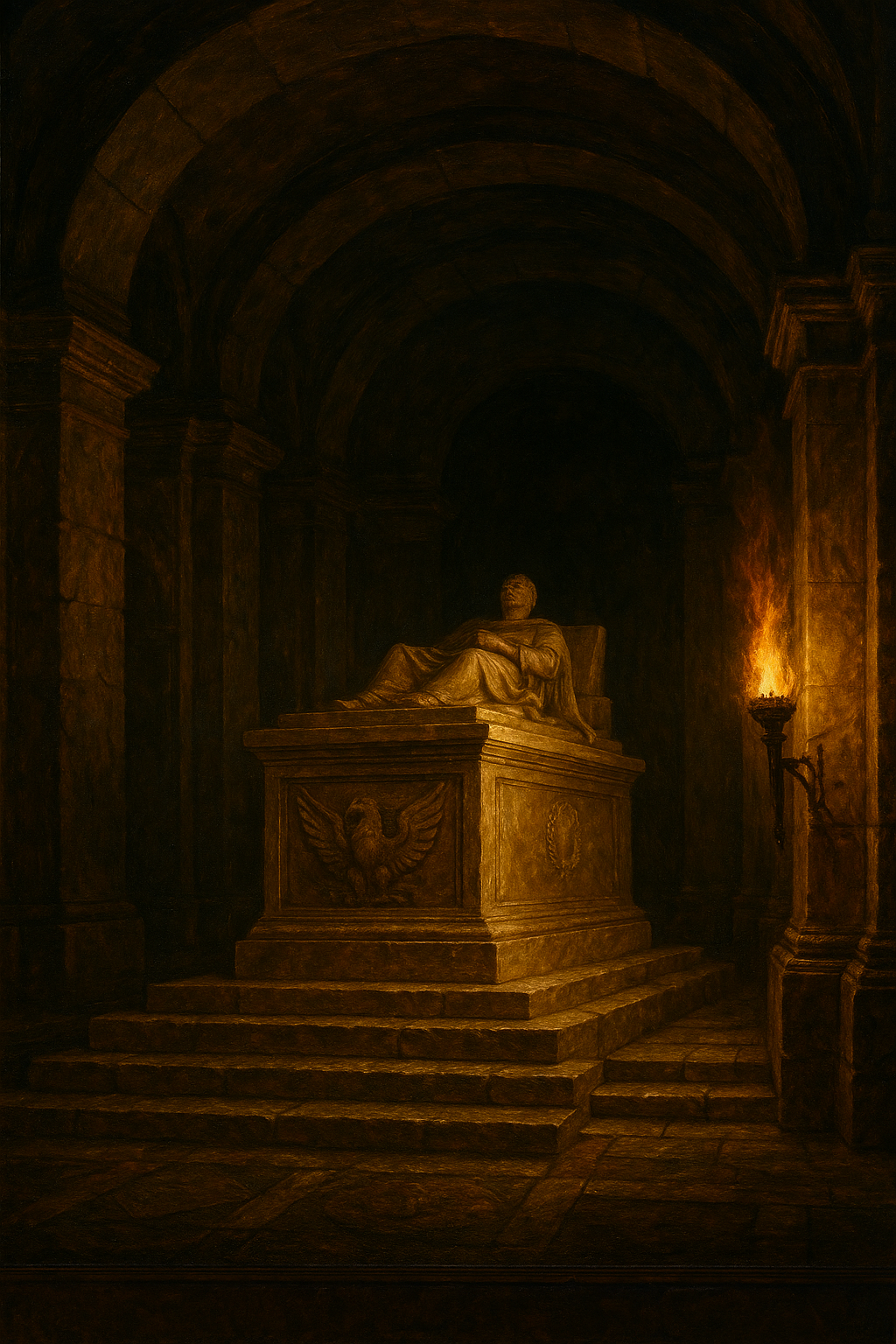
The structure unites the functions of shrine, tomb, and monument. Above ground rises a grand temple whose dome commands the skyline, its oculus flooding the interior with golden light. Beneath lies a labyrinth of crypt chambers, each dedicated to emperors and those rare figures raised by senatorial decree to the rank of the Honoured Dead. These lower halls are rich with funerary inscriptions, sculpted sarcophagi, and quiet alcoves where attendants recite the daily litanies of remembrance.
Throughout its history, the Mausoleum has remained one of the most revered sites in the Empire—an anchor of continuity during times of war, plague, and political upheaval. To stand within its precinct is to feel the weight of centuries pressing with solemn purpose upon the present, reminding each citizen that the Imperium is founded upon sacrifice as much as triumph. For many, a visit to the Mausoleum is not an act of mourning but a reaffirmation of identity: they are heirs to a legacy shaped by emperors, generals, architects, and mages whose deeds have become the bedrock of Novaium’s greatness.
Purpose / Function
The Mausoleum Imperiale Novaii was conceived as the sacred heart of imperial remembrance, a place where the living might stand in the presence of those who carved the foundations of the Imperium Novum. From its earliest design, it was intended to serve two intertwined functions: a temple in which citizens offer prayers to the approved pantheon, and a mausoleum in which emperors and the rarest of the Honoured Dead find their final repose. In this duality it embodies the Roman ideal that civic duty, divine favour, and ancestral memory are inseparable strands of the imperial soul.
The temple above serves as a public sanctuary, open to all who seek wisdom, blessing, or solace beneath its vast dome. Priests of the Collegium Cultorum conduct rites that honour the ancestors not as gods, but as exemplars—beacons of discipline, courage, and foresight whose virtues are to be emulated rather than worshipped. A citizen kneeling before the ancestral altars petitions the gods through the deeds of their forebears, believing that the worthy dead amplify divine favour by their continued presence within the Empire’s story.
Beneath the temple lie the crypts, where emperors and selected luminaries are interred with great ceremony. Each chamber serves not only as a resting place but as a testament to the life and labours of its occupant. The sarcophagi, inscriptions, and sculpted reliefs are not mere funerary displays; they form a silent curriculum, teaching future generations the ideals upon which the Imperium is built. To be laid to rest within these halls is the highest honour the state can bestow, reserved for those whose deeds will shape the Empire long after their own passing.
In its entirety, the Mausoleum stands as a reminder that the Imperium Novum is a continuum, stretched between the ancestral past and the uncharted future. It is a place where the Empire renews its covenant with memory, and where every citizen—from the humblest pilgrim to the Emperor himself—may contemplate the weight and worth of legacy.
Alterations
Though the Mausoleum Imperiale Novaii has remained faithful to its original vision since the reign of Gaius Marcellus Aurelius, its interior has grown alongside the Empire itself. Each alteration has been made with extraordinary restraint, guided by the principle that nothing may disrupt the sanctity of the founders or diminish the grandeur of the ancestral halls. Every change required senatorial decree, augural approval, and the blessing of the Collegium Cultorum, for the Mausoleum is not merely a building but a living covenant between the Empire and its dead.
The first great expansion occurred during the rule of Aelius Lorian, the Empire’s second emperor, when it became clear that a single burial chamber could not serve future generations. Under his direction, the architects carved a series of discrete crypts branching from the central axis, establishing the tradition of dynastic chambers that persists to this day. These early chambers—Aurelian, Lorian, and Longinus in their infancy—were hewn from the same marble quarry used in the original construction to preserve continuity in colour and veining.
As new imperial lines arose, so too did new corridors. The Corvax crypts, added during the reigns of Helena and Julian Corvax, introduced a subtle shift in iconography, weaving motifs of night skies and ravens into the otherwise classical scheme. Later, the Cassian expansions under Marcus Aurelius Cassian and his successors embraced civic symbolism—scrollwork, laurel friezes, and reliefs of administrative triumphs—reflecting their dynasty’s emphasis on statecraft and legal reform.
The only major change to the temple above came during the rule of Lucilla Marcellia Aurelia, who commissioned the restoration of the interior frescoes, many of which had been dulled by incense smoke and the passing of a century. Her artisans painstakingly preserved the original composition, merely renewing its colours and adding a narrow frieze commemorating the emperors entombed to that date. This act was seen not as innovation but as filial duty to the Empire’s legacy.
Smaller additions—votive niches, improved drainage channels, polished basalt flooring in the processional aisles—have been introduced gradually across the centuries, each folded seamlessly into the established aesthetic. Every alteration honours what came before, ensuring the Mausoleum remains not a patchwork of eras but a continuous architectural lineage mirroring the succession of emperors whose names echo within its marble halls.
In all things, the guiding mandate remains unchanged: the Mausoleum may grow, but it must never lose the solemn dignity bestowed upon it at its consecration. It is a monument built to endure dynasties, and so it welcomes them into its depths without ever compromising its original harmony.
Architecture
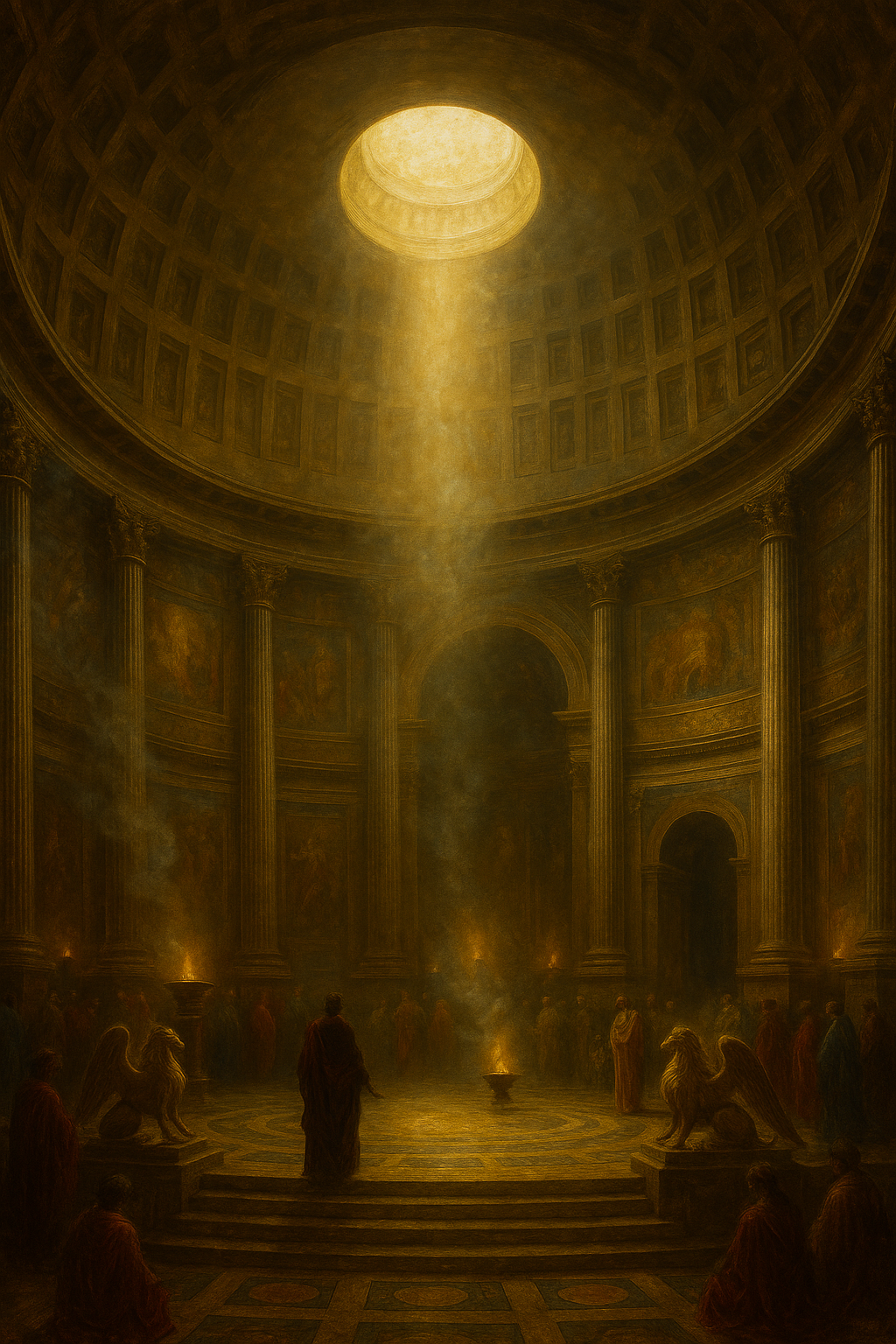
The Mausoleum Imperiale Novaii is the purest expression of Classical Imperial Monumentalism, an architectural language that has come to define the Imperium Novum as surely as its legions and laws. From a distance it appears as a marble crown upon the eastern rise of Novaium, its great hemispherical dome dominating the skyline like a second sun at dawn. The builders intentionally aligned it with the rising light of the equinoxes, so that twice each year a golden beam descends through the oculus to illuminate the central altar—a symbolic union of past and present, mortality and divine favour.
The structure rests on a vast podium of white-gold marble, quarried from the imperial stone fields and transported at immense cost during the early years of the Empire. A sweeping staircase, flanked by sculpted lions and eagles, lifts visitors from the profane world of the city into the sacred precinct. The façade is formed of towering Corinthian columns, each carved with laurel wreaths and phoenix motifs representing rebirth through service to the state. Between the columns stand relief panels depicting foundational moments of imperial history: the first senate convening, the treaty with the Dwarrow Clans, the oath-taking of the legions after the Rift.
Within the temple, the space opens into a soaring rotunda where walls of polished marble give way to intricate fresco cycles narrating the Empire’s ascent. The artisans of Lucilla Marcellia Aurelia’s reign restored these works to brilliance, preserving the original hues—lapis blues, cinnabar reds, and gilded ochres—that have become synonymous with imperial sanctity. The floor beneath is a mosaic starburst crafted of basalt and mother-of-pearl, designed to draw the eye toward the central altar where offerings of incense, oil, and ancestral tokens are placed during rites.
Beneath this splendour lies the subterranean crypt complex, reached through a guarded vestibule behind the altar. The descent is marked by a gradual shift in light and acoustics: braziers and oil lamps cast steady, warm illumination upon smooth stone walls, and the sounds of the city fade into a hum of solemn quiet. Each dynastic chamber mirrors the architectural idiom of the temple above while carrying subtle variations unique to its bloodline. The Aurelian crypts are marked by strong geometric lines and phoenix carvings; the Corvax halls emphasise deep shadow, star motifs, and the stylised raven; the Cassian corridors feature scrollwork and reliefs of civic achievements; the Longinus chambers incorporate spear and blade iconography; and the Lorian halls are adorned with maritime friezes recalling their ancestral connection to the coasts.
Despite these differences, unity prevails: every chamber is built from the same marble as the original rotunda, every lintel bears the imperial wreath, and every sarcophagus is crafted to harmonise with the Mausoleum’s overarching aesthetic. The architecture conveys a single message: dynasties rise and fall, but all are gathered under the Eternal Empire.
The Mausoleum’s design thus embodies the ideal upon which the Imperium Novum rests. Order, continuity, reverence, and monumental beauty converge to transform stone into legacy, ensuring that every visitor—be they pilgrim, scholar, or emperor—feels the weight of history pressing gently upon their soul.
Defenses
The Mausoleum Imperiale Novaii is not a fortress; it requires no battlements or engines of war. Its strength lies in sanctity, tradition, and the quiet vigilance of those entrusted with its guardianship. Throughout its history, the Empire has maintained that the honoured dead need no protection from the living, only reverence. Thus, the Mausoleum’s defenses are ceremonial rather than martial, designed to uphold dignity rather than repel invasion.
At the temple’s forecourt stand the Honour Guard of the Aureate Vigil, an elite detachment drawn from the Legio I Novaium. Clad in polished lorica with crested helms and bearing ceremonial spears, they maintain an unbroken watch in rotating pairs. Their role is symbolic: they deter irreverence, guide pilgrims with measured authority, and serve as reminders that the Empire’s living defenders continue to stand beside its departed founders.
Ritual protections, known collectively as the Lamina Ancestralis, are inscribed subtly throughout the building. These wards consist of consecrated lines etched into thresholds, lintels, and the bases of columns. Though not offensive in nature, they are believed to sanctify the space, preserving the calm of the dead and preventing malign influences—mundane or supernatural—from disturbing their repose. Priests of the Collegium Cultorum renew these invocations each year during the Festival of Founders, tracing them with oils and murmured litanies.
Access to the crypts is controlled not through locks or mechanisms but through ceremony. The bronze doors leading to the subterranean halls are opened only for interments, state funerals, or sanctioned ancestral rites. On ordinary days they remain closed, guarded by attendants who ensure that those who enter do so with proper purpose and proper mind.
In this way, the Mausoleum’s defenses reflect the values of the Imperium itself. Authority is expressed through solemn ritual, not force; reverence through presence, not threat. The Mausoleum endures not because it is unassailable, but because the Empire has long held it to be a place where violence does not belong.
History
The history of the Mausoleum Imperiale Novaii is inseparable from the history of the Imperium Novum itself. Conceived in the early years of the Empire by Gaius Marcellus Aurelius, its construction was both a practical need and an ideological declaration: that the founders of the new Empire would not fade into obscurity but remain ever-present within its civic and spiritual life. When the First Emperor died in Year 18 NE, his entombment within the newly consecrated chamber set a precedent that would guide every generation thereafter.
The succession of Aelius Lorian, the Empire’s second ruler, marked the Mausoleum’s first expansion. Recognising that the Empire had entered an age of permanence, Lorian authorised the creation of additional crypts branching from the central axis. This decision established the tradition of dynastic chambers, allowing each imperial line to inscribe its own legacy upon the sanctified stone while remaining united beneath the overarching Aurelian vision.
As the Empire matured, the Mausoleum expanded in tandem with its rulers. During the Lorian Dynasty, two chambers were added, adorned with maritime motifs reflective of their ancestral ties to coastal lands. The rise of the Longinus Line brought the addition of spear-etched vaults honouring the martial prowess of rulers such as Crispus and Septimus Longinus. The Corvax emperors—Helena, Julian, and later Marcellus Corvax II and Severian—introduced their iconic raven-and-starlight symbolism, creating some of the most visually striking chambers in the complex. Each addition respected the architectural harmony mandated by imperial law, blending subtle dynastic identity with the Mausoleum’s unified classical style.
The Cassian rulers left perhaps the most lasting impression on the Mausoleum’s cultural function. Cassia Aurelia Cassian and her descendants emphasised the Mausoleum not only as a place of burial but as a civic shrine where citizens could seek ancestral guidance. Under their reigns, pilgrim routes were formalised, rites of remembrance expanded, and the temple above became a focal point of public ritual during key festivals. By the time of Marcus Aurelius Cassian, the Mausoleum had become a pilgrimage site as significant as any temple in the capital.
One of the most celebrated restorations occurred during the reign of Lucilla Marcellia Aurelia, whose artisans revitalised the fading fresco cycles of the temple interior. Though she added a narrow frieze recounting the emperors entombed before her, she ensured that the original compositions remained untouched, presenting herself not as an innovator but as a custodian of inherited glory.
Through wars, dynastic shifts, crises of succession, and the tremors of new Rifts, the Mausoleum has remained an unaltered constant. Even during the brief unrest of the Varian Regency, when Julius Aelius Varian ruled in turbulent times, the Mausoleum’s sanctity was never violated—a testament to the Empire’s near-universal reverence for its ancestral seat.
Today, under the reign of Empress Aurelia Cassiana, the Mausoleum continues to expand with dignified restraint, welcoming new generations of the Honoured Dead. It stands not merely as a chronicle of rulers but as a living monument to the ideals that forged the Empire: continuity, duty, and the unbroken chain of memory that binds past to present.
Tourism
Visitors do not come to the Mausoleum Imperiale Novaii as one might visit a market or a monument; they ascend its steps as pilgrims, participating in a tradition as old as the Imperium itself. For many citizens of Novaium, a first visit to the Mausoleum marks a rite of passage. Families bring newborns to receive ancestral blessings, legionaries present themselves before enlistment, and newly elected officials make discreet pilgrimages to whisper vows of integrity beneath the great dome.
During the Festival of Founders, crowds gather at dawn, forming a procession that winds from the Forum to the Mausoleum’s forecourt. Incense braziers line the route, carried by priests of the Collegium Cultorum, and citizens offer wreaths woven from laurel and flame-blossoms to honour both the divine and the illustrious dead. Within the rotunda, the voices of thousands join in the Litany of Memory, a ritual recitation of the emperors and heroes interred in the crypts below. For many, this festival is the emotional heart of the civic year.
Individual pilgrimages are no less meaningful. A craftsman seeking prosperity may linger before the Cassian friezes depicting the Empire’s great builders and lawmakers. A scholar hoping for clarity might sit beneath the Corvax star-frescoes, believing that the intellectual legacy of Helena or Severian Corvax remains perceptible to the attentive. Couples visit on the eve of marriage, offering small tokens to the altar as a symbolic joining of their household lineages with the greater ancestral tapestry of the Empire.
The crypts themselves are rarely open to the general public. Access is permitted only on specific high rites—enthronements, funerals of the Honoured Dead, and once each decade during the Procession of the Descendants, when members of surviving imperial lines walk the full length of the crypts to lay wreaths upon each dynastic chamber. This rare event draws spectators from across the Empire, who gather peacefully outside the Mausoleum to listen to the ceremonial readings echoed through the amplified bronze horns.
Pilgrims who cannot enter the crypts often visit the Garden of Echoes, a walled courtyard to the south of the Mausoleum, where inscriptions of ancestral maxims are carved into polished stone. The garden offers a contemplative space for travellers, scholars, and citizens alike, and is the most common site for foreign dignitaries wishing to pay respects without intruding upon imperial funerary protocols.
In all these acts, the Mausoleum serves not merely as a destination but as a living symbol of the Imperium’s soul—a place where memory becomes ceremony, where the deeds of the dead inspire the ambitions of the living, and where every visitor is reminded that they walk within the unfolding story of a civilisation still shaped by its founders.

Comments