
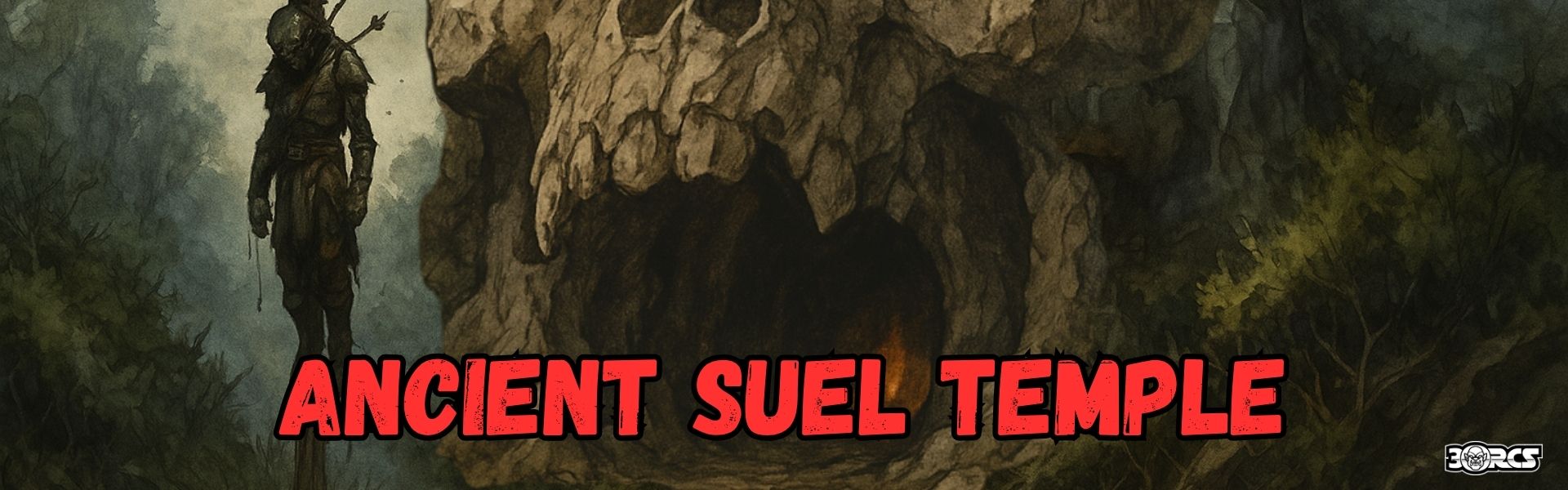
L2-16. Great Crypt Hall of the Six
Two modest doors break the east wall—one a third of the way along, one at two-thirds. Midway on the west wall, a squared door opens to a short passage. Far ahead, the way runs one hundred feet before narrowing: twenty feet of stone steps rise to a 10×20-foot landing before a magnificent metal door crowded with protective glyphs—the Gods’ Gate.
Role & feel
A grand processional honoring Suel rites—quiet, impressive, no traps. The hall invites prayer and rewards reverence: each small altar can grant a 1-hour blessing tied to a Suel power. Any one blessing is a “token of leave” that will open the Gods’ Gate by name.
Using the wall altars (player-led, no rolls)
Each PC may receive one blessing at a time. To claim one:
- Touch the altar’s ruby pip while whispering a short prayer (Old Suloise or translated) on a soft six-count, keeping silence between beats.
- A faint ruby line traces the shelf; a subtle seal marks the supplicant’s palm.
- The altar dims for 1 hour after bestowing a blessing (then relights).
Multiple altars: a creature may swap blessings by praying at a different altar; the new one replaces the old.
Blessings
(duration 1 hour; choose the ones you want active in your campaign)
- Wee Jas — Ruby Law. Stewardship of death, magic under order.
Effect: Resistance to necrotic damage; advantage on saving throws vs. being frightened by undead. - Lendor — Keeper of the Measure. Cadence, time, inevitability.
Effect: You cannot be surprised while conscious; once each round you may add +1d4 to one attack roll, ability check, or saving throw made on a turn in which you move no more than half your speed. - Jascar — Stone & Oath. Bulwark, craft, binding promises.
Effect: Gain +1 AC while wearing medium or heavy armor or a shield, and advantage on Strength (Athletics) checks to shove, grapple, or resist being moved. - Pyremius — Flame Under Rule. Purifying heat, decisive strike.
Effect: Resistance to fire damage; once per turn when you hit, deal an extra 1d4 fire damage.
Inactive niches: Decorative niches for other Suel powers (Kord, Lydia, Dalt , etc.) line the hall but are dormant here; their verses are present as scripture, not boons.
Anathema of the Six (optional rule)
When a Cleric or Paladin devoted to a diametric or enemy deity of the altar’s patron attempts to claim that altar’s blessing, the hall rejects them.
Trigger: A devotee of an opposed god completes the six-count prayer and touches the ruby pip.
Effect (choose one table-wide style):
- Ruby Rebuke (default): The supplicant takes 2d6 psychic and 2d6 radiant damage (no save), gains Bane (no concentration; 1 hour, ends early on dispel magic DC 15), and cannot gain that altar’s blessing.
- Harsh Silence (milder): No damage; the prayer fails and the altar goes dark to that creature for 24 hours.
- Severe Anathema (grim): As Ruby Rebuke, plus disadvantage on spell attacks and enemies have advantage on saves vs. that creature’s divine spells while in L2-16.
Read-aloud cue (short):
Interactions with the Gods’ Gate
- A cursed creature cannot open the Gate—even if another party member holds a valid blessing.
- Lifting the Anathema early: a contrite verse at the matching altar (“Measure mends, law forgives”), remove curse, or leaving L2-16 for 10 minutes to break line-of-effect.
The Gods’ Gate (north landing)
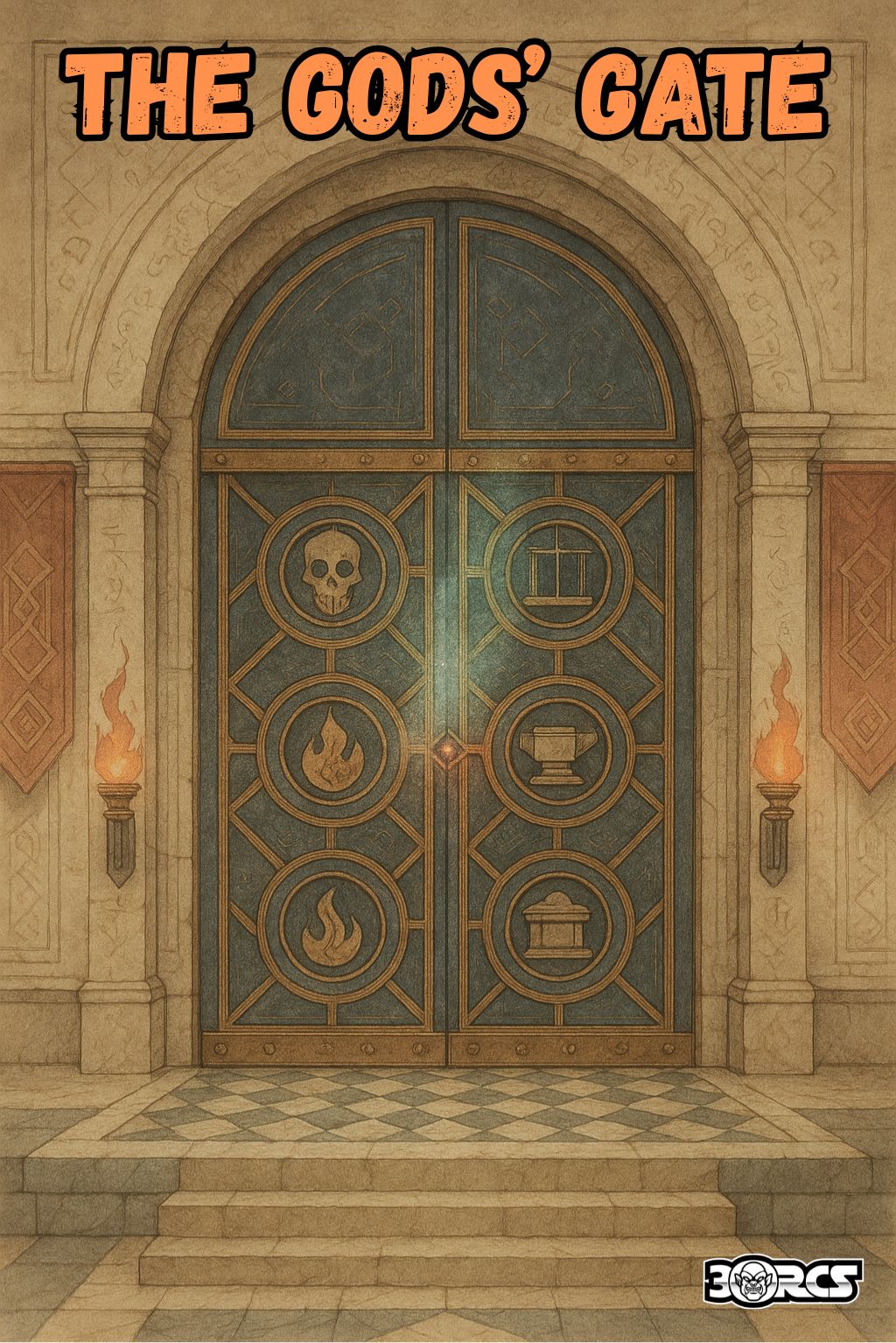
A tall double-leaf of blue-black steel banded in bronze, its face worked with interlaced Suel geometry and the four active god-seals (ruby insets). Protective glyphs trace the margins.
How it opens (no roll): A creature bearing any blessing from this hall places a palm on the matching god-seal and speaks that god’s name (Old Suloise Suel or clear Common). On the next beat of the six-count, bolts withdraw and the doors swing inward.
- No blessing: the door remains inert. Forcing it is futile and only ticks the Attention Clock (+1) with harsh metal echoes.
- Mixed party: any one blessed speaker can open for the whole group.
- Aesthetic effect: when the right name is spoken, the other three seals glow in sympathy—acknowledging the pantheon’s concord here.
Lesser Priests’ Chambers (quick keys)
East-1: Vesting & Rolls
Plain cots, a vesting rack, and a stone desk with service rolls (names, dates, rites kept).
- Finds: incense sticks (6), ruby chalk (3), ledger pages that map who served where (pointers to Wing of Measure vs Wing of Stone).
East-2: Reliquary & Rest
Shallow drawer-niches for finger bones and teeth, with Wee Jas seals.
- Finds: vial of funerary myrrh, scroll of gentle repose, and a cracked processional chime (mends if tapped in a six-count next to any altar).
Connections (no traps)
- Back south: L2-01. Great Crypt Hall of the Six (statue riddle room).
- West-center door: short hall to L2-10. Antechapel of the Ruby Mortarch
- East doors: lesser priests’ chambers (above).
- North: Gods’ Gate (name-keyed by any current blessing) → your northern temple corridors (to be keyed).
Boxed outcomes (quick drops)
Claiming a blessing
The ruby pip warms under your palm. A thin line of light traces the shelf—one… two… three… four… five… six—and your skin takes a faint seal that fades into a memory of heat.
Gate opens by name
The chosen seal brightens; the others answer in low harmony. Bolts draw back with a measured scrape, and the Gods’ Gate swings inward.
Gate ignored / forced (harmless stall)
The geometry holds. Your shove goes nowhere; the echoes skitter down the hall like thrown nails.
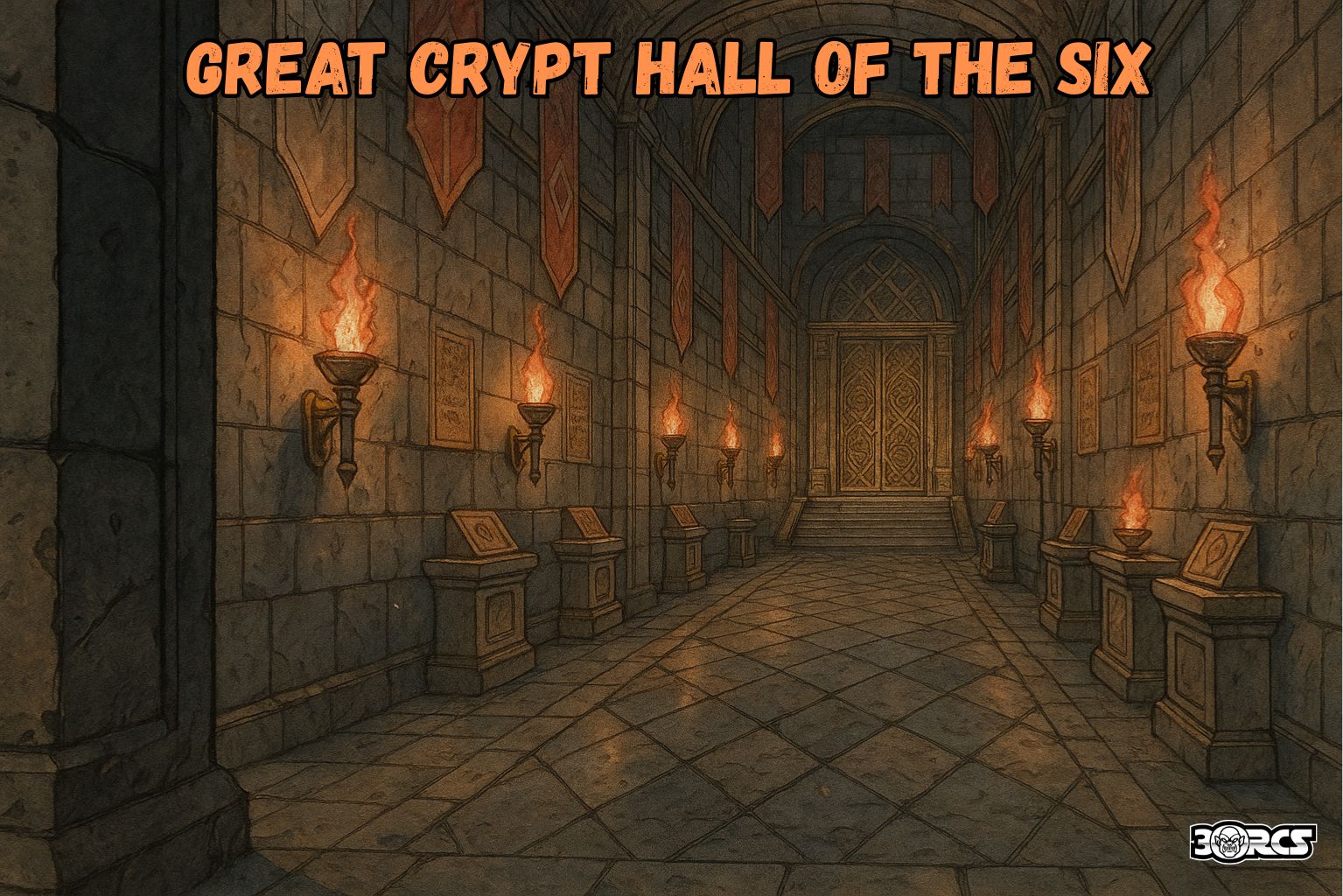
Forty-foot-wide Suel processional: ruby-lit torches, diamond floors, wall altars; two east doors (priest chambers), west-center door to Antechapel; north landing with Gods’ Gate.
At-a-Glance
- No traps.
- Altars grant 1-hour blessings (Wee Jas, Lendor, Jascar, Pyremius).
- Gods’ Gate opens when a blessed supplicant speaks that god’s name and touches the seal.
- Flow: west → L2-10; north → deeper temple; east → support rooms.
Layout & features
- Dimensions: 40-ft wide × 100-ft long; then constricts to 20-ft stairs (15-ft total ascent) to a 10×20 landing and the Gods’ Gate.
- Flooring: alternating basalt and pale stone in six-diamond repeats (Lendor’s measure).
- Lighting: Ruby vigil torches (magical divine fire; as elsewhere, only dispel magic or antimagic can snuff; relight by speaking a verse on a six-count).
- Altars (wall-mounted): each is a waist-high bronze shelf with a palm-sized ruby pip and a small incense cup; Suel glyph plates identify the god.
- Doors:
- East-1 (at ~35 ft): to Lesser Priests’ Chamber A (prep, vesting, ledgers).
- East-2 (at ~70 ft): to Lesser Priests’ Chamber B (rest, reliquary drawers).
- West-Center (at ~50 ft): short corridor (30 ft) to L2-10 Antechapel of the Ruby Mortarch.
- End: Gods’ Gate (see below).
Orc overlay: surprisingly light here—the Mortarch’s attendants have scrubbed banners and floor. A few ochre moons remain in high corners.
Who’s opposed to whom?
- Wee Jas (Law, Magic, Death).
Opposed/Enemies: Beltar (spite, pits), Dalt (thresholds), Phaulkon (free wind), Phyton (beauty/cultivation), Vatun (winter war). Clerics/Paladins sworn to these powers trigger Anathema at the Ruby altars. - Lendor (Measure, Time).
Diametric: Tharizdun (unmaking/primordial chaos broadly at odds with the chaotic/wild Suel—Norebo (luck/roguery), Phaulkon (sky/freedom), Llerg (beast-wild). Treat devotees of these as potential Anathema at Lendor altars. - Jascar (LG Mountain Guardian).
Natural foe: Beltar (fallen earth goddess of hate and pits). You can also include Pyremius as a thematic counter (destructive flame vs. stone guardianship) if you want a second axis here. - Pyremius (Assassins, Poison, Destructive Flame).
Antagonists: Phyton (beauty/cultivation—life shaped by care) and guardians of craft/stone like Fortubo/Jascar; Pyremius is also notorious as the murderer of Ranet (life-fire)—any cult loyal to life-giving flame should recoil here.
DM note: The Wee Jas enemy list is explicit in your article; the others are drawn from pantheon themes and canonical summaries in the same PDFs—use or trim to taste for your table tone.


Comments