
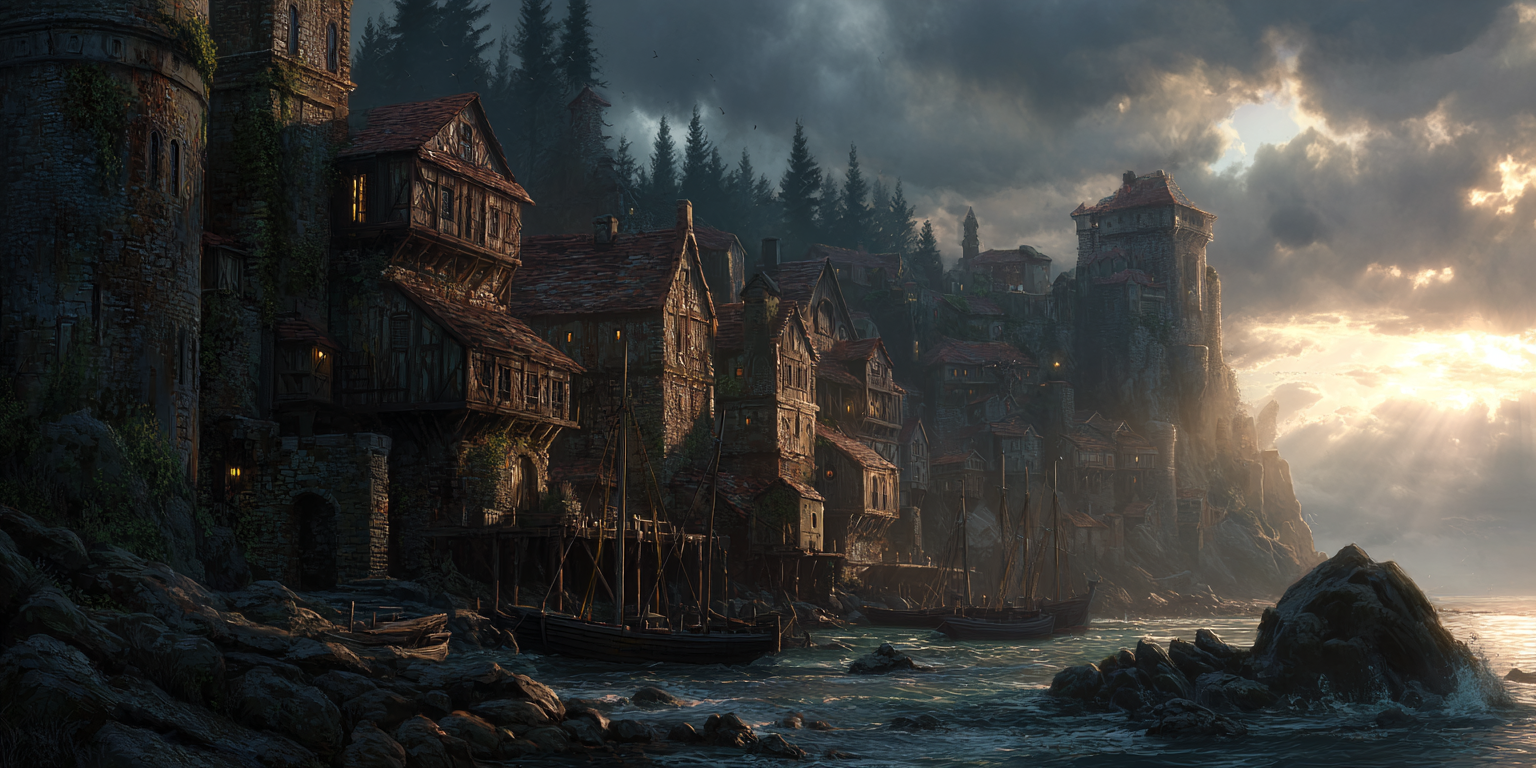
Leilon
“Stone in the tide. Fire in the hills.”
Overview
Once a minor coastal settlement caught between Neverwinter and Waterdeep, Leilon has weathered centuries of hardship—orc raids, dragon fire, arcane disasters, and more. Long abandoned after a devastating cataclysm, the town has recently seen a slow, politically charged resurrection.
Now rebuilt atop its ruins, Leilon stands as a symbol of resilience and ambition—though not without tension. The city bears scars from its past and the weight of uncertain leadership.
Current Leadership
Leilon is currently governed by Lord Darius Vexmoor, a Neverwinter-appointed noble whose family's decline mirrors the town's own rise. Darius’s authority is not uncontested: while he bears the title of Governor of Fort Leilon, his influence stretches into civilian governance as well, much to the irritation of some locals.
To maintain appearances of fairness, a Town Council has been established—made up of influential merchants, ship captains, landowners, and clergy. In practice, many decisions still filter through House Vexmoor's influence, with Darius using diplomacy, debts, and quiet pressure to maintain control.
Historical Background
- Founded: Over 300 years ago as a trade outpost between Neverwinter and Waterdeep
Key Events:
- Destroyed during the eruption of Mount Hotenow (Neverwinter Cataclysm)
- Briefly occupied by adventurers and cult forces during the Tyranny of Dragons
- Reclaimed and restored under Neverwinter's directive post-cataclysm
- Reconstruction Efforts: Backed by both Neverwinter coin and private noble interests (notably House Vexmoor)
Present Day (Late Marpenoth, 1491 DR)
Leilon endures a fragile peace after the Siege, but its future hangs by a thread.
The city’s fields yield little; blight and salted soil have forced dependence on imported grain and preserved fish. Beyond the walls, the undead of the Mere of Dead Men stir once more, drawn by strange lights along the marsh.
No caravans reach the gates—Twinshot, a notorious bugbear ranger, and his bandits rule the High Road between Neverwinter and Waterdeep, cutting Leilon off from inland trade.
Only ships now sustain the town, and even those sail rarely. Autumn storms lash the Sword Coast; smaller coastal craft founder on the reefs, leaving only deep-keeled merchant vessels brave enough to dock.
Of the three great lighthouses, only the Gray Beacon burns, the other two lying dark and in need of restoration.
The sahuagin remain aggressive, forcing captains to hire mercenary guards, while the sea elves of Nyelath’s Grace patrol the nearby waters under a temporary pact with House Vexmoor—offering protection in exchange for food and precious feystones.
House Vexmoor itself teeters on ruin: its coffers nearly empty, its mines yielding feystones now split between the sea elves and the desperate effort to halt Darius Vexmoor’s daughter’s shadow curse. Gold grows scarce, tempers shorter, and winter comes fast upon the tide.
Among Leilon’s scholars and clergy, quiet rumors spread that the beacons’ restoration is not healing the world but holding it together just long enough to face what’s coming.
Local Sayings
- “Stone in the tide, fire in the hills.” (already your tagline!)
- “Strike thrice, sleep sound.” (Watcher blessing)
- “Never trust a Vexmoor tally.” (local resentment over taxes)
Notable Features
• Fort Leilon – The military bastion and seat of House Vexmoor ’s power
• Saltstone Docks – A bustling port vital to regional trade
• The Graytower Beacon – Recently reactivated, rumored to be more than just a lighthouse
• The Salted Knot – A lively tavern frequented by sailors, miners, and mercenaries
• The Stag & Scepter – A finer inn favored by visiting nobles and council members
Culture & Politics
Leilon sits at a crossroads—too rural for the grandeur of Waterdeep, too proud to be just another Neverwinter holding. Its people are pragmatic, loyal to coin and kin, and suspicious of titles without proof. Lord Darius Vexmoor has brought order, yes—but also noble drama, tax burdens, and political undercurrents unfamiliar to many of the town’s rougher-born.
Still, the town grows. Trade increases. Walls rise. And in every home rebuilt, there is hope—and rumor.
The Noble Houses of Neverwinter
While Lord Protector Dagult Neverember holds the city in name, true power rests with the Great Houses, each competing for favor, trade, and lineage.
Their rivalries are ancient and merciless, often playing out through sponsored guilds, merchant caravans, and private militias.
House Alagondar — The Lost Bloodline Reclaimed
Once the royal family of Neverwinter, thought extinguished after the cataclysm, the Alagondars have recently reemerged through distant heirs and surviving bastards. Their claim to legitimacy is weak but politically explosive.
- Publicly: They present themselves as philanthropists, sponsoring rebuilding efforts and “returning Neverwinter to its roots.”
- Privately: They court feystone traders, believing the luminous crystals can fuel mythal-like defenses to rival Waterdeep’s wards.
- Key Figures: Lord Dareth Alagondar (charismatic populist), Lady Kaelyn Alagondar (arcane scholar, rumored Sharite sympathizer).
- Connection to Leilon: The Alagondars quietly fund expeditions to the Leilon mines, competing with Vexmoor interests for feystone contracts.
House Vexmoor — Exiled and Bitter
Once powerful merchants of Neverwinter’s Silver District, their expulsion during the collapse of the Fey Court of the Silver Night remains an open wound.
Rumor claims that the current Lord Darius Vexmoor’s line never forgave Neverember for seizing their holdings. The younger Lady Cassandra walks the city’s streets as both diplomat and ghost of a lost nobility.
House Harskell — Bankers and Builders
Neverwinter’s financiers, controlling the Merchant’s Exchange.
They have quietly begun to monetize feystone futures, selling shares of Leilon’s production in advance — a speculative market that could bankrupt the town if trade falters.
They are the least loyal to Neverember but the most practical in a crisis.
House Drathorn — The Dragon’s Eye
New money and dark connections. The Drathorns sponsor monster hunters, relic brokers, and discreet mercenaries.
Whispers claim they’re funded by Thayan gold or even the Zhentarim, buying influence in Neverwinter’s underbelly.
They’re also rumored to be tracking Vinrael “Hunter” Sarathai and other Blood Hunters for research into the Crimson Sanctum.
Rights & Codes — Leilon
| Right | Code & Notes |
|---|---|
| Arms | R — Simple/medium arms permitted; martial weapons restricted unless in service to House Vexmoor or Neverwinter. |
| Spellcasting | D — Defensive spells permitted; destructive or travel magic restricted without writ. |
| Beasts | D — Draft animals permitted; exotic creatures forbidden without council sanction. |
| Trade | T — Tariffed trade; Vexmoor agents enforce a 10–15% tax on all commerce. Smuggling is harshly punished. |
| Faith | P — Pantheon permitted; all temples/shrines must be council-approved. The Watchers at Dusk are formally registered as a Moradin sect. |
| Status & Justice | C — Common justice; trials held before Vexmoor-appointed magistrates. Nobles and Neverwinter envoys judged by peers. |
| Movement | C — Curfews enforced; outsiders monitored at the gates, with writs required to stay overnight. |
Improving Standing in Leilon
- Vexmoor Sponsorship → Arms R → M (martial weapons tolerated) / Trade T → G (guild privileges).
- Council Writ → Spellcasting D → DT (defensive + travel spells permitted).
- Temple Recognition (Watchers at Dusk) → Faith P → R (full clerical recognition Status C → N (priests judged as nobles in religious matters).
- Military Service (Fort Leilon) → Status C → A (auxiliaries of Neverwinter’s forces; judged under military law).
- Community Honor (Saltstone Docks or miners’ guilds) → Trade T → U (locals may waive tariffs for proven allies).
Notes for DMs
- The Watchers at Dusk give PCs a secret faith-based path to legitimacy. A priest like Shyk is treated as fully licensed clergy in Leilon, but outside the region their “cover” as Moradin clerics might be challenged.
- House Vexmoor is eager to control licenses and taxes, so characters who bypass through faith or community standing may spark political conflict.
- The Cult of the Dragon is an ever-present threat: the more open the Watchers’ influence, the more likely it is to draw cult retaliation.
Religions
Leilon’s spiritual life is dominated by the Watchers at Dusk, a sect of Moradin’s faithful whose teachings emphasize honest work, vigilance, and safe rest. Officially, the Watchers are registered as a branch of Moradin’s worship, but many locals view them as a distinct order. Because of the Cult of the Dragon’s vendetta, the Watchers conceal their full identity and avoid proselytizing openly, presenting themselves as “Moradin’s lantern-keepers.”
- Recognized Faiths: Moradin (officially Tyr (justice Chauntea (growth, respected by farmers and traders Tymora (luck, popular among sailors Tempus (battles and protection).
- Locally Dominant Faith: The Watchers at Dusk (Moradin sect, concealed as mainstream Moradin worship). Shrines are found throughout mining districts and town homes. Outsiders rarely recognize the sect unless initiated.
- Tolerated Faiths: Oghma, Gond (knowledge and craft, welcome but minor Selûne (moons, sailors Umberlee (sea goddess, tolerated for necessity at the docks, but her clergy are kept under watch).
- Proscribed Faiths: Cyric, Bane, Myrkul, Shar, Talona, and dragon cults of any stripe. Drow gods are outlawed outright. Worship of Asmodeus or any devil is treated as treason against Neverwinter.
Impact on Adventurers
- Clerics & Paladins of the Watchers (like Shyk) may present themselves as priests of Moradin to gain standard Faith privileges. Within Leilon itself, however, they are treated as ordained clergy and granted protections equivalent to a registered temple.
- Locals instinctively defer to Watcher priests in disputes over labor, rest, or mining rights.
- Outsiders who recognize and honor the Watchers’ rites (e.g. striking the Anvil’s Toll, keeping the Ever-Burning Vigil) may gain sponsorship and improved Status & Justice rights while in Leilon.
Leilon — Quick Reference
Cost of Living (per week)
- Poor (common bunkhouse, simple meals): 5 sp
- Modest (shared room in tavern, daily bread & stew): 1 gp
- Comfortable (private inn room, decent meals): 3 gp
- Wealthy (Stag & Scepter lodging, wine & tailored clothes): 10 gp
- Noble (full service, retainers, feasts): 25+ gp (by arrangement)
Local Services
- Room & Board: The Salted Knot (rough), The Stag & Scepter (refined)
- Repairs & Smithing: Ember & Iron (weapons, armor, tools)
- Alchemy & Oddities: The Tinkered Tonic (potions, strange gear)
- Fletcher & Arms: Willowshade Arrows (bows, arrows, light arms)
- Docking Fees: 2 sp/day small boat; 1 gp/day large vessel
- Guides & Laborers: 2 sp/day (unskilled), 1 gp/day (skilled)
Town Traits
- Population: ~1,200 (miners, sailors, craftsfolk, merchants)
- Ruler: Lord Darius Vexmoor (Governor of Fort Leilon)
- Council: Merchants, clergy, landowners (limited power)
- Reputation: Resilient, ambitious, scarred by past calamities
Common Rumors
- The Graytower Beacon hides deeper secrets than it shows.
- Vexmoor taxes grow harsher every season — rebellion whispers spread.
- Miners say strange voices echo from flooded veins near the Mere.
- Dockhands swear the Mermaid’s Lament carries more than cargo.
Player Notes
- Living here is cheap compared to Waterdeep or Neverwinter — but politics and danger fill the streets.
- Downtime activities (crafting, carousing, research) cost 20% less if done in Leilon due to small-town access and barter culture.
- Hazard Pay: Adventurers hired locally usually expect 2 gp/day.
Adventure Hooks
- Tax Rebellion: Merchants secretly fund smugglers to evade Vexmoor tariffs.
- Faith in Shadows: The Cult of the Dragon hunts Watchers in the mines.
- Council Intrigue: A merchant councilor seeks to oust a Vexmoor ally.
- Curfew Smugglers: PCs stumble on an after-dark operation moving contraband.

Comments