"Cities are built by kings and armies. Merchant’s Meet? Built by coin, luck, and the stubborn refusal to move elsewhere." -Veteran trader
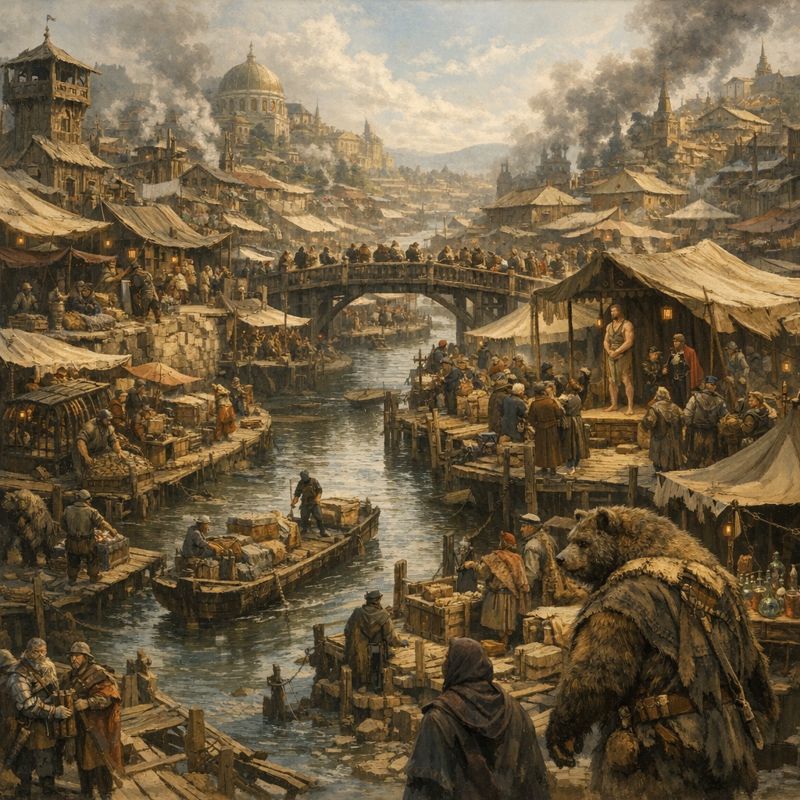
A 'great' city, if-only by the standards of today, built on the bones of thousands too stubborn to leave. It's humble beginnings a line of merchants with tents and wagons lining the dusty road between Bordersword and Stargaze, where weary caravans paused to barter, mend wheels, and share their firelight before the next uncertain horizon. But trade breeds roots like neglect does rot. Canvas hardened into timber, mud paths into alleys, and before anyone could name it, the road gave way to a city. Then came the quakes of 249 CA. The ground split open, the camp drowned, and for weeks the survivors clung to the wreckage. When the floodwaters carved a new river through the burgeoning city, a gleaming scar the folk named The Merchant's Meet Flood., it was reborn. The river now feeds it, fuels it, and threatens to swallow it again with every storm. What was once a roadside campfire has become a feature of central Everwealth, a tangle of wagons, bridges, and open-air bazaars that rise and sink with every current. There are no kings here even if the flag of Everwealth's waves in the wind. Here there is only coin. The law bends to the highest bidder, and contracts are worth only the wax that seals them. Slavery masquerades as apprenticeship, debt as piety, and murder as negotiation. The Silken Hand smuggles cursed relics through the same docks where The Saddleborn Guild traders sell beasts from Kathar. The Orcish Crime Syndicate deals openly in flesh, selling extortion, vice, protection, or assassination depending on who pays first. Even The Knights of the Horns., the closest thing to benevolent hands this nation has, are little more than notaries in holy garb, sanctifying bargains instead of souls. Merchant’s Meet cannot be ruled because it cannot be shamed; Here every sin is for sale, and every prayer has a price.
The city’s population is as fluid as its economy, with merchants and travelers constantly coming and going.
Humans and
Dwarfish make up the majority, but the presence of traders from
Kibonoji and
Orcish from the southern lands of
Kathar, both borders nearby, ensures a mix of
Elfese and Orcish tradesman or uncommonly seen races across their borders like the Katharan
Ursi or the occasional band of
Whogi tribesmen from
The Hungering Marsh nearby. Unlike more established cities, class divides here are dictated less by blood and title and more by wealth and connections. A skilled trader, Saddleborn beast-handler, or Scholar’s Guild alchemist might rub shoulders with a Consortium prince of coin, while the poor scrape by in tents pitched on riverbanks, hoping for their next lucky break. Refugees and bond-slaves alike swell the outer wards, blurring the line between residents and cargo.
Merchant’s Meet lacks a true ruling class. Instead, its affairs are dictated by the Merchant’s Assembly, a council of guildmasters, wealthy traders, and alchemists whose power extends only as far as their purses. The “mayor” is a negotiator chosen to mediate between factions, with no mandate beyond keeping the markets open. The Assembly favors profit over order, and laws shift depending on who paid the most at the last vote. The Knights of All-Faith maintain a small chapel within the city, but it serves less as a place of worship than a bank of oaths—loan papers, contracts sworn upon relics, bargains sanctified in candlelight. Their neutrality makes them one of the few factions trusted across guild lines, but their influence is limited to the parchment and vows they witness.
Unlike
Bordersword nearby to the west or the impeding warzone to the east that has become
Stargaze, Merchant’s Meet bristles not with steel, but with gold. Its defenses are a patchwork, wooden palisades erected by spice guilds, stone barricades funded by jewelers, and ramshackle watchtowers sponsored by
The Saddleborn Guild to watch their stables. Mercenaries man these defenses, their loyalties tied to their employers. The Merchant’s Meet Flood itself doubles as both lifeline and weakness, its docks teeming with barges but its waters patrolled by smugglers and pirate crews. In wartime, the Meet relies on diplomacy, every faction with coin has a stake in keeping the markets alive. Yet should a true army march on its walls, most know the city would fall.
Trade is the marrow of Merchant’s Meet, and its industries orbit entirely around the exchange of goods. Fresh produce and alchemical reagents pour in from Kibonoji. Weapon-forges run on steel drawn from Kathar. Saddleborn caravans ferry exotic beasts through the gates, auctioning them alongside labor contracts. The Meet’s specialty is not in what it makes, but in what it moves. But coin carves dark channels as well. Slave contracts pass through the Auction Hall disguised as “apprenticeships.” The Silken Hand keeps contraband flowing: cursed relics, illicit magick, poisons banned elsewhere. The Orcish Syndicate thrives on flesh and extortion. Merchant’s Meet is no longer just Everwealth’s trading post, it is its black heart.
The Meet is a city built on its own bones, layer upon layer of markets, caravans, and wagons turned to permanent homes. Cobblestones meet wagon planks, bridges groan with rot, and river-docks lean under the weight of goods. The Merchant’s Meet Flood forced the construction of docks and ferries, transforming the city into both a caravan stop and a riverport. Yet it lacks sophistication. No aqueducts, no sewers, only ditches and rain collectors. Streets flood with every storm, and half the alleys stink of rot. But no one cares, so long as the markets never close.
- The Grand Market - The pulsing heart of the city, where stalls shift daily and caravans clog the streets. Here fortunes are made and lost in a single afternoon.
- Golden Row - Home to the mansions of Consortium brokers and Assembly magnates. Auctions of slaves, relics, and estates happen behind closed doors.
- The Low Aisles - A sprawling maze of slum-markets and shadow stalls where the Syndicate and Silken Hand conduct their business. Contracts and chains are bartered as readily as bread.
- The Alchemist’s Quarter - A volatile sprawl of labs and potion-shops where smoke and fire drift constantly. It is rumored half the city’s fires start here.
- The Flood Docks - Warehouses and harbors clinging to the river, swollen with goods. Saddleborn caravans stable their beasts here, while smugglers unload in the shadows.
Together, these districts weave a city always on the edge of collapse, yet too valuable to let fall.
Merchant’s Meet’s greatest asset is its position. It sits as the throat of the Three Lands, the halfway mark between east and west. The Merchant’s Meet Flood, born from disaster, made it indispensable, feeding crops, filling fisheries, and floating barges. Warehouses bulge with alchemy, jewels, spices, and bodies waiting for sale. The city’s other asset is its volatility, no ruler dares crush it for fear of shattering the trade arteries it controls.
- The Merchant’s Assembly - A kabal of Merchant's Meet's wealthiest moguls and barons; Whispered to have a hand in every trade.
- The Saddleborn Guild - Maintains stables and caravan-barracks at the Flood Docks, auctioning beasts, mounts, and indentured ferrymen. Their caravans keep the Meet tied to Everwealth’s cities.
- The Alchemist’s Consortium - Monopolizes potion and reagent trade, their Quarter brimming with dangerous experiments.
- The Silken Hand - Smugglers who deal in contraband, relics, and black-market magick.
- The Orcish Crime Syndicate - Masters of flesh, chains, and extortion, feared yet untouchable.
- The Knights of All-Faith - A token chapel presence, brokering contracts in oaths sworn to gods.
Merchant’s Meet was never intended to be carved into the map. Unlike cities raised by decree or shaped by conquest, it began humbly as a scatter of traders along the trade road between Bordersword and Stargaze leading into
Kibonoji. By 166 C.A., caravans hauling produce, silks, steel, and alchemical tinctures gathered here with such regularity that a permanent market became inevitable. The dirt paths were soon lined with tinkers, Saddleborn beast-handlers, and Scholar’s Guild scribes selling charts to caravan leaders. What had been a campfire-studded field grew into the beating heart of trade across The Three Lands, a crossroads too valuable to abandon. Over time, permanence settled in. Blacksmiths staked their forges into the soil, alchemists dug cellars for volatile stores, and inns rose from the bones of abandoned wagons. Refugees and wanderers were folded into the workforce, some willingly, others bound as “indentured apprentices” whose contracts often proved harsher than chains. The Meet became a place where every hand could find work, or be sold. Its fate, however, would be sealed in 249 C.A., when a devastating chain of earthquakes tore across the region. The quakes cracked the foothills of
The Cloudrend Mountains and shattered
The Battlement Cliffs, unleashing waters long restrained by stone. Entire districts drowned in moments, families swept into the flood. For weeks the survivors clung to wreckage, rebuilding fires atop the bones of their own market. Yet from the disaster came transformation, the cataclysm carved a newborn river through the heart of the settlement, soon named the Merchant’s Meet Flood. What should have been ruin instead became a gift as cruel as it was irresistible. The river fed crops, drove fisheries, and offered swift passage for barges groaning with goods. From ruin came prosperity, from blood came rebirth. Merchant’s Meet surged into its second life, no longer a roadside camp but a city whose wealth eclipsed many of Everwealth’s crown-founded settlements. The city endured not by decree, but by trade and custom, where a man’s word and his coin mattered more than lineage. Its guilds and cartels, its smugglers and mercenaries, hardened into permanent fixtures. To this day, it remains ungoverned in the traditional sense, balanced precariously between prosperity and plunder. Through decades of earthquakes, raids, slave markets disguised as apprenticeships, and caravans stretching to the horizon, Merchant’s Meet stands as Everwealth’s defiant proof that coin alone can build a city where crowns and swords cannot.
- The Alchemist’s Vault - A heavily guarded compound within the Alchemist’s Quarter where volatile potions, cursed reagents, and failed experiments are stored. The air hums faintly here, some say the walls still breathe.
- The Auction Hall of Everwealth - A sleepless marble arena of greed where relics, slaves, and even entire businesses are sold under ornate chandeliers every second of the day.
- The Flood Docks - The city’s lifeline and its rot. Barges groan with goods and bodies alike, while Saddleborn handlers, smugglers, and pirates share the same piers under different flags.
- Golden Row - A glittering facade of mansions and private salons where the Merchant’s Assembly feasts and schemes. Auctions of souls and estates take place behind velvet curtains.
- The Fighter - A renowned inn. Named for the preserved Aeroplanes out-front of the building, a famed tourist attraction.
Few visit Merchant’s Meet purely for leisure, but travelers seeking fine goods, exotic imports, and hard-to-find alchemical ingredients flock here. The city’s gambling halls and underground fighting pits offer entertainment to those with coin to spare, while the Golden Row caters to high-end clientele with luxurious inns and private auctions.
Merchant’s Meet is a city built upon itself, old caravans turned into homes, ancient market stalls incorporated into permanent buildings. Its structures are an eclectic blend of wood, stone, and cloth, with many homes doubling as storefronts.
Positioned at the crossroads between Bordersword and Stargaze, Merchant’s Meet is built on relatively flat terrain, its outskirts blending into farmlands and small woodland patches.
The city experiences mild seasons, with warm summers and cool, rainy winters. The frequent trade activity means that dust and the scent of foreign spices are a near-constant presence in the air.
Merchant’s Meet itself has few natural resources, relying entirely on trade. However, its proximity to Bordersword grants it access to military-grade steel, while Stargaze provides fresh produce and exotic goods from Kibonoji.


Comments