
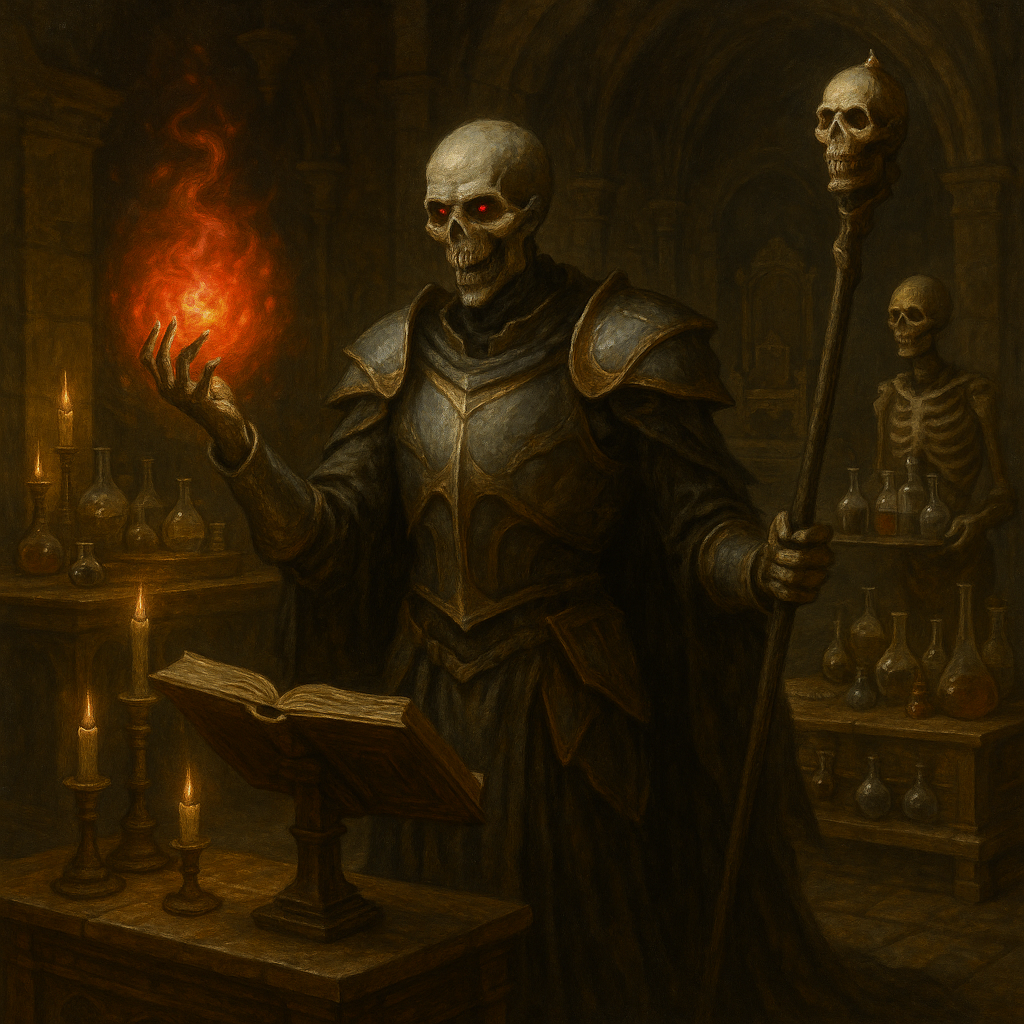
Lich
"You may cut me down a thousand times, yet so long as one shard of my soul burns in the dark, I will rise again to haunt your children’s children."
A Lich is not born but forged, an unholy craft that reshapes a mortal spellcaster into something neither living nor truly dead. Where necromancers merely borrow the strength of graves, and evokers hurl fire that fades when the battle is done, a lich wields eternity itself as both weapon and shield. Through the creation of a phylactery, a vessel housing their true soul, they sever the tether of flesh and cheat death, returning again and again so long as that vessel remains intact. In their hands, magick no longer follows the rhythms of mortal fatigue. A lich can unleash storms of frost, fire, or shadow in unrelenting succession, their skeletal bodies incapable of exhaustion. Their command of necromancy reaches far beyond the shambling puppetry of common corpse-raisers, a lich may call whole graveyards to stir at once, sew severed spirits into weapons of living flame, or tear the breath from a battlefield with a gesture. Where mortals bend and break from overuse of The Arcane, liches burn with ceaseless hunger, draining the souls of others to fuel their endless working. Beyond necromancy, liches wield terrifying mastery of Evocation, Illusion, and Abjuration, their sometimes centuries of study allowing them to bind their citadels in wards impervious to siege, shroud themselves in cloaks of false light, or obliterate armies with conjured storms. They are scholars as much as tyrants, memory unrotted by age, each spell refined across decades until it becomes perfect and merciless. The true horror of a lich lies not only in their raw ability but in their endurance. To fight one is to fight an enemy who cannot die. Cut them down, and their phylactery recalls them. Burn them, and they reassemble from ash. Starve them, and they feast upon the essence of the fallen. No kingdom may truly rest easy so long as its soil still holds a lich’s hidden vessel. This is why their very name is synonymous not merely with undeath, but with inevitability. They are famine given thought, winter given will, eternity given a crown.
Qualifications
Lichdom is not a craft that may be learned in apprenticeship halls or whispered through guild corridors. It is forbidden knowledge, scavenged from ruins, stolen from devils, or whispered by artifacts like the Staff of Unquiet Counsel. To even attempt the transformation requires mastery of necromancy and soulbinding, disciplines that already carry the taint of damnation. The would-be lich must peel away every tether to the living world, severing hearth, flesh, and spirit alike.
Among the grim steps:
- Phylactery Binding: a ritual of agony where relics, blood, and magick are boiled into a vessel. This vessel, often a chalice, gem, or bone reliquary, becomes the cage of the lich’s soul.
- The Final Severing: the act of suicide not to die but to be reborn, the body collapsing as the soul anchors elsewhere. Most fail here, crumbling to dust, their phylactery inert.
- Endurance of Eternity: only those whose will is sharper than death’s scythe awaken anew. The rest are forgotten as failed husks, their names devoured by the Arcane itself.
Requirements
To claim eternity, one must betray every law of mortal life. Phylacteries demand the marrow of saints, dragon bone, relic-ivory, or stones soaked in centuries of blood. The ritual consumes more than flesh, it devours kinship, memory, and mercy. Once transformed, the lich becomes an enemy to all natural law. The Arcane Coalition declares lichdom the ultimate heresy, punishable not by death, since death is meaningless to them, but by utter annihilation.
Appointment
There is no ceremony, no coronation. A lich crowns themselves through survival. Their “appointment” is proven only when they claw their way back from death, hollow-eyed, the echo of their soul burning in a vessel hidden away. In this, they are both the priest and the sacrifice, the crown and the executioner.
Duties
Liches serve no god, no kingdom, no covenant but their own survival. They do not till fields or swear oaths of loyalty. Their duties are singular, bent toward eternity itself:
- To feed their phylactery with the souls of the living, draining vitality to stave off oblivion.
- To harvest knowledge and relics, believing eternity grants them ownership of every secret.
- To rule in shadow, raising armies of dead or puppeteering cults, ever reaching further into the marrow of civilization.
Responsibilities
Where paladins bind themselves to gods, liches bind themselves to hunger. Their daily survival is ritual, flesh stitched against decay, relics scoured for nourishment, spells perfected to wring more essence from each stolen soul. They are custodians only of themselves, architects of eternity. Each responsibility they shoulder is a stone in the mausoleum of their endless reign.
Benefits
The fruits of their heresy are terrible indeed. Immortality grants centuries to hone spellcraft until even gods take notice. Armies crumble before their tireless legions of risen thralls. Kings bend knee to their patience, unable to wait out the eternal. Yet these benefits are not gifts but chains, binding the lich ever deeper into hunger, paranoia, and obsession. Theirs is a victory that tastes of ash.
Accoutrements & Equipment
No lich is bare-handed. They carry relics as other men carry knives, their most sacred being the phylactery, the vessel of their eternity. Around it orbit tools of ruin: grimoires bound in flesh, staffs like the Unquiet Counsel that whisper forgotten fire and frost, corpse-armors stitched from dragonhide, rings crusted with bone-dust that pulse with stolen souls. Each relic is less an item than a wound in the world, forged to anchor a creature who refuses to leave.
Grounds for Removal/Dismissal
There is no dismissal, no retirement, no quiet grave. To destroy a lich is to destroy its phylactery. Even then, it must be shattered, burned in sanctified flame, and sealed beneath consecrated soil. To fail in any step is to invite their return. For this reason, most who fight liches end not as victors but as bones in their armies, raised to mock the struggle of their final moments.
History
Lichdom was first birthed in the crucible of The Fall by many accounts, when Devils surged and mortals clawed for survival. Records differ, some claim it was a trick learned from The Hells, others a punishment wrought by the gods upon those who sought eternity without their blessing. In the chaos of The Great Schism, liches became warlords. They raised citadels of bone and hollowed cities into catacombs. Some still stand, ruins whispered to pulse with the echo of bells tolling for no one. Their histories are not written in parchment but carved in famine, plague, and endless winter. Each age of Everwealth bears scars left by a lich’s reign.
Cultural Significance
To Everwealth’s folk, liches are less beings than calamities. To see one is to see a kingdom’s doom unfolding. Mothers whisper their names as curses to still children’s tongues. Priests denounce them as mockeries of fate. Yet beneath the horror lies a seed of temptation. Among cabals and secret circles, liches are idolized, proof that eternity can be stolen. Some scholars, quietly, even within The Scholar's Guild, whisper that lichdom is the natural endpoint of all arcane pursuit, that every great magus is but a half-step away from eternity. But for common folk, no philosophy clouds the truth: a lich’s shadow means hunger, graves unquiet, and souls screaming into the night.
Notable Holders
Though lichdom is rare, Everwealth remembers its blasphemous saints:
- Seras Calgrave: Lich-lord of the southern wastes, whose reign lasted a century with the The Staff of Unquiet Cousel in hand. His citadel burned for seven years after his fall.
- Morwen Lakshmi: She who bound her soul to a chalice of black glass and worked beneath Halt-Cliff’s in secret, plucking souls from the grave until the living fled the city as she set legions of her taken dead upon it. The Arcane Coalition saw to her demise personally, though it is whispered her phylactery was simply recovered by a mole within the Coalition rather than destroyed as the reports say; And she now waits, whispering her legions from the grave once-more, plotting her ultimate revenge.
- Remus, The Bone King: A skeletal monarch of The Lost Ages, whispered by some to be the first of his kind. His phylactery, a gleaming crown of ivory and gold, was never recovered, though The Knights of All-Faith perhaps with... too much... fervor, insist it was shattered in their purges. His necromantic craft is cited as the pinnacle of lichdom, so much so that every scrap of his lore the Knights uncover is burned with fervent joy, as if fire alone could erase him. Yet doubt endures. Some scholars murmur that Remus accomplished the unthinkable: forging not one, but two phylacteries, his soul anchored in redundancies only he could fathom. If so, destruction of the crown was no triumph, but theater. In hushed taverns and damp cloisters, tales persist of a Bone King too cunning to fall, too steeped in death’s calculus to succumb to it. His crown, or its echo, is still said to whisper beneath the ruins of Tarmahc, cradle of men drowned in The Fall, lying in silence beneath The Laughing Sea. There, he waits, not defeated, but delayed, inevitable as tide and bone.
Status
Sparse, but present nonetheless; Perhaps their most startling feature, we know they are here, but we know not where, terrible foes that can strike with an army of your fallen kin at any moment.
Creation
The Bone King's manuscripts are some of the earliest evidence of Lichdom, dated to the later Lost Ages; But these scripts speak of masters, centuries of work based on pre-existing material, that each imply Lichdom has existed for a long, long time.
Equates to
Other lands name them differently, Phylactarchs to the Orcish, Death Magisters to the Dwarfish, Wraith-Lords to the Elfese, but in Everwealth, no title carries the same dread weight as “Lich.” A single syllable that means hunger, corruption, and eternity unearned. It is also their most common title, even among other cultures the name Lich is often interchangeable.
Source of Authority
The Lich themself and no one else, save for the educated vanquisher with enough strength to overwhelm them and knowing the location of their phylactery.
Length of Term
Indefinitely so-long as the Lich can maintain enough souls to power their phylactery. Often Liches will maintain a 'well' or 'font' of many captured souls within their lairs to ensure their availability.

Comments