
Studying Magick:
in Magick:"Knowledge is power, and power is a dangerous thing when left unchecked."
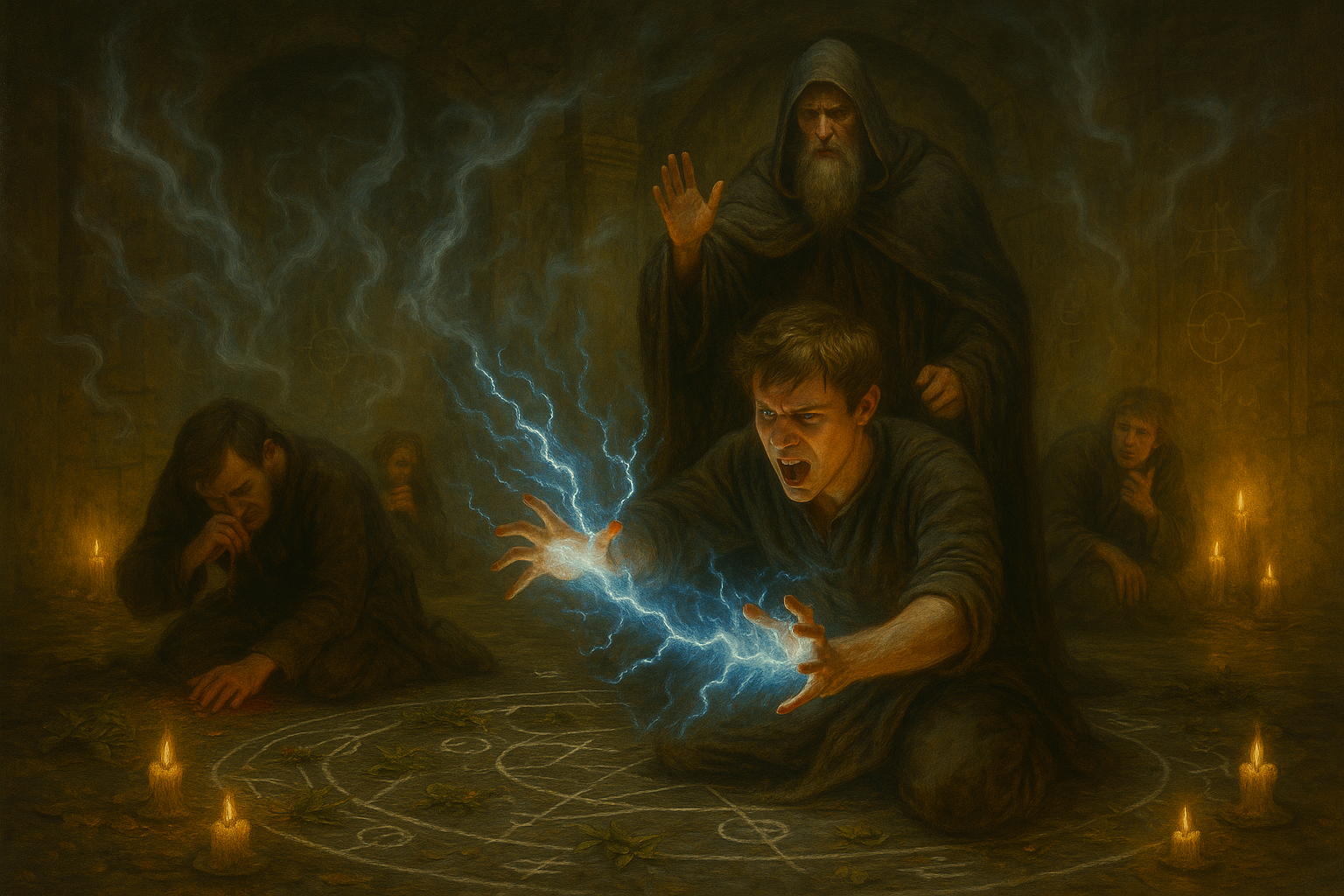
To study magick, is to enter a discipline older than nations; And as-feared as Apprentices begin not with spells, but with foundations, learning how magick behaves, where it gathers, and the many ways it can slaughter the unprepared. Students learn to read the weight of their souls, calculate the stress a spell places upon the body over and over. Before they ever conjure light, they are tested in philosophy, mathematics, anatomy, and the ethics of power; Curriculums designed to prove they are trustworthy before they are ever allowed to be talented. The institutions that teach these disciplines vary, but all require years of immersion before a student is ever permitted to receive the License to Practice Magick needed to bind even a simple charm on their own without facing an extended stay in a cold, damp dungeon where the guards consider their wails of agony a job well done. Higher study divides into distinct schools and pathways, each reflecting a different philosophy of how magick should be understood. Evokers study the primal forces, heat, cold, pressure, storm, and learn the laws that permit their reshaping. Enchanters focus on the structure of will, studying how objects interact with magick and how it affects tools, charms, or steel. Illusionists dissect perception itself, and while their work is less explosive, it is no less dangerous, the mind is a fragile vessel for magickal trickery. Alchemists walk the line between medicine and blasphemy, seeking to understand the living body as a canvas for Arcane flow. Each school has its own rituals, methods, controversies, and infamous failures, and every student must declare their specialty long before they are deemed competent to practice. In Everwealth, the study of magick is a labyrinth, beautiful, brutal, and tightly supervised.
Those seeking formal instruction may study under The Scholar's Guild, whose academies serve as the kingdom’s sanctioned repositories of magickal knowledge. These academies are sterile, orderly, and suffocatingly rigid. Tuition is crushing, entry is political, and failure is often catastrophic. Students spend days transcribing diagrams, nights measuring elemental thresholds, months undergoing examinations by scholars who fear error more than ignorance. The curriculum reflects the paranoia of The Arcane Coalition, The Monarchy's chosen regulators of magickal use; One mistake, one mispronounced syllable, one unshielded experiment, could reignite old horrors. Thus, the Guild trains mages not only to be skilled, but cautious, obedient to the systems that regulate them or facing a public execution at their hands. Beyond the Guild or joining the ranks of the coalition, are more esoteric routes, hidden libraries in monastery vaults, druidic inheritance taught in moonlit groves, itinerant hedge-masters who pass down secret craft to students willing to brave both danger and illegality. Independent study is technically permitted but practically impossible. These self-taught practitioners rely heavily on Everwealth’s scattered traditions, charm-crafting, folk-alchemy, elemental rites, dreamwork, or blood-oaths. Their methods are varied, intuitive, and steeped in local superstition, but no less valid than the academies’ meticulous note-taking. Many of the greatest breakthroughs in history were wrought by these outsiders, those who studied not out of privilege, but hunger, obsession, or necessity. Yet to study magick outside sanctioned halls is to risk the Coalition’s attention, and once they notice, every experiment, every text, every spark becomes evidence they use to justify locking you in a shed and setting it ablaze. To learn magick in Everwealth, one must choose a path not solely of knowledge, but of allegiance, and be prepared to pay for that choice with far more than coin.
All writing and lore by author Patrick Enger; All art done by Chat-GPT (for now).