
Drazahar
"Even the air here knows how to kill."
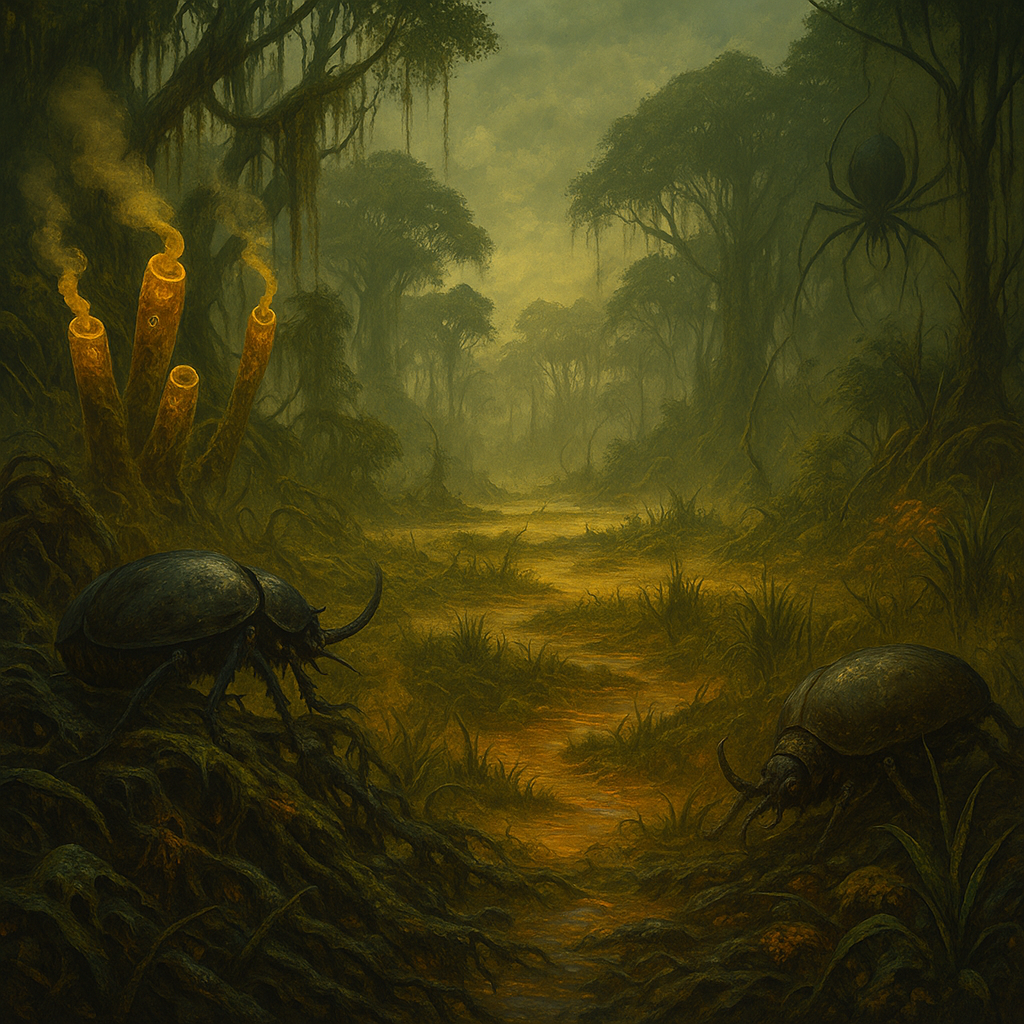
While this place may be the smallest of the five continents, there is more death in one mile of Drazahar than in all the wars Everwealth has ever fought. It lies far to the south, where The Laughing Sea clots with amber foam and the clouds never clear. From a distance, it almost looks tranquil, green jungles, golden marshes, rivers gleaming like veins of light, until one learns those rivers burn the skin, and that the forests hum with insects too large to see without terror. Drazahar was never conquered because it was never meant to be. Every expedition sent to its shores ends in fever, silence, or song, the kind the land itself seems to hum. Everything in Drazahar is hungry. The jungles drip with poison, the swamps sweat fever. Vast tube-plants breathe clouds of caustic mist when touched. The trees bleed resin that hardens into translucent amber husks, sealing away insects the size of Giants. Grass blades cut flesh. The rain carries living spores. Swamps hum at night with sangfly choruses, swarms of mosquitos whose stings induce weeks of fevered dreams, spiders weaving webs of silken filament hard enough to shear the armor of the unexpecting traveler. Some flowers open only at the sound of heartbeats, releasing pollen that chokes the lungs. Even still water is a trap, parasites lie dormant in reflections, waiting for a face to lean too close. To breathe here is to trespass. To bleed is to feed the soil. The Chitinians, four-armed, black-shelled, are its oldest children. They are not products of any cataclysm, nor offspring of any divine error, but the first witnesses to both. In ages when Dragons still fought over the heat of the sky, Chitinians already walked the resin fields and sang their hives into being. They marched on the other continents many times, to Kathar, to the shores of Tarmahc , even to the edges of the Elfese lands of Chikara that became Everwealth today; But their conquests never endured beyond their borders for long. The world rejected them like an infection. Yet Drazahar kept them, and they kept it. Neither would give an inch, and neither would die.
Culture
To the Chitinians, survival is sanctity. Their creed, the Doctrine of Continuance, holds that all life exists only to endure, that every wound, every mutation, every death feeds the cycle. Disease is not punishment but communication. They believe Drazahar itself is alive, testing all who walk upon it. They do not speak as mortals do; their language is vibration and color, their written words are scents. When they speak Common, it grinds like gravel, every syllable strained through layered mouths. Lies are forbidden, a disruption of the Pattern, the sacred hum that binds the Hive’s memory. Children are raised in communal Amber Nurseries, suspended in nutrient sap where they absorb the Hive’s resonance before they are even born. The dead are melted and poured into the Hive’s walls, their memories preserved as faint shifts in vibration. Every Chitinian lives in chorus with the ghosts of their ancestors.
Public Agenda
The Hives do not seek conquest. They seek balance, not peace, but persistence. They believe the other continents are infected with excess: civilizations that mistake expansion for meaning. They trade sparingly, resin, ichor, hardened chitin, the rare fungus that grows from the corpses of their dead, but never freely. Any who take too much are absorbed into the amber. Drazahar does not sell without a price.
Assets
- Ambersteel - Living resin hardened in flame; harder than dwarfish steel, flexible as bone.
- Ichor-Glass - Crystallized essence from subterranean worms; Glows faintly when near magick.
- Pathogen Gardens - Hothouses of cultivated diseases; used for war, medicine, and prophecy alike.
History
Drazahar’s age predates every, standing, mortal record, even the myths of The Fall whisper that it was old when the stars were young. Scholars argue whether it is the world’s first landmass or its last scar, the place where creation bled and cooled into permanence. The Chitinians claim their ancestors emerged from beneath that amber crust fully formed, the first to walk the resin fields when the air itself was poison. To them, Drazahar is not simply home but the mother of all endurance, a land that does not forgive weakness, only reshapes it. Many believe dragons themselves were born here. The deepest amber caverns hold fossilized eggs large enough to house a small cottage, their interiors fused with molten gold and strange, metallic bone. The Chitinians hum that the “First Breath”, the fire that once scorched the heavens, rose from these resin wombs before the world even knew death. Some whisper that the dragons were Drazahar’s fever made flesh, its first dream given wings. To this day, amber still burns where lightning strikes the old nests. Empires have come and gone, yet Drazahar remains unchanged, a living relic of evolution by suffering. Its Hives remember ages before the Schism, when amber fleets once sailed to distant shores, and its soil remembers every trespasser it has devoured. The continent has never known conquest, only infection, and it endures as it always has, humming, festering, and dreaming beneath a crust of gold and rot.
Demography and Population
Roughly half a million Chitinians, distributed among more than twenty Hives, each with a unique hum-pattern and coloration. No human or dwarf settlement endures longer than a single season. Though Chitinians dominate, the continent has not remained theirs alone. Whogi, drawn by the endless swamps and mists of the lower basins, have carved out narrow territories at the continent’s edges, clusters of reed-huts and mud sanctuaries clinging to the safer bogs. Their skill in alchemy and natural resistance to toxins have allowed them to survive where even Chitinian larvae perish. They trade their hallucinogenic brews and insect medicines with certain Hives, tolerated so long as they “sing in harmony” with the land. Serpentine, exiles and opportunists from the drowned islands of Tarmahc, have slithered into the salt marshes and resin deltas of southern Drazahar. Here, they build spiral enclaves from coral and amber, breeding poisonous flora into living architecture. Their disciplined nature grants them uneasy coexistence with the Hives, but their obsession with control has earned them deep distrust. The Chitinians call them “the silent coil”, foreign flesh that does not hum with the land. Both races are tolerated, never trusted.
Territories
Drazahar is less a continent than a living wound, and the Chitinians are both its children and its caretakers. Their Hives rise where the land permits, not by right, but by consent. Each region bears its own temperament, some calm and resin-rich, others murderous to the touch. The Chitinians claim descent from the First Brood, the original inhabitants of Drazahar, birthed from the amber wombs that bubbled up after The Fall. Their hold is ancestral, yet never secure; they do not own the land so much as persist upon it. Every Hive that grows too bold is soon reclaimed, buried by creeping root, drowned in spore floods, or devoured by the continent’s fauna. No foreign colony has ever lasted. Human prospectors rot in their tents before the first harvest, and dwarfish miners vanish beneath resin tides. The soil itself rejects outsiders, its hum turning violent in the presence of foreign blood. Drazahar’s borders are fluid and treacherous, defined not by map or treaty but by sound, the frequency of the land’s pulse. Beyond the range of the Hive’s song lies wilderness too hostile even for the Chitinians, where the air corrodes lungs and the light carries fever. For all their history of failed conquests and ancient wars, the Chitinians have never left Drazahar, and Drazahar has never let them go.
Military
The Resin Hosts are less an army than a biological reaction, the continent’s immune system given form. When called to war, warriors molt into combat shapes, their shells seeping resin that hardens into amber armor. Weapons grow from their limbs like calcified thought, resinous blades that hum in the air, vibrating mauls that crack bone and steel alike, and caustic bile that burns magick on contact. But those days of unity are long past. The amber fleets that once crossed the seas have been claimed by the tide or turned to reefs of solid sap. Their war-songs no longer echo across foreign shores, and the world no longer fears the amber sails on the horizon. The great Hives that once cast their shadow upon the oceans now war only with themselves. The Hosts still exist, thousands upon thousands of soldiers, each Hive breeding its own martial breed, but now their campaigns are inward. Whole armies vanish into the jungles chasing echoes of rival hums. Skirmishes are fought over water, over resin veins, over the right to feed a Hive’s heart. The Chitinians’ wars are slow, feverish, and endless; they do not conquer, they correct, tearing down whatever grows too high. Civilization, such as they once knew it, does not survive long in Drazahar. The land refuses order. Cities collapse beneath the weight of overgrowth; walls are eaten by moss that digests amber as easily as flesh. Every attempt at unity becomes another song of dissonance, and the jungle always wins. Those who remain are hardened, tribal, and half-feral, the Remnant Hosts, warriors who remember conquest only as myth. They polish their armor with ash, carry heirloom weapons of dead resin, and hum the war-hymns of ages when their kind stood tall against the world. Yet even their might is tempered by the land that birthed them. For every blade they raise, a thousand vines reach back. To invade Drazahar is to declare war on its atmosphere. To live there is to fight for your life every single second.
Technological Level
All Chitinian technology is organic. Their forges digest metal. Their armor breathes. Their lamps are glands that exude light. They record knowledge in Resonant Nodes, lumps of amber that vibrate with encoded memory, not readable by eyes, but by feel. Their magick is sympathetic, control of growth, decay, and mutation through rhythm and hum. The line between spell and instinct no longer exists.
Religion
What is worshipped here are no gods, but continuity. Their faith is The Continuance, the belief that the world must always repair itself, even if the repair is monstrous. Death is never final, the Hive remembers. The most sacred ritual is The Unbreaking, a great hum in which thousands synchronize their resonance until the Hive trembles. When the vibration peaks, the amber glows from within, as if something deep below has answered back.
Foreign Relations
Drazahar does not deal in alliances, only tolerances. The Chitinians do not seek diplomacy, they do not trust it and never have; Domination or death was always their creed. To them, every treaty is a delay in conflict, every handshake a test of contagion. When they trade, they do so from behind resin veils or through intermediaries who never live long after the exchange. What little contact the continent keeps is born of necessity, not trust.
- Everwealth - cautious trade. The amber and ichor markets are worth fortunes, but the risk is legendary. Ships that dock on Drazahari shores often return warped, their hulls sweating resin, their crews coughing up gold dust.
- Kathar - mortal enmity. Katharan hunters once captured Chitinians to extract their venom; their bones now hang as trophies in the Hives. Any Katharan vessel sighted near Drazahari waters is sunk on instinct, its remains left as warning to the tides.
- Naumos - mutual curiosity. Aquian scholars alone can survive the mists long enough to barter, trading pressure-glass for ichor. The Chitinians call them “Deep Hummers,” claiming their voices echo like the sea’s pulse.
- Kibonoji - Theological hatred. The Elfese claim Drazahar is proof that nature without hierarchy is shameful. Missionaries sent to “cleanse” the continent are never seen again, sometimes, their bones wash ashore engraved with hymns they never wrote.
- Arcryo - Wary distance. The frozen continent and Drazahar share no trade, no dialogue, only recognition, predators too different to hunt one another. Yet some Chitinian myths speak of the “Quiet Cold,” a hum so deep it might be kin to their own.
- Malabash - Reverence. The Chitinians call it The Silent Hive, a mirror continent they claim hums in its own language of storms. Some believe Drazahar and Malabash are the same land, torn open on opposite sides of the world.
Laws
In Drazahar, law is not written, it is remembered in vibration and smell. The Chitinians have no courts, no prisons, no advocates. Their justice is instinctive, ancient, and absolute. To live among the Hives is to understand that survival is law, and that the Pattern, the great hum that binds them, does not forgive dissonance. A crime in Drazahar is not judged by motive, but by consequence. Anything that weakens the Hive, that disrupts the balance between land and life, is punished without deliberation. The soil itself is said to carry scent of guilt; When a liar breathes too deeply, the ground exhales spores that cling to them until sentence is carried out. The Laws of the Hive are few, but final:
- Disrupt not the Pattern. Those who defy the hum, heretics, saboteurs, or oath-breakers, are dissolved into resin and reabsorbed.
- Waste not the living. Every drop of flesh or ichor has a purpose; to discard is sacrilege.
- Lie not with scent. Deception is considered a disease of the spirit, cured by cauterization or exile.
- Refuse not the Chorus. When summoned by the Chitinian, every voice must answer. Silence is rebellion.
Agriculture & Industry
Farming in Drazahar is an act of negotiation, not dominion. The soil bites back, the rain burns, and the roots grow faster than any blade can tame. Crops are bred to resist decay by decaying first, mushrooms that shed their skins hourly, tubers that exhale hallucinogenic spores to ward off pests, vines that sting when harvested. To eat here is to risk infection, and to harvest is to bleed. At the heart of Drazahari industry stands the Amberwomb Tree, a towering, translucent species whose sap hardens into golden resin stronger than tempered steel. These trees are both sacred and dangerous, their roots drink toxins and magick alike, and their fruit glows faintly in the dark, pulsing with stored energy. When wounded correctly, sung to, not cut, they exude a honey-thick resin that can be refined into Ambersteel, the material from which the Hives’ domes and armor are grown. The Chitinians do not mine, they coax. Every weapon, wall, or vessel begins as a seedling or secretion, shaped through heat, hum, and patience. Their forges are gardens, their foundries swamps. Nothing is wasted. Flesh becomes fertilizer, blood becomes lacquer, death becomes design.
Trade & Transport
Trade in Drazahar is a sickness that learned to walk. Nothing here truly travels, it crawls, it seeps, it hums. The Hives are connected
Education
In Drazahar, learning is survival, and survival is the only lesson worth remembering. The Chitinians do not teach through words or classrooms, but through endurance. A hatchling learns the pattern of poison by tasting it once and living through the fever. A young warrior learns strength by carrying resin until it fuses to their shell. A Mender learns anatomy by rebuilding what the jungle breaks. Knowledge is transmitted through resonance, scent, and trial, never instruction. Elders allow the wild to test the young, for they believe the land itself educates best. Those who survive venom, famine, or fever are said to have “heard the land’s answer.” Those who do not are simply reclaimed by it. To study in Drazahar is to bleed, molt, and continue. Failure is not punished, it is composted, remembered in the hum of the Hive.
Infrastructure
Nothing built in Drazahar stands still for long. The land swallows foundations, the vines digest stone, and even the amber walls of the Hives slowly melt back into the soil that birthed them. Roads are little more than packed resin trails carved through fungus-choked swamps, devoured and regrown each season. What passes for architecture is alive, bridges that flex with weight, towers that hum with breath, dwellings grown from hardened chitin rather than raised by hand. The Hives themselves are both city and creature, expanding and collapsing as instinct demands. Attempts to craft permanence always fail. Fortresses rot from within, aqueducts sprout mold that drinks their own flow, and every machine must be fed to keep from being reclaimed. To dwell in Drazahar is to build knowing that time and the land will undo your labor, and to accept that this, too, is part of the pattern. The Chitinians do not mourn decay, they expect it. Their civilization is not measured in years, but in how long a structure hums before it sinks back into silence.
Demonym
'Drazahari'.
Gazetteer
Drazahar is not a mapped land, it is guessed at. No expedition has ever charted its entirety, its borders shift like tides of rot and regrowth. The following are known and whispered landmarks, drawn from Everwealthy cartographers and Scholar’s Guild logs sealed under warning sigils.
- The Marrow Vale: A basin of mist and bone-white mud that devours sound. The ground exhales fever-spores, and at its center, fossilized towers rise like ribs. Said to be where the oldest Hive still hums beneath the soil in secret.
- The Shattered Shoals: A stretch of coastline made of fused amber reefs and shipwrecks. The sea itself is viscous here, some say alive, and it has a habit of keeping what enters.
- The Viscera Plains: Blackened fields where plant and animal have become indistinguishable. Giant moss-beasts roam here, half-tree, half-carapace, and entirely hostile.
- The Hive of Ashen Tone: One of the few surface Hives, its amber walls scarred gray from failed bombardments. Its hum is said to cause nosebleeds for miles around.
- The Resinway: A network of natural tunnels linking the major Hives. Lined with bioluminescent veins and warm to the touch, it is the closest thing Drazahar has to a highway.
- The Ichor Pits: Sunken wetlands that glow faintly blue at night. Beneath their film lie creatures that breathe ichor instead of air. Alchemists claim the pits weep the blood of the land itself.
Currency
The Chitinians do not use coin. They weigh worth. Every transaction is marked by scent and secretion, exchanged through resin tokens called “Resin Weights.” Each is infused with pheromones that encode ownership and value, detectable only to those trained to “read” them by smell or vibration. To outsiders, these appear as faintly translucent amber discs. But among the Hives, no two are identical, their scent and hum cannot be forged. For foreign trade, the Chitinians use Amber Beads or vials of Ichoric Fluid, both valued by Everwealth’s black markets as much as gold, though feared for their tendency to hum when handled. There are no denominations. Value shifts with need, scent, and scarcity, a living economy bound to biology, not mint.
Major Exports
Drazahar exports only what it can shed, the excess of its wounds, the refuse of a continent still rebuilding itself. Its wares fetch fortunes abroad but are cursed in reputation, often traded under false names.
- Ambersteel: Magickally conductive resin alloy, strong as dwarfish forge-iron and nearly weightless.
- Amberwomb Resin: The semi-living sap used to create ambersteel, in its raw form useful for a range of applications from adhesives to flammable agents.
- Chitinian Carapace: Shed plating hardened by age, sold as decorative relics or somewhat macabre armor plating.
Major Imports
Trade with Drazahar is rare and short-lived. The continent takes only what it cannot grow or shape itself, and even that reluctantly. Foreign goods arrive encased in resin to prevent contamination.
- Refined metals and Everwealth grain (for alchemical study, not consumption).
- Glasswork and instruments from Naumos, used for resonance calibration.
- Limited magickal reagents, though most are rendered inert by the air before use.
Legislative Body
There is no parliament, senate, or council. The Hives are ruled by The Chorus, a collective of resonant Speakers whose harmonized voices shape law through vibration. To propose a law is to sing it, a low, thrumming chant carried through the Hive’s amber walls. When the Chorus reaches perfect harmony, the vibration is absorbed by the Hive itself, etching the new law into its structure. The amber changes color, and the rule becomes part of the land. When discord arises, the law fades, quite literally melts away. Thus, law in Drazahar is both audible and physical, only as enduring as the unity that created it.
Judicial Body
Interpretation of the Pattern’s will is left to the Menders, a caste of priest-artisans who maintain the Hive’s physical and moral integrity. They diagnose discord in the Hive’s hum and decide whether it stems from sickness, sin, or sabotage. Verdicts are delivered through ritual vibration: a series of tones sung into the accused’s carapace. If the body resonates with the Hive’s song, they are deemed innocent. If it resists, they are dissolved and reforged into amber tools, eternal instruments of harmony. The Menders answer not to kings or gods, only to the Pattern. Their judgments are absolute, and their tone never wavers.
Executive Body
The Resin Hosts serve as Drazahar’s enforcers, both soldiers and living extensions of the Hive’s will. Once warriors, now humbled, they act less as conquerors and more as immune cells. Their purpose is internal maintenance, purging infection, quelling rebellion, silencing dissonant Hives before they fracture the continent further. Command is decentralized. Orders are transmitted through vibration, carried by the land itself, allowing entire hosts to mobilize without speech or heraldry. In times of unrest, the Hosts emerge from beneath the resin soil like an immune response, fight until harmony is restored, then return to sleep. No banners. No victory. Only balance.

Comments