
Arcryo
“Beyond the last map and the last dawn lies Arcryo, where breath turns to glass, and even the gods go silent.”
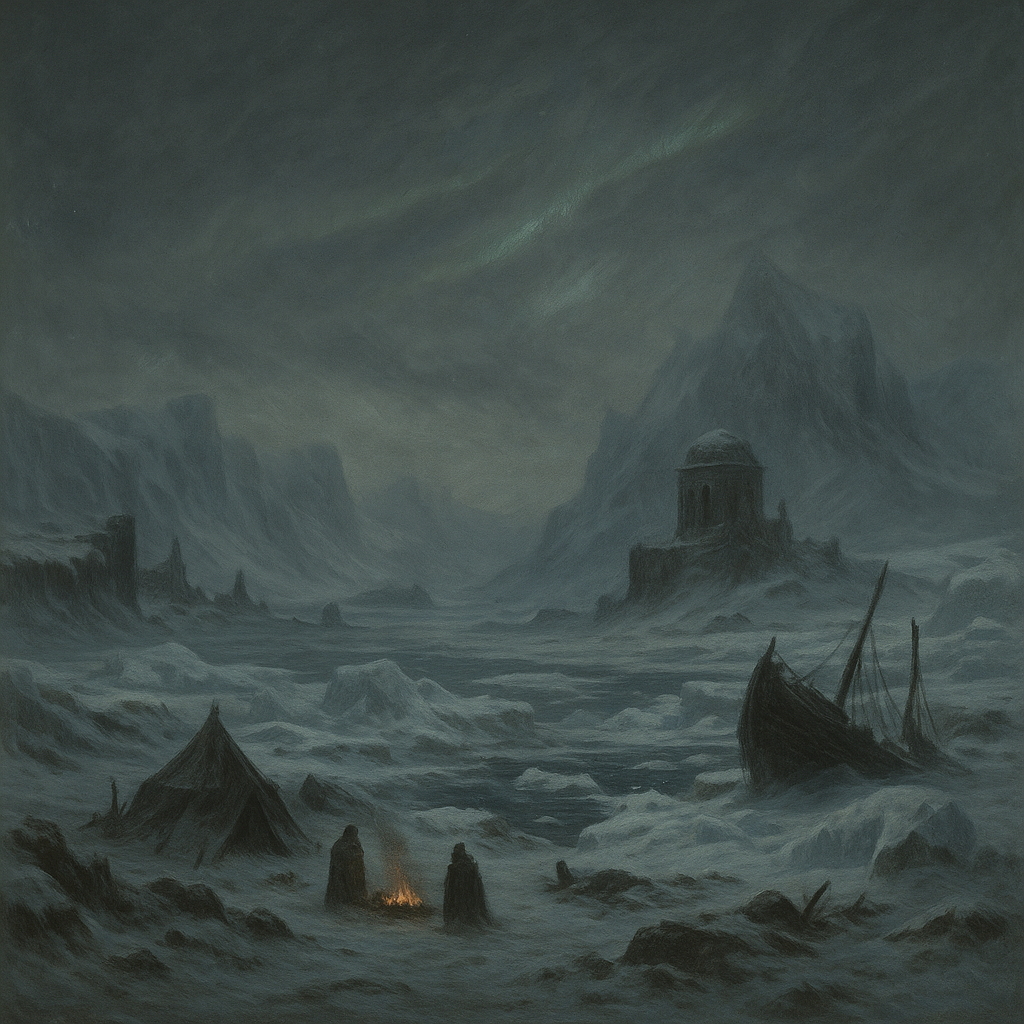
Arcryo is the northernmost and largest of Gaiatia's five continents, an endless wasteland of ice, snow, and silence. Here, blizzards are walls, the air itself a weapon, and the horizon never still. No sun truly rises over its wastes, only a pale, ghostly shimmer cast by distant auroras. To most of Gaiatia, Arcryo is less a place than a threat, the edge of the world, where the cold devours not just flesh, but thought. It has been nearly a thousand years since any have mapped its shores in full; those who try vanish into the white, their compasses spinning, their corpses frozen in place like grim way markers for the next fool. Few mortals survive here, and fewer still are born to it. What ruins remain, broken observatories, frost-buried monasteries, or long-dead mining stations, belong to ages that thought the world could be tamed. Now they lie half-swallowed by glaciers, their fires long extinguished. Rumors persist of vast structures beneath the ice, cities encased in frozen time, their walls glowing faintly from within. Some claim these lights are the souls of those who died here, others say it is magick older than The Fall, still trapped and dreaming beneath the frost. Trade is impossible, survival improbable. Even The Scholar's Guild abandoned its expeditions centuries ago after a dozen failed returns. The air kills the unprotected, freezing lungs and eyes in moments; magick falters, compasses lie, and sound travels too far or not at all. Only pirates and heretics dare the coasts now, salvagers drawn by whispers of buried Viridite veins or the promise of draconic bone and scale. None last long. Yet Arcryo endures, vast, unchanging, patient. The Moon-Kin call it “the Cradle of Quiet,” and perhaps they are right. It is a place where magick sleeps, where time itself seems to hold its breath, and where the cold is an appetite that consumes all in its breadth.
Those who dream of exploring it speak of glory. Those who wake from it speak of nothing at all. But Arcryo is not dead, though it wears the cold shape of death well. Beneath its glacial shell, veins of Pyrrhium still pulse faintly, the last embers of a celestial wound left by The Fall. The ice groans with ancient memory, shifting, splitting, revealing glimpses of black caverns that seem carved by neither tool nor time. Explorers who’ve peered too long into those depths speak of heat rising from below and of light that flickers in steady, deliberate rhythms, like the pulse of something dreaming. To most, these are tricks of reflection and exhaustion. To the Moon-Kin, they are proof that Arcryo is alive, that the cold itself breathes, and hungers. Those who return from its borders are rarely unchanged. Some lose speech, some sight, and a few come back hearing voices in the wind that know their names. Dwarfish airmen tell of seeing seas moving beneath the ice, their depths filled with gold and scales the size of keeps. When the auroras flare, the land hums, a sound that rattles through steel and bone alike. Then comes silence again, thick and absolute, as if the continent is listening back. No nation claims Arcryo, for none can. It is not merely inhospitable, it is indifferent. Empires have tried to tame it, scholars to measure it, prophets to explain it. All have failed. The cold does not conquer. It erases, patiently and without malice, until even the memory of warmth feels like a lie.
Structure
Arcryo has no borders, no rulers, no governance beyond the frost. What remnants of civilization persist do so in scattered enclaves, half-collapsed mining colonies, bone-walled monasteries, and drifting ice fortresses manned by exiles. Each survives by ritual and repetition, not progress. Leadership is transient, decided by endurance; when a leader freezes, another stands in their place until the cold takes them too. No cities endure, only outposts that flicker like dying stars across an eternal white horizon.
Culture
The few who live upon Arcryo’s periphery are shaped as much by silence as by blood. The Moon-Kin revere the land as sacred, an open tomb and cradle both, believing the ice to be the veil between worlds. Theirs is a culture of restraint, marked by quiet rites and songs sung only under the lowest of light. Among the Whalers of the Southern Teeth and the Frost-bound remnants of northern Folk, survival itself has become ceremony: to eat, to breathe, to burn even a single fire is to commit an act of rebellion against the void.
Public Agenda
There is no organized intent across Arcryo, only persistence. The Moon-Kin seek communion with what they call the Sleeping Sky, interpreting the land’s tremors as messages from gods buried beneath the frost. Whalers and scavengers hunt more from instinct than ambition, and the rare scholars who return from the wastes speak only of containment, warning that some doors beneath the ice should never be opened. In Arcryo, purpose itself freezes alongside the body.
Assets
What Arcryo holds, it hoards in silence. Beneath its glaciers lie veins of Pyrrhium and Viridite, magickal metals dormant yet volatile, glowing faintly when storms converge overhead. Fossilized leviathans entombed in the ice provide bone and oil for the few who dare harvest them. Its coastlines, jagged and ever-changing, conceal drowned Pre-Schism observatories and shipwrecks still humming with dormant wards. Every expedition brings wealth enough to tempt, and cold enough to kill.
History
Long before The Great Schism, Arcryo was believed to be a celestial wound, an impact site where the world first cooled from fire into flesh. Early Dwarfish expeditions mapped its southern glaciers, building sky-caravans to harvest the minerals below. None lasted. The cold advanced, swallowing halls, machines, and memory alike. By the time of The Fall, Arcryo was already legend: a place where time stood still and where the gods’ first breath still lingered, frozen in the air. In the centuries since, only ghosts and Moon-Kin have endured it, and both seem equally eternal.
Demography and Population
There are no thriving peoples in Arcryo, only those who persist by accident or curse. Population estimates are impossible; the land itself swallows records, graves, and names alike. The few who endure the continent’s edges, the Moon-Kin, scattered whaler clans, and rare southern scavengers, number perhaps a few thousand souls at most, though even that count fluctuates with every storm. Births are celebrated as miracles, but deaths are constants, expected as the tide. For every child born beneath Arcryo’s auroras, three die before their first thaw. The old rarely live long enough to be buried; they are given to the ice, seated upright with their eyes open toward the lights, so their spirits may join the silent chorus above. Disease is rare, there is no warmth enough to breed it, but starvation, exposure, and the white fever take dozens every season. Communities form in fits and fractures , tiny outposts clinging to half-buried ruins or drift-ice flotillas. Populations shift with the weather; a single blizzard can erase an entire village, leaving nothing but ice mounds and whispering auroras. Of those who remain, most are transient, driven by hunger or superstition from one frozen graveyard to another. To live in Arcryo is not to dwell, it is to delay dying. Each generation is smaller than the last, their lives measured in heartbeats between storms. The Moon-Kin call this attrition “the Long Culling,” and believe those who fall become the wind itself, guiding the rest toward shelter. It is a cruel mercy, perhaps the only kind the North allows.
Territories
The largest of all continents, Arcryo spans a third of the world’s northern hemisphere. Its borders are fluid, defined by ice floes and the grinding of glaciers. The southern rim occasionally sees ships from Kathar or Everwealth daring its frozen bays, but farther north there is nothing but white horizon and silence. No one truly “owns” Arcryo, it owns itself.
Military
Arcryo has no armies, only the will to endure. The few who survive its white desolation form no nations or ranks, only scattered hunters, whale-sentinels, and Moon-Kin warbands who guard what little warmth remains. Their weapons are bone, frost, and magick half-forgotten, their battles fought against hunger and the cold more than any foe. When strangers trespass upon the ice, they meet silence first, then the wind, then the Pale Hunts, xspectral warriors who move through blizzard and shadow like the ghosts of the dead. No army could ever conquer Arcryo; the land itself is its defense, its snow swallowing steel, its storms tearing Airships from the heavens, its cold killing even memory.
Technological Level
Arcryo stands at the threshold of regression and myth. Its inhabitants wield a primal ingenuity forged by necessity. Steam freezes, steel shatters, and enchantments fracture under auroral flux, yet life endures through bonecraft, alchemical oils, and instinctive magicks tied to lunar resonance. The Moon-Kin’s “coldlight” relics, spheres of trapped illumination that never extinguish, remain one of the few true wonders of the North, their origins unknown. To the scholars of Everwealth, they are proof that even extinction can be luminous.
Foreign Relations
Arcryo maintains no diplomacy, only warning. No envoys, no merchants, no treaties. Everwealth’s expeditions avoid it after the last survey ship returned with half its crew frozen solid mid-motion, their faces serene. Kathar’s war-merchants speak of ice-locked treasure fleets still visible in the distance, while Kibonoji’s scholars whisper that the Moon-Kin were once kin to their own Elfese ancestors, long since devoured by the snow. Tarmahc’s surviving ports sometimes receive driftwood carved with Moon-Kin runes, washed ashore like offerings. None know if they are greetings, or grave markers.
Laws
The laws of Arcryo are simple and terrible, keep the fire lit. Do not eat the dead. Do not sleep beneath the open aurora. These are not suggestions, but survival. The cold punishes all equally, and superstition has long become scripture. Among Moon-Kin, violating sacred taboos is said to draw the gaze of the “White Leviathan,” a god-beast said to emerge from beneath the glaciers to consume the soul. Most obey not out of faith, but fear.
Agriculture & Industry
Nothing grows naturally in Arcryo. Farming is impossible, and the land yields only death and bone. What passes for industry is scavengin, whale harvesting, seal rendering, relic-salvage from buried ruins. Some Moon-Kin cultivate Frostbloom Kelp, a pale fungus that glows faintly beneath the sea thatvcan be fermented into a bitter, hallucinogenic liquor used for warmth or prophecy. Trade in these goods is minimal, and most of what is “produced” is consumed locally to survive another storm.
Trade & Transport
There are no roads, only ice drifts and frozen seas. Travel occurs on sledges drawn by bonehounds, or over the glaciers on hooked boots and madness. Whaling skiffs crawl along the coastlines during the rare thaws, and relic-salvagers from the south sometimes anchor at the edges of the ice shelf to haul up what the storms uncover. Navigation depends more on sound and instinct than sight, as the auroras twist the stars into unfamiliar constellations.
Education
Education in Arcryo is oral and ancestral. The Moon-Kin teach through story, gesture, and the reading of the auroras’ shifting script. To learn to listen, to the ice cracking, the wind’s tone, the silence between heartbeats, is to survive. Knowledge from the south has no place here; books freeze, ink splits, and parchment turns brittle as glass. The only lessons that endure are those carried in memory.
Infrastructure
Arcryo’s infrastructure is a skeleton, ice tunnels, whale-bone bridges, frost-sealed caverns. Firepits are sacred centers of community, often ringed by bones carved with runes to hold heat longer. Abandoned pre-Schism observatories and mines serve as fortresses for scavenger bands. The Moon-Kin’s sanctuaries are said to be carved directly into glaciers that sing when the wind passes through, a haunting melody that carries for miles.
“The Cold Endures.”
Founding Date
These lands have remained practically un-inhabitable throughout Gaiatia's history. The exact date it was named has been lost, but it has been called such as-far-back as two-thousand years.
Alternative Names
'The Frost Sanctum', 'The Quiet Dominion', 'The Pale Empire', 'The Sleepless Tundra', and 'The Glacial Choir'. Among outsiders, Arcryo is sometimes called 'The White Grave', a name born of its deadly cold and the belief that no sound escapes its storms.
Demonym
Arcryan (plural Arcryans) also known colloquially as “Frostborn” or “Icebound.” Used to describe citizens of Arcryo, or those whose bloodline traces to its polar monasteries and frozen citadels.
Gazetteer
Arcryo has no true cities, only scars that remember them. Along the Southern Teeth, clusters of frostbitten shanties cling to black stone cliffs, their walls made of whale-bone and iron scrap from ships long frozen into the ice. The most stable settlement is Frostmarrow, a whaling outpost turned graveyard of hulls, where scavengers and Moon-Kin barter over seal fat and scavenged relics by dim oil light. Farther inland lies The Pale Observatory, an ancient pre-Schism ruin half-buried in a glacier, its great lens pointed eternally toward a sun that never rises. Those who enter its halls report faint echoes and moving shadows, as though the stars themselves walk its corridors. Beyond this, geography dissolves into myth, rumors of an alien cathedral entombed beneath miles of ice, and the coldest edges of The Laughing Sea, where the ocean has frozen mid-tempest, preserving waves taller than mountains.
Currency
Trade is rare enough to make coin irrelevant. Barter is king, measured in warmth and survival. Whale oil, tonics, preserved meat, and working Firearms are the closest things to currency. Among the Moon-Kin, crystalline discs known as Lunites are used ceremonially, thin shards of refracted glass said to hum faintly when held under aurora light. They hold little practical value beyond their beauty, but travelers prize them as proof of having survived the North.
Major Exports
What little leaves Arcryo is strange and coveted, dragon bone, crystallized ice, whale oil, and shards of aurora glass harvested from lightning-struck glaciers. Scholars prize these for their magickal properties, each hums faintly when warmed, and some can hold enchantments longer than steel. But every shipment comes at a cost measured in lives.
Major Imports
Nothing living reaches Arcryo except fools and the desperate. The few trading ventures from Everwealth bring firesteel, salt, and furs in exchange for draconic bone, whale oil, or frostbloom powder. These expeditions are rare and increasingly condemned as suicide missions.
Legislative Body
There are no lawmakers in Arcryo, only those who live long enough to be believed. Within Moon-Kin enclaves, traditions are maintained by a circle of elders who speak in unison beneath the auroras, claiming to echo the still voice beneath the world. Their word shapes what law exists: never burn the dead, never wake the sleeping ice, never speak a god’s name beneath open sky. To break these is to invite the cold itself to judge you.
Judicial Body
Justice in Arcryo is immediate and final. Among the Moon-Kin, punishment is handed down by masked figures who wander between encampments, carrying relic-blades of unknown make. They listen to the accused, consult the auroras, and then act, sometimes with exile, sometimes with silence. The condemned are often left outside the camps, their bodies freezing upright by dawn. To the Moon-Kin, this is not cruelty, but balance; to interfere with fate is seen as hubris.
Executive Body
What passes for enforcement is survival itself. Each enclave, shipwreck, or whaling station maintains a loose system of watchmen, trappers, and scavengers armed with harpoons or ice axes. The Pale Keepers act as both spiritual and temporal executioners, while Frostmarrow’s whalers enforce their own maritime codes with fists and rope. Across the wastes, there is no higher authority, only the cold’s indifference and the fragile oaths men swear against it.
Location

Comments