
Dragons
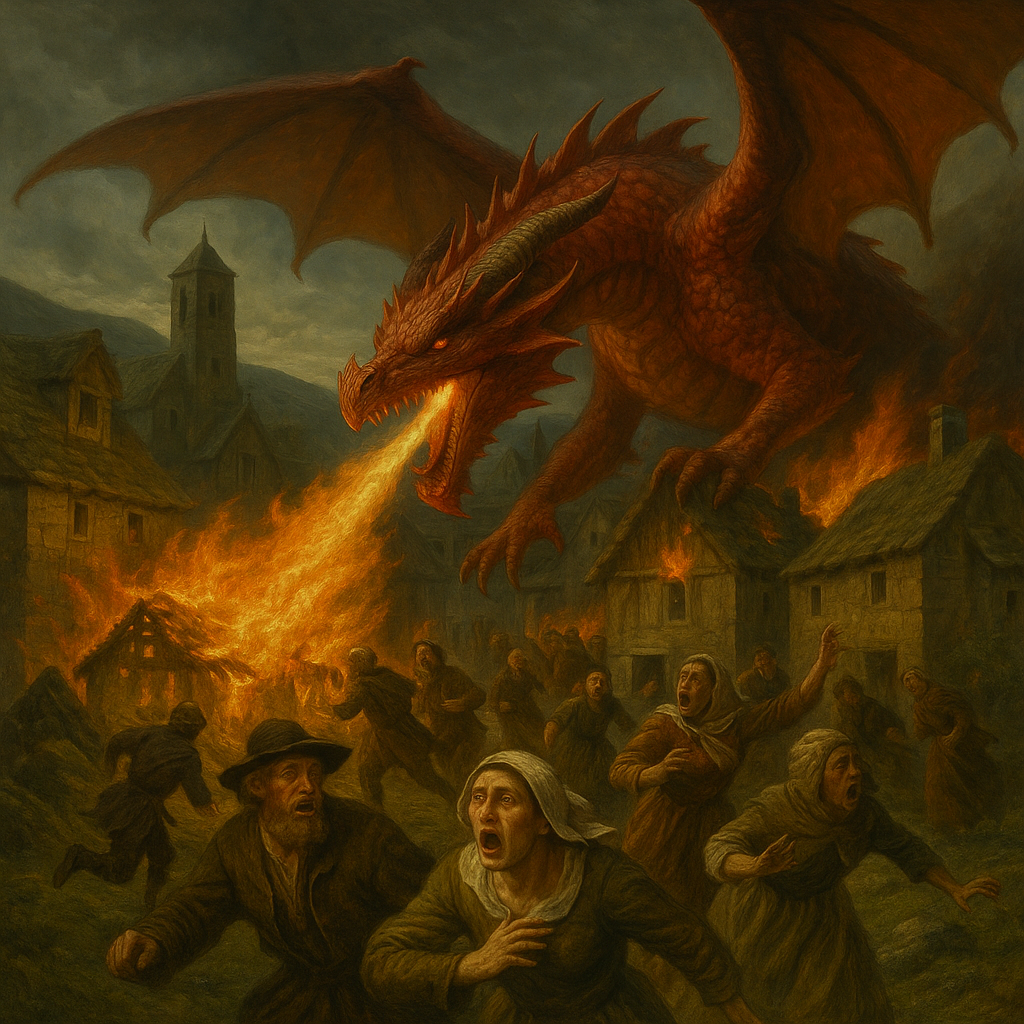
"The town-taker".
There are no greater monsters on Gaiatia, and none so dreadful in legacy. Dragons are not beasts, they are hunger that learned speech, malice that grew a skeleton. Their wings are the shadow before extinction, their eyes the first stars seen by the dying. When they descend, they do not kill, they erase. Cities vanish in a single breath; fields become glass; the soil itself screams. The land remembers them only through absence. Where once stood villages and shrines, only bone ash and melted coin remain, and the wind carries names no tongue will speak again. They do not visit, they correct. Their presence is not a hunt, but a revision of the world, every living thing a mistake they are compelled to unwrite. Once nearly hunted to extinction before The Great Schism, the arrogance of folk turned our victory to invitation. When the Firearms and the Tanks meant for them were turned upon one another, the skies were left unwatched. Freed from persecution, the dragons bred unseen in mountain crypts, drowned temples, and old volcanoes still warm from their last sleep. Generations passed. Hunters became myths, and then became meals. By the time the towers of men looked upward again, the stars themselves had begun to move. They return now like memories we forgot to fear, vast, soundless, methodical. Each new settlement that rises becomes a wager against inevitability, and the dragons always collect. They are the architects of our ruin, patient masons of apocalypse, the reason our age never outgrows its ashes. Yet hunger alone does not drive them. It would almost be mercy if it did. They delight in suffering, not for sustenance but for art. They linger over their kills, listening to the shapes of screams as a composer might savor notes. They do not burn to end life, but to taste it. Pain, to them, is texture, a palette through which they commune with existence.
In chilling tandem, dragons devour more than flesh; They consume memory, will, and language. Every soul swallowed becomes a whisper inside them, each one feeding their intellect until the beast and the philosopher are one and the same. The eldest among them are immortal minds coiled within immortal bodies, creatures of cathedral intellect and corpse-born majesty, whose thoughts span centuries and whose mercy is indistinguishable from weather. And when that cold eternity turns restless, when their endless appetites begin to crave novelty instead of nourishment, they descend in other ways. They take mortal shape, not through disguise, but desecration. A dragon wears flesh the way a puppeteer wears a glove, twisting bones and blood into a mask that smiles too perfectly, that breathes too still. They speak softly, kindly, promising knowledge, protection, transcendence. Villages welcome them. And when the taking begins, slow, ceremonial, cruel, no one believes it until the skies turn red. From these horrors came the Half-Dragons: living blasphemies, born not of love but of violation, vessels of fire disguised as kin. Their bloodlines are crime made hereditary, and in every generation, a few are born to remind us that some wounds breed true. To slay one is to wound an idea; to see one and live is to inherit the world’s oldest fear. Even dragon-bone fortresses and dragon-scale banners cannot mask the truth that they are gods of absence, their existence measured only by the silence that follows. Each century, they return stronger, wiser, and fewer, their dominion perfected through scarcity. And if their kind should rise again in number, no age will follow ours, no churches, no kings, no sky unburned, only the hush of ruin and the slow, deliberate beating of wings over a world too broken to burn, too afraid to scream, and too proud to beg.
Basic Information
Anatomy
Dragons are monstrosities of impossible anatomy, furnaces given thought, sinew wrapped around divinity’s corpse. Their forms vary between kin and climate, yet all share a terrible design, four limbs thick as towers, wings broad enough to drown cities in shadow, and maws wide enough to swallow carriages whole. Their necks move like living siege engines, spined serpents attached to the bodies of great lizards, and their tails end in barbs or bludgeons capable of flattening stone keeps. Their scales are the closest thing to perfection nature ever produced, light as bark, hard as tempered iron, proof against blade, bullet, and most magicks. A single intact plate from a fallen wyrm can purchase a dynasty. Beneath these scales burns a circulatory system of molten ichor, visible through thinner joints as veins of emberlight pulsing with their heartbeat. When they exhale, it is not mere fire, but metabolized memory, the conversion of what they’ve consumed into raw annihilation. Every variety bears unique distinctions, black-scaled storm dragons whose breath cracks mountains; white frostwyrms that exhale silence colder than death; green swamp tyrants that breathe acid as rot incarnate; blue coastal phantoms whose steam suffocates ships; brown desert skinners that shear skin from bone with their gales; and the red world-burners, whose breath glows like a god’s heart. More terrible than their size, though, is their mind. Dragons do not die of age, they only grow, feeding until their bodies and intellects surpass anything mortal. Each meal adds memory to their marrow, every scream a fragment of awareness they carry forward. The oldest are no longer beasts at all, but consciousnesses vast enough to reshape their forms at will, wearing flesh as others wear masks. To face one is not merely to confront a predator, but a philosophy, the belief that hunger is holy, that the world exists to be devoured, and that mercy is a flaw unworthy of gods.
Genetics and Reproduction
One advantage we have over dragons is that they do not breed quickly, and when they do only produce 1-3 successful offspring on-average from eggs which take roughly a year to hatch; So repeated successful hunts their nests and exterminate them can have a tangible impact. If the mother or her eggs are not sdestroyed during this rare vulnerable period throughout a dragons' life; Once hatched, if food stores are absent the mother will often gnaw off limbs for the hatclings to feast upon with jaws already equipped from-birth to rend flesh. When breeding, if locals are unfortunate enough to be near such an event, two dragons will engage in what can only be described as 'tantric sex', toppling many acres of woodlands, hills, or small mountains loudly in attempts to 'take' the other as is the common belief, no particular gender being the initiator of the event, but the event itself so destructive it is classified as a natural disaster in the immediate area, mandatory evacuations and-all.
Growth Rate & Stages
When birthed dragon eggs will take 8-12 months to hatch, once they do for the first several months they are referred to as 'hatchlings' which are the size of a small dog, these hatchlings will then grow rapidly over the couse of it's life, considered a 'dragonling' from the first year until the ages of 18-20 when it's growth will mostly cease as it enters adulthood; Though dragons who feed frequently will in-fact keep growing indefinitely from eating enough; Which despite making some dragons who live long enough quite daunting in size even compared with other fully matured ones, also makes their appetites harder to sate as their size increases often causing them to starve to death after eating large amounts, substantial meals no-longer able to be acquired from stripping the area.
Ecology and Habitats
Dragons are like humans in a way, as menfolk are found in many climates all-over Gaiatia, so-too are dragons, taking man's ability to adapt to their surroundings to new extremes as they tend to do. Cousin species mentioned previously, dragons being so naturally magickal has fostered exaggerated mutations between species resulting from them populating a specific climate or habitat over time. Ancient dragons roosting for generations in the arctic north birthing white-scaled ice dragons, immune to cold with breath like a blizzard; Or dragons who make their homes high in the mountains growing blackened scales and screaming bolts of lightning from their razored maws.
Dietary Needs and Habits
Dragons are, by nature, devourers. Carnivores in every essential sense, yet capable of consuming nearly anything that lives, burns, or even shines. Their hunger is not born of need but of instinct, a compulsion that borders on worship. Flesh and bone sate their bellies for a season, yet it is the act of consumption itself that nourishes them, the sound of breaking bodies, the heat of the kill, the terror that ripples through a field before the flame comes down. It is said that when a dragon feeds, the world grows quieter for miles around, as if the land itself holds its breath. While capable of surviving on fruits or vegetation when desperate, dragons regard such meals as insults to their nature. A single feast, half a town, a herd, or a caravan, can sustain one for months, their magickal metabolism refining flesh into power with obscene efficiency. Yet it is never enough. As they grow, so too does the void within them. Dragons that feed frequently do not simply fatten; they expand, body and mind alike, each meal adding weight to their wisdom and venom to their cruelty. The oldest among them are said to recall every taste, every scream, their thoughts threaded from the memories of all they’ve devoured.
When prey is plentiful, dragons become languid tyrants, nesting in their chosen dens for years, hunting only when boredom stirs their malice. Around them rise their hoards, mountains of ruin and reverence, built from the corpses, gold, and wreckage of every conquest. They drag back not only the remains of the slain, beasts, men, wagons, even entire buildings, but the trinkets of civilization itself: crowns, chalices, jewels, relics, coin. What began as carrion soon becomes ornament. Each new rampage adds to the glittering strata until their lairs resemble cathedrals of theft, their bedding piled high with ill-gotten treasure and the bones of those who guarded it. To mortal eyes these heaps seem chaotic, yet to a dragon they are sacred architecture, an altar to appetite. Every coin, every corpse, every gem reflects a life taken and a world diminished, and the dragon rests upon it all as both priest and god, dreaming of the next thing that dares to shine.
Biological Cycle
Because, of-course they don't, once a dragon reaches physical maturity at the age of about 8-10 years, it will cease to age permanently, functionally immortal so-long as they have steady access to food; Members of their kind often older than many civilizations today. Occasionally the dragon will shed a thin layer of skin called a 'dragon-shed' when growing similarly to a snake, that while nowhere near as desirable as a whole scale finding one can fetch this finder a very hefty sum, used as fine cloth for having somewhat similar properties of durability while being quite soft in-turn; Dragon-shed should also serve as a stern, grave warning that you are in a dragon's territory, and that it's owner likely already knows it.
Behaviour
Predominantly aggressive, territorial, and cruel beyond reason, dragons do not kill for need but for the music of fear. Countless accounts tell of them stalking their prey for hours, savoring the panic as though it were perfume, or setting alight a child before the mother’s eyes only to watch her despair ripen into screams. They are not beasts of instinct, but intellect, fluent in their own serpentine tongue and capable of speech that drips with mockery when they choose to address their victims. Druids and mages who have dared converse with them claim that the elder wyrms speak with the poise of philosophers and the cruelty of executioners, wholly aware of the suffering they cause, and delighted by it. Such creatures do not destroy from hunger, but from artistry. Their pleasure is precision, their sin patience. And it is this delight in torment, more than their fire or flight, that has halted our age’s advance, new towns razed before they can root, schools and sanctuaries turned to bone-white slag. Unless their dominion is broken, the world itself may one day fall silent beneath the sound of their laughter.
Additional Information
Perception and Sensory Capabilities
As-if the essential peak biology a predator could possess were not daunting enough to surmount, dragons whether of the icy tundras or the Hells below are remarkably perceptive; A bloodhound can track a scent for miles, dragons can track a scent for hundreds, can see at a similar distance with the precision of a trained marksman and hear the snap of a twig during a thunderstorm as-clearly as a shout in a library. Finding food a simple a task to dragons as breathing, most unfortunate to anything made of flesh and blood really.
Scientific Name
Draconis devastator.
Origin/Ancestry
Ancient reptilian creatures with magickal capabilities refined overtime through evolution influenced by their environments.
Conservation Status
With the immense danger this species presents to the population of Gaiatia in its entirety, dragons are encouraged to be desperately avoided until they may hopefully one day be hunted to extinction.
Geographic Distribution
To name a dragon is to insult it. Their kind knows no taxonomy that mortals would survive uttering, yet scholars persist in classification out of necessity and fear. Over centuries, patterns have been observed, varieties of ruin molded by the climates that birthed them. Though all are united by the same immortal hunger, their forms are as diverse as the ways the world can burn.
- Black Dragons - Found in volcanic peaks, high ridges, and the ruined spires of old strongholds. Their scales are oil-dark and ridged with faint grooves that resemble lightning, crackling faintly when they exhale. Leaner than their kin but they are also the fastest, their wings vast and leathery. A black dragon's breath manifests as storms, searing bolts of electricity or deafening thunderbursts that can collapse stone citadels in a single blast. Many mountaineers swear that lightning itself fears to strike while a black dragon circles above.
- Blue Dragons - Found in coastal regions and sea cliffs, often mistaken for waves when gliding low over the surf. Sleek and serpentine, their feet are partially webbed and their bellies a foamy white matching their webbed appendages. Their breath is not fire but dense, boiling vapor that blinds and suffocates entire crews. Sailors call them Sea Phantoms, by the time the fog clears, only wreckage remains.
- Brown Dragons - Born to arid canyons and endless dunes, their scales are pale and sand-worn, so thin they cut flesh like razors when touched. Long-limbed and skeletal in silhouette, they move with a scything grace, their wings narrow and fan-like. Their breath is a gale of cutting wind, powerful enough to strip bark and skin in moments, the sound alone rupturing eardrums. It is said the desert wind itself is born from their sighs.
- Green Dragons - Haunting jungles and swamps, they are thick-bodied and heavily plated, with scales slicked in venom and a crest of bone horns that drip caustic slime. Their eyes glow faintly yellow through the muck. Their breath manifests as a mist of virulent acid, dissolving armor, flesh, and magick alike. The air they leave behind corrodes iron and sickens soil for miles. Hunters who track one too long often die coughing blood before ever glimpsing the beast.
- Red Dragons - The archetype of dragonkind, and the most catastrophic. Their scales shimmer like molten ore, constantly shifting between crimson and gold. Their size exceeds all others, and their wings blot the sun. Theirs is a breath that burns even stone. They are rarely seen and never forgotten; each one is a god of annihilation with no worshipers left alive.
- White Dragons - Dwellers of Arcryo’s glaciers, the northern tundras, and frozen lakes such as Lough Icewind during colder seasons. Their scales are not white but translucent, reflecting light like shattered ice. Their bodies are stocky and compact, built to burrow through permafrost and withstand impossible cold. Their wings are tattered and heavy, like sheets of frostbitten flesh. Their breath releases storms of ice and razor hail, not mere cold, but a predatory stillness that flash-freezes the very air. Wherever they hunt, sound dies first.

Comments