
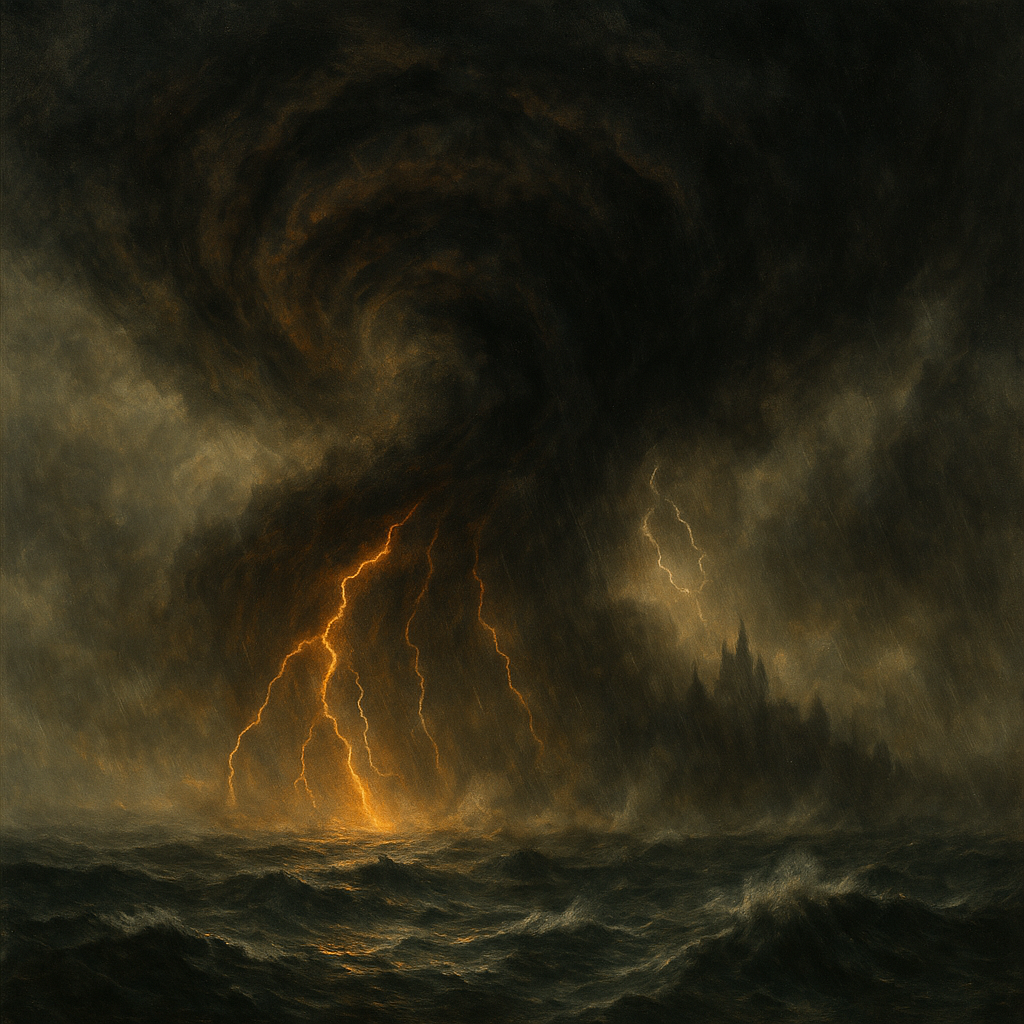
Malabash
"The storm above Malabash does not move with the wind, it breathes. And when it exhales, the sea rises to listen."
Once a thriving crossroads between trade routes and a beacon of magick and science, Malabash is now a continent-sized calamity; A place nearly the span of the Three Lands, (The Continent holding Everwealth, Kibonoji and Kathar combined) trapped beneath a shifting cyclone that has not ceased since The Great Schism began. From shore to shore, the sky seethes in an unbroken spiral of black cloud, lightning of unnatural color crawling down like veins of molten glass. The air burns with salt and static, rain and hail fall together in sheets sharp enough to flay flesh, and tornado bands roam the horizon like hunting beasts. Where once stood ports, academies, and halls of trade, there is only a ceaseless hurricane of untold proportion. The fates of the millions who once lived here are up for debate; Most say they were likely unmade, magickally torn apart, their souls scattered into the storm. To this day, the storm calls to the desperate and the damned. Expeditions vanish, ships return with scorched hulls and crews who no longer speak, their eyes reflecting lightning that never fades. Scholars whisper that Malabash potentially holds the most relics of our former civilization in the world, untouched since the Schism. Vaults of lost magick, pre-Fall weapons of war, or something far older that feeds the endless tempest. Dragons alone brave its horizon, vanishing into the clouds like cinders swallowed by an unseen furnace. At night, the storm’s glow crowns the sea in hues of violet and green, a beauty too cruel to be natural, and sailors swear that if you linger long enough, the thunder begins to call you by name.Structure
Before its fall, Malabash was ruled by The Triumvirate, three philosopher-kings whose mastery of magick and science defined the age. Each presided over one of the island’s governing pillars: The Forge (industry and invention), The Arcanum (magick and metaphysics), and The Archive (knowledge and history). Beneath them operated a lattice of guilds, councils, and appointed ministers, Mage-Smiths, Engineers, and Record-Keepers, whose rivalries were legendary. After the storm’s birth, all hierarchy collapsed; now only lightning holds dominion, and its rhythm is the only law left obeyed.
Culture
What culture once flourished here has been erased utterly. Pre-Schism records describe Malabash as a hotbed of scientific ingenuity, its cities governed by an alliance of scholars and Mage-Smiths who blended technology and magick seamlessly. Giants forged the island’s foundations, while Smallfolk engineers built conduits said to harness the skies themselves. Humans prospered in the heartlands between them, their merchant-lords of enriching all. All three races perished in unison, leaving only echoes, artifacts that still sing faintly when the lightning passes over their ruins.
Public Agenda
Malabash’s only “agenda” now is oblivion. The storm consumes all that touches it, as though feeding on intrusion. Every expedition sent since the Schism has vanished—some burned mid-air, others found drifting months later, their crews turned to salt or stone. The Scholar's Guild officially declared the island “forbidden territory” in the 112th year of The Civil Age, its existence to be studied only from afar. Nonetheless, zealots, treasure-seekers, and exiles still attempt the crossing, convinced the island’s ruins hide the greatest pre-Schism vaults ever built.
Assets
The wealth of Malabash lies not in ore or metal, but in what may yet endure within its heart. When the clouds thin, rarely, and never for long, observers along the far coasts claim to see the silhouettes of towers piercing the cyclone’s wall, a city still standing amid the tempest, its skyline veiled in lightning like shattered bones behind a wall of smoke. Scholars call it Averane’s Ghost, the last untouched remnant of the old world. Some believe its spires house entire libraries of pre-Schism lore, their wards still unbroken; Others say vast manufactories yet turn, powered by magick runes and forgotten engines that neither time nor ruin could silence. The air hums with patterns too deliberate for weather alone, and flashes within the clouds reveal windows still burning with inner light. Whether these are living mechanisms, autonomous citadels, or simply reflections trapped in the maelstrom’s endless motion, none can tell, but all agree that something endures in the dark heart of Malabash, still dreaming, still working, untouched by every age since the world broke.
History
Before its fall, Malabash stood as the radiant nerve of the world, despite being settled later than any other. A blast furnace of effort from mages, scholars, and traders who believed they would build a new, better nation dedicated to progress above all else; A mission in which it seems they almost succeeded. Its capital, Averane, was said to rival the heavens in brilliance, a city whose towers sang with harnessed lightning and whose forges burned with bottled thunder. Giants carved its foundations from mountain and sky alike, Smallfolk engineered its living machines, and Humans bound it all together through a unity of purpose unseen since. It was here that the Triumvirate, three philosopher-kings whose magickal research reshaped civilization. Then, in The Great Schism, something happened. Witnesses on distant shores saw the sky peel open like torn cloth as thunder began not to strike, but cascade down over and over. For three days and nights, the world shook under a roar that had no echo, a sound so vast it blotted out thought. Then, as dawn broke on the fourth, the continent vanished behind a curtain of dust and rain that has never lifted since. Some Clerics say it was the consequences paid by a continent that tried to rival the gods. Others say the Triumvirate failed something catastrophically, with horrendous consequences. Whatever truth lies buried within those endless clouds, it has never been spoken again, save for the thunder, which still repeats the same long, wordless sound, as if trying to remember what it once was.
Disbandment
There was no formal end to Malabash, no surrender, no treaty, no collapse to mark its passing. It simply ceased. Caravans bound for its ports never returned; trade routes turned to silence; correspondence from its scholars stopped mid-sentence. The last recorded message from Averane was a single fragment transcript recovered from a wreck off the coast of Old Tarmahc, its words half-burned on the tattered parchment. “The storm has us now.” In the months that followed, those who once called themselves Malabashi, diplomats, traders, refugees abroad, either vanished or went mad from grief, their dreams haunted by the sound of endless rain. The world quietly struck the nation’s name from maps, its memory dissolved into fear and legend. Yet even centuries later, the storm has not dispersed, and some whisper that Malabash was never truly disbanded at all. Its cities, its rulers, its people, perhaps they remain within the cyclone, forced to survive a sky-born torment that never ends. A continent frozen not in ice or stone, but in thunder, waiting, and unwilling to die.
Demography and Population
At its height, Malabash held an estimated twelve million souls, Humans in the heartlands, Smallfolk engineers in the coastal cities, and Giants scattered across the mountains. Birth and death were carefully balanced; disease had been nearly eradicated. Now there is nothing. No census, no population, no sound but the wind. Some sailors claim to see silhouettes of walking figures on the lightning-lit plains,too tall, too slow, too steady to be ghosts.
Territories
Malabash was once a sprawling island-continent stretching from the Coral Straits to the edge of the Laughing Sea. Now it exists as a storm-shrouded wound in the world. Its coasts are barren glass, its rivers turned to lightning veins. From afar, it appears to breathe, swelling and sinking as the cyclone turns. No map remains accurate for more than a day, for the land itself is alive, remade in every rotation.
Military
The Aether Guard formed the spine of Malabash’s might, a standing army of alchemically fortified soldiers, each equipped with weapons channeling bottled thunder. They fought from floating bastions, skyships that hovered above the battlefield by capturing raw lightning. None returned from the day the Schism storm rose. Some accounts speak of their final deployment: marching into the tempest singing hymns of metal and flame. Their anthem was said to end with the line, “If the sky is our enemy, we shall forge it anew.”
Technological Level
Malabash stood centuries ahead of the rest of the world. It was the only civilization to merge magick with machine seamlessly, mastering flight, energy conversion, and matter transmutation. Their greatest sin was curiosity untempered by caution. The Schism may well have begun here, a failure of science so catastrophic that reality itself recoiled. In modern Everwealth, surviving texts are studied with equal parts awe and dread, the scholars whispering that knowledge is not light, but fire.
Religion
The Malabashi did not worship gods, they sought to replace them. Their spiritual philosophy, The Doctrine of Equivalence, held that divinity was a function of understanding: to master the natural order was to ascend beyond it. Clerics of other faiths called them heretics. They replied with lightning. Now, centuries later, cults across Everwealth still whisper prayers to the Triumvirate Ascended, believing that the rulers of Malabash became something greater within the storm, immortal minds circling in the clouds, still dreaming of creation.
Foreign Relations
Before the storm, Malabash was a proud ally and great rival. Its magickal exports defined trade, its scholars sat in every foreign court. Yet arrogance breeds enemies: when the Schism struck, few lifted a finger to help. The surviving nations now fear what remains, declaring it cursed ground. Even the bravest captains will not sail within a hundred miles of its black horizon.
Laws
Malabash’s laws once governed a utopia of progress and reason. Theft of knowledge was punished by exile; Interference in natural law by execution. Their central tenet, “The will of creation must be understood before it is surpassed”, was both their creed and their doom. After the storm’s birth, it is said the surviving archives screamed aloud as their enchanted scripts caught fire, burning their own commandments to ash.
Agriculture & Industry
Malabash’s plains once shimmered with engineered crops that grew without soil, irrigated by vapor drawn from the sky. Entire mountain ranges were mined by sentient machines, while lightning refineries turned storms into power. After the Fall, nothing green remained. Today, scorched craters and twisted metal forests mark where those industries stood. When thunder flashes, the outlines of invisible towers can still be seen for a heartbeat, as if the machines never stopped working.
Trade & Transport
Trade was the artery of Malabash. A network of lightning rails and sky-caravans connected every city to the coast, ferrying goods faster than any other land. Great magnetic conduits, powered by the same energy that would one day destroy them, allowed for transport that defied terrain. Now, the sea lanes once feeding its ports are graveyards of ships, their hulls melted and masts turned to ash. The winds themselves seem to reject travel, blowing in endless contradiction.
Education
Education was the heart of Malabash’s pride. Every citizen learned the basic principles of magick and mechanical law by adolescence. The Academies of Averane rivaled any in the world, lecture halls of living crystal where thoughts were transcribed into air and machines debated philosophy beside men. None remain. It is said that when the storm began, the final lesson spoken in the Grand Auditorium was recorded by the winds themselves, echoing eternally in the cyclone: “We have learned too much.”
Infrastructure
Malabash’s infrastructure was a marvel beyond imitation. Cities floated on magnetic plates above their foundations, bridges pulsed with energy, and aqueducts carried lightning instead of water. After the Schism, every conduit became a weapon, every tower a lightning rod for divine wrath. Today, explorers who drift too near report ruins still glowing under the clouds, pulsing like veins in the corpse of a titan. The storm feeds on what remains, and it hungers endlessly.
DISBANDED/DISSOLVED
"In our pursuit of heaven, we taught the sky to hate."
Dissolution Date
Lost Ages, year 1848. 58 years before The Great Schism.
Gazetteer
Before annihilation, Malabash was the envy of the known world, its cities a tapestry of magickal machinery and academic brilliance. Giants raised citadels that touched the stormline, Humans filled them with markets of silver and silk, and Smallfolk ran the humming conduits that made the sky burn with living light. Today, there is no culture, only the echo of what was. The storm itself has become Malabash’s language, every thunderclap a syllable of loss, every flash of violet lightning a fleeting memory of pride.
Currency
The currency of Malabash was the Volt, thin silver discs etched with a triskelion of storm-runes that glowed faintly when charged by magick. In trade they were trusted even beyond the island’s borders, symbols of precision and honesty. Now they are found blackened in shipwrecks or fused into strange glass along the coastlines. Some collectors claim that under certain moonlight, the coins still hum, whispering calculations no living scholar can decipher.
Major Exports
Malabash exported enlightenment, machinery, knowledge, storm-forged alloys, and arcane principles that transformed civilization. Its inventions built the first airships and fueled the rise of the industrial forges in Everwealth. The storm ended that golden trade in a single breath. Now, its only export is fear. The thunder rolling across the sea is its message, and it speaks to every shore.
Major Imports
Before the storm, Malabash imported luxury, furs, wines, and enchanted silks from places like Tarmahc and the southern realms. Its appetite for art and excess was insatiable, its nobility competing to outshine the gods themselves. After the storm’s rise, the only import that matters is death. What few expeditions reach its shores bring back nothing but salt, madness, and thunder-burns that never heal.
Legislative Body
Law in Malabash was written by the Concord of the Triumvirate, a council of philosopher-clerks who inscribed legal codices in living script that adapted to circumstance, a perfect, self-revising code of justice. When the Schism began, these laws turned against themselves, contradicting endlessly, their texts twisting into unreadable fractals. It is said that the final command written into law before the end simply read “Contain.”
Judicial Body
Justice was administered by the 'Vigil', a class of magick-augmented judges capable of reading truth from the pulse of the accused. Their verdicts were absolute, their errors statistically nonexistent, until the storm. When the cyclone rose, many testimonies believe their temples were struck first, the marble floors melted into glass. Scholars believe it was no accident.
Executive Body
The Triumvirate’s decrees were enforced by the Aether Guard, soldiers clad in conductive armor woven from mithril and stormglass, their weapons charged by lightning captured from the heavens. They were both peacekeepers and executioners, their presence enough to silence revolt. Some say their armor still walks within the storm, animated by the echoes of their last orders.
Location

Comments