
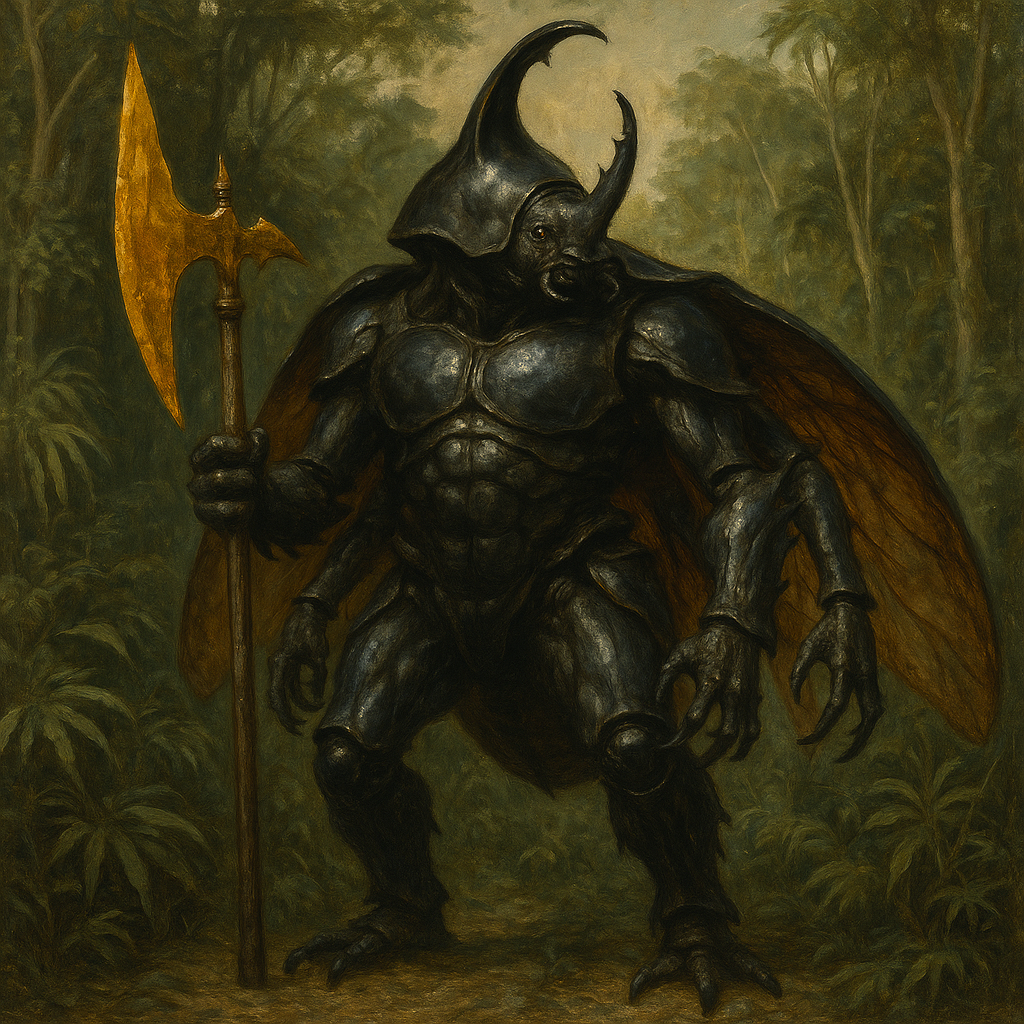
Chitinians
"We do not conquer the land. We hum in its shadow, and prove we deserve to stay."
The Chitinians are the black-shelled heirs of Drazahar, four-armed, winged, and born from soil where only death and destruction grows. Their hives hum beneath jungles that spit poison into the air, half city and half organism, pulsing with the same rhythm that thrums in their veins. Each warrior is sculpted by battle, every inch of shell an inheritance of trial. To see one in motion is to witness evolution itself learning to fight back. They are people of survival and violence in equal measure, shaped by an environment that kills the weak and crowns the stubborn. Their doctrine of 'Continuance', endure, improve, prove, is one they adhere to every waking moment. In Drazahar, if a thing cannot evolve or adapt, it dies. Merit, among the Chitinians, is won through combat. Their histories are carved not in script but in vibrating stone, duel-ledgers, hunt-counts, siege-songs, each an audible record of those who dared to hum louder than death. The Hive remembers every strike. War and art are one, they sculpt ornate weaponry from a sacred alloy of resin and metal known as Ambersteel, a molten hybrid of tree-sap and ore that hums when in motion. Red, orange, and gold, it gleams like trapped sunlight and is strong enough to shear steel, though only a Chitinian can tend it without it turning brittle from neglect. It is traded across the world for fortunes, forged into Everwealthy blades and Katharan idols, but it never forgets the hum of its makers. When a Hive declares war, their strongest warriors, the Resin Hosts, will emerge. A grueling process but one they consider the highest of honors, only the greatest among them permitted to ascend to their ranks. They are soldiers who consume a sacred potion within an amber flask; Forcing their shells to harden, weapons to grow from their glands, and their hums to become able to shatter glass. They fight like nature incarnate, bursting from burrows in shock waves of dust, and fire. Their warcraft is a synthesis of alchemy, biology and brutality, vibrating mauls that shatter magick, caustic spit that dissolves armor, toxic blood that taints lands like a curse. They are most often seen beyond Drazahar in Kathar’s warring savannahs, where they fight beside the Maned Beast-Kin in tribes of mutual respect, or in Everwealth’s gladiator pits, where they sell their seasons as a rare but thrilling spectacle. There among the crowds their victories echo like hymns and terrible warnings. Feared as monsters and revered as craftsmen, the Chitinians occupy a strange place among the races of the world. Their resonant magicks, their sound-based communication and living weapons defy natural order; Thusly they are often counted among the peculiarities of the Infernal, not the Beast-Kin as one would expect from their insectoid nature. To stand beside or before one in battle is to understand the difference between chaos and mastery. They are not Devils, nor are they beasts, but the perfect synthesis of endurance and creation, the living will of a hostile land given purpose. To be Chitinian is to scream against oblivion and make the world tremble back.
Naming Traditions
Feminine names
'Rhess', 'Vaelsha', 'Ikrina', 'Solch, Merth'.
Masculine names
'Drokk', 'Charn', 'Vhel', 'Morrix', 'Ka’tar'.
Unisex names
'Khur', 'Varnix', 'Thelm', 'Shirr, Oss'.
Family names
None. Each bears a Hive-mark, chemical and vibrational, a scent and frequency unique to birthplace. Some adopt titles like of the Resin Fields or from the Shattered Hive.
Other names
'Shellborn' (common), 'Bugs' (slur), “Resin Folk” (archaic).
Culture
Major language groups and dialects
Their native tongue is hummed and scented, resonance and pheromone, heard through bone and shell. With outsiders they use a halting, gravelly Common thick with trills. There is no native script, scent and hum are memory.
Culture and cultural heritage
They were once the dread of every horizon, amber fleets sliding like living hives across black water, their hulls singing in low resonance beneath the wind. Long before Everwealth’s founding, when empires still thought the sea a boundary and not a grave, the Chitinians crossed it. They struck Kathar’s coasts, raided Tarmahc’s isles, burned ports in Malabash, and left drifting reefs of resin where their warships sank. Their ambersteel armadas, half-grown and half-forged, terrified the world again and again in ceaseless persistence. They never came once, they came in waves, years apart, as though the continent itself was mass-producing them like weapons in war time. No colony of theirs ever lasted. The soil rejected their roots, and their own hives rotted from within, resonance splintering, leadership fracturing, spores eating through hull and heart alike. Every world they touched fought back, not as nations, but as antibodies. When The Great Schism violated any semblance of peace, they too suffered greatly.
What transpired was a long, bloody purge. The Schism’s rift-winds and magickal collapse divided Drazahar against itself. Half the Hives clung to old doctrine, conquest as proof of purpose, while the rest turned inward, declaring that survival, not expansion, was the truest strength. The resulting centuries of Hive-war nearly ended their species, burying whole generations beneath rivers of molten resin; Ending a mere century ago in an event some scholars call 'The Last Battle of the Schism'. From that crucible came the Chitinians known today, harder, hungrier, divided by philosophy yet united in endurance. Though few living recall their fleets, the world still feels the echo. Every continent has known Chitinian claws, every border remembers the hum. Traders and soldiers alike stiffen at the sound, even when it’s only wind in amber or the buzz of summer flies. Across the centuries they have become myth and warning both, the shell-born plague that learned patience. Now they divide cleanly into tribes and Hives, their wars local but unending, their legends carved into resin ribs and vibrating walls. They do not seek dominion so much as proof, that each generation hums louder, fights cleaner, and leaves a stronger shell behind.
Shared customary codes and values
Continuance, endurance, improvement, proof; This is the creed of the Chitinian. Rot, disease, and mutation are trials to overcome, not tragedies. Hives keep war-ledgers of duels and deeds, to fall silent is to die, to fight well is to be remembered. Direct, ritual-polite, violence-honest. Games are duels; arguments, tests. Mercy exists, spare the brave, harvest the coward.
- Merit hums the loudest. Rank is earned in the ring, tunnel, or hunt.
- The Hive is all. Individual legend must feed collective strength.
- Waste nothing. Flesh, shell, mistake, reuse, refine, repeat.
- The hum binds truth. Lies are poison; cowards hum thin.
Average technological level
Primitive to the eye, terrifying in organic craft. Weapons grown, armor secreted, fortifications alive. Their tools and vessels carry residual heat and vibration from living resin veins. Their technology looks primitive to outsiders, no iron, no forges, but it is alive and far more dangerous than it appears. Every weapon, tool, and structure is the result of bio-alchemy, grown from seed-resin and magickal fungus cultivated in humming chambers deep below the hives. Their weapons begin as resin buds grafted onto bone molds. Fed with heat, ichor, and vibration, they harden into ambersteel, translucent blades streaked with red and gold, edges so fine they hum when drawn. Spears flex like insect limbs, war-mauls store kinetic energy in resin sacs that burst on impact, and arrows grow glassy barbs that dissolve inside the wound. Their armor is secreted, not built. Warriors molt into hardened that fuse to the body, black shell latticed with amber veins that glow faintly under stress. Every plate remembers its bearer’s hum; if stolen, it deadens to brittle slag. Their fortifications are hive-grown bastions, walls of living resin threaded with fungus that exhales heat and light. They throb like hearts, sealing cracks, digesting invaders, and whispering vibrations across miles to warn of attack. Resin conduits carry sound instead of wire, and magickal amber nodes serve as both lanterns and memory cores. To those who mistake it for savagery, Chitinian craft seems alien and crude. To those who have fought against it, it is a nightmare that grows back every time it’s burned.
Common Etiquette rules
Among the Chitinians, etiquette is resonance, tone, rhythm, vibration. To speak is crude; to hum correctly is divine. A greeting begins with a low chest-hum, echoed by the other in acknowledgment. To hum out of sync is a challenge, to cease humming mid-exchange is an insult beyond words. The Hive demands harmony even in disagreement, those who raise their voices above the collective tone are silenced, sometimes permanently. Hospitality takes the form of vibration: visitors are offered resin stones warmed by breath, to synchronize heartbeat and hum before any negotiation. Physical gestures are minimal but deeply symbolic, forearms crossed is a vow of unity, while exposing the inner shell of one’s wrist (where the resin glands pulse) is an act of intimacy or apology. Among warriors, to touch antennae is the same as clasping hands in oath; among leaders, to do so without invitation is treason.
Common Dress code
Chitinians dress with purpose, not vanity. The shell is sacred, and what little they wear, if-anything, things like sashes or bandoliers; It serves to signify rank, history, or fulfill a function. Resin-filament harnesses bind amber plates to the body, each plate carved with hum-lines denoting Hive and lineage. Warriors adorn their shells with ambersteel bands, sharpened and polished to mirrorlike sheen, reflection to them both intimidation and offering, a gesture of self-recognition to one’s enemies. Artisans often weave fungal fibers into layered cloaks that shed spores when struck, both clothing and deterrent. Leaders and elders mark themselves with gilded resin seals, thin membranes fused into the chitin that pulse faintly with light. During mourning or war, blackened oil is spread across the shell to mute its sheen, symbolizing the dimming of the Hive’s collective hum. No Chitinian wears fabric that muffles vibration, silence is shame, even in clothing.
Art & Architecture
The Chitinians do not build in the mortal sense, they grow. Every Hive is a living monument, a structure coaxed from magickal resin secreted by amberwomb trees and shaped by vibration. Walls pulse faintly with bioluminescent veins, breathing heat like animal flesh. Towers droop and harden in rhythm with the Hive’s hum, their forms dictated as much by mood and need as by design. Their art is inseparable from survival. Sculpture is memory, resin figures of fallen Hive-kin grown from their remains, amber reliefs that trap the faces of those lost in war or molt. To outsiders, the aesthetic is grotesque: bodies fused with walls, shrines made of carapace and ambersteel ribs, spires that weep golden sap in the rain. To Chitinians, these living works are sacred continuance, art that never dies, only molts. Weapons and architecture share a lineage. A spear and a spire differ only in scale. Both hum with stored resonance. A Hive at full song vibrates through its foundations; the architecture itself becomes choir and fortress alike. Foreign masons call their style chitin baroque, where every surface breathes, and even the doors seem to twitch in anticipation of war.
Foods & Cuisine
The Chitinians consume through dissolution. Their mandibles secrete caustic resin that softens organic matter before absorption, a slow, ceremonial act resembling both meal and prayer. Flesh, fungus, and magickal flora all serve as nourishment, though they show reverence for the dead by recycling the fallen into Hive nutrient pools. Their most valued sustenance comes from the Amberwomb Trees, vast resin-veined organisms that bleed golden fruit known as ichor pods. When fermented, this substance becomes Hivewine, thick, glowing, and hallucinogenic, consumed during rites of molting or mourning. Hivewine intoxicates mortals, but for Chitinians it enhances their vibrational senses, allowing them to hum in harmony with the Hive’s core. Other delicacies include fungal paste hardened in amber molds, boiled plants resembling masses of larvae called 'maggotroot', and strips of resin-smoked carrion-beast. Feasts are communal and rhythmic, diners hum low harmonies as they eat, a sound believed to calm the digestion and honor the consumed. In the wild reaches of Drazahar, hunger itself is sacred. To eat is to prove one’s endurance, and to starve is to join the Hive’s memory.
Common Customs, traditions and rituals
Chitinian custom is ritualized survival, every act, from feeding to warfare, is part ceremony, part defiance. They hum to mark the hour, to remember the dead, to greet the dawn. Silence is unholy; to still one’s hum is to mimic death. Each Hive conducts a Resin Communion every lunar cycle, warriors gather in their amber halls to pour molten resin over the walls, feeding the living structure with heat and memory. The resin absorbs their collective vibration, glowing faintly as it hardens, a visible record of unity. Another common rite is the Hum of Mending, performed after battle. Survivors gather around the wounded and hum their tones in harmony until the resin in their armor or flesh begins to seal. It is not magick, only resonance and will, yet it works often enough that outsiders call it miracle. Chitinian festivals are not of joy but of endurance, contests of scar-carving, tunnel racing, or the Crack Rite, where two warriors clash until one’s shell fractures to reveal the amber veins beneath. The victor is not the unbroken, but the one who still hums through pain.
Birth & Baptismal Rites
Life begins in amber. The Birthing Vats, vast resin chambers deep within the Hive, pulse with warmth and scent, fed by ichor, magick, and the steady hum of attending drones. When a larva matures, it cracks through the amber like glass, spilling into the Hive’s glow. Its first breath is taken amid vibration and steam; its first sound is its birth-note, a unique hum it will carry forever. The Hive listens, and if the note harmonizes with its song, the young are claimed. If it clashes, it is consumed by the resin. No one mourns, the Hive wastes nothing. Naming like most of their words, is scent and sound combined, elders coat the new shell in resin oil, hum the first resonance, and press their claws into its carapace. That indentation remains for life, a mark of belonging, a permanent chord in the living chorus.
Coming of Age Rites
Adolescence is marked by The Amber Hunt, when youth who's shells have finally hardened must kill a living beast and bring back its ichor. Some Hives require the prey to be sentient, an enemy warrior, a trespasser, a rival drone. What matters is not the kill, but the tone the act leaves behind, the hum of courage is sharp, while cowardice leaves a tremor that never fades.
Funerary and Memorial customs
Death is digestion. The fallen are not buried or burned, they are rendered back into the Hive. Their flesh is dissolved in resin pits, their shells ground to dust and mixed with amber paste used to strengthen the walls. In death, they reinforce what birthed them. The hum of the dying is recorded in resonance stones, smooth amber nodes that hum faintly when storm-winds pass. Each Hive has a Hall of Tones, where these stones are kept in honeycomb recesses, softly singing the voices of the dead in chorus. The living visit to meditate or to ask guidance; It is said the stones answer back when war is waged. When an entire Hive perishes, the structure itself becomes a mausoleum. The resin ceases to grow, hardens to glass, and fills with preserved figures frozen mid-hum. Such Silent Hives are considered sacred and cursed, pilgrims come to listen to their faint songs, though most never return.
Common Taboos
- Silence: To still one’s hum is an abomination. Even sleep-hums are expected; absolute quiet is the mark of corruption or betrayal.
- Fire in the Hive: Flame blackens the resin and severs memory. Fire is used only for war, never within living walls.
- Discarding Shell or Flesh: Every part must serve. To throw away broken shell or spilled ichor is to insult the Hive.
- False Hum: Mimicking another’s tone is punishable by death, it is the theft of identity.
- Untended Amber: Leaving resin or Ambersteel unpolished is an omen of neglect. A dull weapon is a coward’s voice.
Common Myths and Legends
- The First Brood: When the world was young, the soil of Drazahar boiled and sang. From it rose the first Hive, born of the planet’s fever. They say the First Brood’s hum split the sky, calling storms and dragons alike into being. Dragons, the myths claim, are merely Chitinians that learned to love the sky more than the soil.
- The Singing Sky: Once a thousand Hives hummed in unison, trying to speak with the stars. The heavens answered, a great beam of amber light that turned half the continent to glass. The survivors said it was not wrath, but reply.
- The Great Amber: Beneath Drazahar lies a buried ocean of hardened resin that holds every hum ever sung. On certain nights, when the storms part and the air stills, one can hear it breathing. Those who follow the sound into the fissures below are never seen again, but their hums sometimes return in the wind.
- Queen Ith’Shaar and the Molten Hive: During the Fall, a Hive sank into molten resin. Its queen refused to flee and rebuilt her kingdom from the bones of the dead. Her hum was said to melt steel and mend shell alike. When her Hive finally burned, its ash fell as glittering dust across the world. Some claim that every newborn Chitinian hums a fragment of her last song.
Historical figures
- Vorh the Molten, Warlord of the Last Amber Fleet: The greatest admiral of the amber fleets, who led Drazahar’s last great crusade across The Laughing Sea. When the Schism storms tore his armada apart, he ordered his ships to burn rather than drift silent. His molten flagship became a floating pyre that smoldered for a year, marking the sea’s horizon with red light. His hum is still heard in deep-sea storms, captains say if you listen too long, your hull begins to sing back.
- Queen Ith’Shaar, the Bone Architect A matriarch who rebuilt her Hive after it sank into molten resin during the Fall. She fused her warriors’ remains into the foundations, creating a fortress of bone and amber that thrummed like a heart. Her rule ended when she merged herself into its walls, becoming its pulse. To this day, the Molten Hive still glows faintly from beneath the jungles of Drazahar.
- Kresh of the Amber Wing, the Reclaimer A visionary after the Schism’s devastation, she sought to reunite the broken Hives through flight. Her followers hollowed mountains to bolster their wings for the next generation. Legends say her Hive rose as a golden storm, vanishing into the clouds. When the wind hums over Drazahar’s cliffs, the Chitinians say it’s Kresh’s choir circling home.
- Lur-Ka’tar, Duel-Singer of the Red Ledger: A champion of the Continuance creed who recorded his every kill by carving resonance lines into his own shell until it shattered. He sang even as his chest split open, his last hum so powerful it caused the resin walls of his Hive to vibrate for three days straight. To this day, duels fought for honor are begun with his song.
- Shirr-Morrix, the Split-Tongue Philosopher: Once a warlord, later a heretic, Shirr-Morrix taught that conquest weakened the Hive by scattering its hum. His teachings divided Drazahar and sparked the Hive-wars that nearly extinguished their kind. In the end, he was sealed alive inside ambersteel, his final words echoing endlessly within. Some claim to hear his voice when forging new resin blades, asking whether they hum for glory or survival.
- Vaelsha of the Thousand Hums: A war-chorister and spymaster during the civil wars who trained her Hive to communicate through layered frequencies. Her warriors fought silently, their hums inaudible to outsiders but deadly precise to each other. It’s said she could command an army through a single vibration and bring down fortresses by singing into their foundations. Her resonance techniques are still taught by the militant Hives of the southern jungles.
Interesting Facts & Folklore
Idioms and Metaphors
- Wings are thick and muscular, burst-flight only, perfect for ambush.
- Many sleep burrowed in vibrating resin cells that induce battle-dreams.
- Some Hives raise lure-sculptures, amber-and-bone beauties that call predators close.
- A dying champion’s last hum can spider-crack glass and stun birds from the air.
- “The hum falters.” - morale breaks.
- “Amber for bones.” - oath of total backing.
- “Silent Hive.” - doom is here.
- “Hum against the land.” - defy what feeds you.

Comments