
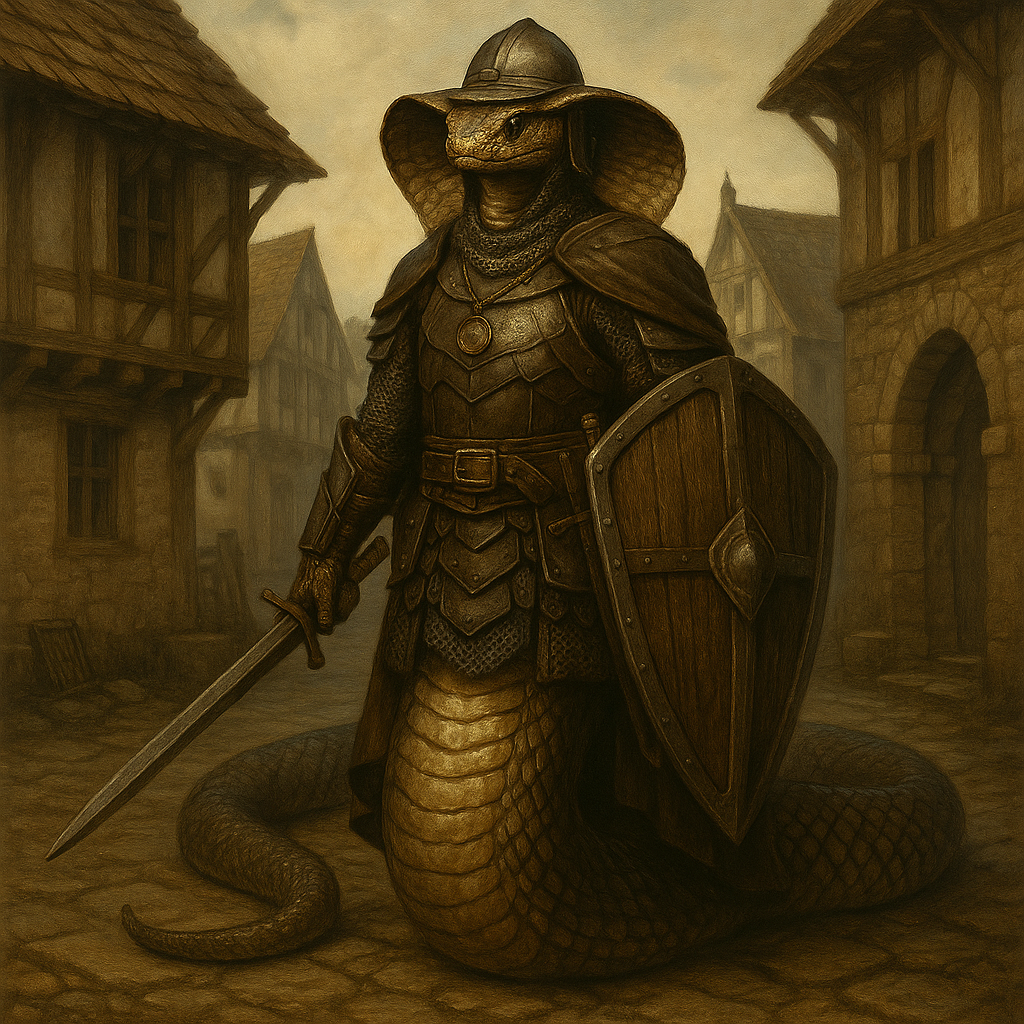
Serpentine
"Never did I imagine I would encounter a snake which spoke like a man, much-less that it would extend a clawed hand to hoist me from the wreckage of my ship."
The Serpentine, a sleek, sinuous race of snake-folk hailing from the drowned coasts and jungled spine of ancient Tarmahc, Alandrior, a land shattered by The Fall and swallowed by the sea. Their forms blend the human and the reptilian, broad torsos tapering into scaled tails, heads crowned by hoods, horns, or frilled crests depending on lineage. Some are patterned like cobras, others armored like rattlesnakes, their diversity a reflection of both bloodline and the fractured regions they once ruled. Unlike many kin races, the Serpentine are arenas of adaptation, sub-aquatic lungs allow them to breathe both water and air, a gift that ensured their survival when tsunamis and earthquakes annihilated much of Tarmahc in ages past. Where others drowned, they endured. Where others fled, they stayed. When The Great Schism broke out here across the ruins amid the cluster of small islands Tarmahc became, the Serpentine in-turn became locked in conflict with the Lizard-Kin who also clung to these broken lands; Their wars were vicious but pragmatic, and from this crucible came a people marked by discipline, craft, and cold philosophy. They are infamous for the “plantations” of Tarmahc, criminal labor camps where condemned men and women worked fields until they either found redemption or perished that still operate to this day. To outsiders this is cruelty, but to the Serpentine it isjustice, “There are no kind hands in the fields of law, only firm ones. One must fear the consequences of breaking the law.” Beyond their reputation for venom and ruthlessness, the Serpentine are renowned as craftsmen of necessity and innovation intertwined. They invented the canoe, tongs. Pioneered methods of leather preservation still envied by alchemists and tailors alike. Distilled poisons of such precision that even today their techniques are imitated but rarely equaled. The Serpentine's funerary practices reveal their efficiency based philosophy most clearly, not even the dead are wasted, their remains crafted into tools, tokens, or garments for the living. In this way, memory is kept tactile and useful. To meet a Serpentine is to encounter a people who speak rarely, act precisely, and coil their dignity around themselves like armor. Their reputation as cold-blooded executioners conceals a deeper truth: they are bound by ritual, memory, and an unshakable will to survive in a world that drowned their first homeland. A Serpentine will outlast. Always.
Naming Traditions
Feminine names
- Zaesha.
- Yrilka.
- Siven.
- Harash.
- Kalthe.
Masculine names
- Tholgar.
- Zherin.
- Ulveth.
- Darnok.
- Verrash.
Unisex names
- Akkith.
- Sarn.
- Lusk.
- Yali.
- Khadrin.
Family names
Serpentine surnames reference ancestral deeds, venom strength, or regional claim. Examples:
- Coil-of-Law.
- Deepfang
- Black-Hiss.
- Veil-in-Vine.
- Waterscale.
Other names
- Scaled Ones (neutral, used in scholarly texts).
- Slitherkin (mildly derogatory, often said with a sneer).
- The Lashmasters (derogatory, referencing plantation history).
- Vinebloods (poetic, used in Old Tarmahci ballads).
Culture
Major language groups and dialects
Serpentine speak Lassh’ar, a hissing, breath-focused tongue filled with glottal stops and forked emphasis. Some dialects include aquatic variants, spoken exclusively underwater. Phrases:
- “Shis’tar vek.” - "The current is not always your enemy."
- “Uthrakh ven’al.” - "My venom is not wasted."
- “Karrin hissi’dorn.” - "Coil before you strike."
Culture and cultural heritage
Serpentine culture is structured, austere, and deeply hierarchical. They venerate ritual over passion, believing every act, be it death, trade, or war, should follow ancestral law. Their past as slave-owners of Tarmahci criminals is not hidden, but discussed solemnly in educational sagas and scrolls of moral consequence. Their religion centers on the Coil, a symbolic cycle of rebirth, consequence, and purpose, echoed in their winding architecture, spiral patterns, and funerary rites.
Shared customary codes and values
Justice must be functional, not emotional, Serpentine are straightforward if-anything, empathetic considerations towards those they deem clear perpetrators of crimes against them or country often meet their punishment before their crimes are ever declared. Though not each Serpentine, many do share some degree of cultural similarity.
- Beauty lies in silence, symmetry, and sting.
- Emotional outbursts are considered signs of weakness or poor breeding.
- Precision and memory are paramount. A lie uncorrected is a debt unpaid.
Average technological level
Though many Serpentine cities were drowned, their surviving enclaves maintain advanced alchemical knowledge, particularly in venom extraction, leather preservation, and lightweight naval construction. They lack heavy industry but excel in adaptive survival technologies.
Common Etiquette rules
- Eye contact is a challenge; avoid unless invited.
- Do not reach for a Serpentine’s tail without express permission.
- Offering water is a sacred gesture of peace.
- Conversations are to be concise and deliberate, loquaciousness is offensive.
Common Dress code
Serpentine attire wraps the torso in breathable cloth, often dyed in rich blue, green, or golds that compliment their pigmentation. Armor is scaled or layered, mimicking the natural defense of their bodies. They wear leather bands, venom charms, and bone trinkets carved from kin after death, seen not as morbid but honorable.
Art & Architecture
Architecture spirals inward, with sunken courtyards, mosaic scales, and sloped ceilings designed to simulate burrowing dens or river eddies. Visual art is tactile, sculptures, carvings, and leather murals abound. They depict stories in coils rather than lines, meant to be “read” with the hands.
Foods & Cuisine
The Serpentine diet is heavy in fish, crustaceans, fungi, and root vegetables, often fermented or pickled. Venom wine is a fermented drink made from their distilled venom and citrus peels, a tart, mildly hallucinogenic brew. They are fond of spiced stews and nutrient pastes served cold. No cooking over open flame underwater, instead, meals are often smoked or dried.
Common Customs, traditions and rituals
- The Venoming: A sacred coming-of-age trial where adolescents are tested for venom potency, discipline, and memorization of the ancestral laws. Those who pass receive their First Fang Vial, worn as both a rite of adulthood and a personal totem.
- Shedding Seasons: Occurs biannually. Families gather to create private spaces where each member sheds their skin in solemn silence. The shed skin is not discarded but ritually tanned, often used for scrolls, leatherwork, or ceremonial bindings.
- The Coil of Memory: Each family maintains a spiral-shaped shrine, layered with bone trinkets, fang carvings, and painted scales from past relatives. Each generation adds to the Coil, expanding it as a living, physical history of the bloodline.
- Hiss Chanting: Ceremonial prayers performed entirely through controlled hissing patterns. These are used to communicate with ancestors or seek the favor of the divine spirits of the Coil. Some chants are performed underwater and only audible beneath the surface
- Coil-Dancing: A ritualized, spiraling dance performed during solstices, funerals, and trade pacts. Participants use undulating tail movements and synchronized gestures to mimic serpentine ancestry, divine cycles, and spiritual rebirth.
- Venom Veiling: During periods of grief, a mourning Serpentine will seal their fangs with wax or cloth, symbolically abstaining from the use of their deadliest gift until mourning is complete.
- Fang-Trading: When two Serpentine wish to solidify a lifelong bond, romantic, political, or martial, they may extract and exchange a single fang, which is then polished and worn as jewelry. To remove or lose the fang is to sever the bond.
- Scale Polishing: A weekly ritual of cleanliness and reflection. Each sale is polished in silence, often with help from a partner or kin. The act is believed to strengthen discipline and reveal hidden wounds or emotional burdens.
Birth & Baptismal Rites
Infants are bathed in sacred algae and wrapped in coils of their elders’ shedded skin. Their first hiss is recorded on carved shell, placed in the family’s reliquary.
Coming of Age Rites
Known as “The Venoming”, adolescents are tested in three disciplines: memory of ancestral laws, venom potency, and underwater endurance. Those who pass are gifted their first fang sheath and a single vial of their own venom to keep or trade.
Funerary and Memorial customs
The dead are not buried. Their skins are tanned and turned into ceremonial leathers, armbands, belts, or scabbards—for loved ones. The bones are powdered and mixed into ritual paint used to mark the temple of memory.
Common Taboos
- Never hiss in mockery.
- Do not shed in public. Shedding is sacred and private.
- Waste no venom; spilled venom is seen as lost fate.
- Mimicking the tail movements of another is considered an obscene insult.
Common Myths and Legends
- The Woundless Coil: A god-serpent who shed once every moon and never aged.
- Issha the Fang-Mother: Said to have woven the first poison from her own fangs.
- The River That Cried: A drowned city whose last priest turned its tears into venom.
- The Seven-Tailed Traitor: A warrior who defied the Coil, whose skins now line the gates of the underworld.
Historical figures
Zherin Deepfang - Crafted the original Codex of Laws used by plantation overseers.
Harash the Silent - A legendary assassin who used venom glyphs instead of blades.
Sarn Coil-of-Law - Argued before the Elfese courts for Serpentine autonomy post-Schism.
Zaesha Vineshadow - Leathercrafter-priestess credited with formalizing the practice of crafting from the dead.
Ideals
Beauty Ideals
Smoothness of scale, symmetry in coil, sharpness of fang. Painted eyes, polished fangs, and coiling grace are considered signs of inner control and power.
Gender Ideals
Serpentine genders are status-linked, not strictly biological. One’s venom potency, control over emotions, and skill in tradecraft dictate gender alignment and societal expectations.
Courtship Ideals
Courtship is initiated through ritual coiling, slow, deliberate dances where tails wrap but never touch. Gifts of carved bone, venom-dipped sashes, or co-crafted tools are typical. Mating is rare and formal, often brokered between families.
Relationship Ideals
Bonded pairs or groups are chosen not for passion but for compatibility of intent. Trust is paramount. Betrayal is repaid not with death, but exile and the severing of one's ancestral leathers.
Interesting Facts & Folklore:
Idioms and Metaphors:
- Venom Vows: Blood oaths sealed by mixing venoms. Breaking such a vow is punished with exile.
- The Shedding Tree: A massive, sacred coral where elders go to die, shedding one final time into the current.
- Fang-Rings: Decorative rings worn on the fang, each marks a venom sale or blood debt.
- The Whisper Spiral: A chamber where hisses are echoed for days, used to record long oral histories.
- “Coil before strike.” - Be patient and deliberate.
- “His scales shine, but his belly is dirt.” - Someone who appears noble but hides filth.
- “Drink your own venom.” - Take responsibility for your actions.
- “The river has two mouths.” - A warning that someone speaks with a forked tongue.
- “She shed too soon.” - Said of someone who grew beyond their station too quickly and unwisely.

Comments