
Orcs
"You must say with a sincere heart and humbled spirit: 'We, the Children of Huum, will be your subjects. We will give you our remaining strength, our tarnished glory, and our worthless tribute in recompense for our offense'. You must, in person, come with your lesser kings and generals, all together, without exception, to render us satisfaction and pay us homage. Only then will we, the Urkh'dhaal, acknowledge your total submission. And if you do not follow this edict, which is the will of the Burghan itself, or act against our orders, we will forever know you as our eternal enemy. For we are the punishment of the divine will brought upon you, the Children of Huum, for your many offenses and your continued dishonor. Question not why we, the Urkh'dhaal, divine will of the Burghan, have brought you low. It is evident. Had you not been dishonorable, we would not have been set upon you. Had you not been offensive to the Burghan itself, we would not need to bring you to heel.- Temmu Bluut'gaalvdaarm, First Dhaal'ghan of the Urkh Mhe'dhaal of Arcesia
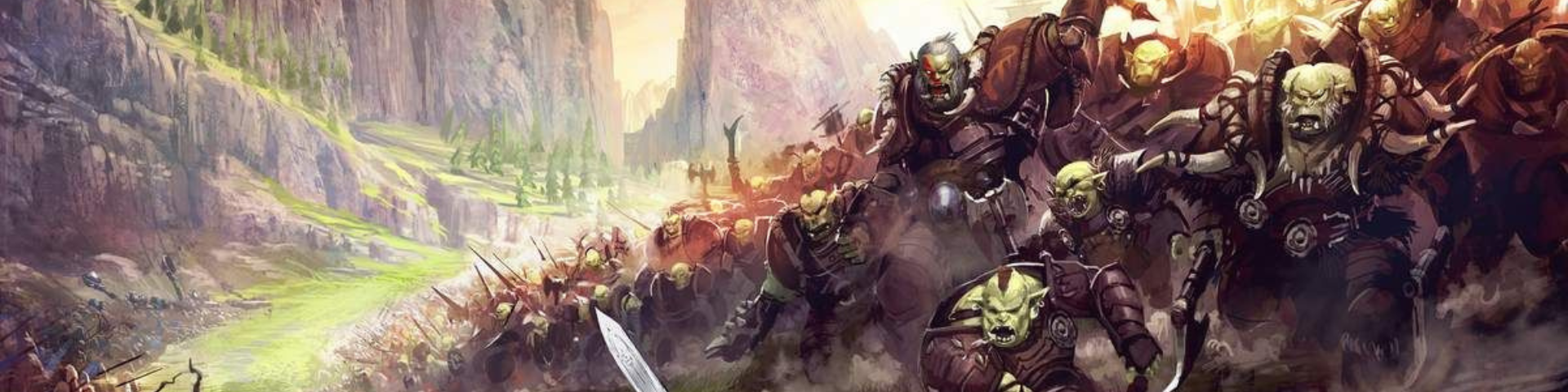
The Orcs are regarded as one of the most hostile invasive species ever to tread the soil of Aemaphia. They have shaped the modern political landscape with the grace of a blacksmith’s hammer upon an anvil, forging nations and shattering empires in blows both deliberate and devastating. Though the green-skinned Urkh’kar arrived on Aemaphia a mere seven thousand years ago—a blink in the long measure of the world—the mark left by their Emergence is indelible, blood-written across history. In the burning heart of Arcesia, they established one of the most feared civilizations the world has ever known: the Dominions of Arcesia, or as they call it in their own tongue, the Urkh Mhe’dhaal.
Throughout their turbulent history, the Orcs have been the scourge of Terran ambition, contributing to the collapse of multiple Terran empires and altering the course of the entire species' destiny. They are the eternal enemy of the Children of Huum, having led countless, bloody campaigns against the great civilizations of Acarcia—from the nomadic Saddlelords of the southern steppes to the proud legions of Corin the Conqueror himself. In time, the Orcish tide spread beyond the blood-soaked borders of Arcesia: some Orcs integrated into the diverse cities of Aesersia, while others sailed across the Gasenausian Sea of Aecornaus to colonize the distant, haunted shores of Trunsia. Yet wherever they travel, the hearts of all Orcs are bound by two unyielding laws: Honor Above All and Honor Demands Blood. And deep within the ancestral memory of every Orcish community, from war-bands to merchant enclaves, burns an unforgiven grievance: that the Children of Huum abandoned the Urkh'dhaal at the dawn of their existence. In the eyes of the Orcs, this dishonorable betrayal is a wound that no blood price can heal. As long as the Dominions of Arcesia endure, they stand as a looming beast at the gate of the Union, a living promise that the old debts of blood have not been forgotten.
Basic Information
Anatomy
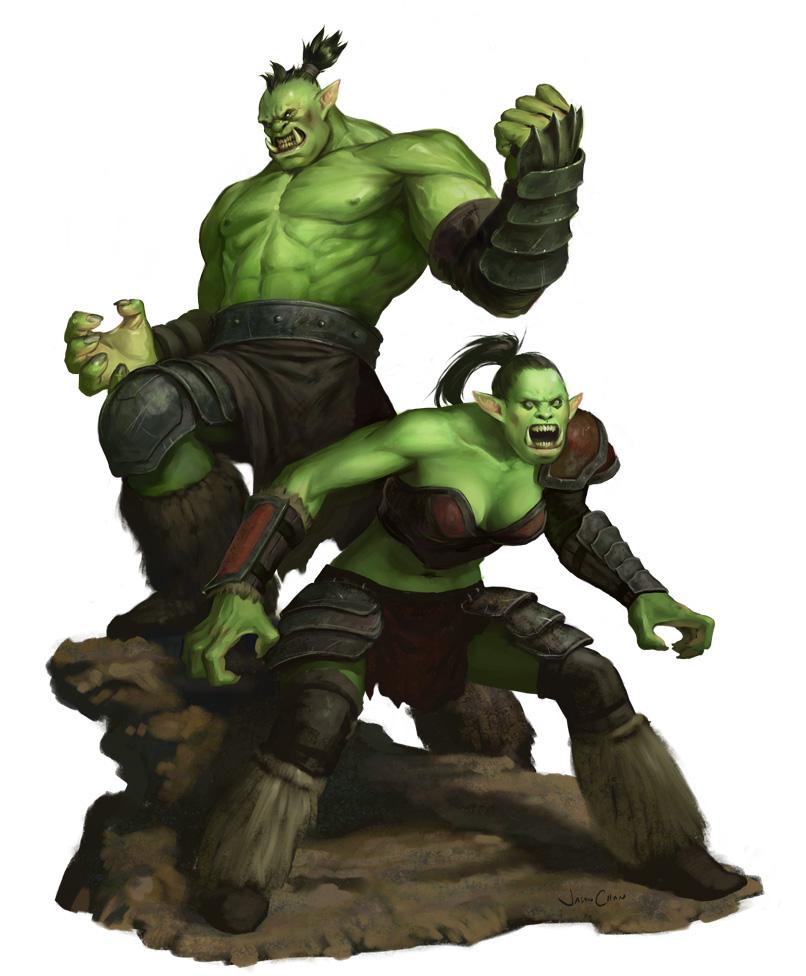
"Do not try to escape pain. Enduring pain is not an act of surrender. It is an act of defiance. It is brave and noble to suffer with honor."- Thraak Fistfire, Lieutenant General of the Cordean Republic ArmyThe Orcs of Arcesia, known as "Homo Orcus" to scholars while referring to themselves as the Urkh’kar, are a robust hominid species whose anatomy reflects their origins in the fel-drenched crucible of Suerec’gar. Averaging between six and six and a half feet in height and weighing between 250 to 300 pounds, Orcs are noticeably larger and denser than Terrans, with reinforced bone structures and high muscular efficiency that grants them exceptional endurance and power. Their dermis is thick and leathery, resistant to abrasions, temperature extremes, and radiation, and typically appears in varying hues of green, with rarer blood-red or pale-blue tones found among certain ethnic lineages. Their eyes are adapted to unnatural luminescence—featuring jet-black sclera and vibrant crimson irises, granting them superior vision in low-light environments. Most iconic of all are their tusks: curved, protruding from beneath the lower jaw just behind the canines, these tusks are not only durable and regenerative but serve as vital cultural markers. Orc craniums are broad and low-set, with prominent brow ridges and widened nasal bridges, contributing to an expressive but fearsome visage. Their limbs are slightly longer in proportion to Terrans, lending a gait that combines grounded power with surprising agility. Internally, Orcs possess redundant organs for increased survivability, including a reinforced cardiovascular system that supports rapid physical growth and regeneration. As a whole, the Orcish form is one honed by hardship, forged for endurance, and shaped as much by divine survival as by evolution.
Apocalyptic Adaptations
During their long survival in Suerec’gar—an irradiated, corpse-strewn wasteland laced with Fel energy—the Orcs of Arcesia developed a host of extraordinary physiological adaptations. Their immune systems became hyper-efficient, capable of neutralizing most toxins and resisting conventional disease entirely. Their organs, especially the liver and lungs, evolved to filter not just biological contaminants but ambient Fel mutation, allowing them to survive—and even thrive—where other species would dissolve or be corrupted beyond recognition. Their bones became denser, infused with mineral-hard deposits, while their muscle tissue regenerated rapidly under stress. The signature Orcish tusks are believed to be remnants of a now-vestigial Fel-detection organ, repurposed by evolution into both weapon and cultural symbol. Even Orc blood carries unique regenerative properties, clotting instantly and repairing tissue at a miraculous rate. In essence, the Orcs did not simply endure Suerec’gar—they became a species tempered by its wrath, shaped into apex survivors of a land that sought to unmake them.
Genetics and Reproduction
"Let the child live well, for the mother has already conquered."- Common Orcish Familial Blessing
Orc genetics are uniquely stable and highly specialized, the result of evolutionary pressure in the Fel-scorched wastelands of Suerec’gar. Unlike other hominid species, Orcs possess virtually no genetic plasticity—they do not mutate or adapt to environmental changes through natural evolution. Instead, they boast a genetically locked resilience, granting them exceptional resistance to toxins, disease, fel-radiation, and extreme climates. Their biology is marked by dense musculature, rapid healing, redundant organ systems, and cellular regeneration that borders on the miraculous. This biological constancy means that true Orc variants—such as the red-skinned Bloodjaw or blue-skinned Bonejaw—can only arise through magical intervention, not natural variation. At their core, Orcs are a species honed not by change, but by the refusal to be changed.
Arun’dash
Orcish reproduction is a biological marvel—swift, resilient, and steeped in sacred purpose. Gestation lasts a mere eight weeks, one Concordant Month, after which a fully viable Orc child is born. Thanks to a highly specialized pelvic structure and rapid internal healing, Orc mothers experience almost no birth mortality and typically recover within hours or days. Orc populations can recover from war, plague, or famine with miraculous speed, contributing to their legendary resilience and reputation as an unstoppable force.
In the eyes of the Urkh’kar, childbirth is not a domestic affair—it is a form of divine single combat, the sacred act of pulling a soul from the void and anchoring it in flesh. This belief forms the basis of Arun’dash, the honored labor of childrearing, which is shared communally but reveres the mother as its central warrior. To bear life is to wrestle it into existence; claiming that which is near-unattainable for the good of all. For the Urkh’kar, there is no greater act of duty to the community, to the divine, and to the future. To bear a child is to endure what few others can; to raise one is to commit to a lifelong labor of shaping strength and spirit. As such Orc Mothers are considered honored warriors, and are treated with reverence, considered to be walking avatars of sacred power.
In contrast, fatherhood is culturally known as Nuor’guurbal, "To Endure Kin"—a tongue-in-cheek term reflecting the Orcish view of fatherhood. To the Orcs, the biological father, having provided only the seed and suffered not the pregnancy or birth, has evaded any claim to honor that is granted from the Arun'dash. Thus, Orc fathers are the lowest figures in the family hierarchy, expected to provide and serve as a form of ongoing penance to both mother and child. It is common in Orcish families for the father to be called by affectionate titles such as the "Provider Penitent" or "Second to All". In familial disputes, children often jokingly remind their fathers: "You had the easy part". While there is love for fathers in Orcish culture, there is not much in the way of paternal respect. Reproduction and parenthood among the Urkh’kar is not about legacy or sentiment—it is about duty, strength, and honor, carried in blood and paid forward through service.
Growth Rate & Stages
"Pain is not fair, but neither are the bounties you’ve enjoyed. You suffer today to savor tomorrow’s pleasures. Relish today’s blessings, for tomorrow you will reap hardship again."- Mat'suedo Gaalv'nai, Former Skyspeaker of the Kar'mak Yarigchen
The study of Orc anatomy, part of the larger study known as Morphologea Hominidae, is a field of dangerous observation with many practical applications to an adventurer, blending the disciplines of natural medicine, Fel biometrics, and rugged physiology. Orcs are not merely another hominid variant—they are a biologically refined species, purpose-forged in the crucible of Suerec’gar, their flesh tempered by generations of exposure to Fel. Their bodies exhibit dense musculature, thick dermal layering, and redundant organ systems, granting them extraordinary resilience, pain tolerance, and regenerative capacity. Internally, their circulatory and endocrine systems seem engineered for rapid mobilization and recovery, with blood that clots near-instantly and tissues that can regrow from injury with astonishing speed. Tusks, long mistaken as mere weapons or trophies, have been revealed to possess unique regenerative matrices and nerve-rich pathways, making them central to both communication and cultural identity. Perhaps most fascinating to scholars—and alarming to field medics—is their resistance to both conventional toxins and magical afflictions. Orcs are not easily mutated, healed, or cursed, which has led to the growing discipline of Orcish Bioconstancy—a study into why their genetic code resists change, whether mundane or magical. Those who dare to dissect, document, or interact with Orc physiology do so with great caution, for what lies beneath the green skin is not a brute’s simplicity, but a survivor’s perfection—a body built not to adapt, but to endure everything.
Paart’dashuun
The path of maturity among the Orcs is known, in their tongue, as Paart’dashuun. This term translates to something like "A Youth Well Lived" or "A Youth Suffered Well". Maturity is a strange path for Orcs to navigate, especially when compared to the other hominid. Orcs exhibit one of the most accelerated growth rates among sentient hominids. Infancy lasts a mere six months, after which an Orc child quickly achieves the physical and cognitive benchmarks equivalent to an eight year-old Terran. By the age of two, they are walking, speaking, and even wielding tools with the precision of a terran teenager. Adolescence begins at age six and concludes at twelve—by which point an Orc is not only physically mature but combat-capable and biologically ready to reproduce. This intense developmental velocity is a direct consequence of evolutionary pressures within Fel-saturated Suerec’gar, where survival demanded rapid replacement and self-sufficiency. Consequently, Orc youth are metabolically overcharged; requiring huge quantities of fuel, long periods of rest, and intense activity to properly attune their growing form. Orc youth are particularly temperamental, in part because Orcish physical development is painful, gross, and awkward as a result of its rapid application.
Despite this speed, Orc brains reach full maturity with comparable complexity to other hominids, though their experiential time is drastically shorter. An Orc of thirteen may possess the body of a warrior and the instincts of a tactician, but only a dozen years of lived experience. As a result, young physically mature Orcs are often very emotionally immature; characterized by rash patterns of behavior, limited empathic understanding, emotional volatility, and simplistic reasoning. This creates a unique sociocultural paradigm in which youthful aggression is tempered by ritual, philosophy, and tradition—not because Orcs are naturally wise, but because they must be taught to carry blood with balance before it spills. Furthermore, cultural doctrines—such as The Words of Wisdom—guide this volatile mix of early power and limited experience to mitigate social chaos. For example; while young Orcs are physically capable of reproduction upon reaching maturity, they are taught that it is not culturally permitted to do so until they have "Earned the Right" through acts of sacrifice, purity, and honorable service to the collective.
To outsiders, this experiential youth may present as impulsiveness or immaturity. Among the Orcs, however, it is seen as emotional honesty. Where Terrans wear a "Mask of Years" the Urkh’kar express themselves boldly, without shame or subtlety.
Ves’thuun: The Orcish Rite of Remembrance
Among the Urkh’kar, death is not an end, but a reckoning—a final truth spoken in ash. Burial is unthinkable. Instead, Orcs practice Ves’thuun, or the "Truth in Ash", a sacred funerary tradition spanning a full Concordant Month. Upon death, the deceased is honored first through Khoal’mor, the Week of Mourning. The immediate family paints their tusks black, and hosts seven days of public remembrance where all may come to speak tales of the fallen’s valor, offer gifts, and join in hours of ritual weeping. Each evening ends with a feast, turning sorrow into strength through communal reverence. If the body has been recovered, it is cremated upon a ceremonial pyre. The resulting ashes are entrusted to a priest, who over the course of a week, transmutes them into Thuun’dagor, the Ash Binding—a sacred paint said to carry the final truth and soul-weight of the deceased.
When the Thuun’dagor is ready, the family embarks on a pilgrimage to Vhaal-hai Ungo’unkak-thuur, the Valley of the Ancestors in Ruktha’gar. They have sixteen days to reach this hallowed place, where memory and mountain merge. There, stone is selected—material imbued with ancestral resonance. The family spends seven days carving the name, deeds, and essential truths of the fallen into what will become their Unkak’muoh, or "Soul Stone". These carvings are then anointed with Thuun’dagor, binding the spirit to stone. Upon completion, the family returns home for the final week of Ves’thuun, known as Zal’duom’mor—the Remembrance of the Spirit. During this time, the entire community celebrates the life of the fallen through song, poetry, dance, and feasting—rejoicing in the legacy left behind, and giving the soul its final place in the living memory of the Urkh’kar.
To be denied Ves’thuun is a violation of spirit. If a body is unrecovered, the family will stop at nothing to reclaim it—some Orcs live entire lives on quests to retrieve the lost remains of kin. Furthermore, to unceremoniously scatter an Orc’s ashes, as Terran militaries often do following conflicts, is considered a profound spiritual atrocity and yet another example of the inherent dishonor of the Children of Huum. Both of these tragic situations can result in an even worse predicament for the kin of the deceased— the rise of a Wight. An Orc Wight manifests when a corpse is denied rites. These foul undead will return as a hate-ridden blight, compelled to journey home and confront those who failed to honor them. In rare mercy, they are met by warriors strong enough to grant them rest. In most cases, they bring death to their kin, shrieking curses of betrayal and forgotten honor as their mere touch drains the life from their former loved ones.
It is said among scholars that Orcs do not fear death—but dread being forgotten. Thus, the rite of Ves’thuun is the sacred practice that keeps the memories of the lost intact and their potential wrath sealed in stone.
Ecology and Habitats
"Orc history is written in their blood and upon the countless stones of their dominions. Thus, despite our best efforts, Orcs never forget and they rarely ever forgive."- Calden d'Tabar, Terran Historian
The Orcs of Acarcia, known collectively as the Urkh’dhaal, represent a pinnacle of ecological specialization—not through adaptability, but through refined resilience. Unlike other hominid species, Orcs do not mutate in response to environmental pressure; instead, they possess genetically locked physiology honed through millennia of survival in Fel-scorched wastelands. This evolutionary rigidity has produced an apex predator with unmatched stamina, regenerative capability, and resistance to disease, poison, and radiation. Their phenotypical diversity—green-skinned Bilejaw, red-hued Bloodjaw, pale subterranean Bonejaw, and degenerate Grim’lok—does not stem from natural variation, but from magical manipulation, environmental extremity, or aberrant captivity. In every case, their form is shaped not by passive adaptation, but by violent pressure and sacred design. Whether crawling through the caverns of the Infragercia or launching raids from the blood-soaked shores of Trunsia, the Orcs of Aemaphia endure not because they change—but because they are built to outlast the world itself.
Tsos'nhash
The Tsos’nhash, commonly known as the Bilejaw Orcs, are the most widespread and culturally dominant Orcish ethnic group across Arcesia and much of Acarcia. Recognized by their verdant green skin—a hallmark of Fel-tempered resilience—they thrive in a wide range of environments, from volcanic highlands and arid steppes to temperate river valleys and fortified cities. As apex generalists, Tsos’nhash possess an adaptive martial spirit rather than adaptive biology, enabling them to endure harsh climates, toxic flora, and predator-rich territories without physical mutation. They are efficient hunter-foragers, masterful builders, and aggressive territorial stewards who cultivate hardy crops and herd durable beasts such as the Aurok and Daeodon. Unlike their more specialized kin, Tsos’nhash integrate easily into both frontier and urbanized settings, making them the primary Orc presence in most Guild records, adventuring parties, and military legions. To Terrans, they represent the "Typical Orc", though among the Urkh’kar, they are seen not as average—but as exemplars of perfected resilience. In every corner of Aemaphia where Orcish banners fly, the green-skinned Tsos’nhash are never far.
Bluut'nhash
The Bluut’nhash, or Bloodjaw Orcs, are the crimson-skinned descendants of a tragic divergence—those who, during the chaotic Orc Emergence, were cast not into Arcesia but into the warped wilderness of eastern Trunsia, where they fell under the cruel enthrallment of the Hags. Over centuries of Feycraft fleshwarping and ritual subjugation, these Orcs were transformed into something wholly other; quasi-Fey hybrids, bound to blood-oaths and the eerie logic of the Gloom’s Bleak Fey Lords, twisted soveriegns of the Mysts of Myth who rule from behind masks of beauty and rot. Slightly shorter than their Tsos’nhash cousins but no less formidable, the Bloodjaw are marked by outward-curving tusks and sickly glowing green irises that seem to pulse with malign insight. Their very essence hums with a constant low-burning aura of magic. The dominion of the Bloodjaw Orcs sprawls across an unnatural landscape—bone forests, bleeding brambles, haunted lakes, and cursed salt flats—and from these shores they launch slaver fleets across Aecornaus, feeding captives to the wicked covens and gore-encrusted altars of their patrons. Ecologically, the Bloodjaw are apex predators in a magically polluted biome; they consume ley-line tainted prey, drink water polluted with all manner of foul runoff and alchemic concoctions, bleed the land for magic, and shape their surroundings through perverse sacrifice. They are not Orcs merely changed by magic—they are living curses, sharpened by Feycraft into nightmarish tyrants.
Gaalv'nhash
The Gaalv’nhash, known as the Bonejaw Orcs, are a rare and haunting sight, dwelling deep within the oppressive dark of the Infragercian Shallows and Expanse. Their gaunt frames, elongated limbs, and pallid blue skin mark them as distinctly other from their surface kin. Evolved—or rather, magically sculpted—to survive the crushing depths and lightless tunnels of the Underlands, the Bonejaw possess exceptional sensory adaptations: their enlarged yellow-irised eyes grant them keen low-light vision, while their acute hearing allows them to navigate through echo and vibration with uncanny precision. Their forelimbs are longer than those of any other Orcish subgroup, ideally suited for climbing, burrowing, and crawling through tight subterranean spaces. Yet these same enhancements come at a cost—exposure to extreme surface climates quickly overwhelms their fragile balance, rendering them vulnerable to sun, wind, and heat. Thus, while they are masterful subterranean hunters, scouts, and ritualists, the Bonejaw are prisoners of their own evolution, bound to the Infragercia by the very magic that ensures their survival. They are whispered of in torchlit caverns and feared not for their brutality—but for the silence with which they move, and the secrets they keep buried in stone.
Grim'lok
The Grim’lok, known throughout Aemaphia as Grimlocks, are a tragic and terrifying byproduct of arcane enslavement—Orcs who were captured by Mind Tyrants deep within the Infragercia and fleshwarped into eyeless, albino horrors. Designed to be both foodstock and obedient thralls, the Grim’lok exist in an ecological niche that is entirely artificial, maintained within Cerebrode-controlled biotopias and aberrant hive-lairs. Their ghostly white skin is hairless and translucent, their bodies thinner and less muscular than surface Orcs, yet unnervingly agile and efficient in tight, unnatural environments. Without eyes, the Grim’lok navigate entirely by scent and vibration, their olfactory system mutated to absurd acuity—capable of tracking prey through miles of twisted tunnels and sensing emotion through sweat and hormonal discharge. They feed on fungal crops, Mind Tyrant scraps, and, when resources are scarce, each other. Though stripped of autonomy, their instincts remain Orcish in origin: restless, aggressive, and painfully aware of their own humiliation. Ecologically, they are a cautionary parasite—tethered to the psychic ecosystems of their captors and cursed to echo Orcish rage in a body not their own.
Behaviour
"All of honor's wounds are self-inflicted."- Temmu Bluut'gaalvdaarm, First Dhaal'ghan of the Urkh Mhe'dhaal of Arcesia
Orcish behavior is shaped by a fierce devotion to honor, a reverence for endurance, and a brutal, unflinching worldview forged in hardship. The Urkh’kar live by the two sacred laws of the Words of Wisdom: Honor Above All and Honor Demands Blood. Every action is weighed against these tenets, and Orcs strive to live with unwavering honesty, loyalty, and discipline. Their manner is often intense, direct, and emotionally unfiltered—not due to ignorance, but because they see emotional restraint as dishonesty. To them, life is a storm to be endured, and strength—whether physical, mental, or spiritual—is measured not in domination, but in how well one suffers, endures, and carries truth forward. They prize wisdom gained through pain, humor sharpened into truth, and art crafted through struggle. In battle, they are relentless; in faith, devout; in speech, blunt. Yet beneath their iron-willed exteriors lies a culture rich with philosophy, ritual, and a quiet respect for those who survive with dignity. To be Orc is to carry one's burdens openly, to suffer well, and to leave the world knowing your blood bore meaning.
Beneath the Iron Helm
Orcish psychology is a fortress built upon ancient betrayal, divine silence, and the raw truth of survival in a world that offered no mercy. Their obsession with honor is not vanity—it is a response to chaos. In the Fel-scarred wastes of the Lost Lands, where madness bloomed like fungus and death lingered in every breath, the only stability the Orcs found was in themselves. Honor became their law not because it was noble, but because it was the only thing that could not be stripped away. Their hatred is the natural outgrowth of deep, generational pain—an instinctive rejection of that which once left them broken: deceit, abandonment, corruption, and the endless condescension of others. Weakness, impurity, and failure are not just faults to an Orc—they are cracks in the soul that let dishonor seep in.
Yet despite their harshness, the Urkh’kar feel deeply. They love with terrifying intensity. They mourn with profound depth. They admire beauty; not only in the fragile or the fleeting, but in the constant and the difficult. It wounds them more than they show when others see only rage. Only violence. To be mocked as brutish while one’s poetry is carved in complex mosaics of stone; to be feared as a monster when one curates gardens of flowers and songbirds in times of peace; to be called bloodthirsty when their very soul is bound in sacred truths of duty and honor—these are insults not easily forgiven. Despite these grievances, Orcs long only to be understood, not pitied. They do not want sympathy, only acknowledgement. They want others to know that they suffer with purpose, they love with weight, and they bleed with meaning.
Jests, Riddles, and the Philosophy of Laughter
Among the Urkh’kar, truth is sacred, but the Burghan rarely presents it plainly. Instead, divine truth is often cloaked in riddle, paradox, or mystery—a puzzle offered to those worthy of wisdom. From this core belief arises the Orcish reverence for strategic games, poetic riddles, and cunning jests. These are not mere amusements—though Orcs do love to laugh; they are ritualized tests of insight, sharpened by tradition and spiritual weight. Jests are particularly beloved, seen as a form of Truth in Comedy—a humorous puzzle that reveals wisdom through cleverness. Specialized bards, called Duom’keth Vraan or "Speakers of Sharpness", are known for scathing monologues, brutal satire, and soul-flaying verbal duels. It was, in fact, an Orc bard who first coined the now-iconic spell Vicious Mockery, originally used not for combat, but to humiliate corrupt chieftains and expose hypocrisy in public forums.
However, there is a clear and sacred line: Orcs abhor pranks. To make a fool of someone for cheap amusement, without wit or purpose, is nothing more than dishonorable deception. To the Orcs, a jest reveals a hidden truth, while a prank merely hides a petty cruelty. One uplifts the speaker and the other stains the soul.
Additional Information
Facial characteristics
Orc tusks are one of the most defining and enigmatic features of the Urkh’kar, serving both biological and symbolic functions that reflect the brutal elegance of their design. Anatomically, tusks are curved bony protrusions that emerge just beneath the lower canines, constructed from a dense, keratin-rich material that is both incredibly durable and biologically regenerative. While their precise evolutionary origin remains uncertain, scholars of Morphologea Hominidae theorize that tusks were once used for territorial combat, mate competition, or predatory intimidation in ancient Orc progenitors. Over time, however, these tusks developed sophisticated regenerative capabilities—if broken, they heal; if torn out, they regrow entirely. Some theories even posit that tusks originally acted as Fel-sensing organs, mutated through prolonged exposure to radioactive Suerec’gar, and later restructured into functional weaponry and sensory structures.
Culturally, tusks are far more than biology—they are living totems of identity, status, and spiritual worth. Among the Urkh’kar, tusks are modified, marked, or adorned to reflect one’s life story. Priests carve sacred runes into theirs, warriors cap them with iron, and unmarried Orcs drill holes into their tusks to signify availability—filling those holes with precious metals upon marriage. Criminals may have their tusks ritually removed, and the most dishonored endure the burning out of their roots. In mourning, families paint their tusks black; in surrender, a warrior may tear one free and present it to their foe as a gesture of honor. To Orcs, tusks are truth made bone, a visible history of choices, victories, allegiances, and shame. No two tusks are alike, and no part of the Orcish body speaks louder in silence.
Perception and Sensory Capabilities
"Until the next hardship is endured, the next scar is etched, and the next truth is spoken."- Common Orcish Farewell
Orcs possess heightened sensory capabilities, honed through generations of survival in the chaotic, Fel-warped wilderness of their ancestral homelands. Their vision is particularly acute in low-light environments, thanks to their black sclera and red irises, allowing them to perceive detail and motion even in near-total darkness. Their hearing is slightly more sensitive than that of Terrans, capable of detecting distant footsteps, shifting metal, or subtle changes in wind direction—skills vital to both hunters and warriors. While their sense of smell is less refined than that of many Beastfolk, it is still far superior to their other hominid kin, especially for detecting blood, smoke, or decay. Touch, taste, and pain reception are finely tuned not for sensitivity, but for endurance—Orcs can tolerate extremes of heat, cold, and pressure that would incapacitate others. Altogether, the sensory suite of the Urkh’kar is built not for comfort or curiosity, but for survival, threat detection, and the relentless assessment of terrain, prey, and potential enemies.
Orcish Olfaction
Though deceptively compact, the short, flat noses of the Urkh’kar house a remarkably complex olfactory structure—an evolutionary masterpiece refined in the volatile air of Suerec’gar. Internally, their nasal passages are lined with hyper-sensitive receptors capable of parsing extraordinary amounts of data from even the faintest scent. This heightened sense of smell serves a multitude of roles in Orcish life: navigating terrain, identifying allies and enemies by scent signatures, detecting shifts in mood or stress during negotiation, and even selecting a mate—for whom scent compatibility is a deeply personal and romantic consideration. Orcs can often “read” a battlefield, a campfire, or a fellow warrior’s emotional state from scent alone. This powerful olfaction, though paired with an extreme tolerance to rot, bile, and decay, has paradoxically fostered a cultural obsession with purity and personal cleanliness. While almost no odor can physically overwhelm an Orc—few ever gag, even when gut-deep in a corpse pit—they loathe unpleasant smells as a matter of pride and honor. To emit a foul scent is to dishonor oneself and insult one's company. Cleanliness, therefore, is not cosmetic—it is a sacred courtesy. The scent of a person, their environment, and even their belongings forms a constant, unspoken language, woven into daily life as tightly as words or gestures. In the world of the Orcs, to smell is to know—and to stink is to shame.

Comments