


Deadlands
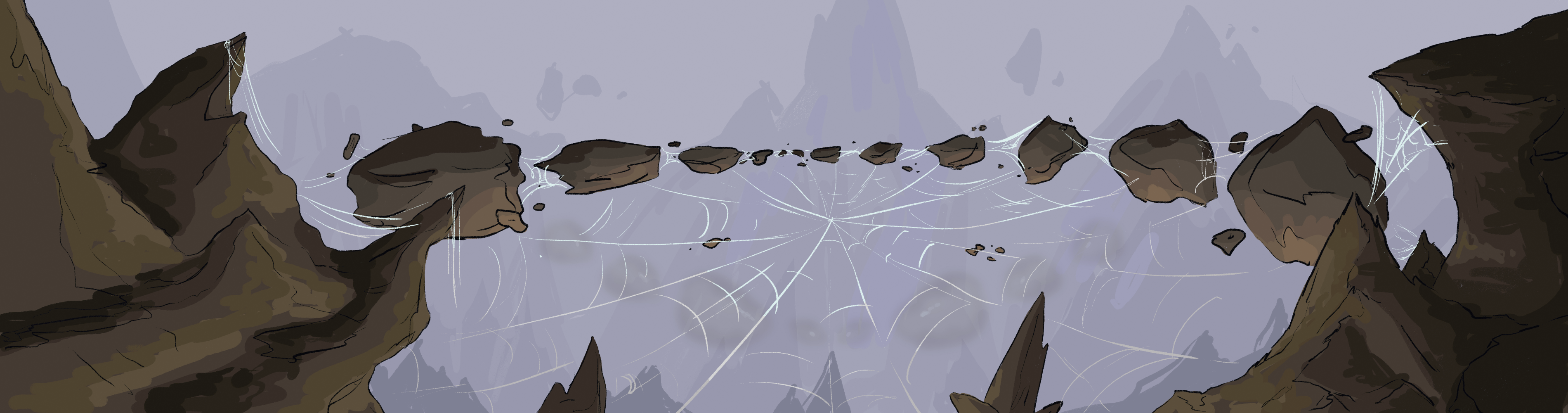
The Deadlands is the largest continent on Nalmaria. Hostilins dominate the region, weaving together fragments of land as the Deadlands slowly chips and falls apart.
Very little of the Deadlands have been explored. Only the south-eastern peninsula has been ventured into, remote-controlled researchers only scratching the surface before being decimated by angry giant spiders.
Geography, Location & Climate
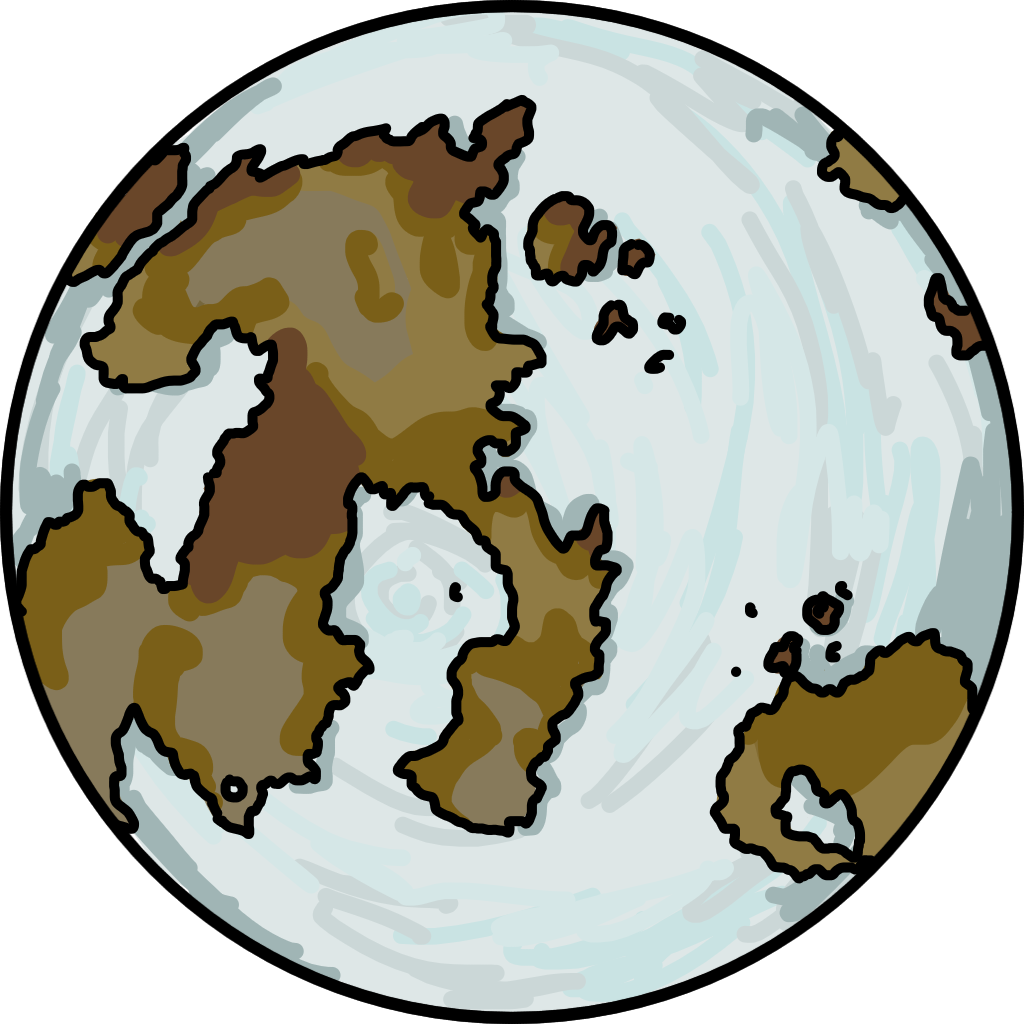
The Deadlands encompasses the entire Western Hemisphere on Nalmaria. To the south-east is the Scorched Lands and the Habitable Zone. and north east is the Galdan Islands.
Collect a Sticker!
Stopping off at a fuel station orbiting Nalmaria, you browse the magazine aisle and spot a handful of free stickers. Better add one to Your Stickerbook!Click to collect sticker: Nalmaria
Towards the north and south of the Deadlands are mountain ranges, with around two hundred active volcanoes.
Despite Nalmaria having no molten core, magma flows through the underbelly of the Deadlands, occasionally gasping for air in an explosion that shakes the entire continent.
The eastern coastlines of the continent are covered in sparse forest. It is the most heavily forested region in the Deadlands, with around a hundred trees per square kilometre.
Temperatures rarely exceed five degrees Celsius. There is next to no variation in temperature throughout the seaons, though volcanic eruptions will raise the temperature for several months, before slowly reverting back.
Notable Landmarks
Yukkan Archipelago
A small group of islands, each with massive craters in the middle. Relatively isolated from the mainland, its wildlife is unique and endangered.Mensen Monuments
The Mensen Monuments are a series of seemingly artificial structures balanced precariously along a volcano's edge.Mount Pupa
The tallest mountain on the planet. It cuts through clouds, with rows of rock formations in the shape of thin spines running down the mountain.Entrance to the Core
There are several tunnel systems that lead directly to the core of Nalmaria, where Queen Pasaval resides.Stackle Bay
A small bay along the farthest north coastline on the mainlands. Small green runes are carved into the cliffside, imbuing dark magical forces.Bluestone Canyon
A deep purple mist rolls down the blue stone cliffs in this canyon. It is the only nesting place of bluestone wyverns.History
Recent Explorations
Some of the latest advancements in artificially intelligent data collectors, designed by razhean engineers, have been used to monitor and study the most hostile of planets, Nalmaria included.A small fleet of these friendly robots led the charge in the southeast of the continent. They were all destroyed by hostilins, but not before vital data was send back to Razhea Capita.
Just under four billion years ago, the kavaari discovered the planet, and subsequently the Deadlands. This lawless environment was dominated by dragons. Ecosystems were once diverse and complex, with lavish rainforests covering the continent in a thick green blanket.
The evolution of hostilins, ten million years ago, completely destroyed these stable ecosystems. Hostilins soared to the top of the food webs, out-competing every single apex predator in the Deadlands. They consumed magma, and that took them to the core of the planet. After consuming every last drop of magma in its core, Nalmaria began to fracture and break apart.
The Deadlands is one huge chunk of rock that is slowly cracking. Huge fissures are appearing across the continent, hostilins patching them up with their silk.
In the last hundred years, a gigantic portion of land in the south of the Deadlands has collapsed and risen up into orbital atmosphere.
Fauna & Flora
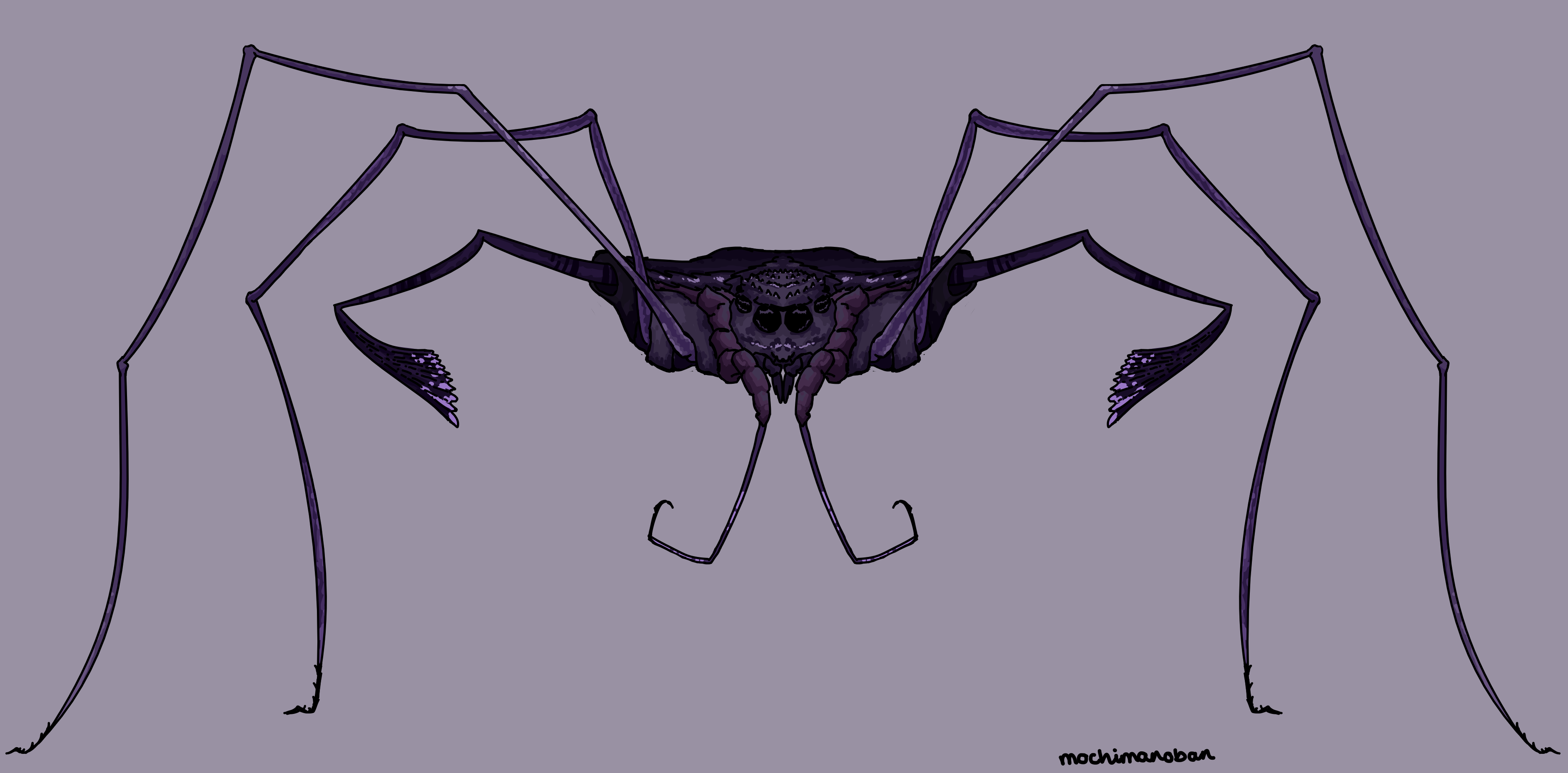
The Deadlands are fairly sparse as an ecosystem. Hostilins dominate with eight iron fists, keeping the populations of every large species in check. This has caused many an issue, completely throwing the food web off balance.
Blanket spiders frequently fly over the Deadlands, casting shadows the size of towns on the arid lands. Their eggs hatch in the clouds, baby spiders raining down for weeks at a time.
Several dragon species still survive in the Deadlands, millions of years after their reign died out. Bluestone wyverns are the most abundant species, standing around four metres tall. They are so small that most predators don't bother hunting them, and this has allowed them to dominate the winding caverns of the region.
Notable Species
Net Spider
Net spiders are queens of the microscopic world. Weaving silken nets, they capture prey five times the size of them.- Read More -
Razorback Crab
Semi-arboreal crabs that hung among the sparce forests of the deadlands. They leap from tree to tree, backflipping into birds, slicing them in half with their spines.Yukkan Wyvern
Endemic to the Yukkan Archipelago, these wyverns are extremely territorial. Some will fly for miles to chase anything that gets too close to its nest.Night Mare
Equines born of darkness and terror. Their existence is dependent on dark magics. They roam the Deadlands in herds of hundreds, terrorising anything in their path.Cloudhopper
Calling the lower atmosphere home, cloudhoppers walk along water vapour in the dry air. Since the atmosphere is fairly dry, this invasive species struggles to survive.- Read More -
Stinging Birch
The rows of stinging barbs around this tree's trunk protect it from predators.Stinging birch trees grow around the central Deadlands, growing in giant rings.





Drablands. :) I like that somewhere called the Deadlands is so full of life.
Explore Etrea | WorldEmber 2025
You know me, I can't have things void of life xD