



Plumeridae
Plumeridae is a small family of dragons, commonly known as feathertails. They are common on a number of tropical planets, native to rainforests.
Feathertails breathe a blue, copper-infused fire. Their firepower is limited, and they rarely use it to not set their native rainforests alight.
Taxonomy
Plumeridae is one of two families in the order Elignatiformes, the other being Elignatidae. There are sixteen species in this family, with two genuses.
Anatomy
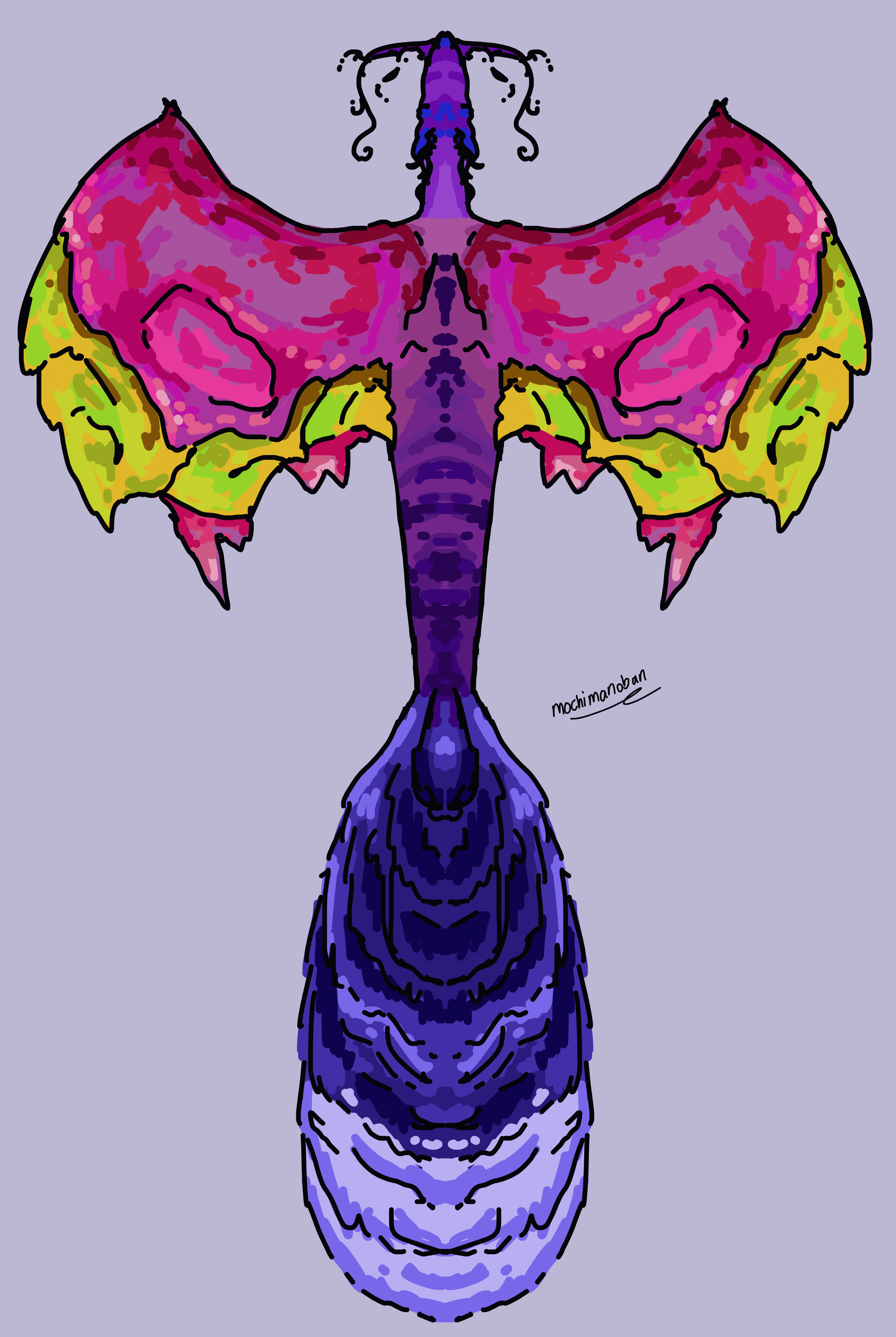
It can be hard to spot a feathertail in the jungle. You'll hear this deafening squawk and then suddenly there's a massive shadow above you, and a flurry of colour. Then it's silent again.
Most feathertails measure around two to five metres, excluding the tail. The largest species, the goliath feathertail, measures seven metres without the tail.
Feathertails have small wings in proportion to the body and tail. In the dense rainforests they inhabit, smaller wings allow them to fly easier, the tail used to make tight turns.
All feathertails are brightly coloured. All species are sexually dimorphic, with males exhibiting much more colourful feathers. The tail is the most prominent part of the dragon, with a train measuring nearly five metres in some species.
Feathertails are wyverns, with a pair of very small legs. These short legs are used to grasp at branches, and with their prehensile tail and whiskers, climb trees with grace.
Diet
Capepo
The two feathertail species native to Capepo feast on sunlight tomatoes.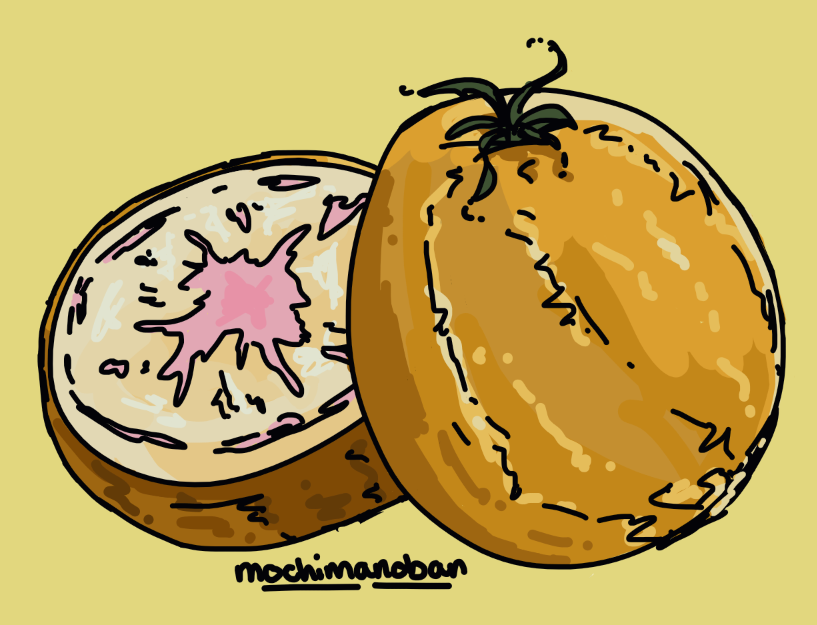
Those darn dragons have stolen all of my tomatoes again.
Feathertails are typically omnivorous, their diet relying on fruits and seeds. They will forage for whatever fruits they can find, and with strong stomach acids, can handle even poisonous plants.
Small seeds and nuts make up a significant portion of their diets, in smaller species. On all planets, snowseed trees grow in the same regions as feathertails, and their gigantic seeds are rich in nutrients.
Some species are opportunistic hunters, others scavenging. A number of species enjoy hunting mid-air, and will chase birds and other small dragons above the rainforest canopies, attempting to set them alight without burning the forest down.
Reproduction & Growth
Most feathertails are monogamous and mate for life. Their mating rituals are elaborate, males putting on elegant performances displaying their tails. Males form giant leks in rainforests openings, females gathering to watch as the males attempt to impress her with her dance.
Once a female has been impressed she will flutter over to her prospective mate and rip his tail off, as a sign that she is attracted to him and he must not attract anyone else. At this point, some females like to rip off a male's tail and run away.
Feathertails lay nine to sixteen eggs in a nest, which they build on the ground out of branches and leaves, moss, stones, and feathers. Some species utilise clay, letting it harden to provide more structural support.
The incubation period typically lasts between one and two months, the male incubating as he can no longer fly after losing his tail. Babies are born altricial, featherless and blind. They rely on the mother to provide food, as does the father. Once about twelve to sixteen weeks old the babies are strong enough to leave the nest, hunting on the ground.
At roughly thirty weeks they can now fly, and leave the nest. Both parents will still support their offspring, who may visit during nesting season each year.
Habitat
Prismatic Fields
Shimmering rainforest
It is one of the most biodiverse regions on the planet, with nearly three million identified species. Remote islands are scattered around the waters surrounding the rainforest, with entire endemic ecosystems.
Feathertails inhabit rainforests on tropical planets. Despite their bright plumage feathertails can be difficult to spot. Aside from nesting season, they spend their lives in the canopies and above.
They gather in large groups around water sources such as rivers and lakes.
This family of dragons can be found on eight planets and one moon: Aniki, Capepo, Ivucarro, Lavasani, Lilapi, Norrab, Silvernis, Xiskin, and Zechichi.
Genuses & Species
Plumeria
| Scientific Name | Common Name | Distribution |
|---|---|---|
| P. acanthidiocephalum | Glasswing Feathertail | Global, Lilapi |
| P. clamora | Barking Feathertail | Xiskin |
| P. clarupectus | Heartbeat Feathertail | Global, Aniki |
| P. cunicularia | Burrowing Feathertail | Phalan Forest, Norrab |
| P. falsoculus | Three-Eyed Feathertail | Prismatic Fields, Byssal Forest, Ivucarro |
| P. fluminidaemonis | Riverback Feathertail | Prismatic Fields, Ivucarro |
| P. magnala | Desert Feathertail | Sian Lowlands, Norrab |
| P. megalostoma | Longtooth Feathertail | Liadin Rainforest, Ivucarro |
| P. micropteris | Bluetip Feathertail | Northern Barbas, Capepo |
| P. oculomagnus | Blacktip Feathertail | North-eastern Barbas, Capepo |
| P. plumeria | Darting Feathertail | Southern Barbas, Capepo |
| P. rosapluma | Redtip Feathertail | Liadin Rainforest, Liadin Plains, Ivucarro |
| P. silverniensis | Silvernis Feathertail | Silvernis |
Alaserpenses
| Scientific Name | Common Name | Distribution |
|---|---|---|
| A. ouranopteros | Rainbow Feathertail | Caschal Forest, Aniki |
| A. flegmus | Sluglike Feathertail | Zechichi |
| A. lavasaniensis | Lavasani Feathertail | Global, Lavasani |





So, so pretty.
Here are my Entries for the water continent Ulűri̋qi̋
thank you! :D