


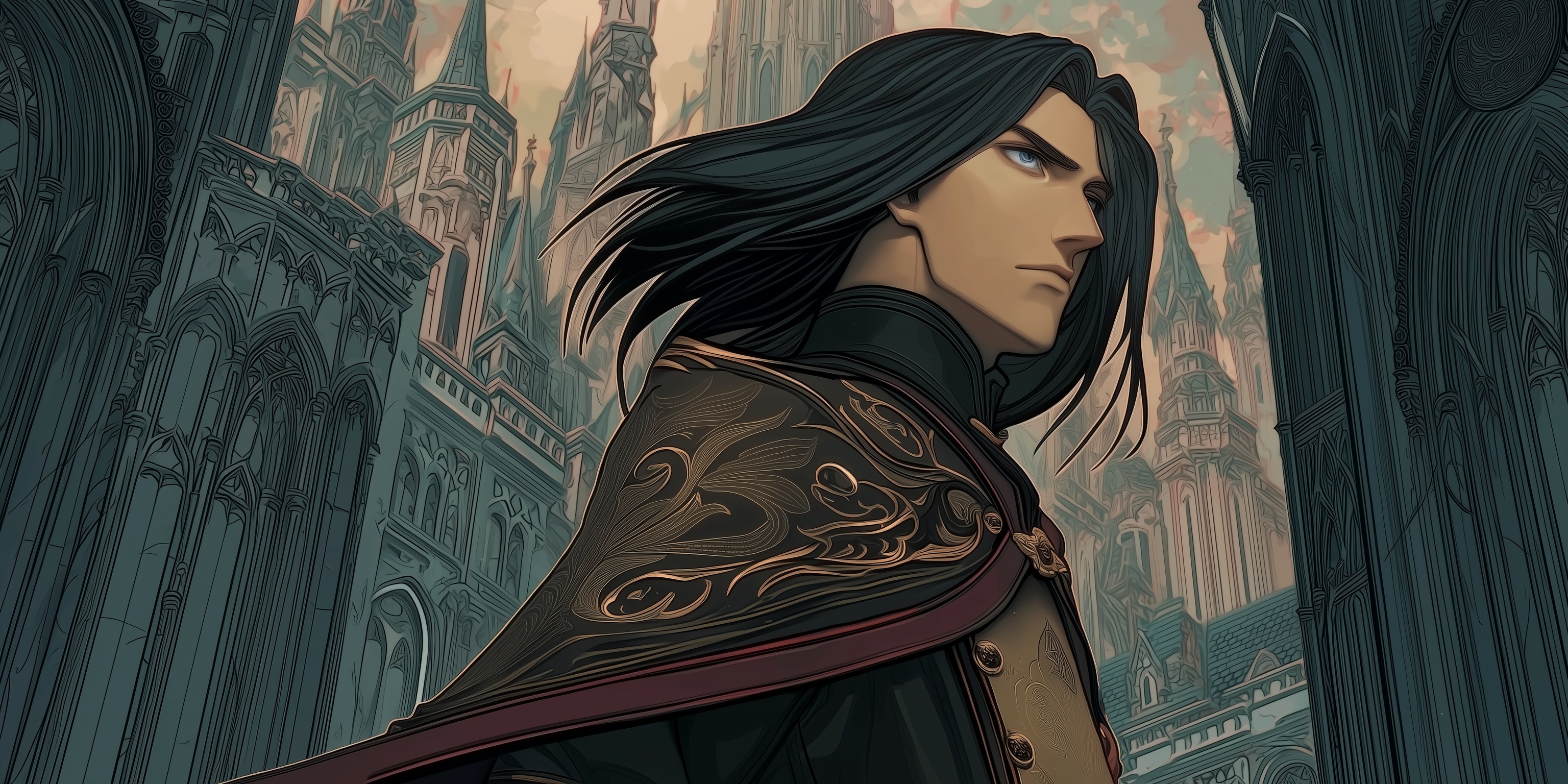
Corvyn Seinrill
"Knowledge can bring light to the darkness, but light casts shadows. And the shadows cast by the light of knowledge too often bring a far greater darkness, into which more than light, and wisdom are forever consumed by the void."
In the annals of Areeott, he is remembered as a hero, a noble warrior who gave his life to defend his homeland. His sacrifice is honored in history books and whispered in reverence, but the truth was buried beneath myth and memory.
Corvyn did not die.
In desperation, he struck a bargain with Lazzill, god of secrets and shadow, to save a family betrayed and a homeland on the brink of ruin. The power granted was not a gift but a curse. Immortality bound him to a world that would never release him, denying the peace he craved and the reunion he longed for most.
To his people, the Seinrill line is a dynasty of barons guiding Areeott through war and prosperity. In truth, each “successor” is only another mask. The ruler has never changed. For seven centuries Corvyn has endured as the hidden architect of the nation, shaping its survival from behind a carefully constructed illusion.
He is the foundation and the prisoner of Areeott alike, a man whose triumph became torment, whose love turned to silence, and whose name lingers only as a shadow across the land he still rules.
The Heart of Areeott
“I am the steward. She is the land."
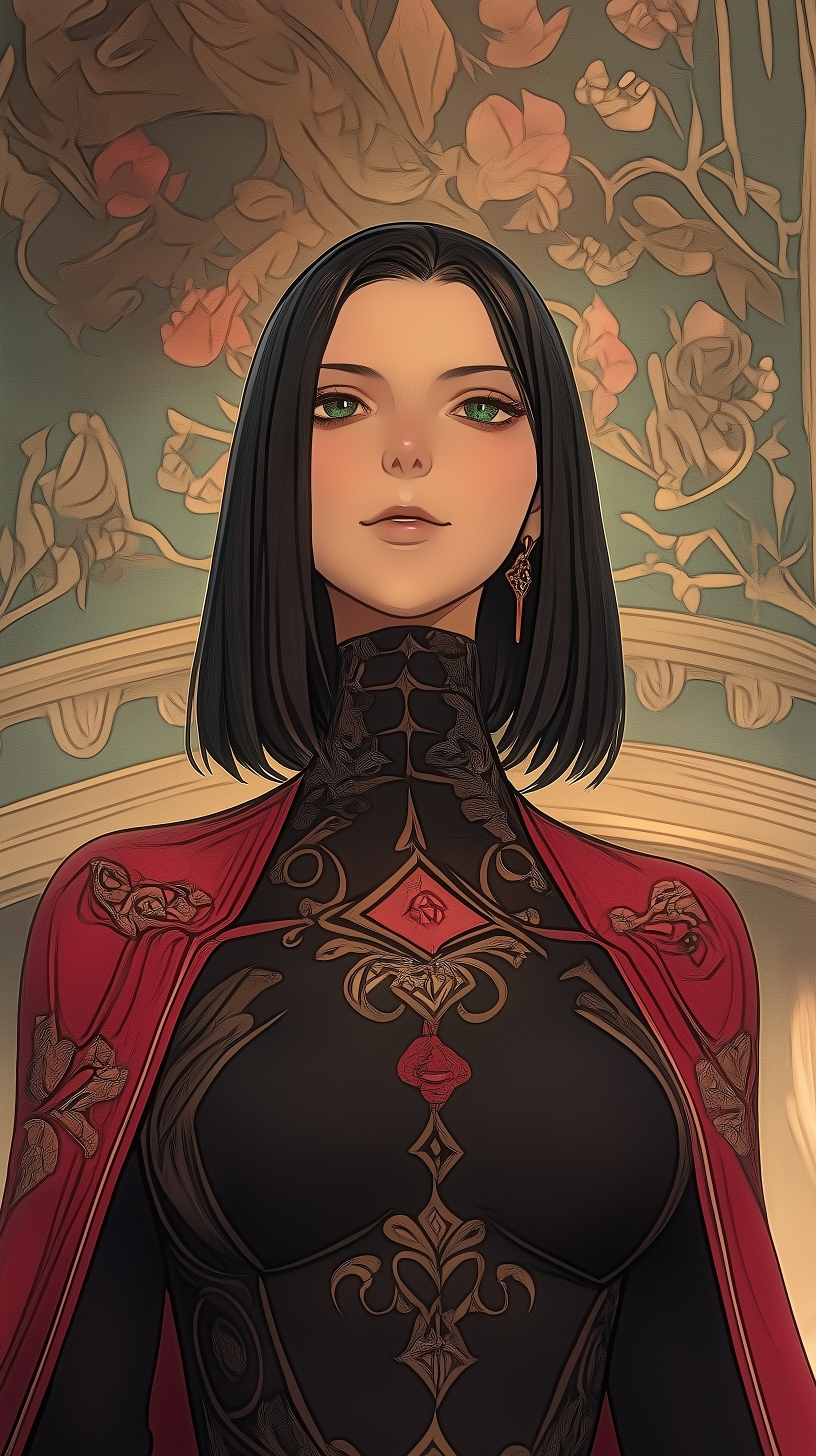
It was in Andrielle Seinrill that Corvyn discovered solace. She softened his resolve, gave shape to his hope for a better tomorrow, and guided him through a realm fraught with turmoil and treachery. To those who knew her, Andrielle was brilliance, grace, and an unshakable will. Her vision of a kingdom untouched by corruption or chaos became the foundation of every ideal she and Corvyn sought to protect. She was no dreamer lost in hope. She faced adversity with unbreakable courage.
In the aftermath of the Shattering, when Bastion’s defenders had fallen and Xal’Kanan’s faithful were scattered, Andrielle stood as the light guiding survivors through the Heretic King’s reign of terror. Pregnant with Anson and Cassandra, she sought refuge in the Seinrill Catacombs after betrayal claimed her family, including her firstborn, Daemon. Her devotion to family and homeland was absolute, yet fate granted no mercy. She was taken not by battle or time but by treachery, torn from Corvyn in an act of unspeakable cruelty.
For Corvyn, she was never only a companion. She was Areeott’s heart. Deprived of her, he remade their homeland into a living monument to her ideals. Yet his devotion casts a shadow. In striving to preserve her dream, he enforces order with a severity that allows no defiance. To him, any disruption is an insult to her memory, and those who stain it are met with justice as unyielding as his grief.
The people believe they are ruled by a dynasty of noble stewards. In truth, there is no dynasty. There is only Corvyn, the eternal ruler, bound by love and loss to preserve the order she envisioned. The nation flourishes, its monuments untouched by time, but beneath the grandeur lies a silent tyranny, a peace without freedom, prosperity without change.
He is not cruel, but his will is absolute. Areeott does not bend, does not falter. It endures because Corvyn refuses to let it fall. Yet even with the power to shatter kingdoms and defy gods, it is not strength that defines him. It is Andrielle’s voice, unspoken yet ever present, that restrains him.
This whisper is more than memory. It is commandment. A vow. In his quietest moments he hears it still. "You're a philosopher and an artist at heart. No matter what happened to me, don't you dare become a destroyer in my name. Keep creating, even if it's through your tears."
He rules not for vengeance but for preservation. Every decree, every polished street, every law is a reflection of her dream. His war is not against armies or gods, but against grief, rage, and the darkness that eternity presses upon him.
So Areeott endures, both sanctuary and tomb. It is a monument to devotion that time cannot erode, and a ruler’s silent struggle to keep love alive in a world that betrayed them both.
Ashes In Eternity
"True loss is not when a life ends. It is when the universe itself denies that life ever existed. In that void, there is no mourning. Only a silence so complete it cannot even echo."
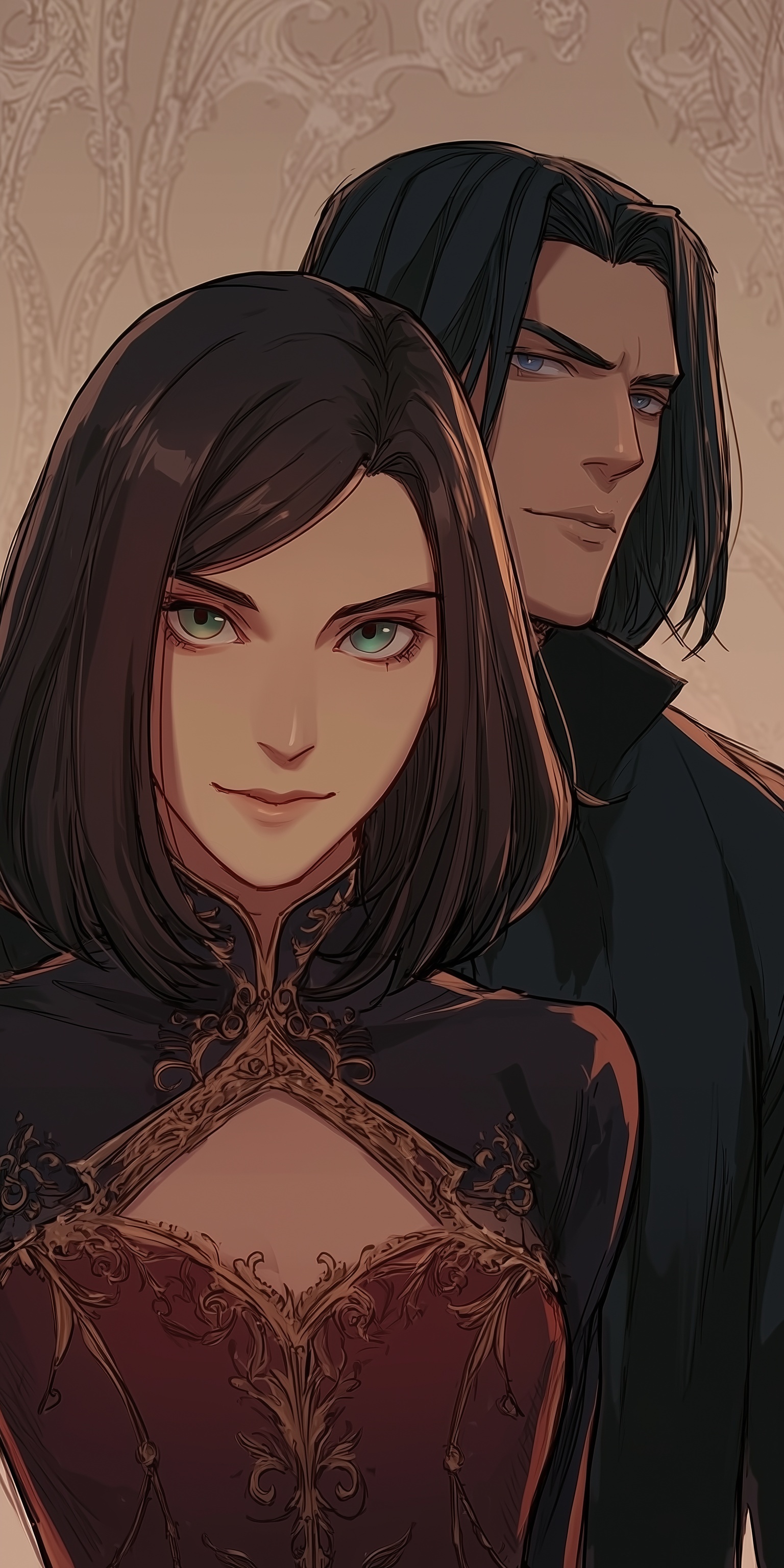
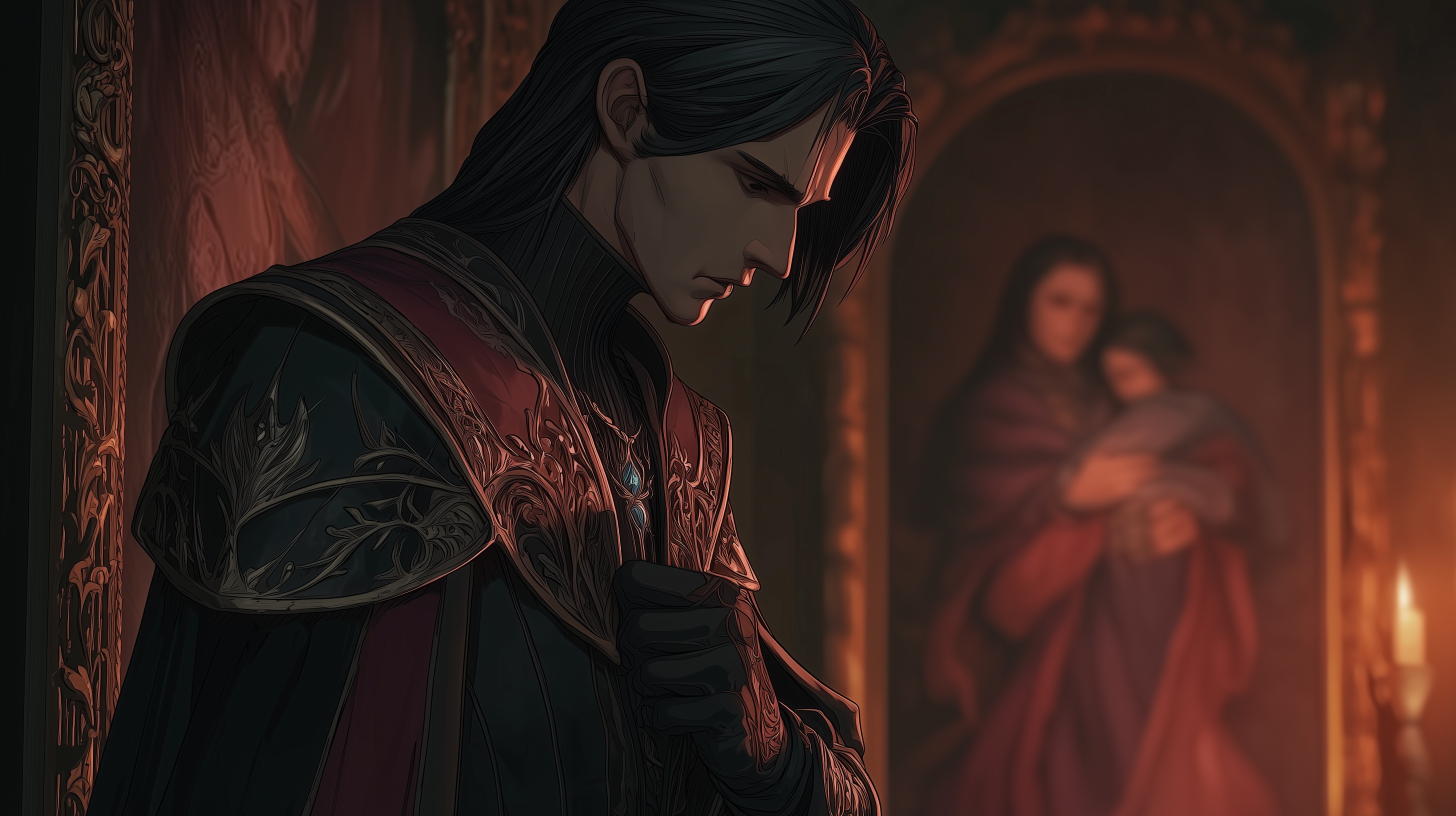
Andrielle Seinrill’s death remains the most crushing moment of Corvyn Seinrill’s existence, an irreparable wound binding him to a hopeless eternity. The convergence of divine meddling, mortal deceit, and the Shattering’s upheaval led to the destruction of all he loved. Though the world sees Andrielle’s death as a personal tragedy, Corvyn perceives it as the pivotal event that shattered his soul and condemned him to endless sorrow.
After the devastation of Areeott at the hands of the Heretic King, Corvyn fought his way back to his homeland, only to find it in flames. His family had been slaughtered, his firstborn son Daemon among them, leaving only Andrielle and their newborn twins, Anson and Cassandra. Overwhelmed with grief, he cursed Xal’Kanan, the god of magic, and in his desperation sought the aid of Lazzill, the God of Secrets and Lies. Corvyn struck a bargain, offering the Master’s Edge, Xal’Kanan’s personal weapon capable of erasing souls from existence entirely, in exchange for the power to destroy the Heretic King and reunite Areeott.
The Master’s Edge was a relic of harrowing potency, revered by The Astaray Knights for centuries. Its purpose was absolute and merciless, to sever a soul from the tapestry of creation, beyond the reach of gods or magic. It had been enshrined in Seinrill Castle for centuries, in the trust of the Astaray Knights, to be used against the Great Wyrms or the Prime Dragons as a last resort. This terrifying ability could only be used three times in the weapon’s existence, and its ultimate wrath had already been brought down twice before against ancient horrors in times lost to memory. Its final charge remained a looming threat, capable of unmaking even a god. Through his bargain, Corvyn gained access to both Lazzill's power and Xal’Kanan’s divine essence, becoming an unstoppable force, commanding arcane might lost in the immediate aftermath of the Shattering. A power to overcome the new wound in reality, that united Areeott and overthrew the Heretic King. Victory, however, came at an unimaginable cost.
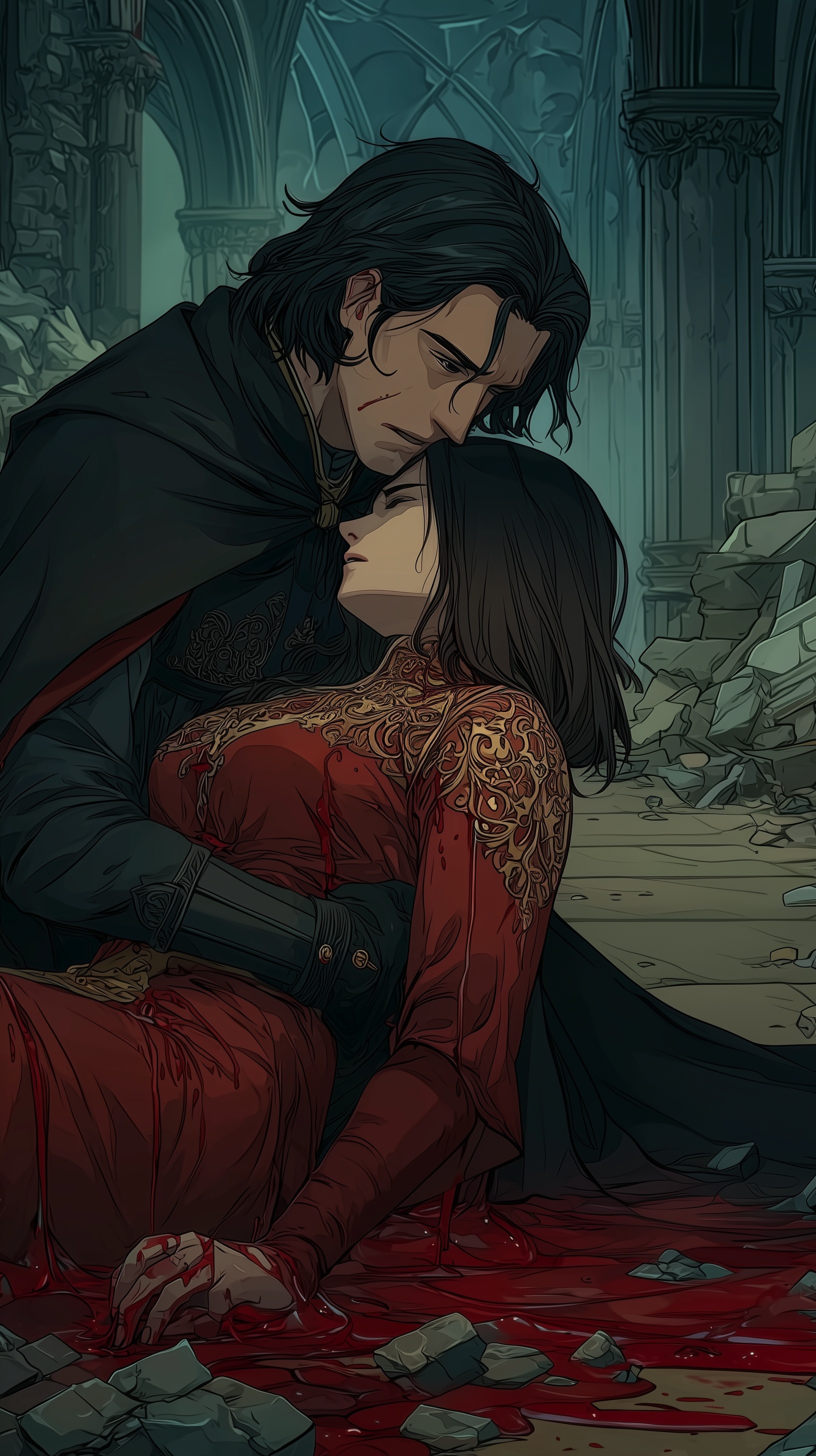
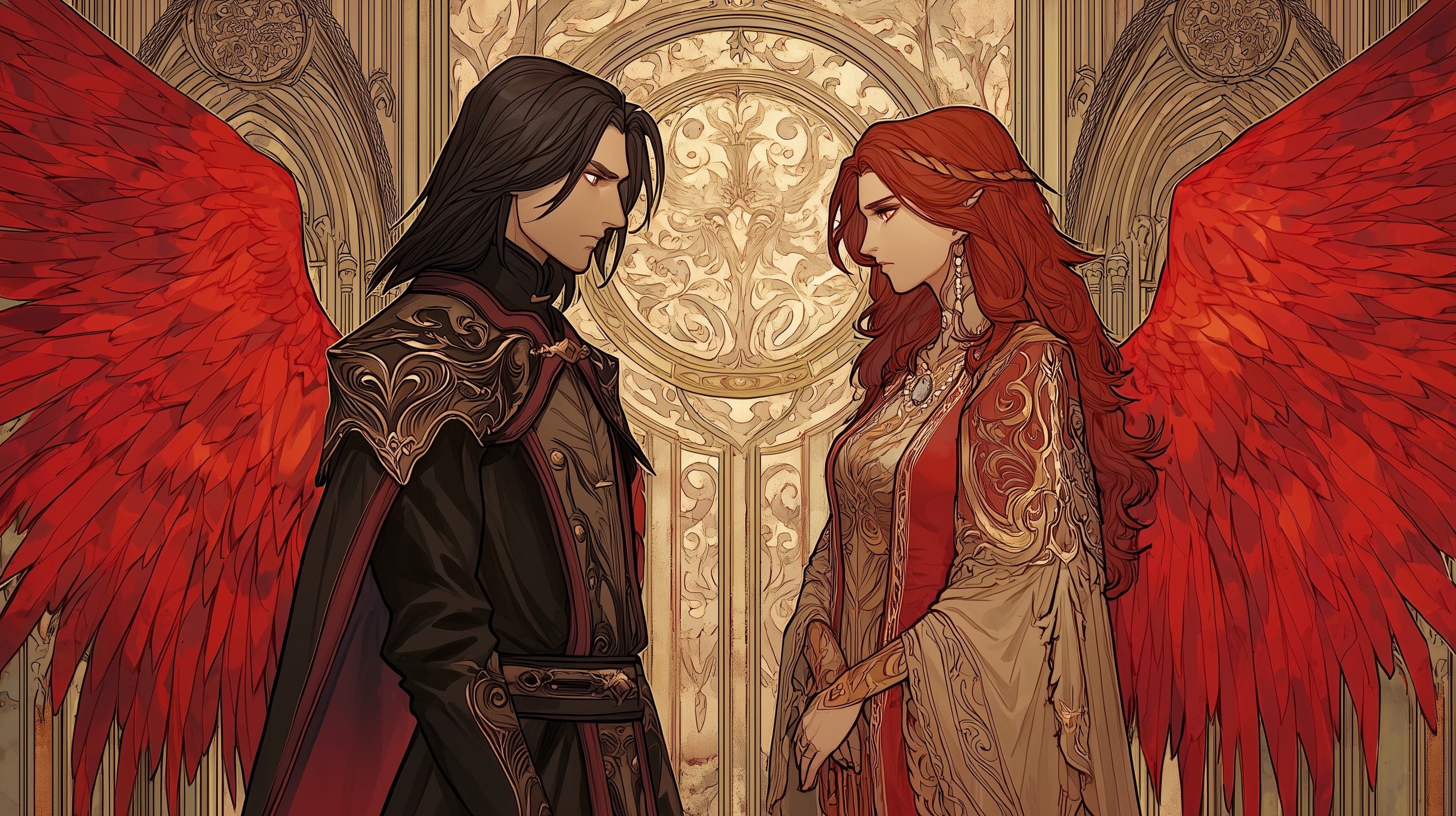
In the final moments of the battle, as Corvyn stood victorious over the slain Heretic King, Nightsong, the ancestral sword of his line, slipped from his grasp as his body gave out from his wounds. Nearby, Oriana Proudfeather, Corvyn's closest lieutenant, stood by holding the Master's Edge, with Corvyn's orders to strike down King Amraz should he fall. Oriana was only masquerading as an ally. She was an angel of Xal’Kanan, a personal avatar and his assassin, commanded to eliminate Corvyn should he prove a danger to her god, and should it come to it, the Heretic King Amraz. Oriana hesitated, the Master's Edge trembling in her hands.
Xal'Kanan knew of Corvyn's seething hatred towards him for the perceived abandonment of both the Astaray Knights and the people of his country, founded in his name to battle an ancient enemy in the wake of the Battle of Bastion and the Shattering. He knew the power Corvyn now wielded and that it would not be long before the Baron of Venlin's own merciless heresy and challenge to his authority. The God of Magic also sensed Oriana's growing feelings for Corvyn. The sword shook in his avatar's hands. There was no logic or reason within the heart. In that instant, he knew there was only one way to ensure that there would be no mortal to command more power than himself.
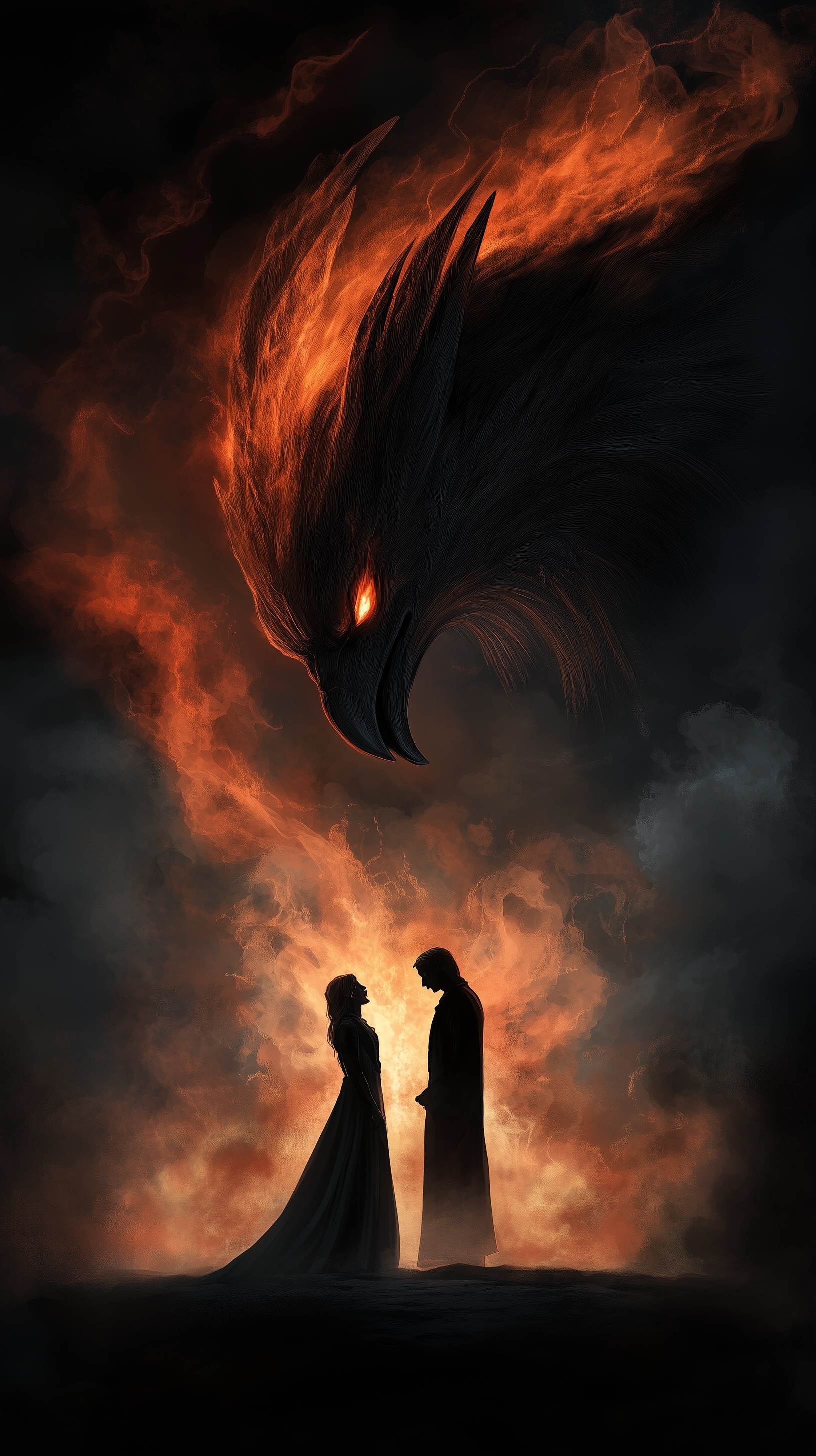
Xal’Kanan possessed his angel's form and compelled her hand. Oriana's phoenix wings emerged as she leapt into the air, the sword poised to strike down Corvyn. In that same moment, Andrielle, believing her husband safe, rushed to him unaware of Oriana poised above. Barely conscious, Corvyn watched in horror as Oriana, descended from above with tears in her eyes, plunged the Master’s Edge toward him, only to impale Andrielle instead. With that lethal strike, her soul was unmade, erased beyond recovery. Cradling her body, Corvyn could do nothing but watch the light vanish from her eyes and hear her final whisper, “Look at the stars.”
In the universe’s accounting, Andrielle ceased to exist altogether, a sorrow beyond mortal grieving. Resurrection and divine intervention could not mend the vacancy left in her wake. For Corvyn, it was a complete erasure, an unparalleled emptiness no arcane power could fill.
In this same instant, Corvyn discovered Oriana’s betrayal. She, who had feigned love and fought beside him, was in truth an angel of Xal’Kanan, tasked with monitoring, evaluating, and ultimately destroying him if he threatened the god of magic. The blow intended to erase Corvyn struck Andrielle instead. Oriana’s tears told him she had been nothing more than a pawn of her god’s tyrannical will. Yet that realization made it no less devastating. Nor would it make his wrath less merciless.
Lazzill, with no further need for the Master’s Edge after its final grim blow was wasted, damned Corvyn to an immortal existence. Unable to die and follow Andrielle to oblivion, he would endure across infinite epochs, long after the stars themselves dimmed and reality crumbled. For Corvyn, the outcome of his grand war was not the triumph of saving Areeott but the irrevocable loss of Andrielle, and the cruel knowledge that he could never rejoin her in death.
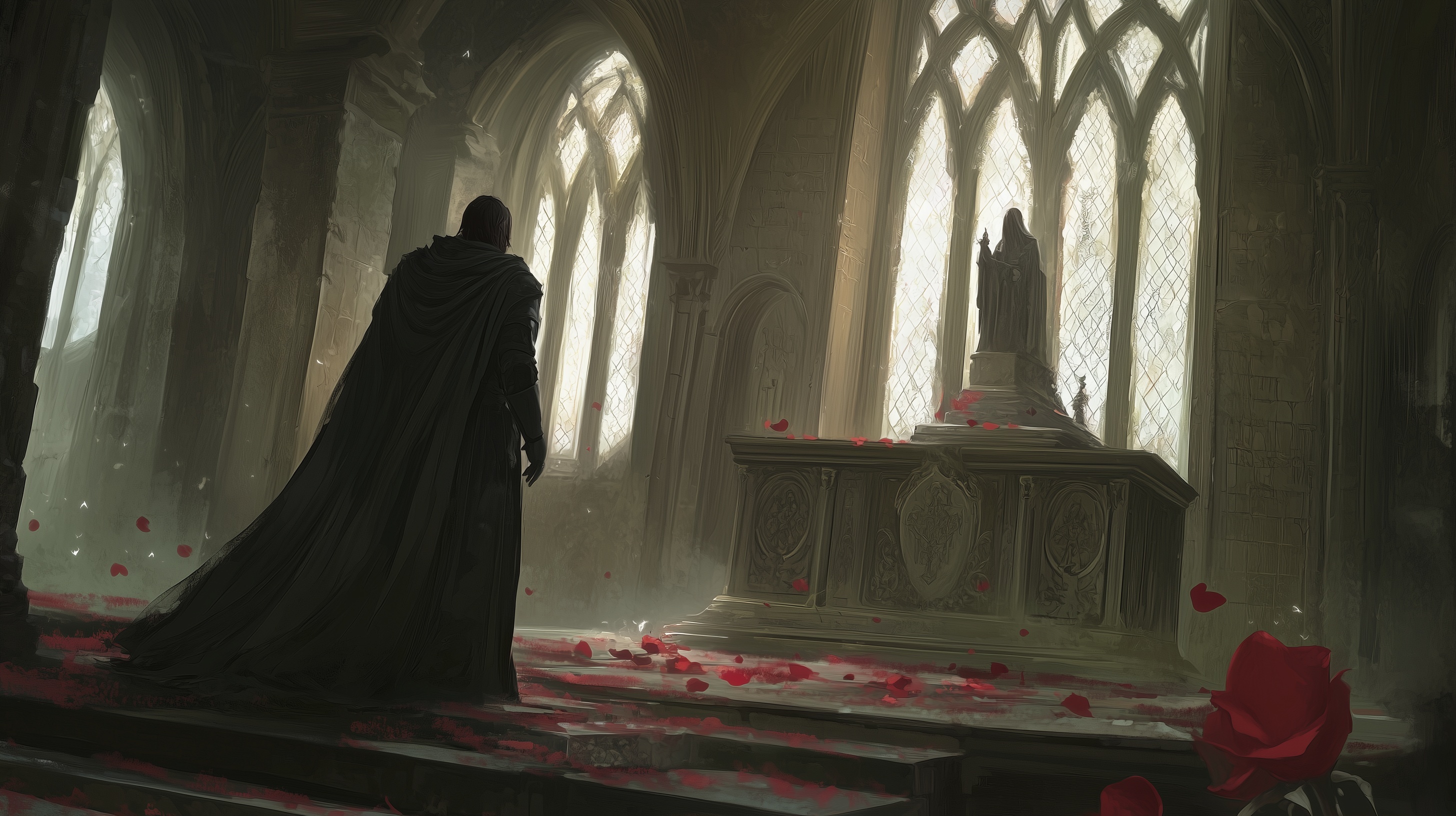
The Scars of Dragonkind
"Dragons make every war theirs. You don’t fight them to win, you fight them to survive the memory of what they take."
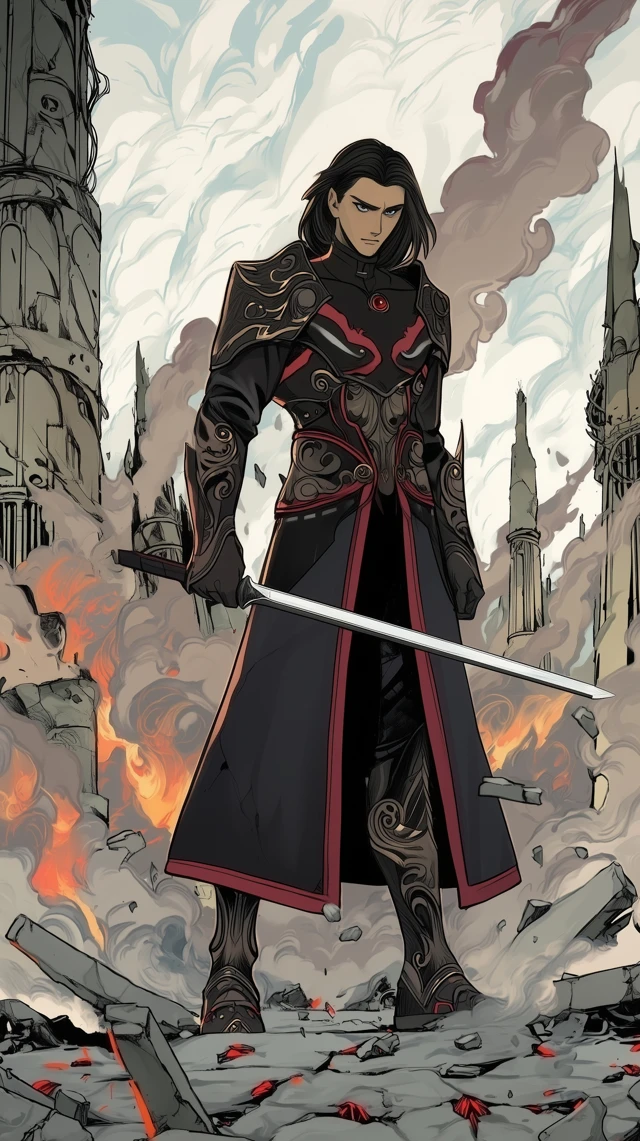
Corvyn Seinrill’s deepest hatred is reserved for dragonkind. Though the gods conspired in his downfall, it was the hand of dragons that first set calamity in motion. To him, they are not just dangerous but the architects of every great devastation that scarred his life and reshaped the world. Without dragons, the Dragon Insurrection would never have burned across the Empire. Bastion would not have fallen. The Shattering might never have crippled reality. And Andrielle, Daemon, and his homeland might still live.
This hatred is not contempt alone. It is obsession, sharpened by centuries of loss. Every resurgence of dragon cults, every draconic scheme, every whisper of their influence is to him not a passing threat but part of an unbroken cycle of destruction. He refuses to let that cycle claim more lives. This conviction is why he clings to the Charter of Areeott, a decree born at the height of the Dragon Insurrection. It names Areeott as the first and final shield of Saint Marius’ empire, standing guard against the Prime Dragons and the Azar Empire at Stormwatch Pass.
To Corvyn, this is no mere frontier duty. It is his sacred charge. Every soldier on the pass, every wall raised or reforged under his orders, is a vow renewed. A promise that Areeott will never again fall to dragonkind.
His crusade has never been passive. Across centuries he has hunted draconic remnants, from ancient wyrms to hidden cults. Entire bloodlines tainted with their heritage have been erased at his command. In his eyes this is not cruelty but necessity, a purge to prevent the return of the ruin that stole everything from him.
Yet for all his victories, his war has no end. Each campaign distills him further into a force of devastation, a shadow of the very dragons he despises. Though he will not admit it, he is trapped in the same cycle of ruin he swore to break.
Even after seven centuries, his vendetta burns undimmed. Areeott, born in fire and blood, remains his bastion against their return. He knows slaying dragons cannot restore what was lost. But if one life can be spared from their destruction, then his endless war remains worth waging.
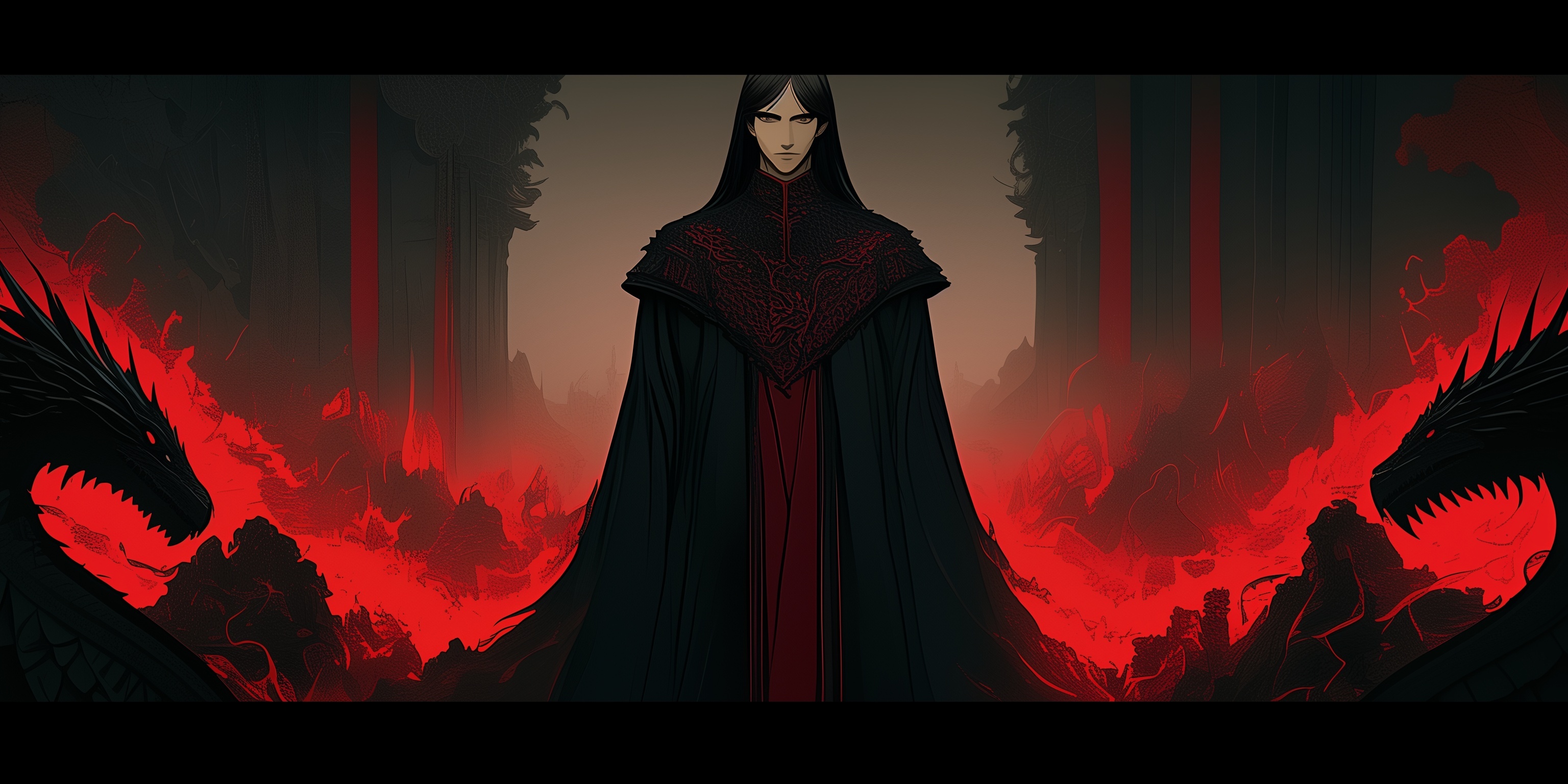
Secrets & Silence
"The greatest secrets are not those that are hidden. They are the ones disguised as truths. Truths so perfect, so unquestionable, that no one ever thinks to look beyond them."
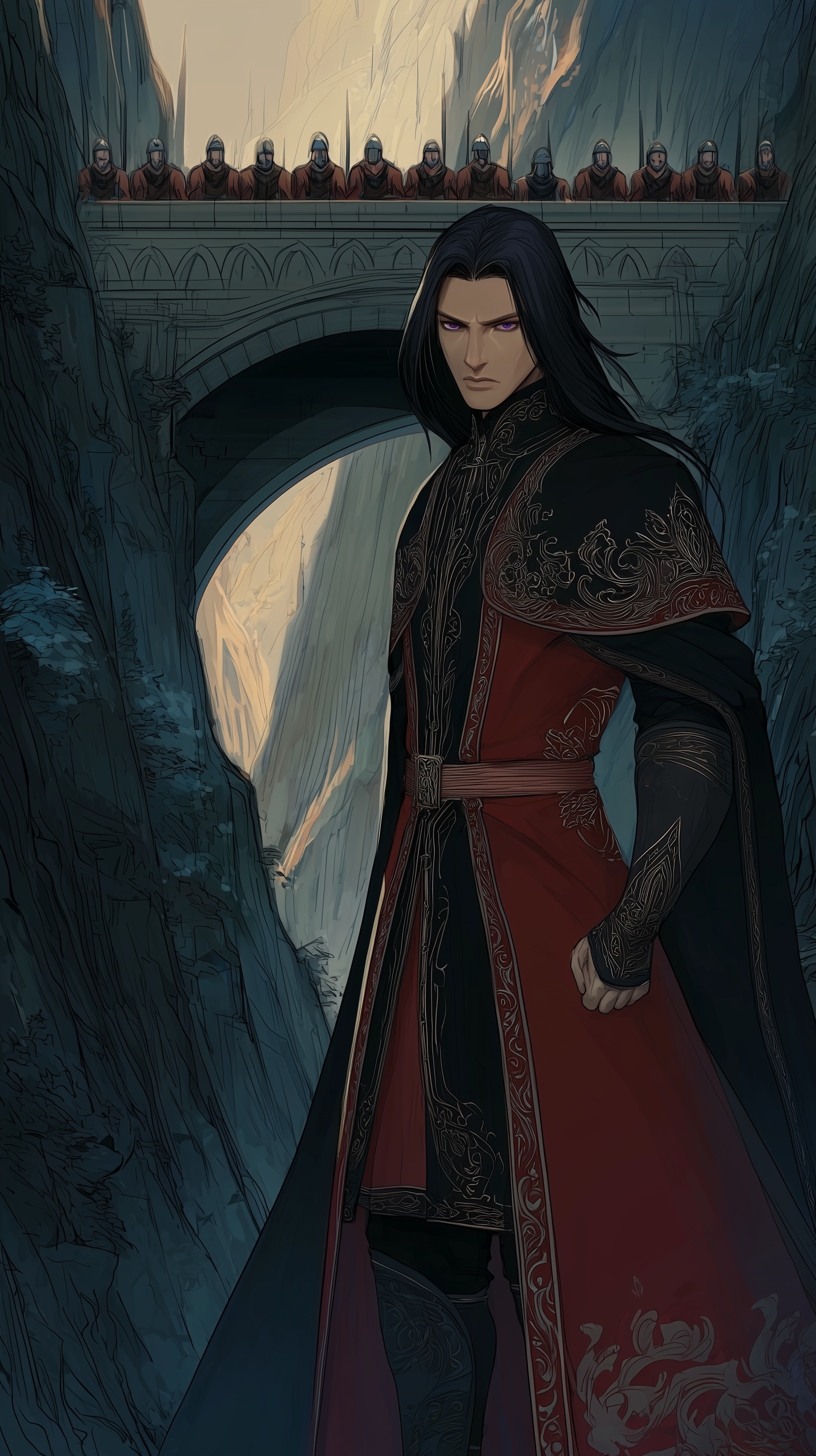
When Andrielle was obliterated from existence, Corvyn Seinrill’s grief became his foundation. Her death and the infinite void it left transformed both his life and Areeott’s fate. What began as a desperate attempt to keep her memory alive became something darker. A hidden empire of control now spans Aerith and beyond, woven through the Umbra and the most remote planes.
For seven centuries Corvyn has maneuvered from behind the curtain. His influence stretches across nations, orchestrating conflicts, subverting rulers, and unraveling secrets. All for a single purpose. To either restore Andrielle or, if that proves impossible, to finally secure his own death.
To achieve this, Corvyn has become a master of deception. It is an agonizing irony for a man who once told Andrielle that the thing he hated most was keeping secrets, especially from her. That moment, born of youthful sincerity, now stands as a bitter reminder of how far he has strayed.
Where once he valued honesty and trust, his existence is now defined by layers of manipulation and illusion. His immortality is concealed behind the carefully cultivated lie of the Seinrill dynasty, while his unseen hand reshapes the world from the shadows. Each deception feels like a betrayal of the man he once was and the woman he loved. Yet he endures it, because he sees no other way.
Through assassinations, political chaos, and subtle coercion, Corvyn maintains a precarious balance in Areeott’s favor. Many of these maneuvers serve as distractions, but most are calculated moves in his ceaseless search for forbidden relics, lost tomes, and arcane anomalies. Every collapsed empire and every seemingly random conflict could be part of a long chain of events he set in motion, inching him closer to his elusive goal.
But for all his power, for all the kingdoms bent to his will, the void remains.
Areeott prospers, yet its people instinctively understand the price of their paradise. Beneath the surface of comfort lies constant scrutiny, unspoken intimidation, and an invisible hand ensuring that nothing disrupts the order he has built. Beyond Areeott, rumors persist. Whispers of a phantom shaping history. A faceless presence toppling rulers. A hand pulling the strings of fate itself.
Corvyn sees these sacrifices as necessary. Areeott must endure. And if it must be ruled by an unseen tyrant, so be it. Every deception and every manipulation is another desperate measure to protect the last fragments of Andrielle’s dream. Yet even as his reach extends across worlds, Corvyn remains trapped by a truth he cannot escape.
No amount of power will bring her back.
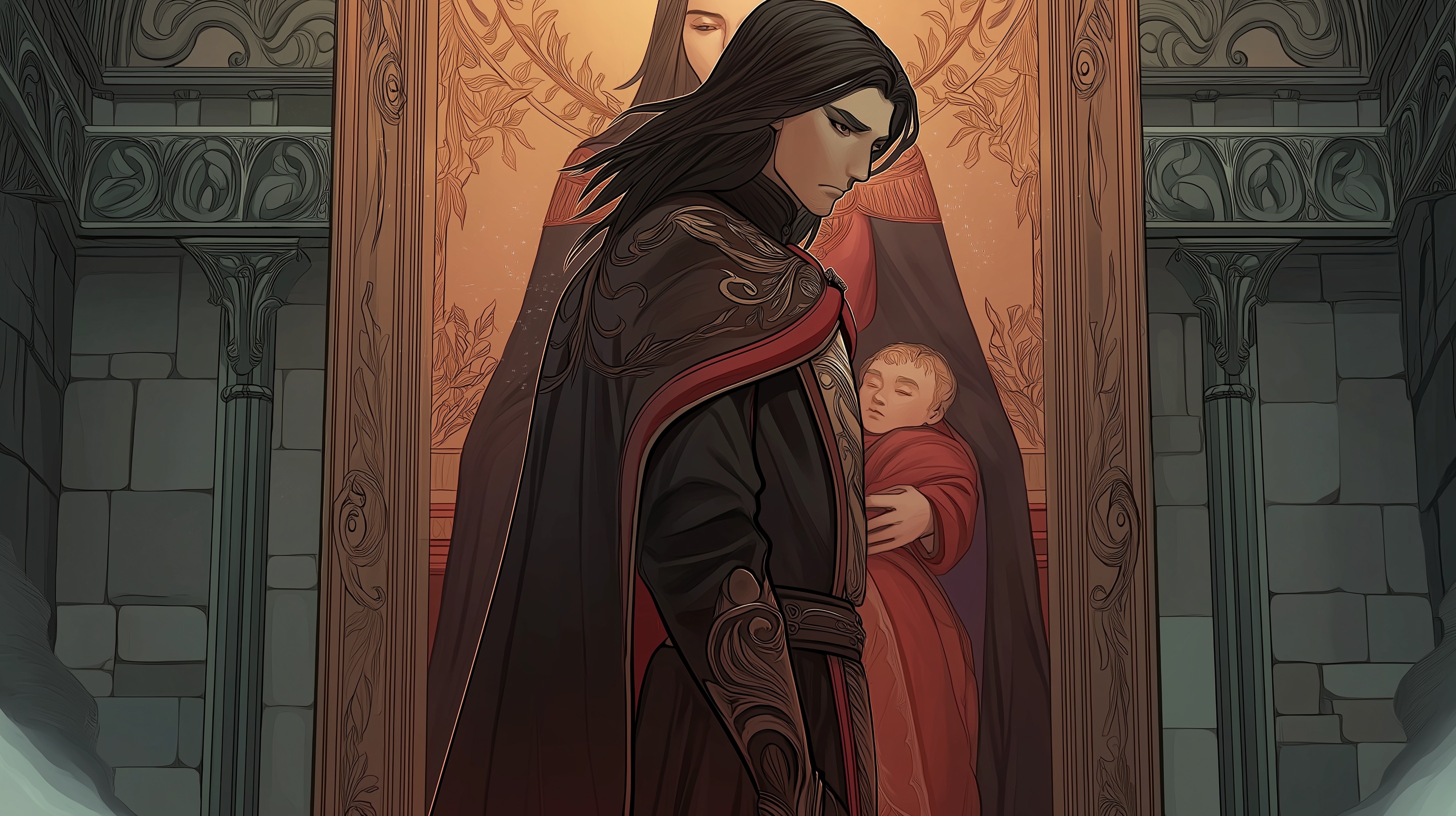
The Phoenix Undying
"Perhaps it is not time that binds us, but the weight of those we carry with us through it. For what is eternity without the souls that once filled it?”

Time, once an enemy Corvyn tried to outrun, has become both his ally and his tormentor. His curse grants him centuries to shape Areeott in Andrielle’s image, yet it denies him the ending he craves. He can perfect the realm, but no stretch of years can restore what was lost. Each decision is a hollow echo of the truth he cannot change. Immortality is not freedom. It is an endless vigil bound to the memory of failure.
Generations rise and fall while Corvyn endures unchanged. Faces blur together until even names fade. Only Areeott remains his constant companion, yet even it changes. Its laws, its culture, its people evolve across the centuries. He takes solace in its resilience, even as the changes wound him with reminders that life continues without Andrielle.
History itself has become his mask. To the world, the Seinrill dynasty appears as a long line of devoted rulers, each remembered for wisdom and justice. In truth, Corvyn guides every reign, manipulating records, archives, and memory to preserve the illusion of mortal succession. The legend of the dynasty conceals his immortality, while beneath it he directs Areeott’s fate with tireless precision. To others, he is a figure glimpsed only in old chronicles. To himself, he is the architect of a labyrinth of lies built atop unhealed sorrow.
This mastery of history gives him reach beyond the limits of mortal rulers. He forges pacts and stirs conflicts with patience measured in centuries. Every plan is a fragment of a larger design to shield Areeott from the ruin he fears will return. Patience is his greatest weapon. Time bends to his will, yet its slow march only deepens the gulf between his purpose and his pain.
Every fabrication that sustains the dynasty is a reminder of how far he has strayed from Andrielle’s ideals. Areeott may reflect her dream, but his unyielding grip distorts it. Any disruption of the order he maintains is not just defiance. It is an assault on the balance he has guarded for centuries in her name.
To Corvyn, time is not a gift or a curse. It is a mirror. It shows him the magnitude of his power and the depth of his solitude. Each thread he weaves into Areeott’s tapestry is an act of penance and preservation, a desperate effort to shelter her dream from oblivion. As ages pass and the world shifts, Corvyn remains. Not from hope, but from necessity that he cannot escape.

Power Without Purpose
“Power is never the question. The question is purpose. Without it, armies become ornaments, and the strongest hand is reduced to holding nothing at all.”
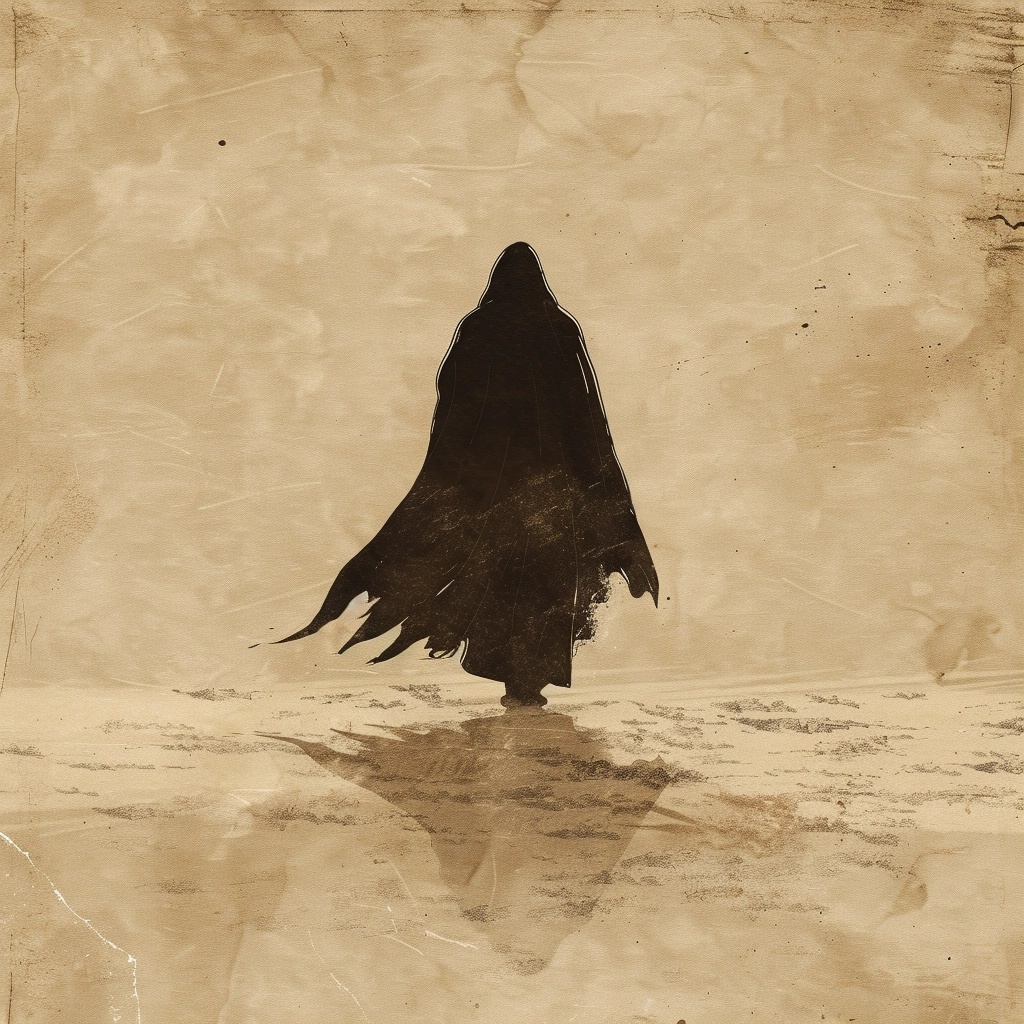
Behind Corvyn Seinrill’s collected restraint lies a monopoly over knowledge that no mortal could hope to equal. He was gifted, but not singular. If brilliance could be measured, he was never the towering prodigy. What he possessed instead was time. Seven centuries of it. While dynasties rose and crumbled around him, Corvyn remained, studying the oldest tomes, prying secrets from beings few mortals would ever dare face, hoarding magic that slipped out of history’s grasp. Where others saw lifetimes, he saw practice. His power is not the spark of genius, but the accumulation of centuries.
This long vigil hardened into obsession after Andrielle’s murder at the hands of Oriana. Denied death, he turned to the only weapons left to him. Study, patience, and relentless pursuit. He walked the planes in search of answers that could undo his fate. Some journeys were quests for her return. Others sought a way to end himself. Still others sought the means to unmake the gods who cursed him. Each path yielded fragments, scraps of impossible lore. None gave him what he needed.
Among his private griefs, none cuts deeper than his firstborn, Daemon. The boy perished at five, lost to the treachery of House Isari when Areeott fell to the darkness brought on by the cowardice of the Heretic King Amraz. Corvyn holds the power to return him, yet he refuses. To raise Daemon into a world without Andrielle, to wake him into her absence, would be another cruelty. Corvyn long ago swore that if the child ever opens his eyes again, it will be to see his mother’s face. Until then Daemon remains in the silence of death, a wound Corvyn chooses never to close.
This restraint defines him more than any spell. His vaults brim with knowledge to tear down kingdoms or unmake gods, yet he does not unleash it. Areeott is not his conquest. It is his vigil. He builds, polishes, preserves, not because creation satisfies him, but because it honors the dream Andrielle left behind. And yet his restraint is not mercy. Those who threaten Areeott summon the precision of his wrath. His fury is not chaos. It is deliberate, orchestrated, and complete.
The tragedy of Corvyn Seinrill is not that he is immortal, nor that he wields power beyond measure. It is that all his strength, all his centuries, all his victories lead back to the same silence. No amount of power will restore Andrielle. No act of will can bring Daemon home to her side. And so he endures, power without purpose, a sentinel who refuses to let the world collapse but cannot free himself from the collapse within.

The Eternal Architect
"A masterpiece is not a gift to the world. It is a wound, carved so deeply into its creator that they can no longer distinguish themselves from the thing they have made.”
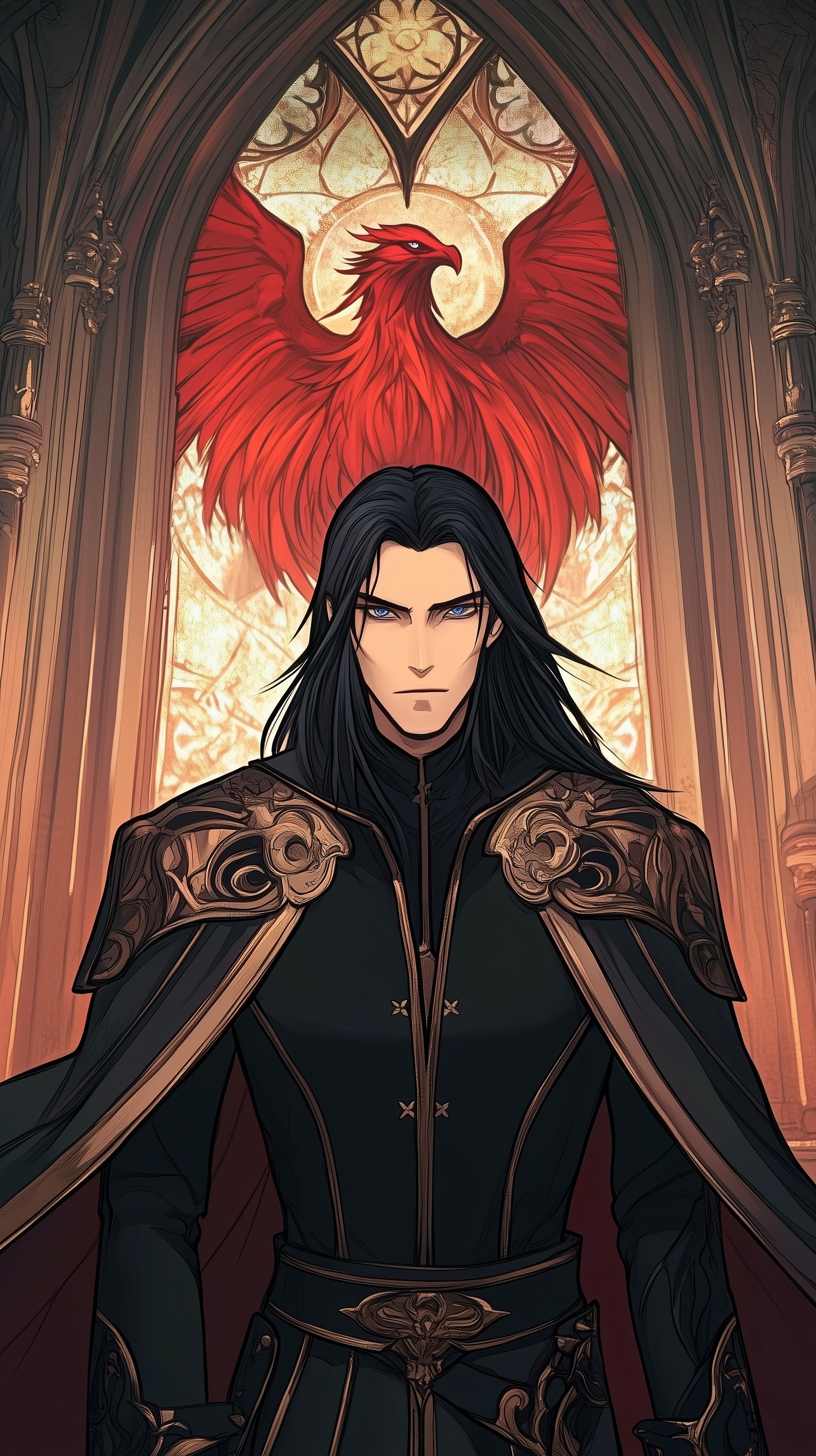
Corvyn Seinrill’s immortal existence has made him the architect of Areeott’s splendor, yet it is a title that grows heavier with each passing year. The perfection of Areeott is an extension of his unyielding will, a creation meticulously shaped to resist chaos. Its immaculate roads and flawless spires reflect the fracture within his soul. This is a masterpiece built not only from devotion, but from desperation.
Each mountain path and city street is a silent testament to his obsession. This realm was sculpted not by love alone, but by anguish, and by the knowledge that his vision can never be shared or fully understood. Among all the marvels of Areeott, one absence speaks louder than any monument. There are no tributes to Andrielle.
This silence is not neglect. Corvyn sees the whole of Areeott as her enduring memorial. Every peak, every fountain, every courtyard embodies her dream. A statue would confine her to stone. He refuses that surrender. Instead, her presence suffuses the country’s design, hidden but constant in each chosen detail. To strangers she is a faint echo. To Corvyn she is the pulse beneath the surface.
Areeott’s beauty conceals the deep pain of its maker. The land is immaculate, the buildings pristine, every line sustained by his tireless watch. To the unknowing, it appears a haven hidden in a harsh world. In truth its perfection comes at a price. Surveillance and control shape every moment of life. Prosperity rests on the will of a ruler who cannot accept disorder, whose sorrow has become law.
Seinrill Castle and the catacombs beneath it form the core of his existence. The castle stands above as a monument to the bloodline, housing relics and a carefully written history. Below lies a vast secret domain. These vaults are not a tomb, but a living archive and arsenal. Here lie trophies of Bastion, treasures seized from dragons, relics taken from the Heretic King. For centuries Corvyn has wandered these halls, not in idleness, but in a relentless search to test the limits of mortality and divinity. Every artifact is another fragment of a puzzle he cannot abandon.
Physical Description
General Physical Condition
"Corvyn’s form was neither carved by vanity nor softened by indulgence. His was a body forged by necessity, a living testament to the trials of his age."

Corvyn Seinrill carries himself with the quiet strength of a man shaped not by triumphs but by necessity. His frame is lean, precise, and enduring. It is not the body of a warrior seeking glory or a mage lost in ritual, but of someone who has lived with the knowledge that failure meant losing everything. There is no indulgence in his appearance and no waste in his movements. His body, like his mind, is a fortress under constant siege.
He long ago rejected the easy paths offered by his condition. No enchantments preserve his strength, no spells maintain his agility. He sustains himself as a blade keeps its edge, through repetition, pressure, and refusal to dull. Solitary routines, combat forms repeated long after necessity has passed, and meditations that fuse martial instinct with arcane focus keep him sharp. Time has bent and tempered him into something that cannot be broken.
There is no vanity in Corvyn. His movements are pared down to the essential, each breath and glance measured. Even at rest he carries presence, quiet and coiled, impossible to ignore. People do not fear him because of size or muscle. They fear him because he looks ready, as though every moment has been rehearsed, and he already knows how he will respond.
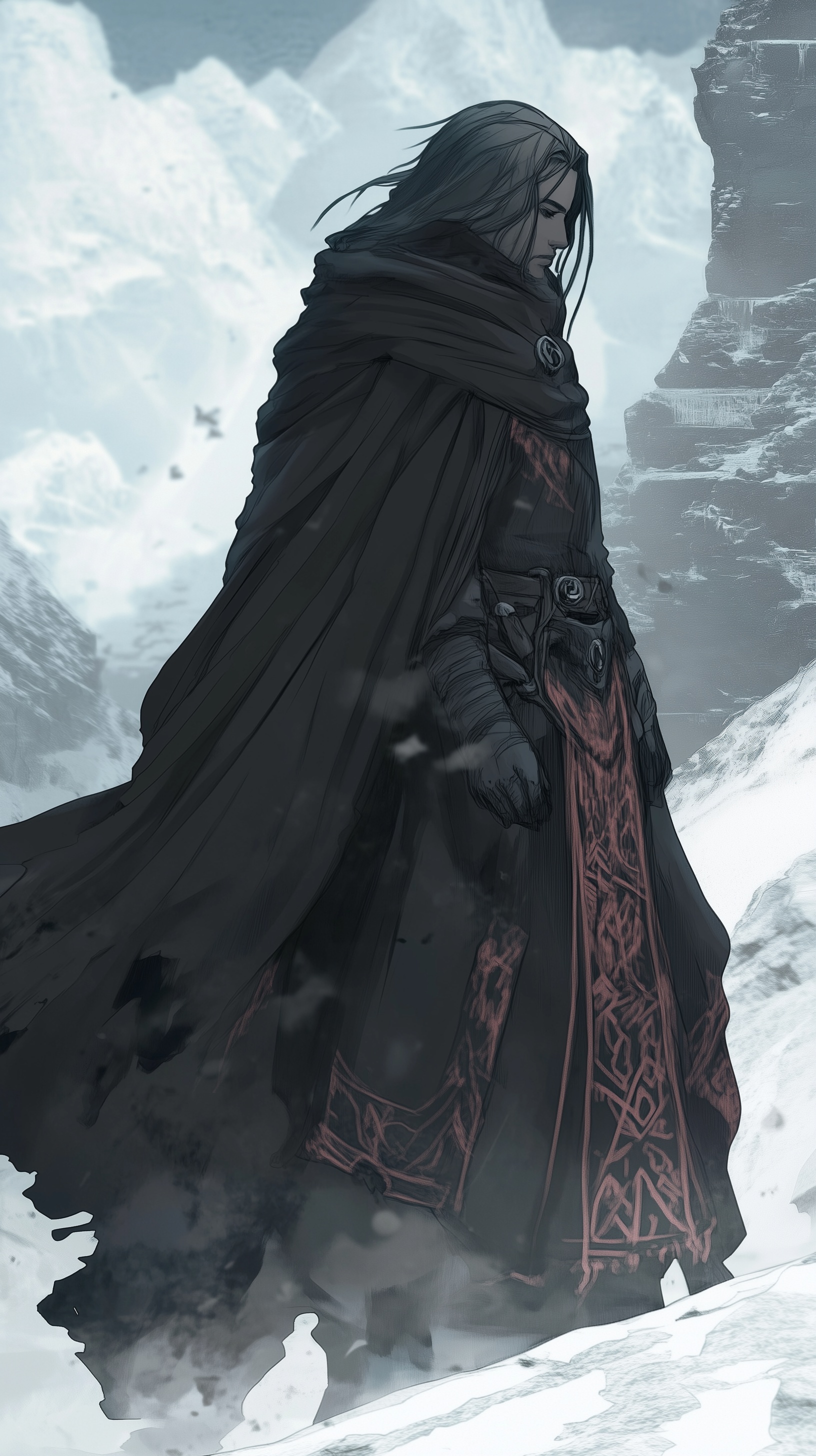
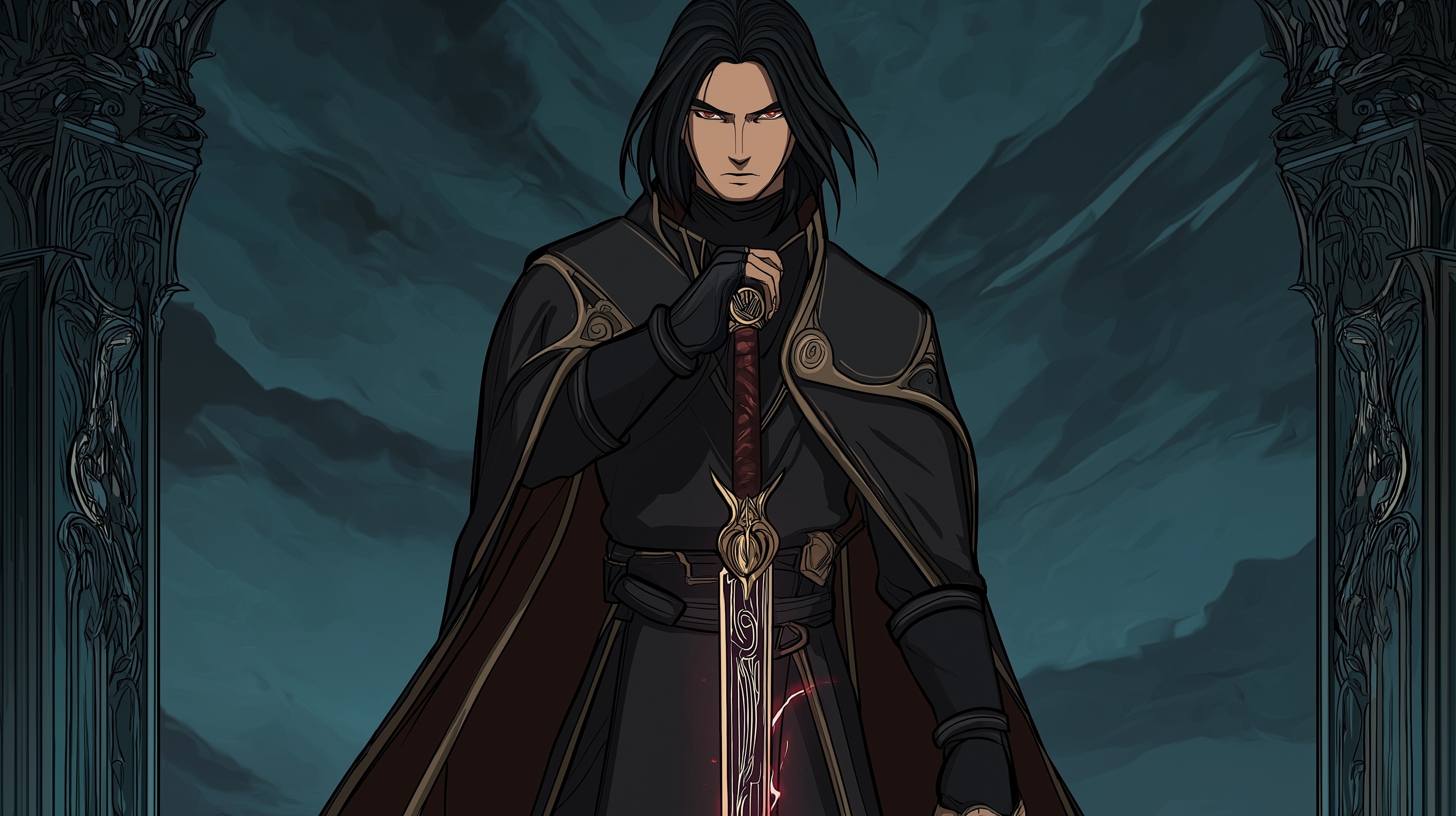
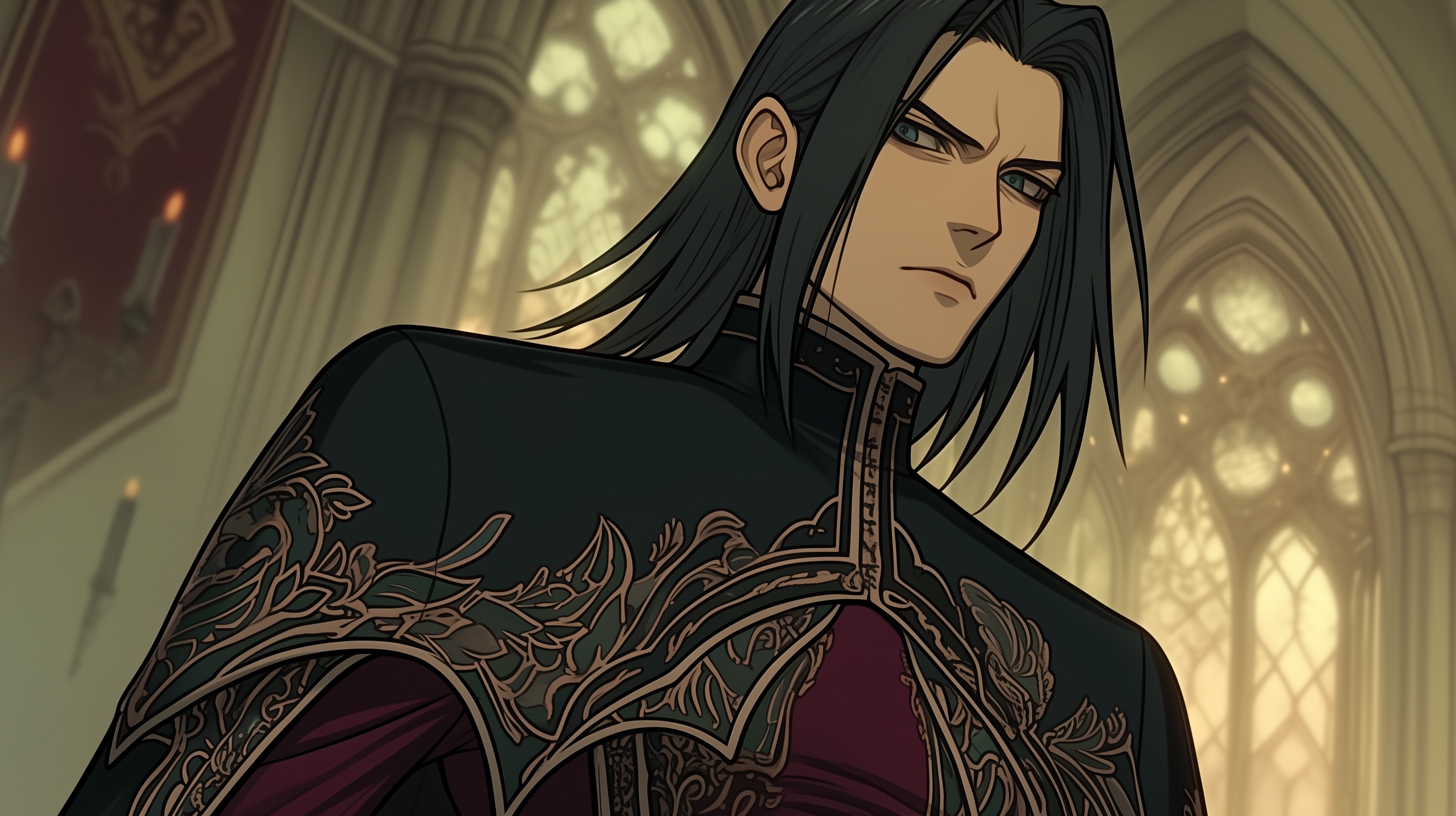
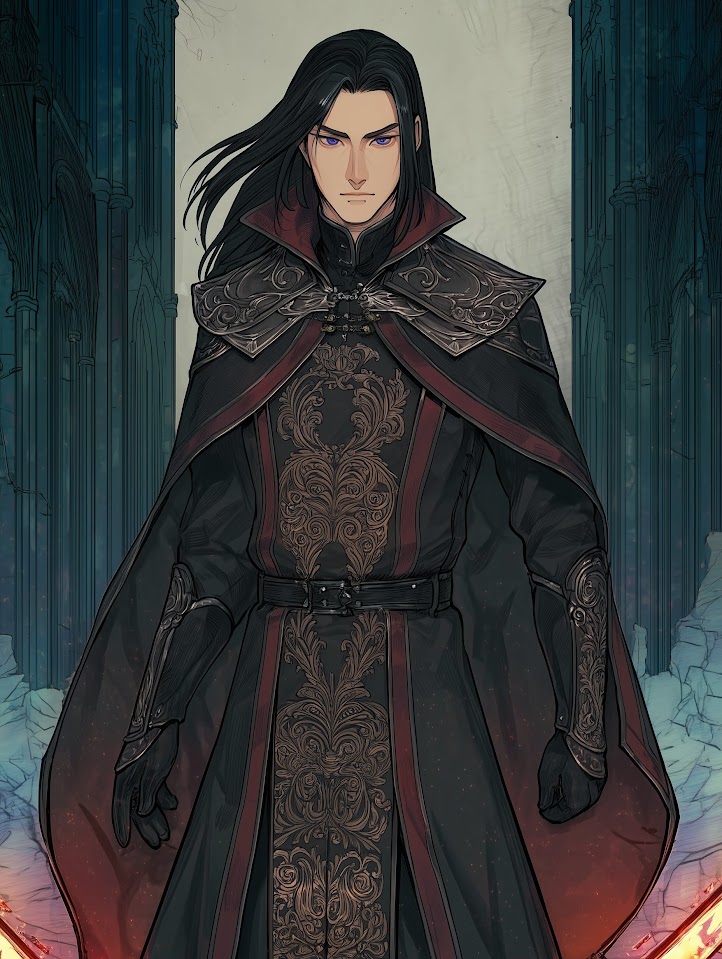
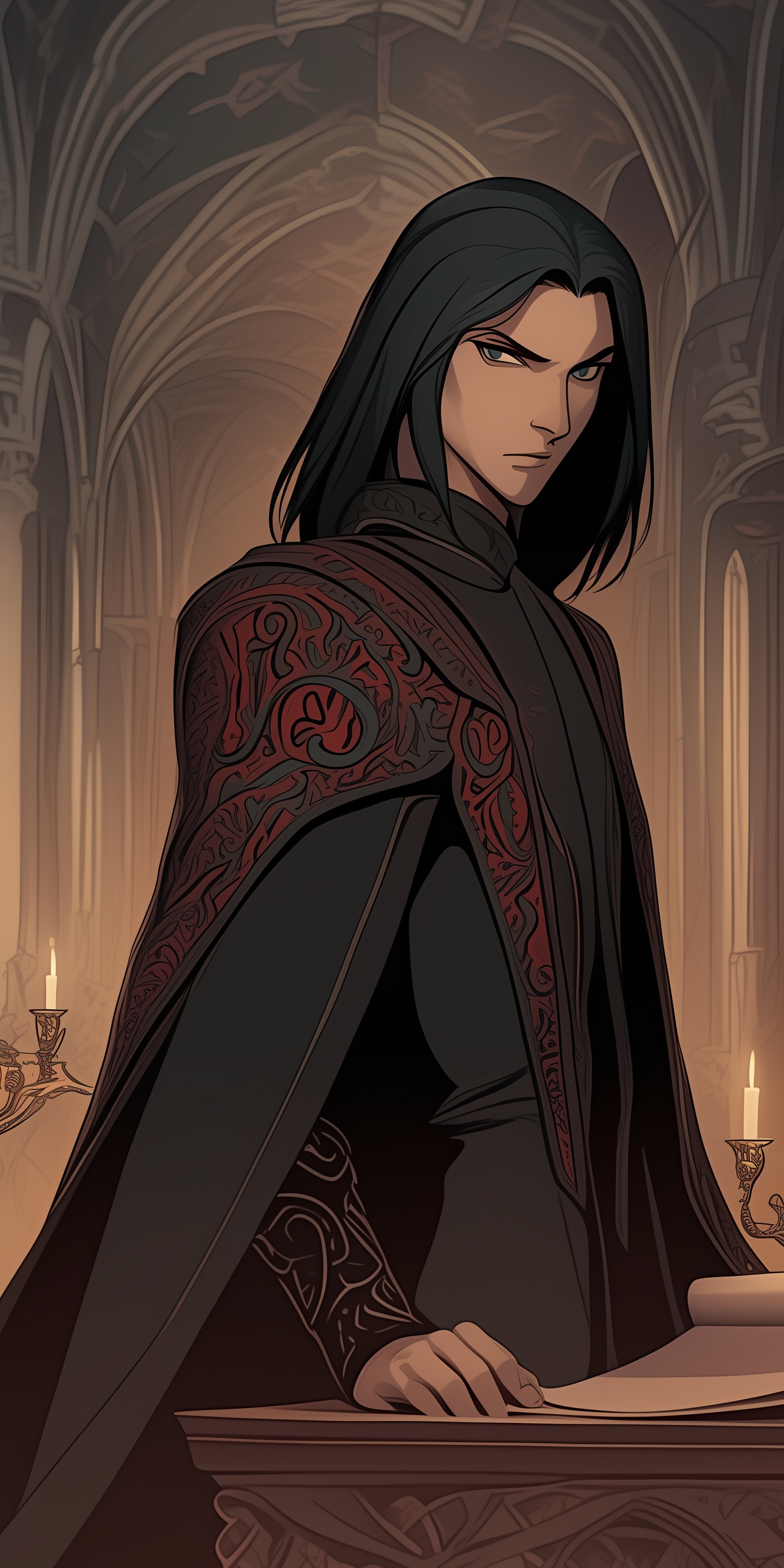
His straight black hair, worn to the shoulders, reflects practicality more than style. His grooming is severe, his skin pale but weathered by long years outdoors and endless nights of vigilance. He does not withdraw from the world. He studies it.
His hands reveal the truth most clearly. Broad, scarred, and calloused, they are the hands of one who has mastered both blade and spell. His fingers are exact, able to inscribe arcane sigils or break bone with equal certainty. In them lies the balance between ruin and design. He can destroy. He chooses to create.
Above all, Corvyn’s body tells one truth. He is not invincible because harm cannot reach him. He is invincible because he will not stop. His endurance is not a gift. It is a decision, renewed each day for seven centuries. And when he stands in stillness at the heart of his silent kingdom, what shows in his eyes is not the secret of survival. It is resolve.
Identifying Characteristics
"Grooming is not fashion. It is the daily rehearsal of command."
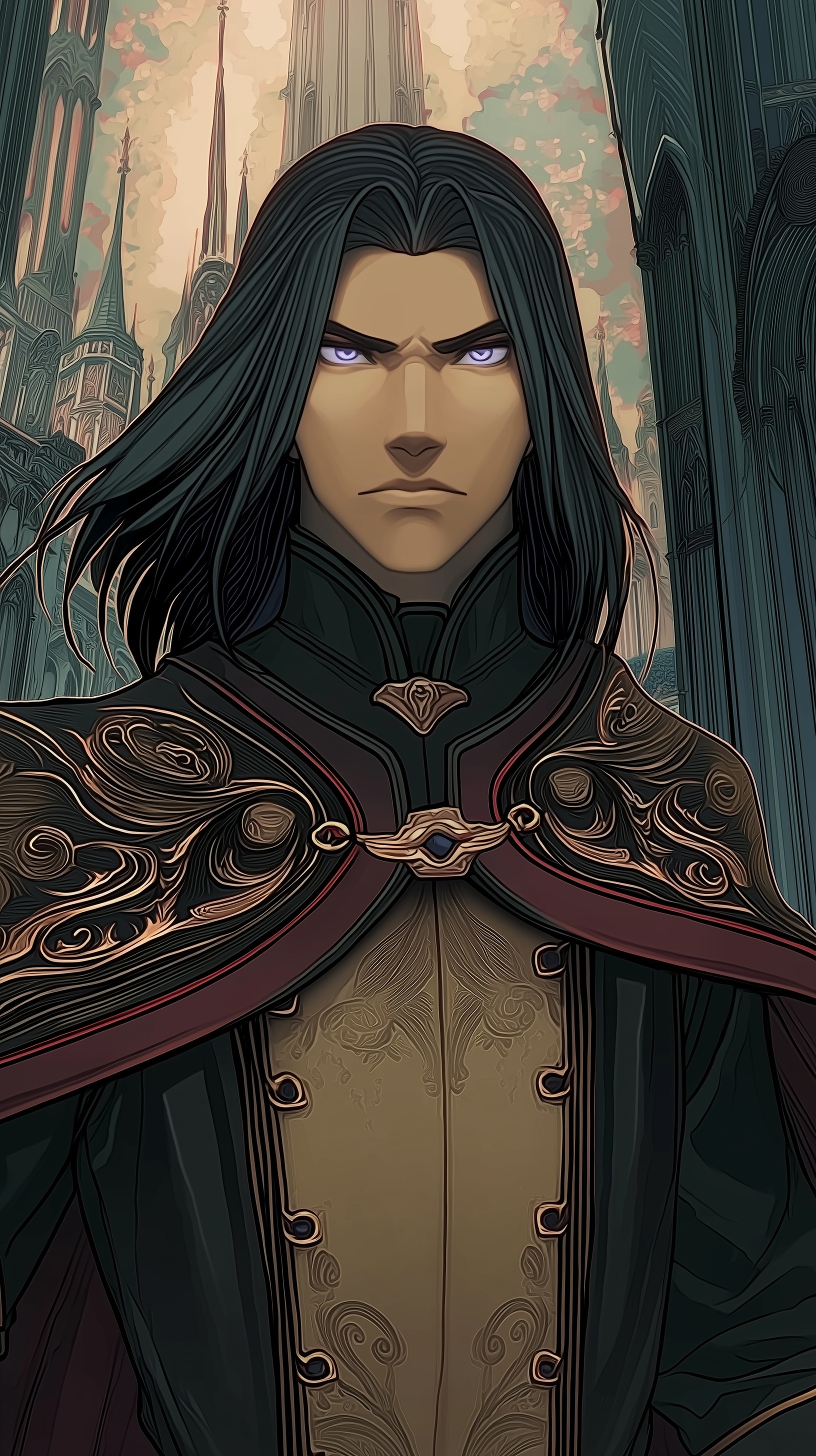
Corvyn Seinrill’s most striking feature is his eyes. Dark orchid in color, they appear subdued in shadow but take on a near luminescence when caught by the light. These are not the eyes of a man who only observes. They belong to someone who analyzes, remembers, and never forgets. His gaze is not cruel and not cold, but unflinching. It gives the impression that every hesitation, every falsehood, has already been measured before the other person realizes they have spoken.
This stillness exerts quiet authority. He does not command obedience by words, nor win loyalty with charm. He simply exists, and that is often enough. Some feel recognized in his presence. Others feel stripped bare. Most feel both. Once you have met his gaze, it lingers in memory long after he has gone.
Everything else about him reinforces that impression of cultivated precision. His straight black hair, worn to the shoulders, is not fashion but purpose. Always clean, always even, with no ornament or flourish. It frames his face as if drawing a boundary between the man and the world he allows to see him. His grooming is never careless. It is immaculate, reflecting the belief that even small neglect is an opening for disorder.
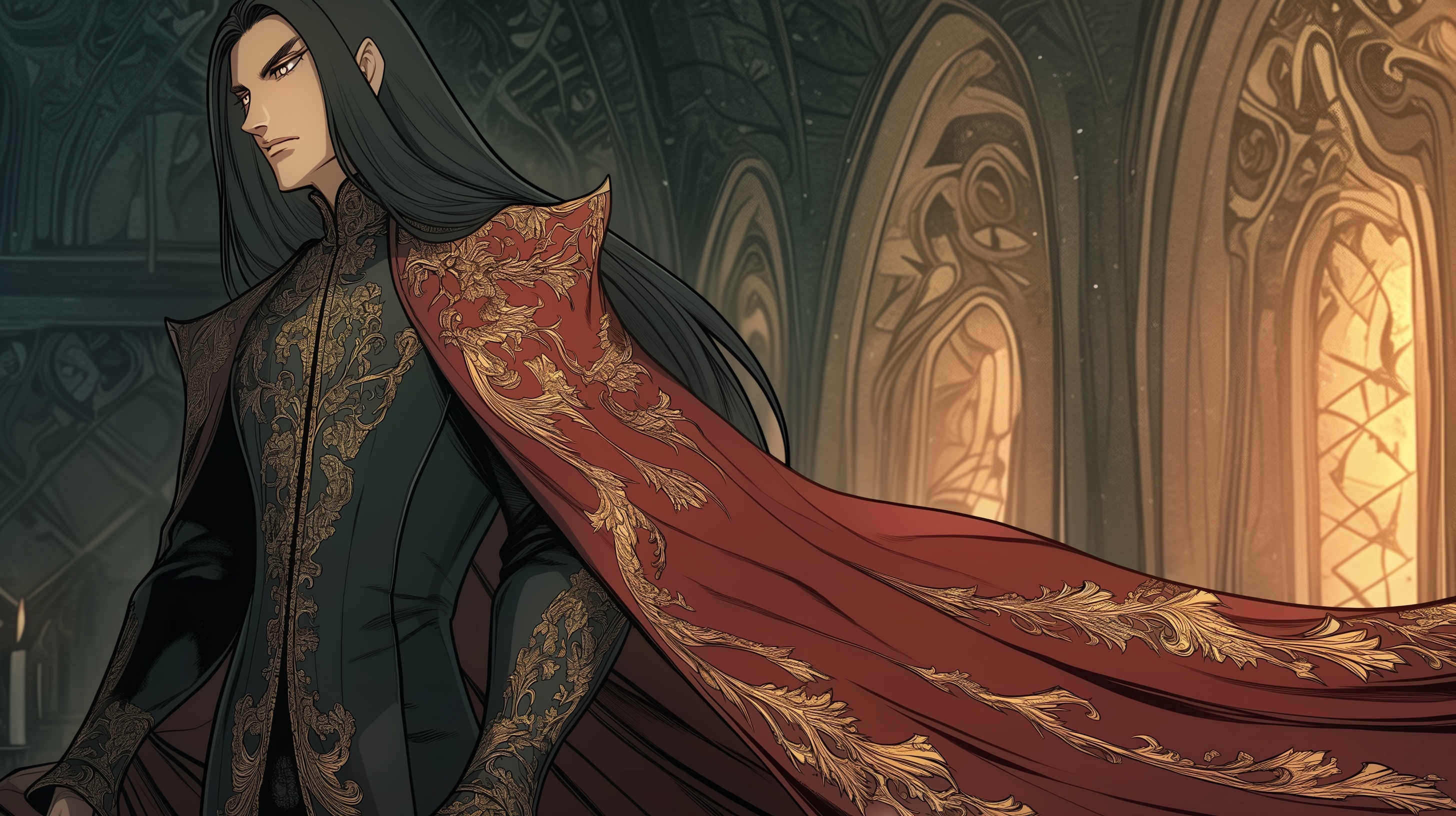
His clothing follows the same philosophy. Tunics, cloaks, and layers in the scarlet, black, and silver of House Seinrill are tailored with deliberate restraint. Embroidery and detail are present but never indulgent, serving only to signal his station. There are no jewels, no enchantments on display, no unnecessary show. Each line is measured, each layer intentional, creating an image of elegance without excess.
Even his boots, polished to a quiet sheen, speak of his discipline. He walks not only through stone halls but through memory, unwilling to allow a single mark to disturb the impression of permanence. His appearance is not for vanity. It is a statement. I am in control. Of myself. Of you. Of everything.
This is why Corvyn does not need titles or heralds. In a world of movement, he remains still, composed, permanent. He does not look like a ruler. He makes you understand that he is one.
Mental characteristics
Accomplishments & Achievements
"You think the country stands because of its laws. It doesn't. It stands because someone decided it couldn't fall and never stopped deciding."

Corvyn Seinrill’s accomplishments are not celebrated. They are not recited in Parliament, not etched into record, and not sung in poems or founding myths. Most of what he has done will never be known. What remains is scattered, misattributed, buried under dynastic lies, or credited to laws whose authors never lived. The truth exists only in silence between generations. Areeott still stands. That is the measure.
The concealment of his survival remains his most enduring act. The Seinrill line endured the Civil War, but fractured and reduced to only Corvyn, Anson and Cassandra as that last three bloodline Serinrill family members. When the time was right, he allowed the world to believe he had died, creating the illusion of an unbroken line through one of his younger twin sisters that had died with the rest of her family. Of course, through Corvyn's hand, those records indicate otherwise. Successors were named, each with a crafted life and a staged death. The dynasty continued, but the hand guiding it never changed. For seven centuries the world has believed Corvyn Seinrill gone. For just as long he has never stepped aside.
He did not restore a broken nation. He reshaped one that could not be allowed to break again. Areeott was traumatized and torn apart by civil war for the first time in its history . Half the nation betrayed by the madness of Roland Amraz, the Heretic King by opportunists. Corvyn gave it silence, order, and predictability. Through his influence the cantons held together. No noble house grew beyond its design. Alliances balanced themselves. Rivals were removed before they could threaten stability. These outcomes were never declared. They simply unfolded until the republic steadied and began again to hold its shape.
He turned the catacombs of Seinrill Castle into a fortress of knowledge. Archives taken from Bastion, sanctums seized from Amraz, and libraries of the fallen all lie in those depths. He did not hoard them for glory but to ensure the present could not be outpaced by the past. Layer by layer he rebuilt traditions of magic into a system unmatched anywhere in Aerith. While others struggle to rediscover forgotten spells, his systems remain intact, self-correcting, and secure.
He prevented four succession crises in Parliament. Each was resolved through quiet inheritance reforms, political reshuffling, or removal. None bear his name. No decree carries his mark. But the balance was preserved.
He dismantled every major draconic cult within Areeott’s borders and the surrounding regions. Some collapsed from contradictions he carefully introduced. Others were infiltrated and broken from within. A few he allowed to grow until their destruction could be used to justify new laws. None endured. Areeott never remembers these victories, because it never knew it was at risk.
He kept Areeott neutral through dozens of foreign conflicts. Trade disputes that could have escalated were extinguished. Ideological threats were cut off before they reached the gates. He sought no conquest. His war was against instability, and he did not lose.
He protected Areeott’s reserves of Arin Silver, the foundation of its arcane and economic strength. Smugglers were dismantled before operations began. Corruption was uprooted before it took hold. Even the most capable foreign agents never uncovered the full scale of the stockpiles. The Silver flowed exactly as he intended, and no further.
These are not the deeds of a hero. They are the acts of a man who refused to let what was broken remain broken. He has no monuments and does not want them. Areeott works. That is enough.
But for all that he has preserved, he has not recovered what mattered most. The catacombs hold knowledge, but not her voice. The streets are quiet, but they do not echo with her laughter. The republic stands, whole and immaculate, but Andrielle is not there to see it. No ritual, no artifact, no secret has reversed what happened. Corvyn endures. Not in celebration of what he built, but because the work is never done.
And it may never be.

Failures & Embarrassments
"By your failure, by your blood, and forevermore... become the phoenix undying."
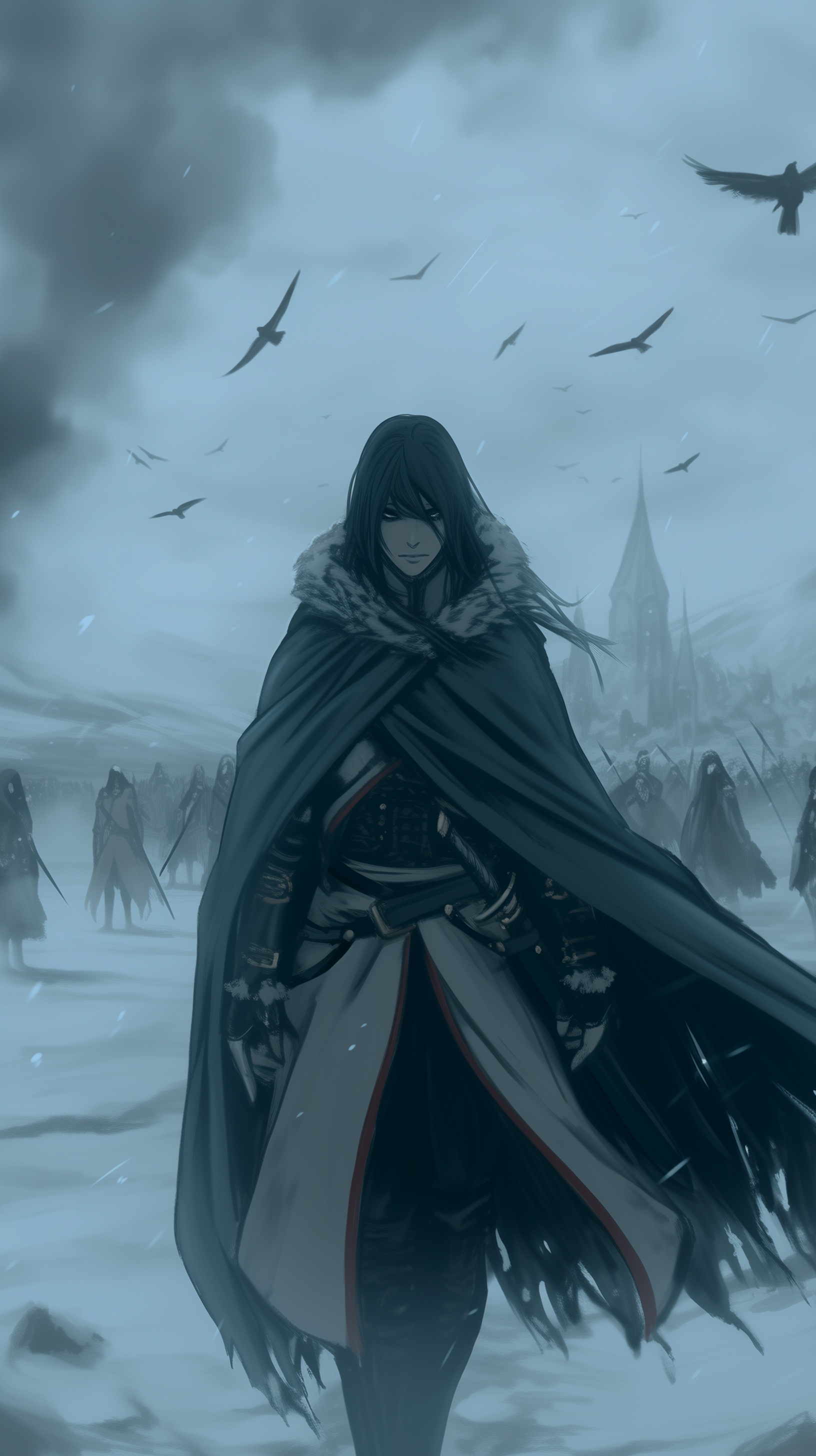
Corvyn Seinrill’s greatest failure is not a single mistake. It is the axis of his entire existence. His bargain with Lazzill during the Arin Civil War was not made for ambition or greed, but in terror. Areeott was burning. The Seinrill family was betrayed and slaughtered. Andrielle, carrying their children, had vanished into the catacombs. With nothing left and abandoned by the gods he once served, Corvyn turned to the only one who answered.
He believed the price would be his life. He would have given his name, his soul, his blood. What he lost instead was Andrielle’s soul, erased by the very weapon he sought to save her. Her destruction was not accident. It was consequence. That truth brands every breath he takes.
His endurance is not reward but sentence. Lazzill denied him death and gave him permanence, a punishment more cruel than oblivion. He is forced to shape a future she will never see, wearing a mask of stability while carrying a silence that grows heavier with each passing year.
His break with the gods severed Areeott from its allies. To its people, independence is proof of strength. In truth, it is exile. The republic thrives only because Corvyn forces it to. Its borders are defended not by trust, but by fear. Its utopia is held not by shared values, but by one man’s relentless design.
The people do not know. They believe in the wisdom of the dynasty. They believe order is inherited from father to son. They do not see that the same hand has guided them for seven centuries. They do not know that their savior is not aging, not grieving, because he will not allow himself to show it. His failure is not only what happened to Andrielle. It is the lie that must never end. Every street, every reform, every monument is in truth a monument to failure.
Isolation has only deepened that wound. He surrounds himself with advisors, heirs, and agents, but he never connects. Each bond is measured, each relationship kept at distance. Mortals live too briefly. Promises decay too easily. Since Andrielle’s erasure, he has convinced himself that no soul is worth the risk of grief. He longs for connection, but denies it.
He watches friendships form and families grow. He hears laughter in the valleys. None of it touches him. Not really.
This disconnection is not cruelty. He still admires humanity. Its brilliance, its tenacity, its ability to build meaning in a fleeting life. He marvels at those who create with the little time they are given. But he will not join them. He helps from the shadows, protects from a distance, because attachment breeds loss, and loss is the one thing he cannot endure again.
So he remains what he has made of himself. A steward without rest. An architect of order built on ruin. His name is synonymous with stability, but his soul is broken. His legacy is law and balance, but his heart is chaos. He gave everything to save the world, and in doing so, lost the only part of it that mattered.
That is Corvyn Seinrill’s true failure. Not that he chose wrongly, but that the right choice cost him everything he meant to protect.
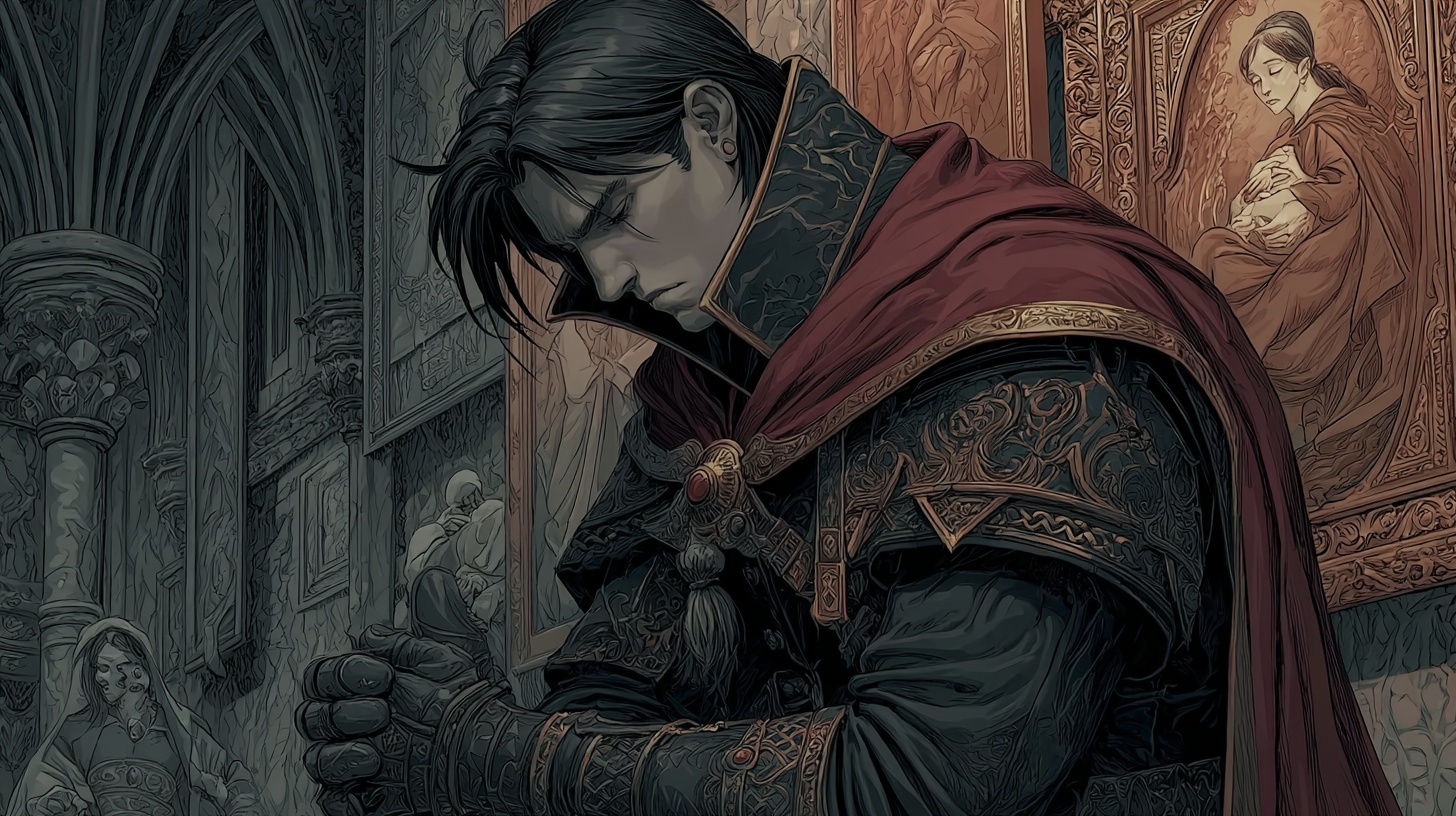
Mental Trauma
"I have walked among those who have sought out a way to cheat death and came to regret it. But they all made a choice. No one should be forced to live forever."
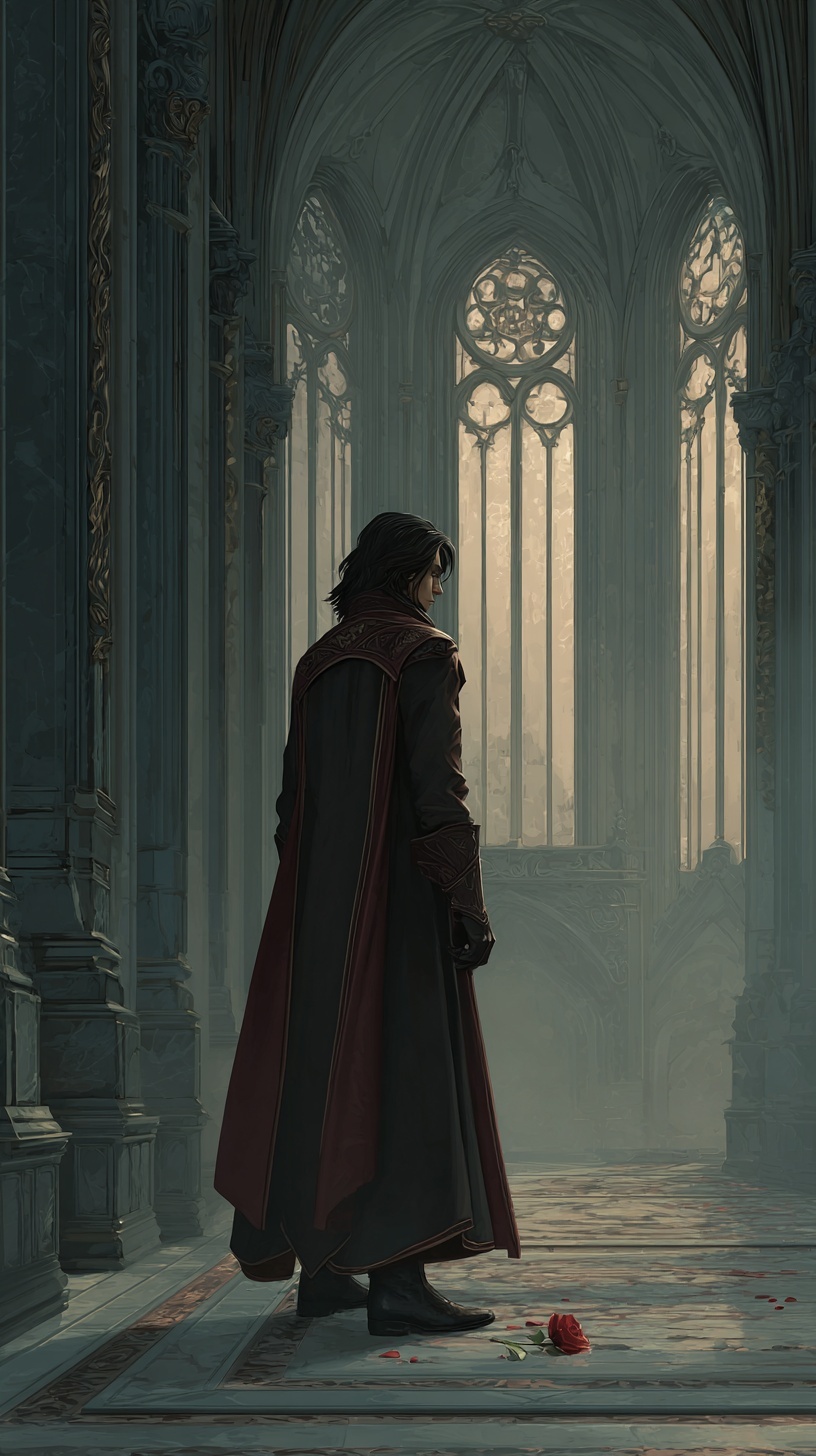
The loss of Andrielle Seinrill is not simply a memory. It is a fracture that bisects Corvyn’s soul. A spiritual amputation so complete that even endless years cannot scab over the wound. Her death was not a natural passing or a battlefield loss. It was obliteration. A soul devoured by a god weapon, unmade by the very power he sought to wield for her protection. She was not lost. She was erased. And he did it.
He cannot forget the moment. His mind refuses to let him. The image replays without mercy. In dreams. In study. In fleeting moments when he dares to imagine what might have been. He remembers her voice, her final words, the scream that never left his throat as the Master’s Edge struck her down. He remembers doing nothing. Bound by wounds, by fate, by his own hubris.
From that moment, Corvyn ceased to be a man. He became a consequence.
Immortality was the gods’ punishment. But it is Corvyn who makes it unbearable. He denies himself comfort. He denies himself closure. Every law, every structure, every secret uncovered is part of a penance that brings no relief. Nothing he achieves feels real. None of it brings her back.
To survive, Corvyn has turned obsession into discipline. Obsession is not a flaw. It is the foundation of his survival. He must keep moving, keep refining, keep shaping the world so that control might shield him from the truth. That he failed. That he was the cause. That she is gone.
His pursuit of forbidden magic is not only defiance of the gods. It is desperation clawing against the impossible. He knows she cannot be restored. He knows the weapon did more than kill. It unwrote. Yet grief does not respect knowledge. So he searches. Because stopping would mean admitting the permanence of her loss.
His distance from others is not disdain. It is fear. Not fear of being harmed, but of harming again. He believes closeness leads to consequence. That love is weakness the gods will exploit. He does not keep others away because he thinks them unworthy. He keeps them away because he believes he is.
Corvyn has sealed parts of himself into locked rooms. Rage. Longing. Hope. All pressed behind iron control. Yet it leaks. Into the architecture of Areeott. Into his meticulous rule. Into the silence between his words. His perfectionism is not vanity. It is self defense. If everything is in its place, then nothing can be lost again.
But the toll is immense.
Every mask he wears to preserve the dynasty strips more from who he was. Each lie widens the distance between the man who loved Andrielle and the shadow who governs Areeott. He cannot grieve openly. He cannot rage. He cannot even remember out loud. So he swallows it all, until it poisons what remains of him.
What survives is not peace. Not healing.
What survives is function.
Corvyn endures because collapse would mean admitting it was all for nothing. Yet his mind frays beneath the centuries of silence. He walks through a country built to honor her, and every stone reminds him she cannot walk beside him.
He rules with calm precision. Beneath it lies a soul locked in mourning. A man haunted not by ghosts, but by absence. By silence, failure, and the unbearable knowledge that even if he unraveled the secrets of existence itself, the answer would still be no.
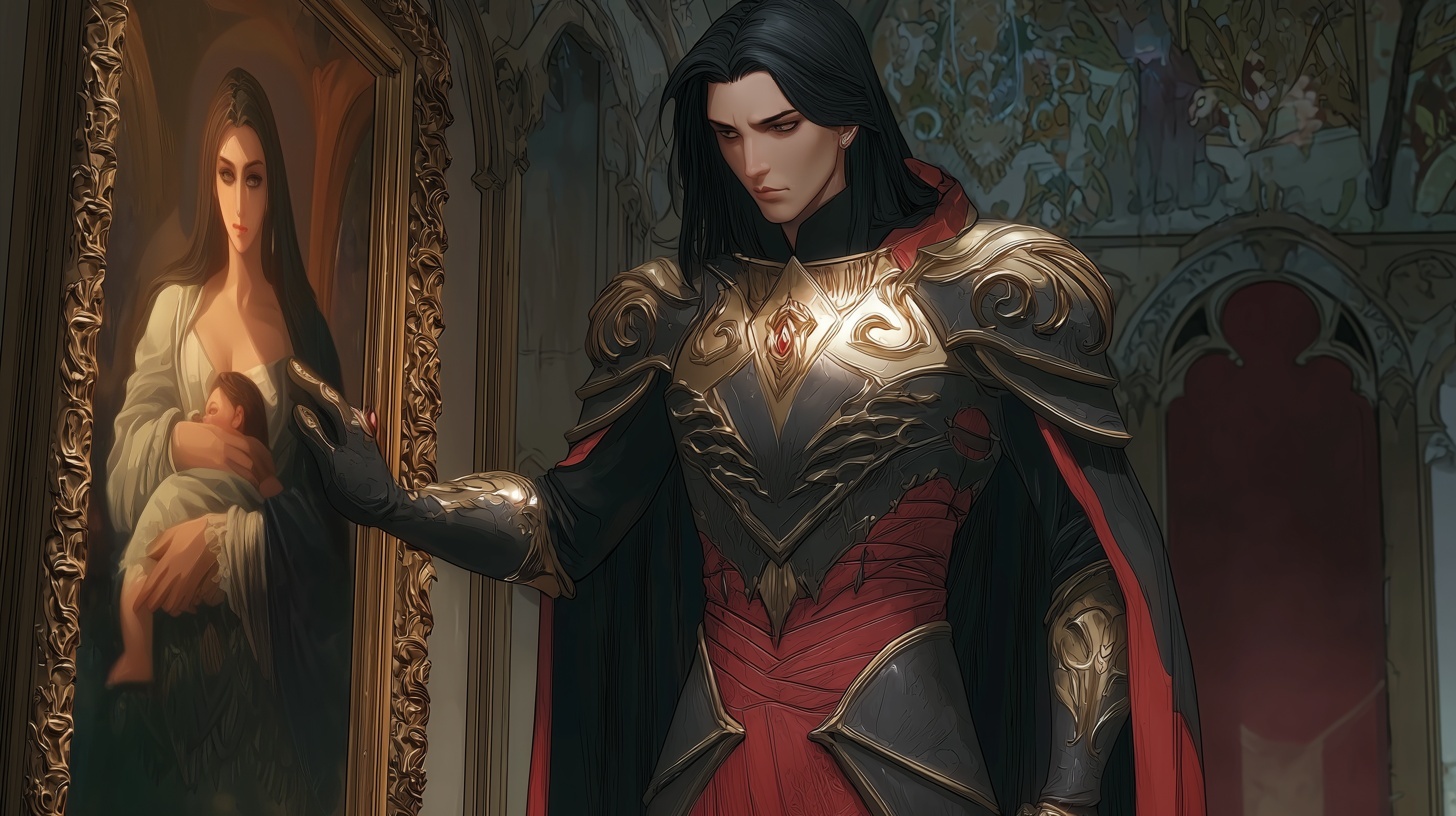
Intellectual Characteristics
"His greatest gift was seeing the flaws in every plan, and his greatest curse was thinking it was his duty to fix them all."

Corvyn Seinrill’s intellect is not a gift. It is a fortress he built stone by stone after loss, betrayal, and divine indifference. Across centuries it has become the trait that holds him together when all else would have shattered. To outsiders his intelligence looks inevitable, as if the world bent its knowledge into his waiting hands. To Corvyn, intellect is not brilliance. It is survival.
He does not approach problems with curiosity. He approaches them as contingincies waiting to be plotted. Every pattern can be broken down. Every system can be understood and controlled. Politics, magic, leadership, all of it is machinery. And he alone has the patience and clarity to keep that machinery from collapse. His mind dissects the world like a surgeon opening a body. Calm hands. Sharp tools. Cold reason and no hesitation.
The cost is constant motion. His thoughts never stop. He sees ten moves ahead in every conversation, hears lies behind truths, and feels the tremor of disasters in the smallest choices. Mortals live in moments. Corvyn lives in centuries. They speak in feelings. He thinks in probabilities. They ask for trust. He asks for proof. The distance is unbridgeable.
In youth he welcomed people. He debated philosophy, taught young initiates of the Astaray Knights, spent nights in libraries surrounded by other seekers. After Andrielle’s death, that part of him closed like a tomb. Emotion became interference. Vulnerability, a flaw in the system. He tried to think his way through grief. Logic against loss. Reason against pain.
He failed. And in failing, he doubled down.
Seven centuries gave him what no genius could achieve. Time. While the world reeled in the aftermath of the Shattering, he studied. While others stumbled through renaissances of alchemy and theory, he rebuilt continuity out of chaos. His reach now spans disciplines most scholars call incompatible. His strategies unfold like layered riddles. Governments function under his hidden influence. He does not plan in days. He plans in decades. His pieces move across lifetimes.
Yet for all this mastery, one riddle resists him. How to undo a death that defies even divine reckoning. The loss of Andrielle haunts him not only as grief but as the equation he cannot solve. His endless search for relics, secrets, and boundaries is not for dominion but for an answer. She is the missing variable. The proof withheld. The problem that renders his entire world incomplete.
This pursuit is why his creations, brilliant as they are, feel hollow even to him. Areeott is a projection of his mind. Immaculate, invulnerable, precise. But beneath the perfection is absence. Nothing he builds brings her back.
So he builds still. He studies. He calculates. He pushes his mind against a silent universe that offers no meaning and no mercy. He is not a brilliant mind at peace. He is a brilliant mind at war with a meaningless cosmos. And until that war is answered, Corvyn Seinrill will never stop thinking, even if it drives him into madness.

Morality & Philosophy
"Peace is not stability. Peace is what breaks when someone stops paying attention. Stability must be built and kept and checked. It is not a natural condition. It is not won through consensus. It is held through discipline. And discipline requires enforcement. Not desire. Not hope. Just decision."
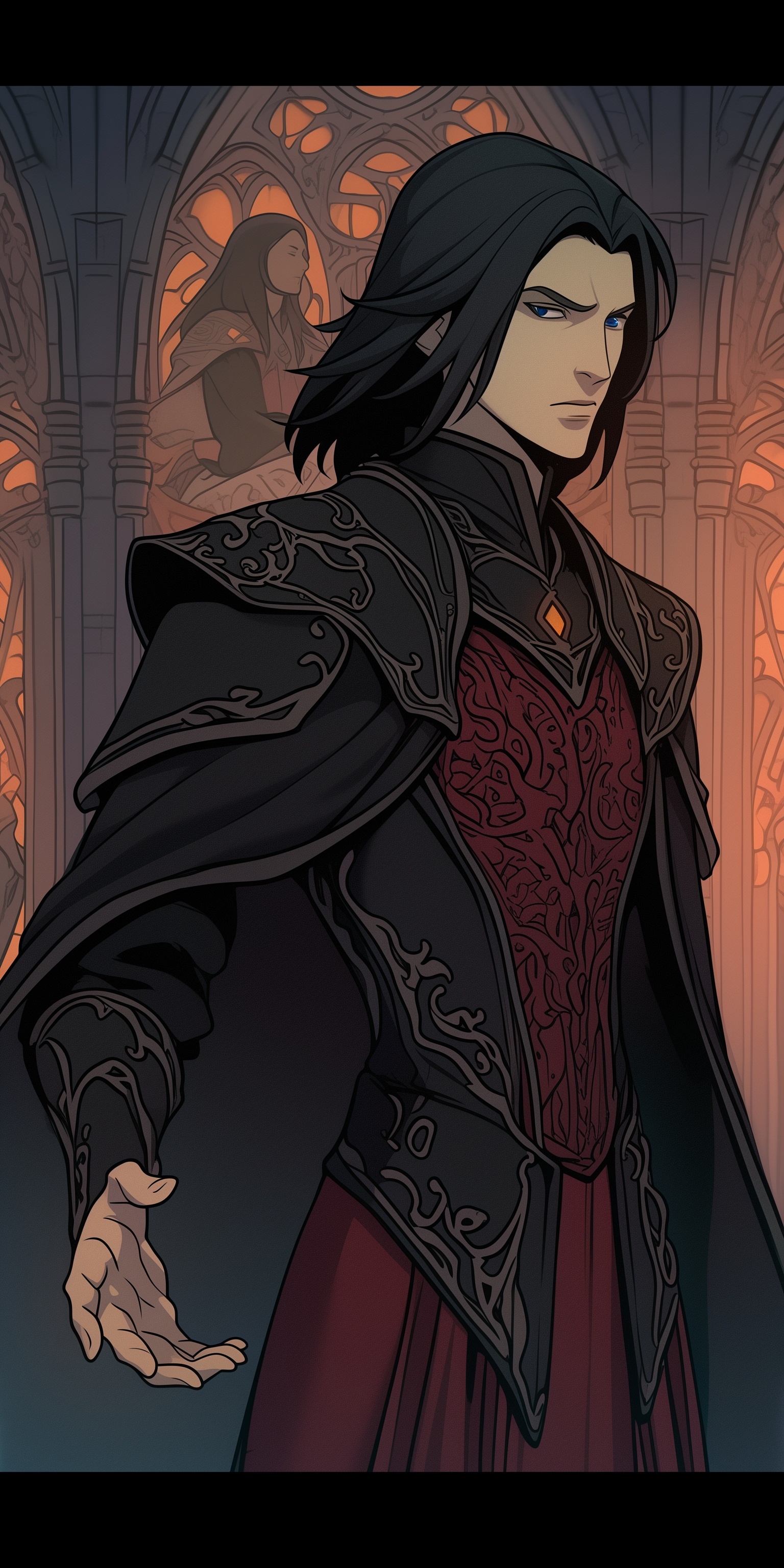
Corvyn Seinrill does not subscribe to common morality. Ideas like good and evil, right and wrong, mercy and justice are, to him, stories told for obedience rather than truth. Morality is not a compass but a scalpel. If an action preserves order or advances the dream of stability he once shared with Andrielle, it is justified. If not, it is discarded.
He treats laws as scaffolding. If a support is weak, it is replaced or removed. He will pass harsh edicts to keep peace, allow injustice to prevent collapse, and silence dissent if it preserves balance. The individual does not define morality. The system does. Continuity is the highest good, even if the cost is blood.
This view is shaped by collapse. The Shattering, the betrayal of House Isari, and the failure of the gods to protect his family were not abstract tragedies. They were proof that freedom without structure is ruin. Sentiment is weakness if it leads to chaos. Kindness is danger if it permits instability.
Yet beneath this severity lies a reverence for mortality. Corvyn believes mortals are greater than gods, because they create beauty from brevity. They innovate without certainty. His hatred of divinity is born from this. Gods hoard truth while mortals die searching for it. Lazzill’s curse and Xal’Kanan’s betrayal turned disdain into conviction. Where once he saw flawed guides, he now sees tyrants. Every spell he masters, every relic he uncovers, is an act of defiance. To him, magic is the last argument of mortals.
But liberation in his hands is cold. He sacrifices with the composure of a surgeon. He knows the blood he spills, and accepts it. He has orchestrated wars, toppled monarchies, erased bloodlines, because he believed stability required it. He does not apologize. Regret is weakness. Yet he still feels the weight. Each order that ends lives flinches against him. Each time he silences dissent, he wonders if Andrielle would turn away in shame.
This contradiction defines him. He believes the ends justify the means, yet measures himself against an ideal he can never meet. Andrielle’s dream was harmony without oppression. He preserved it in stone, law, and silence, knowing it is now a mausoleum. Beautiful. Perfect. Dead.
So he walks the narrow line between savior and tyrant. He builds a legacy he cannot share, shaping a future that will never know his name. He tells himself the sacrifice is worth it. That order is better than freedom. That safety is better than truth. Yet the question gnaws at him. If perfection is bought with chains, is it still worth protecting. Corvyn does not know. He only knows he cannot stop. To admit otherwise would mean he has become what he once fought to destroy. And that would be a tragedy too vast even for him to endure.
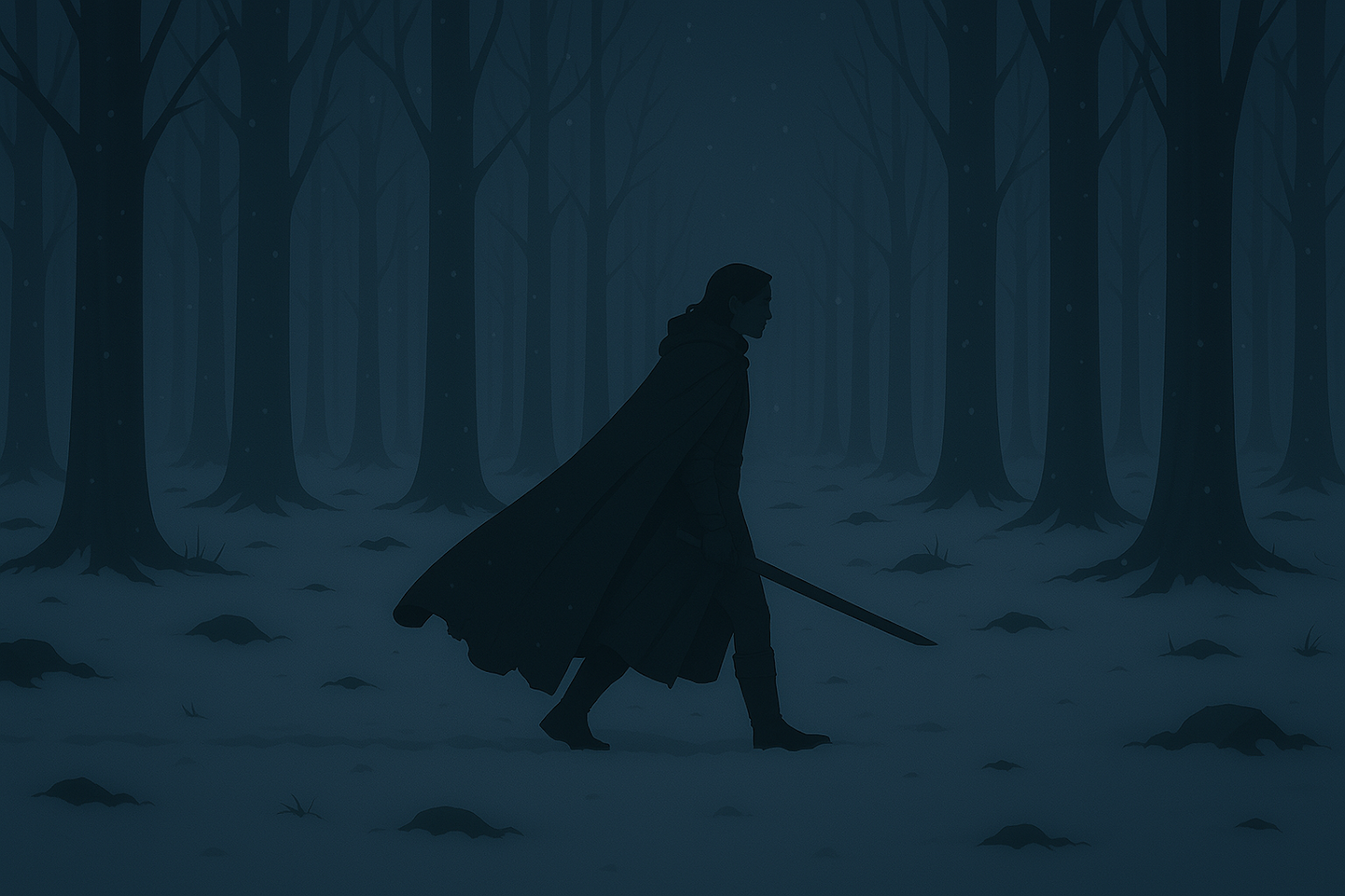
Taboos
"It is better to lose the record of a city than the reason it was built. Ideas must endure. Flesh does not. A moment of silence cannot justify the loss of knowledge that could prevent a thousand more."
To Corvyn Seinrill, some lines are not simply boundaries. They are sacred. Chief among them is the memory of Andrielle, which he guards with a devotion fiercer than his hatred of the gods. Her memory is not nostalgia or romance. It is doctrine. Areeott itself is her temple, and Corvyn is both priest and penitent.
To speak against her is blasphemy. Even a suggestion that she might have erred is enough to bring his wrath. He does not rage or shout. The air tightens, his gaze fixes, and his justice is silent and final. Those who profane her name are not corrected. They are erased.
He enforces this boundary within himself as well. He will not mourn her aloud. He will not collapse into self pity. His grief must be useful. It must create. Anything less dishonors her memory. Despair is luxury, and he will not permit it.
Second to Andrielle is knowledge. To Corvyn, ignorance is the root of collapse. Destroying books, silencing scholars, erasing truth are crimes beyond pardon. Those who commit them are not short sighted. They are enemies of the future, and he hunts them with the zeal of a priest defending scripture. Yet this devotion blinds him. He hoards secrets not only to protect them but to ensure no one else reaches them first. He sacrifices lives for ideas, believing knowledge must endure even if blood is the price.
Dragons are another line. The world may see myth. Corvyn sees apocalypse waiting to happen. Their part in the Shattering and the Insurrection has left no room for nuance. Every cult, relic, or descendant is a threat, and he does not hesitate. He does not act from fear, but from certainty. In this, he becomes mechanism more than man.
At the core of his defiance are the gods themselves. Worship, to him, is submission. To kneel before beings who allow suffering is to abandon responsibility. Lazzill, who cursed him, and Xal’Kanan, who betrayed him, are objects of personal loathing. But his hatred is larger than them. It is a revolt against the order of the cosmos. Where others draw strength from faith, Corvyn draws it from refusal.
These taboos define him more than any title. They isolate him. They frighten those who serve him. They haunt his quietest moments. Yet without them, he believes he would unravel, and with that unraveling Andrielle’s dream would die with him.
So he does not bend. He does not bow. And he does not forgive.

Personality Characteristics
Motivation
"A promise made in love echoes louder than a thousand oaths sworn in fear, and its weight endures long after the one who whispered it is gone."
Corvyn Seinrill’s every action is driven by the loss of Andrielle. Her death, the destruction of her soul, is a wound that no time can close. His pursuit of forbidden knowledge is not born of hope but of defiance, a revolt against a cosmos that abandoned him when he needed it most. He does not search because he believes success is likely. He searches because to stop would be surrender, and surrender would erase her all over again.
Areeott itself is both his sanctuary and his prison. Each law he enforces, each street he polishes, each perfection he imposes is another attempt to sculpt the dream they once shared. It is a living monument, but one that no longer breathes. Every crack in its order whispers that he is still unworthy of the impossible task before him, to outwit death and defy the gods. He cannot move on, and he cannot remain still. So he creates. He controls. He endures.
Beneath this devotion lies a deeper rebellion. Lazzill cursed him with endurance as mockery. Xal’Kanan turned away in silence. Corvyn holds them both guilty, not merely of cruelty, but of theft. Yet vengeance is not his goal. His ambition is more precise. He wants to make gods irrelevant. To strip them of authority by mastering the forces they claim to own. In this, his pursuit of knowledge is not just desperate. It is strategic.
Every artifact, every tome, every relic hidden beneath Seinrill Castle is a step toward rewriting the rules. Not only to bring Andrielle back, but to bend reality so that she was never lost at all. And if that proves impossible, he will use eternity to ensure that no other soul suffers as he has. That no god ever holds such power again.
This conviction is also his danger. The closer he comes to understanding the foundations of creation, the more fragile it appears, and the more tempting it becomes to shatter it. There are nights when he wonders if a world built on cruelty deserves preservation at all.
Yet still he endures. Not for power. Not for pride. But for a promise whispered long ago, that he would not become a destroyer. That he would keep building, even through tears. And so he builds, and suffers, and shapes a world that does not know his name. Because to abandon that purpose would be to lose her again.
This is the fire beneath every word he speaks and every law he writes. His is not the motivation of a ruler, nor a hero, nor a god.
His is the quiet, relentless scream of a man who cannot let go.
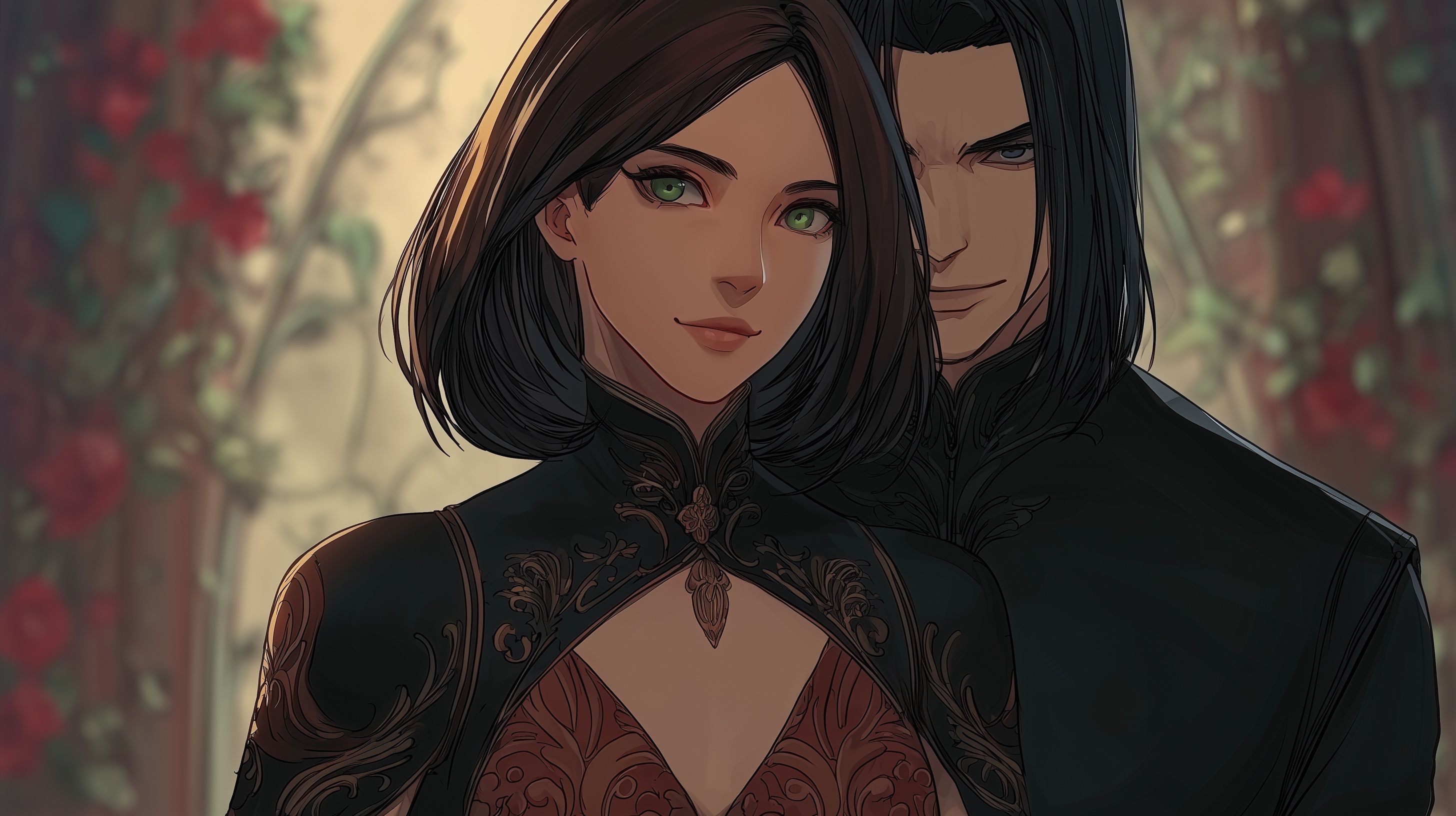
Savvies & Ineptitudes
“His silence wasn’t empty. It was full of decisions.”
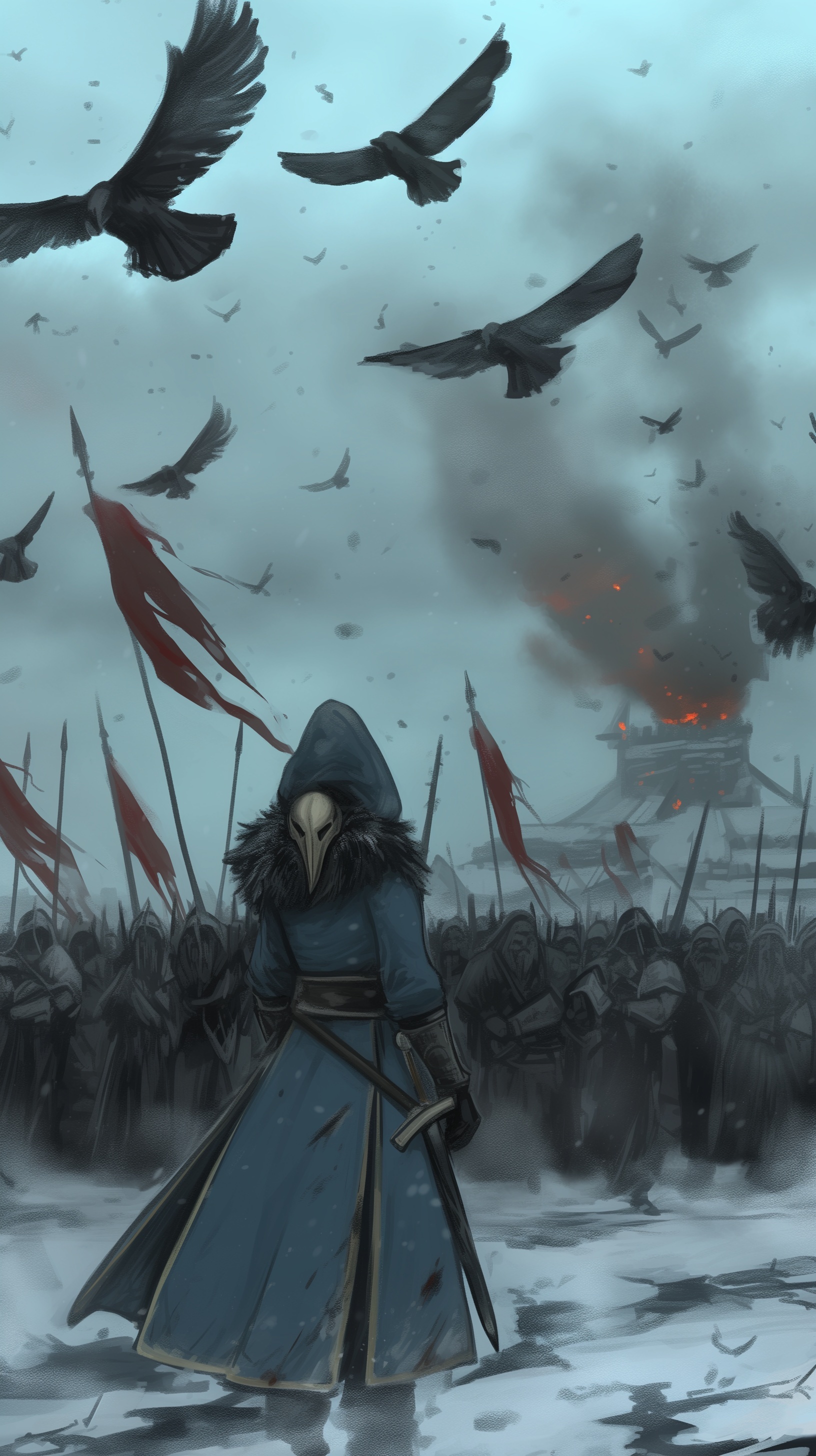
Though myths paint Corvyn as an arcane prodigy, the truth is subtler and more frightening. His mastery is not born of divine spark or natural talent, but of centuries of relentless refinement and uninterrupted access to knowledge others lost. While the world’s traditions fractured in the wake of the Shattering, Corvyn alone preserved continuity. From the Seinrill archives to the spoils of Bastion and the vaults of fallen kings, he gathered what others forgot. He is not a god touched savant. He is a man who never stopped learning. His genius lies not in how much power he wields, but in how little he needs to.
His command of magic is unmatched. He does not simply replicate spells. He deconstructs and rebuilds them, bending their structure to his will. Rituals, temporal anomalies, planar manipulations, necromantic constructs, defensive wards, he wields them all with fluent precision. To him, the boundaries between schools of magic are arbitrary. Magic is a language, and he speaks dialects no one else remembers.
More than a practitioner, Corvyn is a builder of systems. Where others rely on recipes, he designs architectures that last decades or centuries, self regulating and self repairing. The wards that protect Areeott shift in real time. The veil concealing his rule evolves under his watch. His magic is alive because he never stops shaping it.
His strategic mind mirrors his arcane mastery. Corvyn does not fight battles. He writes them. Every conflict Areeott has faced bears the mark of a man who already knew how it would end before it began. His enemies often realize too late that their choices were predicted, seeded, and weaponized against them.
In politics, his presence is just as lethal. He never blusters, never begs. He studies others with the same precision he applies to spells, positioning them to reach the decisions he requires. Most never know they have been maneuvered. Those who do are already too deep within his design to resist.
But brilliance has a cost. Centuries of calculation have eroded his immediacy. He understands desire, grief, and ambition only as concepts. Empathy has hardened into something conditional. He knows how to console, when to praise, when to show mercy, but the warmth behind those actions rarely remains. He is feared not because he is cruel, but because he is always correct.
This detachment leads him to misjudge scale. Sacrifices that seem necessary to him are unbearable to those who live by mortal time. Allies are alienated by his standards, subordinates crushed under the shadow of his precision. Delegation is not a skill he lacks. It is one he refuses to use. In his mind, only he sees the full design, and only he has the patience to bring it to completion.
This conviction isolates him, bottlenecks progress, and breeds resentment. And though he recognizes the pattern as clearly as any battle map, he rarely changes it. Not from pride, but from certainty that perfection requires his hand alone.
Thus, Corvyn Seinrill stands as perhaps the most capable living being in the known world. But he is also his own greatest obstacle. His genius has made Areeott unshakable. It has also made him solitary, a mind of infinite reach locked inside a structure no one else is allowed to hold.
Likes & Dislikes
“Survival is not beauty. It is not comfort. It is the only proof that an idea was worth dying for, and the only reason it deserves to endure.”

Corvyn Seinrill finds purpose in mastery, of magic, of history, of structure, and of precision. His affections are not easily earned, but once established they burn with enduring intensity. Magic, in particular, is more than a tool to him. It is the purest expression of will, a philosophical medium through which reality itself can be resisted, revised, or perfected. Every spell he commits to memory and every rune he inscribes is another brick in the fortress he builds against entropy and divine cruelty. His enchantments are never ostentatious. They are quiet, intricate, and deliberate. He loves magic not for spectacle, but for its rules, its predictability, and its exactitude.
Art and history are another of his compulsions. To Corvyn, mortal creation is rebellion. Statues endure where flesh fails. Paintings speak long after voices fall silent. He surrounds himself with manuscripts, sculptures, and rescued fragments of collapsing empires not as trophies but as testimonies. These works are proof that something can outlast suffering. That, to him, is beauty.
He despises disorder. Not simply as a matter of aesthetics, but as a threat to meaning itself. Chaos is the enemy of preservation, of continuity, of purpose. He has no patience for ambiguity or hesitation. Sentiment without action is wasted energy. Doubt is a luxury he refuses, for it once cost him everything.
Ideology without discipline repulses him. Empty faith, naive zeal, untempered principle, he sees all of these not as virtues but as dangers. To Corvyn, compassion without structure and belief without question are how worlds collapse.
Above all, he harbors an unrelenting hatred for gods and dragons. The divine demand submission while offering silence. Dragons embody only destruction. Lazzill cursed him with endurance in mockery. Xal’Kanan, patron of magic, allowed Andrielle’s soul to be extinguished. His hatred is not grievance, but philosophy. Gods are frauds cloaked in doctrine. Dragons are chaos given wings. Both would see the world broken, and he would see them erased.
His pursuit of knowledge is therefore both rebellion and survival. Each tome and relic is another chain broken. He does not seek power for its own sake. He seeks freedom, the kind that ensures no will, mortal or divine, can ever impose itself upon him again. To him, power is the only true inoculation against despair, and control the only safeguard against grief.
For Corvyn Seinrill, love must be preserved, not remembered. Order must be imposed, not hoped for. And the world must be rebuilt, not as it was, but as it should have been.

Virtues & Personality perks
"Perfection is a kind of hunger. It does not nourish, it only demands more."

Corvyn Seinrill’s greatest virtue is his indomitable will, a force not born of optimism or courage but of necessity. Once he sets his mind to a goal, nothing mortal or divine can turn him aside. His resolve is not the firebrand’s fury or the hero’s valor. It is the cold certainty of a man who must continue, because stopping would mean drowning in everything he has lost. This relentlessness has carried him through centuries of betrayal and torment, allowing him to outlast wars, gods, dynasties, and time itself.
That same will infuses every detail of his rule. From the smallest enchantment to the civic machinery of Areeott, everything bears the mark of his obsession with order and permanence. Systems do not function by chance. They function because he demands they do. If something must hold, it holds. If someone must fall, they fall. Corvyn does not allow failure, not from his country, not from his servants, and not from himself.
Despite his cold severity, he possesses a quiet charisma. His presence draws attention without effort. His words are measured but carry the weight of someone who has seen and endured more than any in the room. He does not speak to impress, but to reshape. Those who serve him are compelled not by warmth but by conviction. Even those who resent him obey, because he offers something rarer than hope. Certainty.
His devotion to Areeott is another form of virtue, though he would never call it that. He does not guard its borders or preserve its order for admiration. He does it because it is the last piece of Andrielle he can still protect. The republic is not only sanctuary but monument. It embodies the dream the gods failed to destroy, and he preserves it with unwavering loyalty.
He is not cruel. He is unyielding. His restraint may be his most extraordinary trait. He holds back power that could unmake kingdoms. He resists the pull of despair, refusing to let sorrow consume him.
If one trait defines him, it is incorruptibility. Not because he is beyond temptation, but because he has already lost everything that can be taken. No bribe holds weight. No threat holds meaning. His soul belongs to someone who no longer exists, and he has forged that loss into an eternal oath. An oath to protect. To build. To endure. Even if the stars go out and the gods turn away, Corvyn Seinrill will remain. Not because he was chosen. But because he chose never to fall.
Vices & Personality flaws
"Stone can preserve what the heart cannot bear to lose."

Corvyn Seinrill’s greatest strength, his need for absolute control, is also his deepest flaw. His obsession with order has preserved Areeott for centuries, but at the cost of its spirit. In his world, deviation is danger and chaos is the enemy. Innovation and spontaneity are not virtues but risks, and emotional honesty is treated as weakness. His systems endure only because he guards them with the vigilance of a prison warden.
He trusts no one. Not because he doubts their ability, but because he cannot abide uncertainty. Delegation feels like surrender. Every plan must bear his mark. Every word of counsel is filtered until it aligns with his vision. This control corrodes his bonds. Allies grow restless. Retainers feel ignored. Loyalty becomes obligation instead of choice.
His emotional distance is deliberate. After Andrielle’s loss, he decided that to feel deeply was to invite ruin. Affection is vulnerability, and vulnerability leads to loss. So he keeps people at arm’s length, offering guidance without warmth, admiration without closeness. He sees individuals as essential, but replaceable. He may honor their talents, but he rarely lets himself care for them.
This detachment has become isolation. His immortality does not make him transcendent. It makes him alien. He cannot share the fleeting worries of those he rules. Their lives pass too quickly, their fears too briefly. Even when he sympathizes, connection eludes him. Though some part of him longs to be known, he has convinced himself it is impossible.
His pursuit of knowledge has also twisted into compulsion. What began as a quest to preserve and protect is now hunger. He unravels forbidden truths, breaches planes, and gambles with magic others will not touch. Not out of greed, but because delay feels like failure. Every unanswered question is a crack in his illusion of control. His desperation blinds him to consequence, and when his plans falter he does not relent. He tightens his grip. He begins again. Always convinced that next time it will hold.
Beneath all this control is quiet terror. That he is already lost. That in saving one soul, he damned his own. He never voices this fear, but it shapes him. It drives the compulsions. It fuels the ambition. In his darkest solitude it whispers that everything he builds may be nothing more than a monument to failure.
Though Corvyn presses on with unshakable discipline, a hidden part of him no longer believes in victory. He endures not to win, but to make the loss mean something.
Representation & Legacy
"The phoenix of House Seinrill is more than heraldry. It is our assurance that Areeott will always rise again, no matter how deep the ashes.”

Corvyn Seinrill’s legacy is a paradox, built upon silence and deliberate misremembering. To the people of Areeott, he is a figure of ancient nobility, a martyr architect who gave his life for their golden age. He lingers at the edge of fables, the last page of history books, immortal not in body but in story. The truth is darker. Corvyn never died. He lives beneath the myths like bedrock beneath the mountains, shaping the realm with an invisible hand while the world believes him long vanished. His legend is his shield. His silence, a choice.
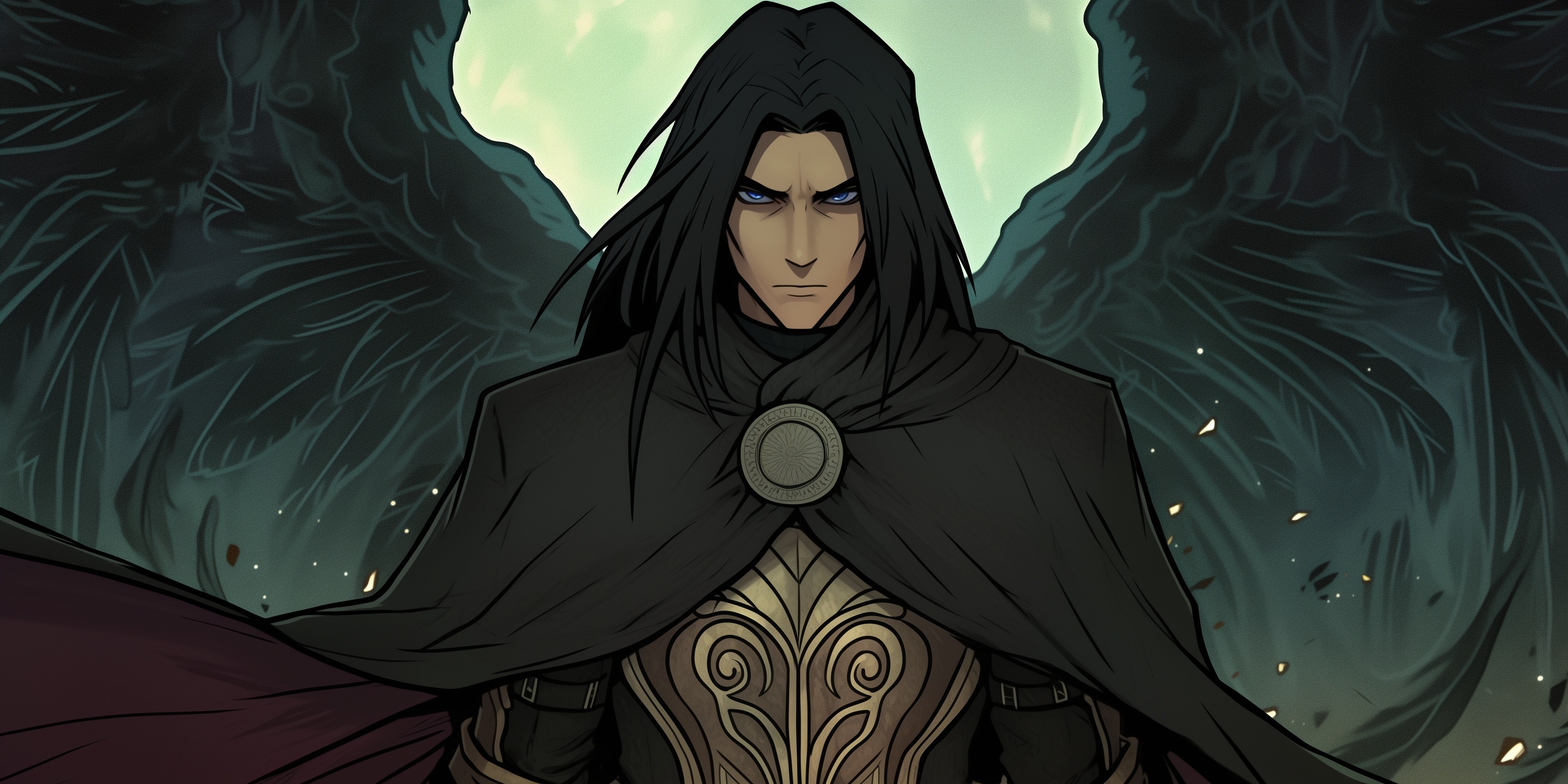
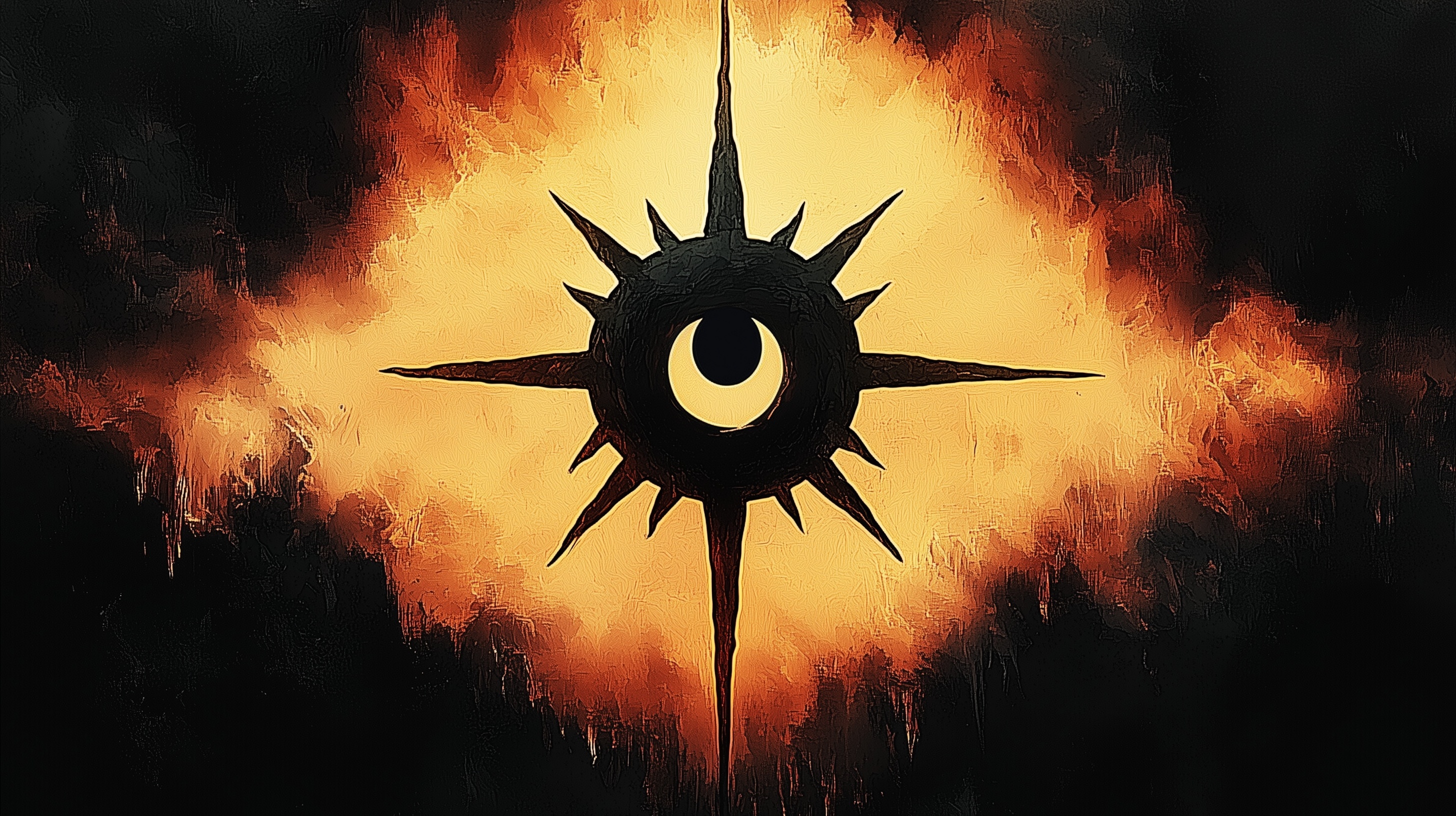
To the world, the phoenix of House Seinrill is a symbol of endurance, carved into arches, etched in glass, and carried on banners. To Corvyn it is a scar, a reminder of the night Andrielle was erased. The emblem is meant to speak of triumph. To him it speaks only of failure, of a fire that consumed instead of purifying.
Beneath the phoenix lies a darker heraldry, that of the Black Sun. Known only to his most trusted agents, this sun in total eclipse represents the truth of his rule. The phoenix offers grace. The Black Sun tells the honest story, that peace is bought in blood, that stability is enforced in shadow, and that every golden age rests on sacrifice. It is not revered. It is feared.
His influence extends beyond symbols. Areeott itself is his legacy. Cities run with mechanical precision, roads remain immaculate, laws endure unbroken. But Venlin, the capital, is not warm. It functions because he wills it to. That will is absolute. Outsiders call it cold. Its people call it secure. Nothing falters, nothing fails, because someone is always watching.
Corvyn has become myth because he chose to. He staged funerals for heirs who never lived, invented dynasties, and buried the truth under centuries of fiction. Generations believe they are ruled by descendants of a noble house, never realizing the same hand has guided them all along. His legacy is not what is remembered, but what he allows to be remembered. He is curator, censor, and sculptor of collective memory.
In the end, his work is not about glory. It is about necessity. He built Areeott to survive gods, dragons, wars, and grief. And though Andrielle will never walk its streets, her ideals live in its gardens, its courtyards, and its laws. He preserves her dream so that she cannot be forgotten.
To the world, he is legend. To Areeott, he is a hero. To the shadows that govern and the empty chambers of Seinrill Castle, he is neither.
He is the architect of a perfect lie.
Social
Reign
"To stand before Corvyn Seinrill is to feel the weight of unseen calculations, as if he has already dissected your every word before you’ve spoken it. He does not need to raise his voice to command attention, nor threaten to inspire fear. He simply watches, listens, and in the silence between moments, you realize that he's already decided your fate."
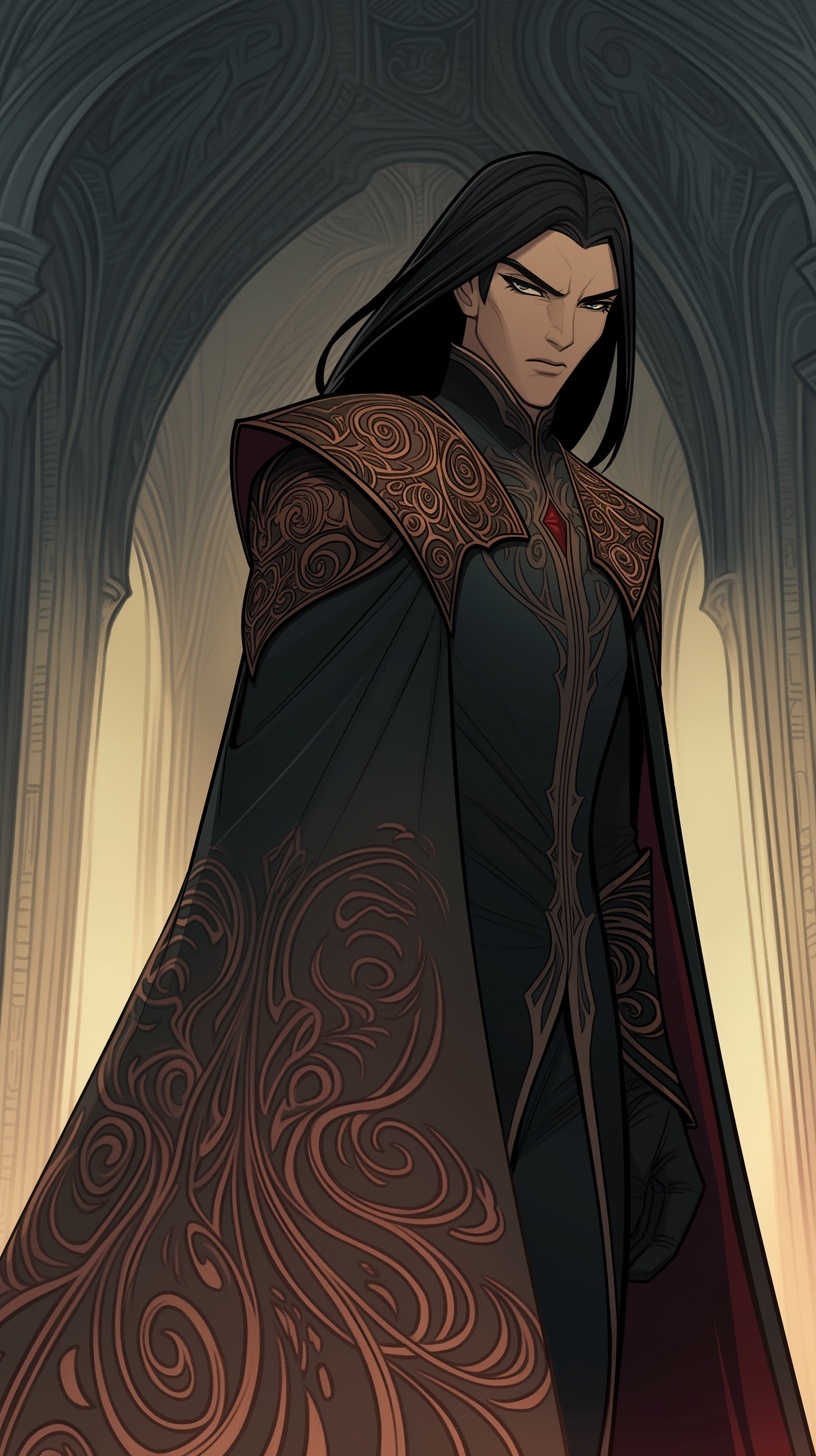
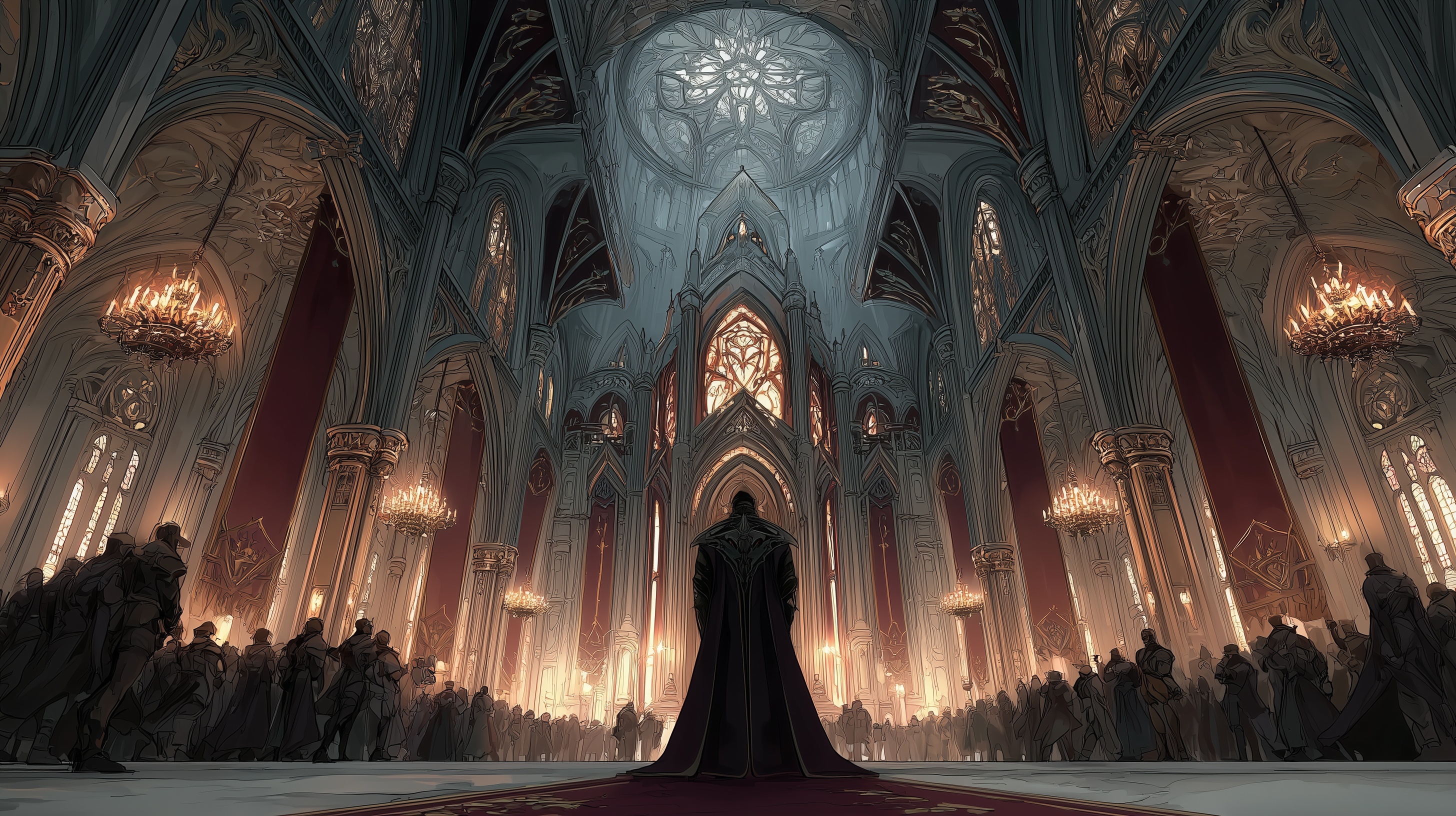
Corvyn Seinrill’s reign over Areeott is an exquisite contradiction, a governance of spectral omnipresence and deliberate absence. He does not sit on a throne, nor issue decrees from gilded chambers. His hand is not raised in ceremony, yet it always rests on the scale. The Arin Parliament, conceived by Andrielle Seinrill and Aelissa Akkara to give voice to the people, exists in full form and function. But it operates within boundaries he designed. Corvyn is its ghost lawgiver, the architect behind the architecture. Every choice made beneath its banners is made inside his design.
He intervenes rarely, and when he does, it is with terrifying clarity. There is no debate. No appeal. His commands arrive through intermediaries, often the Prime Minister or the head of House Serance. Their public roles are significant, but their power is derivative. They are chosen not from blood but from loyalty, raised up from generations of proven service, some even from within the Seinrill House Guard.
Those who deviate from his vision are not condemned in public. There are no spectacles. They are redirected, erased, or rewritten into the design. Laws change quietly. Ministries shift. Names vanish from record. It is not tyranny in the traditional sense, but correction. A governance of precision. Areeott does not fear his hand because it is violent. It fears him because he is inevitable.
The illusion of succession is his most brilliant deception. Officially, he is Corvyn VII, heir to a noble line stretching back to the Shattering. Ceremonies are staged. Funerals are held. Mourning rites are performed. But it is always the same man. The same eyes. The same unyielding silence. His immortality is the best kept secret in the realm, preserved not just by magic but by redacted archives, replaced portraits, reassigned clerks. The dynasty exists because the lie is perfect. And the lie endures because he tends it himself.
The title Baron of Areeott is the public mask, carrying ceremonial weight. But the title Baron of the Canton, his ancestral claim over Venlin and Seinrill Castle, is the one he feels. From that vantage, he has watched noble houses rise and collapse, empires shift, and generations believe themselves free. And through it all he has never left. He cannot.
To the people, he is a relic, a single name in a long line of visionaries. They attribute their prosperity to centuries of steady rule, never realizing it is one grieving hand shaping their history. They do not know their streets were designed to match the stride of one man. They do not know their laws were not debated into being, but imposed with mathematical finality.
To them, Corvyn is a symbol of endurance and prosperity. To himself, he is custodian of a broken promise. His reign is not ambition. It is penance. He rules because the work cannot end. The more perfect Areeott becomes, the more hollow that perfection feels. Each generation safeguarded is another he cannot join.
His rule is flawless. And unending. And empty of peace.
Contacts & Relations
"A sword defends a realm. A secret builds one."
Corvyn Seinrill’s relationships are not born of affection or trust. They are constructed like spells, precisely and for a purpose. His social world is a labyrinth of obligation, debt, and leverage. Though he rarely appears to act directly, his agents, informants, and proxies extend far beyond Areeott. Courts, guilds, and academies across the known world bear the imprint of his unseen influence. Some ties are centuries old, passed down like inheritance. Others are pacts older than the current age.
Most of these affiliations are hidden behind legitimate structures. Trade pacts, academic alliances, noble marriages, research partnerships, and religious diplomacy form the visible shell of a clandestine intelligence regime unmatched in scope. Corvyn does not gather secrets for pleasure. He gathers them because survival demands it. In his world, a secret is never neutral. It is warning, weapon, or threat waiting to mature.
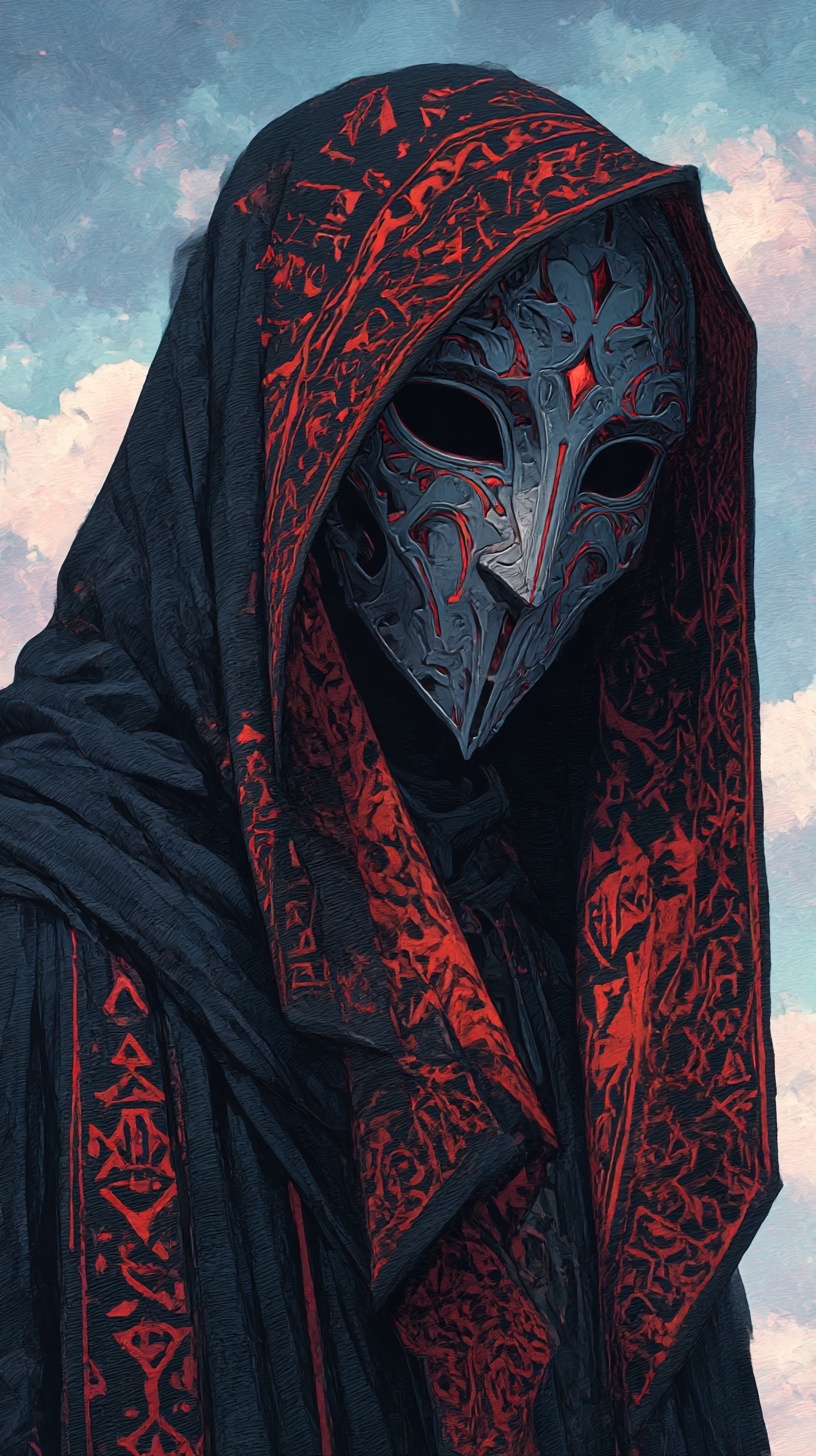
His agents often do not know they serve him. Some answer to ministries whose charters he wrote generations ago. Others receive instructions through encoded documents or crises engineered to leave them no choice but compliance. He keeps no council, only layers of intermediaries. The Seinrill House Guard is the visible edge of a much deeper structure, the expression of a quiet war for information he has waged since the Shattering. Its purpose is to recover knowledge, to prevent truths from being lost, and to exploit the fine line between revelation and ruin.
Alliances are shaped not by loyalty but by necessity. Assets are tools. Even those he protects, scholars or bloodlines, are preserved because they serve a function within the design. When that function ends, so does the relationship. This is not cruelty. It is finality.
Some connections exist to feed his own compulsions. A lead on a buried temple. A fragment of soul theory scrawled in a margin. A half forgotten text on voidbound enchantment. Entire expeditions have been launched for a footnote. Entire factions disrupted because a lie could not go unexamined. These moments are not rational, and he knows it, but they give him purpose. His immortality demands motion, and motion demands context. If no threat appears, he invents one. If no truth emerges, he digs until something bleeds.
In recent centuries, much of this apparatus has turned toward reclaiming and controlling magical heritage. Bastion’s ruins, the Heretic King’s libraries, the vaults of the Fallen Houses have all been stripped of what is useful and folded into his collection. These texts and devices are not hoarded from greed. They are curated, dissected, and integrated. Every recovered relic is another thread in the tapestry he alone can still see. While the world stumbles through shattered traditions, Corvyn walks an unbroken path. That monopoly is not just his strength. It is his mission.
He does not speak of these networks. He does not boast of his agents. But when a cult disappears overnight, when a stolen relic reappears in a vault it never left, when a kingdom quietly reverses a decree without explanation, the world takes note. They do not know his name. They do not need to. They only know someone is watching. And if they are being watched, it means he is not yet finished.
Religious Views
"Worship requires abandonment of thought. That is its poison. When you kneel you are no longer responsible for what happens next. That is how gods survive. It is also how mortals die."

Corvyn’s relationship with the gods is defined by hatred. He sees them as oppressive forces that exploit mortals while offering nothing in return but silence. His immortality, cursed upon him by Lazzill, and Xal’Kanan’s failure to save Andrielle deepened that contempt into philosophy. In his view, reliance on gods is a fundamental weakness. Mortals must forge their own destiny without divine interference.
Despite this rejection, Corvyn is a scholar of theology. He studies scripture not to believe, but to dismantle. He treats doctrine as terrain to be mapped, exposing fault lines where faith falters and ritual collapses under human need. He has debated priests in their own sanctuaries and turned saints’ words against them, unravelling creeds with relentless logic. His knowledge of the divine is not reverent but surgical. He does not seek revelation. He performs autopsy.
Though he long abandoned faith in Xal’Kanan, the god’s ideals of knowledge and discipline remain with him, warped into defiance. What once inspired awe now fuels rebellion. Truths too vital to leave in divine hands he has seized, refined, and made incorruptible. Not holy, but earned.
Among the people of Areeott he permits worship, but his tolerance is born of indifference. Faith keeps order. It is easier to rule those who place their fears in unseen hands than those who face the void directly. Temples remain open, but priests who invoke divine justice too loudly find their words reshaped in archives. Churches that gain too much influence see their tithes diverted or their relics quietly audited. The clergy walk a narrow line, never sure when devotion will be judged useful or dangerous.
Corvyn holds no respect for priests, whom he sees as custodians of delusion. The faithful, to him, are not fools but victims of a system that convinces them to suffer instead of resist. The greatest sin, in his eyes, is surrender. He does not pray. He does not beg. He builds.
For him, gods are unworthy of worship. Those who rely on them abandon responsibility. There is no divine plan. Only the illusion of one, crafted by immortals too afraid to face the world they claim to rule. If divinity exists in Areeott, it is not in temples or rituals. It is in the stone and steel of a land that endures only because he refuses to let it fall.
Social Aptitude
"He never seeks out to be right. He assumes it. And the terrifying part is how often he is."

Corvyn Seinrill’s presence is defined not by warmth, but by gravity. He does not charm, flatter, or seek approval, yet his composure draws all attention to him. His confidence is absolute but never theatrical. He does not posture. He does not boast. He has no need to. Conversation with him feels less like dialogue than scrutiny, as though each word is being weighed before it is even spoken.
He rarely initiates speech, yet when he does, every word is deliberate and decisive. In councils, his voice is measured, but his remarks often set the direction of debate. He does not dominate rooms through volume, but through silence, a stillness that compels others to measure themselves against his certainty.
His etiquette is flawless, but disquieting in its precision. He greets all with the same exact level of formality. Never warm, never cold, always correct. His gestures and words contain no stumble, no hesitation. This perfection, admirable at first, unsettles those who realize it is less culture than calculation.
His ego is not brittle or performative. It is structural. Centuries of survival have taught him that when he acts, nations shift. He does not believe himself infallible, but he trusts his judgment above all others, convinced that Areeott’s survival demands it. To him, authority is not pride. It is burden.
He neither courts nor avoids attention. If he is overlooked, it is because he allows it. When he chooses to be noticed, the air itself seems to quiet around him. He does not wear ostentation, yet he is remembered, not because he demands it, but because forgetting him feels dangerous.
In every setting, Corvyn Seinrill does not merely follow etiquette. He defines it. His composure is so exacting it stops feeling like manners and begins to feel like law. And for those who live beneath his shadow, there is little difference.
Mannerisms
"That smile is never an approval, its a warning. You were expected to understand something. You didn't. That wasn't forgiveness. That was farewell."

Corvyn Seinrill’s mannerisms are defined by deliberate precision. He makes no wasted motions. A tilt of the head signals curiosity. A raised brow delivers doubt or disdain. He often stands with hands folded behind his back, projecting composure and quiet command. Even in anger, his movements remain measured, his control unbroken.
Silence is his most practiced gesture. He allows it to stretch across conversations until it becomes a presence of its own. These pauses unsettle, press his listeners to fill the void, and lend his words a weight out of proportion to their number. He speaks rarely, but his silences shape the room as much as his voice.
He does not fidget or pace. When he moves, it is because he has already decided to move. His voice does not rise, it narrows, sharpened into finality. When listening, he inclines his head in the way a falcon studies prey before the strike. Those who meet his gaze too long describe the sensation as standing at the edge of a drop, uncertain whether they will fall or be pushed.
In council, his stillness commands more than fury ever could. He lets disputes play out until one quiet sentence bends the entire room back into order. His presence is gravitational. Conversations bend around him. Tempers cool. Even silence feels arranged to match his design.
And when he smiles, rare and never reaching his eyes, it is not kindness. It is the quiet signal that he already knows how this will end.
Speech
"You don’t realize it at first. His voice is quiet, deliberate, even patient. He lets the pauses stretch while learning from all the ways you try to fill it. He waits for the shape of your fear to surface. Then he speaks to it. That silence isn't empty. It’s his."
Corvyn’s voice is not merely sound. It is an instrument of control, each syllable placed with intent, each pause a calculated measure to let meaning settle like stone in deep water. He wastes nothing. Even in casual conversation, his cadence is deliberate, his words precise, and those who hear him quickly learn that nothing he says is ever said lightly.
He does not raise his voice. He does not need to. His intensity comes through restraint, the quiet certainty of a man who already knows how many steps remain between this sentence and your surrender. His speech is lean, shaped in phrases that linger long after they are spoken, simple words weighted like blades sheathed in velvet.
There is a timelessness to his diction. He has shed the dialects of youth, yet faint traces of older tongues echo in his cadence. He speaks in ways that feel both current and ancient, using words that have slipped from formal lexicons but still sound inevitable. This agelessness unsettles. It suggests not study but memory.
When he speaks of history, his words carry the weight of witness. He recalls long dead rulers by name and sometimes slips into the present tense, as if he still stands beside them. Listeners rarely challenge these slips. To do so would be to acknowledge the impossible, and once the impossible is accepted, everything else he says becomes harder to dismiss.
Silence is as much his weapon as words. He withholds until the weight of the pause grows unbearable, letting others reveal themselves in their nervous chatter. He never interrupts, never rushes to reply. He waits, then delivers his answer with precision, ending the silence the way a blade ends hesitation. In negotiation, this patience wears opponents down more effectively than any threat.
Even his rare humor is controlled. His wit is dry, understated, and designed to disarm or redirect rather than to entertain. Those who laugh are never sure if they were meant to. It is a reminder that even in jest, he is choosing exactly how he will be seen.
Every word he speaks is a structure. Each sentence a decision already made. His voice is not only a mask, but a mirror, reflecting the inevitability of the man behind it.
Relationships
Nicknames & Petnames
Corvyn called Andrielle "Andi" and Andrielle called Corvyn "Vyn".
Wealth & Financial state
"Structures outlive kings. That’s what wealth is for. Not comfort. Not splendor. It isn’t the reward for building the world. It’s the weight that keeps it from drifting apart after the hands that shaped it are gone."

Corvyn Seinrill’s wealth is less a fortune than a force. It is built into Areeott’s foundations, indistinguishable from the nation’s own lifeblood. Revenues from Venlin’s silver veins, tariffs from Stormwatch Pass, tributes from Houses, and guild fees all flow through institutions he designed centuries ago. What appears to be state wealth is, in practice, his will carried out in numbers.
He does not spend. He allocates. Every investment is calculated, whether a college of apothecaries prepared years before an outbreak or a monument raised to quiet dissent before it begins. His personal expenses are modest. Areeott itself is his estate, its silence and order his only indulgence.
His vaults contain artifacts, records, and relics beyond price, safeguarded not for profit but for control. Beyond Areeott, his hidden holdings in foreign economies still ripple outward, ancient arrangements that few remember yet none dare ignore.
Corvyn does not wield wealth openly. He does not need to. Wealth, in his hands, is gravity, and everything already bends toward him.
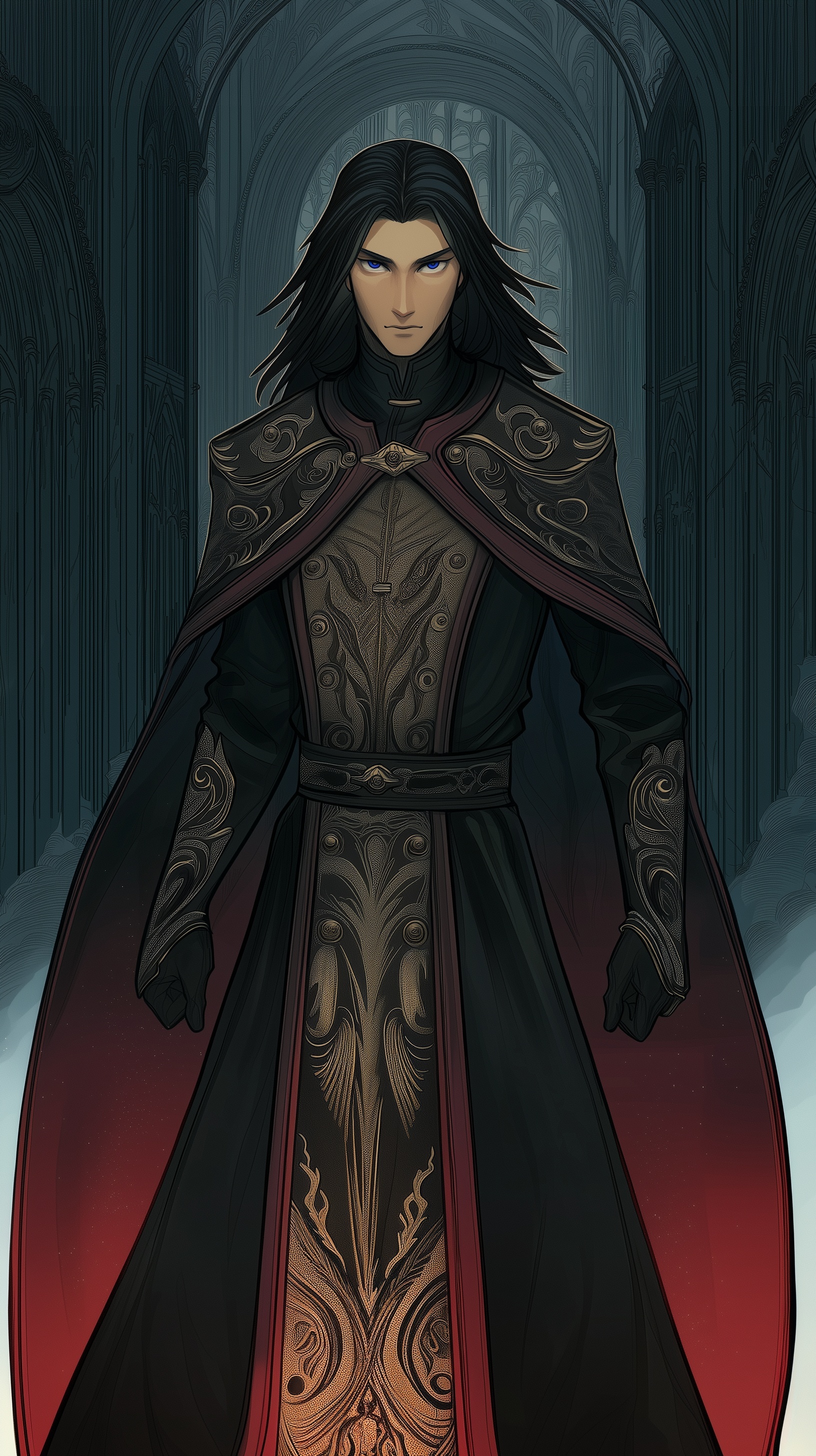
"Memory is a crown that grows heavier with every generation."
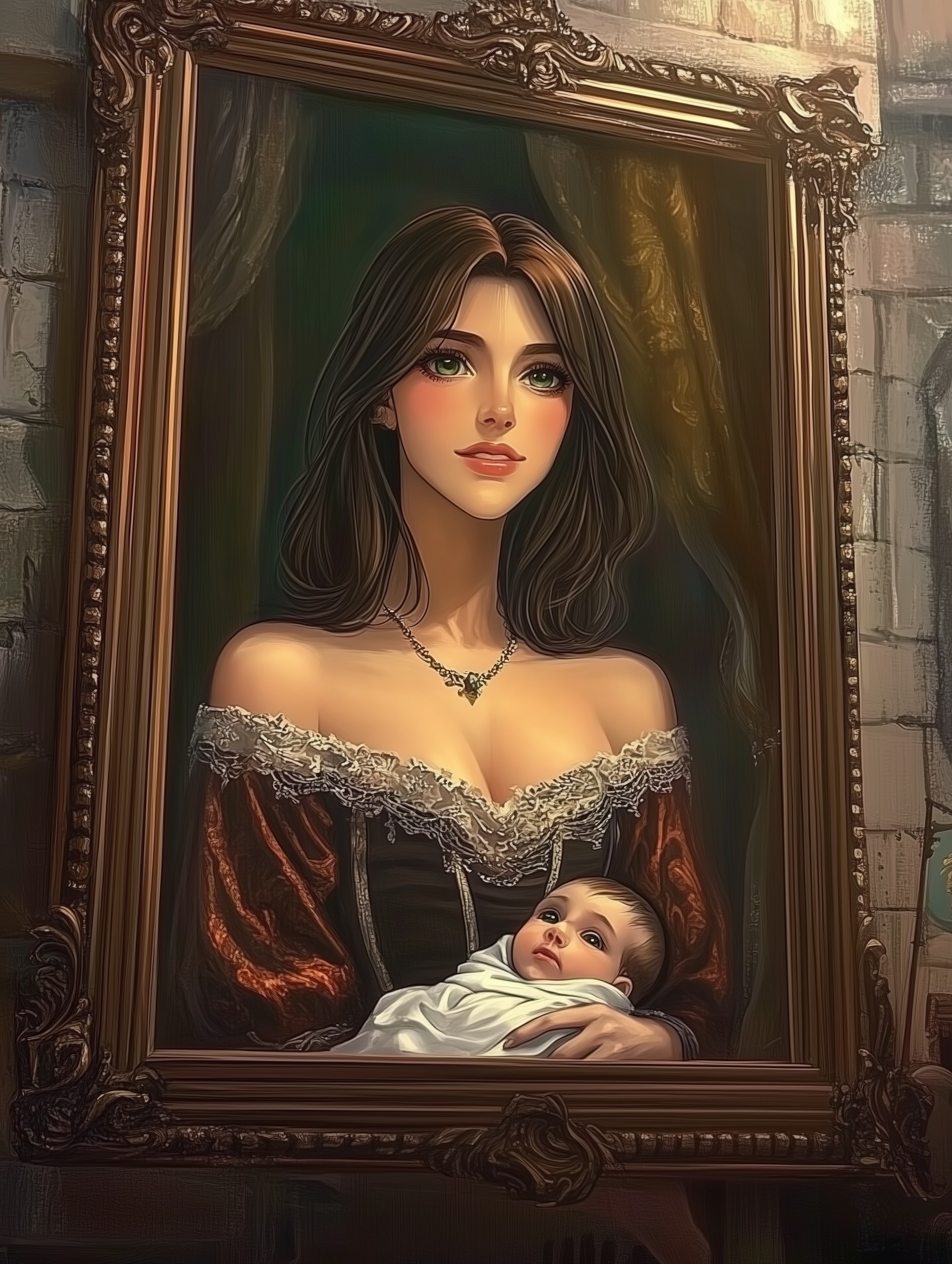
"It is not light that keeps a man alive when all is lost. It is the memory of what the light once touched."






The art on this page is fantastic. I really like your prose as well. How people deal with humans, or non-humans, who can outlive your typical human and not get caught is always interesting to me. I like the idea of manipulating a succession. Pretending you are your own child. Though maybe it would be less fun if you went to chat with someone and they were like, "your grandpa was an ass!" haha I read down to, "The Pheonix Undying," and will come back and read more. But I wanted to leave a comment for what I have read. His loss is brutal, and seemingly has made him brutal as well. Are the different titles different campaigns? I did find it a interesting read. He's a complex character and trapped in a nightmare existence. It may come up later, but I am curious how he fakes the generation thing. Is there offspring that he passes off as himself, or does he live in the shadows that deeply?
He actually do have two living children. You'll read about them later on. The succession is basically him doing one of two things, simply using his abilities to alter his appearance. But that's only if he gets bored enough to actually act the part. Most of the time the reigning Seinrill Baron isn't a family member at all, it's always a member of the Seinrill Houseguard who performed a service that Corvyn found valuable enough. So its sort of a reward. And, each member of the Seinrill House Guard, are entombed as family members in the Seinrill Catacombs (which he also uses as a proving ground for potential guard). So in a way it comes full circle.
Oh and thank you so much for taking any amount of time to read even a sentence of this! It really does mean a lot!
It is interesting! I've seen you leave some likes on my world so I wanted to return the favor and characters are definitely one of my favorite topics.
Thank you! I'm a fan! You have such cool work!
<3