


Cassandra Silvernight
"Fear touches her more gently than it touches others. She feels it, yes, but she does not yield to it. Even the dark she dreads bends before her when she wills it to. I do not know many who can master a thing that frightens them so deeply."
Cassandra Silvernight moves through the world the way a whispered secret moves through a crowded room. You notice her, then doubt you did. You feel her pass before you ever see her face. Those who try to follow her trail rarely find more than the echo of perfume or the faintest shift of shadow where a woman had been standing moments before. In Areeott, there are rumors of a woman with blue orchid eyes who steps through locked doors and never leaves footprints. Most who repeat these stories assume she is a myth told by frightened nobles. Most are wrong. For centuries Cassandra served a king the world never sees. She was the smile at the banquet table, the shadow behind the curtain, the presence in a dark corridor that made liars confess before she ever spoke. She learned to slip into courts, guild halls, catacombs, and the undercity with equal ease, wearing her beauty like a tool and her shyness like armor. Those who glimpsed her at work described a woman who could unravel a conspiracy with the same grace she used to pour a cup of tea. She carried her father’s authority and her mother’s ghost in every breath, wielding both with precision even as doubt rotted quietly behind her ribs. Her brother left. Her faith cracked. The story she had been living fell apart beneath her hands. And when the moment finally came, she stepped out of Corvyn’s shadow not with a scream but with a quiet, devastating no. It was the only word he could not command. It was the one that cost her everything she had been trained to be. Yet it opened the only life she had ever wanted. A life with warmth. A life with laughter. A life with a man who taught her that the past is not a place to live. For all her mastery of illusion, this was the first truth she ever allowed herself to believe. Now the world sees her differently. Not as a blade hidden in the House Guard. Not as the daughter of a legend or a curse. She walks through markets with children at her side and a thief at her shoulder, humming little songs so softly she never notices she is doing it. She still carries her trinkets, her spells, her wicked smile, and the precision of a woman who once walked through the darkest corners of the kingdom. But she no longer belongs to the shadow she was born into. She chooses her steps now. And anyone who mistakes her gentleness for weakness learns quickly why even the bravest men in Areeott do not look too long into eyes the color of winter orchids.

Physical Description
Body Features
"There are threads of Andrielle in her. The tilt of her smile. The fire behind her eyes. The way she holds her sorrow without letting it harden her. Sometimes I look at her and see all the things her mother hoped the world might still become."
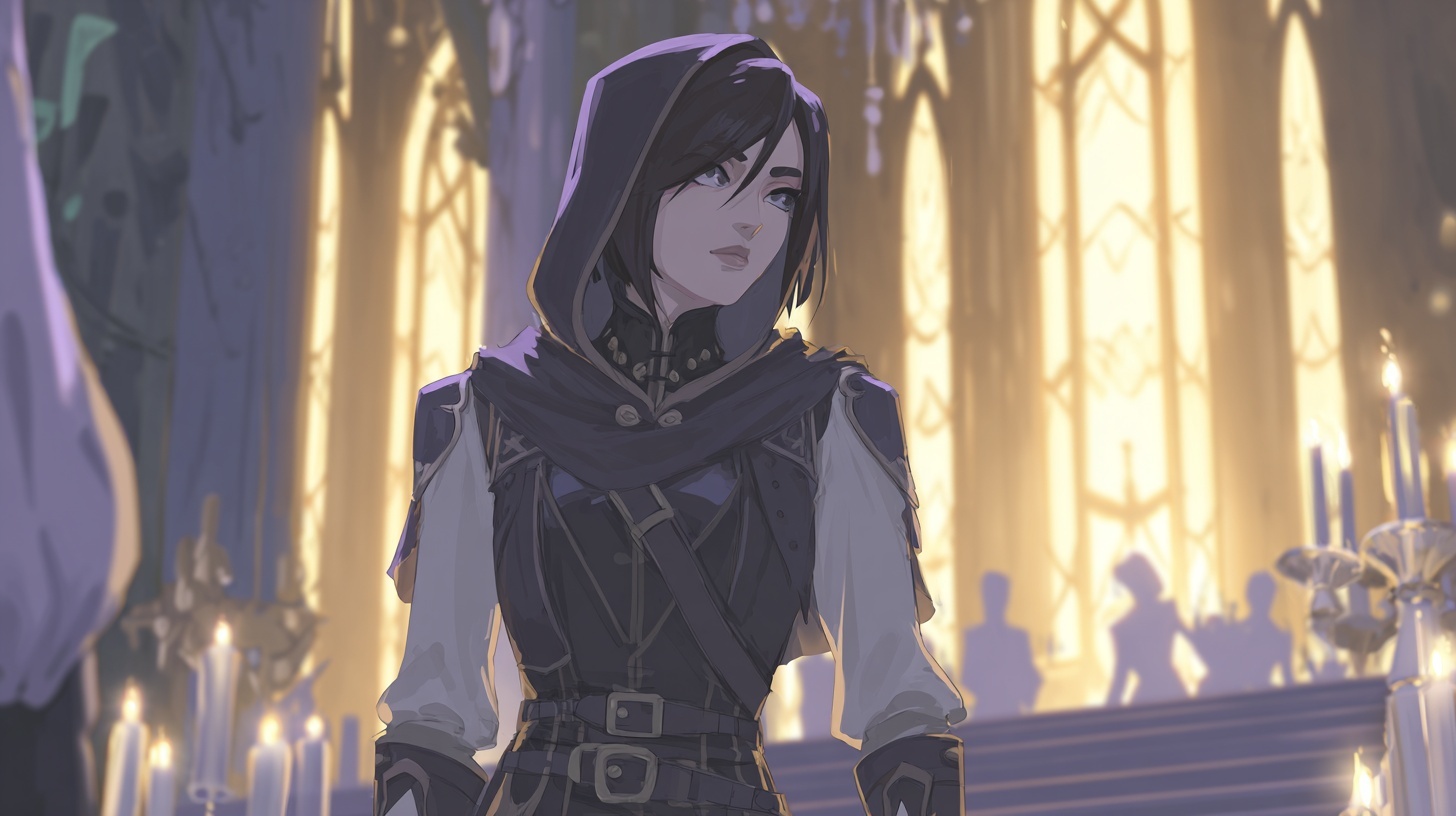
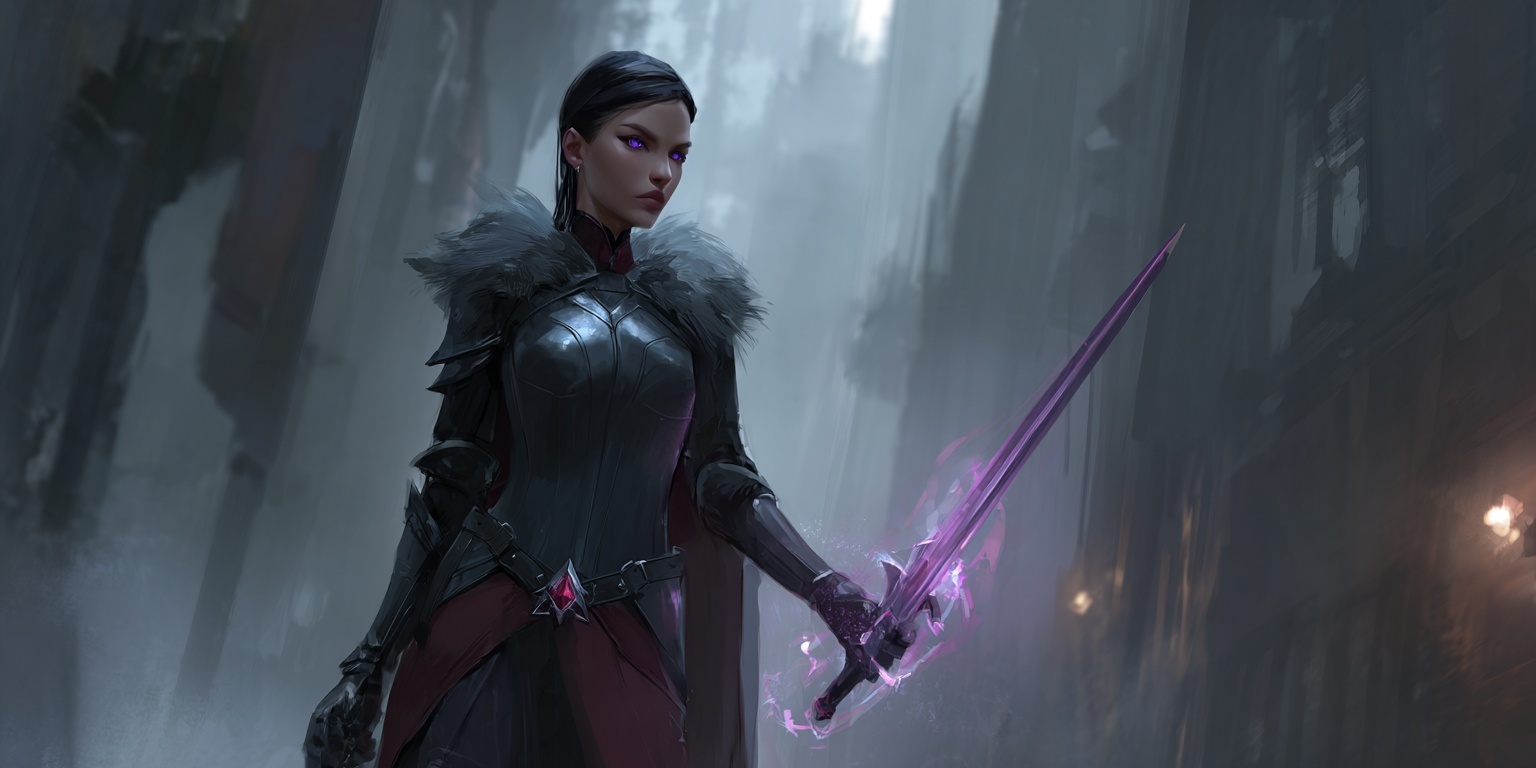
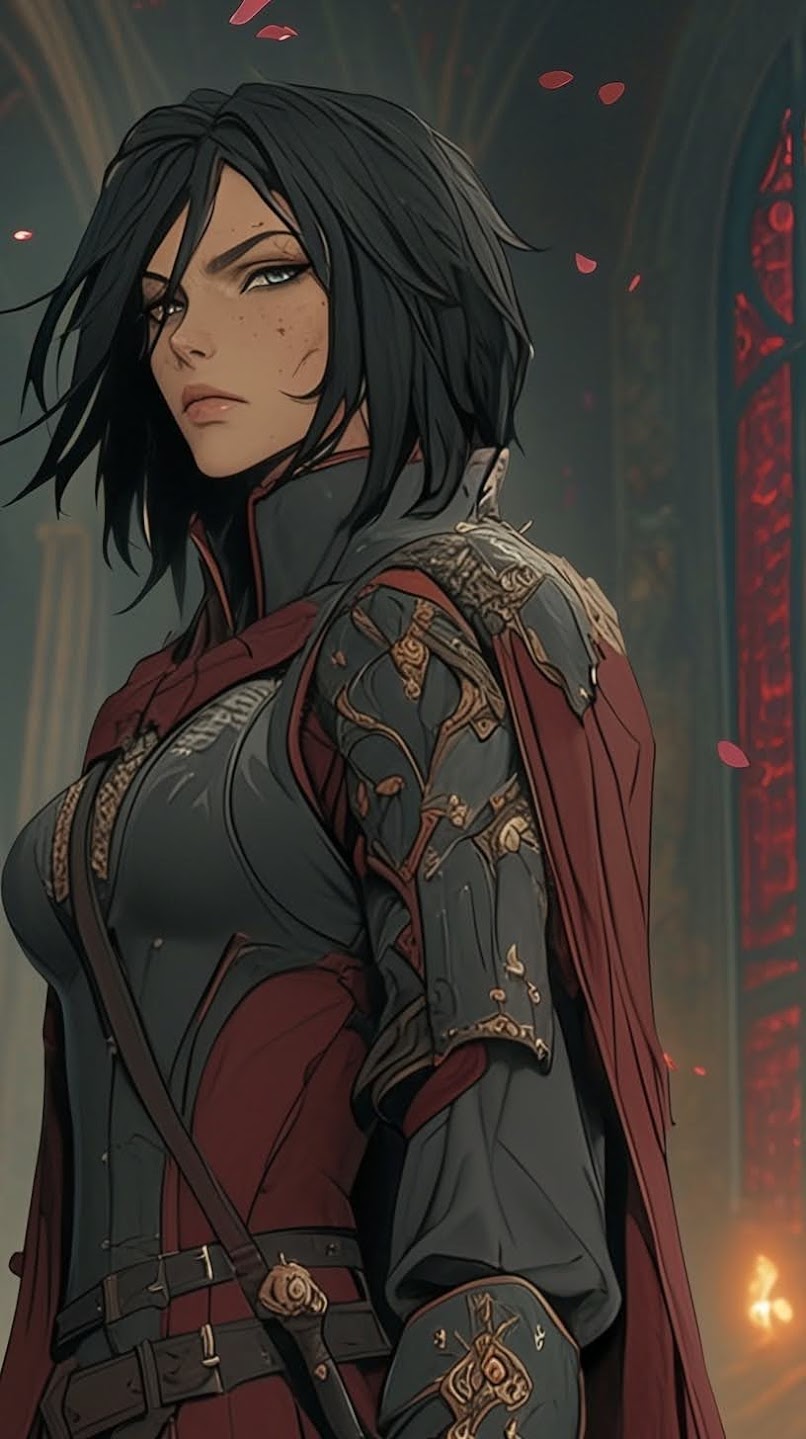
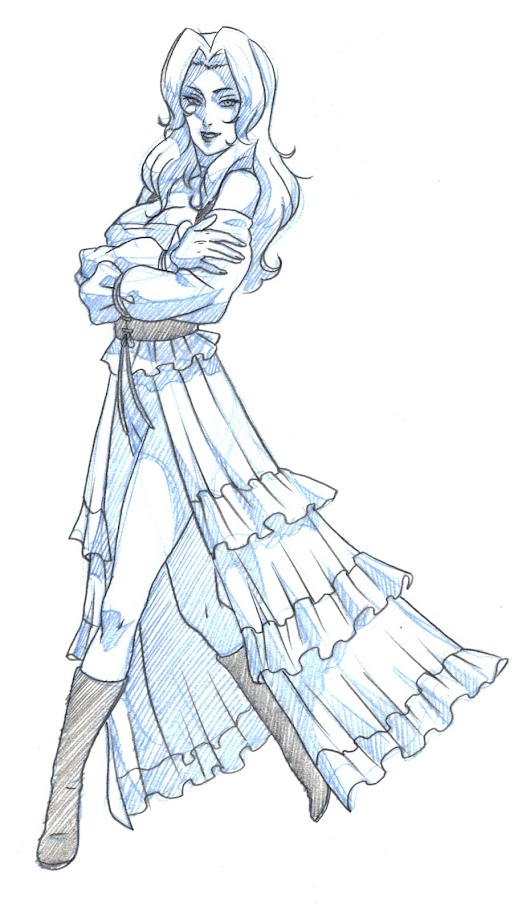
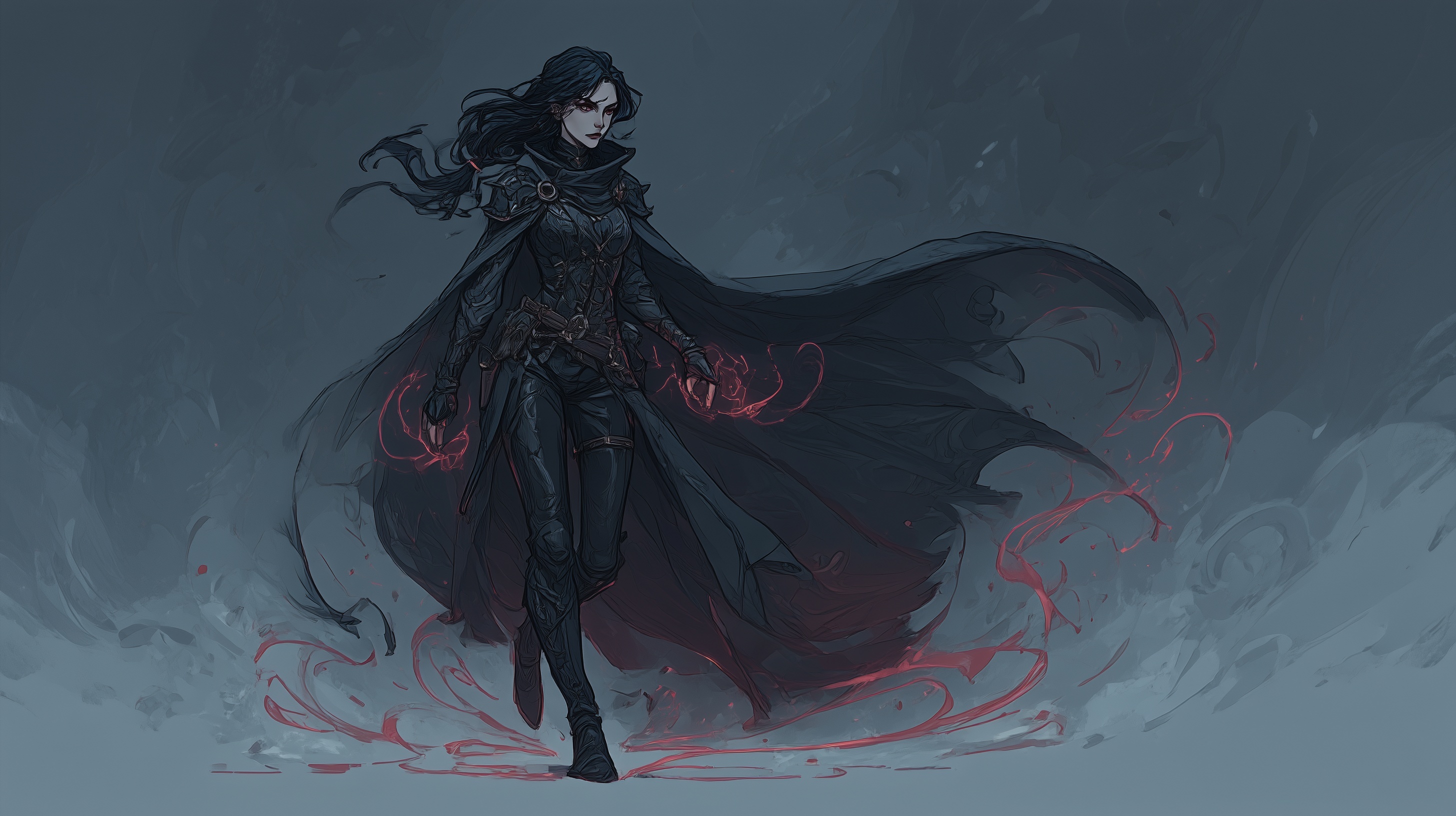
Cassandra’s presence is defined first by contrast. She carries the physical stillness of someone trained to disappear and the striking beauty of someone impossible to overlook. Her features echo both parents but never in equal measure. Her hair is a deep, midnight black that catches light with a soft sheen, usually worn loose or pushed back with casual elegance that suggests she never needs to fuss with it to make it fall perfectly. Her skin holds a warm undertone that contrasts sharply with the brilliance of her eyes, giving her an appearance that feels both inviting and untouchable. Her eyes are her most unmistakable feature. The same blue orchid shade that marked Corvyn in his youth lives in her gaze, bright and piercing in a way that stops conversation mid breath. They reveal her mood in subtle shifts. When she is thoughtful they soften. When she is working they narrow with calculating clarity. When she is nervous they flicker with the smallest tremor of uncertainty. People often underestimate how expressive those eyes are because her face is otherwise composed. They are windows into the quiet storm she carries beneath her calm exterior. Cassandra’s build reflects a lifetime of disciplined movement rather than brute training. She stands with a natural grace that comes from understanding her body as both tool and terrain. Her frame is lean, athletic, and balanced, shaped for speed, stealth, and agility instead of raw strength. Every gesture flows smoothly into the next, even when she is not conscious of it. She rarely raises her voice or moves abruptly unless startled, and when she walks, her steps are light enough that people sometimes fail to hear her approach at all. Her beauty is the kind that grows more striking the longer one looks. At first glance she is simply a lovely woman with confident posture. Then the details begin to reveal themselves. The curve of her jaw softened by natural warmth. The slight tilt of her smile when she is thinking of something amusing. The long, dark lashes that give her shyness an almost regal softness. She does not dress to impress yet everything she wears seems to complement her shape effortlessly. Even in simple clothing she carries herself like someone fully aware of her effect on others but too modest to exploit it without reason. Small details complete the picture. A faint scar along her forearm from a mission gone wrong. The delicate shape of her hands, equally capable of casting intricate spells or carving small stone charms. The subtle tension that appears in her shoulders when she is startled by loud noise. The way she instinctively curls inward when overwhelmed and unfolds again when comforted. Her physical form tells the story of a woman who has lived in danger long enough to master it, yet retained enough softness to remain unmistakably herself.
Special abilities
"Her magic is not the fire and thunder so many covet. It is subtle, deliberate, and precise, shaped by thought rather than fury. I have watched her bend shadow and light with a whisper. Power like that does not shout. It breathes. And in her hands it becomes something close to art."
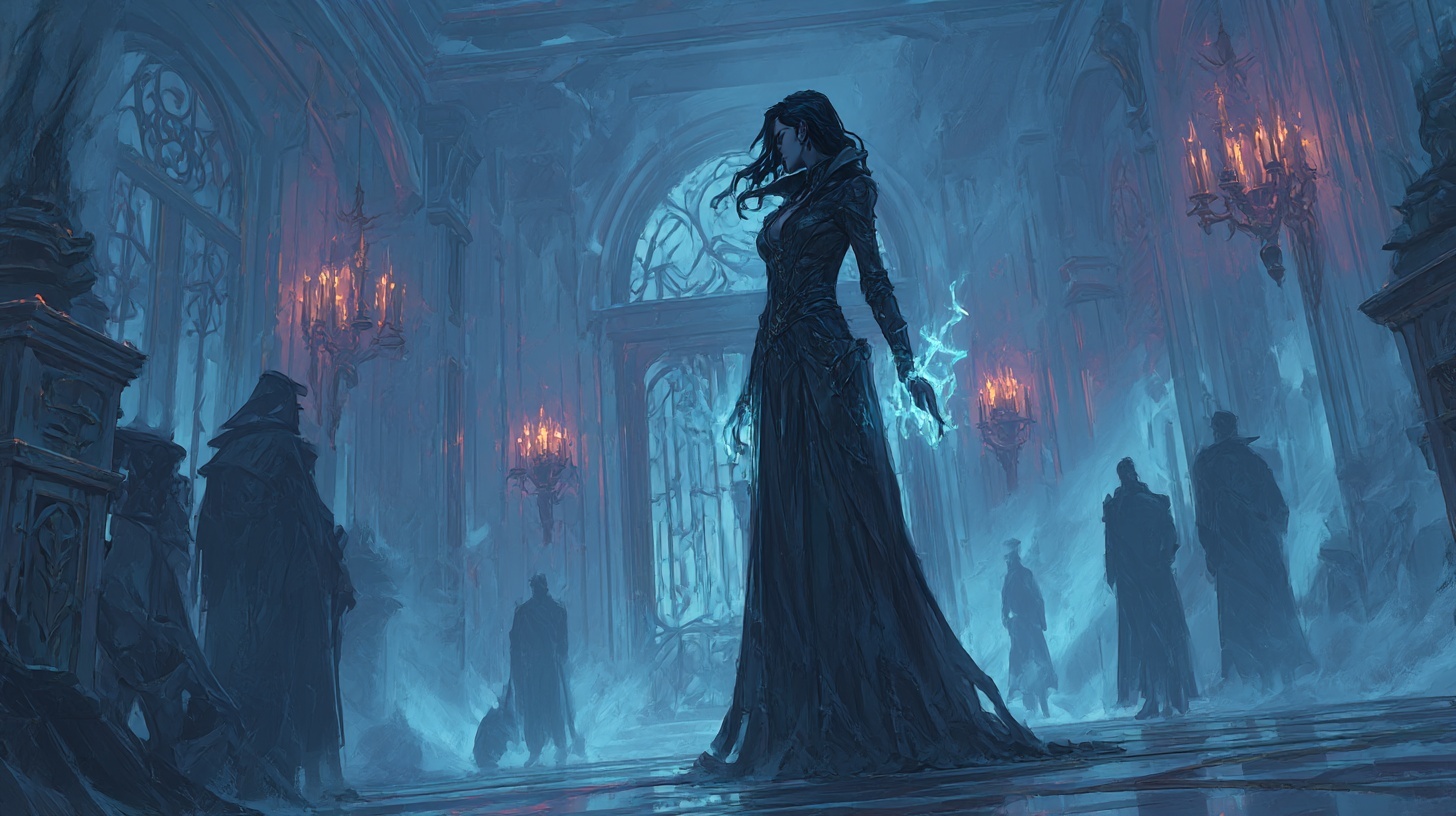
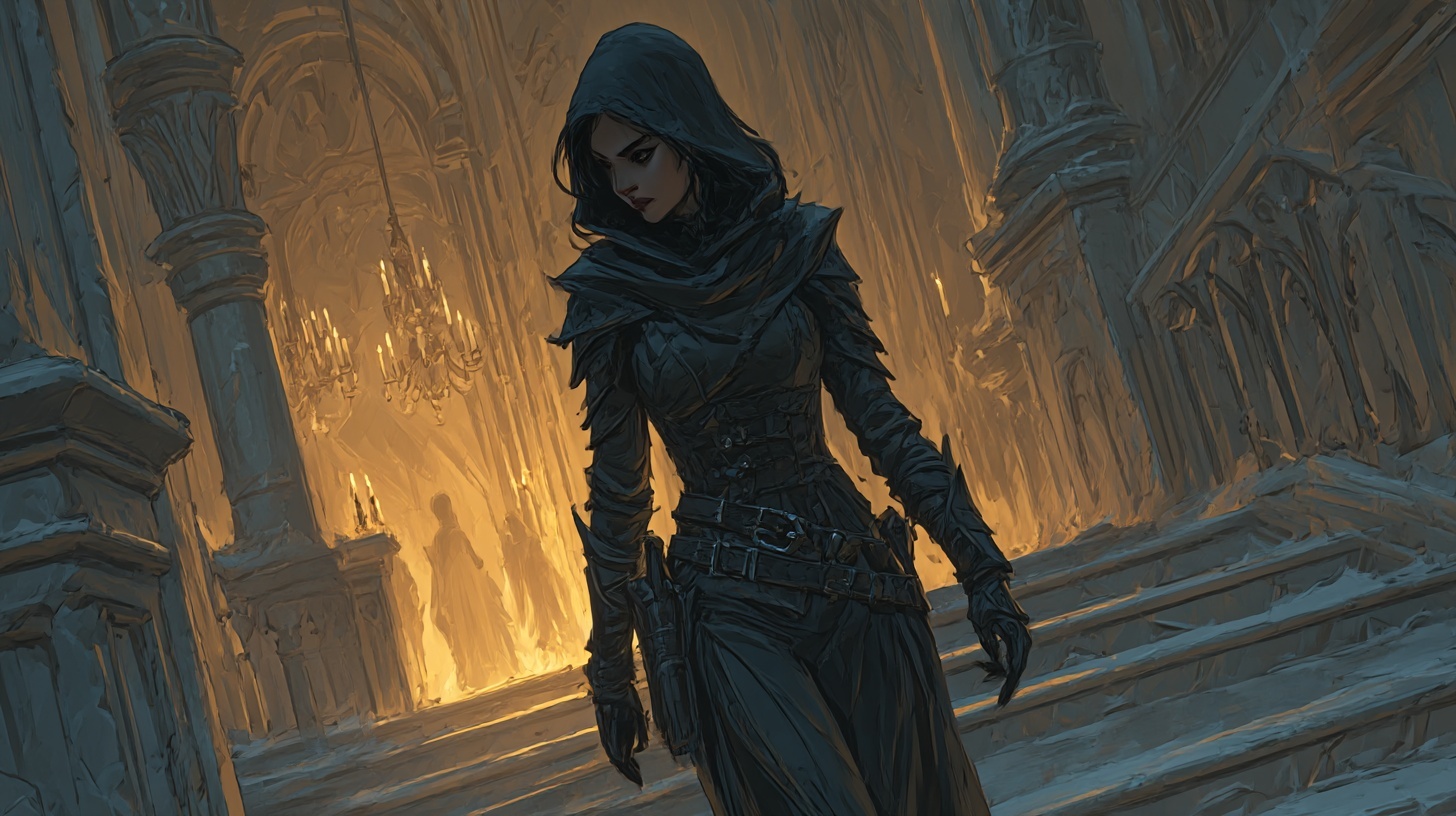
Cassandra Silvernight’s abilities are a rare blend of innate sorcery and disciplined arcane study. Most mages lean toward one path or the other. Cassandra walks both with equal precision. Her natural magic manifests through emotion and instinct, particularly in the realms of shadow, illusion, and charm. These instincts give her an intuitive grasp of subtle spellwork, allowing her to react faster than most trained casters. Where another wizard might need to shape a full incantation, Cassandra can twist a shadow or bend a reflection with nothing more than a thought sharpened by experience. Her formal studies refined these instincts into formidable technique. Cassandra spent decades absorbing arcane theory, practicing spell geometry, and mastering the structure behind illusions that deceive not only the eye but the mind interpreting it. She excels at spells designed to misdirect, conceal, or manipulate perception. Walls become doorways. Silence becomes cover. A crowd becomes camouflage. Her illusions are precise enough to withstand scrutiny from trained operatives and delicate enough to hold together under the weight of rapid improvisation. Infiltration is an art, and Cassandra’s spellwork performs like brushstrokes rather than blunt tools. Beyond illusion she wields a powerful affinity for shadow magic that ties naturally into her temperament and training. These abilities are not rooted in darkness as malice but in darkness as concealment, protection, and quiet potency. She can slip through dim spaces with unnatural ease, mute her presence, and anchor her spells in places most casters overlook. Even when exposed to bright environments she can create micro shadows as anchors for her abilities, giving her mobility and stealth in scenarios where ordinary concealment fails. Her fear of the dark does not lessen her command over it. If anything, the tension sharpens her magic further. Her talents extend into non magical realms as well. Cassandra possesses a near perfect sense of spatial awareness, balance, and timing, the result of centuries spent navigating unfamiliar terrain both physical and social. She can read a room in seconds, anticipate a guard’s patrol pattern after a single rotation, or dismantle a complex lock with calm, practiced efficiency. Her appraisal skills are legendary among those who know her. She can identify forged documents, counterfeit gems, and misattributed artifacts with unsettling accuracy, a talent shaped by equal parts study, field experience, and sheer perceptiveness. All of these abilities work together to form her greatest strength. Cassandra does not overpower obstacles. She outthinks them. She outmaneuvers them. She sees angles others miss and exploits them with gentle precision. Whether she is dismantling a conspiracy, slipping through a guarded estate, or calming a volatile situation with a single well chosen word, Cassandra’s abilities are defined by focus rather than force. She is not the blade that cleaves through danger. She is the quiet hand that redirects it.

Mental characteristics
Personal history
"When she was small she clung to my sleeve as though the world were too wide for her to face alone. Now the world feels smaller knowing she walks somewhere within it. She does not see her own strength. Perhaps that is why it shines so brightly."

Cassandra’s childhood was a quiet, insulated world built from stone corridors, whispered lessons, and the unyielding presence of a father who loved fiercely but carried grief like a second spine. She and her twin brother Anson aged slowly, the lingering edge of Lazzill’s curse stretching their years into something neither mortal nor immortal. They grew up with no mother to guide them, only the stories Corvyn refused to tell and the ones he could not bear to speak. Cassandra felt the absence long before she understood it, sensing the shape of Andrielle’s memory in the way her father looked at her when he thought she was not watching. In those early years she clung to Anson, matching her steps to his because he was the only other person who shared her strange life. Corvyn trained them himself. Their tutors were shadows, blades, tomes, and the long silences between one lesson and the next. Cassandra learned diplomacy and intrigue with the same precision she learned the smallest sleights of hand. She discovered early that people underestimated her. The softness of her voice, the gentleness of her gaze, the shyness that tightened her breath whenever strangers looked too long, all of it formed a mask she did not have to craft. It simply existed. Corvyn shaped her into the quiet answer to problems that could not be solved with Anson’s force. She became an infiltrator, a spy, a subtle instrument meant for delicate work in a kingdom that believed shadows moved on their own. Her adolescence stretched across decades. By the time she resembled a grown woman, she had already slipped through court chambers, illusion shrouds, and enemy vaults more times than any record would ever reveal. The Seinrill House Guard became her world. She served as the Voice when commanded and the unseen hand when necessary. Yet beneath the mastery she built, the doubt grew. Cassandra wanted to know her mother’s truth. She wanted to understand why Corvyn carried so much buried sorrow. Every answer she found twisted into more questions. Anson felt the same weight, but where Cassandra sought understanding, he sought escape. Their bond frayed the moment he vanished without a word, leaving her to navigate a life built from secrets she never chose. The loss of her brother shook her more deeply than she let anyone see. Alone, she poured herself into missions, research, and the quiet hunt for pieces of the past. She convinced herself that if she could understand the truth of their family, she would understand herself. Instead she found only fragments of a tragedy she did not yet have the strength to face. Corvyn offered no comfort. He simply pushed her toward the next task, the next lesson, the next corner of the world he needed controlled or cleansed. Cassandra obeyed because she still hoped loyalty could mend what was breaking inside her. Yet every step into the dark made her more aware of the widening distance between who she was and who she was becoming. Everything changed the day she crossed paths with Dartimen Silvernight. Their meeting was a collision of skill sets, instincts, and dangerously complementary chaos. He saw through her masks faster than she expected, not because he was perceptive but because he lived behind a few of his own. He taught her that the past cannot be solved like a puzzle and that grief inherited is not a burden she is required to carry. He made her laugh again. He made her furious. He made her think. And slowly, he made her believe that a life outside Corvyn’s command was not just possible but necessary. When she finally said no to her father, the word broke centuries of obedience. It also broke her heart. Leaving the House Guard freed her and wounded her in equal measure. She built a family with Dartimen, raising four children with the tenderness she once believed she was incapable of giving. She traded missions for motherhood, infiltration for quiet evenings carving small charms from stone, danger for a home filled with warmth and imperfect chaos. Yet Cassandra never fully escaped the shadows she once walked. They linger at the edges of her life, reminders of the path she left behind and the father she still loves but can no longer follow. She carries her history the way she carries her magic, wrapped close, controlled, never forgotten. And though the world knows her now as a Silvernight, the truth of the woman she has become is something even the House Guard could never have predicted.
Gender Identity
"There are moments when she moves and I see her mother in every line of her face, yet she stands as her own creation entirely. She carries her womanhood with quiet certainty, never as a mask or a weapon unless she chooses. It is grace forged through struggle, a truth she defined rather than inherited."

Cassandra has always understood her womanhood as both truth and tool, something intrinsic and something she learned to wield with deliberate care. She grew into her identity slowly, shaped by centuries of observation rather than the fast, frantic rush that defines most mortal lives. The early years of her existence were spent in the shadow of men. Her father trained her. Her brother balanced her. The House Guard evaluated her worth in terms of skill, obedience, and utility. Nothing in that world encouraged softness. Nothing nurtured the idea that she could define herself on her own terms. Yet even within that rigid structure she grew into her femininity with quiet certainty, holding tight to the parts of herself that were gentle and intuitive and refusing to let the darker demands of her training erase them. She knew early that her beauty would draw attention. She did not resent it. She simply refused to let it define her. Cassandra enjoyed the artistry of being a woman. She enjoyed choosing clothing that felt both comfortable and striking. She enjoyed the power of a lingering glance or a soft smile. She understood that people reacted to her appearance before they reacted to her words and she used that to her advantage without letting it become the sum of her identity. Her presence carried intention. She walked into a room knowing she would be seen yet she never allowed herself to become an ornament for anyone else's fantasy. The contrast between her outward confidence and her inward shyness became a defining part of her self understanding. Cassandra could stride into a council chamber and command silence. She could slip through enemy territory using her charm as a key. Yet ask her to speak honestly about her fears or her doubts and she folded inward like a girl half her apparent age. This softness was not weakness. It was simply the part of her that had never received permission to exist during her years of service. Only outside the commands of the House Guard did she learn that her vulnerability was not a flaw. It was the place where her strength was born. Cassandra’s relationship with gender was also shaped by the absence of her mother. She grew up surrounded by men who never quite understood the inner landscape she was trying to map. The shyness she carried. The longing for guidance she never had. The ache of seeing reflections of a woman she had never known in the mirror each morning. She learned to emulate the stories of Andrielle because she had nothing else to follow. As she matured she realized she did not need to live as the echo of a memory. She could carry her mother’s grace without sacrificing her own shape in the process. Her time with Dartimen expanded her understanding of her identity even further. He never treated her beauty as something fragile. He never treated her shyness as something to fix. He met her strength with admiration and her softness with warmth. With him she could be playful. She could be silly. She could be a woman without the constant need to prove that she deserved the space she occupied. In that freedom Cassandra discovered facets of herself she had never explored. Her womanhood became less a weapon and more a source of quiet pride and comfort. Motherhood completed the arc in ways she had not expected. Holding her first child she understood instantly that her identity had never been divided pieces to navigate but a single whole that had finally found its balance. She was still the assassin who walked through shadows. She was still the scholar with a mind quick enough to shape illusions at will. Yet she was also a nurturing presence who sang soft rhymes without realizing she was doing it. A woman who carved little charms for the people she loved. A mother who could face danger without flinching and still cry over a child’s scraped knee. Cassandra Silvernight did not grow into her identity all at once. She built it piece by piece until the reflection staring back at her was not her mother. Not her father. Not the House Guard. It was simply herself.
Sexuality
"I feared her heart would be another casualty of the life I shaped around her, yet she found someone who sees her with a clarity I never earned. Watching her love without fear is a reminder that she grew beyond the shadows I cast. That kind of trust is a form of courage I have never mastered."
Cassandra’s sexuality grew out of the same long, quiet evolution that shaped every part of her identity. She did not come of age in the usual sense. There was no sudden rush of infatuation or youthful experimentation. Her emotions developed slowly across decades, filtered through her shyness, her fear of vulnerability, and the strict expectations of the House Guard. For a long time she mistook attraction for curiosity and desire for danger. Every instinct she had told her that intimacy required trust, and trust was something her life simply did not allow. She learned to read people for threats before she ever learned to read them for affection, which made the idea of romance feel distant, almost foreign. Her beauty drew attention she never asked for. Men and women alike found her captivating, but Cassandra’s reaction was often discomfort rather than confidence. She understood how to flirt as an infiltrator. She knew how to turn desire into a distraction or a doorway. Yet genuine interest unsettled her. The moment someone liked her for herself rather than the role she was performing, she froze. Her shyness and her training clashed constantly. One part of her could weaponize charm. The other had no idea how to accept it. She spent centuries building a persona the world desired without ever learning to navigate desire on her own terms. For most of her early life Cassandra assumed romance was something meant for other people. The House Guard demanded sacrifice, emotional discipline, and absolute secrecy. Her father carried his grief like a warning. Her brother’s constant presence made it easy to avoid vulnerability. When she did feel attraction it was quiet, hesitant, and often buried beneath her fear of losing control. She preferred distance because distance was safe. Infiltration missions required masks. Real intimacy required the opposite. For Cassandra, that was the one skill she had never been taught, and the one she feared she would fail. Her relationship with Dartimen Silvernight reframed everything. He was the first person she could not misdirect, charm, or hide from. His interest in her was immediate and sincere, yet he never pushed, never crowded, never treated her like a prize. He made her laugh in ways that loosened her defenses and challenged her fear of being seen. Their chemistry was undeniable, but their intimacy took shape slowly, built on trust rather than heat. With him she learned desire without fear, affection without calculation, and passion without losing herself. For the first time in her long life she experienced attraction as something joyful rather than dangerous. Cassandra’s sexuality became an expression of confidence rather than duty. She enjoyed being desired, not as an object but as a partner. She enjoyed choosing when to be bold and when to be soft. The woman who once trembled at a sincere compliment now understood how to take the lead when she wished, to tease when she felt playful, and to meet Dartimen’s charm with a disarming spark of her own. Their partnership taught her that attraction is not a weapon or a liability. It is a conversation between equals. For someone raised in a world of secrets, that realization changed everything. Motherhood deepened her understanding even more. It proved that intimacy did not weaken her independence and that her sexuality was not something she needed to suppress to be strong. She embraced the wholeness of her adult identity. She could be a devoted partner, a passionate woman, a fiercely protective mother, and still carry the quiet shyness that had always been part of her core. Cassandra Silvernight’s sexuality was never a single defining trait. It was a reflection of her growth, her healing, and her ability to choose connection in a life built from shadows.
Education
"I placed every book I could before her, every lesson, every arcane theory, yet she surpassed all of it with a determination that was entirely her own. She did not learn because I demanded it. She learned because her mind would not allow her to remain in the dark. Her hunger for understanding was the one force I could never bend."
Her education began long before she looked old enough to hold a book. Corvyn taught her the fundamentals of reading, logic, observation, and discipline with the same intensity he applied to every part of her training. Lessons were not given in classrooms. They unfolded in dimly lit corridors, in the quiet moments between missions, and in the long silences where she was expected to study her surroundings with perfect recall. Her father understood that knowledge was a weapon, and he shaped her mind with the same deliberate precision he used to shape her body and magic. By the time she appeared to be a young woman she had already mastered subjects mortals spent entire lifetimes pursuing. Her formal arcane education followed a dual path almost no one attempts. She possessed natural magical talent that manifested early, subtle and instinctive, tied to shadow and emotion. Corvyn recognized it and placed before her every book, scroll, and tutor he deemed useful. She studied the structure of spells with a scholar’s rigor and practiced innate sorcery with the instinct of someone who felt magic like a second heartbeat. Illusion, charm, shadow manipulation, stealth magic, and controlled misdirection became her areas of expertise. She spent decades refining them until they operated with the fluidity of thought. Her skill was not born from raw power. It was born from relentless refinement. In addition to arcane study, Cassandra received a comprehensive education in politics, cultural behavior, deception, and court dynamics. The House Guard required more than combat proficiency. It required intellectual versatility. She learned how nobles argued, how guilds negotiated, how criminals lied, and how ordinary people thought. She memorized trade routes, succession lines, historical fractures, and the unwritten rules that governed every major power in Areeott. Her infiltration work depended on this knowledge. She could slip into a gathering of scholars as easily as she could blend with dockworkers because she understood how each group saw the world. Her practical education came from field work. Each mission was an exam. Each failure was an unspoken reprimand. She learned to read a room in seconds, to predict violence by the tension in someone’s hands, to identify forged documents by the grain of parchment, and to dismantle magical traps through intuition rather than formula. Corvyn rarely explained the purpose behind her assignments. He expected her to learn by doing, and she did. The combination of theoretical study and lived experience shaped her into one of the most adaptable operatives in the kingdom. Cassandra’s education continued long after she left the House Guard. Life with Dartimen, travel aboard the Stormrider, and raising her children all expanded her understanding in ways her earlier training never touched. She learned diplomacy outside the rigidity of duty. She learned culture beyond Areeott’s borders. She learned patience and emotional literacy from motherhood and partnership. Her knowledge became something personal rather than weaponized. Though she was shaped by an extraordinary and often isolating education, she ultimately grew into a woman whose wisdom came as much from choice as from training.
Employment
"I have sent many into danger over the centuries. None walked through it with her quiet certainty. She never needed to be the sharpest blade. She chose to be the steady hand that guides it, and that has always been the greater strength."

Cassandra began as an extension of her upbringing. Corvyn did not raise his children toward open careers or conventional obligations. He shaped them into instruments meant to serve the stability of Areeott from behind its polished facade. Cassandra entered adulthood already in service, her training seamlessly transitioning into her first assignments. She observed court sessions from the shadows, followed political currents, learned the rhythms of noble intrigue, and studied the quiet machinery of power. Her earliest tasks revolved around intelligence gathering and subtle intervention, work that required a keen mind and an instinct for reading danger before it surfaced. As her skills refined, Cassandra became one of the kingdom’s most reliable operatives for matters requiring delicacy rather than force. If a negotiation risked collapse, she was sent to steady it. If a noble family concealed a threat, she was placed nearby under a dozen discreet pretexts. Her presence at social events, diplomatic meetings, or private councils was rarely questioned. She understood how to move within those spaces without attracting suspicion, offering solutions that never revealed the true source of her authority. To outsiders she appeared to be a particularly astute envoy in service to an influential house. The reality was far more complex. Her work also demanded regular infiltration and field assignments. Cassandra learned to slip across borders, penetrate concealed networks, retrieve sensitive information, and unravel plots before they endangered the kingdom. She operated alone more often than not. Her magic gave her the subtle precision required for clean entry and cleaner exit. Those above her trusted her with missions where failure could not be public, either because the truth was too volatile or because success required absolute silence. These assignments shaped her into a figure who could blend into any environment, whether a foreign court, a criminal den, or a remote outpost where suspicion ran cold and deep. Over time she became a central figure in internal intelligence work as well. Cassandra was often tasked with evaluating threats that originated within Areeott rather than beyond it. She followed trails of corruption, mapped political fractures, and identified individuals whose ambitions endangered stability. This work placed her uncomfortably close to the consequences of her father’s long shadow. She saw the toll exacted by centuries of secrecy, the strain within institutions meant to protect rather than manipulate, and the fear that simmered beneath the kingdom’s surface. These experiences deepened her doubts about the ethics of her service and forced her to confront her own complicity. Her most demanding responsibilities involved direct protection and oversight of her father’s interests during high risk situations. Cassandra traveled with him when diplomacy turned volatile, monitored threats in foreign territories, and ensured that no rival power gained insight into the true nature of the Seinrill legacy. These assignments were difficult for reasons that had little to do with danger. They exposed her to Corvyn’s inner turmoil, to the grief he never learned to master, and to the ruthless decisions he made in its wake. Standing beside him during these years clarified both her love for him and the growing fracture between their values. Leaving that life required an act of profound courage. Cassandra did not step away because she lacked the will to continue, but because she finally understood that her service was costing her the chance to build a life of her own. Marriage, motherhood, and the freedom to choose her own purpose became possible only after she laid down the responsibilities that had defined her for centuries. Today her employment is self directed. She uses her abilities when needed, particularly to safeguard the people she loves, but she no longer answers to a throne built from grief. Her work now reflects her own priorities rather than the burdens inherited from her father’s past.
Accomplishments & Achievements
"She walks softer than any shadow I have ever feared, and yet when she enters a room, even silence stands aside for her. There is no training for that. It is something a person is born with, or not at all."

From an early age she demonstrated an unusual blend of intelligence, instinct, and magical aptitude that allowed her to master disciplines even seasoned operatives struggled with. Her first major achievement was her seamless integration into Areeott’s political and social spheres. She learned how to navigate courts, guild councils, and highborn gatherings with a fluid grace that made her indispensable. Her presence diffused tensions, uncovered hidden motives, and steered delicate situations toward outcomes that preserved stability without ever revealing the hand guiding them. Her work beyond the kingdom’s borders stands as another measure of her capability. Cassandra carried out long range reconnaissance and intelligence missions that required absolute autonomy. She infiltrated foreign cities and remote strongholds, secured vital information, and returned without leaving a trace of her passage. Several crises that might have escalated into open conflict never reached public awareness because she dismantled them quietly and efficiently. These victories were invisible by design. They were not the sort of triumphs sung in taverns or etched into records. They were the kind of achievements that kept nations from bleeding. Her magical accomplishments are no less significant. Cassandra’s mastery of illusion and shadow magic reached a level even her tutors had not anticipated. She refined complex techniques that blended innate sorcery with rigorous scholarly study, creating hybrid methods of spellwork that operated with the precision of engineered tools. Her ability to erase her presence, mimic identities, manipulate perception, and bypass arcane defenses made her one of the most formidable infiltrators of her age. She did not rely on raw power. She relied on craftsmanship. The results were often indistinguishable from impossibility. One of her greatest personal achievements lies in her resilience. Cassandra made her way through a life shaped by secrecy, loss, and the lingering influence of a curse she did not choose. She endured the fracture of her bond with Anson, the burden of her father’s expectations, and the moral unrest that shadowed her years of service. Instead of breaking, she grew. Instead of hardening, she softened in the ways that mattered. Choosing to leave the life she had always known was not an escape. It was a declaration of selfhood. It was the moment she proved she could step out of the shadow of a centuries long legacy and build something of her own. Her final and perhaps most meaningful achievement is the life she crafted after stepping away from the House Guard. Cassandra became a wife, a mother, and a woman who found purpose in places untouched by intrigue. She built a family founded on warmth rather than obligation, carved a home aboard the Stormrider where love outweighed duty, and reshaped her identity without abandoning the strength that defined her. For a woman raised to be a weapon, creating a life filled with gentleness and laughter stands as her most extraordinary accomplishment. It is the quiet triumph that gives every other part of her story its lasting weight.
Failures & Embarrassments
"She scolds herself for every misstep, even the ones so small they leave no mark at all. What she calls failure is often nothing more than her heart showing through the armor. I have seen true failure. She has never once touched it."

Her work brought its share of missteps as well. Cassandra once infiltrated a foreign estate under the guise of a visiting archivist only to be undone by an unexpected hound that caught her magic tinted scent. She escaped without serious harm but the scramble that followed was neither elegant nor quiet. For a woman who took pride in flawless execution the incident rattled her. She replayed every moment for years after, studying each error until she learned to laugh at it. Even so it remained one of the few assignments she refuses to recount in detail. It was proof that even mastery has limits. Her shyness created its own humiliations. Cassandra had a habit of freezing when someone offered genuine praise or uncomplicated affection. In her younger years a well meaning compliment could derail an entire conversation and leave her red faced and stammering while her father attempted to salvage the social setting. These moments embarrassed her more deeply than any failed spell or flawed infiltration. They exposed the soft interior she spent so much time trying to hide. Over time she learned to accept this part of herself yet the memory of those awkward early encounters still makes her cringe. The deepest wound in her life was the fracture with Anson. She did not see it coming. She believed he would stay. She believed they would face Corvyn’s shadow together. When he walked away without a word she felt abandoned in a way nothing in her training had prepared her for. Cassandra considers this a failure even though it was never her fault. She believes she should have noticed his unraveling sooner. She believes she should have reached him before the break. This guilt followed her for decades until their eventual reconciliation softened it without erasing the scar. Her final and most painful embarrassment came the day she confronted Corvyn and told him she was leaving the life he had built for her. Her voice shook. Her hands trembled despite centuries of discipline. Every word felt like a betrayal even as she knew it was necessary. She expected her father to understand. Instead she watched his grief harden into fury. The moment remains a quiet humiliation in her memory, not because she regrets her choice but because it revealed how deeply she still craved his approval. Standing her ground in front of him was the bravest thing she ever did and the moment that left her feeling most exposed.
Mental Trauma
"There are wounds she carries that no healing spell could ever reach. I see them in the way she hesitates before stepping into the dark, in the way she listens for footsteps that are not there. She learned fear young, yet she walks forward anyway. That is bravery few will ever understand."
Cassandra’s earliest and most enduring trauma is the absence of her mother. Andrielle was a presence she never knew, yet felt constantly. The void left behind shaped Cassandra long before she understood the reason for it. She grew up watching her father break beneath a grief he would not explain and a curse he would not name. Children fill silence with imagination, and Cassandra filled it with fear that something about her was the cause. That unspoken guilt became a shadow that followed her into adulthood, coloring her understanding of love, loss, and her own worth. Even after she learned fragments of the truth, the ache of that unanswered absence remained. The slow aging that marked her and Anson as different created another layer of psychological strain. They matured emotionally at a pace that rarely matched their appearance. Cassandra looked like a young woman long before she felt like one, and the world viewed her through expectations she did not yet know how to carry. She spent decades feeling slightly out of step with her own body and her own identity. Her father offered structure, not comfort. Her tutors offered knowledge, not understanding. This mismatch left her quietly insecure. She learned to hide that insecurity behind discipline, creating an internal tension between the confident operative she appeared to be and the bewildered young woman she still felt like inside. The work itself carved its own wounds. Infiltration demanded emotional compartmentalization far beyond what most people can endure. Cassandra slipped into identities, masks, and lies so frequently that she began to lose track of the boundaries between them and herself. Each mission required her to read danger in every gesture, every silence, every shift in a room’s mood. Sustained vigilance became instinct, but it also became exhausting. She learned how to smile while terrified, how to appear calm while her heart raced, and how to bury fear so deeply that she sometimes forgot it was there until something sudden or loud ripped open the space she had sealed it in. Her relationship with Anson remains one of the deepest emotional fractures in her life. His departure was not just a loss. It was an abandonment that struck at her most vulnerable fears. Anson had been her anchor, the one person who shared her strange existence and understood the language of their upbringing without explanation. When he disappeared she felt unchosen, left behind, dismissed without a goodbye. Even after they reconciled, the wound never fully closed. A part of her still fears that the people she loves will slip away without warning, and this fear fuels her dislike of separation and her instinctive need to keep her family close. The trauma surrounding her father is more complicated. Cassandra loves Corvyn with a depth that frightens her. She also fears him. His grief shaped her childhood. His expectations defined her adolescence. His ruthlessness surrounded her adult life. She witnessed the toll of centuries on a man who stopped healing long ago, and she carried the emotional weight of trying to understand him, justify him, and forgive him even as he taught her to become something she did not wish to be. Leaving him required the courage to break from a cycle she had been raised to accept as normal. The mixture of love, fear, guilt, and defiance she feels toward him is a wound that never fully resolves. Cassandra’s deepest, most quiet fear is that she does not truly belong to any world she has lived in. She is too long lived to fit easily among mortals, too soft hearted to thrive in the shadowed work of her father, too shy to fully embrace the seductive confidence her role often required, and too aware of danger to ever feel entirely safe. This lifelong sense of in between created a loneliness she rarely admits aloud. Her family aboard the Stormrider softened that isolation, but the old habits remain. In her quiet moments she still feels the echo of the girl who had to grow up in silence, in a house full of ghosts, in a kingdom held together by secrets she was never meant to understand.
Intellectual Characteristics
"Her mind is sharper than any blade forged. She sees the world in layers, each one clearer to her than to those who think themselves wise. Whenever she tells me what I have missed, I find myself grateful she inherited her mother’s brilliance instead of my stubbornness."
Cassandra's intellect is defined first by its balance. She possesses a mind shaped by equal parts instinct and study, a rare combination that allows her to understand both the emotional undercurrents of a situation and the mechanical structure beneath it. Corvyn taught her discipline and analysis, while her own natural sensitivity taught her intuition. The result is a sharp, perceptive intelligence that does not rely on brute force thinking. She can absorb complex information quickly, sift through what matters, and discard what does not. Her thoughts move quietly and efficiently, shaped by years of needing to outthink danger before it ever took shape. Her magical intellect is equally distinctive. Cassandra approaches arcane theory the way a master craftswoman approaches her tools, with precision and reflection rather than flamboyant experimentation. She possesses the rare ability to blend innate sorcery with formal spellcraft without losing clarity in either discipline. Illusion and shadow magic require both creativity and restraint, and she excels at both. She understands that the effectiveness of such spells lies not in how loudly they announce themselves, but in how perfectly they fit the moment. Her magic is engineered thought, the product of a disciplined mind that has spent centuries refining its edges. Cassandra is also an exceptional observer. She has the rare gift of noticing what most people overlook, whether it is the tension in a person’s shoulders, the dust on an untouched ledger, or the slight shift in tone that betrays a lie. She processes environments holistically, seeing rooms as living patterns rather than static spaces. This ability made her invaluable in infiltration and intelligence work, but it also means her mind never fully rests. Even in peaceful settings she cannot help but analyze behavior, anticipate movement, or piece together unspoken motivations. It is a skill that protects her and exhausts her in equal measure. Her intellectual weaknesses come from the same traits that make her effective. Cassandra overthinks. She questions herself long after a situation has passed. She replays conversations, second guesses decisions, and tries to understand the emotional logic of others even when it is impossible. This reflective habit can spiral into self doubt, particularly when she feels she has failed someone she loves. Her shyness also complicates her natural brilliance. She often downplays her insight or hesitates to voice conclusions until she is absolutely certain, even when her instincts have already given her the correct answer. In many settings she is the smartest person in the room but rarely the first to speak. Despite these internal tensions, Cassandra’s intellect is defined by empathy. Knowledge for her is not simply a tool for survival or manipulation. It is a means of understanding people, easing their fears, and finding solutions that avoid unnecessary harm. She values subtlety over spectacle, precision over dominance, and truth over victory. Her mind is as gentle as it is formidable, shaped not just by arcane study and clandestine work but by a quiet desire to see the world clearly and treat it kindly. Even after everything she has endured, Cassandra thinks with both her heart and her reason, and that balance is what makes her exceptional.

Morality & Philosophy
"She believes goodness is something chosen each day, not inherited from a crown or dictated by necessity. There are times she has stood against me with nothing but that quiet conviction in her eyes. I never told her how much I respected her for it."
Her moral center was forged in a world where right and wrong were rarely spoken of, only implied through the demands of survival and the expectations of a grieving father. For much of her early life she borrowed her morality from Corvyn and Anson, believing loyalty itself was the highest virtue. She equated obedience with goodness, stability with righteousness, and silence with wisdom. Yet even in those years she felt the discomfort that comes from following rules she did not choose. Her innate gentleness clashed with the harsh reality of her work, and that inner dissonance became the first hint that her moral compass pointed somewhere very different from the path she walked. Her philosophy began to shift the moment she realized that intention does not erase consequence. She carried out missions meant to protect Areeott, believing she was preventing greater harm, yet she could feel the small fractures forming inside herself with every deception, every manipulation, every quiet removal of a threat no one would ever know existed. Cassandra is not naive. She understands that darkness exists in the world and that someone must sometimes act within it. But she began to question whether necessary harm is truly necessary, or simply convenient for those in power. This tension between duty and conscience shaped the quiet ethical struggle that defined her adolescence and early adulthood. At her core Cassandra believes that people deserve dignity, safety, and the chance to choose their own lives. This belief grew not from philosophy texts or political teaching but from the raw experience of watching her father lose his choices one by one to grief, and watching Anson flee because he felt he had none left. To Cassandra, the greatest wrongdoing is the taking of autonomy. She despises systems or individuals who control through fear, manipulation, or force. She has lived under such a system and refuses to inflict it on others. This conviction guides her actions far more strongly than any loyalty to a crown or family legacy. Her moral weakness, however, lies in her empathy. Cassandra feels deeply, even for those who do not deserve it. She tries to understand the motives of her enemies, often reframing their cruelty as pain and their treachery as desperation. This compassion, while admirable, has placed her in danger more than once. It also complicates her assessment of her father. She sees the brokenness in Corvyn and longs to forgive him, even when his actions cross lines she can no longer condone. Cassandra’s heart wants to heal what her mind knows cannot be fixed. The conflict between those impulses shapes much of her philosophical life. The turning point in her moral philosophy came from Dartimen. He taught her that a life lived entirely in service to other people’s ghosts is not a life at all. He challenged her belief that suffering must be carried, that guilt is noble, that sacrifice is the only path to meaning. Through him she learned that responsibility does not require self erasure. She realized that choosing happiness, choosing family, choosing love, choosing herself, is not selfish. It is human. This shift allowed her to view her past with clarity instead of apology, and her future with agency instead of resignation. Cassandra’s philosophy now rests on a simple but hard won truth. The past shapes you but does not own you. Every person has the right to seek healing. Every person has the right to walk away from harm. Every person has the right to build a life defined by compassion rather than fear. She does not believe the world can be perfected, but she believes small kindnesses accumulate. A carved charm placed in a child’s pocket. A quiet warning given to someone who cannot see the danger behind them. A choice not to spill blood when illusion and cleverness will suffice. Her morality is gentle but unyielding, built from the belief that goodness is not the absence of darkness but the deliberate refusal to let darkness decide who you are.
Taboos
"If there is one thing she will not abide, it is betrayal of trust. I taught her many harsh lessons, but that one she forged herself. She would rather bear a wound than give one through deceit, and in that way she remains untouched by the corruption that shaped me."

Cassandra s most deeply rooted taboo is the violation of trust. Growing up in a world built on secrets taught her the value of information, but it also taught her the cost of betrayal. She does not tolerate those who weaponize personal truths against others. To her, trust is sacred because she knows how easily it can be shattered and how long it takes to rebuild. Even in her work she avoided exploiting vulnerabilities unless the situation left her no choice. In her personal life the line is absolute. Breaking confidence is, in her mind, a moral collapse. She also refuses to use her beauty or charm in ways that demean others. Flirting as a method of infiltration is one thing. Manipulating someone into emotional harm is another. Cassandra has seen that kind of cruelty practiced by nobles, criminals, even operatives she once worked beside. She despises it. Her shyness makes emotional intimacy difficult, and her respect for others’ boundaries stems from understanding how uncomfortable unwanted attention can be. For her, seduction without consent or clarity is an unforgivable misuse of power. One of her strongest taboos involves harming children, the elderly, or the vulnerable. Cassandra’s compassion for those who cannot defend themselves borders on fierce protectiveness. She has no patience for neglect, cruelty, or exploitation in any form. This taboo is both personal and cultural, shaped by the Arin traditions she observed growing up and by her own longing for gentleness in a life filled with danger. Anyone who threatens the defenseless instantly becomes her enemy, regardless of politics or circumstance. She is equally rigid about deception within her family. Lies were the currency of her former life, traded constantly for advantage or survival. Cassandra will not let that world follow her into her home. She expects honesty from her husband and children, and she offers it in return, even when the truth is uncomfortable. Secrets that affect safety or trust are unacceptable to her. She knows how corrosive hidden truths can become, having lived under the weight of her father’s silence for centuries. Finally, Cassandra has an intense aversion to reckless violence. Killing without necessity, cruelty for its own sake, and brutality performed to intimidate disgust her. She has worked in shadows long enough to know that violence leaves marks far deeper than wounds. Even in her past life she preferred illusion over confrontation, misdirection over bloodshed. She does not judge those who fight when they must, but she recoils from those who revel in it. To her, violence without purpose is a stain that never fully washes away.
Personality Characteristics
Motivation
"I asked much of her. Too much. Yet she never answered me with bitterness. Only with patience and the desperate hope that she might understand what shaped me. I do not deserve that kind of grace, but she gives it all the same."
Cassandra’s earliest motivation was simple and childlike. She wanted to understand the world she had been born into. She grew up surrounded by mysteries and half spoken truths. Her mother’s absence was a silence no one explained. Her father’s grief was a storm no one named. Even her own slow aging marked her as something unusual. Cassandra pressed forward in those early years driven by the need to make sense of herself. Every lesson, every mission, every whispered scrap of information felt like a step toward understanding the larger story she had been denied. As she matured, that drive turned into a sense of duty. Cassandra believed deeply in protecting her family and the kingdom they anchored. She wanted to prove she was worthy of the training she had received and that she could shoulder responsibility without faltering. This desire was rooted in love, fear, and loyalty in equal measure. Corvyn’s expectations shaped her choices, and she convinced herself that his approval would grant her clarity. She worked tirelessly, hoping each completed task might finally reveal the truth of her mother’s fate or untangle the sorrow that haunted her father. Her motivation shifted again as her doubts grew. Cassandra wanted justice, but she also wanted kindness. She wanted to protect the innocent without becoming a weapon that harmed them. This internal tension pushed her to refine her methods. She sought solutions that minimized suffering and favored subtlety over brutality. Her work became a personal test of how to uphold what she believed in without losing herself. She did not speak this conflict aloud, but it shaped every decision she made and every quiet moment when she questioned whether the ends she served truly justified the means. Anson’s departure created a new and painful motivation. She wanted to understand why he left. She wanted to know how she had failed him and whether she could have prevented their separation. For decades she carried an unspoken hope that she might find him, reconcile with him, or at least forgive herself for not seeing the storm inside him sooner. That ache fueled much of her emotional restlessness, driving her to seek answers in old records, hidden archives, and the remnants of their shared past. Her brother’s disappearance opened a wound that pushed her further into introspection. Her relationship with Dartimen transformed her motivations more profoundly than any training or trauma ever had. He showed her a different way to live, one defined not by inherited burdens but by chosen purpose. Cassandra began to want things she had never allowed herself to imagine. A life free from fear. A family. A future that was not written by her father’s grief or shaped by the curse that touched her blood. Through him she learned to look forward rather than backward, and her motivations shifted from obligation to desire. Motherhood completed that transformation. Her motivation became simple, steady, and deeply rooted. She strives to create a life for her children that is free from the shadows she grew up in. She wants them to know love without fear, home without secrecy, and identity without burden. She protects them fiercely, guides them gently, and works each day to give them something better than what she inherited. Cassandra is still driven by truth, justice, and understanding, but those pursuits now orbit a single core purpose. She lives for her family and for the chance to shape a future defined not by tragedy but by choice.

Savvies & Ineptitudes
"Her instincts are precise enough to humble seasoned operatives, yet a single loud noise will shake her to the bone. I do not laugh at this. It reminds me that she endured a childhood built from shadows and still found the strength to fear only what is real."
She moves through most situations with a quiet cleverness that rarely calls attention to itself. She reads people almost instantly, catching the subtle cues that expose tension or dishonesty long before anyone else notices. Years spent navigating courts, back alleys, and dangerous negotiations taught her to watch without seeming to stare. Even when her shyness tugs her inward, her mind is already sorting through patterns and intentions with a calm, practiced efficiency. Social spaces that should overwhelm her instead unfold in ways she intuitively understands. Her practical strengths show the same deliberate grace. She breaks down complex problems the way a jeweler examines a stone, studying every angle until the solution becomes clear. Whether dealing with an arcane barrier, a coded message, or the slow unwinding of a political dispute, she works with quiet patience. When plans shift unexpectedly she adjusts with controlled focus, trusting her training to carry her through the narrowest gaps. Finesse suits her. She excels in challenges that reward thoughtfulness over aggression. Daily life brings out a gentler expression of her savviness. Cassandra organizes spaces without cluttering them, remembers fine details others miss, and keeps her household running with subtle competence. Carving charms steadies her hands. Preparing tea steadies her breath. She can haggle with merchants as easily as she can comfort a child who has had a hard day. These small, everyday acts give her a grounding she never found in the shadowed work of her youth. Her weaknesses often come from the same sensitivities that shape her strengths. Unpredictability unsettles her, especially when it arrives as noise or sudden movement. She startles easily and reacts before she thinks, a reflex left over from years spent expecting danger behind every unexpected sound. Darkness affects her even more deeply. For someone whose magic works effortlessly in shadow, the absence of light stirs an old, irrational fear she cannot fully unlearn. When caught in true dark her breath tightens, her mind races, and she must fight the urge to conjure light immediately, even when stealth demands restraint. Honesty creates another snag in her otherwise composed demeanor. Cassandra can deceive entire courts when her work requires it, but the moment someone she loves asks her a sincere question, every mask she has ever learned collapses. Her voice softens, her gaze shifts, and her guilt shows openly. She cannot lie cleanly to the people who matter, even when doing so might spare her discomfort. This vulnerability dovetails with her quiet self doubt. She rarely gives herself credit and often assumes the worst of her own contributions. For someone so perceptive, she remains surprisingly blind to her own worth.
Likes & Dislikes
"Show her a quiet room, a cup of tea, or a well crafted book, and she will bloom like spring after a long winter. Disturb that peace with chaos or cruelty, and you will see just how quickly her calm becomes steel."
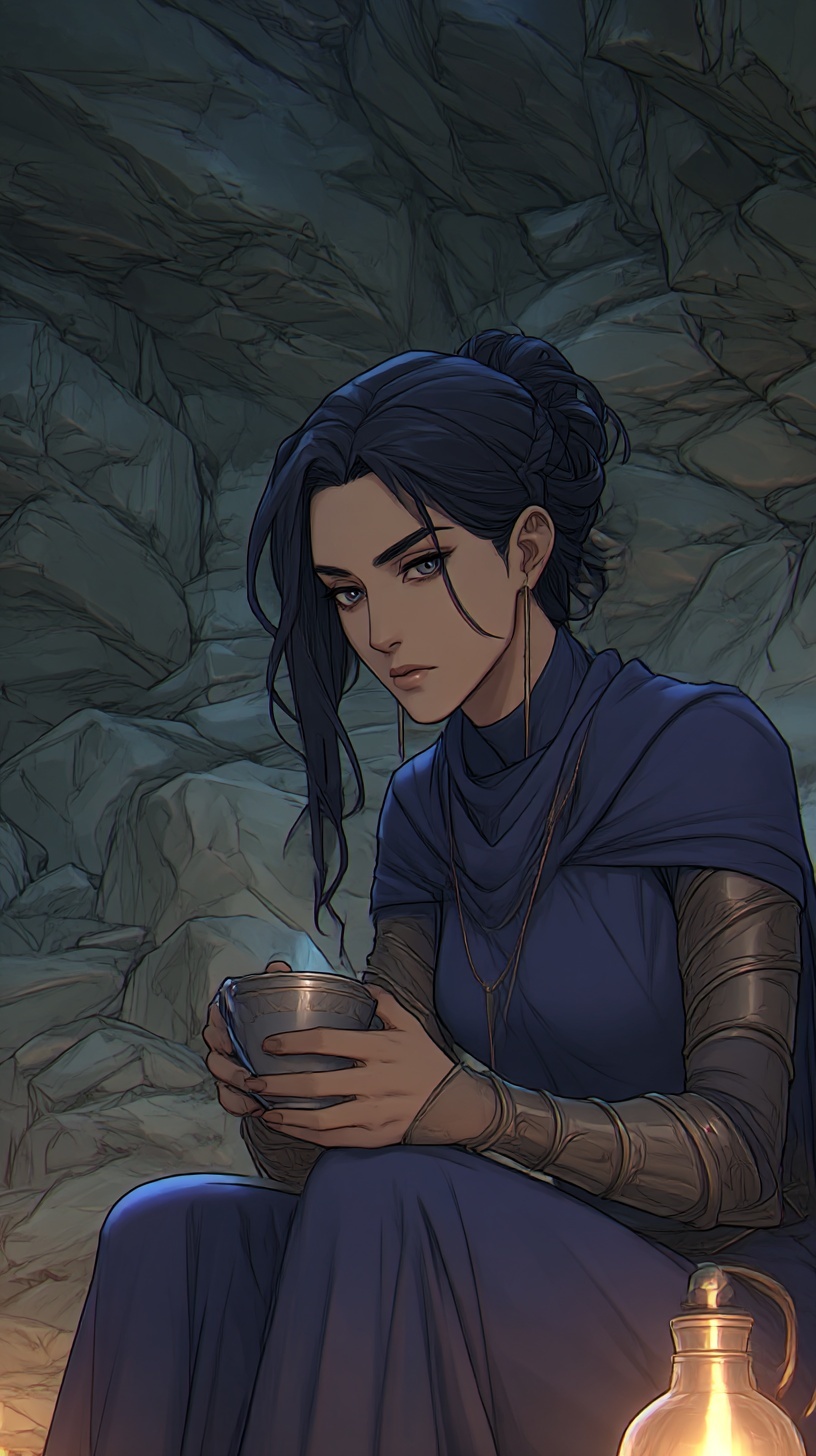
Cassandra enjoys anything that invites stillness without demanding silence. Tea is one of her greatest comforts, not for the drink itself but for the ritual surrounding it. She collects blends from every port she visits and treats each cup as a moment to breathe. Books give her the same solace. She gravitates toward rare volumes, old histories, peculiar travelogues, and stories with quiet emotional weight. Crafting small charms brings her a steady kind of joy. The act of carving stone or shaping metal lets her focus her mind and offer something meaningful to the people she loves. Markets delight her too. She loves the bargaining, the noise, the treasure hunting, and the challenge of spotting a hidden gem among clutter others overlook. She is happiest in spaces that feel orderly and lived in. Soft light, clean rooms, and familiar routines calm her. Domestic life, something she once believed she would never have, suits her gently. She likes mornings aboard the Stormrider when the children are half awake and Dartimen is pretending he is not, and she likes evenings spent talking with friends when the weight of her past work feels far away. Kindness from strangers, the laughter of children, warm food shared without ceremony, and small acts of generosity stir something tender in her. These simple pleasures remind her that the world is more than shadows and secrets. Her dislikes tend to spring from the things her old life taught her to fear. Loud noises unsettle her. Sudden shouts or clattering crashes make her brace for danger even when none is present. She despises being startled, not out of frailty but because her instincts respond far faster than her awareness. Disorganized spaces put her on edge as well. Clutter makes her feel as if she is losing control of her environment. She dislikes crowds when she is not working and attention when she has not chosen to invite it. Unwanted flirtation annoys her, not because she is shy, but because she values intention and respect. She holds a sharper dislike for arrogance and cruelty. Cassandra has seen how much damage people cause when they assume others exist for their use. Anyone who belittles women or underestimates them earns her coldest stare. She reacts badly to dismissive comments, backhanded assumptions, or attempts to question her capability. Abuse of the vulnerable triggers an even stronger reaction. She has very little patience for those who prey on the weak or the powerless. Her temper in these moments is quick, precise, and without warning. Some dislikes are softer and more personal. She cannot stand being alone for too long. Silence at night brings back the memory of a childhood spent in a castle where too many things went unspoken. She dislikes feeling shut out or uninformed when the people she loves are in danger. She dislikes the smell of burning tallow, the metallic tang of old blood, and certain lullabies that echo fragments of a life she never quite understood. These moments remind her of the years she spent trying to live inside the stories of others instead of her own.
Virtues & Personality perks
"She carved her own life from the ruins of mine. I watch her with her children, and I see a woman who learned to love without fear. If there is any redemption left for me, it is that she grew into something better than anything I had the right to expect."
Her strongest virtue is the steadiness of her compassion. She feels things deeply but moves through the world with a gentleness that never asks to be noticed. Even after centuries spent navigating danger and deceit, she treats people with patience and quiet respect. Children, the elderly, the frightened, the overlooked, the wounded hearts of strangers she will never meet again, all draw out the softest parts of her nature. Her kindness is not performative or strategic. It is instinctive. It guides her just as surely as her magic does and shapes the way she approaches every problem placed in front of her. She carries an unwavering sense of responsibility. Cassandra does not run from difficult choices, and she does not pretend not to see when something needs doing. If someone is hurt she goes to them. If something is broken she tries to mend it. If chaos threatens the people she loves she steps into its path without thinking twice. This sense of duty once chained her to a life she did not choose, yet it is also the foundation of her integrity. Even now, when she no longer answers to Corvyn or the mechanisms of the House Guard, she brings that same seriousness to her family and her small corner of the world. Her adaptability is another quiet strength. Cassandra adjusts to new environments, unfamiliar cultures, unexpected challenges, and shifting emotional landscapes with grace that rarely draws attention. Years of infiltration taught her how to blend, but her adaptability runs deeper than disguise. She listens. She watches. She changes her approach when circumstances require it. She can sit comfortably in a noble salon or laugh with dockworkers without altering who she is. This fluidity helps her navigate complex social worlds with minimal friction and allows her to offer comfort to others in precisely the way they need. Her emotional resilience is a perk most people never see clearly. Cassandra has endured abandonment, loss, impossible expectations, and the crushing loneliness of a childhood built from secrets, yet she remains open to love. She can be shy, anxious, uncertain, and still choose vulnerability. She can doubt herself and still act decisively when it matters. Her heart bruises easily but heals stronger each time, and that quiet courage is a trait far rarer than any magical ability. It is the reason she could walk away from Corvyn’s shadow and build a life defined by honesty rather than fear. She also possesses a talent for bringing out the best in others. Cassandra encourages without pressuring, supports without smothering, and notices strengths people overlook in themselves. Around her, tempers cool and arguments soften. She does not command peace. She cultivates it. This subtle charisma makes her an anchor for her family and a grounding presence among friends. Even Dartimen, whose life thrives on chaos, finds himself steadied by her without ever feeling restrained. Her virtues work quietly, shaping her world through warmth rather than dominance, and leave an impression far deeper than the reputation that once followed her through the shadows.
Vices & Personality flaws
"She forgives too easily. Doubts herself too quickly. Loves so fiercely she forgets she is allowed to rest. These are not weaknesses to me. They are the proof that she remained human in places where I have turned to stone."
Cassandra’s flaws grow from the same tender places that shape her strengths. Her shyness, endearing in calm moments, becomes a stumbling block when she must speak openly about her own needs or discomforts. She hesitates, withdraws, and tries to smooth the situation rather than assert herself. This habit leads her to carry more emotional weight than she should, quietly absorbing tension instead of confronting it. People often assume her silence means agreement when she is simply overwhelmed or afraid of disappointing someone she cares about. Self doubt clings to her in ways she has never fully learned to shake. Cassandra holds herself to impossible standards and treats every shortcoming as a personal failure. She overanalyzes conversations long after they end, worries she has said too much or too little, and assumes others are more capable even when she has demonstrably outperformed them. Praise embarrasses her, criticism wounds her more than she lets on, and mistakes linger in her mind far longer than they deserve. This internal pressure can erode her confidence at crucial moments if she is not consciously fighting it. Her aversion to chaos and loud disruption borders on reflexive panic. Sudden noises, abrupt changes of plan, or unexpected confrontations strike at her old operative instincts. She reacts before she thinks, sometimes sharply, sometimes with a slap delivered purely out of instinctive fear. These reactions embarrass her deeply and can make her seem brittle to those who do not understand the history behind them. Even in peaceful surroundings her body anticipates danger in every uncontrolled moment, and she spends more energy than she admits calming herself back to ease. Cassandra’s compassion sometimes cuts too deeply. She tries to understand motives that do not deserve understanding and offers grace to people who would never do the same for her. This makes her vulnerable to emotional manipulation, particularly from those with wounded pasts or tragic stories. She wants to believe the best, even when evidence points elsewhere. This softness leaves her prone to lingering guilt, misplaced responsibility, and a tendency to take on burdens that are not hers. Her empathy, left unchecked, can become a doorway others exploit. Abandonment has left a mark she rarely acknowledges aloud. Anson’s disappearance carved an ache that resurfaces whenever someone she loves withdraws or moves beyond her reach. She grows tense and quiet, watching for signs that history is repeating itself. The fear of being left behind makes her cling harder in subtle ways, checking in more often, hovering when she senses emotional distance, or bristling when she feels shut out. These reactions come from an old wound that never healed cleanly, and though she manages it with grace, it still shapes her behavior more than she wishes it did.
Social
Contacts & Relations
"Wherever she travels, people remember her. Not for the missions she completed or the secrets she uncovered, but for the way she treated them. Even those who crossed her speak her name with caution tempered by respect. Influence earned through kindness is influence far stronger than fear."
Cassandra maintains a network of connections that reflects every stage of her life, though few outside her closest circle ever glimpse its breadth. Her years in Areeott placed her in the company of nobles, merchants, scholars, diplomats, and operatives, many of whom still remember her as the quiet woman who saw everything and said very little. Some respect her. Some fear her. Some have no idea what she truly was. Even after leaving her father’s service she remains a familiar yet enigmatic presence in the kingdom’s upper tiers, someone whose opinion can shift a negotiation and whose silence can unsettle a room. Her ties to the Arin cantons run deeper than blood or politics. Cassandra’s long life and quiet curiosity led her to form lasting relationships with artisans, archivists, shepherd clans from the high passes, and the wandering storytellers who carry folklore across Areeott. These individuals trust her in ways they do not trust most nobles. She listens, remembers, and treats them with the same sincerity she offers her own family. Many of them still send her news, small gifts, or bits of local wisdom, not because she requests it but because she earned their affection through presence rather than authority. Cassandra’s past work left her with a number of uneasy affiliations. Criminals she once infiltrated or negotiated with recognize her on sight and respond with a mixture of respect and wariness. Some owe her favors they will never repay. Others avoid her entirely, remembering the quiet woman whose smile meant she already knew more than she should. She does not maintain these connections intentionally, but the underworld remembers her in its own way. Even now her name travels through whispered conversations whenever the Stormrider docks in places better left uncharted. Her most meaningful relationships outside her family belong to the crew of the Stormrider. Cassandra’s bond with them is grounded in shared hardship and shared choice rather than duty. They trust her not because she is formidable but because she is steady. She provides perspective when tensions flare, comfort when losses sting, and sharp insight when plans go sideways. Each member of the crew occupies a distinct place in her heart, from those who rely on her calm to those who tease her shyness with affectionate familiarity. They are an unconventional family, but to Cassandra they are a home she chose for herself. Areeott’s political world continues to pull at her through old obligations and lingering loyalty, though she keeps her distance. Officials who once relied on her discretion still send inquiries through carefully worded letters. Friends within the baronial courts seek her counsel when matters turn delicate. Even the few who suspect she left Corvyn’s shadow do not press her for details. Cassandra moves among these affiliations with careful grace, letting ties fade or strengthen as they deserve. She does not serve a throne anymore. She supports people, not power, and she keeps only the connections that allow her to live her life without returning to the darkness she stepped away from.

Family Ties
"She was born into a legacy of grief, yet she forged a family out of joy. When I watch her with her children, I see the life I once promised her mother. Cassandra kept that promise for me. I do not know how to tell her that."
Cassandra’s sense of family began as something fragile and undefined. She grew up in a household shaped by loss, bound to a father who carried centuries of sorrow and a brother who shared her strange, slow growing life. Corvyn was devoted but distant, powerful but wounded, and Cassandra learned to read his moods long before she understood their cause. Anson was her anchor. They were raised almost as two halves of the same soul, moving together through a world that made little sense to them. Those early ties shaped her understanding of love as something quiet, protective, and complicated. Her relationship with Corvyn has always been marked by a mixture of deep affection and deep fear. She loved him fiercely, wanted his approval, and tried for centuries to understand the emptiness she saw behind his eyes. Even after learning pieces of the truth about Andrielle’s death and the curse woven into their blood, Cassandra still felt the gulf between them widen. She knew he cared for her, yet his grief overshadowed every attempt at closeness. Leaving him was one of the most painful choices she ever made, but even then she never stopped loving the father he once was and the man she hoped he could become. Anson’s disappearance left a wound that shaped Cassandra’s heart for decades. They had been inseparable, bound by their shared upbringing and the strange rhythm of their extended childhood. When he walked away without goodbye, she felt abandoned in a way nothing in her training had prepared her for. Their reconciliation in later years restored the bond but did not erase the ache. Even now she watches him with the eyes of someone who knows what it feels like to lose him once and fears what it would be to lose him again. Their connection remains one of the most important parts of her life, defined by love, grief, and the long work of healing. Her life with Dartimen brought her a new kind of family, one built not on inheritance or duty but on choice. Their partnership grew out of mutual understanding, shared humor, and the rare ability to see through one another’s defenses. With him she found the warmth she lacked as a child and the freedom to grow into someone more than a tool shaped by her father’s past. Their marriage gave her a sense of belonging she had never known. Dartimen became her equal, her partner in chaos and calm, and the first person who taught her that the future did not have to echo the past.
Social Aptitude
"When she speaks softly, people listen. When she chooses silence, they listen harder. She has her mother’s ability to steady a room without ever raising her voice. I have ruled courts and armies, yet she commands hearts with a single quiet word."
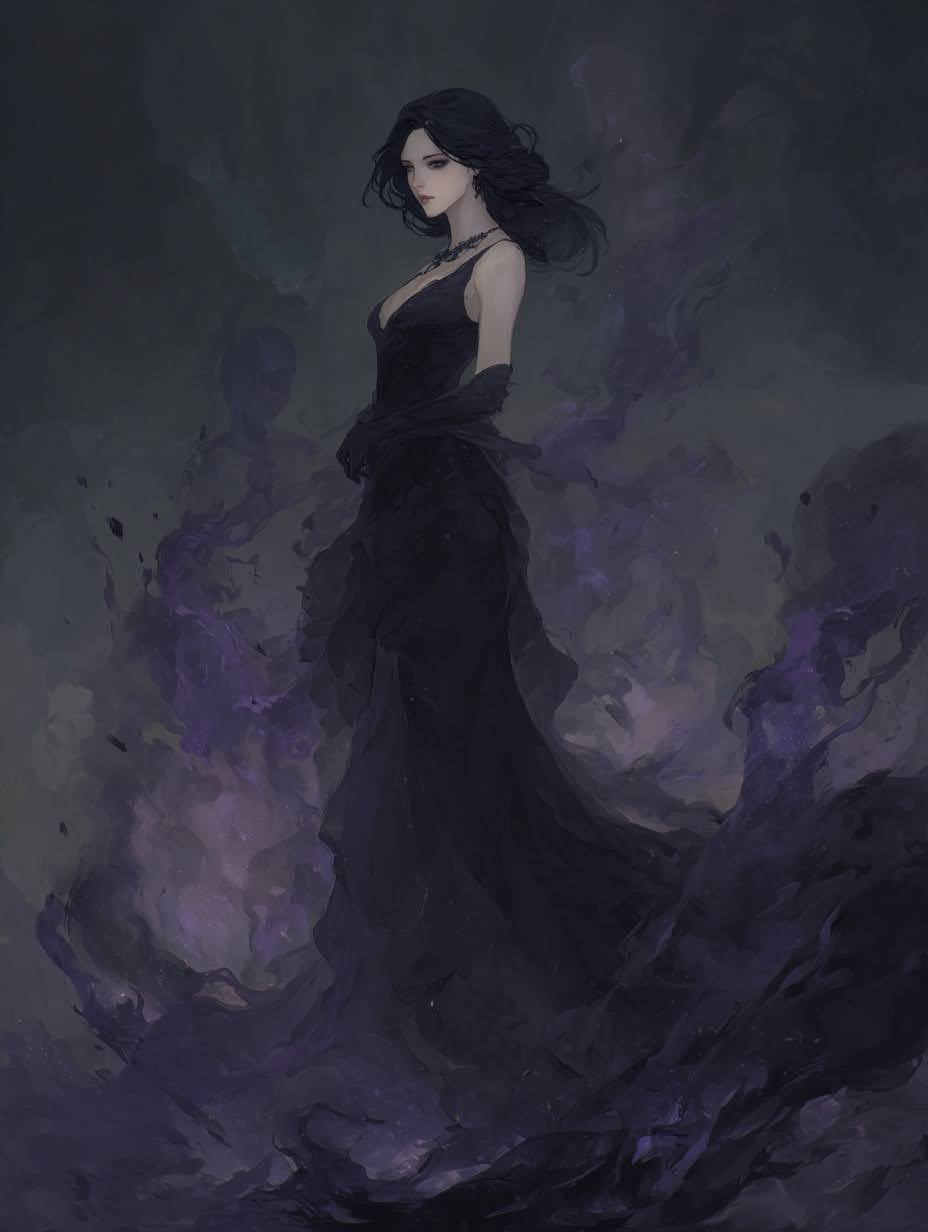
Cassandra Silvernight’s social presence is a study in contrasts. She enters a room with a natural grace that draws the eye, yet the moment someone looks directly at her she often retreats into a quiet, polite shyness. People tend to project confidence onto her because of her beauty and composure, but beneath that surface she is far more introspective than she appears. Her manner is gentle, her voice soft, and her expressions subtle, which makes others lean in rather than step back. Even when she says little, she creates the sense that she is fully engaged, listening with an attentiveness that makes people feel seen. Her observational skill gives her a strong advantage in social spaces. Cassandra notices details others miss, the small hesitations that reveal discomfort, the tone shifts that signal dishonesty, the posture changes that betray anxiety or pride. She adjusts her approach accordingly, offering reassurance to the uneasy and firm boundaries to the overconfident. This gives her an air of natural diplomacy. She rarely forces conversations to move her way. She guides them with gentle nudges, knowing exactly when to speak and when silence will say more. Her restraint reads as poise rather than uncertainty, and most people walk away believing she handled the encounter effortlessly. Informal settings bring out a different side of her. Once she feels safe she becomes warm, witty, and quietly playful. She enjoys dry comments delivered with perfect timing, little observations that make others laugh, and the kind of humor that slips out before she realizes she has said anything at all. Her friends know that beneath the calm exterior is someone who genuinely enjoys good company. She is affectionate in subtle ways, adjusting someone’s collar, brushing lint from a sleeve, or offering a charm she carved without ceremony. These small gestures speak louder than grand displays would. Social conflict is more difficult for her. Cassandra avoids raising her voice and dislikes confrontations that escalate without purpose. When challenged unfairly she goes still rather than loud, and her silence can be far more unnerving than anger. She does not argue unless pushed, but when someone crosses a moral line she stops yielding entirely. In these rare moments her composure becomes sharp rather than soft, and the quiet authority in her posture reminds others that she is not someone to be underestimated. Even then she chooses precision over aggression, correcting behavior without humiliating the person in front of her. In trusted circles she shines brightest. Cassandra thrives in environments where sincerity outweighs performance. Around the crew of the Stormrider or with her family she relaxes into full warmth, laughs freely, and lets her shyness soften rather than restrict her. She listens deeply, offers advice without judgment, and treats every person’s perspective with respect. Her social aptitude is not about dominating a space. It is about shaping it gently, creating room for others to be comfortable. Even after centuries lived in shadows, she remains a woman who prefers closeness over spectacle and connection over attention.
Speech
"She speaks softly, yet her words strike with precision. She has that rare gift her mother possessed. The right phrase, at the right moment, delivered with such calm that even the fool who hears it mistakes the mercy for gentleness."
Cassandra speaks with a softness that often surprises people who judged her by her poise or her reputation. Her voice carries a warm, velvety quality, low enough to feel intimate without ever sounding forced. She chooses her words carefully, shaping each sentence with the precision of someone who spent centuries learning that careless speech can unravel entire plans. Even when nervous she keeps her tone even and gentle, though the faint tremor that slips in gives her away to anyone paying attention. Her shyness colors her cadence, lending her a quiet charm that lingers after she stops speaking. Her manner of speaking shifts subtly depending on the company she keeps. In formal or unfamiliar settings she becomes measured and controlled. Every phrase is concise. Every inflection intentional. She avoids flamboyance and favors clarity, giving the impression that she values meaning over performance. Listeners often describe her speech as soothing even when she is delivering sharp insight. She does not rely on volume to command attention. Her calm delivery compels others to focus, pulling them into the rhythm of her thoughts rather than overwhelming them with force. In comfortable company her voice loosens and warms. She speaks more quickly when excited, laughs with her whole breath when something catches her off guard, and occasionally blurts out observant or witty comments before realizing she has said them aloud. These unguarded moments reveal the playful woman beneath the practiced composure. She hums absently while she works, recites little rhymes without thinking, and slips into affectionate teasing when she feels safe. The people closest to her hear shades of emotion in her voice that strangers never will. When dealing with confrontation she rarely raises her voice. Cassandra’s displeasure reveals itself in the stillness of her tone rather than its height. Her words become sharper at the edges, not harsh but unmistakably firm. She speaks slowly, as though measuring each syllable to ensure it carries exactly the weight she intends. This quiet sharpness can freeze a room. Even people who underestimate her quickly learn that a soft voiced warning from Cassandra carries more authority than a shouted order from most others. Her linguistic aptitude extends beyond tone and cadence. She speaks multiple languages with ease, mimics accents when necessary, and adjusts her vocabulary to match her surroundings. Whether she is negotiating in a merchant’s stall, soothing a frightened villager, or conversing with scholars, she adapts her speech without losing her own voice. She communicates with kindness, intention, and a sincerity that leaves a lasting impression. Even in silence her presence communicates volumes, but when she chooses to speak, her words land with the quiet precision of someone who understands exactly how powerful they can be.
Relationships
"If the world ever truly saw Cassandra as she is, they would mistake her for something fragile. They would not understand that gentleness is a strength born only of those who have survived what should have broken them. She is proof that power need not roar to be undeniable."
The Left Hand
The Voice
The Constant


Absolutely brilliant article. Quite possibly one of my favourite character articles to date. Note: You might want to realign or change the width of some of your images so the text either does not wrap or wraps and has a bit more space to breath.
World Anvil Founder & Chief Grease Monkey
Join the Solspire Chronicles Adventure!
“No act of kindness, no matter how small, is ever wasted.”
- Aesop
Thank you so much! I'm still kind of learning the formatting, and text wrapping on the platform so at some point, all of my articles are going to get the formatting revamp.