

Echani ([ɛˑʃɑˑniˑ])
This article is for the Echani species. For the Eshani ethnicity, click here.
The Echani are a species that have diverged into six ethnicities. Though they share many common aspects, please refer to each ethnicity for specifics regarding their culture, history, ideals, etc.
Basic Information
Anatomy
Their build is athletic and lean, reflecting a body built for speed and precision rather than brute force.
They have four limbs—two arms and two legs—that are proportionally long and slender. Their limb bones are also denser than average, adding durability to withstand high-intensity martial arts and other physical demands.
Echani muscles are sinewy and dense, optimized for rapid movement and explosive power. Their muscle fibres contain a unique cellular composition that provides endurance and quick recovery, which are beneficial for sustained battles in colder temperatures. This musculature also allows them to produce bursts of speed and agile movements necessary for their combat style.
The bones of an Echani are slightly thicker and more resilient than many similar humanoids, with a high mineral content that gives them an added layer of strength. Echani joints, especially in the shoulders and hips, are also more flexible, allowing a more comprehensive range of movement.
After thousands of years of evolution, the Echani circulatory system is adapted to their planet's specific climate. For example, on the colder planets of the system, hemocyanins transport oxygen throughout their bloodstream rather than haemoglobin. Oxygenation of Echani blood causes a colour change between the colourless deoxygenated form and the blue oxygenated form. This blood type was inherited from the Arkanians and, historically, served as extra-cellular protection against the cold.
Genetics and Reproduction
Echani reproductive systems are more robust than many humanoids, as most are meant to carry children to term in harsher weather. Echani gestation periods are also a little quicker than most mammals, typically lasting between 7 and 8 months, to more quickly expose offspring to the climate.
As a result of genetic manipulation by the Arkanians, who valued perfection above all, Echani were made to be cut-and-paste versions of one person. Over the millennia, siblings remained almost indistinguishable from each other. They often appeared exactly the same to outsiders, even across gender lines, and all children very closely resembled their parents. Twins were a common occurrence in Echani families, and they were regularly identical and challenging to identify even by their parents.
Growth Rate & Stages
Echani infants develop fine motor skills with extreme rapidity. They can grasp, balance, crawl as early as three months, and begin walking by 6 to 8 months of age. At their first birthdays, toddlers can maintain their balance, coordinate their movements, and begin basic exercises resembling combat stances.
By age 2, Echani children show coordinated and agile movements. They're introduced to basic martial drills by age 3, focusing on foundational postures and controlled body movements. About one year later, at 4, young Echani can engage in rudimentary sparring sessions, usually among friends or classmates. Their emotional intelligence progresses quickly, too, in order to manage the social subtleties that combat demands.
5-year-old Echani display a tactical understanding of fighting, enabling them to start using combat as a means of expression, though at a more uncomplicated stage than adults. By age 6 or 7, they're expected to have sufficient skill to engage in full sparring matches under adult supervision.
Echani children reach a high level of physical competency by age 8, demonstrating a capacity to communicate their emotions and intentions through fighting. They can match strength and reflexes with adults at this point, too, although in controlled settings.
By age 10, Echani pre-teens have the cultural standing of adults. They are capable and expected to engage in more complex combat forms and social exchanges without the protective oversight often required by human children.
Young teens approach physical and cognitive adulthood much earlier than humans. By ages 12 to 14, they reach their full physical strength, stamina and agility, making them equal to adult fighters. By this stage, they've honed not only their combat skills but also their intuitive ability to understand opponents' moves and express their own emotions through fighting.
Ecology and Habitats
The ideal climate for the Echani species aligns with their origins on Arkania: cold, snowy, and temperate environments. They thrive in regions with subzero temperatures, minimal humidity, and consistent snowfall, and their physiology is best suited to high-altitude, mountainous terrain or tundra-like conditions.
Initially bred for extreme cold, the Echani have not evolved significantly enough in just 12,000 years to thrive on planets that do not feature a cool or cold climate. Exceptions like Thyrsians persist due to extended isolation and genetic mutation. In general, only some biological changes occurred, such as slight shifts in melanin levels, body shapes, or sweat glands.
How the Echani Adapted
Technological Solutions
The Echani wear temperature-regulating garments woven with materials that provide insulation against heat while maintaining comfort in harsher climates.
Wearable cooling devices or small, portable units are standard for those living on warmer planets.
Cities and settlements are equipped with systems that regulate internal temperatures, such as reflective or heat-resistant materials and underground structures for natural cooling.
Cultural Practices
In hotter climates, the Echani incorporate water preservation and hydration rituals into their daily lives, reflecting their adaptation to scarce water resources.
Combat is central to Echani identity, so their movements reflect adaptations to heat, with slower, energy-conserving forms of combat emerging on warmer planets.
Physiological Adaptations
On hot planets, Echani physiology includes more efficient cooling mechanisms, such as enhanced sweat evaporation.
Their pale, reflective skin and silvery hair, initially adapted for snowy environments, also reduce heat absorption in desert or jungle environments.
Dietary Needs and Habits
The Echani who live in arctic or subarctic climates focus their diet on foods that are preserved or locally grown in cold-hardy varieties. Meat, fish, and nutrient-rich grains are also staples in their diet. The Echani are also known for curing and fermenting foods, which complement their preference for meals that require minimal cooking effort but still support physical endurance.
- Proteins
- Fish and game were the primary sources of protein, often prepared with minimal spices but cooked to retain their natural flavours and nutrients. Fermented fish is also common.
- Grains
- Besides seed bread, dense flatbreads made from locally grown grains are standard.
- Fermented & Pickled Foods
- Due to their long shelf life, fermented or pickled vegetables and fish are common in Eshani meals, enhancing both flavour and nutritional value as well as adding acidity and balance to richer dishes.
- Vegetables & Foraged Foods
- Hardy root vegetables, winter greens and wild mushrooms are staples. On warmer planets, berry foraging is more common, with roseberries being the more abundant. These berries are usually preserved for year-round use.
- Herbal Teas
- Since alcohol is rare and often used for specific rituals, herbal teas are popular among the Eshani. They're typically made with local herbs for warmth and energy, and served at gatherings for comfort or health benefits.
Biological Cycle
After freeing themselves from the Arkanians, the Echani had to adapt to the harsh conditions of the Six Sisters once they landed.
They developed a natural form of cold resistance, allowing their bodies to conserve heat more effectively. Their circulation system is designed to distribute warmth evenly, reducing the risk of frostbite in extreme conditions. Food consumption also increases to fuel and maintain this warmth, with heavier, nutrient-rich meals becoming necessary.
Behaviour
INTRASPECIES BEHAVIOUR
While variations existed across the Six Sisters, Echani culture prized combat as both a form of communication and a method to express respect. Conflict, whether verbal or physical, is seen as a constructive interaction where individuals get to understand one another and build trust.
Echani are known for their calm and collected demeanours, as they prefer to convey their emotions through body language, physical touch and martial arts rather than words. These connections make them highly loyal and protective of their kin, cities, and values. The Echani place a strong emphasis on shared strength and self-sufficiency, as well, but always band together to defend their people in times of need.
BEHAVIOUR TOWARDS ENEMIES
Instead of engaging in every threat directly, Echani tend to track and monitor enemies or threats in their regions, observing their patterns to avoid unnecessary conflict while putting themselves in a position to be several steps ahead if the need for confrontation arrived.
Despite being combat-forward amongst themselves, the Echani's isolationist tendencies make them non-provocative with others, respecting enemies' boundaries to avoid conflict. They are, however, quick to respond with controlled, decisive action if threatened, using calculated force to ward off or eliminate danger to their system.
VIEWS ON OTHER SPECIES
The Echani have a quiet and observant interest towards other species that approach their system but have no explicit attachment to them. They take interest, however, in individuals and groups who demonstrate similar values and principles of resilience, skill or discipline, viewing them with an almost instinctual respect.
With societies beyond the Six Sisters, Echani prefers neutrality and, more so, isolation. However, they are known to enter alliances if they require something and must establish external trade relations to obtain it.
RELATIONSHIP WITH PREDATORY ANIMALS
Many Echani mythologies personify the predatory creatures that live on the Six Sisters as envoys of Kanir's choosing. They view their altercations with these predatory species as tests of strength, resilience, and tactical thinking, and attribute the proper amount of respect to them. When prevailing in these altercations, prayers to Kanir are said over the animals, as it was believed that Kanir herself sent the animal to test the Echani's strength.
These animals do not go to waste, either, and while many parts of them are displayed as trophies, most are shared amongst family members during large celebratory feasts or preserved for later consumption.
RELATIONSHIP WITH PREY ANIMALS
The Echani hold a respect for natural balance, and their hunting practises are typically focused on sustainability. They avoid overhunting to ensure resource stability, taking only what's necessary to support their needs.
As with predatory animals, Echani treat prey animals with respect and reverence. Hunting success is shared communally, and specific animals hold symbolic importance in traditional celebrations.
Additional Information
Social Structure
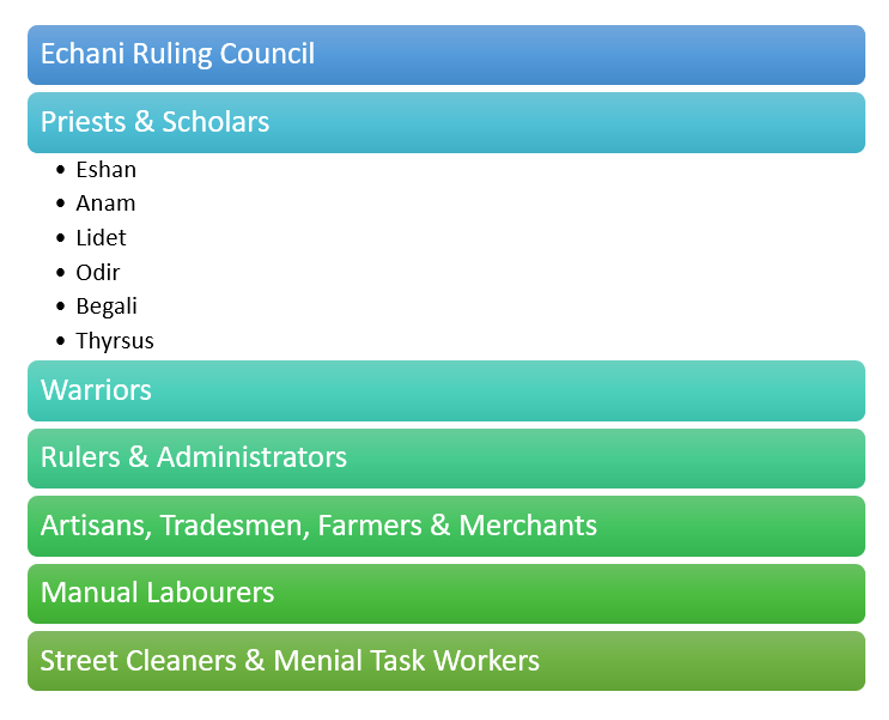
The Echani were a matriarchal caste-based society governed by the all-female ruling council of the Echani Command. The Ruling council was at the top of the caste system and the rest of the system was organised by the planet and then by social position.
Eshan is at the top of the caste system because it's from there that the Echani Command ruled. Anam, Lidet, Odir and Begali came in second, third, fourth and fifth respectively because of the number of warriors present on the planet. Thyrsus was of the lowest caste because they differed so much from the rest of the Echani and the ruling council viewed them as inferior despite having a formidable amount of warriors.
Priests and scholars were above warriors because the Echani believed that it was from their Lunar God that they received their natural gifts of combat and that it was the scholars who were meant to pass them down through the generations. In reality, it was parents and siblings who taught each other to fight in the warrior caste, which was why the general population respected them more than the priests and scholars. Rulers and administrators worked for the Echani Command and took care of the provinces on each planet. They were below the warrior caste as they only ruled over the general population whereas the warrior caste took orders directly from the ruling council. Artisans, tradesmen, farmers and merchants were above manual labourers but were generally regarded in the same manner amongst the general population. The only true difference was that certain taxes only applied to one or the other. Finally, those who performed menial tasks such as street sweeping were at the bottom of the caste.
Unlike most caste systems, one was not bound to their social position because of their birth. However, one could not be free of their planetary caste position. Thus, while you could go from tradesman to scholar without prejudice, if you were born on Begali, you could not be considered "as good" a scholar as if you were born on Eshan.
Facial characteristics
Echani facial features are sharp and angular, with high cheekbones and well-defined jawlines. Their eyes are typically almond-shaped, with a silver hue.
Geographic Origin and Distribution
The Echani are found almost exclusively on the Six Sisters. Those outside of these six planets are typically either exiled, Jedi, pirates, or bounty hunters.
Average Intelligence
Echani intelligence is highly practical, focusing of tactical acumen, environmental awareness, and social understanding. They excel in spatial and strategic thinking, allowing them to easily adapt in combat and adverse situations.
Echani also have a strong emotional intelligence. They read people through microexpressions, subtle body language, and physical touch to reinforce social standing.
Perception and Sensory Capabilities
Echani possess an inner ear structure that provides them with heightened balance and coordination.
As a genetically engineered species by Arkanian scientists millennia ago, the Echani possess a uniquely heightened midi-chlorian count—this was initially designed to create powerful but disposable soldiers. Unfortunately for the Arkanians, this elevated midi-chlorian concentration did nothing for their soldiers except precipitate their rebellion. However, over time, thismutation has resulted in an ability that has become an integral part of Echani culture: communication through physical touch.
When two Echani make contact, particularly in combat or through close interaction, the midi-chlorians within their blood effectively "connect" and "communicate," allowing emotions, intentions, and even memories to be shared between them. This bonding grants the Echani with a profound understanding of one another and enhances their empathy, intuition, and rapport.
The Echani attribute this ability to their Goddess, Kanir, believing her blessing flows within their blood. When an Echani is born with an exceptionally high concentration of midi-chlorians, they are known as "Kanir’s Chosen." This is seen as a divine sign that the individual is destined for greatness or a higher purpose within and beyond Echani society.
Civilization and Culture
Major Language Groups and Dialects
ESHAN
As the political and cultural heart of the Echani, Eshan’s dialect is the “Standard Echani” and holds the most prestige. It is refined and precise, distinguished by soft, clear enunciation and even pacing. Consonant pronunciation is crisp, and vowels are slightly elongated.
ANAM
Anam’s dialect is similar to Eshan’s standard but softer and less formal. The accent is marked by a slightly nasal quality and a gentle rising at the end of phrases.
LIDET
Lidet’s dialect has a smooth cadence. It features open, rounded vowel sounds, with a subtle pitch fluctuation in each sentence that gives it a rhythmic quality.
ODIR
The Odiri’s speech is known for its efficiency and lack of embellishment. It is concise and slightly guttural, with words clipped and vowels shortened.
BEGALI
Begali’s accent is rhythmic and expressive. They favour a wide range of intonations, from musical and poetic to subtly sarcastic. Pronunciation is fluid, and syllables often blend together, especially in the lower castes.
THYRSUS
Thyrsian accents are bold, assertive, and straightforward. They tend to emphasise consonants, especially plosive sounds, lending their speech a staccato quality. They also favour a firm tone and strong enunciation, which often makes them seem abrupt.
Common Customs, Traditions and Rituals
Major life events, rites of passage, and personal growth are marked by tattoos across the Eshani’s faces, making them a living testament to their life’s journey. Each tattoo design has a particular name and associated folk figure, representing anything from one’s entry into the warrior caste, promotions in rank, and family lineage, to memorials for lost loved ones.
History
The Echani began as a genetically engineered offshoot of the Arkanian species in the year 12 358 BBY. Created by Arkanian scientists, the Echani were conceived to become highly adaptive and combat-ready versions of the Arkanians to be sent off to war instead of themselves. As such, strict control was maintained over their creations, treating them as disposable and less than subordinates.
As the Echani's self-awareness and sense of identity and individuality grew, so did their resentment of Arkanian rule. Over time, the Echani organised an independence movement, sparking a long, brutal conflict against their creators between 12 294 BBY and 12 273 BBY. Armed with martial skills and driven by an unshakable desire for freedom, the Echani leveraged their Arkanian-given abilities to outmanoeuvre their rulers and obtain independence. However, rather than remain under Arkanian watch, they chose to depart and seek a new beginning far from their origins.
The Echani eventually settled within the Six Sisters. First, they populated Eshan and, in the challenging subarctic and arctic conditions, developed a culture centred around the combat that had set them free—their ability to communicate through combat was then later believed to be a gift from the Lunar Goddess Kanir and became a core aspect of their identity.
This period saw the rise of the Echani Command, a unifying body that upheld the Echani's martial heritage and managed the governance of the Six Sisters. The Command enforced traditional values, revering their warriors and creating a structured caste system that rewarded each Echani for their respective contributions to society.
The Echani evolved as a fiercely protective and insular society, valuing their hard-won freedom. The rigid structures of the Echani Command and their isolationist stance fueled lasting rivalries with those living outside of Eshan and on the other Six Sisters, particularly with the Thyrsians, who had distinctly evolved away from the main branch of the species.
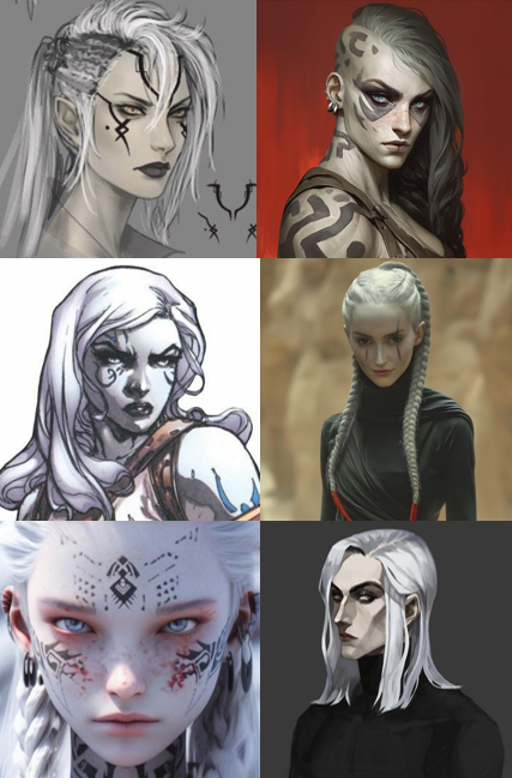
Their build is athletic and lean, reflecting a body built for speed and precision rather than brute force.
Pale, almost white skin; White hair; Facial tattoos

Comments