

Eshani ([ɛˑsʃɑˑniˑ])
This article is for the Eshani ethnicity. For the Echani species, click here.
Naming Traditions
Family names
Eshani last names were passed down from mother to daughter and from father to son in order to maintain both the mother's and the father's bloodline.
Women's last names were a combination of their mother's first name with the suffix "-na" added to the end, and men's names were a combination of their father's first name with the suffix "-de" added to the end.
Certain exceptions could be made in the event a child was cared for and raised by a single parent or in the case of adoption:
In the case of single-parent living, if a daughter was raised solely by a male parent, she would take on his name with the feminine "-na" suffix. If a son was raised solely by a female parent, he would take her name with the masculine "-de" suffix.
If a child was adopted, the child would keep their biological parent's name, should it be known, and add on the appropriate adoptive parent's name. This would result in double-barrel last names where the biological parent's name would come first and the adoptive parent's name, second. In the event that the biological parent's name is not known, only the adoptive parents' name would be used.
Other names
Children were often named after deceased ancestors. Names of deities could be a part of the name, as well. People thought certain traits were connected to certain names and that these traits were carried on when the names were re-used by new generations. This was part of ancestor worship.
Culture
Major language groups and dialects
As the political and cultural heart of the Echani, Eshan’s dialect is the “Standard Echani” and holds the most prestige. It is refined and precise, distinguished by soft, clear enunciation and even pacing. Consonant pronunciation is crisp, and vowels are slightly elongated.
ACCENTS & DIALECTS ACROSS CASTES
- Ruling Council
- Across all planets, the Ruling Council members' speech remains dignified, polished and restrained. Each planet's Council incorporates their local flavour, but it maintains a more formal diction.
- Scholars & Religious Figures
- Members of this caste speak with careful intonation that varies by planet. Those on Eshan and Lidet favour softer and more melodic speech, while those on Thyrsus and Begali incorporate stronger, more assertive undertones.
- Warriors
- Eshani warriors generally share a slightly more clipped and purposeful tone across planets. Warriors on Thyrsus and Begali are particularly bold and sharp in their approach, while those on Eshan and Odir are far more restrained in this aspect.
- Lower Castes
- Labourers, tradespeople and artisans typically speak with a more relaxed and colloquial tone.
Culture and cultural heritage
Though unaware of their origins as a genetically modified species, the Eshani display traits of a deliberate genetic design, such as their remarkable physical conditions, combat abilities, and the increased amounts of midi-chlorians in their blood. The Eshani perceive these attributes to be natural abilities rather than scientific modifications, especially their ability to communicate through combat.
In their society, the Eshani's focus on physical prowess and tradition-driven rituals reflects a dedication to forging new customs. However, remnants of their engineered origins appear in their organised caste system, their value for intellectual pursuits, and their love for precision and order—all faint echoes of their Arkanian ancestors' structured, scientific values.
The caste system, while adapted to fit Eshani philosophies of merit and discipline, still indirectly embodies Arkanian society, which is known for dividing labour and societal roles with a rigorous sense of purpose and hierarchy. The warriors' preference for elegance in combat and attire stems from a subconscious inclination for Arkanian ideals of refined control and physical perfection. The Eshani's ritualised combat and habit of analysing an opponent's fighting style is also a hint towards structured observation, an approach embedded in Arkanian scientific philosophy.
Despite this, the Eshani interpretation of all this is spiritual rather than analytical, attributing all of their abilities to Kanir rather than seeing them as inherited techniques and vestiges of their descendance from genetically modified Arkanians.
Shared customary codes and values
The Six Sisters often differ in cultural nuances, but they uphold a core set of values and customary codes that bond their society together (for the most part):
- Combat Communication
- Across all six planets, martial skill is revered as a means of self-defence and a form of expression. Combat training is a lifelong journey, considered essential for all Eshani, regardless of gender or class.
- Loyalty & Unity
- While each planet has its perspective on the Echani Command, loyalty to the Eshani as a collective identity is a value ingrained in all levels of society. As such, criticism of the Command is tolerated, but not when it compromises collective Eshani unity. All Six Sisters share pride in their unique culture, which they go to great lengths to preserve against outside influences.
- Family Lineage & Honour
- Honour to family and lineage is paramount. Eshani are highly aware of their ancestors and the legacy they carry, taking pride in past achievements and striving to maintain family honour.
- Commitment to Skill & Discipline
- Eshani society upholds skill and discipline as core principles, valuing excellence in all pursuits, from combat to arts to craftsmanship. It’s customary to choose a skill or craft to master, as Eshani believe that dedication in any field strengthens the spirit. From the warrior caste to artisans, everyone is expected to work towards mastery.
- Adherence to the Caste System
- The caste system is regarded as a natural order, with each caste carrying specific duties and responsibilities that were vital to society. As such, respect is shown to all castes, and crossing caste boundaries disrespectfully or undermining another caste’s duties is seen as dishonourable.
Average technological level
The Eshani's technology evolved alongside their culture.
As a race of warriors, their ability to craft high-quality weapons has advanced to the point where Eshani blades are known across the galaxy. This feat was made difficult due to the nature of the weapons' construction, as cortosis is difficultly weaved into the metals used to make them.
Furthermore, while their medical knowledge may seem primitive to outsiders, it suits their needs and is rather advanced for a species with their type of culture. Medicinal herbs and homoeopathic remedies are the norms, but they are well-versed in various types of complex surgeries and diseases that come with the warrior lifestyle and the associated injuries.
Since the Echani population is spread out on six planets, the Eshani have the capability for space travel, although most choose not to venture far from their system.
Common Dress code
CEREMONIAL ATTIRE
- Tailored Kirtles & Pinafores
- Ceremonial attire typically begins with a close-fitted kirtle or a similar underlayer that clings to the body. Over this, a finely embroidered pinafore is worn, its straps held by silver or jewelled brooches. The brooches often incorporate family emblems, religious symbols, or personal insignias. The kirtles are often in neutral colours like silver, grey or white, meant to echo Eshan’s natural landscapes.
- Geometric Patterned Belts
- The belts are intricate and purposefully placed. Unlike the wide, twist-around belts of ancient wear, modern belts are narrower and decorated with geometric embroidery or metallic accents.
- Layered, Jewel-Adorned Cloaks
- A defining feature of ceremonial wear is the heavy, floor-length cloak, often in darker hues like navy, charcoal, or even deep purples, fastened at the shoulders with ornate clasps. Although long, these cloaks are made from lightweight, high-quality materials, allowing them to flow and create a striking silhouette. They’re designed to be removed if necessary for movement, making them an optional adornment in high-action rituals.
- Bracelet & Arm Adornments
- Arm adornments are less about sleeve management and more about decoration and symbolism. Wide leather or fabric bands with etched metalwork are wrapped around the forearms. These bands may include coloured beads or minor inscriptions specifically designed to honour the wearer’s heritage or specific achievements.
- Simple Yet Elegant Jewelry
- Jewellery is always understated. Earrings or hair ornaments are only worn occasionally, and the pieces are usually silver and set with stones like nunsteyn, lanthanide and mytag.
- Subtle Footwear or Sandals
- Eshani avoid complex shoes, and ceremonial footwear generally includes soft sandals or simple slippers.
EVERYDAY ATTIRE
For daily life, Eshani favour clothing that allows for efficiency and ease of movement. Unlike ceremonial attire, everyday wear is practical, versatile, and easily adjusted for casual and active situations.
- Form-Fitting Tunics & Trousers
- Tunics are close-fitted and made with slightly stretchy materials that allow for unrestricted movement. These typically come in neutral tones—white, pale grey, or light blue—and include minimalistic collars or trim around the neckline and sleeves. Trousers are lightweight and flexible, fitting closely around the waist and ankles but providing enough stretch for agility. Many include reinforced stitching along high-stress areas to ensure durability.
- Sashes & Waistbands
- Sashes or fabric waistbands are still common, especially for those in the warrior caste. These sashes are practical, used to store small weapons or tools, and are designed for quick adjustment. They are usually made in solid colours and occasionally embroidered along the edges with geometric designs.
- Layered, Lightweight Wraps or Vests
- Instead of cloaks, Eshani wear thin wraps or vests daily. These garments are ideal for changes in weather or activities and can be removed or adjusted easily.
- Minimalist Jewelry or Arm Cuffs
- Jewelry is less common in day-to-day Eshani life, though some may wear a single bracelet, cuff, or small pendant to symbolize family or personal beliefs.
- Functional Footwear or Bare Feet
- Shoes in Eshani day-to-day life are optional, with many opting to go barefoot for greater sensory connection with their environment. When footwear is necessary, they choose sandals or minimalist shoes with thin soles.
- Adaptable Hair Accessories
- Eshani with long hair often use bands or clips to manage it, typically in the same silver or pale tones as their clothing.
Art & Architecture
ART CULTURE
The Eshani's emphasis on body language and combat as a form of communication extends into their art, where movement is captured and celebrated. As such, sculptures, murals, and paintings often depict warriors in fluid combat stances or sequences of motion that convey emotion and storytelling behind them or the artist.
Their art incorporates flowing, organic geometric patterns that symbolise interconnectedness, the flow of energy (both in combat and the Force), and the cycles of life and death. These designs are found on everything from buildings to personal weapons, armour, and clothing. Engravings on these items can also commemorate victories or significant events in an Eshani's life, similar to their facial tattoo traditions.
As the Eshani have a complex relationship with both light and dark in a philosophical sense, their artwork often uses contrasting light and shadow to emphasise dualities. This can be done using glowing, bioluminescent materials or creating art pieces that change appearance based on the viewer’s angle or lighting.
Given their rather practical nature, much of their art has a dual purpose. Armour and weapons, for instance, not only serve practical purposes but are also considered masterpieces in their own right. Their architecture, too, is as functional as it is beautiful, with temples, homes, and public spaces designed with their martial lifestyle and their subarctic climate in mind.
MUSIC CULTURE
While most cultures view music as a form of shared connection and a way to express emotions, the Eshani collective views it as a redundant and impersonal means of connection. Music features in ceremony alone, typically as a means to accentuate a reenactment, accompany a sermon or lead a march or procession. Of course, exceptions apply, and some families or individuals listen to music simply for enjoyment. As a general rule, however, most Eshani who listen to music on their own listen to the rhythms that accompany their traditions.
When played, Eshani music is percussive, as it typically mirrors the coordinated movements of combat during reenactment or the marching of feet during a procession. Drums, chimes, and other percussive instruments set the pace for stylised reenacted combat and the tone for sermons during religious ceremonies. The rhythmic complexity mirrors the subtlety and complexity of Eshani combat styles and methods of communication, with shifts in tempo attempting to reflect moments of calm, tension, and release.
Vocal music doesn't play much of a role in Eshani music. Chants and synchronised shouts, however, are sometimes used to emphasise the percussion instruments or mimic battle cries or the howling of wolves.
Eshani duels are sometimes accompanied by instrumental music, which heightens the emotional implications and intensity of the confrontation, though this is rare. Strings or wind instruments are used during more meditative or reflective moments of combat, while heavy percussion dominates during actual sparring.
Certain musical pieces are reserved for specific practises. For example, "The Chosen's March" is played only at the procession and presentation of a Chosen. Playing it outside of this context is viewed as disrespectful and an insult to the important of a Chosen's path.
Foods & Cuisine
The planet's arctic and subarctic climates forces the Eshani to focus their diet on foods that are preserved or locally grown in cold-hardy varieties. Meat, fish, and nutrient-rich grains are also staples in their diet. The Eshani are also known for curing and fermenting foods, which complement their preference for meals that require minimal cooking effort but still support physical endurance.
- Proteins
- Fish and game were the primary sources of protein, often prepared with minimal spices, but cooked to retain their natural flavours and nutrients. Fermented fish is also common as long as it's long-lasting.
- Grains
- Besides instant seed bread, dense flatbreads made from locally grown grains are standard. Grains suited to colder climates are preferred, as they can be grown year-round, and are often paired with root vegetables or foraged greens.
- Fermented & Pickled Foods
- Due to their long shelf life, fermented or pickled vegetables and fish are common in Eshani meals, enhancing both flavour and nutritional value as well as adding acidity and balance to richer dishes.
- Vegetables & Foraged Foods
- Hardy root vegetables, winter greens and wild mushrooms are staples. During the brief summer, berry foraging becomes more common, with roseberries being the more abundant. These berries are usually preserved for year-round use.
- Herbal Teas
- Since alcohol is rare and often used for specific rituals, herbal teas are popular among the Eshani. They're typically made with local herbs for warmth and energy, and served at gatherings for comfort or health benefits.
Common Customs, traditions and rituals
RITUAL OF KANIR'S LIGHT
On the night of each lunar solstice, the Eshani observe the Ritual of Kanir’s Light to honour their ancestors and connect with Kanir’s guidance. Families gather outdoors and light silver-hued lanterns of blue flame, casting light in reverence of the moon goddess and their ancestors. This ritual is thought to cleanse the spirit and strengthen family bonds, as each lantern symbolises an ancestor believed to guide them.
LIFE EVENTS MARKED THROUGH TATTOOS
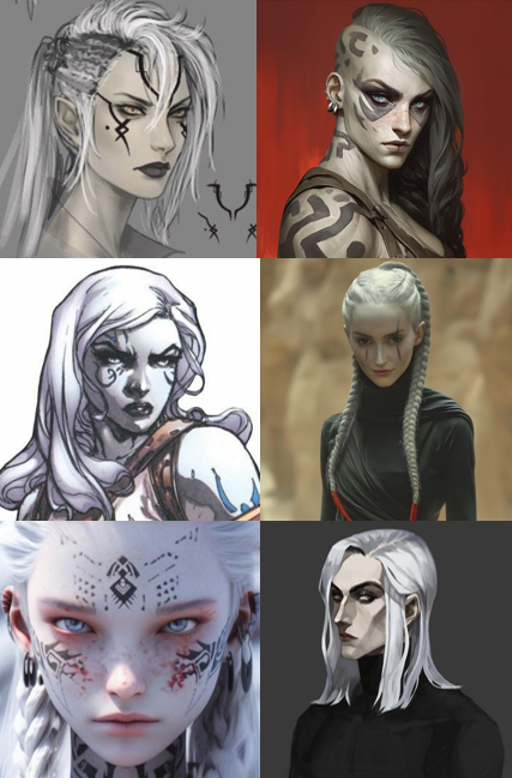
Major life events, rites of passage, and personal growth are marked by tattoos across the Eshani’s fsces, making them a living testament to their life’s journey. Each tattoo design has a particular name and associated folk figure, representing anything from one’s entry into the warrior caste, promotions in rank, and family lineage, to memorials for lost loved ones.
Birth & Baptismal Rites
While the Eshani had relatively advanced medical knowledge, they relied heavily on folk remedies and practices. As such, birth was seen as extremely dangerous.
Eshani would pray and sing songs to Strona, the Goddess of Motherhood and Birth, in order to protect both mother and child.
Seven nights after the birth, the child was recognised by the mother: they were placed on her knee, sprinkled with Okrin, named, and thus admitted into the family.
Guests are invited to bring gifts and well wishes for the child, as well, but no larger ceremony is held.
VIEWS ON LIFE
Just as they honour their dead through rituals and remember them through the art of combat, the Eshani would view life as something lived in service to legacy. Every action, battle, and decision is a mark on one's personal history that contributes to the legacy left behind for future generations.
Life for the Eshani is deeply relational, built on understanding others through combat or physical interaction. Relationships are not just emotional but are forged through shared movement and physical encounters. The Eshani see life as an endless series of opportunities to connect with others on a profound level—whether through combat, dance, or other forms of physical expression.
Given the Eshani's acceptance of death as a natural and honourable end to life, they view life itself as part of a larger, cyclical process. Death is not an end but a transformation, and life is simply a stage in this broader cycle. This gives the Eshani a sense of impermanence, where the focus is not on the fear of death but on living with purpose, seizing the moment, and leaving behind something meaningful.
Whether in combat, personal discipline, or relationships, the Eshani believe in honing one's skills and understanding throughout life. This pursuit of mastery isn’t just about physical prowess but about emotional and spiritual growth as well. Life, to the Eshani, was about striving to better oneself in all aspects, not just for personal gain but for the benefit of one’s family, clan, and community.
The Eshani’s emphasis on personal expression through combat and movement means that they highly value individual freedom. Life is to be lived authentically, with each person’s unique journey honoured and respected. The Eshani believe that each individual has a sacred right to carve their own path, and this path is defined by their choices in battle, love, and loyalty.
Honour and duty are core principles in Eshani society. They view life as a sacred responsibility to uphold these values, not just in combat but in everyday actions. To live dishonourably is a greater failure than death itself. Therefore, living honourably, fulfilling one’s duties to family, clan, and society, and acting with integrity are considered the highest virtues in life.
Coming of Age Rites
Strangely enough, there are no rites of passage from child to adult in Eshani culture. From the moment a child can fight, they are treated with the same respect as any other member of their society.
Funerary and Memorial customs
The ancestors were exceedingly important for the self-image of an Eshani family, and people believed that they were still able to influence the life of their descendants from the land of the dead. As such, contact with them was seen as crucial to the well-being of the family, and treating them well, even in the afterlife, meant securing happiness and prosperity for the family.
Conversely, the dead could haunt the living and bring bad fortune if the rituals were not followed appropriately; the sacrifice of animals, food and drink was necessary for this, as was the toasting of deceased family members at the beginning of feasts.
The graves of the deceased were also placed near the family dwellings so that they may protect the house in the afterlife. However, this was becoming increasingly uncommon, as families didn't always have a large homestead to oversee. As such, cemeteries were far more common within the Six Sisters these days, with families taking time out of each week to visit their dead.
VIEWS ON DEATH
For the Eshani, death is viewed as an honourable conclusion to life, especially if it comes in combat or as part of a meaningful cause. Since they believe that combat reveals one’s true self, dying in battle is considered one of the highest honours.
Eshani culture also embraces the concept that death is not the end of existence but a transition to another phase of the cycle. They see life as temporary and death as a necessary transformation. The dead are honoured and remembered, not mourned endlessly, because they continue to live on through their legacy and the impact they made during their lives.
After death, the Eshani place significant importance on the legacy left by the deceased. They honour their dead through physical markers like burial mounds or memorial stones, where the life and achievements of the individual are intricately recorded and celebrated. Death is seen as an opportunity for the family and clan to remember the deceased and preserve their contributions to the collective memory of the Eshani people.
Eshani burial practices are deeply ceremonial, reflecting their respect for the cycle of life and death. Their rituals involve offerings to keep ancestors content or symbolic acts of release, signifying the passage of the soul. These acts demonstrate the respect they have for their ancestors and reinforce the connection between the living and the dead. While mourning is a private and personal affair, public acts of remembrance ensure that the deceased’s memory remains alive within the community.
Since Eshani culture emphasises combat as a form of communication and bonding, death is also seen as part of a collective journey. When someone dies, their death affects the community and the family, and it’s a reminder that everyone is interconnected. Their shared experiences, especially in battle or physical expression, mean that the dead leave behind an imprint on those who fought or lived alongside them.
Given their warrior-like culture, Eshani also value honour more than the mere preservation of life. This belief leads them to accept death, even embrace it, if it occurs in a way that aligns with their principles of loyalty, combat, and integrity. Dying without honour, for example, through betrayal or cowardice, is viewed as the worst fate. The Eshani would prefer death to dishonour, as they believe that living dishonourably erases one’s legacy and disrespects both the individual and their clan.
Common Taboos
- Disrespecting combat as communication
- For the Eshani, combat is a very important form of communication and spiritual connection. To treat it as mere violence or to not attribute it the importance it deserves is highly frowned upon. In the same vein, a fighter who strikes for pain rather than communication is often shunned from general sparring practice.
- Using weapons that aren't ceremonial
- No matter the context, using weapons in a fight or a spar, unless they hold some ceremonial or spiritual purpose, is not only frowned upon, it is forbidden.
- Refusing to participate in combat
- Combat is an essential ritual that is part of everyday Eshani lives. It is used to settle disputes, communicate, and solidify relationships. Refusing an invitation to spar, especially during important life events or ceremonies, is akin to denying the person the chance to connect and get to know you.
- Ignoring ancestral guidance
- The Eshani deeply revere their ancestors and believe that they guide them and influence their lives even in death. Disregarding the wisdom of parents, grandparents, ancestors or guiding spirits in matters of decision making, combat and honour is regarded as highly disrespectful.
- Artificial enhancements
- While the Eshani may occasionally accept the use of necessary prosthetics, voluntary enhancements to gain an edge over opponents is frowned upon, as it is seen as an admission of inability. Physical prowess is a matter of hard work and dedication, and any shortcuts employed to increase one's ability is considered an insult to the culture, your opponents, and the Goddess who bestowed the Eshani with their abilities.
- Seeking power for the sake of power
- Eshani culture values strength and skill, but it does not value power itself.. Leaders are expected to serve the people, and those who seek to rule for personal gain, similar to Treganna, are looked down upon. This extends to a dislike of overly ambitious or ruthless behavior, as it can be seen as putting oneself above the community.
- Forming romantic attachments with outsiders
- Given the Eshani’s emphasis on shared combat as communication, connecting with outsiders, especially romantically, is seen as challenging and potentially weakening their cultural purity. Since only Eshani fully understand their unique form of expression, relationships with outsiders are often met with suspicion and, occasionally, hostility.
Common Myths and Legends
The Battle of Yadir & Treganna (as told by the Eshani)
It is said that many centuries ago, an Eshani named Treganna went into many battles and could not die nor shed any blood, no matter how many times her enemies said that they had slain her. This apparent invincibility poisoned Treganna's mind into thinking that she was above all Eshani, and she sought to usurp power from the Eshani Command in order to rule the Six Sisters herself. Treganna would succeed in this endeavour, but the people of Eshan called upon Yadir to expulse her from the throne.
As the stories go, Treganna and Yadir engaged in a battle so fierce it nearly destroyed Eshan. However, in the end, Yadir would overcome the seemingly unkillable Treganna. Pierced by a spear of Yadir's making, Treganna found herself to be quite mortal when she saw her own blood for the first time. As she lay dying, it is said that Treganna came to her senses and used the last of her life essence to return to life those she had slaughtered in her quest for power. Before passing, Yadir and the Eshani forgave her and, in death, Treganna would haunt battlefields to escort the dying into the afterlife.
The spraying of sacrificial blood before battles was meant to keep Treganna at bay and provide extra protection before heading into the fray. Additionally, Eshani or prisoners of war were sacrificed only on the battlefield and only in times of great need. This was often done in Treganna's name, as it was thought that consecrating the dead to her would either turn the tides of the war in their favour or supply Treganna with the blood she lost in death as a replacement for taking theirs.
A common Eshani folk story tells that those who were resurrected by Treganna with the last of her life essence have a cursed bloodline and that Eshani who are particularly defiant of authority are often said to be descendants of these accursed individuals. Others, however, say that these people are naturally stronger than others as they are imbued and blessed with Treganna's very life essence.
The Battle of Yadir & Treganna (as told by the Jedi)
According to legend, Yadir and Treganna were both extraordinary warriors who were among Kanir's Chosen, marked for greatness from a young age. Both were said to be blessed by the Lunar Goddess with unparalleled combat skills and an almost supernatural presence in battle. Their destinies, however, diverged dramatically.
When they came of age, Yadir and Treganna each left Eshan, called to the Jedi Order to become peacekeepers and defenders of the galaxy. They fought side by side in many battles, and their bond as comrades was believed to be unbreakable. But as time passed, Treganna became enamoured with the idea of ultimate power. She grew restless and dissatisfied with the Jedi’s strict philosophy, which she viewed as limiting and blind to the potential that lay within her. Drawn to darker knowledge and tempted by the mysteries of the Sith, Treganna ultimately renounced the Jedi Code, embracing the Dark Side.
Her ambition led her to return to Eshan, where she overthrew the Eshani Command, declaring herself ruler of the Six Sisters. Under her rule, Eshan was plunged into war as she sought to reshape her homeworlds according to her vision of strength and domination. Her powers made her nearly indestructible, her movements in battle terrifyingly graceful, and her strikes unerringly lethal. Many believed she was blessed, immune to death itself, for no wound would fell her, nor could any weapon draw her blood.
Horrified by her actions, Yadir defied the Jedi Code, abandoning his place in the Order to return to Eshan and stop Treganna. The two engaged in a fierce, world-shattering battle that became the stuff of legend, with Treganna wielding the destructive power of the Dark Side and Yadir fighting with the determination and purity of the Light.
Eventually, Yadir’s resolve and skill allowed him to pierce Treganna’s defences with his lightsaber. For the first time, Treganna saw her own blood, and realised in her final moments the mortal error of her pride. In her last act, she drew upon her very own life essence and restored those she had slain to life. Then, in death, and finally at peace, Treganna, returned to the Force.
Historical figures
KANIR
The Lunar Goddess that is central to the Eshani's religion. It is believed that Kanir is the source of their ability to communicate through combat. This belief not only deepens the connection they feel with each other during physical exchanges, but it also enshrines combat as a sacred, nearly divine mode of communication.
YADIR
Yadir is said to be the first Eshani to be selected by Kanir as Chosen.
He is portrayed as a heroic warrior who embodies the highest Eshani ideals of honour, strength, and loyalty to his people. Known primarily for his legendary battle against Treganna, Yadir is remembered by Eshani and outsiders alike for his willingness to defy the Jedi Order to protect his homeworld. This choice led to his expulsion from the Order, but it also elevated him in Eshani reverence.
Because of his connection to Kanir, the Eshani believe that Yadir was blessed as her first Chosen and Eshan's sole protector. This gives Yadir an almost divine status, especially since he represents the potential of each Eshani to channel their connection to Kanir and, by extension.
TREGANNA
Initially mortal, Treganna was once an unmatched Eshani fighter and Jedi who had never bled or been injured in battle, feats that led her to become enamoured with the idea of ultimate power. She grew restless and dissatisfied with the Jedi’s philosophy was slowly drawn to darker knowledge. Ultimately, Treganna renounced the Jedi Code and embraced the Dark Side.
As the stories go, Treganna and Yadir engaged in a battle so fierce it nearly destroyed Eshan. However, in the end, Yadir would overcome Treganna. Pierced by a spear of Yadir's making, Treganna found herself to be quite mortal. As she lay dying, it is said that Treganna came to her senses and used the last of her life essence to return to life those she had slaughtered in her quest for power. Before passing, Yadir and the Eshani forgave her, and, in death, Treganna is said to haunt battlefields to escort the dying into the afterlife.
Ideals
Beauty Ideals
As many Eshani resembled their family members, a visual cohesion to the family was most aesthetically pleasing.
Those who differed in appearance more than what was socially acceptable usually weren't considered as attractive as those who exhibited the typical features of the species, such as their angular features, pure white hair, silver eyes, and great height.
Gender Ideals
The Eshani are a matriarchal society. As such, women hold positions of power, leadership, and authority within their society. This means that political, social, and military decisions are predominantly made by women.
While women hold primary authority, Eshani society values a balance of skills and attributes across genders. Combat, one of the central pillars of Eshani culture, is a way of life for both men and women. Because combat is a form of communication, both genders are expected to participate equally in martial training and defence. However, gender roles manifest in specific rituals or societal customs where women lead, and men are more active in supportive roles.
In Eshani culture, combat is the ultimate expression of one’s true self, and through fighting, individuals gain respect and understanding of one another. As such, men and women are seen as equals in martial ability, with gender playing little to no role in determining a person’s combat rank or respect as a warrior. Both men and women are encouraged to pursue martial prowess, and leadership positions within their military are typically based on combat ability rather than gender alone, even though women oftentimes hold senior or commanding roles more frequently due to the matriarchal structure.
Given their focus on individual expression through combat and communication, one would think that the Eshani might be more fluid in their understanding of gender, allowing for a broad spectrum of gender identities. However, those who do not conform strictly to their biological male or female genders would not find acceptance within society, as Eshani culture prioritises the lineage of women.
As the chronicling of one's lineage begins from birth, those born male, even if they have taken steps to affirm a female gender, will not find that their history matters to the collective Eshani society. If they had biological female partners, however, it would be their lineage and family history which would be accepted into the collective Eshani canon.
In Eshani society, family lineages and inheritance passed through the female line, with mothers holding the central role in guiding the family and making important decisions. While men are still involved in family life, certain familial customs, and child-rearing, the leadership of the household, including passing down traditions, titles, and property, is centred around women.
Though women hold the highest authority, men would not be marginalized. The society fosters cooperation to a certain degree and respect between genders, allowing men and women to work together while acknowledging that women take on a more important place in society.
Relationship Ideals
As it was the core of the family, marriage was one of the most important social institutions in Eshani culture. A wedding was an important transition not only for the couple but also for the families involved. A marriage was a legal contract in which inheritance and ancestral baggage were implied, while the wedding itself was the solemnization of a pact in which the families promised to help and fight with one another.
Weddings were a short and individual process which was subject to many rules and rituals that ended in the wedding battle. These procedures had to be followed for the divine powers to sanction the marriage and to avoid any issues in its aftermath. However, the Eshani prided themselves on their awareness of the intricacies of a marriage blessed by Gods, as divorces were not believed to be divine retribution, but rather a result of complex individual emotions that they had had the opportunity to know through physical contact with their spouse.
Before the marriage, the groom and a few members of his own family would visit the family of the bride in order to propose. This was then set as the date of betrothal, the first legally binding step between the families. It was also the occasion used to negotiate the inheritance and property relations of the couple, as well as the present from the groom's family to his future wife's mother. When an agreement was reached, the deal was sealed with a large feast.
The wedding itself was the most important ritual in the entire process, as it was the first public gathering of the two families. Each family member participated in a ceremonial battle, which was said to depict the circumstances of the first Eshani wedding on a battlefield. The Eshani believed that Kanir witnessed the wedding battle, and if the blue-flamed torches lit for the ceremony went out during the battle, it was believed to be an omen of good fortune for the couple, as they would be bathed in Kanir's moonlight.
After the family's ceremonial battle, the bride and groom entered a sparring of their own, putting all emotions and personal connections at the forefront of their minds in order to further bond with one another. It was believed that Yadir witnessed this personal battle, and that the closer one became to their spouse during the fight, the more Yadir had blessed the union.
Major organizations
ECHANI COMMAND
The Echani Command consisted of six female leaders, each representing one of the Six Sisters. These women were the highest authority, responsible for making decisions for the entire Echani civilization. Despite Thyrsus being a patriarchal society, a female delegate represented them in the Command.
DISCIPLES OF KANIR
The Disciples of Kanir are a religious group within Echani society who are deeply dedicated to the worship of Kanir, the Lunar Goddess. They uphold and interpret the spiritual and cultural aspects of the Echani religion, including the belief that Kanir is the source of the Echani's ability to communicate through combat. Their influence extends into the daily lives of the Echani by guiding rituals, preserving traditional values, and upholding customs that honour the goddess's legacy.
CULT OF TREGANNA
The Cult of Treganna is a heretical sect fixated on the War and Death Goddess Treganna but more on her time as a Sith and Dark Side Force user. They believe that Treganna's spirit endows them with strength and fearlessness, and they strive to invoke her spirit and give themselves power beyond that which was bestowed upon them by Kanir.
SILVER HAND
A quiet resistance favouring peace and egalitarian reform rather than outright rebellion, the Silver Hand envisions a future where each of the Six Sisters enjoys more autonomy and equality. They advocate for fewer divisions between the Castes and create underground schools where anonymous members of each Caste teach their skills to all.
CORTOSIS VEIL
The Cortosis Veil, known simply as "The Veil," is shrouded in mystery. Known only to the highest-ranking members of the Echani Command, the organisation's primary mission is to gather intelligence on other planetary systems, potential rivals, and other influential entities while quietly observing any developments in the galaxy that could threaten the Six Sisters. In direct opposition to the Command's official position of insularity, the Veil operates as an invisible safeguard, gathering knowledge to ensure the Six Sisters remain one step ahead of any adversaries.

Comments