

Magister Legionum
“Where an Emperor rules the Imperium, the Magister Legionum keeps it alive.”
The Magister Legionum is the Imperium’s supreme commander of arms, the iron spine upon which the empire’s survival has rested for more than eight centuries. If the Emperor is the soul of the state—shaping destiny, law, and vision—then the Magister is its disciplined will, manifest in steel and strategy. No other mortal office demands so complete a union of intellect, endurance, and unwavering resolve. The Magister does not simply command armies; they shape the very conditions under which the Imperium endures.
The office was not born from ceremony but from necessity. In the uncertain years following the Imperial Arrival, the legions—once the pride of Old Rome—found themselves scattered across alien terrain, facing foes unknown, landscapes unmapped, and political leadership still reeling from displacement. It became clear that the survival of the Imperium depended not on ancient titles or senatorial debates, but on the ability to wield its military strength with unity and precision. Thus was the Magister Legionum established: a commander whose authority would stand above faction, province, and politics.
Across generations, the Magister has served as the architect of military doctrine, the guardian of discipline, and the strategist whose insight determines whether provinces thrive or burn. They have coordinated the great frontier wars, repelled Jotun raids from the frozen north, managed delicate standoffs with the Brass Cities, and stabilised the realm during crises such as the Red Harvest and Sea-Fall. In every era—whether marked by expansion, diplomacy, or calamity—the Magister has been the steady hand that prevents fear from becoming collapse.
Yet the role extends far beyond battlefields. The Magister is the silent interpreter of Imperial strength—a figure whose choices ripple into politics, culture, and identity itself. Their presence assures citizens that their borders are secure; their reputation deters rivals from testing the empire’s resolve; their discipline inspires legionaries who march in the knowledge that their commander has walked the same mud, endured the same cold, and carried the same weight of responsibility.
To hold the title is to shoulder the accumulated legacy of every scar the Imperium has endured and every triumph it has earned. It is to stand at the meeting point of history and survival, where a single decision may determine the fate of thousands. And it is to embody the Imperium’s most enduring truth: that while empires may rise from vision, they endure only through vigilance.
The Magister Legionum is not merely a general.
They are the Imperium in its most disciplined form—
unyielding, far-seeing, and forged in the crucible of necessity.
Qualifications
To stand as a candidate for Magister Legionum is to bear the cumulative weight of a lifetime spent in service, hardship, and command. The title is not granted by birth, political favour, or noble lineage—it is earned through decades of scars, relentless discipline, and the rare ability to command respect without demanding it. Across eight centuries, only a handful of commanders have possessed the full constellation of qualities required for consideration.
A future Magister must begin where every legionary begins: in the shield line, learning the unforgiving lessons of endurance, cohesion, and the discipline that binds soldiers into a single organism. No candidate is exempt from the mud, the hunger, the long marches, or the fear of their first battlefield. The early years test not talent but tenacity—proving whether a soldier can be trusted to stand firm when the line quivers.
From there, the ascent is a series of crucibles. As a centurion, the candidate must demonstrate mastery not merely of tactics, but of human nature. They must learn to read exhaustion in a soldier’s posture, pride in a cohort’s silence, and danger in the subtle tremors that ripple through a camp before dawn. They must command men who will die on their orders and maintain the moral integrity to carry that burden without arrogance or collapse.
As a tribune or legate, they must prove capable of shaping entire theatres of conflict. Here the tests shift from physical endurance to intellectual mastery: logistics, counter-raiding strategies, siegecraft, engineering support, winter campaigning, coastal defence, and cooperation with dwarven, elven, halfling, and centaur auxiliaries. The War Colleges sharpen what experience teaches, but no classroom can replicate the volatile complexity of a living battlefield. Only repeated success under pressure separates a promising officer from a true commander.
Just as essential as battlefield brilliance is political steadiness. A prospective Magister must navigate senatorial expectations, provincial pride, foreign treaties, and legionary tradition without becoming the pawn of any. History remembers too well the disasters born of officers ruled by ego, ambition, or factional influence. The Magister must be above such entanglements—not because they are immune to pride, but because they have learned to master it.
Finally, the candidate must possess a quality beyond simple competence: the indefinable aura that compels legionaries to follow. Soldiers can sense hesitation in a heartbeat; they can smell fear in a commander’s voice; they can see dishonour long before senators do. A Magister must inspire confidence so complete that cohorts march into storms knowing their commander has already counted every risk and every life.
Thus, qualification for the Magister Legionum is not measured by medals or titles but by a lifetime of earned authority—authority forged in battlefields, campaign tents, supply depots, war councils, and in the quiet, lonely decisions that only senior commanders truly understand. It requires a mind sharpened by strategy, a body tempered by hardship, a spirit disciplined by loss, and a will unbroken by the weight of command.
Only those who embody the full measure of these qualities—without flaw, without compromise—are ever named worthy of taking the next step toward the Aurelian Torque.
Requirements
Eligibility for the office of Magister Legionum is defined not by privilege, ambition, or ancestry, but by a series of uncompromising requirements shaped by eight centuries of triumphs, failures, and hard-won lessons. Each requirement exists because somewhere in Imperial history, a lesser commander proved why its absence would endanger the entire realm.
The first requirement is total immersion in the legionary hierarchy. A candidate must have served at every rank—from legionary to centurion, tribune to legate—without exception and without circumventing the chain of command through noble influence or senatorial favour. This ensures that the Magister does not merely understand the legions from above but knows their burdens from within: the weight of a shield, the cold grip of a night march, the rhythm of a cohort’s heartbeat before the charge. A commander who has not earned authority step by step is deemed unfit to wield it across an entire empire.
The second requirement is unbroken loyalty to the Imperium alone. No candidate may hold foreign oaths, mercantile obligations, noble debts, or clandestine allegiances. The legions cannot be commanded by one whose loyalty is pulled in multiple directions, nor by a commander vulnerable to political compromise. The Imperium’s enemies have long tried to reach the Magistership through diplomacy, bribery, and infiltration; every attempt failed because Imperial law demands a purity of allegiance that cannot be bought or manipulated.
The third requirement is physical and mental resilience proven across long campaigns. A Magister must endure the exhaustion of forced marches, the strain of sleepless planning, and the cold clarity required to send soldiers into danger. The Senate’s medical council evaluates candidates with the scrutiny reserved for engines of war; chronic illness, unsteady judgement, untreated trauma, or diminishing stamina are disqualifying. The legions cannot hinge upon a commander who falters when the long winter grind wears lesser officers down.
The fourth requirement is strategic breadth. Modern Magisters must be comfortable commanding not only humans, but multi-species auxiliaries with their own traditions, strengths, and vulnerabilities. A commander unable to coordinate the precision of Elven archers, the raw force of Dwarrow sappers, the speed of Centaur outriders, or the cunning of Halfling scouts cannot hope to lead the Imperium’s diverse forces as a single body. Thus, candidates must demonstrate mastery over cross-cultural leadership—an art more delicate than siegecraft and more dangerous than frontier diplomacy.
The fifth requirement—and often the most decisive—is legionary confidence. The final safeguard of the office is the judgement of those who serve beneath it: the Primus Pilus Council and the senior tribunes. If they express unified dissent, the candidate’s name is struck immediately. No Emperor, no Senate decree, no political faction has ever overturned this. The legions do not tolerate a commander they cannot trust, and the Imperium does not risk appointing one.
Finally, there is the unspoken requirement: the burden of character. Though unwritten in any charter, every soldier knows it. A Magister must be able to hold the full weight of the Imperium upon their shoulders without bending under pressure or breaking beneath guilt. They must be able to order sacrifices when necessary, yet avoid becoming numb to the lives entrusted to them. They must possess the rare equilibrium of iron discipline and human empathy—the balance that keeps armies fierce, not cruel; loyal, not fearful.
These requirements form a barrier few can pass. They ensure that the office remains what it was always intended to be: not a prize for the ambitious, but a mantle for the worthy. Only those who meet every criterion—tested by hardship, stripped of illusion, and strengthened by resolve—may stand before the Emperor and be considered for the Aurelian Torque.
Appointment
The appointment of a Magister Legionum is not merely an administrative decision but a moment in which the Imperium itself holds its breath. More than any other mortal office, the Magistership balances between politics and survival, tradition and necessity, ceremony and ruthless pragmatism. The process unfolds in deliberate stages, each rooted in eight centuries of precedent and shaped by failures the empire refuses to repeat.
I. The Closed Deliberations
The journey begins in private, long before a name is spoken aloud. When a Magister dies, resigns, or is removed, the Emperor convenes the Council of Iron:
- the Senate Military Commission,
- the Primus Pilus Council,
- and the senior field legates.
Behind sealed bronze doors, they dissect the careers of eligible commanders with a relentlessness that borders on cruelty. Campaign records are scrutinised, supply failures interrogated, and battlefield decisions re-examined not for their outcome, but for the judgement behind them. No flaw is dismissed, no misstep forgotten. The Imperium has endured eight centuries of war because it refuses to appoint a commander whom sentiment or political favour would elevate undeservedly.
Only when absolute clarity emerges does a single name leave the chamber.
II. Legionary Acclamation
Once a candidate has survived the scrutiny of the Council, they must next face the judgement of those whose loyalty cannot be purchased or compelled: the legions themselves.
In the Castra Magna, beneath the towering banners of every legion ever raised, the candidate steps forward to stand before the assembled senior tribunes. These officers—hardened veterans who have buried more comrades than most citizens will ever meet—serve as the conscience of the army. They know fear, exhaustion, and the cost of command in ways civilians never can. They do not judge as senators do; they judge as soldiers, sharply and without mercy.
If they approve, the hall erupts in the ancient thunder of shields struck against stone. If they remain silent, the candidacy ends instantly, no matter the Emperor’s preference.
The legions do not follow a commander they do not trust, and the Imperium does not risk forcing one upon them.
III. The Oath of Iron and Flame
If acclaimed, the candidate is led to the Hall of Standards, a sanctum where the air itself seems heavy with memory. Here stand the battle-torn banners of past legions, each frayed edge a testament to sacrifices made across continents.
Before the Emperor and the full military host, the candidate kneels and speaks the Oath of Iron and Flame—a vow of absolute service, binding them to defend the Imperium without ambition, corruption, or cruelty. The oath does not elevate the Magister above the legions; it binds them to the legions, tethering authority to accountability.
Senators may swear by law, priests by flame, but a Magister swears by iron.
IV. The Investiture of the Torque
The ceremony culminates in the moment every legionary remembers: the bestowal of the Aurelian Torque. Forged from the steel of early frontier battlefields and engraved with the names of every past Magister, it is not a crown but a burden—heavy enough to remind its bearer that glory is secondary to duty.
When the Emperor settles the Torque upon the candidate’s shoulders, a ripple passes through the ranks. From that moment, their voice becomes command, their decisions become doctrine, and the survival of the Imperium rests upon their judgement.
Tradition holds that the moment the Torque is clasped, the new Magister’s first breath is a vow—silent or spoken—to uphold the legacy carved across centuries and to leave the legions stronger than they inherited them.
V. The First Order
By custom, the new Magister ends the ceremony with a single command—symbolic, but telling. Past Magisters have ordered the polishing of neglected memorials, the recall of a disgraced centurion for redemption, the inspection of frontier supply lines, or the immediate posting of envoys to uneasy allies.
Legionaries whisper that this first order reveals the essence of the Magister: ambition, humility, foresight, or stern discipline. Whatever form it takes, it marks the first step in a chapter that will shape the Imperium for decades to come.
Duties
The duties of the Magister Legionum form a burden so vast and intricate that only a handful of individuals in eight centuries have carried it without faltering. The Magister is not simply a field commander or strategist, but the living fulcrum upon which the Imperium’s security, discipline, and martial culture depend. Their responsibilities reach from the smallest frontier watchtower to the grandest war councils of Nova Roma.
Guardian of Imperial Strategy
The Magister is the architect of long-term military doctrine. While legates and tribunes oversee the execution of campaigns, only the Magister designs the broad strategic framework that determines how the Imperium defends its borders, expands its influence, and deters its adversaries.
They must anticipate threats decades in advance—Jotun migrations, Warborn tribal shifts, Brass Cities manoeuvres, Rift-borne unpredictabilities—and design doctrine sturdy enough to withstand them.
A single strategic error can doom provinces.
A single flash of insight can safeguard generations.
Keeper of Discipline and Legionary Tradition
The legions are the Imperium’s backbone, and their discipline is its marrow. The Magister holds ultimate authority over the rituals, values, and martial customs that shape Imperial military identity. This includes:
- setting the standards for training and promotion
- enforcing discipline across every legion
- safeguarding the integrity of the oath sworn by each soldier
- maintaining the rituals that bind legionaries to their cohort brothers and sisters
A lapse in discipline anywhere in the empire reflects upon the Magister—who must answer for it.
Supreme Commander in War
When the Imperium goes to war, the Magister becomes its unchallenged battlefield authority. Though the Emperor may shape the grand direction of a conflict, it is the Magister who conducts the actual art of war.
They command all legions, auxiliaries, engineers, scouts, and naval formations, coordinating movements across hundreds of leagues. They must know when to advance, when to retreat, and—most difficult of all—when to sacrifice a position to preserve the long-term strength of the empire.
In moments of existential threat, the Magister’s judgement becomes the line between triumph and catastrophe.
Adviser to the Emperor
Though the Magister answers only to the Emperor, their duty includes advising the throne with unflinching honesty.
A lesser officer might soften a report or hide a failure.
The Magister cannot.
Their counsel often tempers imperial ambition, reveals political dangers invisible to civilian advisors, or clarifies the true costs of war—measured not in silver or prestige, but in lives.
History remembers emperors who ignored Magisters.
None died peacefully.
Mediator of Internal Conflict
The Imperium is vast, its legions numerous, its commanders proud. Rivalries, disputes, and doctrinal clashes inevitably arise. The Magister acts as the supreme arbiter of all internal military conflict, able to reassign officers, settle disputes between legions, or discipline commanders whose ambition threatens unity.
Through this duty, the Magister preserves cohesion across a military machine too vast for any emperor to micromanage.
Overseer of Frontier Stability
Most of the Magister’s work is invisible to the capital:
- inspecting remote garrisons
- evaluating fortress readiness
- monitoring incursions and migrations
- ensuring that the long border with the Warborn does not erupt into chaos
- maintaining watchposts against Jotun coastal raids
The Empire’s stability rests not on the walls of Nova Roma, but on the countless small decisions made along the frontier—and the Magister ensures they remain sound.
Commander of Multispecies Legions
The modern Imperium fights alongside allies and auxiliaries whose traditions, strengths, and tempers differ greatly. The Magister is responsible for integrating Elven archers, Dwarrow sappers, Halfling scouts, Centaur outriders, and other auxiliaries into a coherent fighting force.
They must respect cultural boundaries while enforcing Imperial discipline—a delicate balance requiring wisdom, experience, and political tact.
Steward of Military Diplomacy
The Magister plays a subtle but essential role in foreign relations.
A misstep with the Jotun can trigger a winter war.
A misphrased order near Brass Cities territory can collapse a treaty.
A poorly timed deployment can transform border tension into bloodshed.
Thus, the Magister’s duty is not only to wield force but to restrain it.
Custodian of the Legions’ Moral Compass
Perhaps the most difficult duty is maintaining the ethical integrity of the legions.
The Magister must ensure that:
- prisoners are treated within the codes of war
- oppressed populations are protected, not exploited
- legions do not become instruments of tyranny in the provinces
The legions must be feared by enemies, respected by allies, and trusted by the people.
The Magister ensures this balance is never lost.
The duties of the Magister Legionum are not a list—they are a lifetime.
They demand a commander who can act with steel when needed, yet with restraint when wisdom requires it.
A commander who holds the line not only with soldiers, but with foresight and integrity.
The Imperium has endured at least as much through its Magisters as through its emperors.
And so long as a worthy Magister bears the Aurelian Torque, the legions—and the Imperium—will stand unbroken.
Responsibilities
The responsibilities of the Magister Legionum are vast enough to fill a lifetime and delicate enough to crumble under a single misjudgement. Where duties describe the purpose of the office, responsibilities describe its weight—the constant, unending labour that sustains an empire whose enemies are relentless, whose borders are long, and whose legions are the heart of its identity.
These responsibilities are not glorious.
They are not ceremonial.
They are the grinding machinery behind every triumph the Imperium claims.
Commanding the Deployment of the Legions
Every movement of the Imperium’s military begins with the Magister’s seal. Whether shifting a cohort to reinforce a failing frontier, dispatching legionaries to assist in a provincial uprising, or positioning reserves in anticipation of new Rift-born threats, the Magister must choreograph deployments across thousands of leagues.
A single misplacement can invite invasion.
A single delay can cost a province.
Maintaining the Empire’s Military Readiness
Readiness is not a static condition but a perpetual endeavour. The Magister oversees:
- seasonal readiness checks,
- mandatory training cycles,
- standardisation of equipment,
- rotation of fatigued cohorts,
- inspection of fortress inventories,
- and review of legionary fitness reports.
From polished boots to siege engines, the Magister ensures the Imperium is ready not merely for a war, but for any war.
Overseeing the Officer Corps
No institution produces or destroys leaders like the legions.
It falls to the Magister to:
- approve promotions,
- dismiss incompetent officers,
- intervene in feuding commands,
- redirect ambitious commanders who threaten cohesion,
- mentor rising talents,
- and ensure each legion’s hierarchy remains functional, loyal, and tactically precise.
A single corrupt legate can unravel a campaign.
A single brilliant tribune, properly nurtured, can secure a generation.
Managing the Lifeblood of War: Logistics
The legions do not march on glory—they march on supply.
The Magister directs the colossal logistics network that sustains the empire’s armies:
- food shipments from Halfling fleets,
- dwarven-forged weapons and siege engines,
- elven medical supplies and reconnaissance reports,
- horse stock from Centaur herds,
- and the unending flow of grain, medicine, timber, and coin.
If a single supply line falters, legionaries suffer.
If a web of them collapses, empires fall.
Coordinating Multi-Species Auxiliaries
Modern warfare is not purely human.
The Imperium fights alongside allies with distinct cultures and capabilities.
The Magister is responsible for balancing:
- the precision of Elven rangers,
- the destructive engineering of Dwarrow sappers,
- the speed of Centaur outriders,
- the stealth of Halfling scouts,
- and the stubborn reliability of human legionaries.
Each auxiliary force has its own rules of honour, traditions, and strengths.
Only a Magister can unify them without diminishing any.
Arbitrating Military Justice
When a legionary breaks discipline, a cohort stumbles into disgrace, or an officer misuses authority, the Magister becomes judge, jury, and architect of consequence.
They must balance mercy with order, fairness with deterrence.
Their decisions set precedents studied by tribunals for decades.
Military justice is harsh when necessary but never cruel.
The legions’ honour depends on the Magister’s judgement.
Managing Frontier Intelligence and Threat Assessment
The Magister sits at the nexus of information from across the realm:
- Warborn warband movements,
- Jotun seasonal migrations,
- political rifts within the Brass Cities,
- Elven court tensions,
- Dwarrow underroad collapses,
- strange sightings following Rift events.
Each report must be weighed, contextualised, and acted upon.
Miss the wrong whisper, and disaster grows in silence.
Advising the Senate and Emperor
The Magister must interpret military reality for civilian leadership without exaggeration or denial.
They translate raw battlefield truth into counsel the Senate can act upon, tempering senatorial ambition and illuminating risks invisible to those who have never marched beneath a legion’s standard.
When the Emperor seeks clarity, it is often the Magister who provides it.
Shaping the Legions of the Future
The Magister must perpetually plan beyond their own lifetime.
They oversee:
- reforms,
- doctrinal expansion,
- training innovation,
- fortress construction,
- new unit development,
- integration of foreign technologies,
- and the long-term cultivation of the officer class.
The Magister’s legacy is not measured in victories alone, but in the legions they leave behind.
Preserving the Moral Authority of the Legions
If the legions become feared as oppressors rather than honoured as protectors, the Imperium fractures.
Thus the Magister must ensure:
- restraint in victory,
- honour in conduct,
- respect for civilians,
- discipline in wartime,
- and the preservation of military virtue across every fortress and frontier.
The Imperium stands as much on the moral authority of its soldiers as on their steel.
The responsibilities of the Magister Legionum are endless, overlapping, and frequently thankless.
They are the quiet machinery behind Imperial power—
the invisible labour that prevents the empire from collapsing under its own weight.
Where emperors shape destiny,
Magisters maintain reality.
Benefits
The Magister Legionum enjoys benefits unmatched by any mortal save the Emperor, yet these privileges are not indulgences. They are tools, responsibilities, and symbols—each one earned through decades of hardship and bound to the unspoken truth of the office: that every advantage exists only to enhance the Magister’s ability to safeguard the Imperium.
Absolute Operational Authority
The Magister commands the legions in their entirety, with the power to mobilise armies across provinces, redirect fleets, restructure command hierarchies, and override senatorial delays in times of crisis. This authority is not ceremonial—it is the sharp edge of Imperial survival.
A single word from the Magister can save a city, crush a rebellion, or realign the military posture of half the empire.
This is the benefit most envied by foreign generals
and most feared by Imperial enemies.
Access to the Empire’s Deepest Intelligence
The Magister receives every report from scouts, spies, frontier agents, naval observers, dwarven underroad sentinels, elven waywatchers, halfling harbourmasters, and imperial diplomats.
No other mortal sees the world with such breadth.
Patterns invisible to others emerge clearly to the Magister, allowing them to sense shifting threats long before they surface.
This is the privilege that keeps the empire awake
long after others have grown complacent.
Command of the Domus Bellatoris
The Magister resides in the Domus Bellatoris, a citadel within the Castra Magna designed for command, not comfort.
It contains:
- map halls showing real-time frontier movements,
- strategy chambers inscribed with eight centuries of campaigns,
- war archives older than most cities,
- a council amphitheatre for emergency convocations,
- secure vaults holding treaties, intelligence dossiers, and military contingencies.
To live here is to dwell at the heart of the Imperium’s martial mind.
A Personal Guard Drawn From the Praetorian Phalanx
The Magister is protected at all times by a squad of the Praetorian Phalanx, elite warriors whose loyalty is sworn not to the Emperor but to the preservation of Imperial command structures.
Their presence is symbolic as much as defensive:
it reminds foreign dignitaries, provincial governors, and even senators that the Magister is not a mere administrator, but the embodiment of the legions’ will.
Influence That Rivals (and Sometimes Surpasses) the Senate
Though the Senate holds legislative authority, senators speak carefully in the presence of the Magister.
A Magister’s endorsement can make or break a military budget, shape foreign policy, and determine whether a frontier province receives reinforcements or is left to negotiate its own survival.
More laws have been shaped by a Magister’s raised brow than by any senator’s speech.
Prestige Among Allies and Respect Among Enemies
To foreign nations, the Magister Legionum is often the most important figure they will deal with.
Dwarrow lords carve the names of honourable Magisters into stone tablets.
Elven Courts send their finest archers to serve under a Magister they respect.
Jotun war-chiefs speak the title with a mixture of irritation and admiration.
Even Warborn warlords—though they refuse to bow—teach their young that the Magister is a foe worthy of saga.
No other human office commands such pan-cultural recognition.
Purview Over the Roll of Iron
The Magister becomes a living steward of the Roll of Iron, the sacred record of every legion that has stood, fallen, risen, or been reborn.
They alone may amend the record, add commendations, or enshrine a legion’s final stand into imperial canon.
For many Magisters, this responsibility is more profound than the command of armies.
Access to the Codex Bellorum
The Codex Bellorum is a vast and growing repository of military doctrine, historical precedent, emergency protocols, and wisdom preserved by every Magister since the Founding Era.
Though not magical, it is treated with the reverence of a holy text:
a handbook of how the Imperium has survived everything the world has ever thrown at it.
Only the reigning Magister may read it in full.
Personal Legacy Beyond Death
Death does not end a Magister’s influence.
The names of history’s greatest commanders become rallying cries for future legions.
Statues rise.
Banners are named in their honour.
Cadets at the War Colleges study their campaigns with the same devotion theologians reserve for sacred scripture.
Some Magisters become synonymous with eras—embodying the values, fears, and triumphs of their age.
The only immortality the Imperium recognises
is the kind earned through service.
These benefits do not lighten the Magister’s burden.
They sharpen it.
They are the instruments through which a single individual steers the military destiny of a continent, standing between civilisation and the chaos that forever presses against its borders.
To others, these benefits resemble power.
To the Magister, they are obligations.
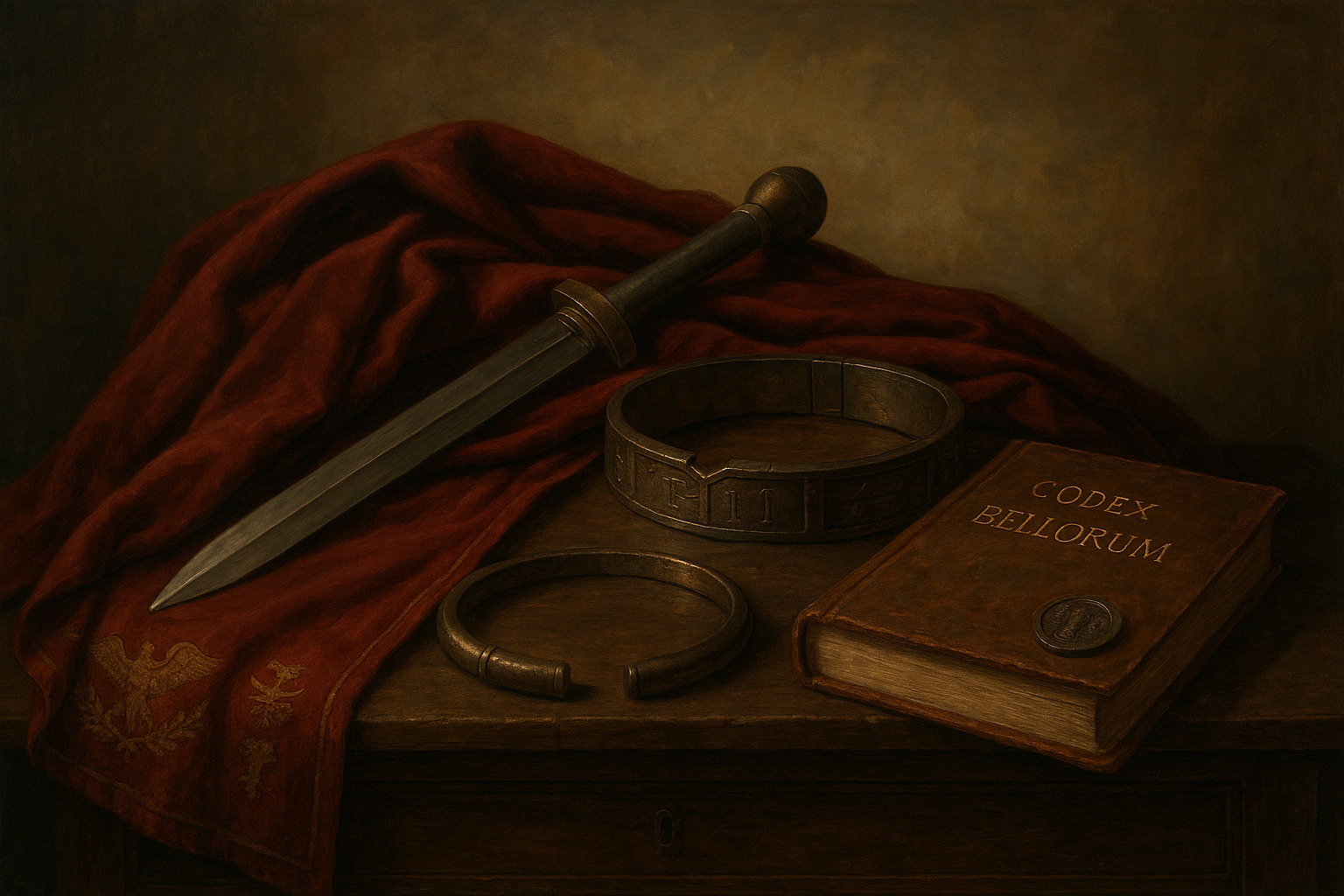
Accoutrements & Equipment
The regalia of the Magister Legionum are forged traditions—symbols of service, authority, and the unbroken lineage of command stretching back eight centuries. None are ceremonial trinkets, and none are enchanted. Each exists because past Magisters proved its necessity on campaign after campaign.
The Aurelian Torque
A heavy collar of darkened steel engraved with the names of all past Magisters. Recast for each new holder, it carries the literal weight of legacy. Its purpose is not splendour but burden—reminding the Magister that authority is carried, not worn.
The Baton of Iron Command
A tempered-steel command baton capped with a bronze eagle. It is the Magister’s visible badge of office, used during inspections, councils of war, parades, and battlefield briefings. A simple gesture of the baton has become a universally understood sign among the legions: advance, hold, attend, or prepare.
It is purely symbolic—but in the Imperium, symbols carry the weight of law.
The Mantle of the Cohort-Marshal
A crimson cloak of oiled wool and reinforced leather, weatherproof and battle-ready. Its interior bears the insignia of every legion and auxiliary under the Magister’s command. Worn across camp, council, and cold frontier bastions, it marks the Magister as the living centre of unity among thousands.
The Gladius Imperatoria
A perfectly balanced sword forged in the Old Earth style. Though modern warfare rarely calls for a commander’s blade, the gladius remains the Magister’s reminder—and declaration—that every leader of armies begins as a soldier. The blade bears the inscription: VIRTUS VINCIT OMNIA — “Discipline Conquers All.”
The Codex Bellorum
An ever-expanding tome of military doctrine, tactical innovation, campaign logs, and battlefield precedent. Updated by each Magister, it contains the distilled essence of Imperial military wisdom. Some chapters are brilliant, others cautionary, all necessary. It is the closest thing the Imperium has to a living martial scripture.
The Seal of Iron Command
A compact iron signet depicting the legionary eagle crossed with a gladius. Orders bearing its imprint carry absolute authority across the empire, overridden only by the Emperor’s Seal.
Its presence on a document signals urgency, finality, and unquestionable command.
Grounds for Removal/Dismissal
The removal of a Magister Legionum is among the rarest and most solemn acts in the entire structure of Imperial governance. It is a moment when centuries of tradition, discipline, and military unity tremble—when the Imperium must acknowledge that the commander entrusted with its survival has faltered in duty, integrity, or judgement. For this reason, the process is designed not for convenience but for absolute certainty.
No Magister is removed lightly.
No Magister is removed swiftly.
And no Magister is removed without consequence that echoes across the legions.
The Tribunal of Standards
Dismissal begins only with the convening of the Tribunal of Standards, an extraordinary council that has been assembled fewer than a dozen times in Imperial history.
It consists of:
- the Emperor,
- the Senate Military Commission,
- the Primus Pilus Council,
- the chief legal officers of the Imperium,
- and representatives of every active legion.
The Tribunal’s symbol—the unfurled banners of all legions—marks the gravity of the moment. When these banners hang motionless over the hall, every soldier across the empire knows something has gone deeply wrong.
Grounds for Dismissal
The Tribunal may consider dismissal only when one of the following grave conditions is present:
Loss of Legionary Confidence
If the senior tribunes, primus pilus, or legates declare unanimously that the Magister has lost their trust, the matter must be investigated. The legions will not follow a commander whose judgement they doubt.
Breach of Military Law
Misuse of authority, dereliction of duty, corruption, cruelty beyond the codes of war, or political manipulation of the legions are grounds for immediate scrutiny.
Catastrophic Judgement Failure
Certain failures—such as mismanaging a frontier defence leading to mass casualties—may trigger inquiry if negligence, ego, or incompetence played a decisive role.
Physical or Mental Incapacitation
If a Magister can no longer command coherently, the Tribunal may be convened to safeguard the legions from collapse.
Every allegation is investigated with a meticulousness bordering on severity.
The Imperium cannot afford error, either in tolerance or in condemnation.
The Deliberation
Tribunal deliberations are conducted beneath the legionary banners in a hall sealed to all but the council. Each member speaks in turn, beginning with the most junior and ending with the Emperor.
Evidence is read aloud.
Campaign logs are reviewed.
Witnesses—officers, physicians, envoys—are questioned.
Tradition demands silence between testimonies, a silence meant to reflect the weight carried by every decision made by a Magister across their career.
A verdict is reached only when every member recognises the truth, however bitter.
The Unfastening of the Torque
If dismissal is decreed, the ceremony is as stark as it is devastating.
The Magister is summoned to the Hall of Standards, where the Emperor awaits. Legionaries line the hall in solemn formation—no cheers, no shouts, only disciplined silence.
The Magister kneels.
The Emperor unfastens the Aurelian Torque, breaking the unbroken lineage of command.
This moment is remembered as the Sundering of Authority.
Legionaries who witness it often recount it with the same tone reserved for battlefield losses.
The Torque is carried away by two tribunes, its metal destined to be reforged—cleansed of failure, yet bearing the weight of history.
Amendment of the Codex Bellorum
Finally, the Codex Bellorum is amended with a precise, unembellished record of the dismissal.
Some entries span pages, detailing failures in judgement.
Others consist of a single line.
All are preserved for future commanders to study—warnings carved in history.
Aftermath
A dismissed Magister is stripped of command authority and removed to a provincial estate or quiet administrative assignment. Execution is exceedingly rare and reserved only for treasonous collaboration with foreign powers.
The consequences extend beyond the individual:
- legions re-evaluate their loyalty structures,
- officers become more vigilant,
- and the empire enters a period of introspection.
A dismissal is both a wound and a cleansing—
a painful reminder that the Imperium survives not by forgiving errors of command,
but by ensuring they never take root.
History
The office of Magister Legionum was forged in the raw, unsettled years that followed the Imperial Arrival—an era defined by uncertainty, scattered authority, and the humbling realisation that the legions which had once held Rome’s borders could not survive the new world without reinvention. The Emperor and Senate, overwhelmed by political confusion and the basic demands of survival, turned to the only institution still capable of responding with discipline: the legions themselves. Yet even these stood divided—commanded by officers who argued over doctrine, supply, and responsibility while frontier threats grew bolder.
It was in this crucible that Vibius Aelius Rufus was elevated around 10 NE, becoming the first Magister Legionum. A veteran of Old Earth’s frontier wars, Rufus recognised that survival demanded unity. He standardised signals, restructured the chain of command, and enforced a uniform training regimen across every cohort. His reforms knit the scattered legions into a single organism—flexible where necessary, unyielding where required. Under his leadership, the legions weathered the first Warborn incursions and secured the early defensive borders upon which all later Imperial strength would be built.
As the Imperium entered the brutal cycle of the Frontier Wars (30–203 NE), the Magisters became the spine of Imperial survival. Through blistering summers and frozen campaigns, they coordinated multi-theatre strategies, negotiated battlefield cooperation with the Dwarrow Clans, and adapted Imperial tactics to counter foes unlike any found in Old Earth. It was during this era that the legions learned to fight alongside non-human allies, to master the rhythm of foreign warfare, and to embrace combined-arms approaches that later defined Imperial military identity.
In the centuries following the Twin Rivers Treaty (244 NE), the office shifted from fire-brigade generalship to a more stabilising role. Magisters oversaw the fortification of the western marches and the establishment of long-range reconnaissance routes, ensuring that frontier settlements were no longer isolated. They instituted the doctrine of paired-province defence, ensuring that no border campaign could collapse without aid from its neighbour. This era also saw the rise of the first great engineering collaborations with the Dwarrow, enabling the Magisters to reshape terrain itself—cutting mountain passes, reinforcing riverside bastions, and laying the foundation for centuries of frontier stability.
The Jotun Arrival (400 NE) marked another turning point. For the first time, the Imperium faced a foe whose strength dwarfed human steel and whose raids struck with devastating force along the northern coast. Magisters reinvented coastal warfare, establishing interconnected watchtowers, rapid-response cohorts, and winter-ready supply lines capable of withstanding siege and blizzard alike. It was during this century that the Magister Legionum became not merely a battlefield commander, but the architect of continental defence systems.
The arrival of the Brass Cities (600 NE) introduced a more complex, diplomatically precarious era. Gone were the early days when Imperial borders expanded by necessity and conflict was expected. The Brass Cities brought discipline equal to the legions, armies of clockwork precision, and an ideological pride that threatened escalation at every misstep. Magisters of this period required as much political subtlety as martial clarity. Through careful negotiation, measured displays of force, and patient de-escalation, they preserved peace while never allowing the legions to appear weakened.
The crises of the Red Harvest (703 NE) and the Debukheim Collapse (740 NE) reaffirmed the Magister’s role as crisis commander. The Warborn struck with a coordination unseen in centuries, forcing Magisters to relearn the savagery of the old frontier wars while balancing the logistical complexities of a far larger empire. Only decades later, the collapse of the great Dwarrow hold at Debukheim tested the Magister’s ability to respond to a foreign disaster with speed sufficient to prevent its spread. In both cases, the office proved itself indispensable—capable of absorbing catastrophic shocks and restoring order.
The Sea-Fall (773 NE), a Jotun-driven calamity that shattered coastal towns, ushered in the modern era of naval militarisation. Magisters now commanded not only land armies but deepwater squadrons, overseeing reforms that finally checked Jotun maritime raids and established lasting dominance over the northern ocean routes.
By the time Marcus Valerius Draconis assumed office in 792 NE, the Magister Legionum had become the quiet backbone of Imperial power—a stabilising force whose authority drew not from ritual or mysticism, but from centuries of unbroken competence. Modern Magisters inherit a mantle shaped by eight centuries of warcraft, diplomacy, disaster response, and relentless adaptation. The Imperium endures not because its borders are fixed or its enemies subdued, but because the Magister Legionum stands as the vigilant mind that anticipates the next storm before it arrives.
Throughout history, emperors have risen and fallen, senates have flourished and fractured, and entire civilisations have appeared through the Rift—yet the Magister Legionum remains. For in every age, from the blood-soaked fields of the early frontier to the treaties and tensions of the modern era, the Magister has been what the Imperium needs most:
A commander strong enough to hold the line,
wise enough to see its weaknesses,
and unyielding enough to reinforce it—
again and again,
for as long as the Imperium endures.
Cultural Significance
Across the vast expanse of the Imperium Novum, the Magister Legionum occupies a place not merely of authority, but of symbolism—an office that each culture, ally, rival, and subject interprets through the lens of its own fears, hopes, and traditions. Though the Magister’s power is grounded in discipline rather than divinity, their presence in the world casts a shadow long enough to shape myth, cautionary tales, and national identity.
Imperial Citizens — The Shield Made Flesh
To the citizens of the Imperium, the Magister Legionum is the living embodiment of security. Children in the provinces grow up hearing tales of Magisters who saved entire cities, held mountain passes with a single cohort, or marched for days without sleep to reinforce a faltering frontier. In taverns and markets, veterans recount how a Magister’s presence can steady a line on the edge of collapse.
Street poets call the Magister Custos Ferrum—“the Iron Guardian”—a reflection of the belief that so long as the Magister stands, the empire itself cannot fall.
The Dwarrow Clans — Master of the Oath-Forges
Among the Dwarrow, a culture built on oaths and memory, the Magister Legionum is revered not for conquest, but for constancy. Dwarrow lore remembers the earliest Magisters who fought beside their stone-born warriors during the First Frontier Wars, sharing trenches carved into bedrock and fires lit beneath siege engines.
They call the Magister the Stone Oath-Bearer, a title reserved only for those who lead without breaking faith. Some holds even carve statues of renowned Magisters beside their own war-kings—an honour extended to no other foreign office.
The Elven Courts — The Conductor of Iron
Elves, whose mastery lies in precision and grace, see the Magister not as a brute commander but as a maestro of vast, disciplined formation. Elven philosophers comment in their scrolls that only humans could blend such rigid order with such fierce adaptability—something elves consider paradoxical and faintly marvellous.
In Elven art, Magisters are depicted as tall, shadowed figures surrounded by geometric patterns of soldiers, like constellations assembled by intent rather than fate.
The Halfling Enclaves — The Harbour Master of War
Halflings venerate logistics more than heroics, and thus see the Magister Legionum as the empire’s grand coordinator—one who understands tides, timing, supply, and precision as intimately as any admiral.
Halfling sailors say, “A Magister’s order reaches every port before their words land,” a testament to their respect for the empire’s unmatched logistical apparatus. In halfling ballads, the Magister becomes a kind of mythic navigator steering the Imperium through storms both literal and political.
The Centaur Tribes — Strength Earned, Not Granted
Centaurs respect power that is earned through merit, and thus the Magister occupies a rare place in their cultural imagination. They see the Magister Legionum as the ultimate expression of earned authority—a life shaped by hardship and tempered by command, rather than bestowed by birth or arcane favour.
Many centaur warbands still tell stories of Magisters who rode with their clans in distant campaigns, sharing dust, wind, and danger without arrogance.
The Warborn — The Unbreaking Foe
To the Warborn—orcish and goblin clans—the Magister Legionum is less a symbol of honour and more a benchmark of worthy opposition. They call the Magister Skarr-Moruk—“the Unbreaking Foe”—a term spoken with equal parts hatred and awe.
Warborn skalds still sing of the few Magisters who outwitted their mightiest warlords. Even defeated Orc chieftains are known to concede, “Where the Magister stands, armies stand with him,” an acknowledgement seldom granted to outsiders.
The Brass Cities — Equal in Discipline, Opposite in Nature
The Brass Cities, steeped in ritualised warfare and solar martial doctrine, study the Magister Legionum with academic rigor. Their generals regard the Magister as the Imperium’s counterbalance to their own Marshal of the Sun-Guard.
In Brass scholarship, the Magister is called Umbra Strategos—“the Shadow Strategist”—a figure whose brilliance lies not in illumination, but in subtlety, flexibility, and the quiet mastery of terrain and timing. Though rivalry exists, so does respect; the Brass do not underestimate an office that has survived eight centuries of conflict.
The Jotun — The Small Commander with a Giant’s Mind
To the Jotun, whose culture venerates towering physical strength, the Magister is a fascinating contradiction: a mortal of modest size who commands armies with a mind that spans horizons. In Jotun tales, the Magister is the “mind-giant,” a strategist whose thoughts strike with the force of a frost-hammer.
Jotun raiders have been known to toast Magisters during winter feasts, praising their “iron thinking” even as they raid the northern coast in defiance of their strategies.
The Magister as Myth, Memory, and Measure
Across all cultures, one truth remains constant: the Magister Legionum is the standard by which military excellence is judged. They are not elevated by divine favour, nor empowered by mystic rites—they are the Imperium’s purest expression of earned mastery.
To allies, the Magister is reassurance.
To rivals, the Magister is deterrence.
To enemies, the Magister is the wall against which ambitions break.
In the songs of the young, the stories of veterans, the whispering of diplomats, and the grudging respect of foes, the Magister stands not merely as a commander…
…but as a symbol of what disciplined humanity can become when honed to its absolute edge.
Foreign equivalents exist in name but not scope. The Brass Cities’ Marshal of the Sun-Guard approaches similar authority, yet commands a fraction of the forces. The Jotun Sea-King commands immense personal might, but no bureaucracy. In truth, no foreign office matches the Magister’s combination of scale, structure, and legacy.
- Artoria Maelia Cassiana
- Aurelia Flaminia Severina
- Decimus Artorius Varro
- Drusus Helvius Acastus
- Gaius Corvax Majorian
- Gnaeus Varro Sabinianus
- Livia Corvina Drusilla
- Livia Domitia Sabina
- Marcus Julius Rufinianus
- Publius Herennius Gallus
- Publius Marcellus Cotta
- Quintus Atilius Regulus
- Severus Lorian Varian
- Sextus Marennius Otho
- Titus Maecilius Fortunatus
- Titus Quinctius Falco
- Tullus Vorenian Longinus
- Vitellia Sabina Caeliana

Comments