

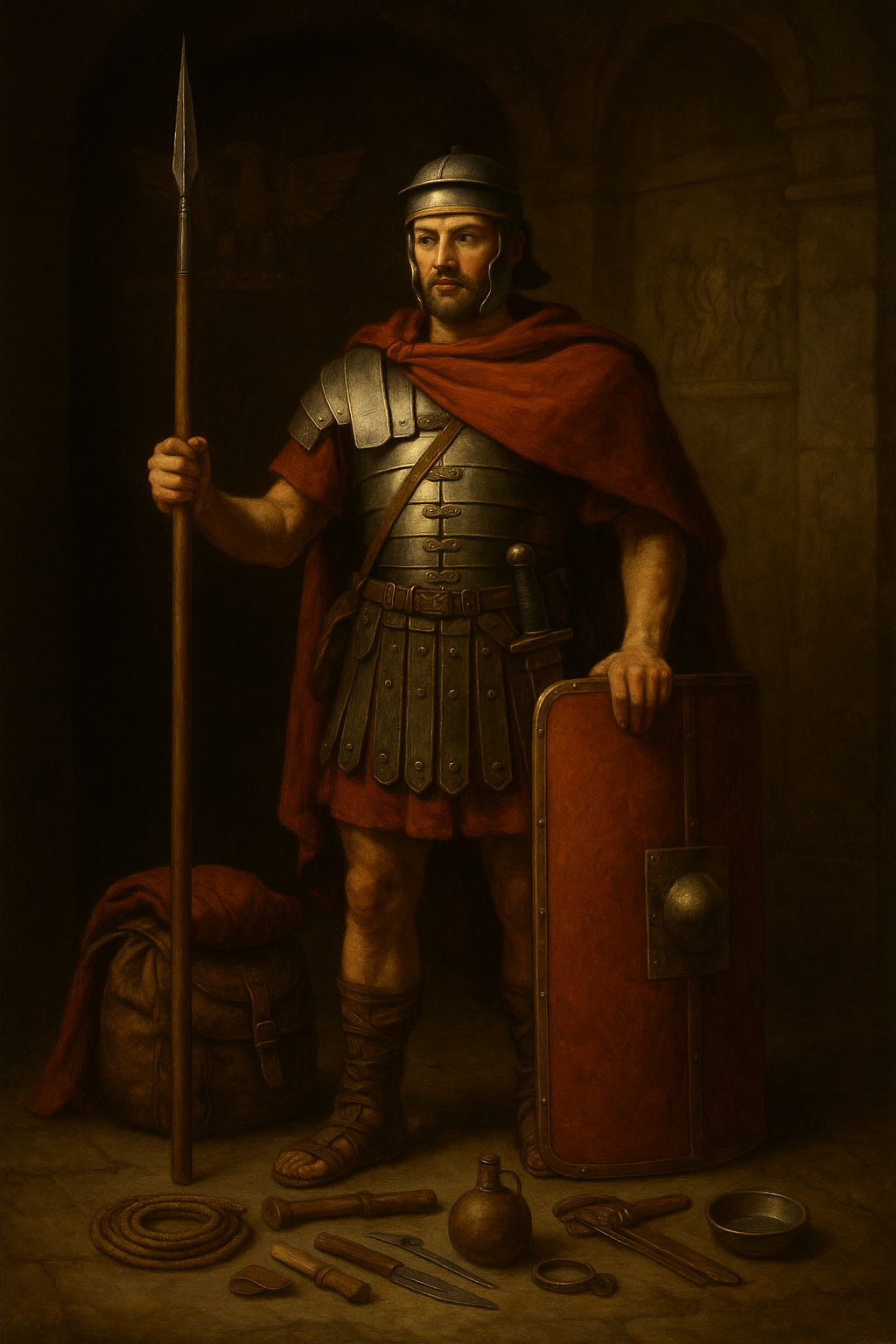
Legionary
“A man is not counted among the people until he has carried the shield of the Legion, marched the road of exile, and returned bearing either scars or honour. Such is the price of civilisation.”
To speak of a Legionary is to speak of the Imperium itself. For eight centuries the Legions have been the hammer and shield of human civilisation, tempered first by the Rift, then by the endless borders of this stitched-together world. Every male citizen, upon reaching his eighteenth year, walks the road to the castra and dons the red cloak of service unless the gods have marked him for magic or a master has claimed him for apprenticeship. Some complete their term and return to civilian life; others remain and become the professional backbone of the Empire’s might.
A legionary is more than a soldier. He is a symbol of discipline, unity, and order in a land where foreign peoples, hostile realms, and ancient powers press upon every horizon. Whether posted to the frozen eastern shores to watch the sea for Jotun sails, or marching the dusty southern marches where Centaur raids are rare but swift, or bracing against the brutal northern frontier where the Warborn test the walls each generation, the legionary stands as the Empire’s constant. His presence is both reassurance to the loyal and a quiet warning to the restless.
While magic is rare and seldom seen within their ranks, the Legions are shaped by centuries of conflict in a world where dwarven iron, elven precision, and centaur swiftness have all left their marks. Drill, skill, endurance, and iron discipline bind the ranks far tighter than any spellwork ever could. The Legionary remains the archetype of Imperial service: steadfast, unyielding, and eternally marching toward the next horizon.
Career
Qualifications
The path to the legionary’s shield begins not with privilege, but with duty. By Imperial law, all male citizens upon reaching their eighteenth year are required to present themselves for service unless they have already been taken into apprenticeship or have demonstrated the rare gift of magic. This universal levy forms the backbone of the Legions, ensuring that every generation shares in the discipline and hardship that bind the Empire together.
Female citizens, while not subject to the levy, may elect to serve. Those who do are held to the same standards of strength, endurance, and discipline as their male counterparts and often distinguish themselves in roles requiring precision, resolve, and adaptability. Though fewer in number, their presence in the ranks is respected and entirely institutionalised; service is service, and the shield cares not for the hand that bears it.
All recruits—conscripts and volunteers alike—undergo rigorous trials upon arrival at the castra disciplinae. Physical endurance, long-march tolerance, and weapons aptitude are tested relentlessly. Those who falter are not dismissed, but hammered into shape through a training regimen famed for its merciless efficiency. Literacy is not required at entry; many recruits learn their letters only once inside the Legions, which maintain a long tradition of educating soldiers for command and civic life.
Beyond conscripts, the Legions also accept professional volunteers, men and women who choose the soldier’s life and remain well beyond their obligated term. These career soldiers form the institutional memory of the Legions—its centurions, its engineers, its scouts, and its hardened veterans.
Yet the truest qualification is spoken in every training yard from Novaium to the northern frontier:
“A legionary must stand when others break.”
Career Progression
A legionary’s journey follows a path both rigidly structured and shaped by the crucible of the frontier. Though every citizen begins with the same red cloak and wooden training sword, the roads they walk from that moment can diverge sharply depending on talent, discipline, and the whims of war.
Recruit (Tirō)
All conscripts and volunteers begin as tirones, enduring months of unrelenting drill within the castra disciplinae. Here they learn formation combat, shield discipline, endurance marching, basic engineering, and camp craft. Only upon passing their final trials—the March of Endurance and the Trial of Shieldwall—are they granted full legionary status.
Legionary (Legionarius)
The standard soldier and beating heart of every cohort. Most serve the mandatory term, rotate through multiple frontier posts, and return to civilian life with honour. Those who show aptitude may be assigned to specialist duties.
Specialists (Immunes)
Legionaries who demonstrate skill beyond common drill may be elevated to immunes—soldiers exempt from the harshest labour due to their specialised roles. These include engineers, medicae, armourers, sappers, scouts, signallers, scribes, drillmasters, logistics handlers, and handlers for dwarf-forged machinery. This class forms the technical spine of the Legions.
Junior Leaders (Principales)
From the immunes arise the principales—optios, signifers, tesserarii, and other junior officers who maintain discipline and communicate command within the cohort. Their promotion requires both battlefield reliability and the respect of their peers.
Centurion Path (Centurio)
The centurion is the backbone of command: feared, respected, and often harder than the iron he carries. A centurion may command anywhere from a tent-group to an entire century. Most professional soldiers aspire to this rank, though few have the endurance, presence, and stubborn will required to attain it. Centurions often serve decades and become legends within their legions.
Senior Officers
Beyond the centurionate lie the ranks of:
- Pilus Prior (senior centurion of a cohort)
- Tribunus (tribunes, often drawn from noble families or decorated veterans)
- Legatus (legate, commander of a legion)
These officers blend political literacy with battlefield command—a balance that has shaped the Empire’s fortunes for centuries.
Retirement & Post-Service Roles
Upon completing 10 years of service, soldiers are entitled to:
- Frontier land grants, forming the backbone of Imperial settlement in contested regions.
Professional soldiers and officers who serve longer terms often transition into:
- Local governance
- Provincial administration
- Magistracies
- City guard command
- Senatorial advisory positions
Thus, the Legion is not merely a military career—it is a ladder into the administrative machinery of the Imperium Novum.
Payment & Reimbursement
Service in the Legions is not a path to wealth, but neither is it a life of poverty. The Empire pays its soldiers with a mixture of coin, security, and long-term opportunity—each calibrated to reinforce loyalty and ensure the Legions remain both functional and aspirational.
Base Pay
A standard legionary receives a modest stipend, paid monthly from the Imperial treasury. This sum is enough to maintain equipment, purchase small comforts, and send a portion home if desired. The pay of conscripts and volunteers is identical at first, though professional soldiers receive incremental increases tied to years of service and battlefield reliability.
Specialist & Rank Supplements
Those who advance into specialist roles (immunes) receive additional payment in recognition of their technical skills or administrative responsibilities. Junior leaders (principales) earn higher stipends still, as do centurions whose authority and burdens far exceed those of the common soldier.
Senior officers draw competitive salaries appropriate to their political responsibilities, though many gain more from influence and patronage than from coin.
Campaign Rewards
During active campaigns, soldiers may claim:
- Field allowances for extended marches
- Bonus pay for confirmed service in high-risk regions such as the northern frontier or the Jotun-threatened coasts
- Shares in spoils—though this is tightly regulated and far less generous than in the Imperium’s early centuries
Provisioning
In addition to coin, legionaries are issued:
- Rations
- Standard gear
- Replacement equipment at subsidised cost
- Access to the castra’s armourers, medicae, and supply depots
These provisions free soldiers from the day-to-day financial burdens of survival.
Long-Term Rewards
The true financial boon lies not in monthly pay but in retirement entitlements:
- Frontier land grants for those completing a full term of ten years
- Tax privileges in frontier regions
- Priority access to loans and guild memberships
- Officers are eligible for government appointments, which carry salaries far higher than anything earned in the field
Thus, the Legion rewards endurance, ambition, and loyalty—not merely time spent under the standard.
Other Benefits
While the legionary’s stipend is modest, the true rewards of service lie in the honour, privileges, and lifelong advantages granted to those who bear the Empire’s shield. These benefits form the cultural backbone of the Legion system, reinforcing the idea that military service is both a duty and an opportunity.
Civic Honour
Completing one’s mandatory service marks a citizen as having fulfilled his obligation to the Empire. Legion veterans are respected across all provinces; among frontier towns and rural communities, their presence carries particular weight. Merchants give them nods, magistrates treat them with courtesy, and guilds value them for their discipline and reliability.
Frontier Land Grants
The greatest benefit for the common soldier is the land grant awarded after ten full years of service. These parcels—situated along expanding or contested borders—create new generations of citizen-farmers whose loyalty is rooted in soil earned through endurance and hardship. These frontier settlements often become tight-knit communities bound by shared service.
Veteran Privileges
Retired legionaries enjoy:
- Reduced taxes in frontier territories
- Access to veteran clinics staffed by medicae trained to treat old campaign injuries
- Priority in civic disputes, their testimony weighted heavily due to their proven discipline
- Training rights, allowing them to instruct local militias or castra recruits for additional income
Pathways to Advancement
For officers and long-term professionals, the Legions provide a stepping stone into the machinery of state:
- Local governance
- Provincial bureaucracies
- Command of city watches
- Advisory roles to senators or governors
- Appointment to the expanding frontiers as lords, administrators, or envoys
Camaraderie & Identity
Many veterans speak of an intangible benefit—the unbreakable bond shared with those who marched the long roads beside them. This fellowship often leads to lifelong friendships, business partnerships, and political alliances. In the Empire’s more distant provinces, the Legion’s alumni networks often hold communities together.
Protection Under Imperial Law
Assaulting a serving legionary carries severe penalties. Veterans likewise enjoy legal protections recognising their status as servants of the Empire. This “shield of the state” ensures that even long after retiring, their service is remembered and defended.
Perception
Purpose
The legionary exists to serve as the Imperium’s enduring instrument of stability, expansion, and civil order. In a world stitched together by the unpredictable will of the Rift, the Legions stand as the Empire’s answer to uncertainty—a disciplined force capable of meeting threats mundane or extraordinary.
Guardians of the Frontier
The most visible purpose of the legionary is to hold the line.
From the northern ramparts staring down the Warborn, to the storm-lashed eastern coasts where Jotun longships prowl the horizon, legionaries form an unbroken chain of vigilance. These outposts are the first and often the only barrier between civilisation and chaos.
Builders of Empire
A legionary’s task is not solely to fight. When the Empire expands its frontiers or restores lands ravaged by conflict, it is the Legions who build the roads, bridges, watchtowers, and forts that anchor Imperial rule. Their engineering traditions—honed across centuries and enriched by dwarven exchange—form the backbone of the Empire’s infrastructure.
Keepers of Civil Order
Within the provinces, legionaries act as a stabilising presence. They:
- Support local authorities during unrest
- Escort caravans through dangerous territories
- Enforce Imperial edicts when necessary
- Reinforce city garrisons during festivals or political tensions
Their discipline and training make them the Empire’s most reliable instrument in times of uncertainty.
Symbol of Unity and Authority
Beyond their practical duties, the legionary is a living emblem of Imperial identity. His red cloak and iron discipline remind citizens that the Empire endures because ordinary men and women stand ready to defend it. To allies, the Legions signal commitment; to enemies, they signal restraint backed by unyielding steel.
Reservoir of Future Leaders
Because service is ubiquitous among male citizens—and optional but respected among women—the Legion provides a reservoir of trained, disciplined individuals who later shape the Empire’s bureaucracy, frontier administration, and civic life. Many of the Empire’s most capable governors, magistrates, and engineers once bore a scutum.
The Empire’s First Answer to the Unknown
With each new Rift event, strange lands, peoples, and beasts arrive without warning. It falls to the Legions to investigate, secure, and, if necessary, pacify these emergent territories until diplomatic or arcane authorities can assess them. A legionary must be as adaptable as he is disciplined.
Social Status
Within the Imperium Novum, few callings command as much respect—or expectation—as that of the legionary. Service in the Legions is woven so tightly into the fabric of citizenship that a man who has not marched beneath an Imperial standard is often regarded as unfinished, a citizen in potential rather than in full.
Honoured by the Citizenry
Legionaries, both serving and retired, are held in high esteem across all provinces. Their discipline, sacrifice, and shared hardship form the backbone of Imperial identity. In rural frontier towns, a veteran’s word can quiet a tavern; in the great plazas of Novaium, citizens instinctively make way for the passing of a century on the march.
Expectation of Conduct
This respect comes with weight. Legionaries are expected to embody the virtues of the Empire:
- discipline
- loyalty
- restraint
- courage
A legionary who disgraces himself tarnishes not only his cohort but the institution itself. The Empire is swift and unforgiving in correcting such stains.
Women in the Ranks
Female legionaries, though fewer, enjoy equal respect. Their voluntary service is often viewed as a mark of exceptional resolve. In some provinces, they are celebrated as exemplars of civic virtue.
Professional Soldiers as a Class
Career legionaries—those who remain after their mandatory term—form a distinct social stratum. They are seen as pillars of stability, men and women who choose duty over comfort. Centurions in particular occupy an almost mythic status: half-warrior, half-judge, wholly unyielding.
Veterans as Founders of Frontier Society
Retired legionaries are the lifeblood of frontier communities. Their land grants give rise to disciplined settlements, fortified farmsteads, and civic leadership. Many frontier governors and magistrates began as legionaries, and their steady influence is often credited with preventing border provinces from descending into chaos.
Viewed by Foreign Peoples
Among allied or neutral peoples, legionaries are respected—sometimes feared—for their orderliness and relentless resolve. Among hostile realms, they are the symbol of Imperial reach, the red-cloaked line that stops expansion or drives it forward.
Demographics
The legionary profession touches nearly every corner of Imperial society, owing to the universal levy and the Empire’s vast network of frontier garrisons. While the precise strength of the Legions fluctuates with political needs and border tensions, several broad patterns define their demographic makeup.
A Citizen Army by Design
Because all male citizens aged eighteen must serve—unless exempted by magic or apprenticeship—the Legions draw from every class and province of the Empire. Sons of farmers train beside sons of merchants, noble scions beside dockworkers. This shared service is one of the great social equalisers of Imperial life.
Female Volunteers
Though not required to serve, female legionaries form a small but respected minority. Their numbers vary by province—higher in the disciplined northern territories, lower in the agricultural south—but their presence is fully established within the institutional structure.
Scale of the Legions
At any given time, the Empire maintains:
- Dozens of legions at varying strengths
- Typically 4,000–6,000 soldiers per legion, depending on frontier needs
- A combined force numbering between forty and sixty thousand active legionaries, with additional reserves and support staff
This means roughly 1–2% of the Empire’s population is on active military duty at any moment, with a far larger percentage being veterans or former conscripts.
Geographic Spread
Legionaries are dispersed across:
- Northern Warborn frontier forts
- Eastern coastal defence lines
- Southern Centaur-border watchposts
- Western desert garrisons facing the Brass Cities
- Provincial capitals, road networks, and strategic castra
- The central mustering grounds near Novaium for training and rotation
The rotation system ensures no region becomes culturally isolated or overly militarised, and it exposes legionaries to the full breadth of Imperial territory.
Non-Human Presence
While the core ranks remain overwhelmingly human, a small demographic footprint exists for:
- Halfling naval personnel (rare in the Legions proper)
- Dwarven exchange cohorts
- Elven scouts
- Centaur outriders
These auxiliaries typically form less than 5% of any legion’s strength and retain their own cultural traditions while training under Imperial standards.
Veteran Population
Because service is ubiquitous and grants long-term rewards, veterans form a substantial and influential segment of Imperial society. Entire frontier settlements are composed largely of former legionaries and their families, creating pockets of disciplined, cohesive communities across the Empire.
History
The history of the legionary in Exilum Novum begins eight centuries ago, when the Nova Provincia of Rome—its fields, villages, and one fully mustered legion—was torn from Old Earth and cast into this world by the first Great Rift. The men who marched beneath that original standard found themselves surrounded not by familiar provinces, but by alien forests, strange peoples, and vast tracts of unclaimed land. It was in these early, uncertain years that the profession of the legionary was both preserved and transformed.
The First Years: Holding the Line Against the Unknown
In the immediate aftermath of the Rift, the surviving Roman structures—legal, military, and civic—became the Imperium’s foundation. The original legion, suddenly responsible for defending an entire province in an alien world, found its duties expanded beyond anything its predecessors had known. Legionaries patrolled wild borders, confronted strange beasts, and enforced order in towns unsettled by the cataclysmic shift. It was during this period that the universal levy was first implemented, born of necessity rather than ideology.
The Frontier Wars and Integration of New Peoples
As contact with Elves, Dwarrow, and the emerging Warborn tribes intensified, the profession evolved. Early clashes against the Orcs and Goblins taught the Imperium that disciplined formations could hold against overwhelming numbers—but only with adaptation. Tactics shifted, shields were reinforced, armour refined, and training became harsher. Dwarven smiths introduced new metalworking techniques, while Elven scouts offered insights into forest warfare. These influences shaped the legionary of later centuries, broadening his repertoire beyond Old Earth doctrine while preserving its core.
The Age of Expansion and the Rotation System
With the Empire’s borders gradually stabilising, the Legions adopted a rotational system, moving cohorts between the Warborn frontier, coastal guard duties, and calmer southern and western regions. This not only prevented stagnation, but exposed legionaries to the full breadth of the Empire’s challenges—from endless northern sieges to the quiet vigilance of Brass Cities watchposts. The rotation system became a defining feature of the profession, embedding resilience and flexibility into its culture.
The Professionalisation Era
As generations passed, the distinction between conscript and career soldier became formalised. The Legions evolved from a necessity-born militia into a professional institution with rigorous training academies, specialised roles, and clearly defined ranks. The rise of professional soldiers filled the gaps left by short-term conscripts and provided continuity across campaigns. Centurions and officers emerged as influential figures whose authority extended far beyond the battlefield.
Modern Legions: Adaptation Without Magic
Though magic exists within the world, its rarity—and the Empire’s reserved attitude toward it—means the legionary profession remains grounded in discipline and steel rather than sorcery. Magic users are exempt from standard service, leaving the Legions proud of their reputation as an institution built on mortal skill alone. This has become a cultural point of pride: the Empire may have wizards and augurs, but its borders are held by flesh, will, and iron.
Legacy Across the Empire
Today, the legionary stands as one of the most enduring symbols of Imperial authority. The profession’s history is etched into every frontier settlement founded by veterans, every road laid by marching cohorts, and every tale told by old soldiers still bearing their scars. It is a profession inherited from another world yet perfected in this one—a fusion of Roman discipline and the hard lessons of Exilum Novum.
The legionary profession is fully legal, state-mandated, and tightly regulated by Imperial law. Service is compulsory for eligible citizens, and desertion, refusal, or misconduct are punished severely. Only magic users and approved apprentices are exempt from the levy.

Comments