
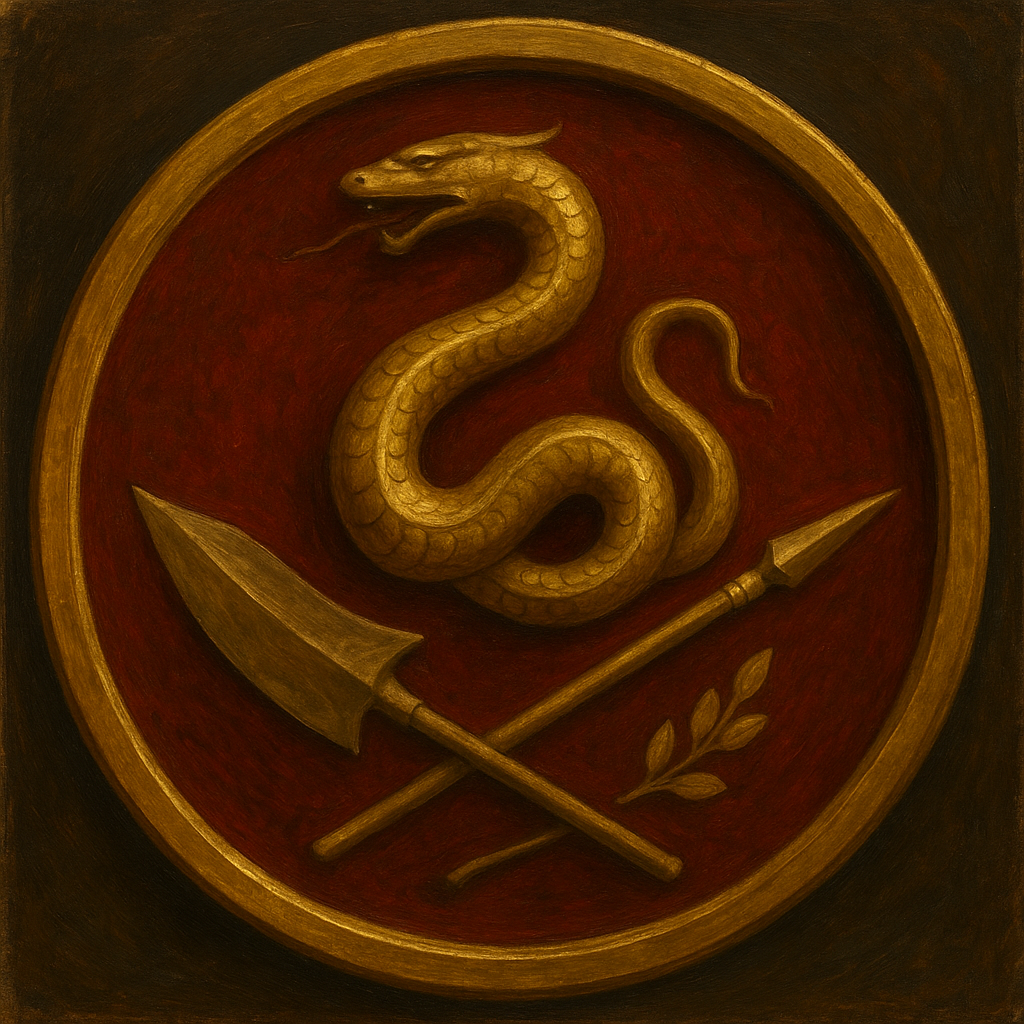
House Draconis
“The Empire endures because its sons stand.”
House Draconis is a newly ascended family from Eutropomia, the Empire’s poorest and least populated province — a harsh borderland pressed between the Warborn clans, the Brass Cities, and the roaming territories of the Horse-Lords. Life in Eutropomia is defined by scarcity, vigilance, and the constant hum of distant conflict. It is a province that produces few nobles, fewer scholars, but more than its share of hardened soldiers. The Draconis family was once typical of this land: subsistence farmers with proud calluses, lean harvests, and a generational instinct to sleep lightly and keep steel close.
Marcus Valerius Draconis was born on a small plot of wind-scoured farmland near Eutropomia’s northern border with the Warborn, where raids were a seasonal certainty and legion patrols the only semblance of stability. His early years were shaped not by privilege but by endurance — repairing fences after night raids, escorting livestock under armed watch, and watching neighbours vanish into the long shadows of the frontier. Service in the legions was not a calling for Eutropomians; it was the only path upward that did not involve a shovel and a prayer.
Marcus’s rise through the ranks shocked the aristocracy and electrified the provinces. His discipline, tactical clarity, and unyielding calm under pressure quickly set him apart. Campaign after campaign carried his reputation further than the narrow roads of his homeland ever had. When he was appointed Magister Legionum, the Senate could no longer pretend his family were mere frontier farmers. In recognising his achievement, they elevated House Draconis into the imperial register, granting a name weight that no Draconis before him had ever imagined carrying.
Today, House Draconis remains small, humble, and unmistakably shaped by its Eutropomian roots. Their homestead has grown but is still closer to a fortified farmstead than a noble villa. They favour practicality over ceremony, duty over display. To common citizens — especially those in the border provinces — they represent the very best of the Empire: proof that greatness can rise from the margins. To the old noble houses, they are a reminder that power earned through merit is far harder to manipulate than power inherited.
House Draconis is, in every sense, a frontier family that has stepped into the heart of the Empire without ever forgetting the feel of dust, hunger, or danger at its back.
Culture
House Draconis embodies the austere, duty-bound ethos of Eutropomia, where survival has always depended on vigilance, discipline, and the willingness to stand one’s ground. Their values were shaped long before elevation: early mornings in barren fields, nights spent listening for Warborn war-cries drifting across the wind, and a lifetime of watching legion shields determine whether a village lived to see another season.
The house prizes honesty, endurance, and humility, viewing noble privilege with wary suspicion. Rituals are simple, often tied to old frontier customs — offerings to honour the fallen, communal meals after hardship, and the tradition of repairing one’s own gear no matter one’s station. They maintain close bonds with the legions and with the small farming communities that raised them, believing that nobility should reflect service, not separation.
To enter House Draconis is to inherit not wealth but responsibility: the expectation to act with steadiness under pressure, to speak plainly, and to place the Empire’s safety above personal ambition. Even as their name grows in influence, their culture remains rooted in the border soil that forged them.
Assets
House Draconis commands only modest material wealth. Their principal holding is the fortified family homestead in northern Eutropomia, a weather-beaten farmstead strengthened over generations to withstand raids from the Warborn and the harshness of frontier life. Although the family has been elevated to noble status, they have not yet acquired the broad estates, villas, or urban properties typical of the older patrician houses. What resources they possess remain practical rather than prestigious.
The household’s income derives largely from the senatorial stipend granted upon their elevation and from the honours attached to Marcus Valerius Draconis’s position as Magister Legionum. These funds are often reinvested into the upkeep of their ancestral land and the support of families of fallen soldiers. The house is served by a small retinue composed mostly of retired legionaries and longstanding Eutropomian neighbours who have taken on roles as guards, aides, or stewarding staff.
Though their material assets are modest, House Draconis enjoys considerable intangible capital: the trust of frontier communities, the respect of the legions, and the influence that naturally accompanies the Empire’s highest military office. In many ways, their greatest asset is the reputation Marcus has forged — a currency more enduring than gold and far harder for rivals to challenge.
History
The origins of House Draconis lie in the rugged fields and broken hills of northern Eutropomia, where the family lived for generations as humble frontier farmers. Their ancestors served intermittently in the legions, not out of ambition but necessity, answering the call whenever Warborn raids threatened to collapse the thin line that separated Imperial soil from chaos. For most of its existence, the family bore no crest, claimed no lineage, and held no expectation of rising beyond the life the province allowed.
The turning point came with the birth of Marcus Valerius Draconis, whose childhood was shaped by the constant tension of the frontier. His early familiarity with hardship and vigilance made him a natural fit for military service, and he entered the legions at the earliest opportunity. What followed was a steady, relentless ascent. Marcus distinguished himself in a series of campaigns along the northern marches, earning a reputation for clarity of command, unshakable discipline, and an incorruptible loyalty to the Empire. His leadership during several critical engagements prevented the collapse of Eutropomian border towns and ensured the stability of a region long considered a liability.
By the early 740s NE, his record had become impossible for the Senate to ignore. When the position of Magister Legionum fell vacant, Marcus was appointed by near-unanimous vote — an event unprecedented for a man of his provincial and unadorned background. In recognition of his service, the Senate issued a formal decree elevating the Draconis family to noble status, marking 742 NE as the foundation of House Draconis.
Since their elevation, the family has remained deliberately modest, expanding their homestead only enough to accommodate new responsibilities and visitors from Nova Roma. They have not pursued political alliances or sought to entrench their status through marriage or wealth. Instead, they continue to define themselves by the virtues that carried Marcus from farmer’s son to the Empire’s highest military office: duty, restraint, and service without expectation of reward.
House Draconis thus stands as one of the rare noble houses forged entirely through merit — a reminder that, even in an Empire shaped by ancient lines and arcane legacies, greatness may still rise from the dust of the frontier.
Infrastructure
The physical footprint of House Draconis is small, shaped far more by frontier necessity than noble ambition. Their principal holding remains the Draconis Homestead in northern Eutropomia, a fortified farmstead built of stone, timber, and decades of pragmatic repair. The structure was never intended to impress; it was built to endure. Thick walls, reinforced shutters, and a central watch-tower speak to its origins during years when Warborn raiding parties frequently tested the border. What began as a simple farmhouse has, over generations, grown into a compact defensive complex capable of sheltering neighbouring families during times of danger.
Since the family’s elevation, modest improvements have been made. A small administrative hall now adjoins the original structure, allowing Marcus’s aides and visiting officers to conduct business without disrupting the daily life of the household. A stableyard has been expanded to accommodate legion remounts and courier horses, and the rough track leading to the homestead has been widened just enough for supply wagons.
Beyond the homestead, House Draconis controls no additional estates, villas, or urban holdings. They rely on Imperial roads, legion supply stations, and provincial outposts rather than maintaining their own network of infrastructure. This simplicity reflects both their practical identity and their conviction that noble status should not sever their connection to the land and people who shaped them.
As a result, the infrastructure of House Draconis is less a display of wealth than a portrait of resilience: solid, functional, and unmistakably Eutropomian.

Comments