

Imperian
“Where law endures, where duty binds, where the Rift itself bowed to mortal will — there stand the Imperians.”
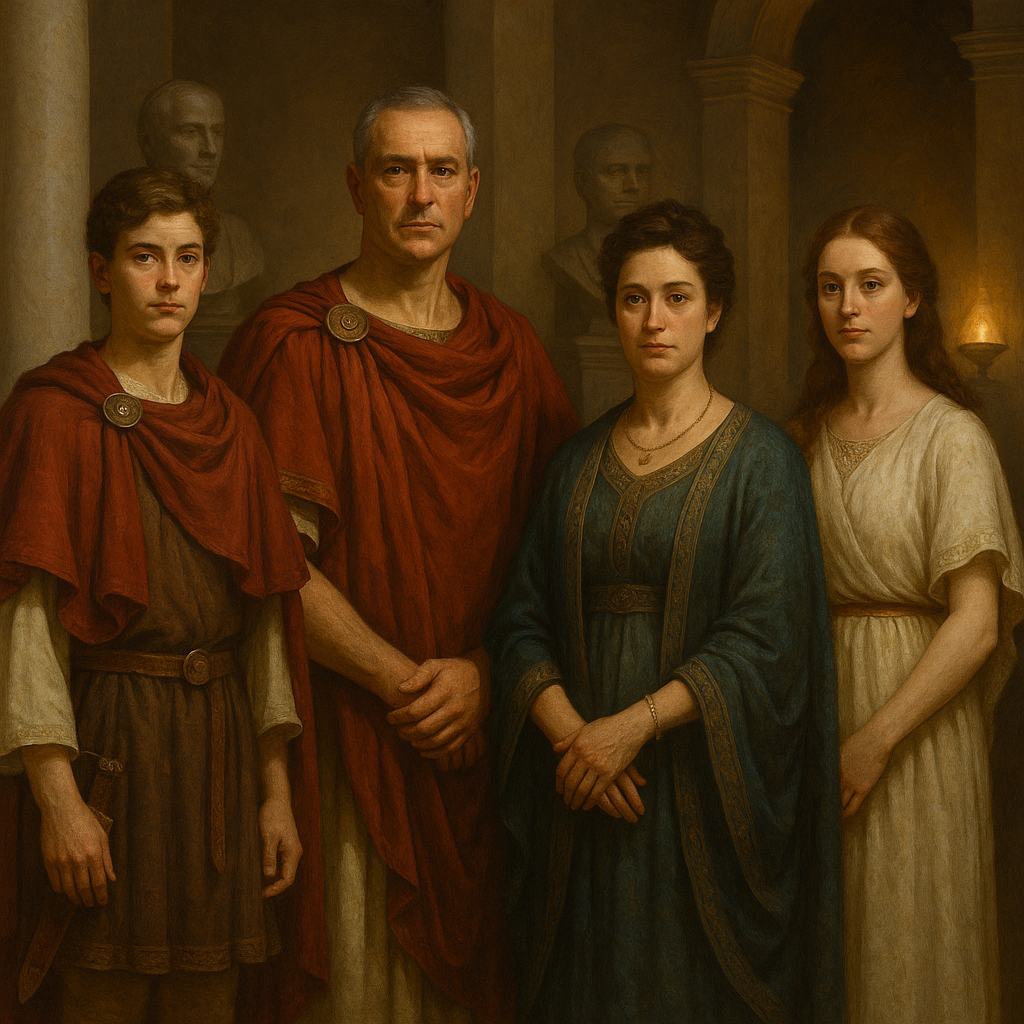
The Imperians are the rift-born descendants of the Roman Latinate people who arrived eight centuries ago with the translocated Nova Provincia. In the years since their arrival, they have forged one of the most formidable political and cultural entities of Exilum Novum: the Imperium Novum. Though shaped by foreign lands and foreign peoples, the Imperians remain unmistakably heirs to Rome — pragmatic, disciplined, reverent of order, and steadfast in their conviction that civilisation is a thing to be built brick by brick, law by law, oath by oath.
Their culture, like their Empire, has endured war, frontier hardship, arcane upheaval, and countless diplomatic entanglements. Yet the defining character of the Imperians is not simply survival, but adaptation without surrendering identity. They have borrowed architectural refinements from the elves, metallurgical methods from the dwarrow, maritime navigation from the halflings, and arcane theory from generations of Rift-born scholars — yet every influence is filtered through the stern civic lens of Imperian tradition.
Imperians hold three ideals above all: duty, family, and the state. A citizen's first obligation is to the Empire; the second to one’s household; all other loyalties arrange themselves beneath these pillars. Stoicism and self-control are praised, though never at the expense of resolve. Their martial heritage endures not only in the legions but in the rhythms of daily life: civic service, disciplined study, rigorous training, and the ever-present expectation that each generation must preserve the strength of the next.
Magic, though never commonplace, has become woven into the Imperian self-image much as engineering once was in Old Rome. Arcane talent is treated as an honoured gift — regulated, respected, and channelled through formal institutions such as the Collegium Arcanum and the Phoenix priesthood, rather than seen as chaotic or mystical. The Rift itself is regarded not merely as a cosmic anomaly, but as the crucible that reshaped their destiny.
Regionally, Imperians vary in temperament and customs. The warborn frontier of the north produces hardy, battle-tempered communities; the northwest, with its proximity to elves and dwarrow, is noted for scholarship and artistry; the halfling-busy western coast is prosperous and urbane; the southern provinces blend Imperian values with equestrian frontier culture; and the desert-border east is known for its stoicism and curious fascination with distant lands. Yet across all provinces, the Imperians share a common heritage, language, and civic spirit — a unified ethnicity that has begun, only subtly, to diverge into regional strands.
Wherever they dwell — from the marble avenues of Novaium to the windswept northern ramparts — the Imperians perceive themselves as the inheritors of a grand duty: to maintain order in a world shaped by chaos, to illuminate the wilds with law, and to shepherd the Empire toward a future worthy of its Rift-forged origins.
Naming Traditions
Feminine names
Imperian feminine names retain their classical roots — elegant, dignified, constructed for clarity of pronunciation in Lingua Imperialis. Common names include Livia, Julia, Marcellina, Sabina, Domitia, Aelia, and Tullia. Rift-influenced names such as Aetheria or Luceris appear among magically gifted families, though traditionalists still favour the older forms.
Unlike pre-Rift Rome, however, Imperian women are not confined to diminutives of their father’s nomen. The societal shift following the Second and Third Rifts broadened expectations: women who distinguish themselves in civic, arcane, or military service often receive personalised cognomina. Names such as Aelia Flammarion or Sabina Riftalis appear in the records of the Arcanii and the Senate, signalling not marital ties but merit.
In the north and on the southern plains, feminine names may incorporate local geographical elements — Valina Nordis or Cassia Equestra — reflecting the growing regional distinctions within the wider Imperian identity.
Masculine names
Masculine names follow long-established forms such as Gaius, Marcus, Lucius, Titus, Publius, Quintus, Varian, and Septimus. Frontier provinces often favour stronger, monosyllabic names like Brannus or Cassor, a linguistic hardening shaped by constant warborn threat.
Men with arcane heritage frequently bear names invoking celestial or Rift-based imagery: Solian, Caelus, Aetheron, and Ignarus are not uncommon among Arcanii families or those with Rift-marked ancestry.
Cognomina retain their classical function: to denote achievements, personal virtues, or recognisable traits. A man celebrated for holding the northern line may bear the title Castor Murus, while a scholar of the Rift might earn Lentius Aetheri. In rare cases, a magically distinguished citizen may receive an agnomen formalised by senatorial decree — one of the few naming practices unchanged since Old Rome.
Unisex names
Some names have emerged as broadly unisex over the centuries, shaped by linguistic simplification, military necessity, and contact with other cultures. Names like Floris, Cassis, Lorian, Arion, and Rexis appear across all genders, especially in western coastal regions where trade and multicultural mixing have softened traditional boundaries.
Arcane-influenced households also favour unisex names when a child’s magical aptitude is foreseen or hoped for, believing such names align better with the fluidity of Rift energies.
Family names
Imperian family names follow the classical structure inherited from their Roman Latinate ancestors, yet eight centuries in Exilum Novum have given rise to subtle evolutions. A traditional Imperian name consists of praenomen → nomen → cognomen, with an optional agnomen granted for exceptional service, arcane merit, or frontier distinction.
The nomen, or clan-name, remains the heart of Imperian identity. Ancient Rift-borne houses such as Aurelius, Valerius, Cornelius, Fabius, and Severinus continue to command prestige, though the centuries have birthed new lines forged in the Empire’s foreign campaigns, magical orders, or frontier settlements. Names like Draconis (dragon-marked lineage), Montelucis (from the mountain lights of the northwest), and Riftarius (descendants of early Rift scholars) have entered common use.
Cognomina tend to reflect personal qualities or deeds — Ferrum, Solarius, Justus, Castellan, Varro — while frontier families may bear harsher epithets derived from local geography or warborn incursions. Meanwhile, the growing influence of dwarven craftsmanship and halfling trade has introduced a small number of “adopted” cognomina honouring old alliances, though these are always rendered in Imperialis form to maintain cultural coherence.
Though family names hold weight, the Imperians still regard citizenship as the true marker of belonging. Freedmen, foreign-born allies, and long-settled auxiliary lines can earn imperially recognised nomina after generations of service, echoing the ancient Roman custom of integrating worthy peoples into a greater whole.
Other names
Regions with strong external contact have developed additional naming quirks:
- Northwest Provinces (Elven & Dwarrow Influence):
Some families adopt poetic or compound cognomina inspired by elven naming aesthetics (Lunaris, Verdantia), or dwarrow place-based names rendered in Imperialis (Monticulus, Ferradun). - Western Coastal Cities (Halfling Maritime Influence):
Sailors and merchants often pick up informal bynames — Stormhand, Keelborn, Tidewalker — though these rarely enter formal registers. - Southern Plains (Centaur Border):
A few frontier families have adopted horse- or wind-themed cognomina (Equester, Ventarus), reflecting long exposure to steppe culture. - Eastern Desert Frontier (Brass Cities Influence):
Subtle linguistic borrowings appear as soft consonants, rhythmic vowel patterns, or brass-inspired epithets (Aureonas, Radiantus, etc.) among traders and diplomats.
None of these override the core Roman structure, but all demonstrate the Imperians’ distinctive habit: they adopt, never imitate. They absorb, never lose themselves.
Culture
Major language groups and dialects
Although all Imperians learn the formal register of Lingua Imperialis, the spoken tongue varies across the provinces. In the northern frontier the language becomes clipped and pragmatic, shaped by centuries of military vigilance and dwarrow engineering influence. The northwest, blessed by peaceful centuries among elves and dwarves, has developed a refined cadence with softened vowels and a precise academic tone. Along the western coast the speech is more musical and fluid, reflecting the lively trade with halfling sailors and the bustling commerce of the Inland Sea. The southern plains produce a broader, more rhythmic flavour of Imperialis, echoing the lilt of Centaur trade pidgins, while the eastern desert frontier speaks with the careful rises and falls of caravan patterns, marked by quiet borrowings from the Brass Cities. Despite these variations, all dialects remain compatible with one another, and the Senate actively promotes linguistic unity as a cornerstone of civic identity.
Culture and cultural heritage
Imperian cultural heritage is the conscious continuation of Roman tradition, reshaped by eight centuries of foreign influence and arcane reality. The Imperians see themselves as custodians of civilisation in a world defined by chaos. Their history is taught not as a distant curiosity but as a living inheritance: the Rift-born ancestors who endured the Transition, the early emperors who forged structure from confusion, and the philosophers and mages who married Roman law with Rift-touched arcana.
Although deeply pragmatic, Imperians are not without appreciation for beauty or refinement. Theatrical performances remain common in western coastal cities, while oratory and formal debate thrive in the capital. Regional variation enriches their identity: the northwest cherishes elven-inspired scholarship; the south preserves horse-lord border traditions; and the cities of the Inland Sea have cultivated a vibrant blend of halfling commerce and Imperial civic decorum.
A stratified social order persists, with highborn families tracing their lineage back to Rift-born patrician stock or ancient military distinction. These families often regard themselves as the natural stewards of the Empire. Lowborn citizens can rise through service or exceptional merit, but the cultural memory of rank remains strong enough that subtle—and sometimes unsubtle—social distance persists. Yet the Imperian ideal is clear: nobility is proven by conduct and contribution; inherited privilege means little without earned honour.
Shared customary codes and values
Imperian values reflect a balance between Roman severity and Rift-shaped adaptability. Duty, dignity, and discipline remain the anchors of moral life. Citizens are taught from childhood that an individual’s worth is measured not by birth alone but by the earnest fulfilment of one’s obligations. Wealth is neither envied nor despised so long as it is honestly gained; the Empire admires industry and resourcefulness, and a prosperous household is seen as a sign of disciplined stewardship.
Despite this meritocratic ideal, the caste-like distinction between highborn and lowborn remains embedded in social interaction. Highborn families carry themselves with a sense of inherited responsibility—though in practice this sometimes manifests as aloofness or superiority. Still, the cultural code demands mutual respect; arrogance is tolerated only when paired with demonstrable competence.
Imperians believe that civilisation is a delicate order built upon countless small acts of honour. Truthfulness, restraint, and careful thought are considered marks of a trustworthy citizen. Even in the humblest villages, these expectations shape conduct as tangibly as any law.
Average technological level
Imperian technology stands at an intersection between Roman engineering and the innovations gained through centuries of cultural exchange. Their civil infrastructure rivals that of any civilisation in Exilum Novum: aqueducts spanning valleys, monumental roads carved through difficult terrain, fortified cities with dwarrow-strengthened foundations, and extensive administrative systems that ensure the Empire functions even in times of upheaval.
Steelworking has advanced considerably under dwarrow influence. Imperian armour and weaponry are renowned for their balance of durability and elegance, and their siege engines are feared for precision and reliability. In the coastal west, halfling shipwright mastery has blended with Imperial naval tradition, producing swift, sturdy vessels capable of long voyages across uncertain seas.
The greatest divergence from Old Rome, however, lies in the integration of arcane augmentation. While magic remains tightly regulated, its controlled use has elevated numerous fields. Healing halls use minor stabilising enchantments; archives employ memory-crystals to maintain exact records; and the Argent Lanterns of the capital illuminate entire districts through carefully moderated Riftlight. Even mundane crafts—glassblowing, construction, horticulture—have been quietly enhanced by centuries of low-level magical refinement.
Imperians do not see themselves as “advanced” so much as resourceful. They take what is useful—dwarrow metalcraft, elven aesthetics, halfling navigation, brass-city mathematics—and shape it to Imperial purpose. Their technology is not a catalogue of inventions but a testament to their belief that civilisation is built through steady accumulation, adaptation, and order.
Common Etiquette rules
Imperian etiquette is a ritualised expression of social harmony. Greetings are deliberate and respectful, acknowledging both person and rank. Citizens speak with measured clarity, avoiding needless flourish or emotional excess. Interruptions are rare; dialogue unfolds with the polite gravity of people accustomed to sharing public spaces governed by order.
Those of high birth expect deference, though the degree varies by region. In the capital, a highborn matron or senator may glide through a marketplace with an almost ceremonial formality, while in frontier towns the distinction between ranks softens under the demands of survival. Even so, a lowborn citizen must show appropriate courtesy, and a highborn citizen must demonstrate earned authority.
Wealth, when displayed tastefully, is admired rather than condemned. A finely crafted cloak clasp or an ornate ring signifies diligence and accomplishment. Excessive flaunting, however, is considered gauche—a sign that the individual understands the appearance of success but not its ethical weight.
Common Dress code
Dress becomes one of the clearest markers of status. Highborn Imperians favour finely woven fabrics dyed with rich pigments, mantles secured with dwarrow-forged clasps, and subtle arcane embroidery that glimmers softly in lamplight. Lowborn citizens wear plainer garments but maintain the same standards of cleanliness and practical dignity.
Regional identity influences dress as well. The northwest incorporates elven dyes and draped robes suited to scholarship. Western coastal folk favour lighter garments suited to maritime winds, often accented by halfling sashes or colourful cords. The southern plains adopt sturdy leathers and wool, frequently marked with sigils of their horse-herding traditions. At the eastern frontier, travellers wear layered robes to ward off desert heat and dust, while the north relies on heavy furs and wool-lined cloaks.
Even when wealth divides them, a shared aesthetic binds all Imperians: garments should be dignified, functional, and expressive of one’s place within the Empire.
Art & Architecture
Imperian art occupies a unique space between tradition and innovation. Their architecture retains the monumental weight of Roman stone, yet now incorporates dwarrow vaulting techniques, elven sightline aesthetics, halfling maritime practicality, and even subtle arcane augmentation.
Public buildings evoke a sense of permanence: basilicas with towering columns, civic forums paved with polished stone mosaics, aqueducts that stride across valleys like colossal bones of an ancient titan. Statues depict both legendary emperors and ordinary citizens elevated by extraordinary service. In some modern works, faintly glowing Rift-crystals are embedded within marble, creating a gentle radiance at night.
Mosaics and frescoes remain the Empire’s most celebrated visual artforms, adorning homes, temples, and libraries alike. Their themes range from historical scenes to allegorical depictions of virtues, arcane forces, and cultural myths. Highborn patrons commission elaborate pieces, but even lowborn homes often possess a single panel depicting family history or ancestral guidance.
Foods & Cuisine
Cuisine is one cultural domain where hierarchy is visible but not divisive. Highborn households enjoy finer meats, rare spices, elven wine infusions, and exotic dishes from Brass Cities caravans. Lowborn families make simpler meals, but even these are thoughtfully crafted, seasoned with regional herbs, and shared communally.
Regardless of class, Imperians value meals that nourish body and spirit. Bread forms the foundation of their diet. In the north, hardy stews feed legionaries and farmers alike. The northwest enjoys refined herb-stewed dishes and dwarrow stone-oven loaves. Western cities delight in fish, citrus, halfling pastries, and amphora-aged wines. In the south, grilled meats and flatbreads dominate, while the eastern frontier is famed for aromatic teas, dried fruits, and spiced lamb.
To eat alone is regarded as a quiet sadness; a meal is meant to be shared, gossip exchanged, and bonds strengthened.
Common Customs, traditions and rituals
Imperian life is guided by rituals that reinforce unity. Morning offerings to ancestors, evening lamp-lightings, and recitations of virtues before meals bind households to their heritage. Markets begin with brief blessings for fairness, while public forums often open with an invocation to civic reason.
Class distinctions make themselves felt in ceremonial space. Highborn families host elaborate banquets tied to senatorial observances; lowborn families participate in more modest but no less heartfelt community feasts. Yet all classes gather together for imperial festivals, particularly the Festum Mortuorum, during which rank softens in the face of ancestry and remembrance.
Regional traditions also flourish. Northern hamlets hold communal watch-night rituals; western cities celebrate maritime festivals with flotillas; the south honours horsemanship with ceremonial rides; and the northwest blends elven song into its civic celebrations.
Birth & Baptismal Rites
Birth is celebrated as both a personal joy and a civic blessing. At eight days old, the child is formally presented to the household shrine, where family elders offer a blessing for strength, fortune, and virtue. Wealthier families may invite Phoenix priests to perform an augmented rite involving flame-symbols representing rebirth and destiny, while lowborn households keep the ceremony simple but heartfelt.
Highborn families often commission small engraved charms or crystal tokens as keepsakes, symbolising the lineage the child inherits. Lowborn gifts are humbler—woven swaddles, carved wooden animals, or blessing-sashes—but carry equal emotional weight.
Coming of Age Rites
Imperians mark the threshold of adulthood at sixteen years through a ceremony known as the Annus Virtutis, the Year of Virtue. On this day, the youth presents themselves before their household and local officials to recite a brief oath affirming loyalty to the Empire, reverence for their ancestors, and commitment to the Virtutes Imperiales. From this moment onward, they are held legally and socially responsible for their actions, and the privileges and burdens of civic life fall upon their shoulders.
However, adulthood is only the beginning of their obligations. At seventeen, all newly recognised adults undergo the Imperial Aptitude Examination, a formal assessment conducted by certified examiners from the Collegium Arcanum and local civic leaders. This examination identifies two crucial traits: natural arcane aptitude and vocational suitability. Only a small portion of the population demonstrates measurable magical talent, but those who do are immediately registered for further evaluation by the Arcanii. Early signs of arcane sensitivity are sometimes noticed in childhood, yet the official, state-sanctioned test at seventeen is the one that determines a young citizen’s arcane future.
Two years after reaching adulthood—at the age of eighteen—comes the obligation that binds the Imperian people together: mandatory service in the legions. Every young man and most women must complete a period of military service, learning discipline, unity, and the practical arts of defence. Exemptions exist only for those already accepted into recognised apprenticeships or those found to possess arcane capability, who instead serve the Empire through structured magical training and state duties. Even these individuals are not excused from civic responsibility; they simply fulfil it through a different arm of imperial power.
Regional variations exist in how families mark these milestones. Northern frontier youths often undertake a feat of endurance prior to their Annus Virtutis, while those in the northwest demonstrate scholarly or arcane promise. Southern plains families honour their children with displays of horsemanship, and western coastal cities celebrate with communal feasts and maritime blessings. Yet everywhere in the Empire, the path is the same: adulthood at sixteen, the state’s judgment at seventeen, and service at eighteen. Together, these rites ensure that every Imperian enters society not only as an individual, but as a contributor to the security and legacy of the Empire.
Funerary and Memorial customs
Funerary rites unite all classes under the same sober reverence. The body is washed, dressed, and laid upon a bier surrounded by lamps. In highborn households, a priest or Arcanii representative may perform rites invoking ancestral guardianship. Lowborn communities rely on family elders or civic dignitaries.
Cremation remains standard across the Empire. Ashes are placed in urns bearing the individual’s name, virtues, and lineage. During the Festum Mortuorum, every household lights a lamp at its threshold. Highborn families host solemn vigils within ancestral halls, while lowborn families gather at communal columbaria. In both cases, death is not feared but recognised as a continuation of duty—first to family memory, then to the Empire itself.
Common Taboos
Imperians maintain strict standards of conduct shaped by class, duty, and the expectation of dignity. Dishonesty in trade, cowardice in civic duties, and negligence toward one’s household are universally condemned. While displays of wealth are acceptable, ostentation without merit invites ridicule; wealth is celebrated only when it reflects achievement, stewardship, or inherited responsibility fulfilled with honour.
The caste structure shapes taboo behaviour as well. Highborn citizens are expected to uphold their dignity scrupulously; a noble behaving crudely shames more than themselves. Lowborn citizens must respect rank, though nobles who abuse their position are judged harshly by social custom, even if not always by law.
Unregulated magic is one of the gravest taboos. Practising arcane craft outside the bounds of the Collegium Arcanum evokes memories of Rift-chaos and threatens the stability Imperians so fiercely guard. Above all, violating hospitality—whether as host or guest—is considered a stain almost impossible to erase.
Common Myths and Legends
Imperian mythology is a layered weave of Old Roman tradition and the new mysteries uncovered since their arrival through the Rift. Some tales have survived nearly unchanged: the heroes of ancient Latium, the trials of the demigods, and the moral fables once recited in the fora of Earth. Others have evolved into distinctly Imperian legends shaped by arcane phenomena and encounters with foreign realms.
One of the most beloved stories is that of the Lumen Riftalis, the First Light seen when Nova Provincia shattered into Exilum Novum. Witnesses described a radiant figure stepping through the Rift at the moment of transition—neither god nor mortal—who guided the panicking legionaries and settlers into formation, ensuring the first night was survived. Whether this being existed or was merely the desperate imagination of frightened people, the legend endures, and many Arcanii quietly admit that some aspects of the tale align with their studies.
Frontier provinces tell stories of the Wall-Walker, a spectral legionary said to appear atop northern ramparts before major conflicts. In the northwest, where elven and dwarven influence runs deep, myths describe the Silent Choir, a group of unseen voices that harmonise with mage-song during particularly powerful rituals. Western sailors insist that strange, colossal silhouettes drift across the far western horizon at twilight—shapes neither ship nor beast nor cloud. The halflings refuse to comment, which only deepens the mystery.
Imperian myths are less concerned with cosmic deities and more with the interplay between human resolve and the unpredictable arcane forces of the Rift. They serve as moral lessons, warnings, and inspiration, reinforcing the belief that destiny is forged through duty rather than divine whim.
Historical figures
Imperian historical memory is dominated by the great founders who shaped the early centuries after the Rift. Foremost among them stands Gaius Marcellus Aurelius, the First Emperor, whose combination of military brilliance and political acumen transformed a Rift-stranded province into a functioning state. His speeches, preserved by scribes, still form part of modern civic education.
Equally revered is Lucia Septima Varra, the architect-stateswoman responsible for the initial construction of Novaium. Her designs blended Roman engineering with insights gleaned from dwarven stonewrights, creating the foundations upon which the modern capital still rests. The northwest holds in special esteem Aelius Montelucis, a philosopher-mage whose integration of elven arcane theory into the early Collegium Arcanum changed the direction of magical study forever.
Frontier regions celebrate their own heroes: stern commanders who held the northern line during warborn incursions; southern cavalry captains who negotiated precarious truces with centaur clans; and navigators from the western coast who charted the Inland Sea with halfling assistance. These figures may not carry imperial titles, but they live vividly in local memory, shaping regional identity and pride.
The Empire’s long history has produced countless such individuals—statesmen, generals, poets, judges, mages, and scholars—each contributing in their own way to the endurance of Imperian civilisation.
Ideals
Beauty Ideals
Imperian beauty is defined less by ornamentation and more by discipline visibly made manifest. An upright posture, a steady gaze, clear speech, and a healthy physique are markers of attractiveness across all provinces. Both men and women value a body that suggests capability — neither excessive softness nor needless display of muscle, but balance.
Clear skin and well-kept hair are prized, as cleanliness is both a civic virtue and a subtle sign of discipline. In the northwest, where elven influence is strongest, finer features and calm composure are admired; in the northern frontier, rugged weathering is considered a badge of honour. Arcane families are often noted for unusual eye colours, faint luminescence, or Rift-touched markings, and these are seen as rare and striking.
While adornment exists, it is controlled: a single ring, a brooch of one’s family, or a crystal seal denoting rank or office. Excessive decoration is considered decadent, though western coastal elites sometimes test that boundary, much to the Senate’s irritation.
Gender Ideals
Imperian gender expectations echo their Roman ancestry, yet centuries of frontier life and arcane adaptation have reshaped them.
Men are expected to be capable, disciplined, and prepared to serve — whether in the legions, in governance, or in skilled labour. Stoicism, controlled emotion, and civic courage are admired virtues. A man who cannot carry his obligations is judged more harshly than one who fails in a single task; endurance defines masculinity.
Women are expected to demonstrate the same discipline, though expressed through versatility: running households, managing estates, practising trades, or commanding civic roles. The Empire recognises merit over restriction; women may serve in administrative offices, priesthoods, arcane orders, and, in some provinces, auxiliary military roles. A woman who masters her duties with grace and competence is considered admirable, regardless of sphere.
In all cases, the Imperians prize responsibility before autonomy, and measure worth by what one contributes to family and state. Gender differences exist, but neither is exempt from duty.
Courtship Ideals
Imperian courtship is a formal dance of honour, familial approval, and practical compatibility. Romance is not dismissed — it is treasured — but it must stand upon the foundation of mutual responsibility.
Courtship generally involves:
- demonstrations of competence (physical, intellectual, or arcane),
- small but meaningful gifts such as carved tokens, scrolls of poetry, or protective charms,
- and publicly appropriate interactions governed by etiquette.
In the west, courtship tends toward the leisurely and artistic, influenced by halfling music and maritime festivals. In the north, gestures are more understated — a shared watchfire shift, or a carved wooden reliquary exchanged as a pledge. Arcane households favour symbolic rituals tied to the moons or the Rift’s residual energies.
Elopement is rare and frowned upon; marriage has civic weight, and parents expect to be consulted. Yet love matches are not unusual — the Empire values unions that produce stable, committed households, and affection is considered a strong foundation for such.
Relationship Ideals
Marriage is regarded as a partnership of duty, honour, and shared ambition. A household is the smallest unit of the state, and Imperians take that seriously. Fidelity is highly valued, and breaches carry social stigma rather than legal punishment. Emotional reserve is common, but within the home affection and warmth are encouraged.
Couples are expected to:
- raise children in the virtues of discipline and civic service,
- manage resources responsibly,
- maintain extended family ties,
- and support each other’s obligations to the Empire.
Divorce is legal but discouraged; when it occurs, it is conducted with formality and extensive mediation. The Empire prefers households remain intact, but not at the cost of dysfunction that undermines civic health.
Non-traditional relationships exist, especially in the more urban and arcane-heavy provinces, but they occupy quiet cultural space — accepted so long as they uphold duty, stability, and respectability.

Comments