
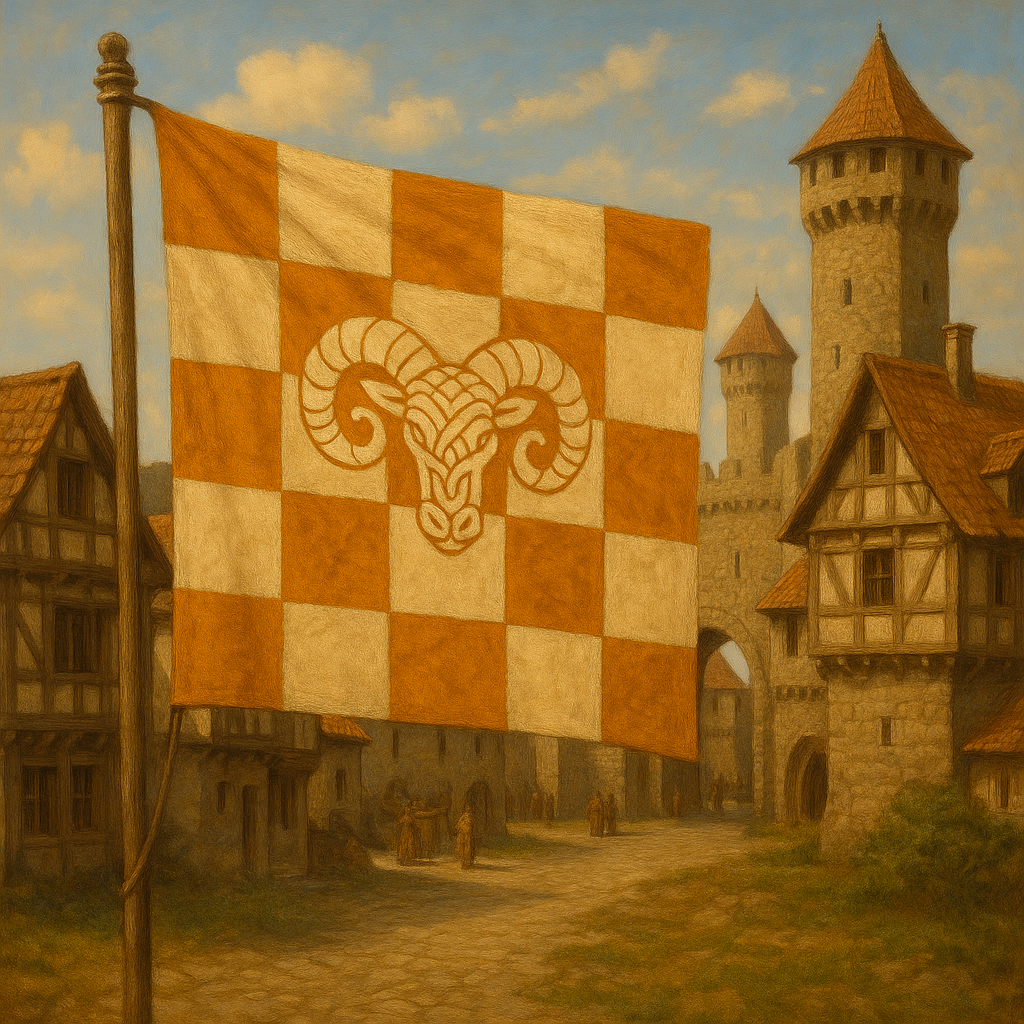
The Charging Banner
"The ram charges forward, but at what cost? Beneath its fearless gaze, the horns of unity often gouge those left in the wake of its charge."
Synopsis:
The Charging Banner of Everwealth is a stark, unapologetic emblem of defiance. Dominated by the woven visage of the Everwealthy native Skyhorn Rams, its unyielding eyes and coiled horns stand against the backdrop of a white and orange checkerboard. The banner is said to symbolize the kingdom’s resilience and determination, the ram a metaphor for charging through adversity. But to some, it is an ironic beacon, a desperate face-saving gesture for a fractured nation where exploitation and bitterness often lie beneath the veneer of unity. To the Everwealthy elite, the banner is a proud statement of survival in a land born of ruin and despair. For the common folk, who toil endlessly under the boot of their rulers or claw desperately at a life in the wilderness, it is a haunting reminder of a kingdom that demands everything and gives nothing in return. Symbolism:
- The Ram: In full form, the Skyhorn Ram symbolizes leadership, protection, and the indomitable will to charge forward. But its horns, woven into intricate whorls, are as much a warning as they are a promise. To soldiers, the ram is a rallying cry; to dissenters, it is a brute beast trampling the weak beneath a show of unity. Importantly, the visage of the ram is almost never present on banners flown in peacetime. The dye required, extracted from the rare Throatbloom Flowers, is exorbitantly costly, and the process of weaving the ram is painstaking. Thus, when the ram does appear, it is an unmistakable declaration; Everwealth is not posturing, it is charging to war. To see it raised against you is to know the kingdom has marked you as an enemy worth the expense.
- The Checkerboard: The white and orange squares supposedly symbolize balance, light and dark, hardship and triumph. Yet the interpretation is contested. The white represents the purity and righteous veneer claimed by those in power, while the orange evokes fiery sacrifice, the masses consumed to keep the kingdom’s wheels grinding. The contrast, alternating endlessly, mirrors the fractured reality of Everwealth: unity promised, division delivered.
The Charging Banner was first conceived in the aftermath of the Schism, when unity was forged less through choice than through necessity. Legend holds the original was stitched from battlefield remnants, a checkerboard of torn and bloodied standards, while the ram was chosen by the monarchy to signal a kingdom that could weather any storm. Yet even in its birth, whispers persisted that it was as much mask as message, concealing the exploitation required to rebuild a broken world. Dwarfish artisans, compelled by debt and duress, were said to have woven the earliest ram-emblazoned versions, the labor forced as much as volunteered. Uses and Ceremonies:
The banner flies above palaces, forts, and ships as a ubiquitous mark of state power. In parades and festivals, it drifts proudly through the streets, a spectacle to reinforce unity. Yet for most citizens, a critical distinction is always noted, the presence, or absence, of the ram.
- Without the Ram: These banners, far more common, signal times of relative peace or distance from conflict. Their checkerboards alone comfort civilians, a reassurance that the kingdom is not actively at war. To criminals and raiders, however, this absence implies low priority, towns flying only the squares are often considered “easy pickings.”
- With the Ram: Raised only when the Monarchy declares war or when a settlement faces existential threat, the ram’s visage transforms the banner into a living weapon of morale and menace. Enemies know the kingdom charges toward them with unified purpose; allies see a call to arms. On the battlefield, soldiers claim the toll of war drums and horns resound louder beneath its gaze.
For rulers, the banner is both pride and proof of their survival amid endless strife. For civilians, its checkerboard alone is comfort, a sign the ram has not yet been called to war. For raiders and brigands, its absence is opportunity; its presence, a death sentence. Artists and poets often interpret it cynically, the ram as a blind beast, charging heedlessly; the squares as a graveyard of lives, too small to capture the kingdom’s contradictions. And yet, whether despised or revered, the banner persists. As long as it flies, it remains both shield and wound, the fractured face of a fractured nation.

Comments