
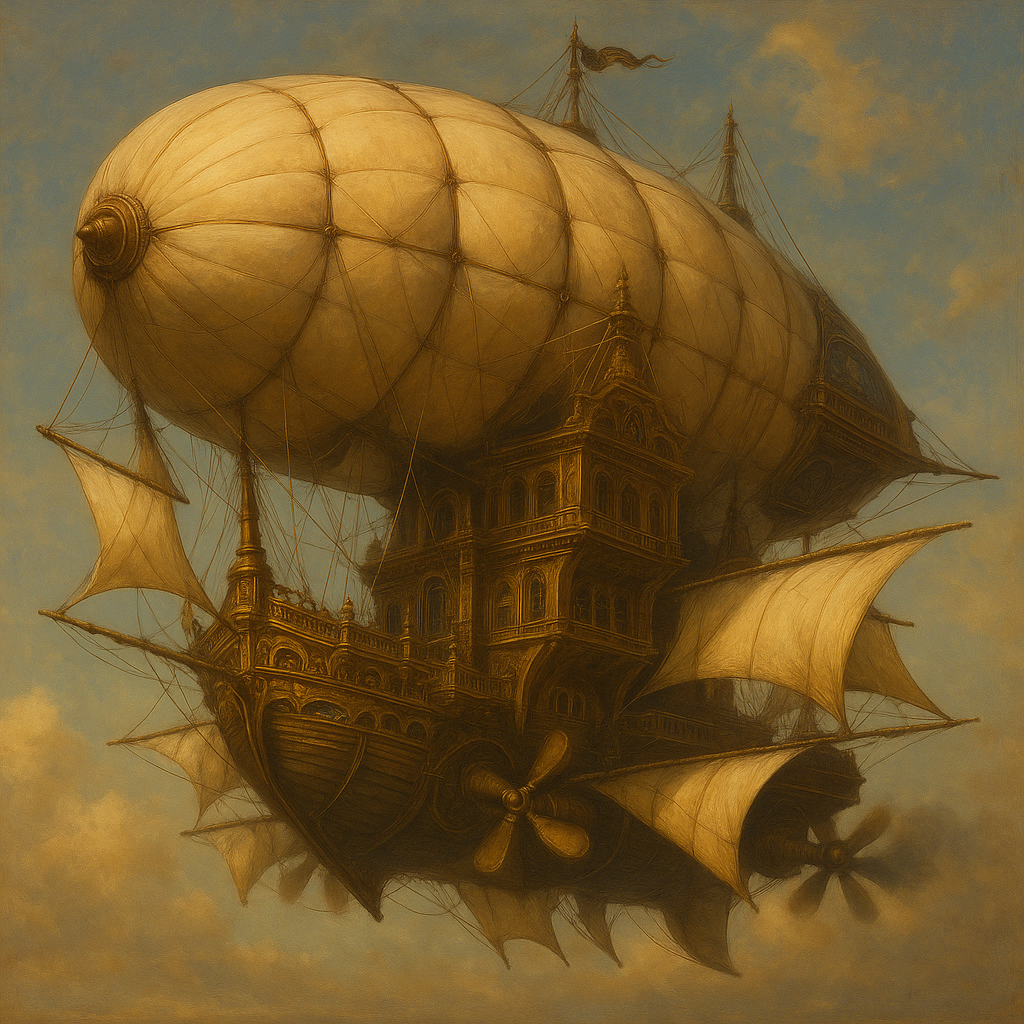
Airship
"The sky was never ours to claim, yet for a century, we dared to hang our banners from its bones."
Before The Fall and the fury of The Great Schism the Fall birthed unto the world would drag us into blood and ruin; Mortals looked upward with ambition. The dream of flight was not just wings of canvas or clattering contraptions of wood, but whole fortresses of timber and steel, drifting above the land like gods on borrowed air. Airships, colossal vessels suspended by alchemical gasses, reinforced with magickal fabrics and alloyed plating, were the crowning marvel of The Lost Ages. They were ships that defied gravity itself, riding the currents of heaven with elegance and terror in equal measure. At first, they were fragile monstrosities, plagued with calamities. Explosive fires tore them apart mid-air. Engines seized and screamed, hurling burning wreckage across cityscapes. Entire crews were lost to ruptured gas bladders or ruptured clouds of flame that sent vessels plummeting into farmsteads and fortresses alike. But refinement followed disaster. Engineers and arcanists found ways to line containment cloth with magick-resistant alloys, sealing away the volatile gases. Secondary propellers were added, rudders reimagined, engines rebuilt with redundancies, and whole generations of craftsmen gave their lives to make the iron leviathans as safe as they were terrible.
By the last decades of the Lost Ages, airships stood as the pinnacle of mortal ambition, massive, layered constructs of sails, propellers, reinforced hulls, armored gondolas, and fire-belching engines, bristling with artillery or carrying hundreds of passengers. They were at once symbols of unity and omens of hubris. To see one drift overhead was to witness the dominion of flesh and magick combined, a horizon split by a leviathan of smoke and sunlight. Their rival came in the form of the Aeroplanes, the smaller, nimbler ironbirds poised to shake the world as we knew it, but the Schism silenced that contest before it could ever be won. Airships, though bruised and dwindling, endured, less fragile than horseless carriages, far more maintainable than Locomotives, and plentiful enough in their heyday that a number still stalk the skies today. Yet their numbers shrink. Factories are gone, blueprints burned, guilds dissolved. No new vessels are made, and the secrets of their frames are dust. The gasses that keep them aloft can still be conjured or brewed, but the hulls, the plating, the alloys, they are finite. Each destroyed airship is a hole torn in the legacy of the world, never to be patched. Thus, those who hold them, whether monarchies or merchant princes, guard them jealously, lording them over rivals as if they were the gods’ own bones. One day, they too will fade, and the sky will again be the realm of beasts and storms alone.
Utility
Airships began as experiments in military reconnaissance, but soon their role swelled. They ferried soldiers, scouted enemy encampments, and rained death upon rebel strongholds with flame-jars and bolt-cannons. From there, ambition stretched further, cargo fleets ferrying ore across mountain ranges, luxury sky-voyages for nobles who could afford to drink wine above the clouds, even visions of floating colonies suspended like thrones over the world. For a time, trade routes were redrawn not by roads, but by winds. But misuse was inevitable. Explosions from poorly maintained gas-skins claimed towns. Pirate captains seized airships and turned them into engines of terror, striking without warning from above. In border skirmishes, fire-droppers set entire forests alight. To many, the airship was salvation. To others, it was an omen, proof that mortals were clawing at the vault of the heavens, daring the gods to strike them down.
Manufacturing
Airship construction demanded a scale of industry and artistry now long extinct. Their frames were born of ironwood and alloy-forged beams, their skins woven of alchemically treated cloth resistant to both flame and spell. Magick-insulated plating, layered like dragon scales, sometimes even with dragon scales themselves, lined the hulls shielding the volatile gases within from sparks, arrows, or stray invocations. Engines were hybrid marvels, half combustion, half glyph, stabilized by redundant rudder systems, each adjustment born from decades of tragedy. The hangars that once birthed them were carved into cliffsides, spanning whole valleys, powered by coal furnaces and rune-carved cranes. Now, all are silent. Modern tinkers patch what remains, but cannot replicate what was. At best, surviving airships are patched together relics, carrying perhaps one-tenth of their original majesty. At worst, they are tombs waiting for a final spark to send them screaming down to earth.
Social Impact
The airship was more than transport, it was triumph. To common folk, the sight of one blotted the sun, a reminder that their rulers had conquered even the sky. Children chased their shadows across fields, priests denounced them as blasphemy, and balladeers wrote songs of the Sky Leviathans that carried armies to war. For a century, they redefined power. Today, their meaning has shifted. An airship overhead is no longer a marvel but a warning. They are scarce, dwindling, irreplaceable, and yet still wielded as weapons of prestige. Nations parade them as symbols of power, cities cheer and cower alike when one descends to dock, and whispers abound of sky-pirates who seek to seize them for themselves. Scholars treat them as holy relics, relics that prove the Lost Ages were not merely a myth. Commoners watch the skies with dread, fearing not the storm clouds, but the silhouette of iron and cloth drifting into view.
- Holgrim of the Hanging Reaches of old Kathar: Already famed for his mechanical philosophies, Holgrim’s engine research aided the propulsion systems that would lift airships into the sky and later prove vital in his co-ivention of the Aeroplanes.
- Guild Consortia of Tarmahc and Chikara: Collectives of shipwrights, alchemists, and rune-binders who turned theory into steel and sail. Their guildhalls were razed during the Schism.
- Elfese shipmasters who weaponized hot air balloons or held sailing ships aloft with multiple rows of them in olden days.
Access & Availability
Airships remain, though their numbers diminish with every crash, every careless battle, every sabotage. The Monarchy controls most of the largest still-operational vessels in the world, deploying them as symbols of dominion and strategic leverage. Merchants and barons hoard smaller cargo craft, while a few bandit lords claim to sail the skies in stolen leviathans patched with scavenged cloth and prayer. Though dozens still exist, each is irreplaceable. No new frames can be forged. No new engines can be birthed. The gases may still be brewed, but the bones of the airship are finite. Thus, every battle, every voyage, risks not merely a ship, but a fragment of civilization’s greatest miracle.
Complexity
Operating an airship is a feat requiring entire crews, skilled in mechanics, alchemy, and spellbinding. To fly is to balance a dozen forces: gas pressure, wind shear, engine strain, rudder torque, ballast weight. Even in the Lost Ages, flight was an act of constant prayer. Now, with damaged systems and dwindling parts, it borders on suicide.
The components are legion:
- Combustion or magickally propelled engines, both hybridized with magickal stabilizers.
- Balloon skins, treated with alchemical flameproofing.
- Hulls plated in layered alloys.
- Sail arrays and propeller clusters, demanding ceaseless maintenance.
- Runic stabilization wards woven into the gondolas.
- Every part is a relic. Every repair a miracle.
Discovery
The first airship lumbered into the sky nearly a century before the Fall. Built likely in the valleys of old Kathar according to record, where coalitions of many guilds who had mastered shipbuilding, metallurgy, and windcraft alike came together to meet this challenge of engineering. The launch was calamitous, engines sputtered, gasses leaked, a propeller shredded itself mid-flight. Yet, the ship stayed aloft. Crowds below wept, cheered, prayed. For the first time in history, mortals had stolen the domain of gods and birds alike. From that day, the race skyward was on. Military fleets rose. Passenger liners carried nobles across continents. Merchants envisioned sky-ports that would rival the seas. And for one brief age, mankind did soar. But then came the Fall, and the dream came crashing down, leaving only relics adrift in a shattered world, fading shadows of an age that dared too much.

Comments