
Corruption
"There’s a difference between law and justice. The law hangs a thief for a loaf of bread. Justice hangs the man who wrote the taxes that starved him."
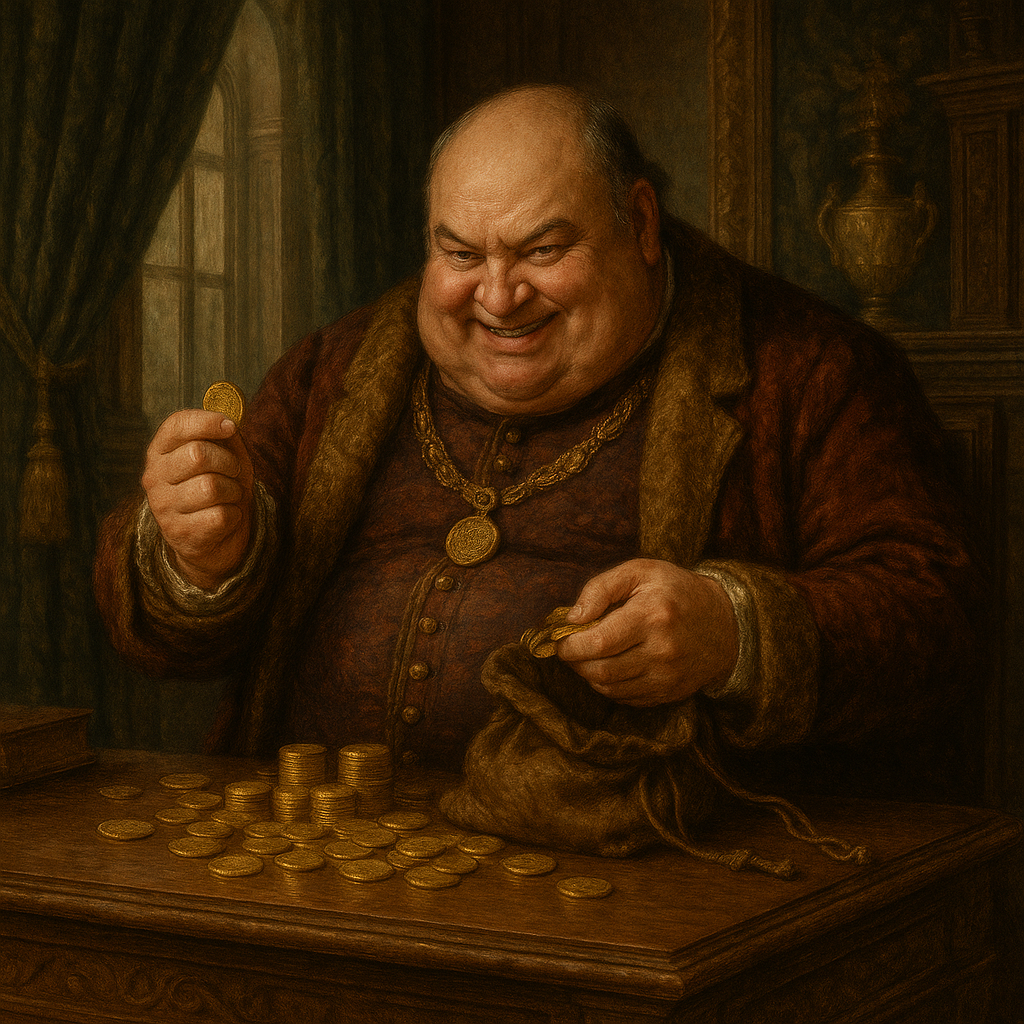
Corruption in Everwealth is no hidden rot, no whispered rumor passed in tavern corners, it is the marrow of the kingdom’s bones. The Monarchy dresses itself in horns and banners, trumpets its oaths and decrees, but beneath the pageantry lies a system oiled by bribes, sharpened by extortion, and fortified by fear. To the average citizen, corruption is not an aberration but a fact of survival. To the powerful, it is not vice but necessity. From the lofty courts of Opulence to the muddy markets of Catcher's Rest, coin bends the knee of priest, guard, and governor alike. Taxes are levied not for justice but for profit. Trials are sold to the highest bidder. Armies march where merchants whisper, and cities bleed so nobles may fatten themselves at banquets. Corruption is not the absence of order in Everwealth, it is the order. And if you listen, really listen, you can hear how the machine keeps time. It is the click of a seal pressed into wax above a forged bill of sale. It is the creak of a honeyed barrel taking on bog water. It is the soft scrape of a judge’s ring across a ledger before he names a price for mercy. In Opulence, velvet curtains breathe in and out with the crowd while a chained throat learns to sing for coin. In Twin-Peak, The Orcish Crime Syndicate's knives keep the peace the way a lid keeps a pot from screaming. Priests raise chalices and lower their eyes. Captains polish law like a cudgel. Dukes campaign with sacks of flour and squads of men who know which doors stay quiet when kicked. Every decree has two readings, the one spoken from a balcony, and the one muttered over a purse. Every right has two prices, what the poor can pay, and what the rich will not. The Ram’s horns glint on Capras because the Crown knows what the people already fear, coins gore cleaner than spears. So understand this much before you step into Everwealth, the gallows are not the worst of it. The worst of it is how quickly you learn the going rates. How fast your tongue finds the right title to kiss, the right street to avoid, the right lie to tell when a guard asks whose blood is on your boots. The law here does not break, it bends, and when it bends it makes a hook. The hook already in your mouth. Historical Roots
The Great Schism shattered more than nations; it shattered faith in law itself. As Humans, Dwarfish, Elfese, Orcish and many, many Beast-Kin fought to claw survival out of famine and fire, necessity became license. Barter gave way to theft, theft to extortion, extortion to policy. The first monarchs, desperate to hold together the fragile alliance, sanctioned practices they could not control, tariffs on slavery, bribes for offices, coin for clemency. When Dylann Valmore was crowned as first of the Royal Bloodline, his throne was not built on unity but compromise, Dwarfish cannons had won the war, so the Dwarfs demanded near-sovereignty. Human refugees demanded land, so the Elfe were cast into exile. Each bargain struck was one more thread in a net of corruption disguised as law. The Monarchy and Its Masks
Everwealthy's is a Crown of Compromise The Monarchy styles itself as a “democratic monarchy,” a contradiction so brazen it is almost admirable. Kings and Queens inherit their horns by blood, but dukes, counts, and viscounts pretend to legitimacy through “elections.” In truth, these contests are auctions, fought not with ballots but with bribes. Bread for the hungry, tax exemptions for villages, whispered threats from mercenary bands, this is the currency of Everwealth’s democracy. A Duke’s victory is not a triumph of popular will but of deeper purses. Counts secure their positions through guild sponsorship and cartel muscle. Governors sell offices outright. The Crown tolerates it, even encourages it, for each link in this chain of graft binds another official to the throne by obligation and guilt. Offices as Markets
The corruption of Everwealth is not chaos but design. Each office is a commodity, each title an investment. The High Justiciar sells verdicts, the Chamberlain trades secrets like coin, and even the Keeper of Lore decides which truths are too costly to publish. The King’s Wizard serves less as counselor than scapegoat, absorbing blame until whispers and daggers consume them. Counts levy crippling fines and raise private militias, nominally in the Crown’s name but for their own gain. Viscounts and Governors bleed towns dry with arbitrary judgments, their boots heavier than their swords. Barons, though hornless, often surpass dukes in influence by bribing soldiers and buying entire districts of cities outright. Power in Everwealth is never clean, but always clothed. A noble’s robe is not proof of honor, only that their bribes were heavier than their rivals’. Law and Justice
The Law on Paper is flimsy as the parchment it is scriben upon. The Monarchy’s laws are blunt: do not steal, trespass, deface, assault, or evade taxes. Yet the law is less shield than cudgel. For the wealthy, these rules are bargaining chips. For the poor, they are shackles. A noble who murders a rival’s son pays a fine and buys another. A peasant who steals a loaf is beaten, crippled, or sealed in a honeyed barrel for the insects to feast upon. Trials are little more than theater. Judges are bought into office, and their sentences are priced like any other commodity. Vigilantes and Private Justice
Because the Guard is stretched thin, conscripted into wars against the Elfese or diverted into protecting noble estates, justice often falls to vigilantes. Some act out of honor, most out of profit. Bounty hunters, mercenary enforcers, even grieving families wield daggers with as much legitimacy as the courts. The Monarchy neither endorses nor condemns such killings; it benefits from the spectacle. Economics of Corruption
Capras are often the only price that needs to be paid in times where scarcity drives men to do the unthinkable. Capras, silver and gold coins stamped with ram’s horn and hoof, are more than currency, they are the kingdom’s blood, or the requirement to spill someone else's. Every exchange, whether legal or illicit, flows back to the Monarchy through tariffs and tithes. Taxes are omnipresent, levied on food, trade, and even the dead. Corruption thrives because the state itself depends upon it. Pirates bribe harbor-masters at Wardsea, their slave cargo rebranded as “indentured stock.” Quartermasters in Bordersword skim profits by selling captives onward to forges or pits. In Opulence, nobles purchase private “bills” for hidden bloodsport, while the Monarchy takes its cut in “luxury entertainment taxes.” Trade and Tariffs
Everwealth sits at the throat of trade routes. Its fertile plains, rivers, and resources make it indispensable. Kathar depends on it for water, Jiebach for fertile soil, and even the Dwarfs for surface grain. But every caravan pays a price, every cargo inspected, delayed, or “lost” until bribes grease the road. Slavery itself is the most grotesque currency of corruption. Entire caravans of captives vanish into the Dust Markets, their names resurfacing as forged indenture contracts. In famine years, the price of a starving man is less than a bushel of grain, and no one pretends to be shocked. Slavery and the Pits
No article on corruption in Everwealth could ignore slavery. It is not a side-market but the kingdom’s very backbone. Licensed by the Crown, taxed by governors, and fed by pirates and warbands, it flourishes because it fattens every link in the chain.
- Labor - Giants haul timbers until they break, Minotaur drag millstones at the end of a whip, Elfese toil in swamps where disease kills freemen too quickly.
- Gladiators - Orcs and Minotaur are sold to amphitheatres in Opulence and Twinpeak, their blood feeding the crowd’s hunger.
- Military Auxiliaries - Shackled soldiers thrown before armies, fodder bought cheap and buried deep.
- Brothels - Lives sold room by room, called “indentured courtesans” in ledgers but chains in truth.
- Domestic Service - Slaves as ornaments, gilded collars to display wealth more than to clean it.
Where the Monarchy bleeds its subjects, cartels and guilds lap the runoff. Corruption is not confined to courts but thrives in syndicates that act as parallel governments. The The Orcish Crime Syndicate dictates trade with Kathar, deciding which goods pass and which lives are sold. The Gilded Hand in Opulence controls smuggling through the shipyards, ensuring every illegal good has a price. The Quartermaster’s Guild in Bordersword profits from every body, selling “convicts” to the pits and reselling their corpses to forges as fuel. The Monarchy denounces such groups publicly, yet their governors dine with syndicate leaders, their taxes filled with cartel gold. Crime and crown are not rivals but partners. Temples and Hypocrisy
Even the gods are not spared corruption’s touch. Priests preach obedience, then tithe slaves in chains. Some claim bondage purifies the soul, others that chains are divine punishment. But sermons grow silent when slavers fill collection plates. The Knights of All-Faith thunder that slavery is sin, yet they are drowned out by louder coins and 'fitting' punishment for so-called heretics who disobey their often nuanced and subjective tenants of faith. Temples are not houses of worship but vaults of bribery, where absolution can be purchased in Capras as easily as bread. Settlements of Corruption
Corruption manifests differently across Everwealth’s cities:
- Opulence - Velvet-draped cruelty, where nobles buy private performances of slaves bleeding in the theatre’s hidden wings.
- Bordersword - A fortress that launders caravans of flesh, calling them “penal levies” while their chains clink in their 'Dust Markets'.
- Twinpeak - A frontier of spectacle, where the Orcish syndicates run pits and mines, and Everwealth officials bow in exchange for cut coin.
- Gullsperch and Wardsea - Harbors where pirates buy legitimacy with bribes, their stolen souls stamped as cargo.
Not all bow to corruption. Escaped slaves form highland bands, raiding caravans and freeing others. Some villages shelter them, knowing gallows await if they are caught. Songs whispered in taverns remind every free drinker that chains and taxes both can shift wrists in a heartbeat. Yet resistance is fragile. For every rebel band, a noble raises taxes. For every outlawed pit, two more open beneath the streets. Corruption endures because it is not parasite but host. It does not devour Everwealth, it is Everwealth. Conclusion
Corruption in Everwealth is not the failing of a system but its essence. The Monarchy thrives because every official is bought, every guard can be bribed, and every priest can be silenced with coin. Justice is not blind but blinkered, its scales tipped by Capras heavier than conscience. Ask a free man if he fears monsters or famine, and he will laugh bitterly. “No,” he will say, “I fear the collector at my door, the guard at the gallows, the noble with his ledger.” For in Everwealth, corruption is not just survival of the fittest, it is survival of the richest. And the wheel turns, bound in iron and blood, grinding all beneath it, until even kings rot with the rest.
Interesting Facts
- The Ledger of Shadows - Deep in the Chamberlain’s vault lies a black-bound book rumored to contain the “true” census of Everwealth, not of people, but of debts. Each name listed there corresponds to an office, each line item to the price of silence. It is said that to erase one’s entry costs more than life, and that the ink never truly dries.
- Bread Votes - During election season, the bakeries of every major city report mysterious flour shortages. Within a week, nobles begin distributing loaves marked with their house sigils. To accept one is to vote; To refuse one is to go hungry. The people call it “the yeast tax,” for every loaf that rises costs them a little more dignity.
- The Broken Seal - Every royal decree carries a wax seal pressed by hand from the Ram’s Signet. But counterfeit seals circulate in every port, sold by engravers who copy the sigil with astonishing precision. Most “official” documents in circulation are forgeries, and the Crown dares not expose them, lest it reveal how much of its own law is built on lies.
- The Price of Pardon - Officially, clemency may be purchased from the High Justiciar with a “penitence fee.” In practice, the price fluctuates daily depending on demand. The saying goes, “A murder on Monday costs less than a loaf on Sunday.”
- The Gold Tongue - In Wardsea, a tradition persists among smugglers, when bribing an officer, the first coin must be placed beneath the tongue of the briber, not the bribed. If the officer accepts it by mouth, the bargain is binding. This ritual has led to more drownings than betrayals.
- The Pits’ Accounting - The Dust Markets of Bordersword keep immaculate ledgers of every slave sold, as required by royal tariff. Each page is stamped with the sigil of the Ministry of Trade. In theory this ensures “ethical commerce.” In practice it simply ensures taxes are paid on every chain.
- The Clean Hands Law - A decree still on the books states that any noble caught taking a bribe must wash his hands publicly in holy water before denying it. The ceremony was meant as proof of innocence; it is now a popular entertainment, performed twice weekly in Opulence’s courts. Vendors sell soap shaped like coins.
- The Saint of Small Bribes - In Gullsperch, dockworkers pray to Saint Merrin the Measured, an invented folk saint said to “bless the petty cheat but curse the greedy one.” Shrines to Merrin accept offerings in copper Capras only; priests of the true faith denounce them, but they too drop coins in when no one’s looking.
- The Price of Silence - In Opulence, couriers who deliver blackmail letters are known as “mutes.” Each has their tongue cut out upon entering service, ensuring loyalty through necessity. They are paid in gold and given burial rights at court cemeteries, the only servants to share that privilege.

Comments