
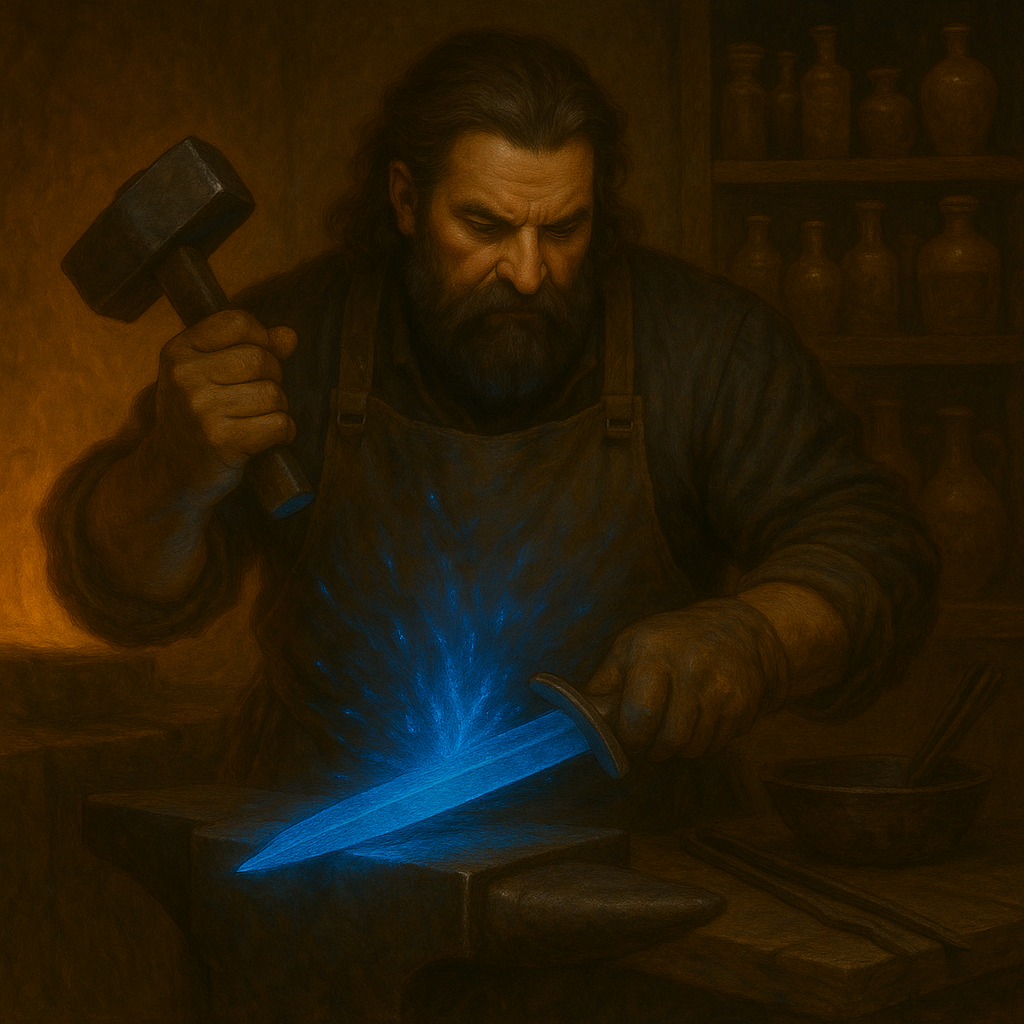
Mage-Smith
"To forge steel is to shape the Gaiatia's bones. To forge steel that breathes fire, sings with intent, or bends like silk without breaking, that is to shape the bones of reality itself."
The Mage-Smith is a rare union of craftsman and magus, wielding hammer and spell with equal mastery. They stand at the crossroads of Enchantment, Transmutation, alchemy, and metallurgy, bending both matter and magic to their will. Their forges are as much arcane laboratories as workshops, where raw steel is sung into new forms and the very nature of a blade can be rewritten. In the days of The Lost Ages, their works were miracles, ploughs that tilled the soil by themselves, armor that mended its own dents, and weapons that could lay waste to an army with a single blow. Today, the marvels of that era are gone, the art shackled by the strict oversight of The Arcane Coalition. Even so, the title still carries both prestige and fear, for whether in the hands of a sanctioned master or a lawless rogue, a Mage-Smith’s creation can change the course of a battle, or a kingdom, in the space of a single strike. In their earliest days, Mage-Smiths were civilization’s answer to scarcity. Their ploughs fed thousands. Their wells purified fouled water. Their constructs performed the labor of dozens of hands. But war corrupted the craft. Nobles and kings saw that the same enchantments that drove a wheel could turn a siege engine, that a blade that never dulled could end dynasties. By the time of the Schism, the Mage-Smith was seen less as savior than as weapon-for-hire, each kingdom desperate to hoard or slay them. The Arcane Coalition’s rise was in part a reaction to this. Mage-Smiths were shackled beneath license and law, required to swear oaths of containment lest their wonders destabilize fragile states. Yet suppression birthed rebellion. Renegade Mage-Smiths still ply their trade in the wastes, hammering not only swords but cursed lamps, bone-hinged doors, or machines that crawl on their own like spiders of brass. Their creations fetch fortunes in black markets, fueling insurgencies and terror alike.
Qualifications
- Mastery of at least one formal school of magick, most often Transmutation or Enchantment.
- Apprenticeship under a licensed Mage-Smith for a minimum of twelve years.
- Demonstrated proficiency in forging mundane arms and armor to Guild standards before magickal integration begins.
- Passing The Arcane Coalition’s Forgewright’s Trial, an examination involving both theory and practical crafting under observation.
Requirements
Appointment
Bestowed through an official Coalition ceremony. Candidates present a magickal work of their own design, both functional and symbolically representative of their philosophy as a smith.
Duties
- Maintain and repair enchanted arms, armor, and tools within their jurisdiction.
- Serve as an advisor in siegecraft, defense planning, and magickal resource allocation.
- Provide secure disposal or dismantling of corrupted or unstable magickal items.
Responsibilities
- Day-to-day forging, enchanting, and refinement of magickal goods.
- Training apprentices and maintaining Guild-approved records of work.
- Ensuring all works meet Coalition safety and ethical standards.
Benefits
- Access to restricted forges, rare materials, and arcane research archives.
- Commission fees from noble houses and military contracts.
- Political immunity within the scope of Guild law (but not Coalition law).
Accoutrements & Equipment
Mage-Smiths produce agricultural implements that plough themselves, mills whose gears never rust, and surgical instruments that resist infection or channel healing magicks. In famine-struck regions, a single enchanted sickle can yield harvests twice as fast as human hands. Though these crafts are less glorified than weapons, they often prove more revolutionary, elevating villages into cities and sparking entire economies. In-tandem, their are some examples of ubiquitous equipment throughout the varying crafts Mage-Smiths create with:
- A personal Arcane Forge, warded against intrusion and sabotage.
- Forging tools of both mundane and magickal nature (Runic Hammers, Heatless Crucibles, Tempering Sigils).
- Licensed Mage-Smith seal, engraved with the bearer’s unique mark and ward signature.
Grounds for Removal/Dismissal
- Revocation of title upon breach of Coalition safety protocols or creation of forbidden items.
- Trial before a Coalition-assembled court, often resulting in license suspension or permanent revocation.
- Voluntary resignation requires destruction or sealing of all active works.
History
The title dates back to the earlier years of The Lost Ages, though the exact original date is unclear, when the first Mage-Smiths forged tools that could heal the sick, plough the land by themselves, or fell armies with a single blow. Their works were treasured heirlooms and weapons of legend, often named and sung of for generations. Following the Schism, Mage-Smithing became tightly controlled under the Arcane Coalition, with marvels of the old world becoming rarer and rarer, many lost entirely. Yet, control has never been absolute. Unlicensed Mage-Smiths, often failed apprentices, Coalition deserters, or those taught in secrecy, have always existed on the fringes of society. Many found their way into the ranks of bandits, marauders, and warlords, bringing with them the ability to produce weapons far beyond the quality of common steel. In the hands of such criminals, a single enchanted blade could pierce plate mail as if it were parchment, a cursed chain could choke the breath from a foe without a single hand upon it, and armor wrought with unstable transmutation could shrug off volleys of arrows before shattering into lethal shards. These renegade forgewrights pose a danger out of proportion to their numbers. Most guardsmen and soldiers, even in wealthy cities, carry only mundane arms, iron, steel, and occasionally silver. Against a weapon or armor piece crafted by an unbound Mage-Smith, such equipment is little better than ornament. This disparity means that, in most districts, the Arcane Coalition itself becomes the only force capable of countering such threats, deploying sanctioned Mage-Smiths and licensed magi to hunt down and neutralize rogue crafters. While some outlaws wield their illicit works for personal power alone, others flood black markets with enchanted weapons and volatile experimental devices. These tools inevitably find their way into the hands of assassins, mercenaries, and rebel factions, spreading instability far beyond the forges where they were made. For every sanctioned Mage-Smith celebrated in the halls of the Coalition, there is a shadowed counterpart somewhere in the wastes, hammering dangerous wonders beneath the stars, bound to no law but their own.
Cultural Significance
Among Dwarfish, a Mage-Smith is a living testament to their people’s ancient bond with metal and stone. Among humans, they are seen as a dangerous luxury, too valuable in war to trust in peace. Elfese often revere Mage-Smiths as keepers of balance, shaping weapons not only for battle but for ceremony.
Notable Holders
- Thaldren Forgevoice - Last known crafter of the Singing Blades of Kethra.
- Veyra of the Nine Coals - Human Mage-Smith who refused all royal commissions, choosing instead to arm rebel militias.
- Druum Hollowbrand - Orcish smith who created the armor that allowed High Chieftain Morrogh to withstand dragonfire.

Comments