
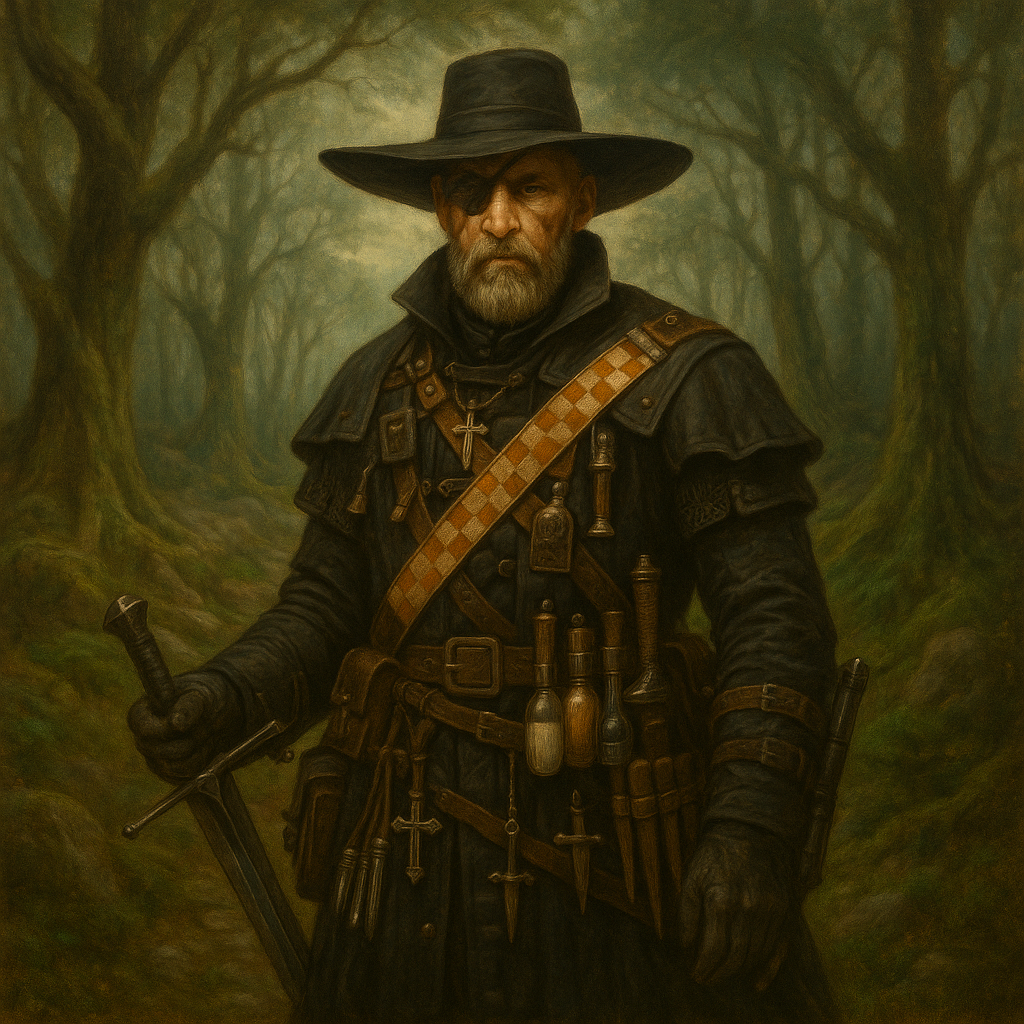
Inquisitor
“Where scripture ends and screams begin, my work begins.”
Inquisitors are Everwealth’s sanctioned blasphemies, alchemists in mail, spellblades in scripture, hunters tempered by relic and ruin to break the unnatural wherever it nests. They are not priests, though many wear blessings like chain. They are not mages, though their steel hums with runes. They are a vocation shaped by famine, war, and midnight things, Witch, Lich, Vampyrism, Lycanthropy, Devils, aberration, revenant, and any curse that breeds beneath a leaking roof. To the villages they save, they are salvation with a price. To the things they hunt, they are the last noise before ash. Neither a single order nor a tidy creed, “Inquisitor” is a mantle carried by intersecting traditions, chantry-trained exorcists of the Knights of All-Faith, hedge-learned severants who bind salt to steel, defectors from The Scholar's Guild who traded theory for flame-touched practice, and free lances who sell their piety by the flask. Some keep vows; some keep bounties; most keep ledgers of sins paid for in coin and ichor. They walk the line between sacrament and slaughter with a professional’s calm, because someone must. Tales persist of taverns falling silent when an Inquisitor walks through the door, for no one knows if their arrival heralds deliverance or a pyre. To many common folk, they embody the paranoia of Everwealth itself, both savior and accuser, one hand holding salt and scripture, the other a meticulously sharpened sword.Qualifications
An Inquisitor is not ordained by crown or guild. They are shaped in fire, famine, and blood, a calling that chooses the survivor rather than the volunteer. This is no formal order, no brotherhood with banners; it is a grim craft one learns the hard way, alone in the wilds, knee-deep in gore, or bound to a covenant of necessity.
To become an Inquisitor, one must possess:
- Knowledge of the Hidden: Lore of curses, monsters, aberrations, and magicks shunned by polite society. Not taught in halls, but scavenged from burned grimoires, whispered in taverns, or carved into scars.
- Stamina and Grit: The body must endure toxins, alchemical tinctures, and sleepless hunts. A failed draught kills the common man; the Inquisitor builds a tolerance where others choke on bloody foam from their lungs.
- Craft of the Salt & Rune: Fluency in the laying of circles, counter-glyphs, and quick-stamped wards. The hand must not shake, for one broken line can spell death.
- Will to Confront: Inquisitors must possess courage, or madness, to face things men are not meant to face, vampyrs that drink thought as well as blood, devils who whisper bargains that veil wicked hidden clauses, witches whose curses maim body and mind.
- To slay what others cannot name.
- To return with proof when all others are ash.
- To show scars that speak louder than oaths.
Requirements
There are no crowns or guild seals that bind one to the path of the Inquisitor. To take the mantle is to survive the trials that would kill other mages, mercenaries, or priests. Age and lineage mean nothing, though a body too frail or a will too brittle will not last long in the hunt. What matters is endurance, discipline, and the stomach to face what other mortals cannot. Some inquisitors are born from the faithful ranks of the Knights of All-Faith, others from broken alchemists whose work led them into shadows they could never unsee. A few are simply desperate men and women who stared too long into the eyes of the cursed and did not blink. What unites them is sacrifice: months of fasting and study, bloodletting to attune themselves to the marks of corruption, scars branded into flesh to anchor runes against their own skin. Inquisitors must master both blade and tincture, prayer and powder, and be willing to let none outweigh the others. In some villages, a would-be hunter is “sponsored” by the community, chained with salt-bells and sent into the woods to confront whatever lurks there. If they return alive, they are regarded forever after as Inquisitor, whether they accept the name or not.
Appointment
To become an Inquisitor is not to be knighted or anointed, but to endure. The appointment is survival itself. Those few trained under the Knights of All-Faith endure a ceremony where scripture is read backward while brands are pressed into flesh, a symbolic stripping of ordinary priesthood to remake them as something half-holy, half-profane. Independent hunters fashion their own rites, but all carry scars as their only true seal of office. Some apprentice under older hunters, learning the craft of salts, sigils, and exorcism water until their teacher deems them strong enough to hunt alone. Others walk into the wilderness to face a beast or witch and return with proof of the kill, their survival becoming its own testimony. A few are “called” by circumstance, lone survivors of cursed villages or broken cults who take up the arms of their fallen and continue the work. There are rituals, blood fasts beneath moonlight, scarification with holy brands, drowning trials in salt-water, but none are binding by law. They are traditions, grim reminders that the path is a crucible. When one emerges bearing the scars, the scars themselves are the only appointment needed.
Duties
The Inquisitor’s duty is to seek and destroy aberrations where they fester. In practice, their duties extend into the mundane: sifting through ash of cursed houses, checking livestock for signs of corruption, questioning peasants with methods more frightening than merciful. “To doubt is to delay, and to delay is to damn a village” is a common maxim, one that justifies their harshest excesses. They patrol forgotten villages at the edges of The Grandgleam Forest, burn out covens lurking within The Bog of Lies, and stalk nobles afflicted with Vampyrism through the alleys of Opulence. They act as exorcists where priests falter, dragging screaming souls from bodies too far gone. They are executioners of witches, devils, and beasts alike, wielding doctrine as freely as steel. Yet duty extends beyond killing. An Inquisitor must investigate, rooting out the hidden rot of curses and corruption before it spreads, following trails of claw-marks, sigils, and broken corpses until the source is uncovered. In this, their role is as much detective as hunter.
Responsibilities
The Inquisitor carries both practical and moral burdens. Records in the Scholar’s Guild accuse entire regions of being “purged” by inquisitors who mistook famine blight for witchcraft. The Guild calls them murderers; the Knights of All-Faith call them necessary; the folk simply call them terrifying. Practically, they are responsible for containment, ensuring that no curse, no beast, no devil’s bargain is allowed to slip free. A botched hunt means villages burned, children orphaned, or worse, creatures stronger from the blood spilled in their escape. Morally, the Inquisitor must balance the line between necessary suspicion and madness. Every Inquisitor lives with the temptation to see corruption everywhere, to accuse and burn until nothing remains but ash and salt. Too many hunters have crossed this line, becoming feared not as protectors but as killers who would gut a farmer’s child for sneezing at the wrong hour. Restraint, then, is as much a part of their craft as steel or spell.
Benefits
The Inquisitor’s benefits are measured in survival. Many also profit in less holy ways, selling relics ripped from monsters, hoarding grimoires too dangerous for guild archives, or trading alchemical recipes to smugglers. Some hunters live richly, but never long. They live where others die, standing unbroken against horrors that annihilate common militias. Their tinctures grant resistance to curses and toxins; their runes burn through unholy flesh; their training sharpens reflexes until they move with inhuman precision. Some claim their lifespans are unnaturally stretched, preserved by the very alchemy that scars them. And there are darker benefits still: fragments of knowledge torn from witches, samples of Ichor harvested from devils, trophies of claw and fang studied until they yield their secrets. An Inquisitor, unlike most mortals, does not merely survive monstrosity, they learn from it, and in learning, they become more terrible still.
Accoutrements & Equipment
An Inquisitor is never unarmed. Inquisitors often craft their own devices from the corpses of what they slay, wolfbone knives to pierce lycan hide, vampyr teeth ground into powder for anti-venom, hag-hair braided into cords that bind familiars. Such trophies blur the line between weapon and curse, and many hunters die carrying them too close. Their belts bristle with vials of salt, quicksilver draughts, and smoke-powders meant to disrupt unholy glamour. Their blades are stamped with runes hammered into steel by priests or mercenary smiths, their pistols loaded with silver and sanctified ash. Exorcism water, blessed scrolls, wooden stakes, and binding chains are their trade as much as swords or muskets. Many wear charms against curses, raven skulls, saint-bones, coins from the tongues of the executed, each talisman both weapon and ward. In their hands, these things are more than tools; they are extensions of the Inquisitor’s will, instruments tuned to the single note of destruction.
History
The first Inquisitors rose not from councils or kings but from desperation. After The Fall, when cities drowned and devils stalked famine roads, whole communities built shrines to these hunters, offering their dead as both sacrifice and study. Inquisitors became walking archives of wounds, every scar a written history of Everwealth’s darkest nights. In the waning hours of The Lost Ages, when famine and pestilence left villages ripe for devils and witches alike, men and women began arming themselves not against other armies but against things that slithered from forests, rivers, and shadows. They were alchemists and hunters both, sharpening silver and boiling draughts, driven by necessity rather than creed. During The Fall, they hunted devils when priests faltered, their numbers swelling in chaos. In The Great Schism, they were both saviors and butchers, whole villages spared by their blades, others slaughtered when their paranoia overran their purpose. Everwealth remembers them as much in fear as in gratitude, for their legacy is twofold: saviors of mankind, and sometimes its executioners.
Cultural Significance
Inquisitors are both needed and hated. To the common folk, they are grim saints who stand against the things no militia can face. Yet they are also dreaded visitors, for where an Inquisitor arrives, death follows, whether of beast or of man accused of witchery. Nobles employ them in secret, fearful of what their presence admits, that castles are no defense against vampyric corruption, that coin cannot bribe a curse to sleep. Temples both bless and curse them, praising their destruction of the wicked while denouncing their blood-alchemy as heresy. The Scholar's Guild studies them at a distance, fascinated but wary of a craft that has no codex and no restraint. And The Knights of All-Faith regard them as uneasy cousins, allies in purging devils, but too unpredictable to be welcomed wholly into the fold.
Notable Holders
- Tarsin the Salt-Monger, whose blade was said to carry a hundred runes, one for every curse he slew.
- Elira the Ash-Maker, who burned an entire village to rid it of vampyr corruption, and was herself burned by survivors who swore she had gone too far.
- The Nameless Three, Inquisitors who hunted together for decades, each one scarred beyond recognition, their bodies stitched with alchemy until they no longer resembled men at all.
Status
Inquisitors remain few but ever-present. There are no schools, no banners, only individuals scattered across Everwealth Their numbers never swell, for their craft kills as often as it strengthened.
Form of Address
'Inquisitor', 'Witch-Hunter', 'Monster-Slayer'. In whispers, commoners sometimes call them “Ash-Bringers,” for every Inquisitor is followed by the smell of burnt things, whether homes, witches, or whole villages.
Equates to
Other peoples and cultures give names of their own to those who stalk the night in pursuit of aberration and curse. Among the Canid clans they are called Blood-Hounds, folk driven half-mad by the scent of tainted blood, said to never lose a trail once marked. The Dwarfish name them Runeblades, for their arms are etched in sanctified script, steel sharpened against both flesh and spell alike. The Elfese whisper the title Moon-Banisher, a slur more than an honor, for they see these hunters as desecrators who burn groves and spill holy ichor in their zeal. In the southern ports, smugglers speak of Chain-Drinkers, a grim acknowledgment that many such hunters rely on tinctures of salt, quicksilver, or powdered bone to steel their veins against what they face. Yet in Everwealth, none of these foreign titles hold weight. Here, they are simply called Inquisitors. To name one thus is enough, for the word itself already carries the scent of fire, blood, and the fear of footsteps on your threshold at midnight.
Source of Authority
The Inquisitor has no master. Their only authority is their own survival, the whispered prayers they carry, and the trust of those desperate enough to hire them. They answer not to crowns, councils, or gods, but to the necessity of the hunt.
Length of Term
An Inquisitor remains such until death or corruption claims them. Some burn out in a single decade, consumed by toxins or scars. Others endure for centuries, sustained by alchemy and hatred, lingering on until they resemble the very monsters they track.

Comments