
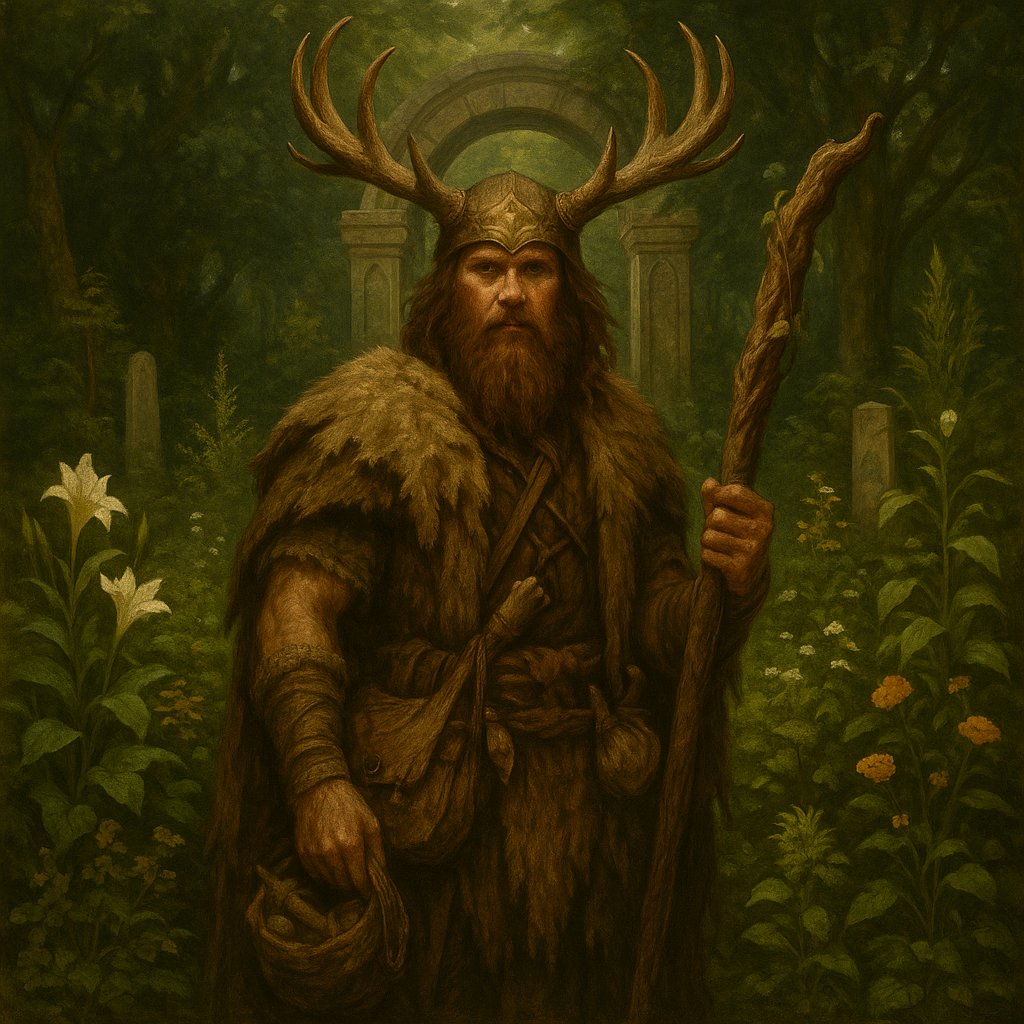
Druid
"We are not masters of the wild. We are its teeth, its thorns, its rage made flesh."
Druids of Everwealth are mages who have chosen not the stone-forges of Druvain or the quiet scrolls of The Scholar's Guild , but the untamed crucible of beast and soil. They are neither hermits in cloaks nor gentle healers of gardens, but blood-bound spellcasters who feed their lifeforce into plants and animals, commanding growth, tooth, and claw with terrible intimacy. Unlike necromancers, whose power feasts on the dead, druids borrow from the living, paying with their own vitality and marrow. A druid who calls forth a harvest weakens their years. A druid who takes a beast’s form binds its nature into their flesh forever. Well-trained druids endure these exchanges with discipline, learning to balance hunger, form, and blood without losing themselves. But untrained druids often mistake power for permanence, wearing one beast’s form too often until their body forgets its own. Many a would-be wolf-druid has died half-canine, unable to shed the snout or claws they grew too fond of. Others fracture further, pushing themselves to hold too many hearts, their bodies splitting into hideous chimeras that echo every beast they consumed. In this lies the dread distinction of druidry, madness is not inevitable, but permanence is. The druid who wears too many skins ceases to be mortal altogether, becoming something monstrous even to their own kind. Their powers are immense, whole battlefields of roots may rise at their command, rivers may be dammed with living growth, soldiers turned aside by walls of thorns or beasts conjured from marrow. Yet they are not saviors of famine or stewards of plenty. To grow fields in abundance is to bleed out decades in moments; to call forth armies of beasts is to shatter one’s own humanity. For this reason, druids remain rare, feared as much as they are revered, their gifts regarded as curses in the eyes of many. They are Everwealth’s thorn-priests, its blood-gardeners, the living bond between mortal and wild. Where liches claim eternity through death, druids achieve their endurance through sacrifice, bound not to the grave but to fang, root, and the endless hunger of the soil.Qualifications
Druidry is not licensed in academies or Coalition halls, and its rites carry hidden dangers. The Heart Rite, Blood-Binding, and Maw’s Trial already demand sacrifice, but failure to master discipline leads to subtler dooms, an untrained novice who clings too long to a single form may never shed it again, living out their days as wolf, bear, or boar until their humanity is lost. Similarly, every consumed heart leaves a mark. A stag’s horns may grow permanent, fur may linger, or claws may never retreat. Those who overindulge in forms risk becoming hybrid chimeras, fusions of every beast devoured, grotesque and unstable.
Requirements
Druids live and work under conditions that repel most mortals. Their rites require rare components, hearts still hot with life, marrow harvested from ancient beasts, soils steeped in ritual blood, and, at times, even kin-sacrifice. Each act drains their years, trading youth for growth, vigor for power. Cities shun them, calling their practice heresy; even the common folk recoil at the thought of heart-consumption. For this reason, druids survive in isolation, deep in forests or hidden groves, far from the suspicious eye of civilization.
Appointment
There is no crown, no license, no order to bestow the title. A druid becomes such only by survival. When they emerge from the wood with claws not their own, when their eyes carry the light of beasts devoured, the wild itself acknowledges them. This is their only appointment: endurance.
Duties
The covenant of druidry is not to men or gods, but to tooth and soil. They are guardians of the wild, ensuring balance is preserved not for mortals but for beasts, rivers, and roots. They are bearers of the beast, consuming and embodying creatures to keep their essences alive, even as hunters drive them toward extinction. They restore the land when famine or fire ravages it, but always at personal cost. And they preserve their lore in marrow and ritual, often demanding that their apprentices consume their very hearts when they die, so their knowledge does not vanish.
Responsibilities
Beyond guarding the wild and embodying beasts, druids bear a responsibility to restraint. Their power to conjure harvests and heal blight is immense, but each act devours their own years. They can ripen orchards in days, or feed starving villages with a gesture, but such miracles strip decades from their lifespan. To end famine outright would mean dying in a single harvest, which is why druidry cannot serve as society’s solution to hunger. This cruel arithmetic defines their role: custodians of balance, not tools of plenty.
Benefits
Druids wield the most intimate magicks of the living world. They may assume the forms of beasts whose hearts they’ve consumed, their strength limited only by what they dare to devour. They may blend traits into new creations, antlers on wolves, wings on boars, venom dripping from deer horns. They command lifebloom, forcing plants to erupt into growth, whether in vines that strangle soldiers or grain that springs ripe from barren soil. Their mastery of battlefield control rivals generals: roots to entangle, floods to divert, swarms to unleash. And though each spell bleeds them, the soil repays them in kind, feeding their bodies and stretching their lifespans into centuries.
Accoutrements & Equipment
A druid is never bare-handed. Their staffs are living wood, bled with sap that drips like wounds. They wear pelt-armor stitched from hides that still breathe. In satchels they carry bone relics, marrow tokens of beasts ready to be embodied. Heart-flasks preserve vital forms, the essence of creatures consumed but not yet worn. Every tool is both sacred and grotesque, each a reminder of the price of their craft.
Grounds for Removal/Dismissal
There is no dismissal, no quiet renunciation. A druid ends only when slain, or when their heart is eaten by another, their power consumed and their line preserved. To deny this rite is to leave the forest wither-sick, the beasts restless, the bond broken.
History
The druids are as old as famine, as old as war. Their first records stretch back to The Lost Ages, when mortals sought strength outside forge and city, turning to blood and soil for survival. Some whisper that their craft predates even the gods, born not of faith but of marrow itself. In the Fall, they fought beside mortals, becoming wolves and bears to meet Devils fang for fang. In The Great Schism, they turned against kings and councils, pulling down cities that razed the wild for war. Their legacy is etched not in parchment but in scars upon Everwealth itself, forests regrown over ruins, rivers redirected to drown armies, citadels torn apart by root and fang.
Cultural Significance
Among nobles, druids are rebels, heretics, and obstacles to expansion. They halt roads, topple castles, and make farmland wild again. Among peasants, they are both protectors and terrors, folk-heroes who avenge greed but demand grotesque rites. Within the Scholar’s Guild they are anomalies, studied at arm’s length, dangerous but fascinating. The Arcane Coalition outlaws them entirely, branding their rites as abominations, though rumors persist that even some within the Coalition secretly court their aid. To Everwealth as a whole, the druid is paradox, healer and executioner, saint and beast, feared but never forgotten.
Notable Holders
- Maretha the Antlered grew stag’s horns that never receded, worshiped still in Rootthorpe as a saint of horn and harvest.
- Osric Blacktooth consumed the heart of a leviathan, drowning fleets and reshaping coastlines.
- The Thorn-Circle are a whispered cabal who stitch wolf-hearts into human chests, raising soldiers half-beast and utterly loyal.
Status
They are rare, feared, and persistent. Always present in Everwealth’s deepest groves, seldom seen in cities unless wrath drives them. They do not vanish; they wait, in soil and shadow.
Equates to
Source of Authority
They answer to no king, no council, no god. Their authority is the wild itself acknowledging them, and nothing more.
Length of Term
Indefinite, so long as they bleed, eat, and endure. Some live centuries, fed by the soil itself, though the longer they endure, the less they resemble what they once were.

Comments