
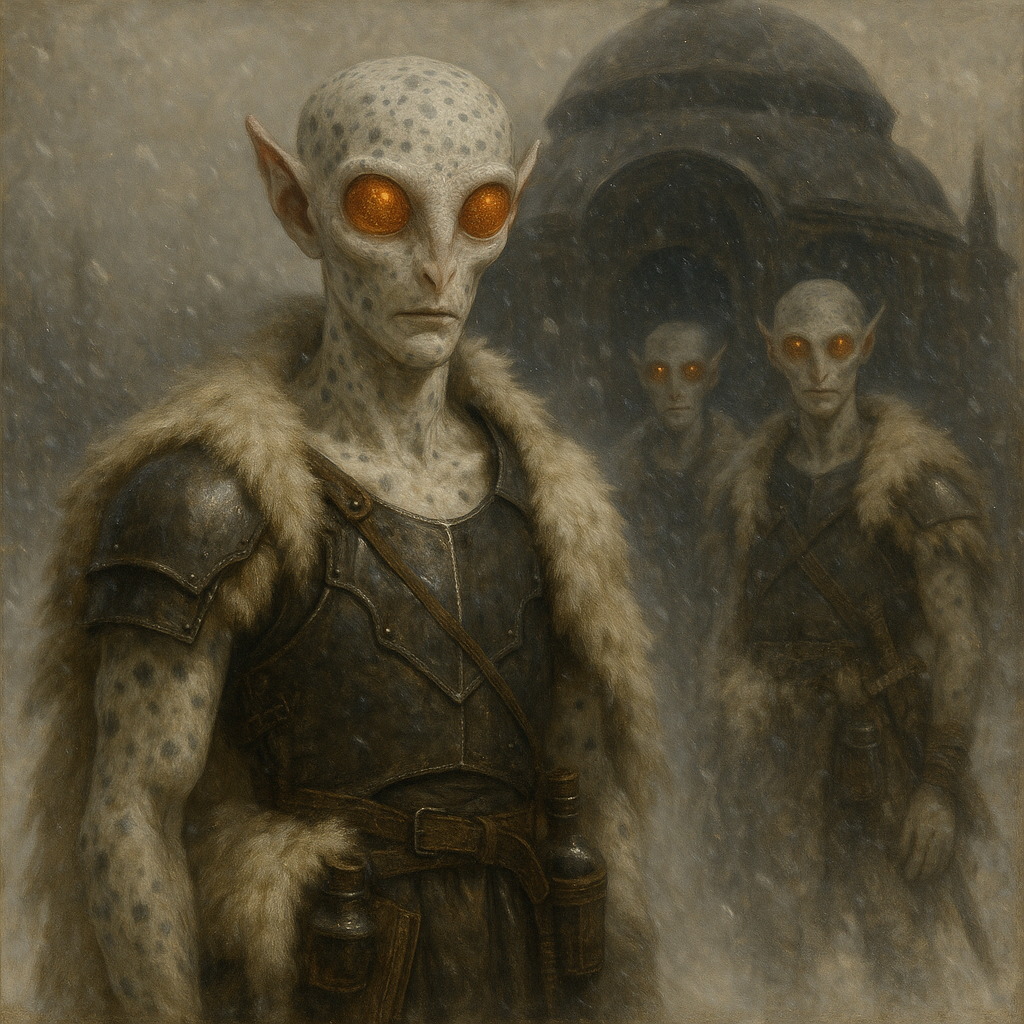
Moon-Kin
"No one remembers their arrival, only the crater, and the silent figures who stepped from its ruin as if mystery itself had learned to walk."
Historians agree on little about the Moon-Kin, save this, they did not come from this world. Whether marooned by The Great Schism or exiled from some nameless realm, their presence is a wound in history, a people without a past, yet carved into our present. People of silence and frost, towering shades who emerged not from the soil of Gaiatia but from a blackened crater in the frozen wastes of Arcryo, where no life should have thrived as they did. Their solitary settlement at the crater's center is no city or township at-all, but a tremendous fortress buried deep beneath the ice, only small scattered fractions poking out above the snow while it extends for miles underneath. They speak of their home as a vessel that once sailed the black seas between moons, though whether this belief is memory, dream, or madness, no one can say. What remains certain, is that it is a massive structure of polished black stone, constantly humming a sound like a low, steady chant; But this home of theirs does add some credence to the theory of star-striding ancestry. Its walls run with Pyrrhium in deliberate veins, cut, cast, and joined with impossible precision by today's standards, though no record speaks of the Moon-Kin ever trading for it. As if they did not find the metal when it fell from the heavens as the rest of us did, but brought it with them from whatever world birthed both it and them. None know whence they came, whether marooned by the Schism, driven from a farther ruin, or wandering into our world by error, but the sight of them is enough to chill the blood. White as ash, eyes ember-bright, with limbs drawn long as though meant for lesser gravity, they carry the mark of exile in every measured breath. Though few in number, they live with a unity utterly alien to the races of Everwealth, and every other realm we know.
Their society is ordered into caste-like circles, each an echo of a purpose long forgotten, now fossilized into ritual. Archivists transcribe contradictions into holy scripture, stacking truths and lies alike into towers of glass that no one dares to reconcile. Their priests, called 'Vectors' walk the frozen decks of the crater-ship, singing hymns to the pyrrhium veins as though their harmonies alone keeps the vessel alive, though the lights flicker the same whether they sing or not. To the Moon-Kin, these acts are not work but worship, gestures repeated for centuries, their meanings devoured by time. Whether they preserve their vessel or merely sing to it, none can say. Their law is simple, waste nothing, speak little, endure, lest the ship, or whatever sleeps within its walls, forget them in return. In manner they are unsettling; they do not grasp mortal notions of distance or modesty, standing inches from a stranger’s face, tasting magick with tongues like serpents, their stares unblinking. The Moon-Kin remember nothing of their origin save fragments. Some of their oldest accounts describe weapons flaring with light instead of steel, carriages that crossed skies in the blink of an eye. Yet each generation bends the past anew, adding, editing, or removing passages over-and-over until truth is smothered in layered contradiction. Their otherworldly inheritance shows in their comfort with void and cold, in their crater-speckled skin that blends with the surface of the moon as-well-as the snow, or in their uncanny survival of winter storms that would empty a mortal’s lungs in-an-instant. They seem at ease in desolation, as though the barren tundra is closer to their true home than any hearth or hall of this world. Even now, their fortress hums as though awaiting a signal, and the Moon-Kin keep their silent vigil beneath the ice, watching skies they no longer claim. Some whisper they are not stranded at all, that they are waiting, for the black seas to open once more, and the song in their pyrrhium halls to call them home.Naming Traditions
Feminine names
Soft, elongated, vowel-heavy, with subtle cadence shifts, like breath on glass.
- Aelivra.
- Oshaen.
- Luthivrae.
- Soraelen.
- Veyrieth.
- Maroqua.
Masculine names
Sharper consonants, deeper timbre when spoken, often finishing with clipped syllables.
- Irusk.
- Draveth.
- Kaelor.
- Sovric.
- Tonnash.
- Velthir.
Unisex names
Balanced forms, neither heavy nor soft, carrying an eerie neutrality.
- Oruqen.
- Tessel.
- Iishan.
- Vraelor.
- Qaelith.
- Noiven.
Family names
Moon-Kin do not trace bloodlines as mortals do; instead, they adopt cohort and vessel-markers, often tied to fragments of their ship or Circle.
- Embercrater.
- Spineward.
- Veythollow.
- Ashrunnel.
- Oruveil.
- Crimsonrudder.
- Coldspire.
Other names
Titles and honorifics drawn from role, artifact, or rumor rather than parentage.
- Whisper-Priest.
- Child of the Mid-Spine.
- Vector of the Ninth Rudder.
- The Hollowed Tongue.
- Keeper of Leaves.
- Red-Spine Warden.
Culture
Major language groups and dialects
They speak Lunethic, a vowel-heavy language sung across a five-tone scale, where pauses and silences weigh as much as words. A long breath between syllables can change meaning more than a phrase. Ear-flicks and tongue gestures are integral, rendering it unnerving to outsiders. Written language is spiral and radial, etched on glass-leaves and bone, meant to be read outward from the center, never left to right. Scholars describe it as a language designed to remember itself.
Culture and cultural heritage
Though adaptive to any environment, they cling to the frozen tundras of Arcryo, as if the silence and cold echo their true home. Their “heritage” is less blood than story, passed down through Circles of Archivists who inscribe memory into glass. Yet their stories shift with each retelling; the past erodes, reforms, contradicts. They have no kings or queens, only Vectors who guide silence through storm, Warders who guard the halls, and Archivists who reconcile fractured memory into something resembling truth. To outsiders, they seem disciplined; to themselves, they are fragments searching for a whole that may not exist. The Moon-Kin first appeared in the late Schism, stepping from the black temple-ship in the frozen crater of Arcryo. No one knows if they arrived by accident, exile, or pursuit, whether they were marooned by a consequence of the Schism, or fled a world now lost. Their earliest accounts are fractured, etched on glass-leaves that contradict one another. Some speak of riding “carriages of light” that crossed skies in an instant. Others describe rifles of fire and halls that bent gravity itself. Whatever truth once existed is long since warped by retelling. The first Everwealthy explorers to encounter them described them as “ghosts of the moon,” tall, pallid figures moving without sound. Fear spread quickly, but so did fascination. Their home, half-buried, thrumming with runes no scholar could decipher leaves many drawn to them out of curiosity alone;And the Moon-Kin are hospitable to what few are capable of making the journey through the frozen wastes to satisfy their curiosity. But this is a rare circumstance to be sure. Yet the Moon-Kin endure, idling away confused but content within their little corner of the world. Adapting to thei ice and snow as if the blizzards were a comfort, not a threat. At the centuries passed since their arrival, they became less rumor and more myth; Some not believing they even exist. Extremely rarely seen beyond Arcryo, trickling into Everwealth’s ports only when necessity demanded trade, glass veils for rare arctic pelts, storm-charts for whale oil. Their pyrrhium rods became objects of obsession. The Elfs of Kibonoji claim them as somehow stolen relics, their people holding a strict monopoly otherwise; The Scholar's Guild calls them proof of otherworldly technologies. But the Moon-Kin themselves offer little more than shrugs as their only input on the truth of the matter. Today, scarcely a few thousand remain, scattered across the crater halls. They are as rare as the Avian, but far less trusted. Outsiders see them as eerie, unblinking, and invasive, creatures with no concept of personal space or how we understand typical interaction, speaking in monotone cadences while pointing their long fingers into one’s face to address them. Some whisper they are not mortals at all but remnants of a forgotten war beyond the sky, stranded in a land that was never theirs. If this is true, then the Moon-Kin are not merely refugees of the Schism, but the last emissaries of a catastrophe yet to come.
Shared customary codes and values
The Moon-Kin live by maxims as old as their alleged crash, “Cold is truth,” “Memory over pride,” and “Account the cost.” Their lives are bound by efficiency, no wasted heat, no wasted motion, no wasted lies. They measure survival in silence and reckon honor not by courage but by how faithfully one records their failings. Waste is sin, and silence is virtue; to be still and exact is to be whole. One facet of their history despite the wild array of interpretations among them is one point each belief hinges on; One day, their people were simply here. Awakening within a massive central chamber amid this hulking vessel in personally-sized pod-like divots surrounded by tens of thousands of their naked kin along with text and tools they could not understand. They do not know if they were born this day, or awoke from a slumber so-long it rotted every trace of their old memory away. Their language though, seemed intrinsic, their attachment to eachother, and the stars themselves, but therein lies the contention, for not one among them knows why.
Average technological level
Their technology is alien in emphasis, not scope: glass-ceramic composites, bone laminates, pressure seals, resonance-hums that replace hinges, and pyrrhium pylons whose workings even they cannot replicate. They have no black powder, no steel armies, but their temple-ship still glows with power centuries after its fall, humming like the heart of a thing not entirely dead.
Common Etiquette rules
They do not speak over wind; they wait until the storm passes or move to the lee. Touching another’s ears is forbidden, as they are sacred listening-organs; touching tongues is sacramental, reserved for vows. They announce how much heat they bring into a room, “Three hands of fire”, to account for shared resources. To contradict another’s story is rude; instead, they “add a leaf,” stacking new accounts on old rather than erasing them. Their custom of pointing directly into someone’s face while speaking, seen as precision among themselves, is deeply unsettling to outsiders.
Common Dress code
Their clothing is made for cold, not fashion: layered seal-fleece, bone toggles, pale bark-cloth, and white-lacquered wind-plates over spine and limbs. Ear-veils protect from frostbite during rituals, while orange hoods shield their compound eyes from snow glare. Jewelry is forged from fused glass and pyrrhium dust, glowing faintly in dim light. Their adornment is always functional: veils mute wind, plates redirect ice, rings store memory.
Art & Architecture
Their art is curved, never angular, no corners in which the cold might gather death. Hall walls are etched with wind-flow maps and survival stories, glowing faintly with embedded glass-dust. Music is not entertainment but architecture: hums and tongue-drums create resonant heat in crowded chambers, keeping the air alive. Their greatest art is the Vector Choir, whose harmonic chants tune the pyrrhium vanes of the temple-ship, preventing collapse during storms.
Foods & Cuisine
Theirs is a cuisine of necessity, high-fat broths, freeze-dried fish parchment, blood-porridges warmed in bone bowls. They pickle kelp-tangles imported from southern fleets and chew on resinous root-fronds that keep breath slow and steady in blizzards. The most treasured drink is star-tea, brewed over pyrrhium coils until crimson and steaming. It is said to still the mind, to “teach silence.” Meals are quiet, communal, never wasted.
Common Customs, traditions and rituals
- The First Silence: youths spend a week in near-wordless apprenticeship, learning to listen before they speak.
- Vector Choosing: young Moon-Kin walk the Spine Girders in a storm, those who find the calm line amid chaos become Vectors.
- The Leafing: errors are etched into glass and displayed for a season, so all may learn from failure.
- Tongue-Binding: betrothed entwine crimson thread between their tongues for three nights, speaking as one.
Birth & Baptismal Rites
Newborns are plunged into ice-water swaddles so their lungs learn the slow rhythm of breath in blizzards. Names are given not by parentage, but by the first silence they hold without crying. A child’s earliest soundless breath is their christening.
Coming of Age Rites
At maturity, each must spend a night alone outside the lee of the ship, returning with three things: a map, a scar, and a lie. The lie is confessed and etched into the Memory Trench, a permanent record that adulthood begins not in triumph, but in admitted error.
Funerary and Memorial customs
The dead are laid in heatless halls, stripped of warmth so none is wasted. Bones are rendered into thin flex-plates inscribed with their lives, lowered into the Memory Trench where they drift in slow suspension. The greatest dead are “fixed to the Rudder,” their memory-plates built into the ship’s vanes to steady the halls against the storm.
Common Taboos
- Wasting warmth or fire.
- Shouting into storms.
- Cutting one’s own ear (ultimate exile).
- Mocking tongues or pointing without intent.
- Using pyrrhium dust as narcotic.
Common Myths and Legends
- The Quiet Vector: a hidden path through air itself that leads home if stepped perfectly.
- The Red Spine: the ship’s pylons are bones of a dead star, cracking one awakens hunger.
- The Corridor That Forgot: a hall that grows longer with every lie spoken inside it.
- The Map With No North: etched glass showing only Here; leaders are taught this map so they rule what they have, not what they dream.
Historical figures
- Tessel of the Ninth Rudder: Vector who tuned the vanes mid-storm and saved three Circles during the White Year.
- Ashael Plate-Maker: Archivist who began the ritual of Leafing after leading a ruinous hunt.
- Irusk the Warm: Warder who traded warmth for truth in Everwealth ports, bringing back fragments of pyrrhium lore.
Ideals
Beauty Ideals
Beauty among the Moon-Kin is not measured in symmetry or ornament, but in stillness, pallor, and endurance. The most admired are those whose skin mirrors the moon itself, untouched white veined with faint crater-rosettes, and whose compound eyes burn like embers behind their hoods. Thinness, height, and silence are favored; a body that holds heat too long or breathes too loudly is considered blemished. To them, beauty is the absence of waste, elegance as efficiency, grace as a geometry against the cold.
Gender Ideals
Gender, as mortals reckon it, means little. Their Circles assign duty by reach, cadence, and cold-tolerance, not by sex. Those who stand longest in the gale, or who silence their breath most perfectly, are held in higher esteem. Though outsiders press gendered pronouns upon them, Moon-Kin often blur the lines, taking shapes or titles that confound expectation. What matters is not who one is born as, but how precisely one holds their vector in the storm.
Courtship Ideals
Courtship is quiet, unnerving, and absolute. Pairs or trios sit in shadow for nights on end, facing each other with tongues extended, measuring taste and silence rather than words. A bond begins with shared watches, heat accounted together, and meals eaten in mirror-pace. The most solemn rite is the Tongue-Binding, when crimson thread is plaited between their retractile tongues, forcing them to move, breathe, and even taste as one for three nights. A bond not endured in silence is never considered true.
Relationship Ideals
To the Moon-Kin, a relationship is not a romance but a shelter. The phrase, “Your heat is mine in winter; my silence is yours in grief,” embodies their vision of partnership. Loyalty is measured in shared warmth and recorded memory: one partner etches the other’s failures as faithfully as their triumphs. Love is not a flood of passion but a tally of kept oaths, an agreement to endure together. When such a bond ends, it is not screamed or wept, but recorded on a glass-leaf and stacked into the Memory Trench, a reminder that silence, like cold, preserves even what is broken.
Interesting Facts & Folklore
Idioms & Metaphors
- Shadow of the Impact: It is said that when the temple-ship fell, the shadow of its descent was burned into the ice. The crater still hums with low resonance during storms, and locals claim that standing there too long makes your heartbeat sync with something buried deep.
- Memory Drift: Every generation invents a new version of their origin. Old Archivist plates show Moon-Kin carrying rods of light, riding sleds that skimmed the sky, or wearing armor that glowed like molten frost. The contradictions are not hidden but stacked together, and the people insist that truth is “a tree with too many branches to prune.”
- Heat-Ledgers: They tally debts in warmth, hours of fire shared, blankets given, breaths saved. Some human merchants who traded with them found their ledgers decades later, still etched into glass leaves, names of the living and the dead tallied without distinction.
- Fear of Mirrors: Folklore among the Moon-Kin claims that mirrors “freeze” their reflection, trapping pieces of soul. Some will not even look into still water, veiling their eyes until the surface is disturbed.
- The Tongue-Binding Curse: Outsiders tell of Warders who have bound their tongues with crimson thread, sealing them into silence. When one finally speaks again, it is never their own voice, but something older, colder, echoing from the Crater-Hall itself.
- Walking Without Noise: Hunters swear that when Moon-Kin pass over snow, it does not crunch, and when they step on ice, it does not crack. This has given rise to rumors that their weight is only a suggestion, that they are not fully here.
- “Hold the quiet.” - Wait. Endure. Do not waste what cannot be replaced.
- “Add a leaf.” - Record it; cease arguing; let the contradiction stand.
- “We are the lee.” - We are the shelter against the storm; stand behind us.
- “Warm hands, cold mouth.” - Act kindly, speak little.
- “Do not chase the red bone.” - A warning against obsession with pyrrhium, or against any pursuit that consumes sanity.
- “The wind keeps the lie.” - A way of saying the world itself remembers deceit, even when people forget.
- “To lose the quiet.” - A shameful admission of waste, weakness, or loss of control.
- “No shadow in snow.” - Used of someone not to be trusted, a presence that cannot be accounted for.
- “Breath without frost.” - A metaphor for futility, like speaking without substance.

Comments