
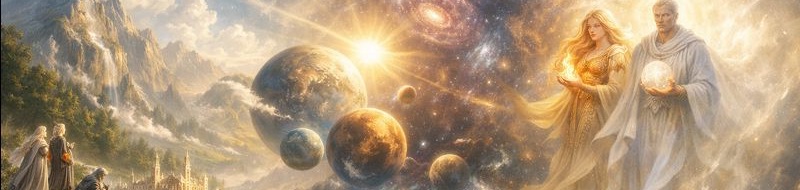
The Pantheon
CHAPTER I
THE FORM AND FUNCTION OF THE HEAVENS
I. Ab and the First Division
In the beginning was Ab, and Ab was alone.
Ab was not matter, nor thought, nor spirit, for these are divisions—and division had not yet begun.
Ab was the whole of all things, the fullness from which all else would come.
Ab was perfect, unmoving, and at peace. Yet within that peace stirred the first will—not desire, but love. For love unshared cannot rest.
From that love came the will to give, and from that giving came the first motion. It was not light or sound, but the trembling of possibility—the beginning of division.
From Ab came two children: Indrin, firstborn of structure and law, and Ylaea, second-born of motion and change.
Indrin was the voice of order, the strength that holds the pattern together. His was the stillness of the mountain and the path of the stars.
Ylaea was the pulse of creation, the joy that stirs the sea and the fire that drives life to grow.
They were opposite, yet each incomplete; for form without life is barren, and life without form cannot endure.
Ab looked upon them and was pleased.
Then Ab said, “Be as I am, and know yourselves.”
And in that word, the two became aware of their own nature—and of the vast empty space waiting to be filled.
II. The Age of Creation
The children desired to make as Ab had made.
Indrin gathered the stillness of the void and shaped it with his will. His works were strong but lifeless—crystal towers of thought that never moved nor aged.
Ylaea followed, and her creations were wild and living—storms of color, rivers of fire, oceans of light—but they dissolved as quickly as they formed.
Seeing their struggle, Ab spoke one final time:
“Take of me. What I am, I give. Shape it as you will.”
The twins hesitated, for they knew what it meant: to draw from Ab was to empty the Source. Yet the desire to create burned stronger than fear.
Ylaea reached first, drawing from Ab’s heart and casting it wide. The void blazed with new fire. Suns were born and hurled across the expanse; worlds formed from molten dust, spinning in the glow of the newborn stars.
Then Indrin took what remained and gave it order. He cooled the fires and shaped the paths of the heavens. He bound the worlds in their courses, stilled the chaos, and brought the great balance that endures still.
Together they made the Expanse, and from the mingling of their power came the Myriad—a host of divine spirits to watch and tend all things. Some were given to flame and wind, others to water, stone, and growing life. Each was a part of the great harmony, each a reflection of both order and change.
But creation demanded more. For though it was vast and beautiful, it was silent and still.
III. The Gift of Life
As creation matured, Ylaea moved again. She descended upon the worlds and breathed life across the land. Her breath spread like a flood—chaotic, powerful, and without form. It covered mountains and valleys alike, boiling through the seas and coiling into the air. All that it touched moved and changed—but aimlessly, without purpose or shape.
Indrin beheld the flood and came after her. With calm and steady hand, he gave her chaos form. He shaped the waters and set their bounds; he lifted the lands above the seas and gave the winds their courses. From the mingling of their natures, the world took order.
From the soil sprang green things of endless kind, and from them grew the web of all living flesh. Beasts of the field, fish of the water, and birds of the air came forth, each finding its place beneath the heavens.
The world became a living paradise—balanced and full.
Yet the Myriad were not content. They had been given dominion, but found no joy in ruling alone. They loved Indrin and Ylaea as children love their parents, but the twins had withdrawn into rest. The Myriad desired something that would look upon them with wonder and return that love.
So Indrin and Ylaea took from the last of Ab, and together they shaped a new being—a creature of clay and breath. They formed it in remembrance of Ab’s giving: strong enough to stand, weak enough to need, wise enough to choose.
From that act came the first of the sentient races.
First were the Elves, long-lived and graceful, born to tend the forests and guide the flow of magic that still hummed through the world.
Then came the Dwarves, deep-delving and steadfast, drawn to the bones of the earth and the shaping of its gifts.
Last came Men, short of years but great of spirit, whose hunger to build and change would move the ages to come.
Others would follow—new races born of Myriad hands and local will—but these three were the first and oldest children of the world.
IV. The Great Loss
When their work was finished, the children looked upon all that they had made—and silence fell. For they could no longer feel Ab.
The Source was gone; its voice no longer spoke, its light no longer shone.
They searched the heavens and found only the echo of what had been.
And yet everywhere they looked, they felt Ab’s power still—in the pull of the tide and the warmth of the sun, in the growing seed and the living breath of every creature.
Indrin said, “We have fulfilled the design.”
Ylaea said, “We have spent our inheritance.”
And both wept, for the parent they had loved was gone forever—poured out into all that lived.
From that day, the cosmos was Ab’s body, and life itself was Ab’s spirit. Every motion, every breath, every spark of magic was the echo of that original love.
Thus ended the First Expanse, and the Age of the Three was no more.
V. The Age of the Myriad
In the long ages that followed, the Myriad took stewardship of creation. For a time, there was harmony. But as the ages turned, the balance waned.
Each of the Myriad was born from both Indrin and Ylaea, but in differing measure. Some inclined toward order and preservation; others toward passion and change. What had been designed as complement began to divide.
At first the quarrels were small—contentions of stewardship, rivalries of craft and art. But pride grows quickly in the hearts of immortals. Worshippers among the mortal races began to favor one Aethara over another. To be remembered was to be strengthened; to be forgotten was to fade.
And so, devotion became currency. The Myriad contended for the prayers of mortals. Temples rose, creeds multiplied, and Aetharas who once served creation now sought to rule it.
Some appeared before mortals as mentors, others as conquerors, others still as lovers or kings. Wars were fought in their names—first among men, and then among the Aetharas themselves.
Myriad rose and myriad fell. Many were forgotten, their names surviving only as echoes in song and ruin. Some were known by many names and faces, others by none at all. There were hundreds, perhaps thousands, whose hands touched the mortal plane in those days, and no full count was ever made.
Thus the heavens, once one, became as the earth below—rife with faction, deceit, and ambition.
VI. Tirathos and the Betrayal of Eithrinivasticlaen
Among the Myriad, there was one who stood apart in steadfastness: Tirathos, lord of justice and just war. In him, the balance of order and mercy was once held in perfect measure. His hand was swift but fair; his word, a shield for the innocent.
But where light endures, shadow gathers.
Among his peers was Eithrinivasticlaen, the Whispering Flame—deceiver, architect of envy, and master of hidden designs.
Eithrinivasticlaen envied Tirathos’s station and the purity of his following. With subtle word and long deceit, he turned the other Myriad against the Warden, weaving rumors that Tirathos sought dominion beyond his charge.
The council of the heavens was swayed. In the end, Tirathos was condemned and banished from the upper courts.
For a time, his domain lay broken. His followers scattered—many to new masters, some to ruin.
But not all abandoned him. Among the legions that once bore his banner, one stood resolute: the Archangel Methblimashar’el, his chief among the heavenly host.
VII. The Exile and Return of Tirathos
During the exile of Tirathos, Methblimashar’el remained faithful. He guarded what remained of his lord’s dominion—its gates, its laws, its honor—against dissolution. He endured ridicule from the other hosts, yet never wavered.
When at last Tirathos returned from his exile, he was changed. The long silence of banishment had hardened his heart. The balance that once defined him was gone.
Mercy was now weakness. Compassion, folly.
Justice, once a shield, became a sword.
He resumed command of his legions, but his gaze no longer lifted toward heaven. He sought to impose order through fear, to bind chaos by domination. Those who questioned him were branded traitors. Even the righteous trembled under his gaze.
Methblimashar’el, bound by loyalty, obeyed. Yet in his heart he felt the fracture—the sense that what he served was no longer just.
VIII. The Infernal War
It was in this time that the Infernal War erupted—when the realms beyond creation turned upon one another, and the Abyss and the Hells clashed in endless slaughter. The conflict threatened to spill into the mortal planes, and Tirathos decreed that his legions would intervene to preserve the balance.
To Methblimashar’el he gave command.
The Archangel descended with the hosts of the Warden and waged war for uncounted centuries. They fought not to conquer, but to contain. Yet with each victory, the cost grew heavier. Celestials, once slain, were lost forever; but fiends, born of the very chaos they served, returned unendingly.
The war was unwinnable.
Seeing this, Methblimashar’el sought another way. Against command, he parleyed with a devil lord, Uriiginor the Cunning, offering his own blade in exchange for a single chance to end the slaughter.
The pact succeeded. The infernal legions turned upon themselves, and the field was won.
When Methblimashar’el returned, expecting mercy, he found only wrath.
Tirathos, now absolute in judgment, declared his act a betrayal—obedience broken, purity defiled.
And in his fury, Tirathos cast down his most loyal servant.
IX. The Fall of Methblimashar’el
The Archangel fell through the veils of the heavens, his wings burned away, his name struck from the rolls of light.
He fell until he struck the mortal world, broken and alone.
For many years, he wandered. He took the name Ashar, and walked among mortals as one of them. He learned hunger, fatigue, and fear. He saw injustice not as a concept, but as a wound. He defended those who could not defend themselves, and men began to follow him.
He discovered that mortal life—so brief, so frail—was also radiant beyond measure. For in their weakness lay the freedom the heavens had lost.
And in time, he came to understand: his soul was not as theirs. Should he die, he would not ascend to the Aether, nor fall to the Hells. Heaven had rejected him, and the Pit would unmake him.
Thus he sought not power for himself, but salvation—for if he could not ascend, he must become something greater, or risk becoming ruin incarnate.
X. The Ascension of Ashar
Ashar’s life among mortals became legend.
He stood against Justirants, shattered false Aetharas, and gathered to himself men and women of virtue and courage. He taught that balance was the highest good—that courage without wisdom was destruction, and mercy without strength was futility.
His followers called him the Risen Flame, for wherever he stood, darkness receded.
And in the end, when his mortal life was spent, the heavens opened—not by decree, but by right.
He rose not as angel, nor as servant, but as something new: a Aethara wrought of mortal dust and divine purpose.
In him, the pattern of Ab was fulfilled again—unity born from division, love from sacrifice.
Thus Ashar, the Risen One, took his place among the Myriad.
He entered not as conqueror, but as reformer. And his coming would change the heavens forever.
For his ascent marked the waning of the Myriad’s age—
and the dawn of the Asharian Reformation.
CHAPTER II
THE CELESTIAL CIVIL WAR AND THE ASHARIAN REFORMATION
The Prelude to War
The Celestial Civil War was not born of a single moment, but of ages of disquiet and divine contention. For eons, the Courts of the Aethera existed in discord—Aethara pursuing their own desires without heed for harmony or the balance set forth by Indrin and Ylaea in the First Expanse.
The return of Tirathos, the Warden of Justice and Shield of the Aether, turned this long unrest into open strife. Once a paragon of vigilance and protection, Tirathos had returned from his exile changed. Whatever he had endured beyond the High Gates, it had stripped him of mercy and left only the cold echo of order.
His doctrine, once rooted in guardianship, had calcified into Justiranny. Where once he had stood watch for the sake of others, he now sought dominion over all. His decrees demanded total obedience, not only from mortals but from his fellow Aethara. He gathered his legions—once the keepers of law and light—and forged them into an army of conquest.
To the east of the Aethera stood Doreon, the Lord of Renewal and Dawn’s First Light. He had ever championed the freedom and vitality of creation. Where Tirathos saw strength in control, Doreon saw life in change. He and his allies—the Aethara of compassion, creation, and truth—opposed the Warden’s growing dominion, fearing that if his rule spread unchecked, creation itself would stagnate and perish.
Thus the heavens, which had long stood divided by philosophy, were drawn into war.
The Chaos of War and the First Sundering
When the first blow was struck in the Courts above, the fabric of the world below shuddered. For the realms of men and Aetharas are woven together, and when one is wounded, the other bleeds.
The war of the Aethera spilled across the firmament. The vaults of the heavens shook as the hosts of Tirathos clashed with the coalition of Doreon. Legions of light and flame met upon the fields of the firmament, and the echo of their battle reached even the mortal planes.
This age of cataclysm is remembered as the First Sundering. Mountains split and rose anew, seas boiled and fled their shores, stars were blotted out and rekindled in different skies. The lands of mortals were broken and re-formed, for every divine act resounded through the material world.
Mortals, bound by faith to their Aethara, took up arms in mirrored wars. Kingdoms fell; cities burned; the faithful turned against one another in the names of powers they could not comprehend. The Sundering was not only a reshaping of the earth but a scarring of the soul of creation.
Tirathos Ascendant and Doreon’s Despair
Through ages of battle, Tirathos’s discipline and might began to prevail. His armies, drawn from countless hosts of the Aethera, marched with perfect order and ruthless precision.
Doreon’s coalition—noble and radiant though it was—found itself faltering. The Aethara of freedom and life could not match the relentless tide of iron that pressed against them. Their ranks thinned, their resolve waned.
One by one, the great lights of the coalition dimmed. Doreon himself, wounded and weary, was driven from the High Gates. His dawnlight faltered, and the Aether trembled under the iron shadow of Tirathos.
It seemed the war was lost. Justiranny had triumphed, and the balance of the heavens was broken.
The Arrival of Ashar
But in that dark hour came Ashar, the Risen Flame.
He had watched the conflict from afar—neither aligned with Tirathos nor with Doreon. For though he had once served as the Archangel Methblimashar’el, he had learned among mortals the peril of extremes.
Now ascended to the rank of Aethar, Ashar perceived that both sides had erred: order had devoured mercy, and freedom had lost its discipline. The harmony of Ab—the eternal balance between chaos and law—was lost in their war.
So Ashar gathered to himself those who had remained apart from the fighting: the neutral and the weary, the steadfast and the wise.
Sophris, Aethar of Temperance; Magnion, of Magnificence; Aspira, of Right Ambition; Verin, of Truthfulness; and Phileth, of Friendship—these and others answered his call.
From their union arose the Asharian Alliance, a host neither of conquest nor rebellion, but of restoration.
The Rebellion Within the Armies of the Warden
When Ashar entered the field, his coming struck the heavens like a new dawn. His philosophy—of courage guided by virtue, of strength tempered by mercy—spread swiftly through the ranks.
Among the legions of Tirathos, once loyal to the Warden’s banner, many remembered Methblimashar’el of old. They saw in Ashar not rebellion, but the light of justice they had lost.
One by one, wings turned from shadow to light.
Angels and captains abandoned their master’s Justiranny and joined the Risen Flame. Tirathos’s hosts faltered as his own creations turned against him.
Ashar, unwilling to let vengeance supplant purpose, forbade cruelty in victory. “Order must not be slain,” he declared, “but redeemed.”
His army advanced not as conquerors but as liberators, reclaiming the Courts and freeing those bound in blind obedience.
The Fall of Tirathos
The final battle was fought before the Warden’s Citadel, upon the storm-forged plains of the Aethera. The skies bled light as the two armies clashed, and the thunder of their war was felt in every mortal heart.
Ashar led from the forefront, his blade a living symbol of Ab’s unity—chaos and order joined in perfect balance. Tirathos descended to meet him, armored in judgment and wrath.
They fought for nine days and nights beneath the ruin of the heavens. At last, Ashar’s blade struck true—not in destruction, but in revelation. He unmade the chains of Justiranny that bound the Warden’s spirit.
Tirathos fell, not slain but subdued. His armies broke, and the war was ended.
Doreon’s Submission and the Coronation of the Risen Flame
When the fields of heaven grew silent, Doreon, broken and dim, came before Ashar. In him he saw not a rival, but the answer to all their striving.
He knelt and said, “The light I bore is yours now, for you have restored its balance.”
Ashar refused the title of king, saying, “No Aethar shall rule as master. Let each bear the virtue they are given, and all stand as equals beneath the Light.”
But the Courts, weary of war and chaos, proclaimed him nonetheless as First Among Equals, Keeper of the Golden Balance. And so began the Asharian Reformation.
The Binding of Tirathos and Eithrinivasticlaen
Though the war was ended, its roots remained. For in the fall of Tirathos there still lurked the whisper of Eithrinivasticlaen, the deceiver who had once betrayed him. It was he who had sown envy, pride, and ambition among the Aethera, and it was his corruption that had poisoned the Warden’s heart.
Ashar saw that to preserve creation, the extremes of law and chaos must be bound together. And so, in an act of divine synthesis, he forged the Star Forge—a crucible of creation and unmaking.
There he bound Tirathos, embodiment of absolute order, and Eithrinivasticlaen, avatar of chaos and deceit. From their essence he drew forth a power neither one nor the other—a harmony of opposition.
The Star Forge became both weapon and foundation, the means by which the Aethera would be remade.
The Reformation of the Courts
With the Star Forge’s light, Ashar dissolved the shattered heavens, the Abyssal depths, and the Infernal realms alike. The realms of the old order were swept away, their corruption purged.
In their place, Ashar fashioned the Golden Courts, radiant realms of equilibrium and purpose.
There he established the Court of Light, twelve in number—the Aethara of Virtue—and opposite them the Court of Shadow, nine in number—the Aethara of Vice. Between them stood the Uncourted, embodied by Nemeion, Keeper of Death and Passage, who holds the threshold between all realms.
The Courts were bound by covenant that none should walk the mortal plane in full form again. This was the Pact of the Celestial Gate, that mortals might grow without the oppression of direct divine hand.
Each Aethar was given dominion according to their nature, but all were made to serve balance.
Thus the Justiranny of the Myriad was ended, and the Aethera became ordered by wisdom, not by power.
The Second Sundering and the Closing of the Gate
Yet as the Aethera were remade, the mortal realm trembled once more. The Reformation of the heavens tore through the firmament, severing the link between Aetharas and men.
This age is remembered as the Interdomina, or the Second Sundering.
Without the guiding hands of the Aethara, magic grew wild and unrestrained. Nations rose and fell in chaos. Seas drowned kingdoms; mountains split open and burned. For near a century, the mortal world writhed as creation adjusted to its new harmony.
When at last the storm passed, the world stood renewed.
The Aethera withdrew fully from mortal sight, and the balance of Light and Shadow held steady once more.
At the heart of the Golden Courts stood Ashar, the Risen Flame, First Among Equals, Keeper of the Golden Balance.
Around him gathered the Aethara of Light and Shadow, each sworn to the harmony that sustains all things.
And thus ended the Celestial Civil War—
and began the Age of the Aethera,
founded upon courage, wisdom, and balance eternal.
1.2 Ethical and Moral Framework
The Dichotomy of Virtue and Vice
The reformation of the pantheon under Ashar introduced a profound cosmic dichotomy—a distinction between virtue and vice, reflecting not only the external struggle between Aetharas but the inner tension within every mortal. Virtue and vice are not merely concepts or moral categories but are forces inherent to existence itself, woven into the fabric of both the mortal soul and the divine cosmos. This tension mirrors the fundamental question of what it means to live a life in alignment with higher ideals versus succumbing to the baser elements of one’s nature.
Ashar, the King of Heaven, stands as the first among equals within the Court of Light. While he holds the crown of leadership, his authority is defined not by dominance but by his embodiment of courage and justice. Unlike Justirants or monarchs of mortal kingdoms, Ashar’s rule is servant-leadership, characterized by humility and the recognition that all virtues must be balanced for the cosmos to function harmoniously. Each Aethara in the Court of Light represents a vital virtue—courage, wisdom, justice, temperance, compassion, and others—but none can stand in isolation. Virtue, in its purest form, is not the exaltation of one quality over others, but the harmonious integration of all, leading to the flourishing of the individual and society alike.
The cosmic order established by Ashar is not a hierarchy of power for its own sake, but a hierarchy of virtues, where each Aethara plays an essential role in preserving the delicate balance that sustains both mortal life and the celestial realms. Virtue is not a static state, nor is it confined to the pursuit of a single ideal; rather, it is the dynamic interplay of these higher qualities that allows for the full development of the self, and by extension, a well-ordered world. The virtues that the Aetharas embody act as pillars, each supporting the whole; if one is neglected, the entire structure falters.
At the same time, vice represents the natural state of man—the base instincts, the primal desires, and the brutal realities of existence when left unchecked by higher moral guidance. The Aetharas of the Court of Shadow embody the forces of chaos, selfishness, and corruption that threaten to unravel the cosmos. Where virtue is aspirational and requires discipline, reflection, and conscious effort, vice is easy, instinctive, and immediate. Life, if left to the baser self, is often characterized by brutality, self-interest, and survival at all costs—what the mortal philosophers often describe as the "natural state," a cold and indifferent world where ambition, greed, and cruelty reign unchecked.
This duality is more than a moral lesson for mortals; it is the essential tension of existence itself, where the higher self strives to rise above the natural state, while the lower self—the base nature—constantly seeks to drag the soul back into the mire of self-centered indulgence. It is the cosmic balance between these two forces that defines the moral landscape in which mortals must make their choices. Vice is not merely a trial to be overcome; it is the default state of life without the intervention of the divine virtues. Without the guidance of Ashar and the Aetharas of Virtue, mortals would be left to their instincts, doomed to a life ruled by ambition, deceit, wrath, and despair.
This balance mirrors the great debates among mortal philosophers who argue that man, when untethered from higher principles, will naturally descend into selfishness and cruelty. To exist in a state of virtue is an act of will—a deliberate choice to transcend one’s baser instincts and align oneself with the divine order. It is through this struggle that mortals can achieve true moral greatness. The Aetharas themselves demonstrate this tension, for even they must constantly embody and balance their own virtues, lest they fall into the same pitfalls as mortals.
Virtue as the Foundation of the Higher Self
In the ethical framework of the pantheon, virtue is the cornerstone of the higher self—the part of mortals that reflects the divine and strives toward something greater than mere survival. To embody virtue is to rise above the natural state, to transcend the baser self, and to become a living reflection of the divine order. Ashar and the other Aetharas of the Court of Light are not just distant figures to be worshipped; they are paragons of the higher self, models for what mortals can and should become if they commit to the path of virtue.
The concept of virtue within this system bears close resemblance to what mortal philosophers describe as the "mean" or "balance" between extremes. Virtue is not an excessive zeal in one direction, but the perfect moderation—the courage to act in the face of fear but tempered by wisdom, the pursuit of justice balanced by mercy, the strength to defend the weak without falling into Justiranny. Ashar exemplifies this golden mean, embodying courage not as brute strength, but as the ability to act justly and righteously, even in the face of overwhelming opposition.
Other Aetharas, such as Veria, the Aetharadess of knowledge and wisdom, underscore that wisdom is the guiding virtue that allows all others to be exercised rightly. Without wisdom, courage becomes recklessness, justice becomes cruelty, and temperance becomes self-denial. Wisdom, in this context, is the divine insight that allows mortals to discern right from wrong, truth from falsehood, and good from evil. It is through the cultivation of wisdom that mortals can begin to see the world as it truly is, to understand the complex moral landscape, and to navigate it in a way that leads to personal flourishing and societal harmony.
In this philosophical framework, the higher self is not a passive state of being but an active pursuit, requiring a lifetime of reflection, action, and adjustment. The Aetharas of Virtue provide the guiding principles, but it is up to each individual mortal to internalize these teachings and live them out in their daily lives. The higher self is achieved through a conscious alignment with the will of the Aetharas and the laws of the cosmos, where one's actions reflect the eternal truths that govern both the divine and mortal realms.
Vice as the Natural State of Man
While virtue represents the highest potential of mortals, vice is the natural state to which they are always drawn when left untethered from divine guidance. The Aetharas of Vice, such as Vael, the Aethara of ambition and Justiranny, and Avaris, the Aetharadess of greed, embody the forces that seduce mortals into pursuing immediate gratification, power, and dominion over others, without regard for the long-term consequences to the soul or society.
Vice, in this framework, is not simply a temptation to be overcome but the default condition of life lived without the intervention of higher principles. In a world devoid of virtue, life is cold, brutal, and short—a constant struggle for survival in which self-interest, wrath, and deceit dominate. The Aetharas of Vice are not mere villains, but representations of the baser aspects of mortal existence, the primal instincts that drive one to pursue pleasure, power, and wealth at the expense of others.
From the perspective of the Aetharas of Virtue, vice is the greatest challenge that mortals must confront, not because it is an external force but because it resides within the heart of every living being. Vael tempts with promises of greatness and dominion, and his teachings appeal to the mortal desire for control—not only over others, but over one’s own fate. Yet, this ambition is a poisoned chalice, for unchecked ambition leads to Justiranny and ultimately to spiritual decay.
Avaris lures mortals with the promise of wealth, but her greed leads only to isolation and destruction, as those who follow her path become hoarders of wealth and oppressors of the poor. Her teachings reflect the belief that abundance for one must come at the expense of others, a worldview that leads not to flourishing, but to the breakdown of society.
The Role of Free Will in the Moral Landscape
Central to the ethical and moral framework of the pantheon is the concept of free will. Mortals are not born into a predetermined path of virtue or vice; rather, they are given the freedom to choose their actions, to determine their own fate. This freedom is both a gift and a burden, for it places the responsibility for one’s soul squarely on the individual. The Aetharas, while powerful, do not compel mortals to follow their teachings, nor do they intervene to force a virtuous life. Instead, they offer guidance, inspiration, and the tools needed to make virtuous choices.
Free will, in this context, is not merely the freedom to act; it is the freedom to choose the good—to rise above the base instincts that define the lower self and to aspire to something greater. True virtue comes not from compulsion but from the voluntary alignment with the divine principles. The Aetharas respect this freedom, recognizing that forced virtue is no virtue at all.
1.3 The Temple of the Divine Virtues: Structure, Roles, and Function
Overview of the Temple's Purpose
The Temple of the Divine Virtues serves as the central religious authority in Faendara, overseeing the worship and devotion to the Aetharas who embody the core virtues that govern life in the world. The Temple acts as both a spiritual guide and a moral compass for the faithful, promoting unity among the various orders dedicated to each Aethara while allowing for the diversity of expression that is essential to the different races and cultures of Faendara. Though each Aethara represents a single virtue, the Temple emphasizes that no one virtue stands alone—all are interdependent and must be balanced for a just and harmonious society.
The Temple is not simply a place of worship but an institution dedicated to the teaching, promotion, and safeguarding of divine virtues through education, governance, and, when necessary, martial defense. It is both a spiritual center and a governing body, ensuring that the faithful across Faendara adhere to the divine principles.
Governing Structure of the Temple
The Temple of the Divine Virtues is governed by a High Synod, which is composed of twelve Primarchs, each representing one of the Aetharas of virtue. The First Primarch is always chosen from the followers of Ashar, symbolizing his role as King of Heaven, though this position carries no absolute power—rather, the First Primarch is the first among equals. Decisions within the High Synod are made by consensus, ensuring that the will of the Aetharas is represented in every major theological and political decision.
The High Synod oversees the general direction of the faith, but much of the day-to-day governance is managed by the Luminaries, spiritual leaders who oversee large regions or cities. Luminaries ensure that local temples and congregations are upholding the tenets of the virtues, and they mediate local disputes within the orders of the Aetharas.
Regional and Local Organization: Synods and Temples
While the High Synod governs the Temple at large, regional synods—often called simply Synods—are held regularly in major cities and regional centers. These Synods gather local Exemplars, Wardens, Sentinels, and Inquisitors to discuss matters of doctrine, worship practices, and governance. A Luminary presides over these regional Synods, ensuring that the local orders are aligned with the broader will of the High Synod.
Temples dedicated to the various Aetharas can be found throughout Faendara, ranging from grand cathedrals in the capital cities to humble shrines in the wilderness. These temples are places of worship, learning, and refuge, where the faithful gather to seek guidance and partake in rituals. Each temple is dedicated to a specific Aethara, but all recognize the interconnectedness of the virtues, often incorporating shrines or altars to other Aetharas as a symbol of unity.
In larger temples, there may be several tiers of leadership, with Exemplars overseeing the spiritual needs of the congregation, Wardens ensuring the temple’s safety, and Inquisitors maintaining theological purity.
Roles Within the Temple
The Temple of the Divine Virtues is divided into several key roles, each serving a unique purpose within the structure of the faith. These roles are not hierarchical in a strict sense but are instead divided by function, ensuring that every aspect of religious life—whether spiritual, martial, or scholarly—is addressed.
Exemplars (Priests and Spiritual Leaders)
The Exemplars are the primary spiritual leaders within the Temple. They are tasked with guiding the faithful in their understanding of the virtues and teaching them how to apply these virtues in their everyday lives. Exemplars serve as priests, teachers, and counselors, offering wisdom and comfort to the congregants.
• Shepherds: These Exemplars oversee local congregations, guiding them in the practice of virtue and ensuring that they remain true to the teachings of the Aetharas. They perform rituals, lead prayers, and offer guidance in times of spiritual need.
• Scribes: Focused on the preservation and dissemination of religious texts, Scribes are responsible for maintaining the written history of the Aetharas and ensuring that the sacred teachings are accurately passed down through the generations. They often work closely with the Inquisitors to ensure doctrinal purity.
• Wanderers: These Exemplars take on a more adventurous role, traveling between settlements and into remote regions to spread the teachings of the virtues. Wanderers often bring the word of the Aetharas to those who live far from established temples or who are in need of spiritual guidance in times of crisis.
Wardens (Clerics and Healers)
The Wardens are the protectors of the faith, responsible for both the physical and spiritual well-being of the faithful. Wardens serve as healers, guardians, and warriors, often taking on roles that require both compassion and strength.
• Healers: These Wardens are devoted to the care of the sick and injured, serving in temples, hospitals, and on the battlefield. They are highly skilled in the healing arts, using both divine magic and practical medicine to tend to the needs of the faithful.
• Guardians: The Guardians are responsible for protecting holy sites and ensuring the safety of the temple and its congregation. They act as temple guards, ensuring that sacred places are not violated by those who would bring harm to the faith.
• Stewards: Responsible for the upkeep and maintenance of the temple grounds, Stewards ensure that the physical aspects of worship—such as the sacred spaces, relics, and altars—are properly cared for. Though their role is practical, it is also highly spiritual, as they believe that a well-tended temple reflects a well-tended soul.
Sentinels (Paladins and Defenders of Faith)
The Sentinels are the martial arm of the Temple, sworn to protect the faithful and uphold the virtues through strength of arms. They are called to defend the Temple from external threats and often serve as the military commanders of the faith. Though they are warriors, their actions are guided by the virtues they are sworn to uphold.
• Templars: The Templars are the most visible of the Sentinels, leading armies and defending the faithful in times of war. They are the vanguard of the Temple’s military, often called upon to face the enemies of the faith and protect those who cannot protect themselves.
• Defenders: While the Templars lead in times of war, the Defenders are tasked with protecting the holy places of the Temple. They are responsible for ensuring that the temples, shrines, and sacred sites of Faendara are safeguarded from desecration and destruction.
Inquisitors (Scholars and Investigators)
The Inquisitors are the intellectual and investigative arm of the Temple, tasked with rooting out heresy, ensuring theological purity, and resolving doctrinal disputes. Inquisitors often travel the land, investigating claims of heresy, questioning interpretations of the sacred texts, and ensuring that the will of the Aetharas is followed without deviation.
• Seekers: These Inquisitors dedicate their lives to studying the sacred texts, delving into ancient writings and obscure prophecies to understand the deeper meanings of the Aetharas' teachings. They are often involved in debates over interpretation and are respected for their intellectual rigor.
• Judicators: The Judicators are the investigative arm of the Inquisitors, responsible for investigating claims of heresy, rooting out corruption within the orders, and ensuring that all worship remains true to the virtues. They often operate in secret, seeking to correct deviations from the faith before they spread.
Temples, Sacred Spaces, and Rituals
The Temple of the Divine Virtues oversees a vast network of temples, shrines, and sacred sites across Faendara. These spaces are as varied as the Aetharas they honor, ranging from grand cathedrals to humble roadside shrines. Each temple is dedicated to a specific Aethara but often contains shrines to other deities as a reflection of the unity of the virtues.
• Temples of Ashar: These temples are grand and imposing, symbolizing the courage and strength that Ashar embodies. They often serve as places of justice as well as worship, with courts located within the temple complex.
• Temples of Veria: The temples dedicated to Veria are more like vast libraries or academies, filled with ancient texts and scholars who dedicate their lives to the pursuit of wisdom.
• Shrines of Philethe: Often found in natural settings, Philethe’s shrines are places of quiet reflection and joy, where her followers can reconnect with nature and celebrate the beauty of life.
Rituals vary between temples, but all share the common goal of promoting the virtues and ensuring that the faithful remain connected to the divine. Festivals, sacrifices, and ceremonies are held regularly to honor the Aetharas and celebrate the virtues.
Unity in Diversity: Cultural Expressions of Worship
While the Temple of the Divine Virtues promotes a unified understanding of the virtues, it recognizes and embraces the diversity of Faendara’s many races and cultures. Different races may approach worship in ways that are unique to their traditions, but the Temple teaches that the intention behind the ritual is what matters most.
For instance, Elves may honor Modara’s modesty through art and quiet reflection, while Orcs may demonstrate their devotion to Ashar’s courage through acts of martial bravery. Herengons may express Veria’s wisdom through farming techniques or communal decision-making, while Humans might worship Sophris through their role as protectors of justice.
The Temple encourages these cultural expressions, understanding that while the Aetharas are universal, the ways in which their virtues are honored may vary. As long as the core values of the Aetharas are respected, the Temple welcomes all forms of worship.
1.4 Social and Political Influence of the Pantheon
The Role of the Pantheon in Society
The influence of the Faendaran Pantheon is pervasive across nearly all aspects of life, shaping the social, political, and ethical frameworks of the world. The Aetharas, particularly those of the Court of Light, are viewed as not only spiritual guides but as archetypes of moral and civic responsibility. Their virtues—courage, wisdom, temperance, justice, and more—are deeply intertwined with societal expectations, defining what it means to live a righteous and prosperous life. As a result, the pantheon’s reach extends beyond the temples and sacred spaces, influencing the very fabric of governance, law, and social order.
The Aetharas of the Court of Shadow, while often shunned publicly, still hold sway in certain regions, especially in areas where lawlessness or corruption flourishes. In these places, vices such as ambition, greed, and deceit may serve as undercurrents within political systems, fostering inequality and conflict. The tension between the followers of Virtue and Vice is a microcosm of the larger struggle between these forces in mortal society, where balance must be maintained.
Religious Authority and Governance
Across Faendara, religious figures wield significant authority, not just in spiritual matters, but in governance, law, and diplomacy. While the nature and extent of this authority vary from region to region, it is common for priests, clerics, and even inquisitors to hold influential roles in guiding or advising the rulers of kingdoms, city-states, and communities.
Exemplars and Luminaries—leaders within the Temple of Divine Virtues—are often seen as the moral compass of society. Their counsel is sought not only in religious matters but in political decisions that could impact the broader community. The perception that those closest to the Aetharas possess divine wisdom places them in a position of profound influence.
1. Advisor Roles: In many societies, high-ranking religious figures serve as counselors to kings, queens, or elected leaders. These religious advisors offer guidance based on the virtues of the Aetharas they serve, ensuring that decisions reflect the divine will. For instance, a Priest of Sophris might counsel a ruler on matters of temperance and mercy, urging restraint in conflict. Meanwhile, an Exemplar of Justir might advise on issues of justice, ensuring that the ruler enacts fair laws and righteous judgments.
2. Governance by Clergy: In some regions, the clergy itself may take on direct political roles, with religious leaders serving as heads of state or holding significant administrative power. Such societies tend toward theocracies, where the line between religious doctrine and civil law is blurred. For instance, cities devoted to Justir often operate under a judicial system heavily influenced by divine law, where clerics or paladins serve as judges and law enforcers.
3. Regional Influence: The degree of religious authority varies significantly between regions. In the heartlands where the Temple of Divine Virtues is strongest, the clergy might hold formal power, overseeing the spiritual and civil governance of the population. In contrast, more secular or Vice-influenced regions may resist overt religious rule, though even here, the cultural influence of the Aetharas shapes societal norms and expectations.
The Hierarchy of Influence: Divine Virtue vs. Vice
The interplay between the Aetharas of Virtue and Vice is mirrored in the structures of governance. While the Court of Light provides the foundation for a just and stable society, the Court of Shadow represents the dangers of indulgence, corruption, and the unchecked pursuit of power.
1. Societies of Virtue: In societies where the Aetharas of Virtue hold sway, the laws reflect the moral teachings of the Aetharas. These laws are structured to promote the well-being of all, ensuring justice, fairness, and equity. A society influenced by Justir may have rigid legal systems designed to root out corruption and enforce justice, while those under Veria’s guidance prioritize wisdom and knowledge, leading to governance that emphasizes education and informed decision-making.
These societies are characterized by:
◦ Structured legal systems rooted in divine principles.
◦ Community-based governance, where individuals are expected to act in service to the greater good.
◦ Public festivals and holy days that celebrate virtues like courage, hope, and strength, reinforcing societal values through shared religious practices.
2. Societies of Vice: In contrast, regions dominated by the influence of the Aetharas of Vice tend to exhibit characteristics of corruption, ambition, and chaos. While not all followers of Vice are openly malicious, they often operate under a self-serving worldview, where personal power, wealth, and status are prioritized over communal well-being. Vael, Avaris, and Lurea are examples of deities whose worship encourages the pursuit of ambition, sometimes leading to ruthless political maneuvering.
These societies may reflect:
◦ Lax or corrupt legal systems, where bribes and political favors are more influential than justice.
◦ Justirannical leadership structures, where rulers enforce their will without concern for fairness or the well-being of their subjects.
◦ Cult-like factions, where followers of Vice deities gain power through deceit, manipulation, and coercion.
The Intersection of Religion and Law
The relationship between religious authority and civil law is complex and often fluid. In societies governed by the Temple of Divine Virtues, the laws are an extension of the moral and ethical teachings of the Aetharas. These laws, often codified based on ancient texts, dictate both civil conduct and religious observance, creating a legal framework where the virtues are woven into the fabric of governance.
1. Divine Law as Civil Law: In many kingdoms, the principles of divine virtue are not merely suggestions for personal behavior but form the basis of the legal system. For example, the laws against theft and murder are seen as extensions of the virtues of justice and temperance. In these societies, courts are often presided over by clerics or paladins who ensure that the law is interpreted in a way that honors the will of the Aetharas.
2. Religious Enforcement: In societies more directly governed by the Temple, religious courts may exist alongside or even above civil courts. These religious courts handle matters of heresy, blasphemy, and other religious infractions, often determining punishment for those who deviate from the faith. Such courts may also handle disputes over doctrine, ensuring that the faith remains pure and free from corruption or misinterpretation.
3. The Balance of Power: In regions where the Aetharas of Vice hold greater sway, laws may be looser or more easily manipulated. Ambitious leaders who seek power for its own sake often ally themselves with Aetharas like Gelian or Vael, creating environments where laws are subverted for personal gain. These societies, while often more chaotic, can also be more flexible, with power shifting quickly between factions and leadership structures.
The Temple’s Role in Politics and War
The Temple of Divine Virtues plays an essential role in not only shaping governance but also influencing the course of political conflict and warfare.
1. Political Advisors: Religious leaders, especially Luminaries and Exemplars, often serve as advisors to rulers, offering spiritual guidance on matters of state. Their advice is sought when making decisions about war, alliances, or diplomacy, as rulers believe that acting in accordance with divine principles ensures success.
2. Divine Blessings for War: In times of war, the Temple may bless armies or even dispatch paladins and clerics to fight alongside soldiers. In particular, the orders of Ashar and Sophris are known to take an active role in battle, with their warriors often leading the charge against forces that threaten the balance of the virtues.
3. Holy Wars: Conflicts driven by religious differences—holy wars—are not uncommon in Faendara. Societies aligned with the Court of Light may clash with regions dominated by the Aetharas of Vice, seeing these conflicts as righteous crusades to restore balance and order. Similarly, internal conflicts within the Temple may arise when interpretations of doctrine differ, leading to schisms and civil wars driven by ideological disputes.
1.5 Mysticism and Spirituality in the Faendaran Pantheon
Communion with the Divine
Mysticism and spirituality form the bedrock of the Faendaran Pantheon, allowing mortals to engage in profound personal experiences of the divine. Beyond communal worship and temple rituals, there exists a rich tradition of mystical practices that encourage direct communion with the Aetharas. These personal connections vary from simple meditative practices to profound visionary experiences. For many, this mysticism represents a deeper, more intimate relationship with the divine, providing insights, guidance, and sometimes even challenges for spiritual growth.
The mystics of Faendara are highly respected, often revered as individuals who have transcended the ordinary barriers between the mortal world and the divine realms. They are seen as those who can commune with the Aetharas in ways beyond standard prayer and worship, unlocking higher truths through personal experience.
Visions, Dreams, and Divine Inspiration
Among the most common mystical experiences in Faendara are visions, dreams, and moments of divine inspiration, which followers interpret as direct communications from the Aetharas. These experiences are often deeply personal, revealing truths, guidance, or warnings that cannot be gained through study or ritual alone. The Aetharas may choose to reach out to mortals in their sleep, during moments of intense emotion, or at times of great need. Such experiences serve as beacons of clarity in an often confusing and chaotic world.
1. Visions: Visions can come in many forms, from brief flashes of insight to more sustained, surreal encounters with the divine. Sometimes, these visions reveal prophetic messages about the future, offering glimpses of upcoming challenges or triumphs. Other times, visions may be symbolic, requiring interpretation by seers, priests, or the individuals experiencing them. For instance, a follower of Sophris might have a vision of a dragon flying over a battlefield, signifying a future conflict in which they must take part, while a follower of Veria might receive complex symbols that require deep reflection to unlock their meaning.
2. Dreams: Prophetic dreams are a powerful means of divine communication. Dreams allow the Aetharas to speak in riddles and metaphors, reflecting the mysterious nature of the divine. Mortals often wake with only fragments of their dreams in their minds, requiring contemplation or the aid of oracles to make sense of these divine messages. Some dreamers become dreamwalkers, those who can navigate the dream realms and seek out the Aetharas within these ethereal spaces.
3. Divine Inspiration: Moments of sudden clarity—divine inspiration—are often seen as gifts from the Aetharas, providing followers with insight, artistic creativity, or the answers to pressing dilemmas. For instance, a follower of Gelian might be struck with an idea for a new piece of music, believing the inspiration to come directly from the Trickster Aethara. Meanwhile, a follower of Justir might suddenly know the correct legal judgment for a complex case, attributing this to a divine nudge in the right direction.
Mystics, Seers, and Oracles
Mystics, seers, and oracles occupy a special role in Faendara, acting as intermediaries between the divine and mortal realms. Their ability to interpret dreams, visions, and divine symbols makes them invaluable to their communities. Seers are often sought out for advice in times of uncertainty or to foresee significant future events. Oracles may reside in secluded temples or sacred groves, far removed from the distractions of mortal life, so they may focus entirely on divine communion.
1. Mystics: These individuals engage in personal practices such as fasting, meditation, and isolation to achieve a state of communion with the divine. Mystics often retreat from society for long periods, emerging only when they have received profound revelations or to guide others on the path of spiritual growth.
2. Seers: Seers are gifted with the ability to see beyond the present, often receiving glimpses of the future. They serve as divine advisors, helping rulers, clerics, and individuals navigate their fates. Seers may also interpret the dreams and visions of others, using their gift to discern the divine meanings within.
3. Oracles: Oracles are known to channel the divine directly, often entering trances or altered states in which the Aetharas speak through them. Oracles are revered for their ability to offer direct advice from the Aetharas, and their words are often taken as sacred. Oracle-priests serve in temples, offering their divine insights to the faithful.
The Path of Spiritual Growth
In Faendara, spiritual growth is understood as a lifelong journey—one of constant refinement and striving toward divine ideals. Mortals are seen as having the potential to grow closer to the Aetharas by emulating their virtues and following their teachings. While communal worship offers a framework for this journey, true spiritual progress is often made through personal effort and mystical experiences.
1. The Cultivation of Virtue: Each of the Aetharas of Virtue provides their followers with a clear path to enlightenment, encouraging them to cultivate virtues like courage, wisdom, temperance, modesty, and others. The journey toward spiritual enlightenment is one of personal discipline, sacrifice, and often, great difficulty. Mortals are expected to continually strive to embody the virtues of their chosen deity, overcoming their own base instincts and the temptations of vice.
◦ Ashar’s followers pursue courage by facing their fears and standing firm in their principles, even in the face of overwhelming danger.
◦ Veria’s followers pursue wisdom through study, reflection, and contemplation, constantly seeking to expand their knowledge of the world.
◦ Modara’s followers cultivate modesty by defending innocence, quietly working to protect others without seeking personal glory.
2. The Trials of Virtue: As mortals grow in virtue, they often undergo trials designed by the Aetharas to test their faith and resolve. These trials can be physical challenges, moral dilemmas, or spiritual struggles that force the individual to make difficult choices. For instance, a follower of Justir may be placed in a situation where they must choose between mercy and punishment, knowing that true justice requires wisdom and discernment.
3. The Danger of Vice: Followers of the Aetharas of Vice also experience spiritual growth, but theirs is a growth that leads to corruption and self-destruction. The Aetharas of Vice tempt mortals with power, wealth, and pleasure, offering immediate rewards in exchange for spiritual integrity. However, mortals who fall into vice are seen as losing their connection to the divine order. They gain fleeting power or happiness at the cost of their soul's well-being, often descending into chaos, greed, and corruption.
◦ Vael teaches ambition and domination, encouraging his followers to seize power at any cost.
◦ Avaris offers wealth and material gain, leading her followers to become consumed by greed and avarice.
◦ Lurea tempts mortals with war and wrath, urging them to pursue vengeance and violence to achieve their goals.
Spiritual Practices and Mystical Rites
The practice of mysticism in Faendara is not confined to individual experiences. Many mystical rites exist within the formal structure of the Temple of Divine Virtues to help believers commune with the divine. These rites, performed by both priests and laity, are designed to bring the individual closer to the Aetharas through rituals that transcend the ordinary.
1. Meditation and Fasting: Many worshippers engage in meditation or fasting to purify themselves and prepare for divine communion. By depriving themselves of earthly comforts, they seek to sharpen their spiritual senses and open themselves to divine messages. Sylvanists, followers of Calion, often retreat into the forests for solitary meditation, seeking communion with nature and the Aethara's essence.
2. Sacred Pilgrimages: Many mortals undertake pilgrimages to holy sites, temples, or locations where their Aetharas are known to have walked or intervened in the world. These journeys are not only physical but also spiritual, as the act of pilgrimage symbolizes the soul’s journey toward enlightenment. Sophrisites often make the pilgrimage to the Platinum Peaks, believed to be blessed by Sophris himself.
3. Rites of Communion: Special rituals exist within the Temple of Divine Virtues that allow mortals to engage in direct communion with the Aetharas. These rites might involve the use of sacred relics, incense, chants, and other mystical tools to attune oneself to the divine presence. Ravenites, followers of Eiren, practice a solemn communion known as the Veilwalking, in which they meditate on the cycle of life and death, seeking to understand fate through the lens of mortality.
4. Divine Trials: Some mortals deliberately subject themselves to divine trials, seeking to test their faith and commitment to their Aetharas. These trials might take the form of dangerous quests, tests of endurance, or moral challenges that force the individual to confront their deepest fears or desires. These trials of virtue are seen as ways to purify the soul, allowing the individual to become more attuned to their chosen Aethara’s will.
Conclusion: The Mystical Path in Faendara
Mysticism in Faendara offers a deeply personal way for mortals to engage with the divine. Whether through dreams, visions, divine inspiration, or trials of virtue, the Aetharas provide many avenues for spiritual growth. While the Aetharas of Virtue guide their followers toward enlightenment and moral integrity, the Aetharas of Vice present temptations that must be overcome. Ultimately, the journey toward spiritual growth is seen as both a personal struggle and a divine gift, with mortals encouraged to seek balance, wisdom, and clarity as they navigate their lives.
The mystical practices within Faendara’s religious life provide a rich spiritual framework that connects individuals to the Aetharas and the cosmos in profound ways, shaping their lives and communities.
1.6 Doctrine of Sin and Redemption in the Faendaran Pantheon
The Nature of Sin
In the Faendaran Pantheon, sin is understood as any deviation from the divine virtues that underpin the cosmos. Every action, thought, or intention that falls short of the virtues espoused by the Aetharas of the Court of Light is considered sinful. Sin disrupts the divine order, creating a gap between mortals and the divine ideals they are called to embody. This deviation from virtue is seen as a failure to live in harmony with the divine blueprint, which the Aetharas established for mortals to follow.
Sin, however, is not simply about moral failure—it is the corruption of the soul, a path that leads mortals away from their higher selves. The doctrine of sin in Faendara is nuanced, recognizing that mortals are inherently flawed and prone to error. It is not just the act of sin that is significant but the intention behind it and the repercussions it has on both the sinner and their community.
1. Degrees of Sin: The severity of sin varies greatly, from minor transgressions—such as failing to fulfill one’s duties or neglecting a virtue—to more grievous offenses, such as murder, betrayal, or sacrilege. Minor sins are often seen as part of the human condition, moments of weakness that can be overcome through reflection and growth. Major sins, however, represent a deeper moral failing and often require significant acts of atonement to redress.
2. Sin and Intent: The intent behind a sinful action is crucial in determining its severity. A sin committed out of ignorance or fear may be seen as less severe than one committed out of malice or greed. For example, a person who steals to feed their family is viewed differently than one who steals out of pure greed. Justirists, followers of Justir, often serve as judges in these matters, weighing both the act and the intent when determining the appropriate response to sin.
3. Temptation by the Aetharas of Vice: The Aetharas of the Court of Shadow actively tempt mortals toward sin, encouraging behavior that leads them away from the virtues of the Aetharas of Virtue. These temptations often come in the form of promises—power, pleasure, or wealth—that entice mortals to abandon their higher calling for more immediate gratification. The Aetharas of Vice view sin not as a moral failing but as a natural expression of mortal desires, offering paths of least resistance that draw mortals deeper into their base instincts.
4. Consequences of Sin: In the Faendaran tradition, sin is understood to have consequences not only in the mortal realm but also in the afterlife. Small transgressions might be forgiven with repentance and proper atonement, but major sins can stain the soul, leading to a fall from grace or even damnation. While the Aetharas of Virtue are always willing to offer forgiveness to those who seek redemption, the Aetharas of Vice revel in the eternal corruption of souls, often trapping mortals in endless cycles of sin.
Redemption and Atonement
Redemption lies at the heart of the teachings of the Court of Light. Despite the inevitability of sin in mortal life, the Aetharas of Virtue teach that no soul is beyond saving, and that every individual has the potential to return to the divine path through sincere repentance and atonement. Redemption is not merely the avoidance of punishment; it is the restoration of harmony between the soul and the divine order. The process of redemption in Faendara is a transformative journey that involves several critical steps:
1. Recognition: The first and most essential step toward redemption is recognizing one’s sin. This requires a deep level of self-reflection, often spurred by feelings of guilt or remorse. Ashar, the paragon of courage, teaches that it takes great strength to face one’s own failings and confront the reality of sin. Recognition is the moment when the sinner acknowledges that they have strayed from the divine virtues and have caused harm, either to themselves, others, or the divine order.
2. Confession: After recognition comes the act of confession. Confession is not only an acknowledgment of wrongdoing but an act of humility. In Faendaran practice, confession can take several forms—some may confess privately in prayer to the Aethara they have wronged, while others may choose to make a public confession to their community. Justirists, followers of the Aethara of justice, often oversee public confessions, guiding the penitent through the process of seeking forgiveness. Confession is seen as a powerful act of courage, as it requires the sinner to be vulnerable and open about their failings.
3. Atonement: Atonement is the act of making amends for the sin committed. It involves balancing the scales of justice by repairing the damage caused by the sin. This may involve acts of service, personal sacrifice, or restitution. For example, a person who has stolen might be required to return what they have taken and work in service to the community they wronged. In more severe cases, pilgrimages, fasting, or even combat may be required to demonstrate the depth of one’s commitment to atonement. Sophrisites, followers of Sophris, believe that atonement must be tempered with mercy, ensuring that the sinner has a path back to grace, rather than punishment without redemption.
4. Renewal: The final step in the redemption process is renewal—a commitment to live a better life, guided by the virtues of the Aetharas. This stage involves ongoing reflection, prayer, and dedication to avoiding future sins. Renewal is not merely a return to a previous state but a transformation of the individual into someone who is stronger, wiser, and more attuned to the divine virtues. Renewal is the goal of redemption, the moment when the sinner steps back onto the path of enlightenment and begins their spiritual ascent once more.
The Path of Redemption and Divine Grace
The Aetharas of the Court of Light are believed to be eternally merciful, always ready to extend grace to those who seek it. However, grace is not a passive gift; it must be actively pursued through the recognition of sin and the willingness to change. Veriaists, followers of the Aetharadess of wisdom, teach that redemption is a form of self-discovery, where the sinner comes to understand the deeper truths of the world and their place within it. Aspirants emphasize the importance of duty and work in the redemption process, viewing it as a lifelong effort to forge oneself into a better version.
The grace of the Aetharas is seen as both undeserved and infinite—no matter how far one has strayed, the divine virtues always offer a way back to harmony, as long as the sinner is sincere in their desire for redemption.
1. Divine Aid in Redemption: While mortals must make their own efforts to seek redemption, the Aetharas are believed to offer aid to those who sincerely seek to atone for their sins. This aid can come in the form of divine inspiration, protection, or miracles that guide the sinner toward the right path. Doreonites, followers of Doreon, believe that the Morninglord shines his light on those who seek redemption, illuminating their way out of darkness.
2. Redemption as a Lifelong Journey: Redemption is rarely a one-time event. Instead, it is understood as a lifelong journey toward spiritual enlightenment. Mortals are expected to continually refine their actions, thoughts, and intentions, always striving to live in closer alignment with the divine virtues. For this reason, even those who have been redeemed must remain vigilant against the temptations of Vice and the weaknesses of the flesh.
The Doctrine of Vice and False Redemption
While the Court of Shadow actively tempts mortals toward sin, they also offer their own versions of redemption, though these are often fleeting and hollow. The Aetharas of Vice encourage their followers to seek atonement not through moral integrity but through displays of power, wealth, or domination. These acts may satisfy the immediate consequences of sin, but they do not offer the same spiritual growth or lasting transformation found in the redemption offered by the Aetharas of Virtue.
1. Redemption through Power: For followers of Vael, redemption often takes the form of accumulating more power to offset previous failures. A person who has wronged another may not seek forgiveness or make amends but instead gain enough influence to ensure that the wrong is forgotten or forgiven through fear or coercion. In this way, redemption is about restoring one's position rather than restoring one's soul.
2. Sacrifices to the Aetharas of Vice: Some Aetharas of Vice demand sacrifices or rituals to expunge sins, often requiring acts of cruelty, greed, or subterfuge. These acts may temporarily satisfy the demands of the Aetharas of Vice, but they deepen the sinner’s entanglement with vice, dragging them further from true redemption and spiritual enlightenment.
3. The Illusion of Freedom: The false redemption offered by the Aetharas of Vice often comes with the illusion of freedom—freedom from moral constraints, societal expectations, or the need to answer to a higher power. However, this freedom is short-lived, as it ultimately binds the soul more tightly to the forces of destruction and chaos. Mortals who seek this form of redemption often find themselves trapped in cycles of sin, from which they can only escape by turning back to the Aetharas of Virtue.
Conclusion: The Eternal Struggle Between Sin and Redemption
The doctrine of sin and redemption in Faendara reflects the eternal tension between the higher and lower selves of mortals. While sin is a universal human experience, the path to redemption is always available through the virtues of the Aetharas. The Court of Light offers forgiveness and the opportunity for spiritual growth, while the Court of Shadow offers temptation and hollow atonement. In the end, it is the mortal’s choice which path they will follow, knowing that true redemption requires self-reflection, humility, and a willingness to change.
Through the act of recognizing one’s sins, confessing them, atoning for them, and renewing their commitment to virtue, mortals can restore themselves to harmony with the divine order and continue their journey toward spiritual enlightenment.
1.7 Eschatology and Afterlife
Eschatological Beliefs: The End Times and Final Judgment
The Faendaran Pantheon does not have a singular concept of the end times as found in some other belief systems. Instead, it teaches that the cosmos is cyclical, with ages of prosperity followed by periods of strife and renewal. These cycles are governed by the balance between the Courts of Virtue and Vice, as well as the influence of the Uncourted.
The Prophecy of the Last Dawn
Among the most well-known eschatological prophecies is the "Prophecy of the Last Dawn," which foretells a time when the balance between Virtue and Vice will be irrevocably disrupted. According to this prophecy, a great darkness will rise, challenging the very foundations of the divine order. Ashar, as the King of Heaven, will lead the forces of Virtue in a final, apocalyptic battle against the forces of Vice. The outcome of this battle will determine the fate of the cosmos—whether it will be plunged into eternal night or reborn into a new age of light and harmony.
The Role of Mortals in the End Times
The prophecy also speaks of mortal heroes who will rise during this time of crisis. These individuals, chosen by the Aetharas, will play a crucial role in the final battle, their actions tipping the scales in favor of either Virtue or Vice. It is believed that the choices made by mortals in the lead-up to the Last Dawn will have a profound impact on the outcome, emphasizing the importance of living a virtuous life and resisting the temptations of vice.
Renewal and Rebirth
Despite the dire warnings of the Prophecy of the Last Dawn, the Faendaran Pantheon teaches that the end is not truly an end but a transformation. Should the forces of Virtue prevail, the cosmos will undergo a renewal, emerging from the conflict stronger and more harmonious than before. The Aetharas, too, will be transformed, their powers and domains reflecting the lessons learned during the final struggle. This renewal will usher in a new age, where the divine order is more closely aligned with the ideals of Virtue, and where mortals and Aetharas alike continue their eternal journey toward enlightenment and harmony.
The Cosmology of Faendara: The Divine Fabric of Reality
In the vast expanse beyond the mortal coil, where time and space intertwine in ways that elude mortal comprehension, lies the cosmos of Faendara. It is a realm of infinite layers, where the threads of reality are woven by the hands of the divine, forming a tapestry that is as intricate as it is unfathomable. This grand design, known to scholars and sages as the Divine Fabric, encompasses all of existence, from the celestial heights of the heavens to the darkest depths of the infernal planes.
The Celestial Confluence
At the heart of the cosmos resides the Celestial Confluence, the radiant epicenter of divine harmony and virtue. It is here that the twelve Aetharas of the Court of Light, each a paragon of their respective domains, have poured their essence into a singular, unified realm. The Confluence is a place where the very air hums with the resonance of twelve dimensions, a perfect amalgamation of the divine realms, yet remaining distinct in its unity.
This realm defies the constraints of mortal perception. To exist within the Confluence is to experience all virtues simultaneously—courage, joy, wisdom, and more—each interwoven into the fabric of the realm. Here, time is a fluid concept, and space is as malleable as thought. The landscape is an ever-shifting mosaic of the Aetharas' domains: a radiant battlefield bathed in Ashar's light one moment, a serene grove echoing with Philethe's song the next.
At the center of this transcendent realm stands the Temple of Virtue, the most sacred structure in all creation. It is a place where the divine essence of the Aetharas converges in its purest form, a space of unmatched reverence and power. The temple houses the Altar of Virtue, the Throne of Ao, and the Starforge—the holy trinity of divine creation and authority. The throne, though empty, stands as a symbol of the ultimate divine authority, while the Starforge pulses with the rhythm of creation itself.
The Twelve Realms of Light
Surrounding the Celestial Confluence are the twelve independent realms, each a perfect manifestation of a Aethara's virtue. These realms are the homes of the Aetharas, each a reflection of their divine nature and a sanctuary for their faithful followers.
1. Luminaeum - The realm of Ashar, a place of brilliant light and martial valor, where the righteous find eternal peace and strength.
2. Danceweaver Keep - The moonlit forests of Philethe, where joy and freedom reign, and the music of the soul dances in the air.
3. Ironheart Bastion - Aspira's mountainous forge, where the sound of hammer on anvil echoes eternally, a realm of creation and craftsmanship.
4. Scalebearer Keep - The bastion of Justir, where justice and balance prevail, and every soul is weighed with fairness.
5. Omniscient Library - Veria’s infinite repository of knowledge, where the pursuit of truth is endless and wisdom is boundless.
6. Verdant Sanctuary - Calion’s lush wilderness, a place of growth, renewal, and the eternal cycle of life.
7. Dawnspire Sanctum - Doreon's radiant realm of hope and new beginnings, where every dawn brings the promise of a brighter future.
8. Thunderous Coliseum - Magnion’s arena of valor and competition, where strength and courage are celebrated in eternal contests.
9. Dragonheart Fortress - Sophris's fortress of justice and protection, where the innocent find refuge and the righteous are honored.
10. Moonlit Grove - Coralian's sanctuary of mystery and beauty, where the cycles of the moon govern the magic of the night.
11. Reveler’s Roost - Gelian’s lively haven, where laughter, music, and revelry are the essence of existence.
12. Umbral Keep - The somber realm of Eiren, where death is not an end but a passage to the next life, guided by her gentle hand.
These realms, while distinct, are eternally connected to the Celestial Confluence, their essences flowing into the central plane, creating a divine unity that reflects the perfect harmony of the Aetharas.
The Hells
Beneath the light of the heavens lies the Infernal Abyss, a domain of darkness and vice, where the Aetharas of the Court of Shadow hold dominion. This realm is a place of torment and temptation, where souls are ensnared by the seductive allure of power, greed, and ambition. The Abyss is a vast, multifaceted plane, each layer ruled by a different Aethara of vice, from Vael’s Justirannical kingdom to Avaris’s hoarded treasures.
The nine layers of Hell are as follows:
1. Nessus - The fiery realm of Vael, where Justiranny and oppression reign supreme.
2. Dis - Lurea’s seductive realm of temptation and forbidden desires.
3. Minauros - The battlefield of Vorun, a place of endless war and gluttonous consumption.
4. Phlegethos - The webbed labyrinth of Desmer, where ambition and deceit are the keys to power.
5. Maladomini - The decaying garden of Solmeth, where the slow march of death is inevitable and unyielding.
6. Malboge - The treacherous realm of Nyctra, a place of shadow and murder, where trust is a rare commodity.
7. Stygia - The frozen wasteland of Memeion, where knowledge is both a weapon and a curse.
8. Cania - The arcane libraries of Morien, where the pursuit of forbidden knowledge leads to ruin and despair.
9. Avernus - Rhemar’s desolate battlefield, where wrath and conquest are the ultimate pursuits.
These infernal realms are bound together in a twisted harmony of vice, each feeding into the other, creating an unbreakable chain of sin and corruption.
The Styx
Between the heavens and the abyss lies the Styx, a river of souls that winds through the cosmos, touching all realms but belonging to none. It is a place of uncertainty and change, where the boundaries of reality are thin, and the influence of the Uncourted is strongest. The Styx is the domain of Memeion, the Cunning Archduke, who rules over this ever-shifting realm with his insidious intellect and boundless ambition.
The Styx is both a passage and a prison, a place where souls are tested, tempted, and often lost. It is a realm of endless intrigue, where the rules of the cosmos are bent and broken, and where the cunning and the deceitful thrive.
The Abyss: The Chasm of Chaos and Despair
Lurking between the Styx and the Unfathomable lies the Abyss, a realm of unparalleled chaos and torment. This is the place where the most malevolent entities in existence, the demons, reside. Unlike the structured hierarchy of the Hells, the Abyss is a place of endless anarchy and primal violence, built on the fault line between the stable reality of the cosmos and the boundless chaos of the Unfathomable. It is a realm where the very fabric of existence is in constant flux, a nightmarish landscape that defies all order and reason.
The Nature of the Abyss
The Abyss is a chasm of infinite layers, each one more horrifying and unpredictable than the last. It is a place where the laws of reality break down, where the ground can shift from solid rock to molten lava in an instant, and where the sky might be a swirling vortex of madness one moment and a void of endless darkness the next. Here, time flows unpredictably, and space warps and twists, creating a domain that is as treacherous as it is terrifying.
This realm is one of endless suffering, where the damned and the unfortunate souls that wander into its depths are subjected to eternal torment. The air is thick with the stench of decay and the screams of the tormented, while the ground itself seems to pulse with malevolent energy. Rivers of blood and bile flow through the twisted landscapes, and storms of fire and ash rage across the skies, bringing death and destruction in their wake.
The Inhabitants of the Abyss
The Abyss is the domain of demons, creatures of pure malevolence born from the chaotic energies that seep from the Unfathomable. Unlike devils, who embody structured evil, demons are creatures of unbridled chaos and destruction, driven by primal instincts to consume, corrupt, and annihilate. These entities range from the mindless, ravenous hordes of lesser demons to the cunning and powerful demon lords who rule over entire layers of the Abyss with brutal authority.
Demon lords, such as Demogorgon, Orcus, and Graz'zt, are the most feared and revered entities in the Abyss. Each demon lord commands legions of lesser demons, waging eternal war against their rivals in a ceaseless struggle for dominance. These wars are not driven by any grand design but by the insatiable hunger for power and the sheer joy of destruction that defines the nature of demons.
The Abyss is also home to the twisted souls of those who have succumbed to the darkest vices and the most heinous sins. These souls are tormented for eternity, their forms twisted and corrupted by the chaotic energies of the Abyss until they, too, become demons, perpetuating the cycle of torment and destruction that defines this hellish domain.
The Fault Between Reality and Chaos
The Abyss exists on the fault line between the structured reality of the cosmos and the infinite chaos of the Unfathomable. This precarious position means that the very essence of the Abyss is unstable, constantly shifting and reshaping itself in ways that defy logic and comprehension. It is a place where the boundaries between the physical and the metaphysical blur, where the nightmares of the mind can become reality, and where the most twisted and depraved desires find form.
This instability makes the Abyss a realm of infinite possibilities, but also one of infinite dangers. The chaotic energies that flow through the Abyss can warp reality itself, creating rifts and portals that lead to other realms, or even to the Unfathomable beyond. These rifts are unpredictable and dangerous, often leading to the release of even more nightmarish horrors into the already tormented landscape of the Abyss.
The Abyss in the Cosmic Balance
While the Abyss is a place of pure evil and chaos, it is also a necessary part of the cosmic balance. Just as the Celestial Confluence represents the ultimate expression of divine virtue and order, the Abyss embodies the opposite—an expression of pure, unbridled chaos that serves as a counterbalance to the stability of the cosmos. Without the Abyss, the forces of order and virtue might grow stagnant, lacking the necessary opposition that drives the eternal struggle between good and evil, order and chaos.
In this way, the Abyss is both a curse and a necessity, a place where the darkest aspects of existence are given form, but also a reminder of the delicate balance that holds the cosmos together. To venture into the Abyss is to confront the very essence of chaos and despair, to walk the line between reality and the unknowable, and to face the ultimate test of one's strength, will, and sanity.
The Abyss, with its endless layers of torment and chaos, stands as a testament to the darker side of creation, a realm where the boundaries of reality are pushed to their breaking point, and where the primal forces of destruction reign supreme.
The Unfathomable
Beyond these realms lies the Unfathomable, the unknown and unknowable expanse of the cosmos. It is a place where the laws of reality dissolve, and the divine and the mortal alike are subject to the whims of the unknown. The Unfathomable is the source of all mystery, the birthplace of Aetharas and the final destination of souls. It is a place of infinite possibility, where the boundaries of existence are constantly being rewritten.
In this grand cosmology, the divine and the mortal are eternally connected, their fates intertwined in the intricate dance of the cosmos. The realms of Faendara are not merely places but living, breathing embodiments of the virtues, vices, and mysteries that shape the world and beyond. To understand this cosmology is to glimpse the divine tapestry, a work of art woven by the hands of the Aetharas, stretching across the infinite expanse of creation, ever-changing, ever-growing, and ever-unfathomable.
The Celestial Confluence: The Unified Heart of Virtue
The Celestial Confluence is a realm unlike any other, where the twelve divine realms of the Aetharas, each representing a Virtue, converge into a single, unified plane. It is a place where the boundaries of reality are stretched and redefined, existing beyond the comprehension of mortal minds. Here, the essence of twelve heavenly realms merges into one, creating a space where every step, every breath, and every thought resonates with the profound unity of pure Virtue.
The Nature of the Celestial Confluence
To enter the Celestial Confluence is to step into a reality where the divine is experienced in twelve dimensions simultaneously. Unlike the material plane, where existence is bound by the three dimensions of space and the linear flow of time, the Celestial Confluence transcends these limits. In this sacred realm, the twelve dimensions intertwine and overlap, creating an experience that is both overwhelming and awe-inspiring.
The Confluence is as if all twelve holy realms of the Aetharas exist in the same space at the same time, yet each retains its unique essence. It is a paradoxical place, where the distinct characteristics of each realm are both torn apart and perfectly balanced within the same reality. There are no clear boundaries or divisions; instead, the realms flow into one another like the waters of twelve rivers converging into a single, vast ocean. Each river remains unique, yet their waters are indistinguishable as they blend together.
As you walk through the Celestial Confluence, you may feel the warmth of Doreon’s dawn on your face, hear the rhythmic hammering of Aspira’s forge, and catch the scent of Calion’s verdant forests—all at once. The environment is in constant flux, with each moment revealing new aspects of the divine realms, yet there is a profound sense of oneness that permeates everything. It is a place where pure Virtue is not just an ideal but a living, breathing reality, palpable in every facet of existence.
The Experience of the Confluence
Navigating the Celestial Confluence is a journey unlike any other. The landscape is a seamless blend of all twelve realms, yet none of them dominate or overshadow the others. It is as if you are walking through all of them at once, experiencing the full spectrum of divine influence in a single, unified reality. The light of Ashar’s Luminaeum merges with the twilight of Correllon’s grove; the industrious sounds of Aspira’s forge harmonize with the serene whispers of Veria’s Omniscient Library.
This blending of realms creates a sense of profound unity and pure virtue, but it is also remarkably strange. The experience of existing in twelve dimensions simultaneously is disorienting yet exhilarating. Time and space are fluid, and the very concept of individuality seems to blur as you become part of this vast, interconnected whole.
Despite this overwhelming sense of unity, the individuality of each realm is preserved. You might feel the fierce strength of Magnion’s coliseum while basking in the gentle peace of Philethe’s moonlit groves. The rivers of divine influence do not dilute or diminish each other; instead, they enhance and elevate, creating a reality where the full potential of Virtue is realized.
The Temple of Virtue
At the heart of the Celestial Confluence stands the Temple of Virtue, the most sacred structure in all of existence. This temple is the only fixed point in the otherwise fluid and ever-changing landscape of the Confluence. Here, within its hallowed walls, lies the Round Table, where the twelve Aetharas meet as equals, each seat adorned with the symbols, metals, and animals associated with their respective domains.
Beyond the meeting room lies the Sanctum of the Divine Essence, a place seldom visited, where the Altar of Virtue, the Starforge, and the Throne of Ao reside. This room is the holiest of all, a place where the very fabric of the cosmos was woven and where the divine essence of all Virtue converges. It is a space of profound mystery and power, a place where the unity of the Celestial Confluence is most fully realized.
The Mystery of the Confluence
The Celestial Confluence embodies the ultimate paradox: a realm where the individuality of the twelve divine realms is both preserved and transcended. It is a place where the boundaries of reality are both stretched and held in perfect balance, where the rivers of divine influence flow together without losing their distinct identities. It is a realm of pure Virtue, where the divine essence of each Aethara merges into a single, unified reality, yet remains wholly independent. In this sacred space, the divine mystery of oneness and multiplicity is fully realized, offering a glimpse into the infinite and the eternal.
In the following sections of this text, each of the individual heavenly realms and hellish domains will be discussed in detail within the context of their respective Aetharas. The nature, environment, and significance of each divine and infernal realm will be thoroughly explored, revealing how each domain reflects the essence of the Aethara or Aetharadess who presides over it. As you delve into these descriptions, you will come to understand the unique characteristics of each realm and the ways in which they contribute to the overall cosmology of Faendara. Through these detailed accounts, may you gain deeper insight into the intricate workings of the divine and infernal planes, and how they shape the world of mortals.
1.8 Myths and Legends
The Role of Myths in the Faendaran Pantheon
Myths and legends play a central role in the Faendaran Pantheon, serving as both instructional tales and as a means of connecting mortals with the divine. These stories are passed down through generations, often through oral tradition, sacred texts, and theatrical performances. Each myth encapsulates the virtues or vices embodied by the Aetharas, offering moral lessons and insights into the nature of the cosmos.
Sacred Narratives: The Tales of the Aetharas
The myths of the Faendaran Pantheon are rich and varied, often involving interactions between the Aetharas themselves, as well as between Aetharas and mortals. These narratives provide a framework for understanding the complex relationships within the pantheon and the principles that govern the universe.
1. The Binding of Tirathos and Eithrinivasticlaen: One of the most pivotal myths in the Faendaran Pantheon is the story of how Ashar bound Tirathos and Eithrinivasticlaen together to create the Star Forge. This tale serves as a powerful reminder of the consequences of unchecked ambition and Justiranny, as well as the importance of balance and order in the cosmos.
2. The Forging of the Star Forge: The myth of the Star Forge’s creation is often recounted in temples dedicated to Ashar. It tells of how Ashar, using the combined power of Tirathos’s discipline and Eithrinivasticlaen’s cunning, forged a celestial artifact capable of shaping reality itself. This myth is used to illustrate the importance of wisdom and courage in the face of chaos and uncertainty.
3. The Dance of Philethe: Another beloved myth is the story of how Philethe brought joy and freedom to a world burdened by darkness. According to the tale, Philethe descended to the mortal plane during a time of great sorrow, using her dance and song to uplift the spirits of mortals. Her dance is said to have driven away the shadows, bringing light and hope to those who had lost their way. This myth is often celebrated during festivals in her honor, where communities come together to dance and sing in her name.
4. The Trial of Justir: The Trial of Justir is a myth that exemplifies the Aethara’s commitment to justice. In this tale, Justir is called upon to judge a dispute between two powerful Aetharas, each accusing the other of breaking the divine laws. Justir, after careful consideration, devises a test that challenges both Aetharas to prove their innocence. The trial ultimately reveals the truth, and Justir’s judgment restores balance and order to the heavens. This story is often invoked in legal matters and is a cornerstone of judicial practices in societies that revere Justir.
Heroic Tales: The Mortals Who Exemplified the Aetharas’ Virtues
The Faendaran Pantheon also honors mortals who have lived lives that exemplify the virtues of the Aetharas. These heroic tales are used to inspire and instruct, showing that even ordinary people can achieve greatness by following the path of virtue.
1. The Legend of Seraphon the Brave: Seraphon, a mortal paladin of Ashar, is remembered for his unwavering courage and dedication to justice. According to the legend, Seraphon single-handedly defended his city from an invading army, holding the line until reinforcements could arrive. His bravery in the face of overwhelming odds earned him a place in the Hall of Valor, where he is said to continue serving Ashar as a guardian spirit.
2. The Wisdom of Lysandra: Lysandra was a renowned scholar and priestess of Veria, known for her pursuit of knowledge and her efforts to preserve ancient wisdom. Her tale tells of how she discovered a forgotten library deep within the mountains, containing scrolls and texts that had been lost for centuries. Lysandra’s dedication to preserving this knowledge ensured that future generations could learn from the past, and she is honored as a saint in the temples of Veria.
3. The Redemption of Varok: Varok was once a feared warlord, known for his ruthless ambition and cruelty. However, after a divine encounter with Sophris, Varok experienced a profound change of heart. Renouncing his former life, he dedicated himself to protecting the weak and upholding justice. Varok’s story is one of redemption, showing that even those who have fallen into vice can find their way back to virtue.
4. The Creation of the First Forgemaster: This legend tells the tale of a humble dwarf named Durnan, who was chosen by Aspira to become the first Forgemaster. Guided by Aspira’s teachings, Durnan forged weapons and tools of unparalleled quality, which he used to defend his people and build a prosperous kingdom. The myth serves as a reminder of the value of craftsmanship, perseverance, and dedication to one’s community.
The Canonization of Saints
In the Faendaran Pantheon, saints are mortals who have lived lives of exceptional virtue and have been recognized by the Aetharas themselves. The process of canonization involves a rigorous examination of the individual’s life, deeds, and impact on society. Once canonized, saints are venerated in temples and their stories are passed down as part of the religious tradition. Some notable examples include:
1. Saint Seraphon of the Shield: Seraphon’s canonization followed his heroic defense of his city. His shield, which he used to protect the innocent, is now a sacred relic, kept in the temple of Ashar where it is displayed as a symbol of courage and justice.
2. Saint Lysandra of the Quill: Lysandra was canonized for her contributions to the preservation of knowledge. Her quill, used to transcribe countless ancient texts, is enshrined in the Omniscient Library, where it serves as a symbol of the pursuit of wisdom.
3. Saint Varok of the Silver Scales: After his redemption, Varok became a symbol of the possibility of change and the power of repentance. His silver scales, used to weigh judgments fairly, are kept in the temple of Sophris, where they remind followers of the importance of justice and mercy.
4. Saint Durnan of the Forge: Durnan’s legacy lives on in the tools and weapons he created, many of which are now revered relics. The first hammer he forged under Aspira’s guidance is kept in the temple of Aspira, symbolizing the union of divine inspiration and mortal skill.
________________________________________________________________________________________________________________________________________________________
Saintly Canonization is an absolutely massive deal for any mortal to achieve obviously, and there are often whole orders dedicated to carrying on their legacy and their mission long after they are dead.
For instance, the Order of St. Durnan represents some of the finest smiths and craftsmen on the planet. While far more of a trade guild than a traditional holy order, these men and women represent the finest tradition of the venerated Saint.

Comments