

Justir
Court: Light
Virtue: Justice
Alignment: Lawful Neutral (tempered by mercy)
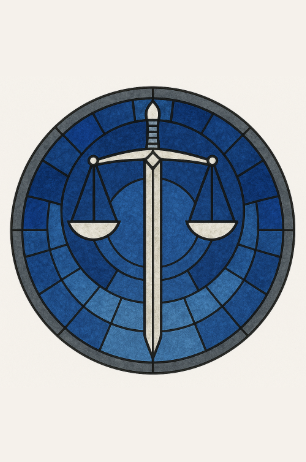
Symbol: A balanced scale resting upon a sword
Colors: White, silver, and deep blue
Domains: Order, Light, Arcana, Knowledge
Realm: The Hall of Judgment
Lore and Influence
Justir, the Maimed God, is the divine embodiment of Justice — the virtue of balance, law, and righteous measure. He is the Judge of the Gods, the One-Handed Arbiter, and the Sword of Righteousness, who ensures that the scales of truth never tilt toward corruption or chaos.
In all depictions, Justir stands solemn and unyielding, his one hand resting on the scales of truth, the other lost in the act of enforcing divine law. His loss is symbolic — a reminder that to judge rightly is to sacrifice part of oneself. His presence is a weight felt by kings and commoners alike, for his gaze pierces all falsehood.
Justir’s justice is not blind. It sees all, weighs all, and acts without passion or prejudice. His is not the justice of vengeance, nor the cold tyranny of order for its own sake. To Justir, justice is sacred proportion — the balance that holds the world together.
He stands as both lawgiver and protector, the divine check upon cruelty and the shield of the innocent. His priests often say: “Mercy without measure is chaos. Law without compassion is tyranny. Justice is the middle road, and Justir walks it alone.”
The Hall of Judgment
Justir’s celestial domain, The Hall of Judgment, crowns the highest peak of the Lawful Heavens. Its vast marble halls echo with the quiet resonance of truth, a sound that shakes the soul yet comforts the pure of heart.
At the Hall’s center stand the Scales of Eternity, suspended above an endless abyss of shadow. No deceit can tip them, no plea can move them — they weigh only what is true. The righteous rise as pillars of light, their names etched into the marble walls; the corrupt descend into the pit below, to face the consequences of their own deeds.
It is said that no sound is louder than silence within the Hall, and that every soul brought before the Maimed God stands utterly bare — stripped of title, wealth, and pretense. There, all are equal.
Worship and Patronage
Justir is the patron of judges, rulers, paladins, inquisitors, and lawkeepers — all who seek to preserve justice through order and fairness. His faith is strongest among courts, cities, and knightly orders, though even humble magistrates and traveling clerics invoke his name before passing judgment.
Temples to Justir are austere but grand, built of pale stone and lined with rows of unlit braziers. Fire burns only when judgment is passed — a symbolic reminder that law must serve action, not vanity. Statues of the Maimed God often show him blindfolded not to hide his sight, but to remind mortals that truth is seen best without bias.
His festivals are solemn affairs marked by oaths renewed and debts forgiven. Disputes are settled, confessions made, and contracts sealed under the watch of the Scales. Those who lie before his altar are said to feel the searing burn of divine scrutiny upon their soul.
“Truth is not kindness, nor cruelty. It simply is.” — The Maimed God
Orders of the Justiciar
The Justicars. Paladins and knights who serve as divine enforcers of law, acting as both executioners and protectors. They carry the Sword of Verdict — a symbol of punishment and absolution alike.
The Scales of Truth. Judges, scribes, and scholars dedicated to uncovering corruption and ensuring fair governance. They are the unseen hand that steadies civilization.
The Oathbound. Inquisitors and seekers who hunt oathbreakers, betrayers, and those who twist the law for evil ends. Their word is their bond, and to break it is to fall from grace.
Each order holds a sacred tenet: “No man stands above the law, and no soul beneath its protection.”
Common Blessed Items
- Scales of Truth. A small silver balance that glows when falsehood is spoken nearby.
- Gavel of the Arbiter. A ceremonial hammer that, when struck, compels all within hearing to speak truthfully.
- The Justicor’s Mantle. A deep blue cloak said to grant its wearer the insight to discern guilt from innocence at a glance.
Doctrine of Justice
The Codex of the Justicar teaches that justice is not passion, vengeance, or whim — it is discipline in service of truth.
Law is the foundation of peace. Without it, the strong prey upon the weak and civilization collapses into chaos.
None stand above judgment. A ruler is bound by law no less than the lowest subject. The scales are equal to all hands.
Justice is not vengeance. To punish beyond necessity is cruelty; to pardon the guilty is corruption.
Truth before all. Lies are poison. They rot law, warp love, and cloud the light of reason.
Wisdom must temper the law. A law blindly followed can become as wicked as lawlessness itself.
A true servant of Justir enforces law not for power, but for peace. He does not delight in punishment, nor shirk from it. He listens before judging, measures before striking, and acts not in anger but in order.
| Gameplay Mechanics |
|---|
| Virtue: JusticeAbility Score Increase: +1 to Constitution or Wisdom (Player’s choice).Virtue of Justice: A follower of Justir must embody the principles of law, fairness, and righteous judgment. Justice is not about vengeance, nor is it about mercy—it is about what is right. Those who walk the path of Justir must be unwavering in their pursuit of truth and equity.Roleplaying Guidance: Uphold justice with an impartial hand. Stand against corruption, oppression, and lawlessness. Deliver judgment fairly, without bias or cruelty, and never allow sentiment to cloud the truth. A lawful world is a just world |

Comments