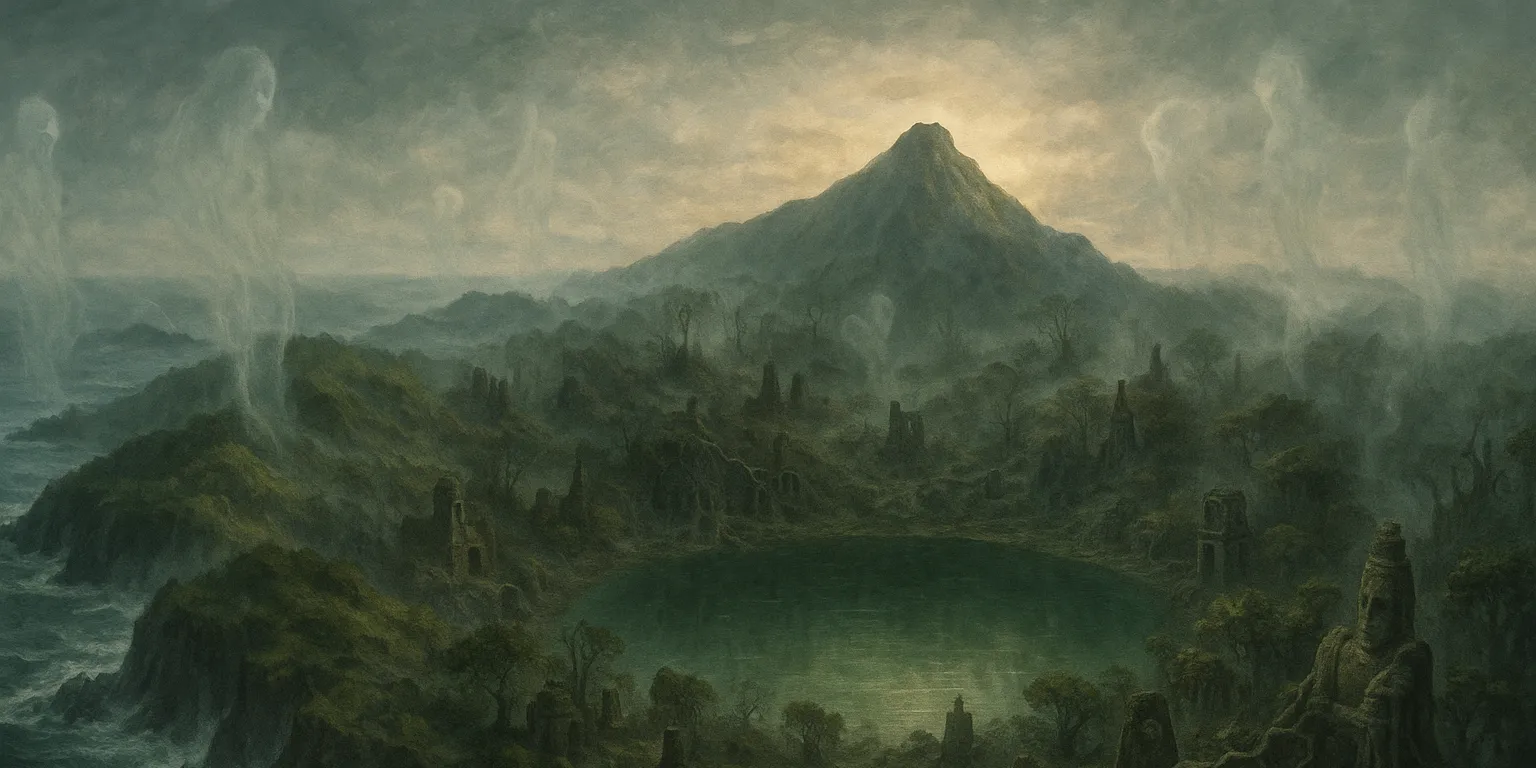
Lampuato
LLampuato is the second-largest island in the Mekonggan Archipelago - and the most famous. It is considered a case study by scholars of The Egregoric Force, for nowhere else have the beliefs of a people turned upon them so completely. In the final days of the Kingdom of Lampuato, the faith of the Mekongga poisoned the land and its gods so thoroughly that they were forced to abandon the island entirely - a situation that has not improved in the century and a half since.
A Decadent Monarchy
During the last century of the Kingdom of Lampuato, the royal family grew increasingly entitled and decadent, believing themselves above both the common folk and the gods of the island itself. While most of the island's population upheld the principles of Kosalo - the divine order that keeps the universe stable - the royal family came to regard this philosophy as mere superstition, useful only insofar as it justified their privilege.
At first, their violations of Kosalo were hidden from public view. But under King Saambu, they abandoned even the pretense of piety, flagrantly defying the divine order in public, confident that the people would not dare to overthrow them for fear of breaking Kosalo themselves.
In this, Saambu and his allies were mistaken.
As they violated the principles of Kosalo, the people grew ever more fearful of the consequences of their king's arrogance. Crops failed without reason, rotting overnight in the fields. Fishing boats returned empty - or vanished altogether - lost to sudden storms charged with malevolent fury. Then the great lake of Rano Moko turned toxic, its waters transformed into a poison so virulent that any who touched it perished. The dead sank into its clear depths and never decayed, for nothing living could endure in that blighted lake.
Famine came to Lampuato, and starvation stalked the streets. In the days before the final uprising, rumors of cannibalism - an act that itself violated Kosalo - spread through the capital, tied to whispered accounts of feasts at the royal court where meat was served while none could be found elsewhere. It was the final outrage. The rebellion that followed was swift and brutal: Saambu and his court were torn apart by a starving, furious mob.
But the end of the monarchy did not halt Lampuato's destruction - it accelerated it. The position of the king had been a key pillar of Kosalo, and rebellion against him was another breach of divine order. The Mekongga understood that such transgressions, piled atop centuries of arrogance and impiety, could only lead to catastrophe - and catastrophe came.
The gods of the island, already maddened by long years of sacrilege, turned murderous. They hunted the people through their cities and forests, turning stone and tree against them. To remain upon Lampuato was to die. Only those who fled survived.
Lampuato Lost
Today, the island is a cursed and hostile wasteland - its jungles venomous, its air thick with malice. The Mekongga who escaped established the Kingdom of Lahat, founded upon radical adherence to Kosalo - despite the violations they themselves committed in conquering that larger island.
They have since established a network of prison camps upon Lampuato, intended to serve the same metaphysical function as Lahat's Kosalo Villages: an attempt to restore balance through ritual habitation. The largest of these is Desa Penjara, where prisoners rarely survive more than a few months against the island's relentless hostility. A fortified naval base also exists, protected by elaborate Kosalo-inspired rites that are largely, though not entirely, effective.
Beyond these settlements, Lampuato is nearly empty. Fewer than a thousand souls live there now. Until the Mekongga themselves forget the sins of their ancestors, the metaphysical atmosphere of Lampuato will remain poisonous to all who set foot upon its shores.
Notable Spirits
The gods of Lampuato are no longer named by the Mekongga. When the kingdom descended into decadence, the island's deities became violent and mad. Upon their flight from Lampuato, the Mekongga chose to suppress the names and stories of their old gods, hoping that by forgetting them, they might fade from the world. In their view, these beings were no longer gods worthy of worship; to be forgotten was the only mercy left to them.
But this is not what happened.
Although the Mekongga people no longer know the names of Lampuato's gods, they still tell stories - of the monstrous divinities that the gods became. Stripped of identity, the spirits of Lampuato have merged into an undifferentiated horde, shifting endlessly from one demonic visage to another.
Rumors from prisoners condemned to Lampuato occasionally reach Lahat, each tale spawning a hundred new fictions that feed the island's legend. Rather than being forgotten, the gods of Lampuato are being reforged - remade by human fear into ever more terrible monsters.
Geography
Lampuato is a large, roughly circular island in the Mekonggan Archipelago. Its terrain is defined by rolling hills and occasional mountain ranges that offer breathtaking vistas of the surrounding seas. The island's most prominent landmark is Gunung Mulia, its highest peak, rising to an elevation of over six thousand feet. Once a destination for climbers, it was said by locals to offer the most beautiful view in the Great Ring.
Lampuato's coastline is lined with sandy beaches, secluded coves, and rugged cliffs, creating a striking contrast against the deep blue waters. Within the island's once-lush forests stood the Grojok Sakti - known in Mekonggan as the Enchanted Grove - a mystical site long shrouded in myth and legend. During the final monarchy's reign, however, the grove was destroyed, leaving behind only a lingering spiritual presence. The ghost of the grove is said to still haunt the place where it once stood, its ethereal essence a reminder of what was lost.
At the heart of the island lies the Great Lagoon, or Rano Moko - a vast inland body of water that now serves as a tomb for the life it once sustained. Fish and other creatures lie dead beneath its poisoned surface, unable even to decay. Ruins of fishing villages still dot its shores, silent witnesses to the island's fall, and the lagoon itself remains utterly lifeless.
Geographic Details
Location: Southwestern RegionLatitude: 23.77 degrees North
Longitude: 55.04 degrees West
Average Elevation: 246 ft
Highest Point: 6,407 ft (Gunung Mulia)
Lowest Point: -5 ft
Area: 7,617 sq mi
Related Articles
This article was originally written for Spooktober 2024. You can find all of my Spooktober Articles at Spooktober Central.
This article was originally written for Spooktober 2023. You can find all of my Spooktober Articles at Spooktober Central.

Is Kosalo a divine law that is actively enforced by the gods of the islands? Or is this more akin to the principle of karma? I really like the idea that stripping the gods of their individual names did not deny them their divine power. The divine horde is a really horrifying idea and brilliant.
Ah - Kosalo functions basically as a style of Folk Magic - local metaphysical conditions created by collective belief. The fundamentals of this are laid out in the articles below, but basically - because enough people in the area believe it works like this, it does.
The Egregoric Force
The power of collective belief
Folk Magic
Regional Magic Systems created by the Egregoric Force.
Oh interesting! And thanks for those links :D