
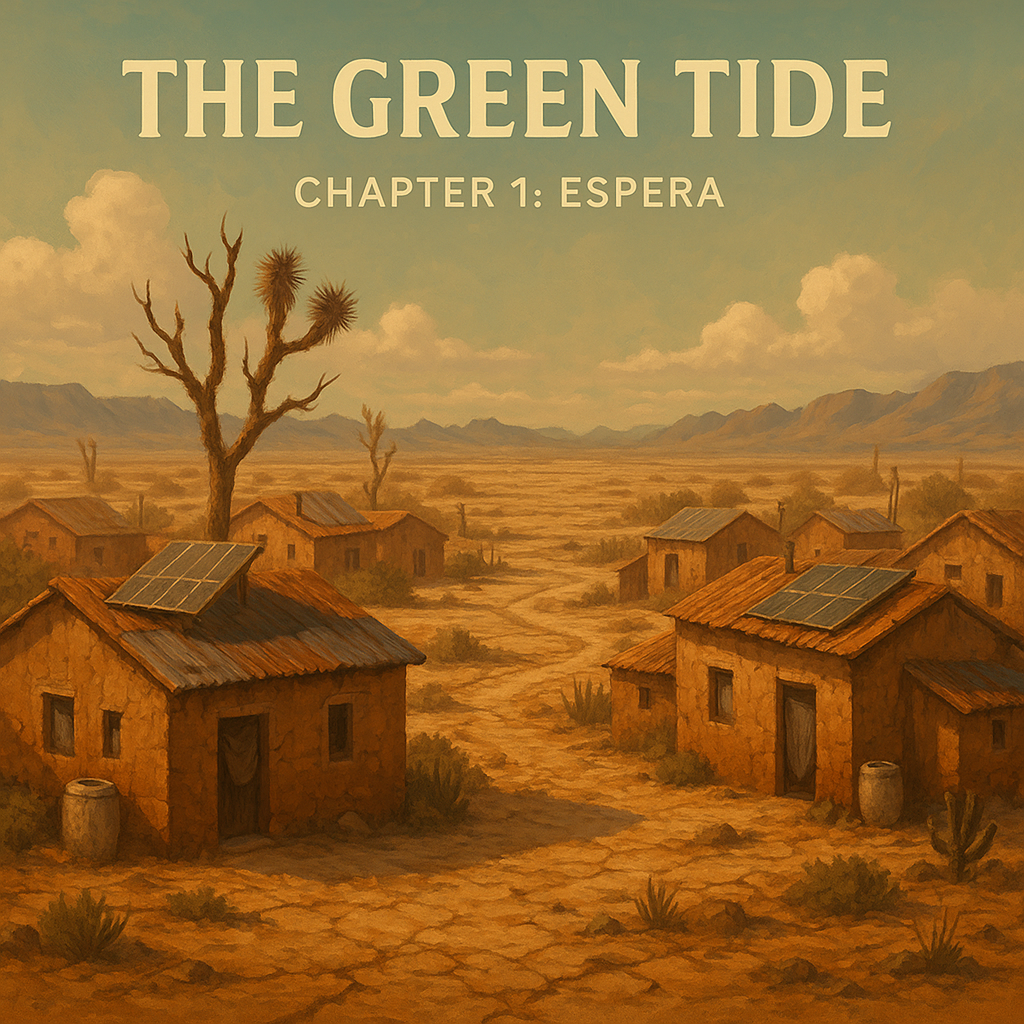
Maelle Corvain
The Desert Keeper Maelle Ruth Corvain- Corvain (a.k.a. Mae)
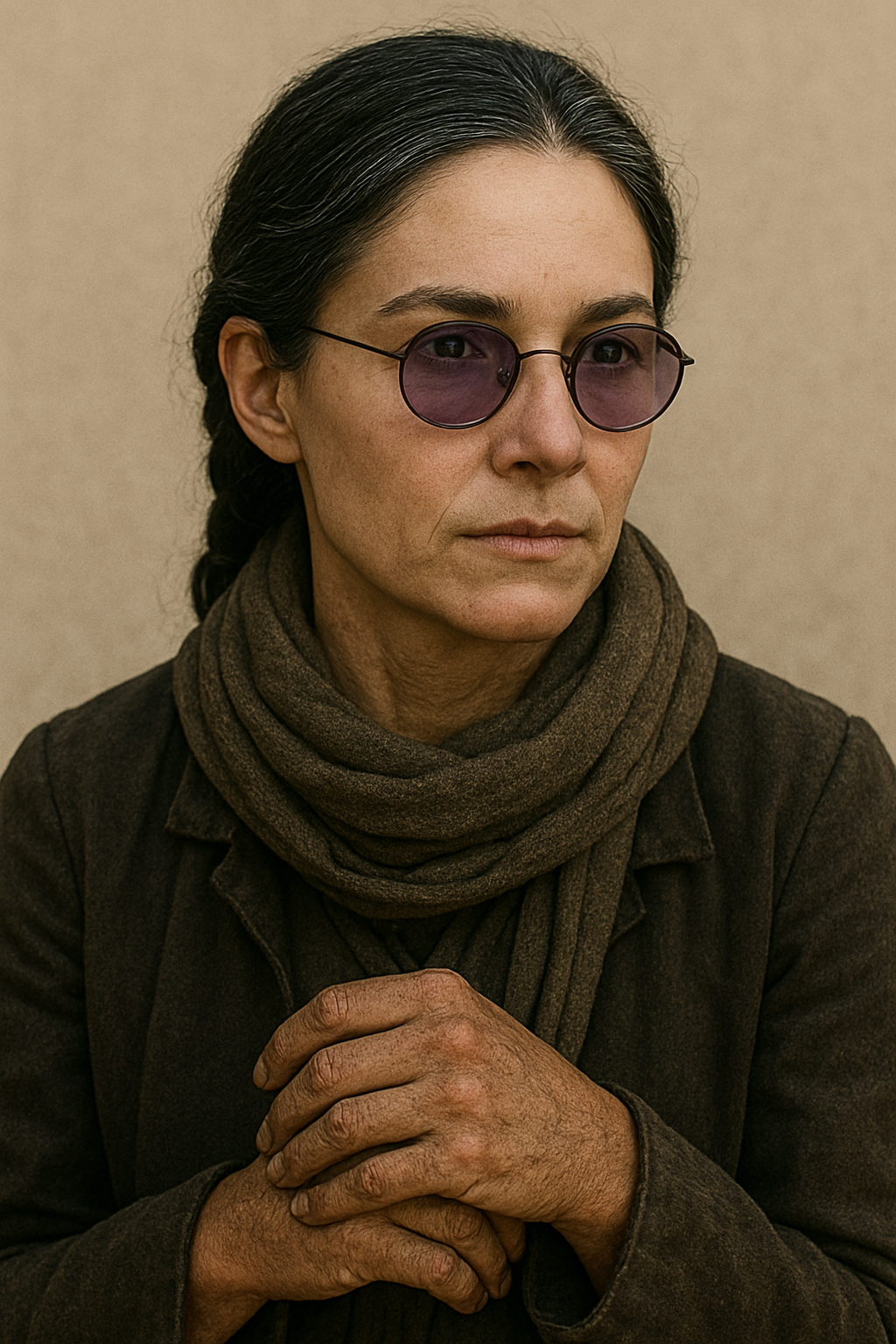
Carved by the desert—compact, strong, and enduring in ways that outlast flesh. Her body has been tempered by survival: hands thick-knuckled and scarred, skin sun-darkened and leathered, hair shot with silver but always bound back in tight braids that refuse disorder. She isn’t large, but she feels immovable, like stone pressed under centuries of heat. She moves at her own pace, deliberate and unhurried, as though even time itself would have to wait politely for her to finish her work. Age hasn’t weakened her; it’s only stripped her down to essence, leaving someone condensed and unbreakable.
Her presence is flinty but never hollow—her blunt words can cut, yet they carry a kind of protection, the same way shade feels in the middle of a scorching day. When she watches the horizon with her violet-tinted Verdancy-detecting lenses, it’s with the patience of someone who has seen storms come and go and knows not to panic before they arrive. To June, Maelle is both anchor and contradiction: the woman who saved her, the one who made a home out of scraps and silence, and yet someone who always carries an edge of secrets in the lines of her weathered face. She is practical, unsentimental, but her care shows in what she does rather than what she says—in the way she braids hair with gentle hands, in the meals she coaxes from the desert’s meagre offerings, and in the quiet, relentless way she makes sure Espera keeps surviving another day.
Physical Description
General Physical Condition
Weathered but unbroken; her compact, muscular frame and wiry limbs show decades of desert labour. Still strong and precise for her age, but slower to recover; agility has been replaced by deliberate, efficient movements. Arthritic joints ache in cold, and a stiff knee from an old injury makes her gait heavy at times, but her endurance remains formidable. Her hands sometimes tremble when tired, yet never when work demands precision. Spore lung has left her with a persistent, dry cough and occasional breathlessness, but she endures it without complaint.
Body Features
Compact, solid build meant for endurance rather than height; broad shoulders, wiry arms, and strong legs from decades of desert walking. Her skin is sun-darkened and leathered, crosshatched with fine lines and sun spots from a lifetime under a merciless sky. Hands are thick-knuckled, scarred and permanently calloused. Dark hair is shot with silver and always tied back in tight braids. She moves deliberately and carries her weight like stone.
Facial Features
Maelle's face looks carved rather than soft: high cheekbones and a square jaw lend her an austere authority, while a strong nose—slightly crooked from an old break—cuts a line down the centre. Her deep brown eyes are steady and penetrating, hooded by weathered lids and radiating fine crow's‑feet from years of squinting into desert glare. Her mouth is set in a thin line more often than not; smiles are rare, fleeting and crooked. Silver threads through her dark hair, which she wears in tight braids that expose the broad planes of her forehead and the stubborn set of her chin.
Identifying Characteristics
A long, pale scar runs diagonally along her forearm, standing out against her weathered skin. A streak of silver hair at her temple contrasts sharply with the dark braids she wears. A small notch in her collarbone hints at an old fracture. Her skin is crosshatched with freckles and sun spots from a lifetime under desert sun, and she carries a slight limp from a stiff knee.
Physical quirks
She rolls her shoulders back with a habitual, almost ritualistic motion before lifting anything heavy. When she squints into the sun or studies someone she distrusts, her left eye narrows slightly more than her right. Her nose is crooked from an old break and one finger doesn’t curl fully, giving her grip an unusual angle. In cold weather a stiff knee makes her gait uneven, and her jaw tenses visibly whenever she’s holding her tongue.
Special abilities
Maelle has no supernatural or Verdant-born powers. Her strength lies in extraordinary endurance, honed by decades of surviving in the desert, and a near-preternatural ability to read the land and its people. She senses subtle shifts in wind and temperature that herald storms, tracks faint trails, and can tell a lie from the slightest change in someone's breathing. She is unusually resilient to spore sickness, shrugging off exposures that would fell others, though she carries scars from past bouts. Her intuition and experience make her seem almost prophetic to those who don't know how hard-earned those skills are.
Apparel & Accessories
Maelle’s clothing is always chosen for practicality and survival. She wears loose, layered garments in muted desert tones to shield against the sun and cold: a long, roughspun tunic beneath a patched canvas overcoat, with durable trousers tucked into heavy boots. A wide cloth sash at her waist holds her tools, knives, and small pouches. Her hair is bound back in tight braids, often with a scarf wrapped around her head and neck for dust storms. She carries violet-tinted goggles to protect her eyes, a small knife at her hip, a satchel for salves, stitching kits and water, and sometimes a sturdy walking staff. She keeps her husband’s ring on a leather cord around her neck, her son’s carved wooden bird in her satchel, and sews a scrap of her mother’s blue floral dress into Juniper’s quilt.
Specialized Equipment
Maelle's gear is chosen for survival, not show. She carries violet-tinted lenses that help her spot Verdancy spores and protect her eyes from glare. A short, broad-bladed utility knife rides at her hip in a weathered leather sheath. A cross‑body satchel holds stitching needles, thread, bone needles, strips of cloth, salves, dried herbs, a whetstone, twine and wire for repairs, and a small bundle of flint and steel for fire‑starting. When scouting, she uses a sturdy walking staff cut from desertwood. A dented metal water flask hangs from her belt, and she keeps a coil of twine and a few metal scViolet-tinted Verdancy goggles; utility knife; satchel with stitching kit, herbs and flint; walking staff; water flask; twine and wire for improvisation.raps tucked into her sash for improvising. None of the items are ornate; each has been mended and sharpened countless times, extensions of her own hands.
Mental characteristics
Personal history
Maelle Corvain was born on June 11th, 2004, in the dusty desert town of Shoshone, California. Her mother, Clara Corvain, was a schoolteacher who held their small family together with faith and practicality; her father, Isaac, was a mechanic whose tenderness slowly gave way to drink. Maelle grew up stitching clothing from scraps and learning to mend engines alongside making tortillas.
The COVID‑19 pandemic shattered her adolescence. On November 19th, 2020, Clara succumbed to complications from the virus. Isaac fell apart in his grief, turning violent. In February of 2021, at only sixteen, Maelle was removed from her father’s home and cycled through foster houses in Las Vegas.
When she aged out of the system on her eighteenth birthday, June 11th, 2022, she took whatever work she could find—waitressing, cleaning, patching broken machines—hardening herself against a world that had no room for softness. In those lean years she met Christopher Wade, a man with warm eyes and calloused hands who saw her not as a burden but as an equal. They married on August 23rd, 2025, yet Maelle kept her surname in honour of her mother. Nine months later, on June 4th, 2026, their son Colton was born, and for a few precious years she knew something like peace.
That peace was destroyed in 2031 when the Verdant collapse swept west. After the fall of Phoenix, Las Vegas went under martial law and ordered mass evacuations. The city gridlocked, and Maelle, Christopher and five‑year‑old Colton were forced to flee on foot. At a military checkpoint, soldiers scanned evacuees for spore contamination. Christopher and Colton tested above the acceptable threshold. When Christopher refused to let his family be separated, a jittery soldier shot him. The bullets tore through father and son. Maelle was held at gunpoint and pushed onward while her family bled out behind her.
Alone and numb, she walked into the desert. Months of wandering and scraping by brought her to the salt flats at Badwater Basin, where other survivors were gathering. Together with the Langford family, she helped found Espera in late 2031. She taught people how to purify water, ration supplies, stitch wounds and harvest salt. She took a liking to Silvan Langford, a boy near the age Colton would have been, and that affection twisted into a painful mix of love and resentment.
On November 11th, 2032, she found an infant abandoned at the edge of the flats. The baby was Juniper Corvain, the daughter of an Archive doctor who could not keep her. To Maelle, Juniper felt like a gift returned by the desert after everything it had taken. Maelle raised June as her own, braiding her hair with the same gentle hands that had once soothed Colton, teaching her to live by the desert’s hard rhythms.
In the decades since, Maelle has become the unspoken anchor of Espera. She carries the memory of her mother, her husband and her son in the keepsakes around her neck—a wedding ring on a cord, a carved wooden bird, a patch of blue floral fabric sewn into June’s quilt—and in the stoic, unyielding way she keeps her people alive. At forty‑five, her hair is shot through with silver and her skin is leathered by sun, but her spine remains unbroken. She has no superhuman gifts, only the iron will to stand against storms and the Verdancy alike.
Gender Identity
For Maelle, gender was never an identity she lingered on so much as a role carved out by necessity. Growing up in the desert, first under her mother’s steady hand and later in the brutality of the foster system, she learned early that survival didn’t care whether you were girl or boy, woman or man—it only cared if you could carry the weight. She has always understood herself as a woman, but not in ways that hinged on softness or expectation. To her, womanhood is resilience, the ability to hold grief and still stand, to mend with the same hands that kill a rattlesnake. She doesn’t use gender as a boundary but as a lived fact of her body, one that bears scars, silver in her hair, and the echoes of a child she carried and lost. For Maelle, gender is not a performance—it is a tether to her lineage, to her mother Clara, to the son she birthed, and to the grit of carrying forward when the world tried to erase her.
Sexuality
Maelle has always understood sexuality through the lens of intimacy, loyalty, and survival rather than labels. She loved her husband Christopher Wade with a depth that was both physical and spiritual, and in that bond found the only safe harbor she ever knew. After his death and the loss of their son, desire became something distant, almost foreign—an echo of a life she no longer inhabits. Among the Saltfolk, where gender and sex are stripped of ornament and seen as practical parts of human connection, Maelle’s orientation rests in widowhood: she does not seek partners, not out of shame or disinterest, but because her heart remains tied to the dead. To her, sexuality is not an open door but a sealed chamber, one she guards as fiercely as the keepsakes she carries from the family she lost.
Education
Maelle received only a basic education. She attended a small public school in Shoshone until the pandemic and her mother's death forced her into survival mode. Most of her true learning came from her parents: her mother taught her to sew, read, and keep household accounts; her father taught her to fix engines and improvise with whatever parts were at hand. The foster system offered little beyond a high‑school diploma, but the years that followed educated her in resourcefulness and endurance more than any classroom could.
Employment
Before the Verdancy, Maelle scraped by on a string of low‑paying jobs—waiting tables, mopping floors, mending clothes, assisting at a mechanic's shop. Work was always a means to an end: food, rent, survival. After the collapse, she took on roles that were not jobs so much as responsibilities. In Espera, she is a healer, leader, scavenger and salt‑raker, a woman who does whatever needs doing to keep her people alive.
Accomplishments & Achievements
Helping found Espera and keeping it alive for nearly two decades. Teaching countless Saltfolk to purify brackish water, bind wounds, and recognize the Verdancy's early signs. Saving Juniper Thorne's life and raising her into a capable young woman. Surviving the pandemic, the collapse and the desert itself without losing her mind or her compassion. Becoming a symbol of endurance and wisdom to a generation that never knew the Old World.
Failures & Embarrassments
Maelle carries deep guilt for failing to protect Christopher and Colton at the checkpoint. She sometimes resents Silvan Langford because he reminds her of the son she lost, and that bitterness shames her. Her bluntness can wound those she loves, and her reluctance to trust newcomers has turned away potential allies. She regrets moments when fear made her harsh or when pride kept her from accepting help. These failures haunt her in the quiet hours, even as she keeps moving forward.
Mental Trauma
The death of her mother to COVID‑19, the abuse from her father, the loss of her husband and son to Verdant panic, and the countless bodies she has buried since have left Maelle with unhealed trauma. She suffers nightmares of the checkpoint—flashes of gunfire and the weight of her son's body falling. She keeps moving to keep those memories at bay, but in still moments the grief resurfaces as a tightness in her chest, a tremor in her hands, a sudden inability to breathe. Her trauma fuels her determination but also isolates her, making it difficult to let others in.
Intellectual Characteristics
Maelle is not formally educated, but she possesses a sharp, pragmatic intellect honed by necessity. She can quickly evaluate a situation, tally supplies in her head, and recall the safest path through the Flats. She reads people well—catching the tell‑tale tremor of a lie or the stiffness of fear—and uses that insight to keep her community alive. Her thoughts are grounded in the physical world: how much water, how far to walk, how deep to cut. She is suspicious of abstract ideas, but her memory for stories and lessons is long; she never forgets a promise or a betrayal.
Morality & Philosophy
Raised Baptist, Maelle abandoned organized religion after the world fell apart, but the moral framework of her childhood lingers: honesty, hard work, and care for your neighbor. She now follows a desert ethic that prizes endurance, self‑reliance, and community over dogma. Survival is sacred; waste is sin. She believes in protecting the vulnerable and punishing those who would exploit them. She distrusts authority and systems after seeing them fail, choosing instead to make her own judgments based on lived experience. For Maelle, actions matter far more than words or intentions.
Taboos
Wastefulness is a sin to Maelle—she cannot abide spilling water, burning resources, or taking more than is needed. She refuses to invoke her lost family's names carelessly and will not speak the Verdant tongue or Verdancy blessings. She will not tolerate lies or the betrayal of the community, and she considers eating Verdant growths a desecration. Leaving someone behind without exhausting every option to save them is, to her, the greatest taboo.
Personality Characteristics
Motivation
Maelle is driven by a fierce need to keep her people alive. After losing her mother to disease and her husband and son to the Verdant collapse, survival became a calling rather than a burden. She measures success in water conserved, mouths fed and bodies mended. Her greatest motivation is ensuring no one else dies the way her family did—silenced by hunger, shot at a checkpoint, or swallowed by spores. She pours her energy into teaching Juniper and the Saltfolk how to endure, building a legacy that outlasts her, and creating a community where the old world's mistakes are not repeated.
Savvies & Ineptitudes
Maelle excels at survival: finding water, purifying brackish sources, foraging edible plants, hunting and trapping, building shelter, and stitching wounds. She reads weather and Verdancy signs with uncanny accuracy, can break down and repair simple machines, and uses a knife with deadly efficiency. She has a good head for numbers and rationing and can lead a group across the flats without a map. But she is inept with advanced technology and has no patience for machines she cannot fix with her hands. She mistrusts abstract art and ornamental crafts, struggles with reading long texts, and is uncomfortable in formal politics or rituals. Fine motor tasks like embroidery frustrate her, and she dislikes tasks that feel wasteful or decorative.
Likes & Dislikes
Maelle loves the simple constants of the desert: the hush of dawn before the sun burns, the smell of rain on salt and dust, the feel of callused hands working together, the taste of strong coffee and cactus soup, the weight of a child's head against her shoulder. She enjoys teaching Juniper to braid and telling stories around a fire. She finds joy in a well-mended coat, a knife honed just right, and the rare gift of laughter. She despises waste in any form, Verdant growths creeping where they shouldn't, idle gossip, complaining without action, and the pomp of uniforms and bureaucracy. Loud noises make her flinch, and she hates being touched unexpectedly. Anything that feels frivolous or ornamental irritates her, as do people who romanticize the Old World without acknowledging its failures.
Virtues & Personality perks
Maelle's greatest virtues are her resilience and loyalty. She is unyielding in the face of hardship and refuses to surrender to despair. Her practical wisdom keeps her community alive, and she makes hard decisions without flinching. She is honest even when the truth is harsh and fair even when it costs her. Her strength lies in her ability to endure, to shoulder pain without breaking, and to give more than she takes. She inspires trust by doing more than she promises and by standing with those she loves until the end. She is brave, fiercely protective of the vulnerable, and willing to sacrifice her own comfort for the good of the group.
Vices & Personality flaws
Beneath her strengths lie deep flaws. Maelle can be relentlessly harsh and blunt, often wounding those closest to her with words meant to harden them. She carries a bitterness that sometimes spills over into resentment, especially toward Silvan, whose survival reminds her of the son she lost. She holds grudges and has difficulty trusting newcomers, pushing them away to avoid being hurt again. Her pride keeps her from asking for help, and she shoulders burdens alone until they break her spirit. She is stubborn to a fault and slow to forgive herself; guilt gnaws at her, and she sometimes punishes herself through work. She rarely allows herself joy, believing it a weakness, and she pushes others to her exacting standards even when they cannot meet them.
Personality Quirks
Maelle rolls her shoulders back before lifting or doing anything strenuous, as if bracing herself for weight. She unconsciously fingers the ring that hangs on a cord beneath her shirt when she is thinking or anxious. She rubs the carved wooden bird smooth with her thumb when she sits by the fire. Her left eye squints slightly more than her right when she sizes someone up or spots danger, and her jaw tightens visibly when she's holding back words. She winds bits of twine or wire around her fingers to keep her hands busy, and she quietly counts steps or inventory under her breath.
Hygiene
Maelle keeps herself as clean as the environment allows. Water is precious, so she does not waste it on vanity, but she understands the importance of hygiene for health. She scrubs her hands and tools with sand and saltwater, washes with a damp cloth rather than a full bath, and braids her hair tightly to keep it out of the way. She tends to wounds with boiled water and clean cloth. She uses desert herbs to mask sweat and maintain dignity without extravagance. Dirt under her nails or on her face is acceptable if it comes from work, but she will not tolerate filth that breeds disease.
Representation & Legacy
For the Saltfolk, Maelle embodies endurance and pragmatic compassion. Her life story—of loss, resilience and quiet leadership—has become both a cautionary tale and a blueprint. She is the last link to the Old World for Juniper, a bridge between what was and what can be. Her legacy will live on in the water purification methods she taught, the stories she preserved, the children she saved, and the communal ethic she instilled in Espera. After her passing, some will call her a hero and others a relic, but everyone will know that without her, their line of survival might have snapped long ago.
Social
Reign
Contacts & Relations
Maelle’s world is woven from a sparse but weighty web of connections, each relationship carved by survival and grief:
- She is bound to Juniper Corvain, whom she raised as her own after finding her abandoned—Juniper is both daughter and second chance, though Maelle guards that tenderness behind sternness.
- With the Langford family, she shares the history of Espera’s founding; she mentors Silvan in moments, drawn to him because he mirrors the son she lost, yet resenting him for the same reason.
- Her alliances are strongest within the Council of Keepers, where she stands as a de facto chief, respected even when her words are sharp. She stands as the elder stone among shifting voices, often the one to remind others of what survival truly costs. With the other Keepers, Maelle is both respected and feared—her bluntness is rarely softened, but her record of survival gives her words a gravity no one can dismiss.
- Mika has a tenuous place—he is young enough to stir Maelle’s protective instincts but carries the recklessness of youth that grates on her. She respects his loyalty to June but keeps him at a distance, unwilling to let herself love him too closely for fear that the desert, the Verdancy, or war will take him too, as it has taken everyone else she ever held dear.
- Her relationship with Henrik, the Security Keeper, is marked by tension edged with respect. He is hard, decisive, and unflinching when it comes to threats outside Espera’s walls, and while Maelle sometimes bristles at his reliance on force, she recognizes the necessity of his vigilance. He in turn defers to her wisdom more often than he admits, knowing she sees dangers in people and storms long before they break.
- Garnett, the eight-year-old who tends the cricket farm, is something else entirely: a reminder of innocence and grit interwoven. Maelle feels a fierce, protective tenderness toward her, though she hides it beneath a gruff exterior. She checks in on Garnett’s farm often, not because she doubts the child’s competence, but because she cannot bear the thought of another child lost to neglect or danger.
- She mistrusts Dr. Elan Thorne, whose abandonment of June left a scar Maelle has never forgiven, and she views the Archive with suspicion, seeing in them both threat and temptation to control.
Her enemies are not personal as much as systemic: the Verdancy itself, the soldiers who slaughtered her family at the checkpoint, and any who would waste or exploit what little the desert allows. Still, within Espera she is both feared and revered, her affiliations defined less by friendship and more by the gravity of reliance—those who stand beside her know she will not bend, and those who stand against her know she will not forget.
Maelle’s closest bonds, the ones that carved her into who she is, are with the dead:
- Christopher Wade, her husband, was her great love and the only person who gave her a sense of safety in a world already unraveling; his loss at the checkpoint, alongside their son, hollowed her in ways she never recovered from.
- Colton Wade, her little boy, remains her deepest wound—she carries his carved wooden bird and relives the feel of his small weight in her arms every night she cannot sleep.
- Clara Corvain, her mother, was her moral compass: a woman of faith, discipline, and endurance, whose death during the pandemic taught Maelle early how fragile stability truly was.
- Isaac Corvain, her father, was a man she loved once but whose descent into drink and violence left her wary of dependence and taught her not to expect rescue from anyone.
Religious Views
Maelle was raised in the quiet faith of her mother’s Baptist household, where prayer and scripture shaped her earliest sense of right and wrong, but those teachings withered in the face of plague, war, and the Verdancy’s spread. She no longer believes in a God who intervenes; instead, her religion has become the desert itself—its laws of scarcity, endurance, and consequence are the only commandments she follows. To her, wasting water is blasphemy, betrayal is damnation, and survival is the only sacrament worth keeping. She holds no rituals beyond the ones she has built from habit: braiding her hair each morning, tending the fire each night, tracing the grain of her son’s wooden bird before sleep. If she prays at all, it is not to heaven but to the salt flats and the silence, asking only for another day.
Social Aptitude
Maelle is not a woman of charisma in the conventional sense; her presence does not charm so much as command. People listen to her because she is blunt, unafraid of truth, and steady in the storms that unnerve others. Her confidence is hard-earned and rarely loud—she does not boast, but she speaks with the certainty of one who has lived through enough to know what matters. She carries little ego; pride shows itself only in her stubborn refusal to yield when she believes she is right, and in her unwillingness to ask for help even when she needs it.
She is introverted by nature, keeping her thoughts close and her heart closer, yet she is not reclusive. When the council meets or when the Saltfolk gather, she steps forward to speak with clarity and weight, though always sparingly. Her etiquette is practical, stripped of ornament or pretense; she is respectful to those who earn it and curt with those who waste time or resources. In her company, silence is never awkward but purposeful, and though she does not often smile, her rare warmth is felt all the more for its scarcity.
Mannerisms
Maelle’s speech is spare, her words chosen with precision and often left hanging in the air longer than most are comfortable with. She pauses before she answers, letting silence do the work of cutting away frivolity, and when she does speak her tone is low, steady, and edged with finality. She rarely wastes breath on pleasantries; instead, her sentences come clipped and practical, often carrying the weight of command even when she does not mean them to. When she is displeased, she has a habit of narrowing her left eye more than the right, a subtle squint that makes people feel as if she sees through their excuses.
Her body is as deliberate as her speech. She rolls her shoulders back before lifting or bracing herself, an unconscious ritual of preparation. She rests her scarred hands flat on tables when she is listening, fingers splayed as though anchoring herself, and she will drum her thumb lightly against her palm when she is thinking. When angry, she does not raise her voice but lets her jaw tighten until the words come out hard as stone. She often fiddles with the ring that hangs beneath her shirt, thumb rubbing its worn surface as if grounding herself. Around children she softens slightly, crouching low to meet their eyes or braiding hair with steady hands, but even then her movements are economical, more protective than indulgent.
Hobbies & Pets
Maelle does not think of herself as someone with hobbies—life in Espera leaves little room for indulgence—but she has small, steady practices that have become her way of carving space for herself. She takes quiet satisfaction in mending: repairing torn clothing, patching boots, or stitching old canvas gives her a sense of order and endurance, as though each stitch pushes back against the chaos of the world. She tends a small collection of desert herbs and knows how to prepare salves, teas, and poultices; though born of necessity, she finds calm in the rhythm of grinding, steeping, and mixing. At night, when the fires burn low, she sometimes carves small shapes out of scrap wood, a habit that began as a way of keeping the memory of her son alive through the bird he once held. She also keeps a practice of oral history, telling stories to Juniper or the Saltfolk children about the world that was, weaving lessons into memory. These quiet acts—repairing, tending, carving, telling—are as close as she allows herself to pleasure, hobbies that disguise themselves as duties.
Speech
Maelle’s voice is low and steady, pitched in a register that carries more weight than volume. She does not raise it often, but when she does the sharpness alone is enough to cut through a crowd. Her accent is the flattened, utilitarian cadence of the Saltfolk—desert vowels worn down, consonants clipped short, with no ornament left from Old World dialects. She speaks in plain language, sparing with metaphor unless it serves a purpose, and when she does use one it is always grounded in survival: “water runs thinner than trust,” or “a fire’s only as strong as its kindling.”
Her tone tends toward bluntness, but not cruelty—she wields honesty like a tool, not a weapon. She has no impediments, but she speaks with the slight gravel of someone long used to dry air and too many nights by smoky fires. She does not waste words on catchphrases, yet her habits of speech become recognizable rhythms: “waste nothing,” “we keep moving,” and “watch the line” recur often, half-command and half-reminder. Compliments from her are rare, but when they come they are brief and rooted in action—“You did it right,” “You held steady,” “That’ll last.” Insults, when she bothers, are equally sparse: “fool,” “child,” or the cutting silence of disapproval, her eyes doing more damage than words.
In greetings, she is curt—often just a nod or a muttered “You’re here.” Farewells are practical, never sentimental: “Keep your water,” “Stay in the shade,” or simply “Go.” When she swears, it is functional and Old World—“damn,” “hell,” “bastard”—but always sparing, wielded like a hammer blow rather than a flourish. Her speech, like the rest of her, is stripped to essence: a language of survival, pared down to what endures.
Relationships
Wealth & Financial state
Maelle lives without wealth in any traditional sense—her class is that of the Saltfolk’s working poor, though among them she carries the status of an elder and founder. She has no debts, for there is no currency left to owe, and her only dependencies are the shared stores of Espera, rationed by need. Her “funds” are measured in salt, clean water, preserved food, and trust within the community. Disposable income does not exist for her; every resource is accounted for, nothing wasted. Her assets are the tangible tools she carries: violet-tinted goggles, her knife, her satchel of herbs and stitching kits, and the intangible authority of her knowledge. Her investments are in people—Juniper most of all, and the survival of Espera as a collective legacy that outlasts her own body.
Stone Mother; Desert Keeper
"Waste nothing." "Keep moving; the desert waits for no one." "Water's worth more than gold." These phrases are repeated by her and those she teaches.
Fluent in English. Conversational Spanish picked up from neighbors and travellers. Knows a smattering of desert creole and Saltfolk slang unique to Espera's culture.

Comments