
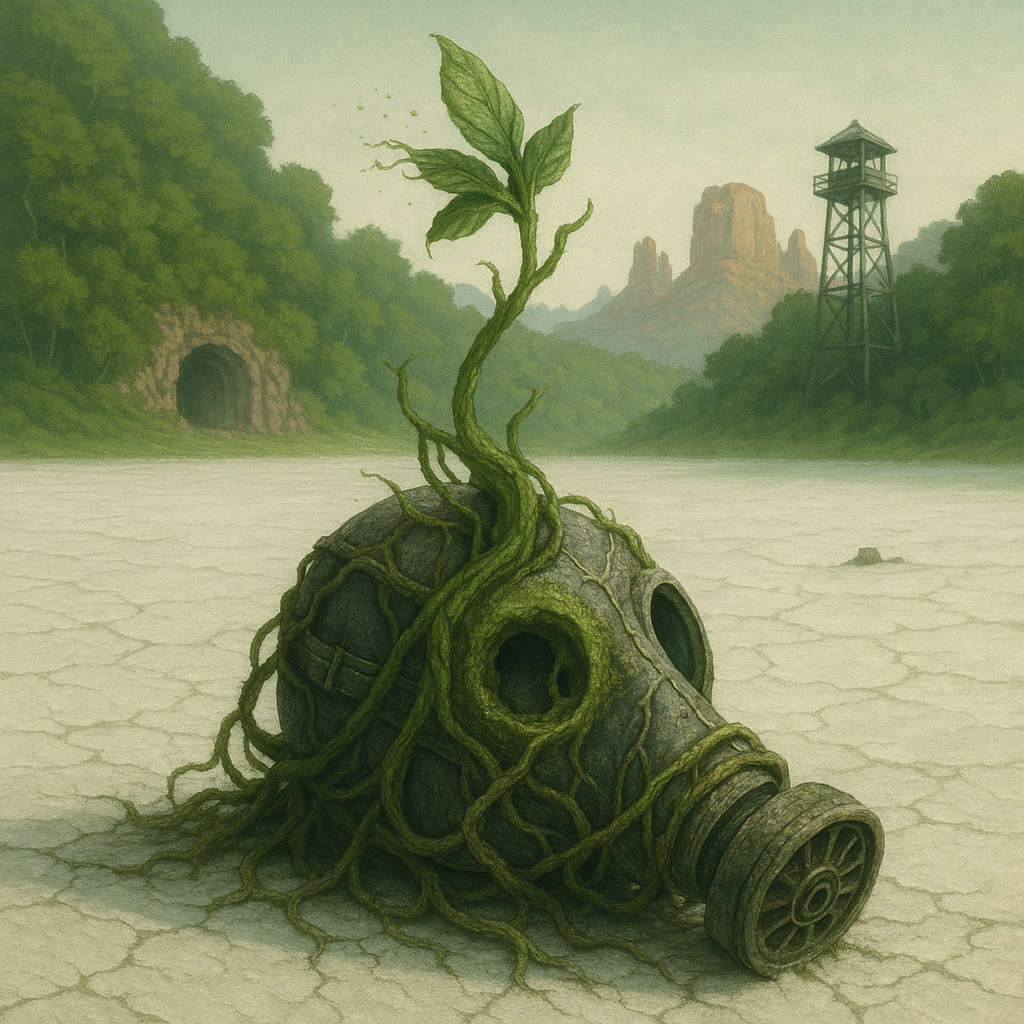
Spore Lung
Spore Lung is a progressive respiratory condition caused by inhalation of airborne Verdant spores. It represents the earliest systemic foothold of Hollowing. While initial symptoms may resemble common bronchitis or asthma, the trajectory is unmistakable: unchecked, it culminates in irreversible colonization of the host by Verdant biomass.
Transmission & Vectors
- Inhalation of airborne spores (primary)
- Prolonged exposure in enclosed spaces with Verdant incursion
- Direct inhalation of Hollowed exhalation or spore cloud from mutated flora and fauna (secondary)
Symptoms
Stage I – Irritation (Exposure)
- Dry cough, metallic taste in mouth
- Throat rawness and mild shortness of breath
- Nosebleeds when spore density is high
- Green “dusting” sometimes visible in sputum under lamplight
Stage II – Colonization (Onset)
- Persistent wet cough producing green-tinged mucus
- Chest heaviness; reports of “moss pressing on the lungs”
- Night fevers, sweating, vivid dreams (often of vines or roots)
- Early verdant resonance: patient reports hearing faint “humming” in silence
Stage III – Fibrosis (Progression)
- Severe breathlessness, wheezing audible without stethoscope
- Cyanosis (bluish lips and fingernails)
- Mosslike patches visible on tongue and inner cheeks
- Dreams intensify into fugue states, patient may lose sense of time
- Lungs begin producing oxygen inefficiently, spore-blooms visible in blood samples
Stage IV – Hollowing (Terminal)
- Airway obstruction by fungal mass
- Voice changes (hoarse, wet, resonant with echoes)
- Cough produces live green tendrils
- Neurological compromise: personality flattening, sense of self dissolves
- Patient no longer distinguishable from Hollowed
Treatment
Stage I-II
- Antifungal tinctures (limited success)
- High-dose corticosteroid analogues (reduce inflammation, not colonization)
- Archive-developed Verdant counter-compounds (experimental and scarce)
Stage III-IV
- No effective treatment. Focus shifts to containment and palliation.
- Patients rarely survive beyond 12-18 weeks from onset of Stage II symptoms.
Prognosis
There is no known cure for spore lung, and all patients eventually progress to Stage IV, at which point there is no effective treatment, and patients are expected to live a maximum of 12-18 weeks after the onset of Stage II symptoms. The Archive is currently trying to create a cure.
Affected Groups
The Verdant doesn’t infect everyone at the same rate—it adapts to the host. For most, Spore Lung is death on a clock. For a chosen few, it becomes something stranger: not death, but transformation.
Predisposition to Spore Lung
Age
- Children & Elders: Highest risk—immature or weakened immune systems accelerate Verdant colonization. Many don’t survive Stage II.
- Young Adults: More resilient, but the Verdant adapts; resistance usually only buys weeks, not immunity.
Body Type & Physiology
- Robust lung capacity (desert runners, salt miners) → may delay onset, but spores eventually infiltrate regardless.
- Malnourished/underweight → faster collapse, as the Verdant exploits weakened tissue.
- Obese patients: mixed data; some suggest subcutaneous fat slows vascular colonization, but metabolic stress hastens overall decline.
Genetic Factors
- Mika-born / Verdant-integrated children: slower onset, sometimes stabilizing in Stage II for years without Hollowing.
- Archive “Green Identifiers”: certain genetic markers (traced back to experimental nurseries) increase both sensitivity and survivability—patients are changed, but not always Hollowed.
Sex
- Archive notes suggest slightly higher survival in females, possibly tied to hormonal modulation of immune response.
"The garden takes men as compost, but women it keeps as seed."
Habits & Exposure
Profession-linked risk:
- Salt Miners have lower risk due to the constant exposure to salt dust, which inhibits spore growth.
- Scavengers have the highest exposure rates, especially when working near bloom lines.
- Archive scientists have a mixed exposure rate due to the lab exposure being high, but the filtration systems are preventative, along with antifungal compounds.
Lifestyle habits:
- Smokers have paradoxically slightly lower early colonization as heat and tar damage the spores, but they collapse faster once they have been initially infected.
- Heavy drinkers have worse outcomes due to having weakened liver/kidneys that are unable to process Verdant toxins.
- Tea made from bitter desert herbs (yucca and creosote) is believed to slow symptoms, but the Archive considers it a placebo with trace antifungal effects.

Comments