
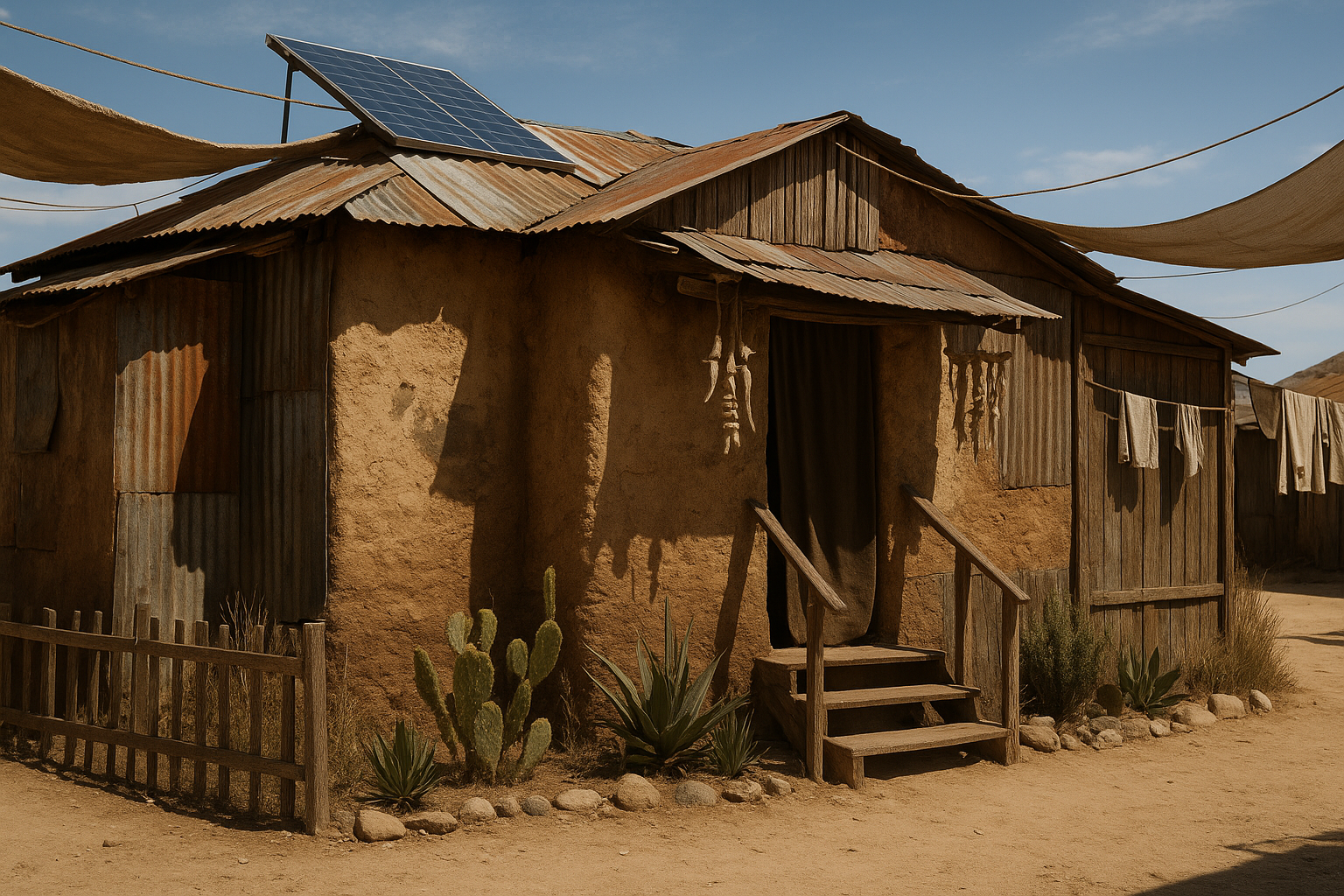
The Keeper's Den
The Keeper's Den is where The Council of Keepers organizes formal meetings to discuss the happenings in Espera. It serves as the heart of Espera’s governance and memory, the place where the council of elders gathers to deliberate on matters of survival. Its purpose is both practical and symbolic: it is where rations are counted, trade agreements negotiated, and punishments for broken taboos decided. It is also where oral histories are recited by the Whisperers and where children, standing in the doorway, first see how the business of their community is handled. For the Saltfolk, stepping inside is not casual — the Keeper’s Den is treated almost as sacred ground, a hall of judgment and counsel. One must be invited in order to enter, and touch their thumb to their forehead, then their chest as a sign of respect upon entering.
Purpose / Function
Over time, the purpose of the building has shifted. In the earliest days of Espera, it was little more than a communal shelter where decisions were made around a fire. As the settlement grew and survival demanded stricter organization, the Keeper’s Den became formalized into a meeting hall, marked as separate from ordinary huts by its size and adornments. Bone charms and salt wards were added to its entrance, not only to ward against ill fortune but to remind all who entered of their responsibility to the community. Its role expanded from day-to-day survival decisions to becoming the place where Saltfolk identity is preserved — where myths are retold, omens are weighed, and the fragile thread of law and memory is knotted tighter.
Today, the Keeper’s Den is both council hall and cultural anchor. It has changed from a shelter of necessity into a symbol of authority and continuity, a building that holds not just leaders but the weight of the Saltfolk’s covenant with the desert itself.
Design
The Keeper's Den is roughly rectangular in shape, measuring approximately 40 feet by 60 feet, with the main council chamber occupying the central space. The ceiling is low and vaulted, supported by thick adobe pillars embedded with salt crystals that catch and scatter lamplight. The walls are painted in earth tones — deep ochre and sand — with ceremonial spirals and geometric patterns carved directly into the adobe.
The floor is packed earth mixed with salt, worn smooth by decades of foot traffic and polished to a subtle sheen. Raised platforms of stacked stone and adobe create different levels within the space: a central speaking area for the Council, elevated seating areas along the walls, and a slightly raised dais where the eldest Keeper sits during formal sessions.
Entries
The main entrance faces east toward the rising sun, approached by a small staircase that ascends into the structure. Heavy curtains of woven desert grass and salvaged fabric hang across the doorway, both for privacy and temperature control. The entrance is flanked by carved stone pillars hung with bone chimes and salt crystals.
A smaller service entrance connects to the wooden addition housing supplies and the armoury, accessible only to Council members and trusted community leaders. Interior doorways between rooms are covered with hanging bead curtains made from polished stones and bone fragments.
Entry to the main council chamber requires invitation and the ritual gesture of touching thumb to forehead, then chest. During formal sessions, guards from the community stand at the entrance to ensure only invited participants enter.
Sensory & Appearance
Upon entering, visitors are struck by the cool, dense air that carries the sharp mineral tang of salt mixed with the warm scents of fire-gel lamps and burning resin. The space is dimly lit, creating deep shadows that dance as flames flicker in their sconces. The acoustic properties amplify whispers and make normal conversation carry clearly across the chamber.
The temperature is consistently 15-20 degrees cooler than outside, providing blessed relief from desert heat. Humidity is low but slightly higher than the bone-dry exterior, thanks to clay water vessels placed strategically around the room. The constant soft chiming of bone ornaments creates an underlying musical backdrop, occasionally joined by the distant sounds of community life filtering through the thick walls.
The visual centrepiece is the intricate salt crystal formations embedded in the walls that catch and refract light, creating an almost mystical atmosphere during evening sessions. Shadows from the flickering flames play across carved wall reliefs depicting Espera's founding and the Saltfolk's journey to the flats.
Denizens
The Keeper's Den is regularly inhabited by:
- The Council of Keepers: Five to seven rotating elder leaders who meet here for formal sessions
- Whisperers: Cultural memory-keepers who conduct oral history recitations during ceremonies
- Council Guards: Community volunteers who provide security during sensitive meetings
- Maelle Corvain: As a prominent Council member and Desert Keeper, she maintains chambers here for extended sessions
- Visiting Dignitaries: Traders and representatives from other settlements who are granted audience
- Apprentice Keepers: Younger community members learning governance and cultural preservation
During major community events, children are permitted to stand in the doorway to observe proceedings, beginning their education in Saltfolk governance and tradition.
Contents & Furnishings
The central chamber contains:
- The Council Circle: Seven cushioned stone seats arranged in a semicircle, each carved with the symbol of a different aspect of survival (water, salt, food, shelter, defense, memory, trade)
- The Speaking Stone: A large salt crystal formation in the center where individuals address the Council
- Clay Water Vessels: Large decorated jars containing the community's ceremonial drinking water
- Record Shelves: Niches carved into walls holding clay tablets with community laws, trade agreements, and resource tallies
- Fire Braziers: Metal containers (salvaged from the old world) that burn fire-gel for light and warmth
- Ceremonial Salt Bowls: Used for ritual purification and blessing ceremonies
The guest chambers contain simple sleeping mats, wooden chests for personal belongings, and small shrines with family memory objects. The communal kitchen features a large stone hearth, preservation tables, and storage areas for ceremonial feast preparations.
Valuables
- The Founding Scroll: A preserved document detailing Espera's original charter and the Saltfolk's covenant, kept in a sealed salt-crystal container
- Community Resource Ledger: Clay tablets tracking all stored supplies, water reserves, and trade debts — invaluable for survival planning
- Ceremonial Salt Crystals: Large, perfectly formed crystals used in the most important rituals, considered irreplaceable
- Pre-Collapse Relics: A small collection of old-world items (maps, tools, books) that provide knowledge about the region before the Verdancy
- Trade Agreements: Binding contracts with other settlements, carved in clay and sealed with salt
- The Memory Bowl: An ancient ceramic vessel used in Whisperer recitations, said to contain the essence of all stories told within it.
Hazards & Traps
While not intentionally trapped, the Keeper's Den presents several dangers:
- Salt Poisoning Risk: Prolonged exposure to the high-salt environment that are not accustomed to it can cause dehydration and mineral imbalance
- Structural Instability: Some areas of the old adobe structure show stress cracks that could collapse under extreme pressure
- Hidden Weapons Cache: The armory in the wooden addition contains volatile fire-gel reserves that could explode if mishandled
- Ritual Consequences: Violation of sacred protocols (entering uninvited, touching forbidden objects) results in severe community punishment
- Emergency Lockdown: During external threats, the building can be sealed from inside, potentially trapping occupants
Special Properties
- Acoustic Amplification: The chamber's design naturally amplifies voices, making it perfect for oratory and ensuring all participants can hear proceedings
- Salt Preservation: The high-salt environment naturally preserves organic materials, helping maintain records and ceremonial objects
- Temperature Regulation: The partially underground design and thick walls maintain consistent cool temperatures year-round
- Spiritual Significance: Many Saltfolk believe the building itself has protective powers due to accumulated rituals and blessings
- Community Anchor: The building serves as a psychological and cultural centre that strengthens community bonds and identity
Alterations
Originally, the Keeper's Den was the first establishment constructed upon the foundation of Espera. It was large enough to house the refugees who arrived in the Salt Flats out of immediate necessity. As the settlement grew and more refugees arrived, denizens began constructing their own private huts and dwellings, that better suited their own personal survival needs. As a result, the original establishment still has bedrooms, which are reserved for special guests. It also houses a large kitchen and communal table, which is used for communal gatherings, feasts, ceremonies, and more. It is at the centre of Espera, and is considered the heart of the village.
When the village expanded and the Keeper's Den became used as a central meeting point for The Council of Keepers, and addition was built out of wood on the outside, like an attached shed, which is now used to shelter rain barrels, stores of grain and food rations, bags of flour, medical supplies, and has a locked armoury of weapons as protection against raiders in case of emergency.
Architecture
The Keeper's Den follows the standard Saltfolk architectural style while being distinguished by its larger scale and ceremonial elements. The main structure is built from adobe and salt-brick — walls crafted from clay, sand, and salt, reinforced with scavenged materials like sheet metal, broken glass, and rebar. The sun-baked walls are thick to keep the desert heat out, giving the building a fortress-like solidity that speaks to its importance.
The building is partially half-buried, using the earth's natural coolness as insulation. The entrance slopes gently downward and is framed by ceremonial bone charms and salt wards that mark it as sacred space. Unlike typical Saltfolk dwellings, the Keeper's Den features carved symbols in its adobe walls — spirals representing continuity, salt crystals for protection, and geometric patterns that tell the story of Espera's founding.
The flat roof is layered with tarps, canvas, and salvaged metal to capture precious dew and rainwater, with channels that funnel water into barrels below. The wooden addition attached to the main structure is clearly newer, constructed from scavenged planks and corrugated metal sheets, its patchwork appearance contrasting with the weathered uniformity of the original adobe structure.
The exterior gleams with the characteristic white-gleam of salt encrustation, making it shimmer like a beacon in the harsh sunlight. Wind and time have smoothed its surfaces, giving it a timeless, almost ruins-like quality that enhances its sense of ancient authority despite being built only decades ago.
Defenses
The Keeper's Den sits at the center of Espera's concentric ring of defences. Like all structures in the settlement, it is built on a foundation of salt-crusted earth, with fresh lines of salt drawn around its perimeter and renewed daily. The building benefits from Espera's primary defence — the wide ring of salt poured constantly around the entire settlement, which acts as both physical and ritual barrier against the Verdancy.
The wooden addition contains the settlement's emergency armoury, with weapons stored behind reinforced wooden panels and metal locks salvaged from the old world. Clay jars filled with concentrated brine are stationed near all entrances, ready to be used as both weapons and wards against intruders or Verdant incursions.
The building's central location provides strategic advantages — it's equidistant from Espera's watch posts and can be quickly reinforced by the community in times of crisis. The partially buried construction and thick walls make it naturally defensible, while multiple exit routes through the connected rooms ensure the Council can evacuate if necessary.
Hidden food caches are stored beneath the building and in the surrounding courtyard, following Saltfolk practice of never concentrating all resources in one place. The building itself serves as a fortress of last resort, where the community can gather during severe storms or external threats.
History
August 2031 - Foundation: The Keeper's Den was constructed as the first permanent structure in Espera, built by the original refugees who arrived in the Salt Flats. Initially served as communal shelter and basic meeting space.
2032-2035 - Early Organization: As more refugees arrived and survival became systematized, the building evolved from simple shelter to informal meeting hall. Basic salt wards and bone charms were added to mark its importance.
2036-2040 - Formalization of Authority: The Council of Keepers was established, and the building became their official meeting place. Ceremonial elements were added to the entrance, and the building's role shifted from practical shelter to symbolic seat of governance.
2041-2045 - Cultural Expansion: The building's role expanded to include cultural preservation. Whisperers began conducting formal recitations here, and the space became central to Saltfolk identity and memory-keeping.
2046-Present - Modern Function: The wooden addition was constructed to house emergency supplies and armoury. The building now serves its full dual role as both practical government centre and cultural heart of the Saltfolk community.
Tourism
While Espera is not a typical tourist destination, the Keeper's Den occasionally receives visitors:
- Settlement Representatives: Leaders from other post-Collapse communities come to observe Saltfolk governance methods and learn survival techniques
- Wandering Scholars: Rare individuals seeking knowledge about pre-Collapse history and post-apocalyptic adaptation strategies
- Aspiring Refugees: Groups considering joining Espera are brought here to understand community expectations and witness the decision-making process
- Trade Partners: Merchants and caravan leaders participate in formal negotiations and contract ceremonies
Visitors seek to experience the unique Saltfolk approach to collective survival, witness the Whisperers' oral traditions, and understand how a community maintains order and culture in harsh post-apocalyptic conditions. Most are particularly interested in the salt-based preservation techniques and the integration of practical survival with cultural continuity.
Inside the Keeper's Den, the air is cool and dense, carrying the sharp mineral scent of salt and brine. The thick adobe walls create a cellar-like atmosphere that provides relief from the blinding desert heat outside. The main council chamber is dimly lit by filtered light through cloth-covered window slits and the warm glow of fire-gel lamps, creating an atmosphere of solemn gravitas appropriate for important deliberations.
The building's acoustic properties amplify voices, making it ideal for oratory and formal recitations. Salt crystals embedded in the walls catch and reflect the lamplight, creating an almost mystical ambiance during evening sessions. The partially underground construction ensures the interior remains consistently cool, while the communal kitchen area carries the scents of preserved foods and cooking fires.
During storms, the building transforms into a protective bunker, its thick walls muffling the howling winds and salt-laden gusts outside, reinforcing its role as a sanctuary and centre of stability for the community.

Comments