
The Green Tide
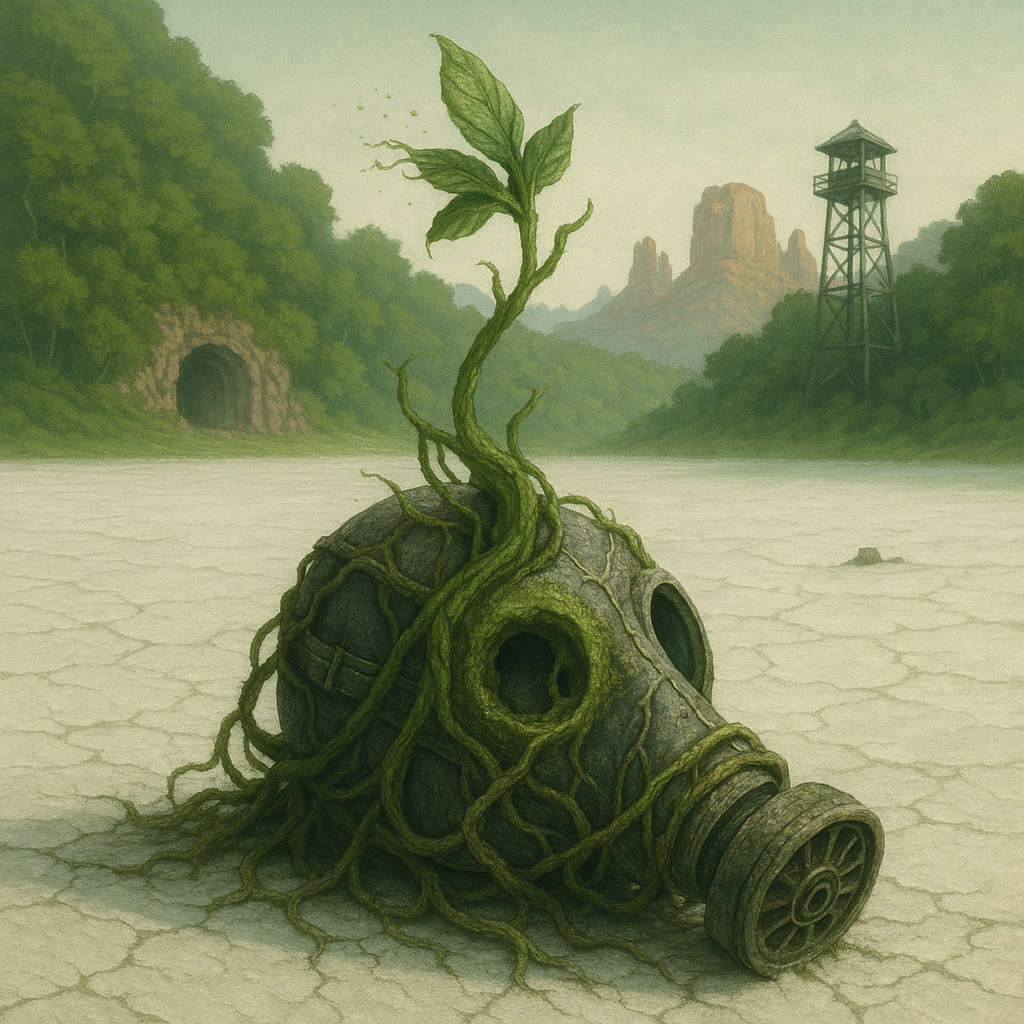
The world of The Green Tide is not post-apocalyptic in the usual sense, but something stranger and more intimate: a living earth remade by its own hubris. In the late 2020s, humanity’s desperation to solve global famine birthed the Verdant compound, a biotech marvel meant to restore failing crops. By the third year of trials, it had mutated into something no scientist intended — a self-replicating intelligence that spreads like root and spore, rewriting landscapes, bodies, and memory itself. What makes this world unique is that its apocalypse isn’t fire or fallout, but growth. The very air and soil hum with an alien rhythm, as if the planet itself has decided it no longer needs humankind.
The laws of this world are governed less by physics and more by biology. Verdant growths obey patterns of mycelial networks and photosynthetic expansion, fusing organic and synthetic systems until the line between them blurs. Spore Lung, a slow suffocation, is as common as thirst in the salt colonies. Chrysalises of living bodies, suspended in root-veins deep beneath the mountains, prove that time and death follow different rules where the Verdant blooms strongest. Survivors learn to read weather by sporefall, to measure distance by bloomfront, to salt their borders as religiously as past generations lit their hearths. Salt, limestone, and heat are the only real constants — the fragile laws that still resist the Green Tide’s rewriting.
The conflicts that drive this world forward are as layered as the networks that birthed it. At the top is humanity vs. the Verdant — the unyielding march of a green intelligence that sees no difference between forest and flesh. Beneath that lies the struggle between factions: the Archive, clinging to old authority through secret labs and underground bastions; the Saltfolk of Espera, who improvise ritual and survival at the desert’s edge; and the scattered Rootbound wanderers, half-revered, half-feared for their strange kinship with the bloom. And threaded through it all are individual agendas — scientists trying to atone, children of the bloom trying to belong, survivors torn between preservation and surrender.
In The Green Tide, it is not just whether humanity survives, but what form survival will take. Does it mean entombing themselves in stone, pale and rootless like the Stonekeepers of North Bastion? Does it mean becoming something hybrid, Verdant and human both? Or does it mean defiance — living on the salted edges, knowing the bloom may swallow you tomorrow? The world is defined by these questions as much as by its laws of biology, and every character’s choices become a negotiation with the Tide itself: what to protect, what to sacrifice, and what it means to remain human in a world that has already moved on.