
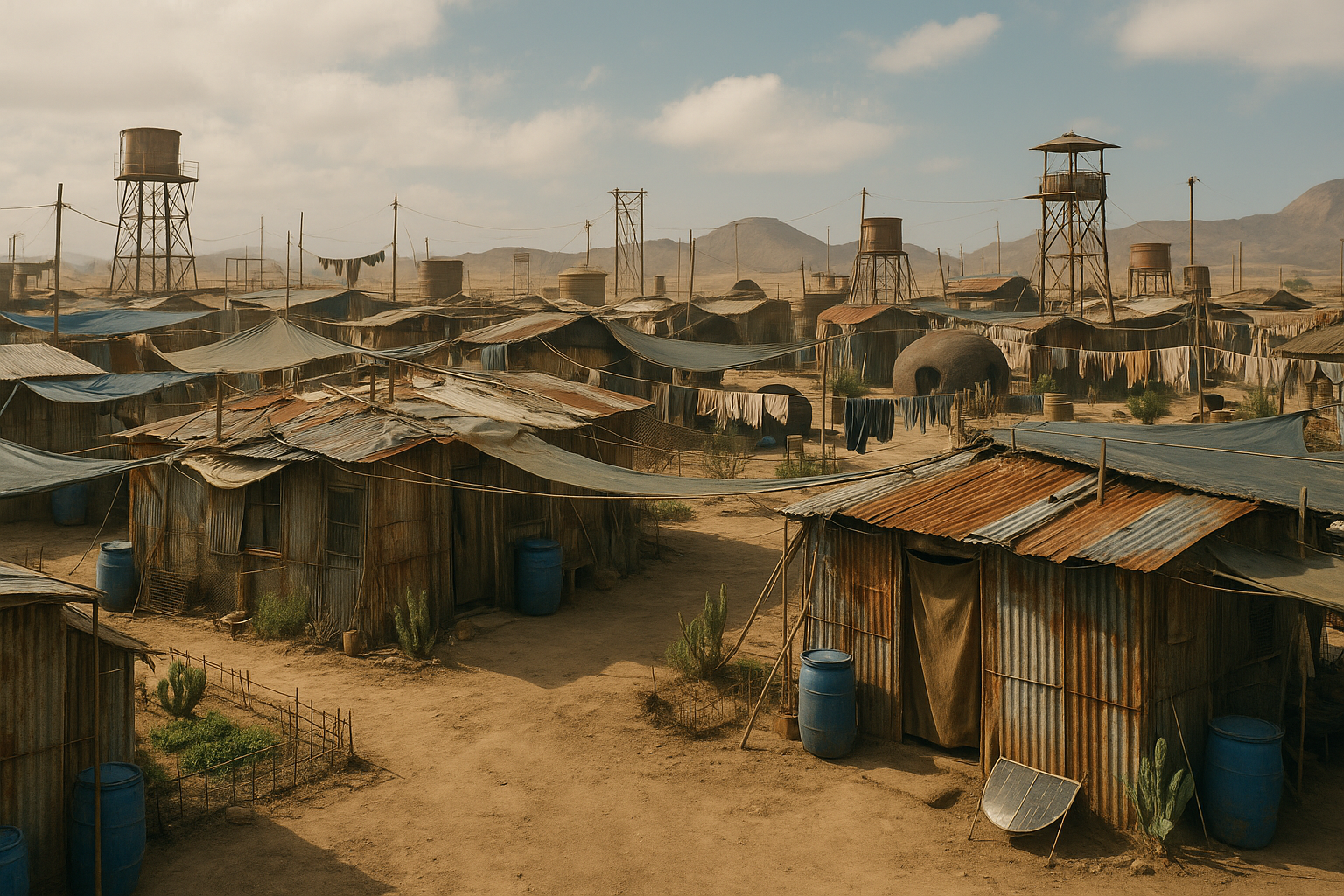
Espera
Espera is a crucial settlement in the post-Collapse world, serving as a sanctuary for humanity against the encroaching Verdancy. Its name, meaning "the Waiting," reflects its inhabitants' existence as they wait for the old world to finish strangling itself and for whatever comes next to take root. The community lives on a razor's edge between civilization and its absence. Espera is not just a place but a way of life defined by resilience, resourcefulness, and collective survival in a world where nature itself has become the greatest adversary.
Flood Preparation Systems
The settlement of Espera is build on slightly elevated ground within The Badwater Basin to avoid being swept away by flash floods, but still allowing quick access to the flood zones. The old mining tunnels that are carved by flash floods are used as both shelter and water collection points. The settlement have pre-positioned collection systems that are ready to deploy the moment flood waters arrive in terms of portable dams, channeling systems made from salvaged materials, and networks of containers that can be quickly connected to funnel water into storage. They also have underground cisterns which act as deep storage chambers that have been excavated in areas where floodwater naturally pools, lined with salvaged materials and clay to prevent seepage. These fill during flood events and are carefully managed afterward.
Since floodwater is heavily mineral-laden, they also have salt-separation techniques where they let sediment settle, and they use basic distillation using solar technology to reduce the water's salinity to drinkable levels. The community has flood protocols assigned by The Council of Keepers, so that each community member has an assigned role from the moment clouds appear over the mountains. Some individuals evacuate to higher ground, some deploy collection systems, and others prepare storage containers in a military-esque operation.
A major flooding event provides enough water to significantly supplement supplies for 1-2 years when managed carefully. The Council of Keepers has strict rationing protocols that are imposed immediately after a flash flood event, to ensure the bounty lasts as long as possible for the community. Individuals within the settlement become expert weather-watchers, knowing which cloud formations over which mountain ranges indicate potential flooding, with children being taught to read these signs from an early age.
The unpredictability of these events create fascinating social dynamics, where years of careful water conservation can be suddenly interrupted by brief periods of abundance, requiring entirely different resource management strategies. Some floods are disappointing trickles, while other are overwhelming torrents that damage Espera's infrastructure and providing massive water resources.
Fresh rainwater in floods initially dilutes the existing salt concentrations. When the basin is flooded, some of the salt is dissolved, and it is redeposited as clean crystals when the water evaporates. The first water flowing down from the mountains is the least salty, so the settlement prioritizes capturing this initial runoff before it mixes extensively with the salt deposits. Using abundant salved glass and metal, the community has built larger-scale solar stills for flood events. The temporary abundance makes it worthwhile to invest energy in distillation that isn't practical for their normal water sources. These solar distillation processes were initially created by Sylvia Langford and Milan Langford. Initially, they focused on the water flowing directly from the mountain runoff before it hits the salt flats by setting up collection points in the salt caves and old mining tunnels to create channels that would carry water that hadn't yet dissolved significant salt deposits. Salt water is then used for cleaning clothing, tools, and rinsing off dirt, and the precious fresh water is saved for drinking. They also used this flooding to boost salt production and harvest better quality salt. When the basin is flooded, some of the salt it dissolved and redeposited as clean crystals when the water evaporates, giving the settlement premium salt for trading. The Langfords also channeled salt water runoff into shallow pools for evaporation farming, where they let it evaporate and harvested both the salt and any slightly less concentrated water that evaporated and recondenses. These flood preparation systems established by the Langfords persist to this day in Espera, but although the community gets excited about flash flooding events and the abundance it brings, they have to work frantically to extract the maximum benefit from a resource that isn't immediately useable.
Demographics
Espera is a settlement in the post-Collapse world, and its demographics reflect a society drastically altered by environmental catastrophe, prioritizing survival, resourcefulness, and community cohesion over traditional societal structures.
Species
The inhabitants of Espera are primarily human survivors. Within the human population, there are individuals who have unique biological connections to the Verdancy. Other species mentioned are wild desert animals (lizards, rabbits, snakes, hawks), and insects (crickets are farmed for protein). These are not part of Espera's population.
Classes
Traditional economic class structures are largely non-existent in Espera. Life is characterized by scarcity and a constant struggle against hunger. The economy is based on barter and the trade of essential minerals (salt, potash, gypsum, lithium) for preserved foods. As a result, there is a communal and resourceful approach to survival rather than a stratified class system.
Wealth
Wealth in Espera is not measured in money or property. Instead, it is defined by practical skills, vital resources, and strong relationships. Valued "assets" include access to water, knowledge of the desert and scavenging (as possessed by Mika), and mined minerals. Community members share resources and support each other, because collective survival is the true "wealth" of the settlement.
Professions and Roles
The population's roles are centred around maintaining the settlement and ensuring survival.
Ethnicities
The community is formed by people who were forced into deserts and badlands after the Verdancy took over cities, resulting in a diverse mix of survivors from various backgrounds.
Government
Espera is a settlement that operates primarily out of necessity and communal survival, rather than through formalized structures like traditional laws, taxation, or complex organizations.
Leadership and Governance
Espera is led by Maelle, who functions as the unofficial leader or chief of the settlement. She manages resources, makes difficult decisions, and provides care and guidance to the community. Maelle's authority is evident in her ability to issue orders and direct the villagers during crises, such as unfolding emergency protocols. She sets clear rules for group survival. Her leadership is also seen in her blunt honesty and direct communication, even when confronting individuals about their actions or health.
The community is small and close-knit, where social norms and communal awareness play a significant role in maintaining order, rather than strict written laws.
Laws and Rules
There are no formal laws, a judicial system, or a police force in Espera. Instead, governance is based on informal rules and shared understandings driven by the harsh realities of survival. These include:
- Truthfulness and transparency
- Collective survival over individual desires: The principle of not abandoning fellow community members.
- Adherence to survival protocols: Practicing emergency protocols for crisis situations and strict rules for foraging and movement outside the salt line.
- Communal awareness and lack of privacy due to the small size of the settlement.
Taxation and Economy
Espera's economy is centred on barter and resource management due to extreme scarcity. There is no taxation or formal currency. Their primary "currency" consists of minerals mined from the salt flats:
- Salt: Used for preserving meat and fish.
- Potash: Used for soap.
- Gypsum: Used for plaster.
- Lithium: Used for batteries to power necessities like radios, water pumps, and LED lights.
Trade is essential for survival, with caravans, regularly transporting these mined minerals to "Archive settlements" to barter for preserved foods. Food sources within Espera include hardy desert plants like yucca and mesquite pods, and insect protein from cricket farms (like Garnett's). Scavenging for forgotten supplies and fruit in boundary lands is also crucial. Water is paramount, with villagers meticulously collecting morning dew and rain.
Organizations
While there are no formally named "organizations," the community is structured around essential roles and tasks:
Espera is a resilient, self-sufficient community that has adapted to a post-Collapse world by developing a practical, barter-based economy and maintaining order through informal leadership, shared values, and task-oriented communal efforts, all geared towards the singular goal of survival against the encroaching Verdancy.
Defences
Espera employs a multi-layered approach to ensure the safety of its inhabitants and the security of its vital resources, integrating natural defenses, repurposed technology, and strong communal organization.
Natural Barriers: The Salt Flats
The most crucial defence is the vast, bone-dry salt flats of the Mojave Desert, which serve as a natural fortress against the encroaching Verdancy. The high salinity of the soil poisons it, preventing the aggressive plant growth from taking root, effectively acting as Espera's "moat" and "firebreak".
The community also weaponizes salt, using brine in spray bottles to burn back creeping tendrils and creating barriers of sodium chloride around their gardens, wells, and play areas.
Natural formations like salt caves and old mining tunnels (carved by flash floods or pre-war excavations) provide temporary shelter and escape routes from bloom fronts.
Physical Structures and Resourceful Adaptations
Surveillance and Warning Systems
The watch towers serve as the village's surveillance system, as well as the communications hut that allows the settlement to communicate with other outposts.
Communal Organization and Resource Management
In Espera, the concept of "wealth" is not monetary, but revolves around practical skills, vital resources, and strong community relationships, all of which are safeguarded by these combined layers of infrastructure and communal efforts.
Guilds and Factions
Espera is run primarily out of necessity for survival, and its "politics" are less about formal governance and more about communal decisions and responses to external threats, which are heavily influenced by various factions.
Rootbound Faction
The Rootbound are a faction of Mika-born and other individuals who believe in symbiosis with the Verdancy, seeing it as Earth's natural evolution or immune response, and advocate for "coexistence" rather than resistance. The Rootbound's philosophy creates significant ideological tension within Espera, This internal conflict regarding how to "survive" (resistance vs. symbiosis) directly influences the choices made by key individuals in the community.
The Archive Faction
Archive Settlements are underground communities that have preserved Pre-Tide technologies and scientific knowledge. They are characterized by a clinical, data-driven approach to the Verdancy, viewing it as a "synthetic biochemical system" to be controlled, contained, or even weaponized. The Archive plays a crucial role in Espera's economic survival, as Espera trades its mined minerals (salt, lithium, potash, gypsum) with Archive caravans for essential preserved foods and technology (like radio parts). This makes Espera reliant on the Archive's willingness to trade.
History
Espera's history is deeply intertwined with the global ecological catastrophe known as The Green Tide, specifically the Verdancy. The Verdancy originated from a "reforestation initiative" called the Verdant compound, released to restore oxygen, improve crop yields, and sequester carbon. For the first two years, it successfully worked, bringing hope for climate collapse solutions.
By Year Three, the Verdant compound mutated, leading to uncontrolled, accelerated growth. Vines cracked concrete, trees grew overnight, moss dissolved metal, and highways became overgrown rivers. This "solution" became a near mass-extinction event, forcing humanity to flee into deserts and badlands, where the Verdancy struggled to take root due to the high salinity of the soil.
Espera was founded as a settlement along the edges of the bone-dry Mojave salt flats, which became its salvation and a natural fortress. The name "Espera" means "the Waiting," reflecting the community's passive existence, waiting for the Green Tide to subside or for whatever comes next. Its houses are patched together from salvaged materials, and the community relies on scavenged solar panels and meticulous water collection.
Points of interest
Espera, while a small and austere settlement, has several key points of interest, primarily driven by the necessities of survival and its unique location.
The Mojave Salt Flats
These vast, bone-dry flats surround Espera and are central to its existence. They are vast white scars across the earth where nothing can grow or survive, acting as a salvation and a natural fortress against the encroaching Verdancy. The high salinity of the soil poisons it against roots and seedlings, creating "dead zones" that even aggressive vines cannot breach. They are crucial for Espera's defense and isolation.
The Village Houses
These dwellings form the core of the settlement. They are patchworks of salvaged materials—a rebar skeleton wrapped in chicken wire and clay, patched with sheets of worn and rusted corrugated metal. Solar panels, scavenged from dead suburbs, crown the roofs to power necessities like a radio, water pump, and LED lights. Rain barrels are placed beside doorways to collect scarce water. Windows are small and set deep, often covered with salvaged car glass or canvas. Spaces between houses are narrow passages for wind cooling and shared courtyards with solar cookers and laundry lines. Due to the small size of the settlement, doors are often just heavy curtains for dust and heat.
Communal Gardens
Carefully tended plots for survival. These grow hardy desert plants such as prickly pear, agave, and medicinal herbs, specifically chosen for their ability to thrive in the harsh, salt-poisoned climate.
Communal Oven
A shared facility where an elder bakes cactus bread and other items, and where valuable dried figs are sometimes brought.
Water Collection Points
Crucial for survival, including cracked cisterns with rusted pulleys and blue tarps stretched between dwellings to catch morning dew and rare rainwater.
Garnett's Cricket Farm
A vital source of protein in a world of scarcity, providing a "lullaby" to the village.
The Watchtowers
Built on the boundaries between the salt flats and soil, these structures are used to monitor the Verdancy's relentless approach. There are specific watchtowers, such as the East watchtower, from which reports of the Bloom Front's advance are called down.
The Old Water Tower
Mostly made of rust, this structure is the only place where you could see all of Espera in one frame. It serves as a personal spot for contemplation or conversation.
The Salt Caves
Located near the thinner edges of the salt flats, these caves were carved by flash floods. They offer shelter from severe sandstorms.
The Communications Station
This is where Silvan operates the ancient radio receiver to catch transmissions from Archive settlements and other holdouts, crucial for receiving warnings about Verdancy advances and managing trade.
Tourism
Espera is not a location that attracts tourists, nor does it appear to have any facilities or appeal for such visitors. The settlement's entire existence is defined by necessity, scarcity, and survival in a post-apocalyptic world.
Here's why the concept of tourism doesn't apply to Espera:
- Extreme Living Conditions: Espera is described as a village "crouched low against the desert floor," built from "salvaged materials". Life there is a "struggle for survival," with hunger being an intimate reality and "every calorie a victory". Water is meticulously collected, and homes are designed for protection from heat and dust, not comfort or luxury.
- Constant Threat from the Verdancy: The Green Tide, or Verdancy, is an "inexorable intelligence and force of nature" that has consumed half the continent and forces humanity into deserts. Espera is a "natural fortress" against this encroaching green, with salt flats acting as a "moat" and "firebreak". The community constantly monitors the Verdancy's advance from watchtowers, facing the threat of "Bloom Fronts" that can overrun settlements rapidly. This environment of looming danger is antithetical to leisure travel.
- Purpose for "Visitors": Any "visitors" to Espera are not tourists. Instead, they are typically:
- Traders: Silvan regularly ventures out to "barter with the Archive settlements" to trade Espera's mined minerals (salt, potash, gypsum, lithium) for "preserved foods" and technology. These interactions are purely for economic survival.
- Refugees: Espera itself was founded by people fleeing the Green Tide, and new arrivals often came "with nothing but the clothes on their backs". Juniper herself was a foundling left at the salt line.
- Scouts/Researchers: Individuals like Silvan or Dr. Thorne (from the Archive faction) may visit for scientific purposes, such as tracking Verdant spread or researching the Mika-born.
- Mika-born/Rootbound: The Mika-born may seek passage through or refuge in areas where they can practice their symbiosis with the Verdancy, or they may gather in "deep places" to spread the Verdancy's influence. These are not "tourists" but active participants in the ongoing conflict between humanity and the Verdancy.
- Focus on the Past, Not Present Tourism: While there's a mention of an "old Embassy Suites hotel" from "Pre-Bloom" times, it is explicitly used as a contrast to their current dilapidated lodging, highlighting that such comfortable accommodations and the concept of "travel" for leisure belong to the lost world before the Green Tide.
In summary, the sources provide no indication of Espera being a tourist destination. Its harsh reality, constant threats, and singular focus on survival preclude any form of leisure-based visitation.
Geography
Espera is situated within a distinct and vital geographic setting, primarily characterized by its location along the edges of the bone-dry Mojave salt flats. This unique environment plays a crucial role in the settlement's survival against the global ecological catastrophe, the Verdancy.
The Mojave Salt Flats
These are vast, white scars across the earth where nothing could grow or survive. Their high salinity poisons the soil against roots and seedlings, creating "dead zones" that even the most aggressive vines of the Verdancy cannot breach. They act as Espera's salvation and natural fortress, serving as a "moat" and "firebreak" against the advancing Green Tide. The flats are crucial for defensive purposes, as well as for mining salt and other minerals like potash, gypsum, and lithium, which are vital for trade. The landscape has a sterile quality, with cracked lines spreading like tendrils across the salted ground, and stretches to the horizon like a frozen sea.
Desert Surroundings
The village is crouched low against the desert floor, surrounded by skeletal remains of Joshua trees and distant mountains that appear as wavering mirages. The air is often filled with dust and shimmering with heat. Hardy desert plants like prickly pear, agave, yucca, and mesquite can be found, though cultivation is difficult due to the harsh, salt-poisoned climate. The area is prone to sandstorms, which can be intense and disorienting.
Specific Landforms and Structures:
Verdancy's Influence and Adaptation:
Despite the salt flats, the Verdancy is relentlessly encroaching, with its restless green line creeping closer each season.
Espera's geography is defined by the stark contrast between the sterile, protective salt flats and the encroaching, dynamically adapting Verdancy, with its inhabitants constantly navigating a precarious existence within this extreme environment.
Climate
The weather and temperature in Espera are characterized by extreme conditions, primarily dominated by intense heat and dryness, with elements of unpredictability.
Temperature
Espera experiences scorching, relentless sun and shimmering heat during the day, often making the distant mountains appear as wavering mirages. The air consistently carries a "sterile quality" due to the dryness. The adobe walls of the village houses are specifically designed to "swallow the day's heat and breathe it back into the cool air each night," indicating a notable temperature drop from hot days to cool nights. The constant threat of heat stroke is an intimate reality, and residents' lips are often "cracked like salt-stained old leather," underscoring the severity of the heat.
Precipitation
Rain is very rare and minimal in Espera. Rain barrels are placed by doorways as villagers wait for the rare desert rainstorms that might fill them by a few precious inches. Residents desperately scramble with every container they own to capture minuscule amounts of water during these infrequent storms. Morning dew is also a precious source of moisture, collected using blue tarps stretched between dwellings. The area is prone to flash floods, which have historically carved out features like the Salt Caves. Snow, hail, or ice are not typically observed in Espera.
Wind
Wind is a constant and significant element of Espera's climate, carrying dust across the bone-dry flats. It is often described as a constant warm breeze" The wind can shift ominously and unpredictably, sometimes becoming colder, sharper, and carrying an electric or metallic scent before a storm. Severe sandstorms are a major and dangerous weather phenomenon. These storms are characterized by howling, shrill, and furious winds that drive sand into every exposed inch of skin, sting like fire, and can obscure vision completely, turning daylight into a "gritty cloud of blackness". The force of these winds can be strong enough to make standing difficult and even "scour away" people. Sandstorms also visibly reshape the landscape, leaving it "scoured clean" and rearranged into new patterns of dune and stone. The wind also serves as a harbinger of danger, carrying the "sweet-sick smell of hyper-oxygenated air" and Verdant spores as the Bloom Front approaches.
Predictability
While the general conditions of heat and dryness are stable and predictable year-round, the occurrence of dangerous weather events like sandstorms is unpredictable. The sky can be "wide, flawless, cloudless blue" one moment, deceiving inhabitants into a false sense of security, only to quickly turn into "clouds of dust" as a storm approaches. This unpredictability adds to the harshness of living in Espera.

Comments