

Crystal Technology
It started with a bang and continued as a chime. The stars sang sweetly, and the song recorded itself deep in the hearts of the proto-planets. Millenia later it rejoiced to be unearthed. To us it sang, "Let us carry you further than you could ever dream. Let us be the bedrock for your wonder. Let us, let us."
Crystals are the heart of modern technology. A clean solution to the rocket equation, crystals are not just powering the present, they are the source of power in ancient relics. Since time immemorial, Artisan across the Sol System have independently discovered the potential of crystals.
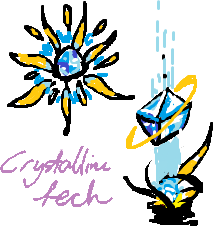
by Annie Stein
Properties
A leftover crystal flickered in a dark corner of my table drawer. Its song was dull and hollow. I took it in my hands, and moved it to the window. Under the stars something swelled in the tiny crystal. It pulled itself up towards the starlight. The pale light refracted into rainbows across the room. The song changed, it was clear and triumphant.Crystals absorb ambient energy, such as light and radiation, and emit the energy in new forms. Some crystals naturally glow, others hover by their own power. Current consensus is that all crystals naturally generate momentum, and that the crystals that do not hover simply don't generate enough to overcome their weight. All crystals can slowly regenerate power over time. Sourcing the correct crystal for the job is important. To a certain extent, all crystals are "trainable". They are able to adapt to tasks over time and become more effective at them. While a crystal engineered for propulsion can never become a battery, it can be retrained to work better in bursts, or over extended use, or adapted to a new enviroment. The brilliancy and potency of a crystal can be enhanced by the right cut, and master lapidarists can even bring out entirely new properties with circuits etched into the crystal lattice. Crystalline structures consist of geometric patterns all the way down to the molecular level. These lattices of perfectly flat facets serve as an ideal base for etching layers of electronic circuits. Advanced crystal technology like Gateway Portals and Gravity Plates is made with encoded crystal. Fully enclosing crystals tends to degrade their effectiveness. Many engineers firmly believe that the crystals themselves operate better in beautiful contraptions of gold, silver, or other precious metals. The latter tendency has been explained by resonance between certain geometric patterns and fine metals, rather than any kind of aesthetic sense on the part of the crystals.
Colour
Crystals come in all kinds of colours. Astrallite ranges from pink to purple to blue, while aurorite takes on the colour of the auroras that made it.Song
Crystals produce a gentle sound as they work. It is often described as a gentle hum or a chiming. Those who work with crystals call it singing, and swear that sometimes, they can even understand it.Localization
The more in tune a crystal is with their location, the better their preformance. Aurorite works best in terrestial spheres, while astrallite is best in space.Hazards
The crystals used in engines are radioactive and require well-maintained radiation shields. The crystals used for personal tech are either inert or small enough for the radiation to be negligible. Charged crystals are fairly safe to handle, but there is a risk of explosion if directly impacted. A shattered crystal will explode violently.Relics
The potential of Crystals has been known for as long as history. In ancient times, crystalline technology was the domain of the keystones and her entourage. Crystals were core to the creation of legendary jewelry, weapons, and armour. These artefacts were imbued with incredible powers, from teleportation and flight to ever-sharp blades. Many of the claims are difficult to substatiate, dividing myth from fact is a difficult task.
Today most of these relics are lost to history. A few are known remain in private collections. The largest known collection belongs to the palace of Venus.
Even when these relics have been made available to study, unearthing their secrets is no easy feat. Some rely on seemingly inate properties of the crystals used, which appear to be neither astrallite or aurorite.
These inquiries have nonetheless born fruit. Replication of the crystal lattices found in the Sword of Clouds was instrumental to the creation of the Gateway Portals.

Veils of Venus (Detail) by Annie Stein
While most planets and moons have astrallite farms of their own, none can rival the plenty produced by Venus. The farms around the morning star are dense enough to earn the moniker Veils of Venus.
Harvest
The first crystals were harvested from metorites, but almost all crystals in use today are farmed. Farmed crystals are grown from a seed crystal, creating aurorite when placed in the auroral zone, and astrallite in outer space. The growing crystals capture solar winds to synthesize additional material. Some crystals are grown entirely within laboratories. A seed crystal is placed in a mineral-rich solution and irradiated with a set of wavelengths that simulate the solar wind. Laboratory-grown crystals tend to be far more expensive, but take much less time and tend to be more uniform than astrallite and aurorite. Crystals can also be found embedded in the crust of planets, moons and asteroids. These crystals are closest to astrallite in terms of properties, and grew in interstellar space before being accreted into the Solar System. With the expansion of mining in the Asteroid Belt, a growing percentage of new astrallite is mined rather than farmed.
Related Materials
Notice: This article is a stub. It may be expanded later!



One of the loveliest and most heartfelt explanations of a technology that I've had the pleasure to come across. I love how the crystals yearn for starlight. I imagine them humming happily when absorbing energy and crying to themselves when they're confined. Great work as always!
Learn about the World of Wizard's Peak. Visit my Worldember 2025 Hub as I work on 50,000 words in December!
Thank you! I like to imagine a mechanic humming away with them. I thought it might be a nice change for the technology to be kind of innately joyful, kind of like technological dogs.
Solaris -— a sapphic space opera
Creator of World of Worlds | Camp Chill | Comment Carolers