

Festum Mortuorum
“We honour them, for we are built upon their ashes.”
“We honour them, for we are built upon their ashes.”
Observed each year on the 16th of Noctis, the Festum Mortuorum stands among the Imperium’s most solemn and universally observed traditions. It is a day when the living pause their labours, shutter their shops, and bow their heads to the long shadow of ancestry. Though Imperial in origin, the festival has, over eight centuries, woven itself together with the rites of the Elves and the Dwarrow, creating a shared remembrance observed across nearly every province.
From the smallest rural hamlet to the marble avenues of Novaium, the Empire becomes a realm of hushed lanterns and drifting incense. Citizens adorn their doorways with wreaths of winter herbs, believed to guide ancestral spirits; temples veil their sanctuaries in black and ochre; and the great necropolis districts open their gates for uninterrupted pilgrimage. It is said that on this night the barrier between worlds thins, and the spirits of the departed may walk the familiar paths of their former lives. Whether taken as holy truth or comforting tradition, few Imperials choose to ignore it.
The festival serves not only as remembrance but also as reconciliation. Families use this day to speak the names of those with whom they quarreled, promising to let ancient wounds fade with the passing years. Legionaries pour out wine for fallen comrades. Arcanii, ever wary of incorporeal disturbance, perform rites to ease any restless shades. In this shared observance, the diverse peoples of the Imperium are bound by the universal truth that all things return to dust — and that memory alone defies the grave.
History
The roots of Festum Mortuorum reach back to the earliest, uncertain years following the Rift event that delivered the Nova Provincia into Exilum Novum. The sudden sundering from their home world left countless Imperials without closure; entire families were separated by the cataclysm, many never learning whether their loved ones survived the transition or perished in the uncharted wilds beyond the Rift’s tear. In response, the first governor declared a day of solemn remembrance, then called Dies Memoriae, during which citizens gathered to speak the names of the missing into the night air.
This quiet rite grew in significance during the Empire’s first major diplomatic achievement: the Dwarrow–Imperial Treaty of 9 NE, brokered after years of frontier tensions. The Elder Courts of the Elves, seeking to prevent escalation into a wider war, offered mediation between the hard-pressed Dwarrow clans and the newly arrived Imperials. Their efforts succeeded, and the resulting treaty forged the first tri-cultural bond of the new era.
To mark the peace, the Dwarrow introduced the Imperials to their ancient practice of stone-etching the names of the departed — a ritual embodiment of lineage and memory. Inspired by this, the Imperium began inscribing the names of the earliest Rift-dead upon the foundations of what would become the Mausoleum Imperiale Novaii. These carvings symbolised the Empire’s commitment not merely to mourn its dead, but to anchor them permanently within the stone of its new world.
Elven influence deepened the festival further. Their mediation had shown the Imperials a cultural reverence for the passage of souls, expressed through the haunting, crystalline Hymns of Passing. First performed as a gesture of goodwill during the treaty celebrations, these hymns resonated so profoundly with the citizens of Novaium that they became a yearly fixture of the festival. Over time, the Elven melodies blended seamlessly into Imperial practice, lending the night its distinctive blend of solemnity and otherworldly calm.
By order of Emperor Lucian Solarius, the modern, unified form of the festival — Festum Mortuorum — was codified in the second century NE. Today it stands as one of the Imperium’s most sacred rites: a reminder of the cost of arrival, the forging of new alliances, and the shared hope that the living and the dead may walk together, if only for a single night.
Execution
The rites of Festum Mortuorum unfold over a single night, but their choreography is ancient, deliberate, and observed with near-universal solemnity. Though regional variations exist, the core sequence of the festival is maintained throughout the Imperium by decree of the Sacerdotium Civicum Phoenicis.
I. The Veiling of the Doors (Sunset)
As the sun disappears, every household draws dark cloth over its threshold. This veil symbolises the boundary between the living world and the realm of shades. It also marks a gesture of humility: no mortal home is worthy to receive the dead without preparation.
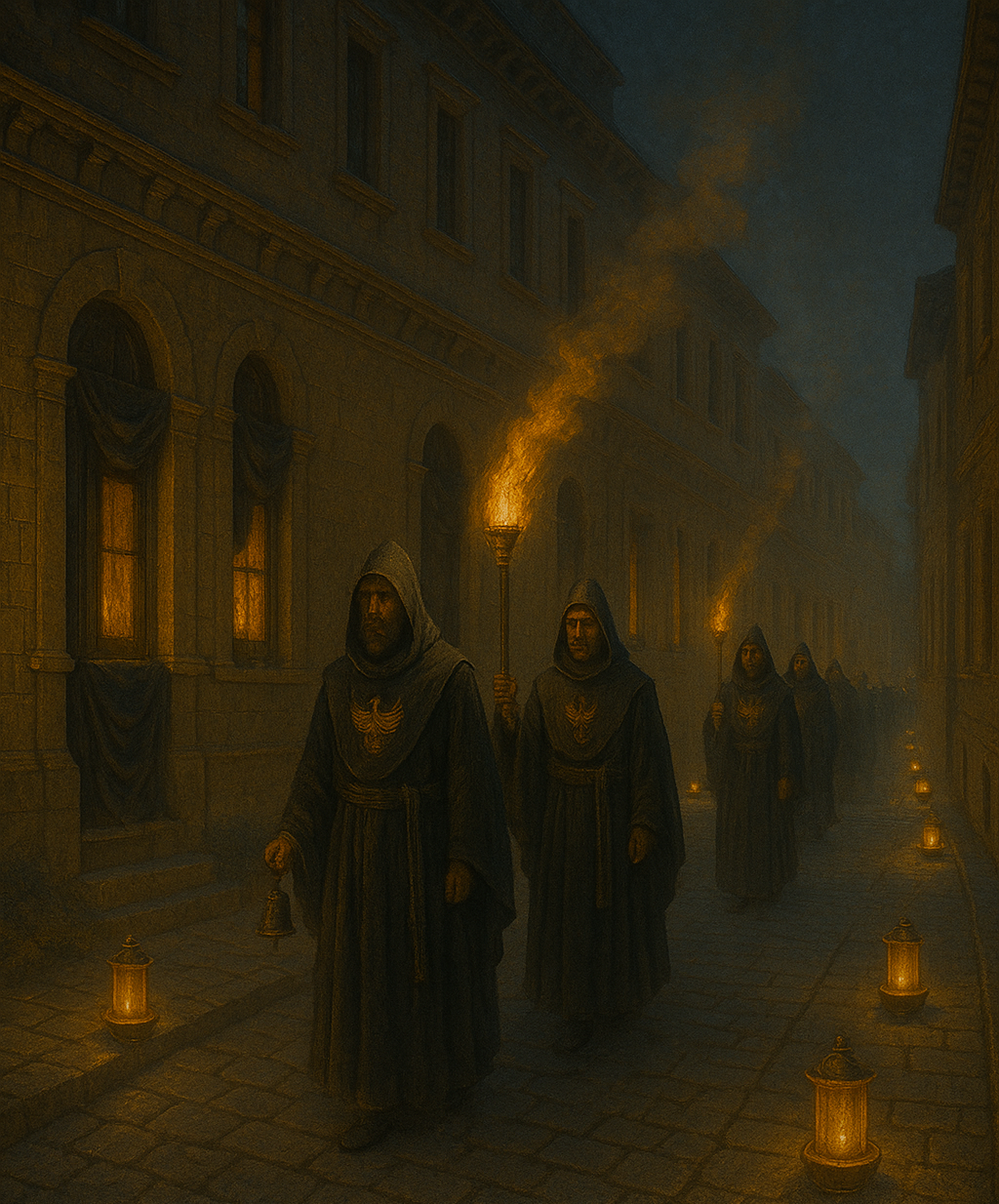
Civic priests process through the streets ringing bronze bells whose tones are said to calm wandering spirits. Soldiers of the local garrison march ahead of them, bearing torches that cast long, wavering shadows against the walls.
II. The Lighting of the Lantern-Path
Every family lights a small lantern — usually terracotta or brass — and places it in the street outside their home. The hundreds of tiny lights form winding golden trails through each district, symbolically guiding the dead to the homes they once knew.
In Novaium, the Legions ignite great braziers at major crossroads, each dedicated to a prominent battalion or fallen cohort. Veterans stand guard beside them in silent vigil.
III. The Procession to the Mausoleum Imperiale Novaii
While most citizens remain near their homes, a great civic procession forms in the capital. Led by the Phoenix Priests, the procession carries the Ignis Memoriae — a sacred flame believed to have burned continuously since the early Rift years. The flame is placed at the base of the mausoleum’s steps, from which the imperial lanterns are lit.
The Imperial Household observes this moment from the upper colonnade. Tradition holds that emperors do not descend during this rite, for they symbolically “stand among their predecessors.”
IV. The Recitation of Names
Across the Empire, families gather to read aloud the names of departed relatives. Legion units recite their dead by century; civic officials publish the names of notable citizens lost that year. Even those without known ancestors — travellers, orphans, new arrivals — may recite the names of Imperials who died unclaimed, ensuring no soul is forgotten.
The Elven Hymns of Passing are sung during this portion, often echoing faintly through entire districts.
V. The Final Offering (Just Before Midnight)
Families place small offerings on their thresholds: a cup of wine, a loaf of spiced bread, sometimes a personal item belonging to the deceased. These are not gifts to bribe spirits, but gestures of welcome and remembrance.
Arcanii observers discreetly monitor this hour for metaphysical instability. Though genuine hauntings are rare, the Academy has documented an unusual rise in dream-visions and ancestral apparitions during the festival.
VI. The Lifting of the Veils (Midnight)
At the stroke of midnight, households lift the black cloth from their doors. This act symbolises the dead returning to their rest. The lanterns are extinguished in silence, save for the central flame at the mausoleum.
Last to depart are the Phoenix Priests, who return the Ignis Memoriae to its inner sanctum, where it will rest until next year.
Participants
The General Population
Every citizen of the Imperium Novum is expected to observe Festum Mortuorum, regardless of wealth, station, or province. Participation is considered a civic duty as much as a personal rite. Work ceases empire-wide, markets close, and even taverns operate in hushed tones. Families gather together across generations; those without kin often join their neighbours, strengthening communal bonds.
The Sacerdotium Civicum Phoenicis
As custodians of state funerary rites, the Phoenix Priests lead the festival’s most sacred proceedings. They carry the Ignis Memoriae, perform the bell-procession at sunset, consecrate the lantern-paths, and invoke the traditional litanies of remembrance. Their presence also serves to maintain metaphysical order — the priesthood is trained to identify and soothe disturbed shades or wayward hauntings.
The Imperial Household
The Emperor and members of the domus imperialis observe a private rite within the inner sanctum of the Mausoleum Imperiale Novaii. Their offerings are made on behalf of the entire Empire, symbolising the continuity of rule and the unbroken chain of imperial precedent. Although the ceremony is not public, its completion is announced at midnight, marking the formal close of the festival.
The Legions
Across every garrison and frontier fort, legionaries perform the Vigilia Memoriam — a structured recitation of fallen comrades from their century, cohort, or campaign. Standard bearers keep a slow march before the lantern-braziers, while officers pour libations onto the ground. Veterans of foreign conflicts often return to their old units on this night, creating a reunion of service and memory.
Civic Magistrates and Senators
Magistrates oversee local logistics for the festival: maintaining safe lantern routes, reading public honour rolls, and ensuring citizens without families are included. In Novaium, the Senate issues the proclamation that begins the day of silence. Senators are expected to appear in person at the mausoleum steps, presenting wreaths bearing the colours of their provinces.
Elven Choirs and Dwarrow Stone-Scribes
Though not required participants, their involvement has become traditional in many regions.
Elven choirs sing the Hymns of Passing, lending the festival a serene, otherworldly resonance.
Dwarrow stone-scribes often engrave the year’s honour names prior to the festival and attend the evening rites as a gesture of respect for their Imperial allies.
Observance
Festum Mortuorum is observed annually on the 16th of Noctis, the darkest month of the year and the point at which the nights reach their longest span in most Imperial provinces. The choice of date is no accident: early Imperial augurs believed that the boundary between the realms of the living and the dead weakens during Noctis, a time “when the stars stand closer and the shadows stand deeper.”
Time of Day
The festival begins precisely at sunset, marked across the Empire by the ringing of bronze bells from every civic shrine and garrison tower.
The rites continue without interruption until midnight, the hour traditionally believed to herald the “return passage” of ancestral spirits.
Some rural regions extend the vigil until dawn, but the imperial proclamation recognises midnight as the official conclusion.
Astrological & Arcane Alignment
Arcanii scholars note that the Veil Index—a measure of metaphysical permeability—consistently spikes in the week surrounding Festum Mortuorum. While the cause is debated, the date has remained unchanged since the first century NE.
Aetherion’s position plays no formal role in the ritual, but many star-watching families still note its faint presence in the sky as a symbol of continuity between generations.
Civic Inclusivity
Imperial law requires that all civic offices, guilds, and legions participate in the day of silence. Participation is not optional: failure to observe the rites is considered a violation of civic dignity and can result in reprimand or fine.
Even the Brass Cities’ embassies in Novaium have adopted partial observance, closing their gates at sunset and placing lanterns at their entryways.
Regional Variants
- Dwarrowholds: vigils often extend into the following morning, accompanied by low, rumbling hymns that echo through mountain chambers.
- Elven Territories: lanterns are replaced with moon-glass globes that shimmer silver-blue.
- Halfling Coastal Enclaves: small paper boats with candles are set adrift at twilight, carrying the names of the lost across the tide.
Despite these variations, the Empire recognises only one universal date and duration: the 16th of Noctis, from sunset to midnight — a night when the Empire chooses to stand shoulder to shoulder with its dead.

Comments