

Emperor of the Imperium Novum
The Emperor of the Imperium Novum stands as the apex of Roman authority reshaped by the strange and perilous realities of Exilum Novum. More than a ruler, the Emperor is the living symbol of continuity across worlds, an anchor that steadies the Imperium amid the cosmic upheavals of each Rift cycle. The role blends classical Roman statecraft, arcane responsibility, and mythic expectation. The Emperor’s presence assures citizens that their world, however fragmented by arrival after arrival, remains bound by a single will strong enough to keep chaos at bay. Through the centuries, the office has evolved into an institution whose influence radiates through every legion, senatorial decree, and arcane working that sustains the empire’s greatness.
Qualifications
To be considered for the imperial mantle is to stand at the threshold of extraordinary expectation, for the throne demands more than noble birth or political ambition. A prospective Emperor must possess a mind trained in the complex dialectic of Roman law, senatorial debate, and the subtle negotiations that bind a multi-civilisational empire together. They are expected to have mastered not merely the rhetoric of leadership, but the art of command—demonstrated through service in the legions, stewardship of a province, or distinguished senatorial tenure.
Lineage remains a powerful expectation, not as a simple inheritance of blood but as a symbol of continuity stretching back to the first Rift Romans who stabilised Nova Roma after their arrival. A candidate’s ancestry is scrutinised for both political alliances and magical potential, for the Phoenix Coronation Rite has no tolerance for frailty. The arcane energies channeled through the Diadem scour away the unworthy; countless would-be heirs have collapsed under its burden during the age-old tests of suitability.
Equally vital is the capacity for Arcane Resilience—a trait cultivated through disciplined study or innate affinity. Heirs are assessed by the Collegium Arcanum not only for their strength of will but for the harmony between their spirit and the Rift’s shifting energies. An Emperor must withstand visions, searing waves of mana, and the psychic weight of the Diadem’s ancestral memories. Only those capable of standing unbroken before these trials are permitted to approach the Coronation Rite.
The pathway to candidacy is therefore defined by a rare confluence: the intellect of a statesman, the courage of a commander, the lineage of Rome, and the arcane fortitude to survive a ritual that would annihilate most mortals.
Requirements
To stand eligible for the imperial throne is to meet a series of exacting conditions shaped by centuries of tradition, constitutional precedent, and arcane necessity. Age alone is not the sole threshold, but it marks the beginning: only those who have reached the full maturity of Roman citizenship—when character, judgement, and responsibility are expected to have crystallised—may be considered. This is not a mere legal formality but a cultural expectation that the future Emperor must already have navigated the complexities of public life before even dreaming of the Diadem.
Equally essential is the purity and exclusivity of allegiance. A candidate must be bound to no foreign crown, pact, or magical entity. The Imperium demands an Emperor whose loyalty stands indivisible, unburdened by obligations that might divide the throne’s purpose or compromise the Phoenix Rite. Even seemingly minor oaths—friendship pacts with elven houses, battlefield vows sworn to dwarven oath-priests, or any magical contracts—are scrutinised by the Senate and the Collegium Arcanum. Those who cannot sever conflicting loyalties are quietly removed from consideration.
The most formidable requirement, however, lies in the candidate’s arcane constitution. The Phoenix Diadem is not a crown but a crucible, a relic woven from Rift energy and layered with the psychic echoes of every Emperor who has borne it. To wear it, even for a heartbeat, is to stand exposed before the full weight of imperial memory—a tide of triumphs, griefs, wars, and burdens stretching back eight centuries. Only those whose spirit resonates harmoniously with the arcane lattice of the Imperium can endure this trial. Many collapse. A few emerge broken. Fewer still stand unshaken.
Thus, eligibility is defined not by entitlement but by survival—of scrutiny, of loyalty, of lineage, and of the arcane fires that test the very core of one’s being.
Appointment
The ascension of a new Emperor is among the most solemn and symbol-laden sequences in the Imperial world, a ritual progression that weaves together law, tradition, military honour, and raw arcane force. When the throne falls vacant—whether through death, abdication, or the exceedingly rare Rite of Severance—the Imperium enters a period known as the Interregnum Vigil. During this time, governance continues, but every citizen feels the tension of a realm momentarily unmoored from its living anchor.
The Senate is the first to act, convening in an emergency convocation where factions old and new attempt to shape the future of the Empire. Names are proposed, debated, and tested against political necessity, the needs of the provinces, and the temperament of the legions. Yet senatorial nomination alone is insufficient. Each candidate must stand before the Collegium Arcanum, whose examinations are rigorous to the point of cruelty. The Arcanii probe the soul, measure the harmony of a candidate’s inner essence with the Rift’s shifting currents, and expose them to controlled bursts of Diadem-grade arcane resonance. Lesser spirits shatter. Some candidates flee. A rare few endure.
Only those who survive these trials may be presented to the legions. Legionary acclamation is no mere formality; the soldiers who guard the Imperium’s borders possess an instinct for strength and resolve that cannot be deceived. Their thunderous approval—expressed in the ancient chant Ave Imperator—has, on more than one occasion, overturned senatorial expectations and reshaped the political landscape overnight.
Once acknowledged by Senate, Arcanii, and Legion alike, the chosen heir is escorted beneath heavy guard to the Basilica Arcanii for the Coronation Rite. There, upon the Altar of Phoenix Flame, the Phoenix Diadem is lowered onto the candidate’s brow. The coronation is less a crowning than a forging: Rift energy floods into the sovereign, carving pathways of magic through flesh and spirit, stitching their essence into the arcane lattice that sustains roads, wards, aqueducts, and spell-infrastructure across the realm. Many scream. Some weep. A very few stand silent, transfigured by the weight of history.
When the light fades and the Diadem cools, the heir rises no longer as a mortal candidate but as Emperor—guardian of the Imperium, steward of its magical heart, and the latest link in an unbroken chain stretching across worlds.
Duties
The Emperor bears a burden that transcends governance, for the stability of the entire Imperium rests upon their shoulders. Their foremost duty is to serve as the living fulcrum between the mortal realm and the volatile tides of the Rift. In times of arcane turbulence, citizens look to the Emperor not simply as a ruler, but as the guardian who holds chaos at the threshold and ensures that civilisation endures where other worlds have shattered.
This duty is moral as much as constitutional. The Emperor must embody justice, temperance, and resolve in equal measure, for their conduct shapes the moral climate of the realm. When law falters, their example restores its dignity; when fear rises, their presence anchors the nation’s courage. They are expected to act as the voice of reason between squabbling senators, the mediator between clashing provinces, and the steadying hand that pulls the legions back from excess or urges them forward in moments of necessary triumph.
Yet imperial duty extends deeper still into the metaphysical. The Phoenix Diadem binds the Emperor to the arcane lattice of the Imperium, requiring constant vigilance and spiritual fortitude. An Emperor must be attuned to the subtle disturbances that precede magical storms, Rift flares, or the weakening of wards that protect trade routes and settlements. Their bond to the Diadem is not passive; it is an unceasing responsibility, a quiet and exhausting stewardship of forces no other mortal could hope to manage.
Thus the Emperor’s duty is a triad of guardianship—of law, of people, and of the very fabric of the world. Through their discipline, compassion, and endurance, they keep the Imperium whole.
Responsibilities
The responsibilities of the Emperor extend far beyond the visible theatre of rulership and reach into every artery through which the Imperium draws breath. In times of war, the Emperor becomes the architect of victory, shaping strategy on a scale that spans continents. They must interpret intelligence from distant frontiers, balance the ambitions of generals, and allocate resources with an eye not only to present survival but to the long cycles of Rift-borne instability that may lurk decades ahead. The legions march with the Emperor’s will at their back, trusting that the mind guiding them sees further and clearer than any battlefield commander could alone.
In moments of peace—which are rarely more than interludes—the Emperor shoulders the immense task of maintaining the empire’s civic and administrative cohesion. Imperial law is vast, ancient, and constantly evolving; its interpretation often hinges on the Emperor’s judgement. They must mediate disputes between provinces, adjudicate complex cases of jurisdiction and citizenship, and ensure that senatorial decrees align with both constitutional tradition and the practical realities of life in a Rift-shaped world.
Perhaps most daunting is the Emperor’s responsibility for the arcane networks that underpin the Imperium’s prosperity. Roads reinforced by mana-stones, aqueducts shielded against blight-winds, city wards that keep Rift fauna at bay—each is bound to the arcane lattice through which the Phoenix Diadem allows the Emperor to sense disturbance and degradation. A failing ward in a remote province may feel like a sudden pressure behind the eyes or a tremor of instinct; a major lattice disruption can strike the Emperor with blinding pain. They must respond swiftly, dispatching Arcanii, engineers, or entire cohorts to prevent catastrophe.
Diplomacy too forms a constant backdrop to imperial duty. The Emperor negotiates trade pacts with halfling sea-princes, navigates the veiled honour-codes of elven courts, parries the provocations of orcish warlords, and manages the brittle peace with the Brass Cities. Every treaty signed, every envoy received, becomes a thread in the vast tapestry holding the known world in tenuous balance.
Overseeing the imperial treasury, directing public works, guiding the priesthood in matters of ritual, and maintaining the confidence of both Senate and people—these responsibilities form the daily rhythm of the Emperor’s life. It is a role without respite, where every choice echoes through legions, provinces, and generations yet unborn.
Benefits
To sit upon the imperial throne is to wield a constellation of privileges that no other mortal in the Imperium can hope to rival, for the Emperor stands at the nexus of power, legacy, and arcane transcendence. The most profound of these benefits lies in the Phoenix Diadem itself. Through it, the Emperor may channel vast reservoirs of Rift energy, granting them clarity of thought in moments of crisis, strength of will during political storms, and an almost preternatural awareness of the empire’s arcane heartbeat. This sensitivity does not merely aid governance—it elevates the Emperor into a state of being that straddles the boundary between mortal insight and something far older, far deeper.
Political authority unfolds in equally sweeping measure. The Emperor’s word carries the binding gravity of law, shaping the trajectory of provinces, legions, and institutions with a single decree. Alliances rise, reforms take root, and wars end at the stroke of an imperial signature. Even the Senate—proud guardian of republican tradition—moves with a reverence shaped as much by awe as by constitutional obligation. In foreign courts, the Emperor’s name travels ahead of envoys like a force unto itself, invoking either dread or admiration.
Material wealth follows almost as an afterthought. The imperial coffers and estates ensure that no Emperor wants for comfort or splendour, though few rulers indulge heavily, aware that excess invites the scrutiny of both Senate and people. Far more treasured is the Emperor’s access to the Aegis Codex: a compilation of ancient runes, arcane contingencies, and secret protocols passed only from sovereign to sovereign. Within its pages lie powers and rites too dangerous for common knowledge, yet invaluable in moments when the realm trembles.
Perhaps the greatest benefit is one the Emperor never fully enjoys in life—the promise of immortality through legacy. Upon their passing, emperors do not fade quietly into history. They are canonised within the civic pantheon as Defensor Orbis, protectors of the world. Their deeds are woven into schoolroom recitations, legionary oaths, and fireside stories told across the Imperium. Statues rise, festivals bear their names, and their wisdom—real or embellished—shapes future generations. In this way, every Emperor becomes a guardian not only of their era but of all eras to follow.
Accoutrements & Equipment
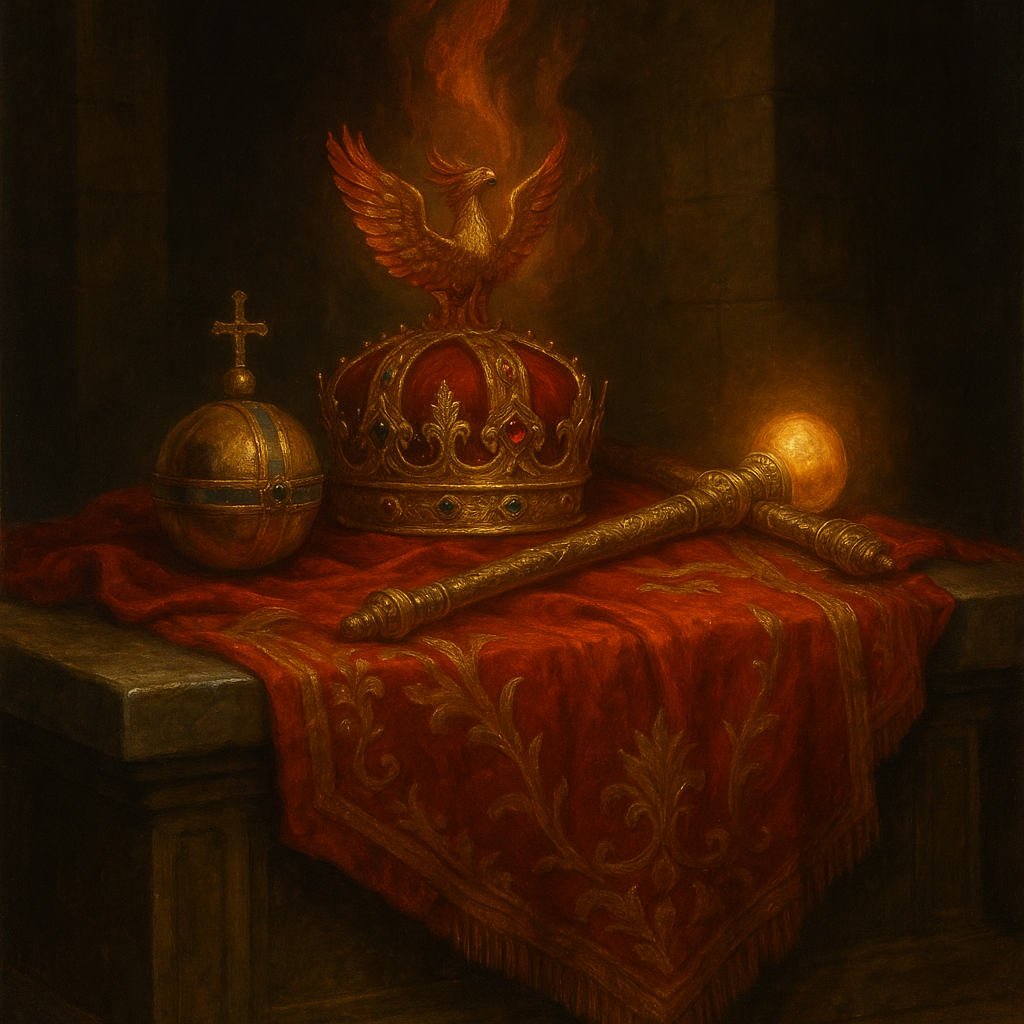
The regalia of the Emperor are not trappings of vanity but instruments of authority, memory, and arcane stewardship, each forged in an age when survival depended upon artefacts capable of anchoring a civilisation torn from its homeworld. Foremost among these relics is the Phoenix Diadem, a crown wrought from Rift-metal that shimmers with colours not found in natural spectra. It is said to contain fragments of the first Riftfire ever stabilised by human hands. When placed upon the Emperor’s brow, it binds ruler and realm in an unbroken circuit of mana, allowing the sovereign to sense both the tremors of distant wards and the faintest shifts in the world’s magical winds. To wear it is to feel the heartbeat of the Imperium itself.
The Sceptrum Imperiale, often mistaken by outsiders as a mere ceremonial staff, houses a core of crystallised Rift-glass that amplifies the Emperor’s will through spell-infrastructure. When raised during senatorial sessions, it asserts legal authority; when lifted on the battlefield, its internal sigils flare like a burning brand, allowing legionaries to rally around its signal even amidst magical storms. Paired with the sceptre is the imperial orb, a symbol of dominion whose purpose extends far beyond representation. Inscribed with runes of mapping and ward-tracing, the orb allows the Emperor to review the condition of the empire’s arcane networks, offering glimpses of weakened leylines, damaged wards, or rising Rift anomalies.
The ceremonial mantle, worn during coronations, triumphs, and diplomatic convocations, is stitched from phoenix-weave: a fabric that glimmers with faint motes of fire when touched by strong emotion. Though exquisitely crafted, it is no mere garment. In moments of danger, the mantle hardens into a flexible shell of arcane force, capable of turning aside lesser spells and diffusing hostile enchantments. Many emperors have survived assassinations only because the mantle absorbed the first, fatal blow.
The most enigmatic of the Emperor’s accoutrements is the Aegis Codex. Bound in dark iron and phoenix leather, the Codex is a repository of ancient authorities, sealed spells, defensive rites, and emergency powers invoked only in circumstances of absolute peril. Its pages shift subtly with time, revealing or concealing passages according to the empire’s arcane state. Only the reigning Emperor can open it fully, and even they must approach it with caution, for the wisdom within is potent enough to reshape cities, calm Rift surges—or unleash consequences too severe for ordinary governance.
Together, these artefacts form the sacred regalia of the Phoenix-Crowned: tools of rule, shields of the realm, and reminders that the Emperor governs not only by law and lineage, but by a covenant of magic etched into the foundation of the Imperium itself.
Grounds for Removal/Dismissal
The removal of an Emperor is an act so grave, so cosmically consequential, that the Imperium treats it not as a political process but as a metaphysical calamity—one that must be answered with ritual severity. The Rite of Severance is the only lawful means by which a reigning Emperor may be stripped of the Phoenix Diadem, and its invocation sends a tremor through every institution of the state. Senators whisper of omens; the Legions tighten their watch; the Arcanii read every flicker of Riftlight as a portent.
The Rite begins only after exhaustive deliberation. Accusations must be substantiated by irrefutable evidence: catastrophic negligence, arcane instability that endangers the realm, treason of a scope unimaginable in lesser offices, or an Emperor whose bond with the Diadem has faltered so profoundly that they risk tearing the arcane lattice itself. Even then, the Senate cannot act alone. The Legions must signal their assent through a formal withdrawal of acclamation, a moment that carries the weight of centuries. Soldiers who once chanted Ave Imperator now stand in solemn silence, acknowledging that continued loyalty imperils the Imperium.
The Collegium Arcanum delivers the final judgement. Its members examine the Emperor’s arcane resonance, searching for fractures in the Diadem’s circuit—breaks that might manifest as delirium, uncontrollable flares of power, or psychic bleed-through from the ancestral memories contained within the crown. If the Arcanii determine that the Emperor’s continued rule endangers the empire, they activate the Severance Protocol.
The Rite itself is harrowing. Deep within the Basilica Arcanii, amid wards older than Nova Roma, the Emperor is brought before the Altar of Broken Flame. The Diadem is coaxed into releasing its hold—never wrenched free, for such violence risks catastrophe. The process feels to the Emperor as though part of their soul is being unbound, for indeed it is; once severed, they are left drained, trembling, and hollowed of the arcane resonance that once connected them to the realm.
Only two emperors in eight centuries have endured this fate. One died moments after the Rite, their spirit unable to withstand the shock. The other lived on for years, a silent reminder of the throne’s terrible weight—an exile whose very presence warned future generations that the Diadem crowns only the worthy, and abandons those who fail it.
History
The Imperial title was conceived in crisis. Nova Roma’s earliest decades were marked by competing consular factions, erratic Rift energies that made even simple governance precarious, and hostile neighbours eager to test a fledgling province torn from its homeworld. In this chaos, the Romans of the Rift understood that neither republican tradition nor legionary command alone could stabilise their new reality. A single figure was needed—one strong enough to unify authority, resilient enough to withstand the magical turbulence of this world, and wise enough to lead a displaced civilisation into an uncertain future. From this necessity emerged the first Emperor, Gaius Marcellus Aurelius, whose ascension set the foundations for a new era.
Under Marcellus Aurelius, the Imperium took its first true shape. He brokered the early peace with the Elven Courts, negotiated defensive pacts with the Dwarrow Holds, and halted the Warborn’s initial incursions with a mixture of strategic brilliance and sheer audacity. His reign established the Tripartite Mandate between Senate, Legions, and Collegium Arcanum, ensuring that the Emperor would never rule alone—even as he stood above all. When he died, the empire mourned not merely a ruler but the architect of its survival.
The centuries that followed saw the imperial office mature into a pillar of world order. During the Second Rift Century, Empress Tiberia Longinus reasserted imperial control after a period of senatorial overreach, quelling internal unrest and ending the First Orcish War in a campaign still studied by generals today. Under her guidance, the Phoenix Coronation Rite was refined into the dangerous but stabilising ritual it is now: a forging of the Emperor’s spirit into the arcane lattice that binds the Imperium’s infrastructure.
By the Fourth and Fifth Rift Centuries, the throne had become synonymous with expansion and consolidation. Emperor Julian Corvax oversaw the creation of the first true mana-roads and implemented the Codex Arcanii, a system of laws regulating magic across the empire. His reign ended in near catastrophe, however, when his experimental pact with a Rift-spirit threatened to unravel the Diadem itself. The backlash fractured the Collegium Arcanum and resulted in the only civil conflict in imperial history fought not over land or power, but over the ethics of arcane sovereignty.
The later centuries—particularly following the arrival of the Halfling Enclave and, later still, the Jotun and Brass Cities—pushed the imperial throne into a role of international arbitration. Emperors became not merely rulers of a single nation but stabilising forces in a landscape of competing Rift-born civilisations. Treaties, trade networks, and mage-standardisation edicts were issued from Nova Roma with the confidence of a power whose authority was recognised even beyond its borders.
Today, with the arrival of the most recent Rift in Year 800 NE, the imperial office stands at a crossroads reminiscent of its earliest days. New mysteries appear on the horizon—strange banners, drifting fortresses, creatures unknown—and only the Emperor possesses the mandate to interpret, confront, or embrace whatever future these arrivals herald. The history of the imperial title is not a closed book but a living chronicle still being written, each Emperor adding a chapter shaped by the challenges of a world forever remade by the Rift.
Cultural Significance
Across the breadth of Exilum Novum, the Emperor is far more than a political figure; they are a symbol whose meaning shifts subtly—or dramatically—between peoples, shaping identity, myth, and memory in ways no single throne could ever fully control. Each civilisation touched by the Imperium projects its own hopes, anxieties, and ancient traditions upon the Phoenix-Crowned, transforming the Emperor into a multifaceted cultural icon.
For the citizens of the Imperium, the Emperor embodies continuity in a world fractured by the Rift. Roman-born families see in the throne a living link to Old Earth, a reminder that their civilisation did not merely survive translocation but rose to mastery in an alien world. Provincial citizens, human and otherwise, often describe the Emperor as Custos Orbis, guardian of the world, a sovereign whose presence assures safety from arcane storms, monstrous threats, and foreign conquest. Public festivals invoke imperial virtues—fortitude, piety, and civic duty—as the ideals toward which all citizens should strive.
Among the Dwarrow Clans, the Emperor is honoured as the Stone-Oath Ally. Though the dwarves bow to no foreign monarch, they maintain a deep cultural respect for emperors who have kept faith with ancient treaties. Dwarven songs speak of emperors as steadfast figures who treat agreements not as political conveniences but as oaths carved into the bedrock of diplomacy. Some holds even maintain carved reliefs of historical emperors who proved especially honourable in war or treaty.
The Elven Courts view the imperial mantle with a mixture of fascination and wary admiration. To the elves—whose leaders reign for centuries—the rapid succession of human emperors is seen as both tragic and invigorating. Each Emperor is regarded as a transient but brilliant flame, burning fiercely for a brief span before passing into legend. Elven chroniclers often depict the Emperor as the Flame-Bearer, a mortal capable of wielding powers that elves consider dangerously volatile. Their art portrays emperors in ethereal silhouettes, haloed by drifting flame or Rift-light.
The Halfling Enclaves, whose seaborne culture prizes adaptability and keen political insight, regard the Emperor as a figure of stability in an unpredictable world. They tell nautical tales of emperors who calmed storms—literal or diplomatic—and refer to the Phoenix-Crowned as the Storm-Steerer. In halfling lore, the Emperor’s regalia is less a crown of state and more a compass that guides the empire safely across the shifting currents of fate.
Among the Centaurs of the Eastern Steppes, imperial authority is respected but viewed through the lens of nomadic tradition. They see emperors as Keystone Riders, individuals who bind disparate tribes—human or otherwise—into something resembling unity. Though centaurs often chafe under imperial law, they admire emperors who demonstrate strength, decisiveness, and respect for honour-bound negotiation.
The Warborn interpret the Emperor in stark, martial terms. Orcish skalds sing not of emperors as rulers but as adversaries worthy of saga. An Emperor who defeats the Warborn in battle becomes woven into orcish oral tradition as a Breaker of Shields, while one who negotiates honourably earns the rarer title of Blood-Wise Sovereign. Even the fiercest orc leaders concede that warfare against an Emperor is warfare against fate itself.
The enigmatic Brass Cities hold a unique view of the Emperor as a counterweight to their own Solar Dynast. Their scholars describe the Emperor as the “Moon to the Dynast’s Sun”—equal in significance, opposite in nature. To them, the Emperor represents adaptive power rather than immutable doctrine, a force shaped by circumstance and will rather than divine mandate. This perspective fuels both intense rivalry and grudging respect.
Even the Jotun, whose culture reveres strength, acknowledge the Emperor as a sovereign forged not merely by lineage but by ordeal. They call the imperial throne the Forge-Seat, believing that any who survive the Phoenix Rite must have spirits tempered like iron. Imperial envoys among the giants often find themselves the subjects of boisterous toasts honouring the “fire-crowned monarch who wrestles the sky.”
Across all these interpretations, one truth remains constant: the Emperor is a mythic figure upon whom the peoples of Exilum Novum project their deepest values and fears. Whether seen as guardian, adversary, ally, or cosmic fulcrum, the Emperor’s cultural presence extends far beyond the marble halls of Nova Roma and into the songs, legends, and imaginations of every civilisation shaped by the Rift.
Beyond the Imperium’s borders, foreign realms maintain their own intricate tapestries of rule, yet none command the vast intersection of martial, civic, and arcane authority embodied in the imperial throne. The Jotun Sea-King reigns through ancestral power and the fury of the northern oceans, his authority immense but ultimately circumscribed by the unpredictable will of wind and wave. The Solar Dynast of the Brass Cities governs with mathematical precision, their sun-forged doctrines shaping a formidable and orderly dominion, yet even this brilliance remains bound to the deserts from which their power springs. The Elven Elder Regents preside over realms woven from memory, ritual, and ancient magic, guardians of a legacy rather than architects of expansion.
In contrast, the Emperor of the Imperium Novum stands at the centre of a civilisation built across worlds, a sovereign whose command shepherds legions, steers senatorial ambition, and anchors the arcane lattice that keeps the empire stable in the wake of every Rift. The foreign titles serve less as equivalents and more as distant reflections, echoing fragments of imperial power without ever matching its full scope or the mythic weight it has accrued.

Comments